




 OAJELS Home



Abstract
This article is made up of three sections. In the first section (I) literature review about the importance of emotional experiences of children for learning and self-development will be presented. In the second section (II) five different psychological perspectives will be evaluated in terms of their assumptions about the nature of children, i.e. behavioral, psychoanalytical, humanistic, psychoanalytic-behavioristic and humanistic-psychoanalytic. How these assumptions within each psychological perspective guide approaching children will especially be stressed. Finally in the last section (III) the benefits of expressive approaches to children will be emphasized and problems related to repressive approaches will be discussed. Expressive environments for children are especially provided by the humanistic-psychoanalytical perspective. Expressive environments are claimed to be based on a positive approach to the nature of children, assuming a built-in potential to grow and transform.
A latent variable that underlies one’s reaction to the state of children today is one’s subjective view of human nature. If one believes that humans are naturally violent and individualistic, then one is not surprised that so much violence, aggression and alienation pervade society. However, if one believes that humans are typically none violent but pro-social, one is more likely to view aggression and alienation as indicative of unbalanced state of affairs that can be remedied. Clearly, we take the latter position. (Narvaes, Panksepp, Shore & Gleason, 2013)
In this paper my aim is to emphasize the significance of positive emotions and expressive environments for healthy self-development and learning of children. When children feel secure and accepted in educational settings, they can express their ideas, wishes, emotions. Such an expressive environment is claimed to provide better motivation for learning and encourage self-development. Educators’ assumptions about nature of children actually guide how they are going to approach them. I will argue that psychoanalytic-humanistic (humanistic as well) view of nature of children helps to provide appropriate emotional climate for children to express themselves and hence promote healthy self-development.
This paper is made up of three parts. First, I will present a brief literature review about the importance of emotions in educational settings, for better learning potentials and healthy self-development. In the second part I will try to explain how different psychological approaches understand nature of children and how these understandings influence their educational philosophies. Which one of these psychological approached provide more secure and accepting learning environment where children can readily express their ideas, wishes and emotions. Finally in the third part I will discuss why expressive rather than repressive environments provide better learning and development opportunities for children.
Keywords:Human nature, Emotional atmosphere; Learning environments; Psychological development; Expressive environments; Repressive environments; Humanistic psychology; Psychoanalytic-humanistic perspective; Child development; Educational climate
Significance of Emotions in Educational Settings
Philosophy of education is concerned with questions such as “what is a child?”, “what is the nature of the child?”, “how
do children develop or what are the factors that prevent the development of children?”, “in which environments the brain learns better?”, and so on. These questions are the subjects of psychoanalysis, evolutionary psychology, and neuroscience.
We think that the fundamental aim of an educational system
is to provide the necessary environment for the holistic
development (mental, psychological, and social) of the child and
the actualization of their inherent potential. When we take this
approach, two important questions arise:
What kind of environment is necessary for the
holistic development and maturation of the child (intellectual,
psychological, social)
What are the key characteristics of an optimal learning
environment?
The answer to the first question covers the main features of the educational system in which the child participates. Education systems are shaped by the educational philosophy that exists in the culture they belong to. The educational philosophy prevalent in a culture is formed by our thoughts regarding questions such as “what is the nature of the child?”, “what are the needs of children?”, and “which factors are important for their emotional and mental development?”.
The answer to the second question is also directly related to the nature and basic needs of the children. Findings show that when basic needs of children are appropriately satisfied children are best motivated to learn [1-3]. The characteristics of the physical and social learning environments have varied greatly over time according to how the nature of children is defined by adults. Definition of children’s nature and childhood have changed throughout history [4]. In line with these assumptions and opinions, the physical (conditions of the school and classroom environment), social, and emotional components of the learning environment (communication and relations between the teacher, administration and the student) are shaped.
For the healthy psychological and physical development of children, it is crucial that their fundamental needs are appropriately met [5-7]. Among the most significant psychological needs of children is the requirement to feel loved, valued, and accepted [8-10]. Children, and indeed adults as well, establish their psychological presence when their emotions are recognized by the people close to them. The emotions that children feel most intensely are helplessness and dependence (on their parents) [11-12]. When children receive love and their expressed emotions are understood by those around them, they can alleviate feelings of loneliness and insecurity. However, when a child experiences emotions of rejection, neglect, and intimidation, these negative feelings can detrimentally affect their psychological and brain development, potentially impeding the learning process [13]. The adverse impacts of negative emotions on development and learning are particularly pronounced during early ages (1-3) and throughout childhood. It has been observed that children learn more effectively in environments that foster peace, happiness, and [14-16]. Learning does not reach its full potential in environments characterized by rejection, fear, disturbance, and anxiety [17]. Research has indicated that emotions also significantly influence learning in adulthood [18-22]. Negative emotions are considered to be one of the factors inhibiting psychological development and contributing to the emergence of psychological problems [23-26].
Studies have demonstrated that the stress experienced by children has detrimental effects on their brain development [27-33]. Prolonged and heightened stress leads to elevated cortisol levels in the body, and excessive cortisol contributes to the degradation of hippocampal neurons crucial for learning and memory [34]. Additionally, even temporary increases in cortisol induced by stress can hinder the ability to differentiate between significant and insignificant events [35]. The presence of a stressful school environment not only impedes children’s wholesome selfdevelopment but also interferes with their capacity to fully benefit from the learning environment [36].
The scope of the impact of emotions that children experience within the learning environment on the trajectory of their personality development, their attitudes towards the learning process, and their mastery of acquired knowledge has become evident through the aforementioned research. Regrettably, the significance of emotions felt by children in the educational setting has only recently begun to be recognized [37-39].
Within an educational context, the intense emotions felt by children are molded by the perspectives and beliefs concerning the inherent nature of children within that culture. Consequently, presuppositions regarding perception of child nature offer insights into the emotions a child within that environment is likely to feel. In the next sections I will focus on how these viewpoints regarding nature of children influence emotional atmosphere of learning environments and attitudes towards children.
Psychological Perspectives and Assumptions Concerning Nature of Children
In this section I will present five different psychological perspectives concerning nature of children, and try to explain how these viewpoints influence the way children are approached in educational settings. How much children’s psychological inner processes, self-expressions like ideas, emotions, wishes are valued, care for and permitted depends on how educationist and psychologist conceptualize the nature of children.
Behaviorist Approach: This perspective is rooted in the notion that a child begins as a blank slate with an exceptionally adaptable nature [40]. Derived from the epistemological framework of the English Empiricist philosophical tradition, this approach posits that children are not born with any inherent qualities; rather, almost everything is acquired through learning. The important mechanisms for this acquisition are associations, rewards, and punishments (classical and operant conditioning) [41]. Observational learning also plays a significant role. Children strive to acquire information based on these principles and manifest diverse behaviors. This standpoint is represented by the behaviorist perspective within the fields of psychology and education. The emphasis in child development, according to this viewpoint, is placed on the exhibited behaviors and their consequences, unfortunately disregarding the child’s emotions and developmental needs. Behavioristic perspective stresses environmental determinism and associationism [42,43]. In this framework, the child possesses no inherent positive or negative potential. The child is not perceived as having an internal structure or inherent capability to regulate their own behavior. Any behavioral self-regulation that emerges as the child matures is attributed to the learning processes they are exposed to. If the child exhibits inappropriate behavior, immediate punishment is deemed necessary to prevent its recurrence. Consequently, the child is subjected to something uncomfortable (and sometimes painful) to deter the repetition of such behavior. This approach is the most basic learning principle of Thorndike [44], one of the founders of behaviorism.
In this perspective, concepts like “a child’s developmental needs” or “self-development” are not recognized and the emotions they experience are considered unimportant. Children, and even adults, are perceived as creatures whose conduct is governed by the principles of reward and punishment. Given the absence of notions such as “critical periods” and “developmental processes” or “psychological needs”, within this framework, there is little distinction, psychologically speaking, between children and adults. Neither children nor adults have been considered to have basic psychological needs. They do not have the inherent potential to regulate themselves. Children are perceived as miniature adults. They possess a more limited range of behaviors merely due to their shorter lifespan. One of the founders of the behaviorist school, Watson 1930, conveys the approach of this school to children precisely through his writings on the subject. The most important point in the development of children is the behavioral patterns they learn at the end of conditioning processes, a bit like an “automaton” (robot).
One of the most important concepts in this approach is how they learn (acquire) certain behaviors or develop a habit of it (get used to it). Children need to promptly acquire certain behavior patterns that are considered to be correct. For example, babies should be put in a separate room immediately after birth in order to learn to sleep alone, and should develop a habit of it (get used to it) [45-48]. Otherwise, they learn to sleep with their mother. Babies’ fundamental need to sleep with their mother and feel secure is not considered as important. It is strongly advised not to rock babies, as they might develop a habit of it (get used to it) and subsequently struggle to sleep without rocking. Similarly, holding babies excessively can lead to a persistent desire for cuddling (conforming to the behaviorist school’s concept of certain behaviors becoming associated with specific environments, thereby leading to a tendency to engage in those behaviors in those settings). I think this approach largely neglects the concepts of needs, development, and awareness. Within this perspective, the primary focus is on behavior, which is molded by rewards, punishments, and associations with the environment. Unfortunately, this approach excludes ideas related to children’s emotions, needs, and self-development. The principal objective is to obtain the necessary behaviors through environmental stimuli (Skinner,1953). Children’s developmental needs, and the notion that children will naturally mature in an environment that caters to those psychological needs is almost completely neglected.
Furthermore, within the framework of this perspective, childhood is seen as a mere preparation phase for adulthood, rather than holding intrinsic value on its own. Children are expected to be prepared for behaviors considered necessary for adulthood at an early stage. Since this approach overlooks concepts like development, emotions, and needs, educators solely concentrate on achieving desired behaviors. In this process, the focus is not on understanding children’s feelings, identifying their developmental needs, fostering self-, development promoting awareness, or nurturing self-regulation. This perspective fails to acknowledge that these characteristics are inherent in both the nature of the child and humanity.
Psychoanalytic Approach
Another perspective on understanding children’s nature comes from the psychoanalytic school. The importance of psychoanalytic theory in education is only starting to be realized. As the significance of emotions in education became more recognized, the value of psychoanalytic theory became clearer [49-51]. Unlike the behaviorist approach, the psychoanalytic view suggests that children are born with certain natural impulses. These impulses are rooted in our evolutionary past and manifest as needs, desires, or emotions in our lives. Freud [52] divided personality into three parts (id, ego, and superego). The id is the personality component that holds these impulses. It is the most fundamental one, and it operates based on the pleasure principle and encompasses impulses like aggression, sexuality, or selfishness. The drive for survival and happiness originates from these impulses. In essence, psychoanalytic theory is a theory of motivation (Brenner, 1973), proposing that the primary motivation of human behavior is satisfaction of the impulses of the id. Freud mainly identified two primary impulses: sexuality and aggression. At birth, children are essentially governed by these impulses. They seek immediate gratification—such as babies kicking when they’re upset. Control over these impulses develops slowly over time. This evolution happens as two other personality components develop: the ego and the superego. The superego is akin to an internalized version of the environment (parents and significant individuals) and embodies moral standards. It’s that inner voice that says, “Don’t do it, it’s not right.” The ego aims to balance these two components (id and superego) and operates based on the reality principle. The id seeks instant gratification, while the superego attempts to temper the id’s desires. However, the ego endeavors to fulfill the id’s desires in appropriate situations, functioning based on reality rather than mere pleasure-seeking. Freud formulated this notion of human nature through his psychoanalysis of the patients he treated.
An essential aspect of this approach is the qualitative
distinction between the psychological structure of children and
adults. Unlike the behaviorist viewpoint, children are not simply
miniature versions of adults. Fairbairn [53] outlines three crucial
qualities of childhood different from that of adults: immaturity,
impulsivity, and vulnerability. These characteristics distinctly set
childhood apart from adulthood. Fairbairn stresses that children
have one major duty; healthy development. Anything that hinders
this development is actually pathological. To facilitate their
development, children require interaction with a more mature
mindset. Bion [54,55] terms this processes as ‘containment’.
Given that children are still developing, impulsive, and delicate,
they often struggle to regulate their emotions. How the adults
around a child respond to the child’s raw emotional expressions
during an event (which Bion labels as “beta-elements”) is crucial
for the child’s healthy self-development. If an adult possesses the
capacity to manage their own emotions (what Bion refers to as
the ‘alpha function’), they can absorb these raw emotions from
the child, soften their impact, and return them in a manner that
the child can process. Bion [56] elucidates in his writings that this
relationship between parent and child is paramount for the child’s
healthy personality development. I believe that a similar process
of “containment” is highly significant for the teacher-student
relationship. This process of “containment” plays a significant
role in the progression of the child’s impulsive, developing, and
vulnerable self since:
Children reflect the emotions they cannot cope with, on
to the adults, and receive them back in a softened and manageable
way.
They observe an adult who calms and transforms raw
emotions, and they internalize this process.
According to psychoanalytic theory, children have
developmental needs that change according to their current stage.
‘Every developmental phase requires the appropriate satisfaction
of psychological needs to enable a child’s full growth and the
attainment of healthy adulthood. Bowlby [57] explains this with
the following analogy: “Similar to how vitamin D is essential
for bone development, secure attachment is crucial for healthy
self-development.” One might question how this topic relates
to education. Although the id is composed of impulsive desires
that seek instant gratification, it also holds all creative potential
(eros, the life drive). Therefore, suppressing the id doesn’t foster
a healthy self; instead, it may lead to the formation of unhealthy
selves that lack creativity and zest for life. Expressing impulses in
a refined and civilized manner is crucial for maintaining a healthy
and creative life. The ultimate goal of education is to promote
a healthy ego development, which translates to cultivating a
personality that’s rational, balanced, moderate, and yet permits
life’s (id’s) energy in certain ways. From a psychoanalytic
standpoint, the developmental process and life involve grappling
with how individuals’ needs will be met, to what extent, and in what
manner, beginning from birth (infancy, later childhood). Education
encompasses a significant part of this developmental process.
Its aim is to assist a child’s inherent potential in fully emerging
and shaping. It helps the child channel their inner urges towards
greater refinement. The origins of children’s drive to wonder, learn,
comprehend, and explore lie in these urges and impulses. Hence,
it’s crucial that these impulses within the child are not stifled or
held back, but rather, encouraged to surface, undergo refinement,
and transform through the process of awareness, all contributing
to the child’s healthy self-development. A self-developed in this
manner will find pleasure in learning and exploring. Fairbairn
[53] believes a child’s most important task is to grow and fully
realize their potential. Anything hindering this process can lay the
groundwork for psychopathology. Summarizing the points above,
according to the classic psychoanalytic approach:
Children are born with certain impulses that manifest
as psychological needs a differing based on their age. Children’s
psychological structure differs from that of adults.
The gratification of these impulses in specific ways and
amounts is essential for healthy personality development.
The maturity of a child’s ego and the development of
their control system depend on satisfying these impulses.
The suppression of these impulses (internally and
externally) leads to internal conflicts and the development of
a neurotic (unhealthy) personality. Children (and later adults)
who suppress their impulses (needs) lead a shallow and lifeless
existence. Curiosity, desire to understand, explore, and learn
all arise from the transformation of impulses through their
satisfaction and the development of awareness within these
processes.
According to the psychoanalytic view, children have negative destructive impulses that they are born with. However, they also have the potential to transform, control, and divert these impulses into more positive channels if secure, respecting, loving, holding and containing environment is provided by adults. The maturation of the personality means that it regulates its impulses better, satisfying them in more refined ways, developing an awareness of itself and its surroundings. This is a long and laborious process. Perhaps the most important function of education is to assist in this development.
Humanistic Approach
Another perspective on the nature of children suggests that they possess positive attributes rather than innate destructive impulses, aligning with the humanistic psychology school. A prominent proponent of this view is Carl Rogers [58] and A. Maslow [59]. Somewhat similar ideas to the humanistic perspective can be found in the object relations school of psychoanalysis, with R. Fairbairn and D. Winnicott being important figures. According to this outlook, children’s nature encompasses positive potentials like love, compassion, understanding and self-actualization. Aggression arises when children are not understood or their fundamental needs go unmet, or they experience mistreatment such as humiliation and violence. Essentially, negative and destructive behaviors in children are not driven by their inherent nature, but by the negative environment they find themselves in Fairbairn [53]. This approach correlates childhood psychological problems with environmental failures. In this viewpoint, a child’s developmental needs hold great significance. For individuals to mature and grow, they require an environment that addresses their psychological needs. Rogers [60] identifies these needs as genuineness (being open and able to freely express thoughts and feelings), acceptance (unconditional respect), and empathy (feeling heard and understood). Similar to how plants fail to grow when they are deprived of water and sunlight, without such a nurturing environment, personality development is hindered. According to humanistic psychology, children are primarily motivated by the desire to realize their potential. If the environment (family, education, and the broader culture) offers the right conditions, individuals can develop and fulfill their potential. Rogers [60] maintains that humans possess an inherent goodness and creativity. Childhood experiences play a significant role in realizing this potential. One’s self-perception and perception of the world emerge during childhood. The relationships with parents, educators, and others significantly shape a child’s beefs about themselves and their surroundings. Receiving unconditional respect and valuing oneself are fundamental needs for children. The appropriate fulfillment of these two needs is essential for psychological well-being and self-actualization. Teachers, after parents, assume an important role in this regard. As children possess an intrinsic inclination to learn, understand, and create, their learning capacity flourishes when they are unconditionally respected, understood, and accepted [3]. Learning diminishes when they perceive threats to their individuality. From the humanistic psychological viewpoint, purpose of education is to create the optimal environment for fulfilling children’s needs. In such nurturing environments, children naturally endeavor to unlock their potential.
Psychoanalytic - Behaviorist Approach
In my perspective, this approach is notably problematic and yields the most adverse consequences on children’s development among educational philosophies. Unfortunately, I think that this viewpoint is prevalent in religious practices, especially the current applications in religious centers across the Middle Eastern region (e.g. Orthodox İslamic Educational Philosophy) and in some religious practices (e.g. Christinaity) in education all over the world especially in the past [61]. (However, there are some alternative educational philosophies in Islam like that of Rumi’s which has some similarities to the humanistic view, Khabibovich [62]).
Unlike considering the child as a blank slate (like behaviorists), this approach perceives children (and people) as possessing certain inherent potentials or tendencies, often exhibiting negative traits like selfishness, sexuality, aggression, together with some positive ones like love and care (Razak, Haneef & Mustapha, 2018). These negative qualities align with the id’s characteristics in psychoanalytic theory (selfishness, sexuality, aggression), implying the presence of negative innate impulses within children. In this approach, the initial understanding of the “nature of the child” somewhat parallels the classical psychoanalytic outlook. However, I think that methods employed in educational settings significantly diverges from psychoanalysis and align more closely with the behaviorist school (environmental control) previously mentioned. In the psychoanalytic perspective, however, the potential to regulate and transcend these negative and destructive impulses within children is acknowledged (through sublimation). The aim of education is to foster the development of this self-control mechanism (Ego) and improve awareness by providing appropriate environment for sublimation through a mixture of expression and repression of impulses and desires. In education both expression and repression are emphasized [51]. In contrast, within psychoanalytic-behavioral and religious educational philosophy however, children are indeed perceived as possessing negative impulses, however, the presence and development of internal psychological structures to effectively manage these negative potentials is not trusted. Therefore, external control procedures akin to behaviorism are commonly applied (therefore I call this approach to education utilizing psychoanalytical-behavioral perspective). Furthermore, in this approach submission to a greater spiritual authority and obeying its orders is seen as the aim of education [63-65]. Because submission and obedience are overly emphasized, expression is almost totally disregarded. There is no idea of learning through experiences by expression, just the contrary suppression and punishment are advised. Expression of wishes, desires, affects are not really perceived as something important for psychological development. Just the contrary. submission to the will of greater authority and inhibition of self-expression are advised. Therefore, this approach advocates environmental control measures akin to behaviorism, especially stimulus control and punishment. Sexual segregation in education and covering of females’ bodies are good examples. Females are seen as sexual stimuli leading to triggering of sexual excitement in males. Males are depicted as organisms with almost no self-control, or self-regulatory systems only responding to environmental stimuli. In this case sexual excitation is controlled by removing the stimulus causing sexual excitation either by segregation or covering of female bodies. If these measures are not enough to control behavior, corporal punishment is readily applied with no consideration of its adverse effects. Submission and obedience to a great spiritual authority is perceived as the ultimate goal of education. There exists no idea or intention of promoting self-control and affect regulation through expression, because specific rules are set forth for children and students to follow being a servant of a greater spiritual authority [66]. In such a context of educational philosophy, submission and obedience are stressed and development through expression have no place at all. Since ultimate aim is conceptualized as serving to a greater spiritual authority, place of expression, development of potential and self-actualization are down played in education. It’s evident how deeply ingrained this approach is within the family, culture, and consequently, the educational context of the middle eastern region. Children’s desires, wants, and impulses are often molded through operant conditioning mechanisms, particularly punishments. In this view, children (and humans in general) are seen as having harmful innate impulses but lacking the capacity to develop psychological mechanisms to control and transcend them. This leads to reliance on punishment to suppress these impulses. I believe that a substantial mistake is made here, both in the family and educational spheres, as well as in the broader culture, resulting in a reduction of children’s motivation to learn, explore, and be curious. While this approach seemingly aligns with psychoanalytic notions about children’s nature, it dismisses the concepts of development, maturation and self-awareness by expression thus applying methods akin to the behaviorist school (environmental control procedures) in child education. Consequently, it significantly diverges from the humanistic approach. The concept that children inherently desire learning, understanding, and self-actualization, and that education should provide an environment where these tendencies can flourish and grow by expression finds no place in this approach. Hence, when constructing an educational system, considerations regarding the nature of the child significantly influence the system’s content. This approach begins with the premise of negative impulses existing within children and subsequently seeks to suppress these impulses further through behaviorist methods. Notably, the emotional experiences of children in the educational setting hold little importance in the behavioral school’s context.
The significant point within this approach lies in the emphasis
of behaviors to be acquired that are described in religious texts.
The desired aim of education within family, school, and culture is
to make children or adolescent comply to specific rules defined in
given religious texts, students are seen as ones where principles of
good conduct are to be “instilled” [64]. Cultivating humans so that
that they would serve to a higher spiritual authority is defined as
the basic aim of education., “Human being’s mission is to be an
effective vicegerent of Allah on earth so that he can serve Him in
the best possible way” [64]. Actualizing their potential however is
not considered as an important aim of education or culture [67].
Thus, within this perspective seeking obedience from children
and youth becomes inevitable. In the absence of concepts like
psychological needs, self-development and self-actualization,
obedience becomes a desired form of education. Educators and
families cannot be aware of the damage that they inflict on the
fragile and immature self of the young. They see no problem in
applying punitive measures to regulate children’s behavior [68].
In truth, forcing obedience and application of punitive measures
can cause comprehensive psychological damage, as acknowledged
even by some behaviorists who worked on aversive conditioning
[69]. Application of punitive measures can cause a downfall
concerning child development, young individuals’ personalities,
their vitality, curiosity, and their incentive to learn. Obedience
means annihilation of one’s personality. The essence of our
psychological existence lies in our desires, wishes, thoughts,
and behaviors. Demanding obedience from someone equates to
saying, “Cease being yourself; think, want, and act according to
my desires.” Our identity comprises our personal desires, wishes,
thoughts, and behaviors. The culture of obedience, coupled with
the constraints that arise within it, accepting these constraints
mean giving up on one’s unique personality. This involves
relinquishing our true selves and adopting someone else’s
persona. When one commands, “Obey me!” to others, it essentially
communicates, “Do not be yourself; let all of you be me, living
according to my wishes.” Obedience, according to Winnicott, means
“psychological death” [70]. The obedient individual develops a
fictitious and superficial self, unable to forge their true identity.
This fabricated self diverges from their core essence – impulses,
feelings, wishes, and thoughts – and consequently, they cannot
effectively realize their capacity for self-actualization, creativity,
investigation, and comprehension. In societies heavily influenced
by this approach, people exist only superficially, struggling to
define their true selves and foster creativity. This denies them
the opportunity for self-realization, and they become unable to
authentically develop and embrace their being. A prevalent trait
among societies embracing this perspective in child education is
their estrangement from creativity. According to Winnicott [71],
“only the real self can truly feel, only the real self can be creative.”
The drive to explore, examine, and look into the unknown stems
from our impulses. If we succeed in sensing, experiencing, and
recognizing our impulses, refining and transforming them, we
can mature and evolve as a genuine self. Winnicott terms this
the “true self.” This progression is a daunting, lengthy endeavor,
constituting the central goal of education. If impulses are unjustly
disparaged and suppressed through punishment and threats
during childhood, children are left no chance but to develop a
shallow existence, detached from their emotions and inner selves.
Consequently, they resort to engaging in various actions not out
of genuine desire or enjoyment, but rather to evade punishment.
A false existence that distances itself in this manner carries little
potential for creativity. Recent research supports the notion that
attempting to regulate children’s behavior through punishment
yields results similar to subjecting them to trauma [72,73]. The
severe detrimental consequences of governing children’s conduct
through punishment can be listed as follows:
Punishment creates a sense of resistance in the recipient,
potentially breeding resentment and hate toward the punisher.
Punishment induces fear and anxiety, amounting to a
form of trauma with each instance of punishment. Consequently,
it triggers defensiveness and pathological processes.
Punishment hinders the understanding of why the
behavior being punished is wrong. Instead of comprehending the
underlying reasons for the incorrect behavior, the individual’s
focus shifts towards the negative emotions triggered by the
punishment, such as fear and self-preservation.
Punishment fails to demonstrate what the correct
behavior is.
Children who receive punishment often observe
aggressive behavior and learn it. When faced with future
challenges, they tend to resort to similar aggressive behavior
as a problem-solving strategy. Punishment can lead to the
development of aggressive and oppressed personalities in both
children and adults.
Due to the inhibiting effects of punishment on processes
such as understanding and comprehension, a child may modify
his behavior to evade punishment when the punishing authority
is present. However, this behavior might not persist when the
authority figure is absent, and the child may struggle to grasp why
their actions were considered wrong.
The association of a punishing environment with
negative emotions, like fear and anxiety, subjects the child to
adverse conditioning in that setting. As a result, the child’s cognitive
function becomes compromised, impeding healthy mental
engagement within that environment. For instance, the child may
develop detachment from school and the classroom, hindering
his ability to enjoy the learning process. Neuroscience studies
have indeed indicated that a stressful learning environment can
suppress cognitive processes and complicate the learning process
[36].
What our education system truly requires is not instilling fear to enforce specific behaviors in children. Instead, our goal should be to aid children in developing their capacity for observation, exploration and understanding. A child equipped with these abilities will gradually learn to figure out the errors in their actions and adjust their behavior accordingly. This potential takes time to flourish, necessitating a period of learning from mistakes and a loving, nurturing environment.
Humanistic –Psychoanalytical Approach
Let’s discuss a mixture of psychoanalytic and humanistic approaches that reflect my approach to education and the nature of children. It is thought the besides their natural tendencies toward aggression, selfishness, and sexuality, children also have a drive to understand, be aware, and unlock their potential. Positive growth happens when children feel loved, accepted, and can freely express and question their feelings and thoughts. In this kind of supportive environment, children start developing their potential to the fullest and also get an opportunity to transform basic traits like aggression and selfishness, which are assumed to come from our evolutionary past [74,75].
Self Determination Theory (Deci and Ryan, 1985) has assumptions similar to this approach. Children are thought to have some basic needs, like relatedness, autonomy and competence. When learning environments provide appropriate satisfaction of these needs’ children are expected to thrive academically and psychologically. At the base of this theory is the idea that children have inner positive qualities like motivation to learn and understand [3]. Emotions experienced by children in learning environments has utmost significance for motivation to learn especially relationship between teachers and students (Roorda, et al 2011). Reeve [76] has shown that if teachers encourage engagement in class and build good relationships, students will have more motivation to learn, get better grades, and show more creativity. The relationship between how motivated students is in class, as well as how much they enjoy school, and how well they do academically, and how creative they are having been backed up by studies [76]. Teachers who create an open environment for learning, listen well, show empathy, build positive connections, offer support to students, and are flexible. The most important thing that affects students’ motivation at school is the relationship between the teacher and the students [77]. Teachers who create an environment where students can participate freely, and treat students with respect, understand their emotions, and believe that the drive to learn comes from inside the students [76, 78,79]. Research findings suggests that the students of teachers following this approach tend to be more motivated in the educational setting, achieve better academically, and foster better development [76]. The crucial point raised in the above research is that children need to grow up and receive education in an environment where they feel connected, loved, accepted, and not threatened. Importance of classroom emotional atmosphere on learning and psychological wellbeing of students have been documented in many research [80-84] In such an environment, students feel free to express and own their ideas and emotions. Assumptions of self-determination theory are rather similar to those of the humanistic view.
The view that the expression of feelings, desires and thoughts is one of the most basic needs of people has long been expressed in the psychoanalytic school [85,86]. It’s very important to own one’s impulses. Owning one’s impulses starts with their expression. Owning impulses is the first step to becoming aware of them [87]. If we don’t own our impulses, if we don’t say “it’s my feeling,” or “it’s my desire,” we could be in need of suppressing or disowning them. In this case, our self becomes alien to itself and to its feelings and becomes divided into compartments, in short loses its integrity (Graham, 2006). When disowned and denied these feelings and desires get detached from our awareness and pushed into the unconscious (suppressed and /or repressed) leading to the formation of psychopathology (McWilliams,2011; Mitchel & Black, 1996). So, why do children have to suppress their own emotion or desire? With the influence of the outside world, of course. The children’s external world consists of his mother, father, and other close caregivers in their family. In the school environment, it consists of teachers and other educational staff. The feelings and wishes of the children which are not accepted and opposed are suppressed through concerns and fears such as losing their love or receiving punishment. Every repressed experience and emotion of the child cut him off from his personality, wholeness of his personality will be lost. Thus, not only that feelings and desires, but also contact with the part of his personality attached to these feelings and desires will be lost. There will be a compartmentalization in his personality, which is the first step in the development of psychopathology [88]. The more the family, school and society reject and repress the behavior and feelings of children (people), the more the wholeness of psychological structures of the people in that society will be lost, their integrity will be weakened. Nothing creative can be expected from that person anymore. Instead of dealing with the realities of life, discovering, learning, understanding new phenomena, a significant part of the person’s mind will be focused on dealing with internal conflicts. Wants, needs, impulses not accepted by parents and society will be repressed and separated from consciousness, leading to a compartmentalized self. Freud [89] defined neurotic anxiety as the fear of repressed subconscious material coming into consciousness. In other words, at that point, while the subconscious conflicts are trying to come to consciousness, the ego is trying to keep them out of consciousness by using defense mechanisms. In other words, the more one’s experiences, desires, or feelings are not accepted in the family or society, the more they are repressed rather than expressed, the more their personalities lose their integrity. Every emotion or desire you repress is actually a part of you. Fairbairn thinks that by repressing, we lose touch with that part of our self, we remove a part of ourselves out of consciousness, we get disconnected from ourselves (Clarke,2006; Mitchel & Black, 1996). Repression by preventing development of awareness inhibits the process of selfactualization. Our psychological life gets dominated by struggling with our inner conflicts and keeping repressed impulses under control rather than development of self-regulation, understanding and awareness. Such individuals waste their time and energy trying to manage their inner conflicts. A dynamic structure is formed, which Freud called “neurotic anxiety” [90]. The more psychological material is repressed, the more intense the conflict is. The critical point in the psychoanalytic approach is the issue of which impulses (needs) are to be satisfied, to what extent and in what ways (to be revealed, expressed).
I think that both education and culture are based on these issues. This is where my thinking differs from the classical psychoanalytic view. Unleashing an impulse, a need, means more than its gratification. When you express an impulse, when you experience it in a non-threatening environment, you realize the impulse, say “this is my desire, my need”. This can only happen if emotions can be experienced freely, without fear. Every desire and experience that is lived freely without fear causes a person to own and become aware of that desire. Noticing it is the first step in controlling and refining it [87]. This process is repeated countless times during the growth stages, but each time it is repeated – including environmental support – the person’s awareness and control over that impulse can increase, a self can mature through experience. If one has exaggerated or gone a bit too far in expressing this impulse, they can later reflect on this process and make necessary adjustments. A learning from experience and development process is triggered by experiencing the impulses and desires. This process can only work effectively in an environment where the child feels accepted, respected, loved and there is no threat or punishment. In such a setting, individuals can mature, and self-control over their impulses and can develop. Research results show that positive affect in educational settings not only increase enjoyment and interest in the work but also improve self-control [91].
The treatment of children differs in educational settings (and also in homes) depending on t how their nature is perceived within a given perspective. If their nature is understood as having inherently good qualities like a tendency for self-actualization, understanding, self-control, growth and motivation to learn, they are approached more tenderly. Within this approach the source of motivation is assumed to be internal to the child so when educational environments provide appropriate satisfaction for basic psychological needs, learning and self-growth is thought to ensue [3] Cornell & Wellborn, 1991 In such environments children will feel loved, accepted and secure therefore they can express their ideas, emotions and wishes freely (expressive environment). On the contrary, if nature of children is perceived as having no inherent tendency (e.g., behavioristic approach), or having rather negative qualities without potential for self-control, understanding and self-growth (e.g. psychoanalytical-behavioristic approach) environmental control of behavior becomes the main target of educational system. Rather than focusing on emotions and needs of children, educational systems mainly focus on acquisition of desired behaviors through classical or instrumental conditioning mechanisms as defined by educators. Rather than expression, suppression or repression of emotions and wishes and desires will be encouraged. Because what will be expressed is thought to be inner negative qualities, leading to no development, learning or refinement. In the next section the importance of expression of emotions, wishes ideas to the development of self and learning will be discussed.
Why Expressive Environments provide better learning and development
Children and youth, if they can freely express their emotions, be themselves in the the absence of fear of punishment or loss of love, they can learn through their experiences and can psychologically develop (expressive environment) (Pandey & Choubey, 2010; Pennebaker,1995). Development involves making mistakes, reflecting on those mistakes and learning from these lessons to approach subsequent challenges with greater maturity and understanding. This progression signifies a journey of growth, one nurtured by an environment of love and acceptance that starts within the family, extends through education, and is encompassed by the broader culture. Only in such an environment provided by adults can children think, evaluate and reflect on their mistakes. Fear and threats activate defensive measures and the process of learning from mistakes halts (Berry, 2006). This journey of development and maturation, however, is neither swift nor simple; it demands patience and love. Offering such an environment to children requires believing in the inherent positive potential within children—a potential to develop, understand, learn, and self-actualize. While classical Freudian theory does not explicitly emphasize this perspective, it holds a central position in Rogers’ humanistic viewpoint. Notably, figures like Winnicott [92] and Fairbairn [93] exhibit closer alignment with the humanistic approach than with classical psychoanalysis. When individuals feel rejected and threatened in their surroundings, their developmental process is disrupted. Rather than reflecting on their errors, seek comprehension, understand their errors and selfactualize, children (people) often resort to defense mechanisms such as denial, rationalization, and projection, distorting reality to avoid acknowledging mistakes. The reality can be overwhelmingly painful for fragmented selves to bear. Rather than learning from experience, and self-development, defensive structures may be developed. As W. Bion claimed for the process of learning from experience (for the development of the mind) to work at any experience, tolerance of frustration must be greater than the potential to evade frustration which can happen if children live in a containing environment (where caretakes can provide love and affection and sooth child’s anxieties) [54,55]. Consequently, unmet needs, desires, and wants, denied by the environment and met with punishment, remain repressed, underdeveloped, and raw (repressive environments). This keeps the self in the sense of constant fear. Regrettably, progress and maturation within such a defensive and conflicting personality framework cannot take place, potentially culminating in psychological distress and psychopathology [94-96].
I think one of the fundamental aims of educational systems is healthy self-development of children (Kelly, 2009; Kohlberg, 1972). It is also assumed that a healthy self where psychological needs are appropriately satisfied will have high motivation to investigate and learn [81]. In a threatening and fearful environments, the learning potential of the brain will decrease and the defensiveness will possibly be activated leading to neurotic tendencies describes neurotic individuals as conservative, indicating their inflexibility, resistance to change, their defensive nature and avoidance of development. As psychoanalyst Paul Russel said in one of his talks “we are the most conservative in the places where we have been hurt.” (p.2, 1996). In contrast, those with a more mature self, capable of realizing their potential, are open to new experiences and adaptable to change. People burdened by a surplus of repressed content constantly grapple with anxiety, as this repressed material consistently pressures the ego to come into conscious awareness. When confronted with any kind of alteration, these individuals fear the emergence of these unconscious desires and inclinations that are hard to control. Their existence revolves around a subtle yet pervasive state of unease and anxiety [97]. In such an environment, reflecting on one’s mistakes becomes a formidable task. They cannot accept and evaluate their mistakes due to their defensive measures and therefore learning from experience cannot actually happen. Any lapse in impulse control, any wrongdoing, cannot be owned by them due to the intolerable fear and anxiety they provoke. However, the crux of the issue lies in the unrestrained, repressed impulses that have been detached from them. The self of a child or adolescent can develop only if they can live out their impulses and own them in a loving and accepting environment, reflect on them and understand them [87]. In such a self, internal conflicts will be minimized. The most significant difference of this approach from Freud’s classical psychoanalysis is as follows: Freud constructed human nature as primarily driven by the pleasure principle, with two fundamental urges of sexuality and aggression seeking satisfaction. Conversely, the humanistic approach posits that the most fundamental urge within a person is their ability to self-actualization. Additionally, I believe that alongside the urge for self-awareness, understanding, and selfactualization, individuals also have the potential for sexuality, aggression (in response to danger), and selfishness. The classical psychoanalytic perspective does not consider positive higher motives in human nature however humanistic psychology gives cardinal emphasis to them to begin with [59]. Children are seen as intrinsically motivated to learn, explore, and investigate. As a result, classical psychoanalysts do not have the idea of impulse satisfaction leading to development and awareness. Actually, this point can be easily seen in Bettelheim’s paper about the application of psychoanalysis to education. “How does the child move from id expression to ego achievement? to educate have a great deal to do with conscience, or super-ego much learning is not pleasurable experience but hard work, there is no easy transition from pleasure to hard work” (1969, p.76). Within this view, the human experience is treated in a rather mechanistic manner, i.e. pleasure by discharge of id’s impulses. Impulse satisfaction is lived out according to the pleasure principle. As the pleasure principlebased existence inevitably leads to frustration, the ego gradually forms, acting in accordance with the reality principle. Frustration is given a cardinal role in the development of ego and reality. Rycroft [98] in contrast, rebuts this notion by stating, “Frustration may lead to acceptance of reality, however only satisfaction may lead to love of reality.” (p. 24). Parallel to this claim, more recently proponents of Self Determination Theory claim that children are naturally interested in learning in the presence of a context where their fundamental psychological needs are satisfied [95]. They defined 3 basic psychological needs: autonomy (sense of volution and feeling of freedom), competence (sense of effectiveness) and relatedness (closeness, relatedness and mutual care) [73].
When learning environments provide conditions for
satisfaction of these basic needs, students thrive academically and
developmentally (Vansteenkiste, Niemiec & Soenens, 2010). On
the other hand need frustration was found to be related to adverse
consequences as depression, burnout or stress (Bartholomew,
Ntoumanis, Cuveas & Lonsdale, 2014) For healthy development
of personality and the actualization of one’s own potential, it
is critical that the impulses are expressed in a loving and nonthreatening
environment and owned. Owning an impulse [87]
is the first step for reflecting on it and regulating it. Expressing
impulses, desires and wishes in a loving and non-threatening
environment is crucial for healthy self-development.
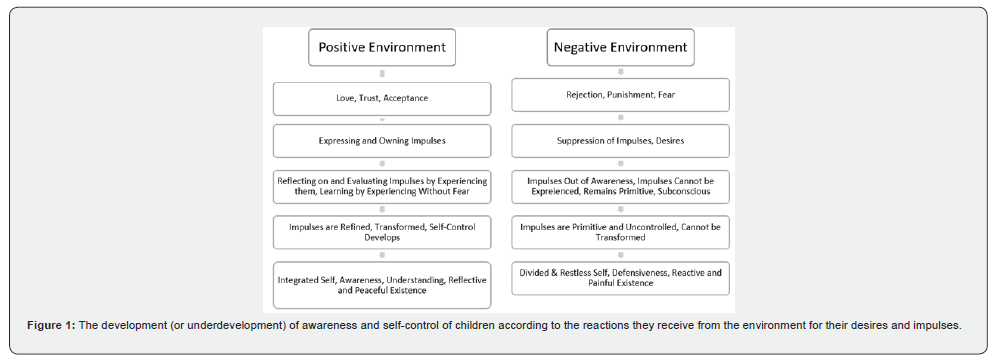
A non-threatening environment allows the child, the
young person, to express her/his impulse, desire and thoughts
where there is no threat, to experience her/his impulse freely, to
own it.
When the impulse is expressed and recognized and
owned the child can reflect on and evaluate the impulse.
In this way, little by little awareness of the positive and
negative aspects of the experience begins to form for the moment.
This is the first step in developing awareness and self-control over
the impulse.
As the impulse is expressed and becomes known, its
power over the personality decreases. For example, it can be
observed that self-control systems are more developed and
societies are more peaceful where the relations between men and
women are more egalitarian and libertarian [99].
When urges are suppressed, the child’s connection with these urges is severed, leading to fragmentation in their personality (because of repression). This fragmentation breeds internal conflicts and results in an anxious and unsettled (neurotic) existence. Mental and emotional potential will be wasted within these conflicts. Suppressed urges do not vanish, rather they begin to dominate the individual’s entire psychological existence and perception. Life begins to be viewed through the lens of these suppressed impulses. Such individual’s entire existence becomes centered around managing these suppressed urges, dealing with internal conflicts. It wouldn’t be realistic to expect creativity from such individuals. They might feel inexplicable envy towards those who can fulfill the desires and impulses they themselves couldn’t satisfy.
Those who trust children and wholeheartedly accept them, with their both positive and negative aspects, provide an environment compatible with their developmental needs. In such an environment of trust, acceptance and love, children experience less fragmentation and detachment within their personality. This enables them to mature by reflecting upon their mistakes. On the contrary, environments that fail to accept children as whole individuals, burdening them with excessive rules and punishments, lead to severe personality fragmentation. Consequently, spontaneity and creativity become nearly unattainable. In societies that don’t foster freedom and creativity, individuals tend to be more impulsive, restless, aggressive, depressed, and anxious. Their fragmented state engenders severe internal conflicts, diminishing their curiosity, vitality, and life energy for pursuits in science and art. Due to the constant search for satisfaction by these repressed urges, the conscious mind is persistently threatened. As a result, the mind becomes preoccupied with the external manifestations of these representations in the world. Anything that could activate these urges becomes a symbol, triggering substantial anxiety within the individual. The person’s thoughts and life energy are directed towards controlling these anxiety-inducing events. Societal norms and values within communities composed of individuals with suppressed and insufficiently gratified urges develop according to this neurotic structure. These societies, unable to create the appropriate environment for the development of healthy selves in their children and youth, are founded on the notion of ‘crushed selves.’ The true purpose of education, I think, is to provide environments where children and young individuals can selfactualize by expressing themselves freely and reflecting on what they express. As claimed by Rogers, understanding, learning, and self-actualization are the fundamental motivations and urges within us humans. All it takes is for families, education, and culture to provide an environment that enables individuals to actualize and transform their potential within. Figure 1 summarizes the points discussed [100-113].
Conclusion
In this paper the importance of emotions experienced by children in educational settings for healthy self-development and learning is stressed. The five different approaches in psychology about the nature of children explained with reference to how they view emotions experienced by children. Psychoanalytichumanistic approach is claimed to provide the most suitable emotional environment for both self-development and learning. The most important factor for self-development is claimed to be the opportunity for expression of impulses, emotions and desires in a none threatening environment. Such an experience is claimed to provide ownership of impulses, emotions and desires leading to development of awareness of and control over them. Moreover, such a development is assumed to be a precondition for ideal learning environment, development of a holistic self and peaceful existence.
References
- Vergara-Morales J, Del Valle M (2021) From the Basic Psychological Needs Satisfaction to Intrinsic Motivation: Mediating Effect of Academic Integration. Frontiers in Psychology 12: 612023.
- Schweder S, Raufelder D (2021) Needs satisfaction and motivation among adolescent boys and girls during self-directed learning intervention. Journal of Adolescence 88: 1-13.
- Skinner EA, Belmont MJ (1993) Motivation in the Classroom: Reciprocal Effects of Teacher Behavior and Student Engagement Across the School Year. Journal of Educational Psychology 85(4): 571-581.
- DeMause L (Ed.) (1995) The history of childhood. Jason Aronson, Incorporated.
- Schutte NS, Malouff JM (2021) Basic psychological need satisfaction, affect and mental health. Current Psychology 40: 1228-1233.
- Tian L, Chen H, Huebner ES (2014) The longitudinal relationships between basic psychological needs satisfaction at school and school-related subjective well-being in adolescents. Social indicators research 119: 353-372.
- Brezelton TB, Greenspan IS (2000) The Irreducible Needs of Children: What Every Child Must Have to Grow, Learn and Flourish. Cambridge: Perseus Publishing.
- Kohut H (1971) The Analysis of the Self: A Systematic to the Psychoanalytic Treatment of Narcissistic Personality Disorders. UK: International Universities Press.
- Winnicott DW (1960a) The Theory of Parent-Infant Relationship. International Journal Psychoanalysis 41: 585-595.
- Kohut H (1984) How Does Analysis Cure. Chicago: University of Chicago Press.
- Trevathan WR, Rosenberg KR (2016) Costly and Cute: Helpless Infants and Human Evolution (School for Advanced Research Advanced Seminar Series). University of New Mexico Press.
- Fischer-Mamblona H (2000) On the Evolution of Attachment-Disordered behaviour. Attachment & Human Development 2(1): 8-21.
- Li L, Gow AD I, Zhou J (2020) The Role of Positive Emotions in Education: A Neuroscience Perspective. Mind, Brain, and Education 14(3): 220-234.
- An F, Yu J, Xi L (2022) Relationship between perceived teacher support and learning engagement among adolescents: Mediation role of technology acceptance and learning motivation. Frontiers in Psychology 13: 992464.
- Reschly AL, Huebner ES, Appleton JJ, Antarmian S (2008) Engagement as flourishing: The contribution of positive emotions and coping to adolescents’ engagement at school and with learning. Psychology in the Schools 45: 419-431.
- Fredrickson BL (2001) The role of positive emotions in positive psychology: The broaden-and-build theory of positive emotions. American Psychologist 56(3) 218-226.
- Perry BD (2006) Applying Principles of Neurodevelopment to Clinical Work with Maltreated and Traumatized Children: The Neuro sequential Model of Therapeutics. In NB Webb (Ed.), Working with traumatized youth in child welfare (pp. 27–52). New York: The Guilford Press.
- Dirkx J (2001) The Power of Feelings: Emotion, Imagination and Construction of Meanings in Adult Learning. New Directions for Adult Continuing Education 89: 63-72.
- Dirkx J (2006) Engaging emotions in adult learning: A Jungian Perspective on Emotion and Transformative Learning. New Directions for Adult and Continuing Education 109: 15-26.
- O’Regan K (2003) Emotion and E-Learning. Journal of Asynchronous Learning Networks 7(3): 78-92.
- Opengart R (2005) Emotional Intelligence and Emotion Work: Examining Constructs from an Interdisciplinary Framework. Human Resource Development Review 4(1): 49–62.
- Shuck B, Albornoz C, Winberg M (2007) Emotions and Their Effect on Adult Learning: A constructivist Perspective. In SM Neilsen & MS Plakhotnik (Eds.), Proceeding of the 6th Annual College of Educational Research Conference: Urban and International Education Section). Miami International University 108-113.
- Shapero BG, Steinberg L (2013) Emotional reactivity and exposure to household stress in childhood predict psychological problems in adolescence. Journal of Youth and Adolescence 42: 1573-1582.
- Miller GE, Chen E, Parker KJ (2011) Psychological stress in childhood and susceptibility to the chronic diseases of aging: moving toward a model of behavioral and biological mechanisms. Psychological bulletin 137(6): 959.
- Timmermans M, van Lier PA, Koot HM (2010) The role of stressful events in the development of behavioural and emotional problems from early childhood to late adolescence. Psychological Medicine 40(10): 1659-1668.
- Ferro A (2005) Seeds of Illness and Seeds of Recovery. New York: Taylor Francis.
- Agorastos A, Pervanidou P, Chrousos GP, Kolaitis K (2018) Early Life Stress and Trauma: Developmental Neuroendocrine Aspects of Prolonged Stress System Dysregulation. Hormones 17: 507-520.
- Bick J and Nelson CA (2017) Early experience and brain development. WIREs Cogn Sci 8: e1387.
- Carrion VG, Weems CF, Reiss AL (2007) Stress predicts brain changes in children: a pilot longitudinal study on youth stress, posttraumatic stress disorder, and the hippocampus. Pediatrics 119(3): 509-516.
- Anda RF, Felitti VJ, Bremner JD, Walker JD, Whitfield C, et al. (2005) The enduring effects of abuse and related adverse experiences in childhood. European Archives of Psychiatry and Clinical Neuroscience 256(3): 174-186.
- Bremner JD, Narayan M, Anderson ER, Staib LH, Miller HL, et al. (2000) Hippocampal Volume Reduction in Major Depression. American Journal of Psychiatry 157(1): 115–118.
- Schore AN (2001) Effects of a Secure Attachment relationship on right brain development, affect regulation, and infant mental health. Infant Mental Health Journal 22(1-2): 7-66.
- Gunnar MR, Barr RG (1998) Stress, early brain development, and behavior. Infants & Young Children 11(1): 1-14.
- Vincent JD (1990) The Biology of Emotions. Cambridge: Mass Basil Blackwell.
- Gazzaniga M (1989) Mind Matters: How the Mind and Brain Interact to Create Our Conscious Lives, Boston: Houghthon Miffin.
- Vogel S, Schwabe L (2016) Learning and memory under stress: implications for the classroom. Npj Science of Learning 1(1).
- Linnenbrink-Garcia L, Patall EA, Pekrun R (2016) Adaptive Motivation and Emotion in Education. Policy Insights from the Behavioral and Brain Sciences, 3(2): 228-236.
- Mortari L (2015) Emotion and Education: Reflecting on the Emotional Experience Emotion and Education. European Journal of Educational Research 4(4): 157-176.
- Schutz PA, R Pekrun R (Eds.) (2007). Emotion in Education. London: Elsevier
- Boakes R (1984) From Darwin to Behaviorism. London: Cambridge University Press.
- Pierce DW, Cheney CD (2017) Behavior Analysis and Learning: A Biobehavioral Approach, London: Sixth Edition. Routledge.
- Delprato DJ, Midgley BD (1992) Some Fundamentals of B. F. Skinner’s Behaviorism. American Psychologist 47(11): 1507-1520.
- Ertmer PA, Newby TJ (1993) Behaviorism, Cognitivism, Constructivism: Comparing Critical Features from an Instructional Design Perspective 6(4): 50-72.
- Thorndike EL (1905) The elements of psychology. New York: AG Seiler.
- Rasmussen EB, Clay CJ, Pierce DW, Cheney CD (2023) Behavior Analysis and Learning. Ney York: Seventh Edition Routledge.
- Martin G, Pear JJ (2019) Behavior Modification: How to do it. New York: Routledge.
- Staats AW (1996) Behavior and personality: Psychological Behaviorism. New York: Springer.
- Williams CD (1959) The elimination of tantrum behavior by extinction procedures. The Journal of Abnormal and Social Psychology 59(2): 269.
- Bibby T (2011) Education- ‘An Impossible Profession’? Psychoanalytic Explorations of Learning and Classroom. London: Routledge.
- Britzman D (2011) Freud and Education. London: Routledge.
- Mayes C (2009) The Psychoanalytic View of Teaching and Learning, 1922–2002. Journal of Curriculum Studies 41(4): 539-567.
- Freud S (1923) The Ego and the Id. In J Strachey et al. (Trans.), The Standard Edition of the Complete Psychological Works of Sigmund Freud, Volume XIX. London: Hogarth Press.
- Fairbairn WRD (1994) A Critique of Educational Aims. In Fairbairn Brittles E & Scharff DE (Eds) From Instinct to Self: Selected Papers of W.R.D. Fairbairn, Vol II. London: Jason Aronson Inc.
- Bion WR (1962a) The Psycho-Analytic Study of Thinking. The Psychoanalytic Quarterly 82(2): 306–310.
- Bion W (1962b) Learning from Experience. London: Karnac Books.
- Bion WR (1958) On arrogance. The International Journal of Psycho-Analysis 39: 144.
- Bowlby J (1958) The Nature of the Childs Tie to His Mother. International Journal of Psychoanalysis 39: 350-371.
- Rogers CR (1961) On Becoming a Person. Boston: Houghton Miffin Company.
- Maslow A (1968) Some educational implications of the humanistic psychologies. Harvard educational review 38(4): 685-696.
- Rogers CR (1962) The Interpersonal Relationship: The Core of Guidance. Harvard Educational Review 32(4): 416-429.
- Hiner NR, Hawes JM (Eds) (1985) Growing up in America: Children in historical perspective. Campaign, Illinois, University of Illinois Press.
- Khabibovich HB (2022) Sufi Philosophy in the Works of Jalaladdin Rumi. American Journal of Philological Sciences 2(12): 21-28.
- Sheik US, Ali MA (2019) Al-Ghazali’s Aims and Objectives of Islamic Education. Journal of Education and Educational Development. Al-Ghazali’s Aims and Objectives of Islamic Education 6(1): 111-125.
- Yasin RFBF & Jani MS (2013) Islamic Education: The Philosophy, Aim and Main Features. International Journal of Educational Research 1(10): 1-18.
- Ali MA (2011) An analysis of conceptions and practices of Pakistani educators in private Islamic schools in light of Iqbal’s educational philosophy. (Unpublished doctoral thesis) Institute of Education, International Islamic University Malaysia, Kuala Lumpur
- Sultana NQ (2012) Philosophy of Education an Islamic Perspective. Philosophy & Progress LI-LII: 10-35.
- Dwairy M (1997) Addressing the Repressed Needs of the Arabic Client. Cultural Diversity and Mental Health 3(1): 1-12.
- Mehmood IM, Qayum S, Ali S (2022) Pakistan Journal of Criminology 14(1): 43-14.
- Sidman M (2001) Coersion and Its Fallout. Boston: Authors Cooperative Inc. Publishers.
- Tuber S (2008) Attachment, Play & Authenticity: A Winnicott Primer. New York: Jason Aronson.
- Winnicott DW (1960b) Ego Distortion in Terms of True and False Self. In The Maturational Processes and the Facilitating Environment. London: Karnac Books.
- Patton S (2020) Corporal punishment harms all children: Rethinking the culture defense in expert witness testimony in child abuse cases. In MC Stevenson, BL Bottoms, KC Burke (Eds.) The legacy of racism for children: Psychology, law, and public policy Pp: 35-52. Oxford: Oxford University Press.
- Gershoff ET, Goodman GS, Miller-Perrin CL, Holden GW, Jackson Y, et al. (2018) The strength of the causal evidence against physical punishment of children and its implications for parents, psychologists, and policymakers. American Psychologist 73(5): 626-638.
- Buss DM (2005) The handbook of evolutionary psychology. John Wiley & Sons.
- Dawkins R (1976) The selfish gene. Oxford University Press.
- Reeve J (2002) Self-Determination Theory Applied to Educational Settings. In Ryan & Deci (Eds.) (2002). Handbook of Self Determination Research New York: University of Rochester Press pp: 183-203
- Eccles J, Midgley C (1989) Stage Environment Fit. Developmentally Appropriate Classroom for Early Adolescence in RE Ames, Ames C (Eds.) Research on Motivation in Education. New York: Academic Press. 3: 139-186
- Deci EL (1995) Why We Do What We Do: Dynamics of Personal Autonomy. New York: Penguin Books.
- Deci EL, Eghrari H, Patrick BC, Leone DR (1994) Facilitating Internalization: The Self-Determination Theory Perspective. Journal of Personality 62(1): 119-142.
- Mahoney JL, Weissberg RP, Greenberg MT, Dusenbury L, Jagers RJ, et al. (2021) Systemic social and emotional learning: Promoting educational success for all preschool to high school students. American Psychologist 76(7): 1128-1142.
- Tang M, Wang D, Guerrien A (2020) A systematic review and meta-analysis on basic psychological need satisfaction, motivation, and well-being in later life: Contributions of self-determination theory. Psy Ch Journal 9(1): 5-33.
- Wang MT, Degol JL (2016) School climate: A review of the construct. measurement, and ımpact on student outcomes. Educational psychology review 28: 315-352.
- Cohen J (2013) Creating a Positive School Climate: A Foundation for Resilience. In: Goldstein, S., Brooks, R. (eds) Handbook of Resilience in Children. Springer.
- Reyes MR, Brackett MA, Rivers SE, White M, Salovey P (2012) Classroom emotional climate, student engagement, and academic achievement. Journal of Educational Psychology 104(3): 700-712.
- Reik T (1959b) The Compulsion to Confess. In J. Farrar (Ed.) The compulsion to confess and the need for punishment (pp. 176 –356). New York: Farrar, Straus, and Cudahy.
- Arnold K (2006) The Need to Express and the Compulsion to Confess: Reik's theory of Symptom-Formation. Psychoanalytic Psychology 23(4): 738-753.
- Havens L (1988) Making contact: Uses of language in psychotherapy. Harvard University Press.
- Fairbairn WRD (1952) Psyhoanalytic Studies of the Personality. London: Tavistock
- Freud A (1962) Assessment of childhood disturbances. The Psychoanalytic Study of the Child 17(1): 149-158.
- Alexander F, French TM (1980) Psychoanalytic Therapy Principles and Application. London: University of Nebraska Press.
- Isen MA, Reeve J (2005) The Influence of Positive Affect on Intrinsic and Extrinsic Motivation: Facilitating Enjoyment and Play, Responsible Work Behavior and Self Control. Motivation and Emotion 29(4): 297-325.
- Greenberg JR, Mitchell SA (1983) Object Relations in Psychoanalytic Theory. London: Harvard University Press.
- Scharff DE, Fairbairn Birtles E (1994) From Instinct to Self: Selected Papers of WRD Fairbairn. Volume I & II. New Jersey: Jason Aronson Inc.
- Flanagan CM (2014) Unmet needs and maladaptive models: A new way approach to longer term problems. Journal of Psychotherapy Integration 24(3): 208-222.
- Vansteenkiste M, Ryan RM (2013) On psychological growth and vulnerability: Basic
- Bartholomew KJ, Ntoumanis N, Ryan RM, Bosch JA, Thøgersen-Ntoumani C (2011) Self-determination theory and diminished functioning: The role of interpersonal control and psychological need thwarting. Personality and Social Psychology Bulletin 37(11): 1459-1473.
- Eagle M (2000) Repression: Part I of II.Psychoanalytic Review 87(1).
- Rycroft C (1986) Psychoanalysis & beyond. London: The Hogarth Press.
- Stephenson CM (2009) Gender Equality and a Culture of Peace. In: de Rivera, J. (eds) Handbook on Building Cultures of Peace. Peace Psychology Book Series. Springer, New York, NY.
- Ames C, Ames R (1989) Research on Motivation in Education: Goals and Cognitions Vol 3. Orlando: Academic Press.
- Bartholomew K, Ntoumanis N, Ryan RM, Thøgersen-Ntoumani C (2011) Psychological need thwarting in the sport context: Assessing the darker side of athletic experience. Journal of Sport and Exercise Psychology 33(1): 75-102
- Bettelheim B (1969) Psychoanalysis and Education. The School Review. 77(2): 73-86.
- Bowlby JM (1953) Child care and the growth of love. Harmondsworth, UK: Pelican
- Bowlby J (1978) Attachment & Loss: Middlese. Pelican Books
- Dwairy M (2002) Foundations of Psychosocial Dynamic Personality Theory of Collective People. Clinical Psychology Review, 22(3): 343–360.
- Freud S (1926) Inhibitions, Symptoms and Anxiety. In J. Strachey, & A. Freud (Eds.) The standard edition of the complete psychological works of Sigmund Freud (pp: 77-175) London: The Hogarth Press.
- Opengart R (2005) Emotional Intelligence and Emotion Work: Examining Constructs from an Interdisciplinary Framework. Human Resource Development Review 4(1): 49-62.
- Rogers CR (1947) Some Observations on the Organization of Personality. Bobbs-Merrill Company Incorporated. In JM Notterman (Ed.) The evolution of psychology: Fifty years of the American Psychologist American Psychological Association 3-21.
- Russel PL (1996) What Is Radical About Psychotherapy. Talk at Cambridge Hospital, February 28.
- psychological need satisfaction and need frustration as a unifying principle. Journal of Psychotherapy Integration 23(3): 263-280.
- Wang MT, Degol JL, Amemiya J, Parr A, Guo J (2020) Classroom climate and children’s academic and psychological wellbeing: A systematic review and meta-analysis. Developmental Review 49: 1987-2002.
- Watson JB (1930) Behaviorism. Chicago: University of Chicago Press.
- Webb NB (2005) Working with Traumatized Youth in Child Welfare (Clinical Practice with Children, Adolescents, and Families). New York: The Guilford Press.

























