




 OAJELS Home



Abstract
Two important arguments led to a different version of the course implementation. Firstly, in previous iterations of the Bilateral Peer Immersion Program (BPIP), Taiwanese EFL students and visiting Indian students engaged in informal cultural exchanges like sharing meals and playing board games—to foster English communication. However, it became evident that many Taiwanese students found these unstructured social interactions in English challenging and anxiety-inducing. Despite the relaxed setting, the lack of contextual scaffolding made it difficult for them to initiate or sustain conversations. Observing this, we recognized a counterintuitive yet powerful insight: students were more confident and communicative when engaging with familiar academic content, even in a second language. Their comfort with disciplinary knowledge—particularly in physics—offered a cognitive anchor that made English less intimidating and more purposeful. In response, we restructured the BPIP to emphasize academic collaboration over casual conversation. Indian students presented their physics research projects, while Taiwanese students introduced their quantum optics lab experiments through PowerPoint presentations and live demonstrations. This shift transformed the program into a CLIL-based exchange, where English served as the medium for disciplinary dialogue rather than social small talk. Secondly, there was a significant pedagogical paradox, particularly from the teacher’s perspective. Each student in the CLIL classroom was pursuing an independent research topic over a 14-week semester. While this fostered deep engagement with content, it posed a challenge for the teacher: how to facilitate a cohesive, shared language-learning environment when the content was so individualized. The CLIL framework demands both content mastery and language development, but in this case, the diversity of research topics made it difficult to design unified language objectives, peer interactions, or assessment strategies. This tension between individualized academic inquiry and the collective goals of language acquisition highlighted the complexity of implementing CLIL in a research-intensive, multilingual classroom. It required rethinking not only the structure of peer interaction but also the teacher’s role as a linguistic and cognitiave mediator across diverse content domains.
Keywords:Content and Language Integrated Learning (CLIL); Bilateral Peer Immersion Program (BPIP); Academic scaffolding; Physics education; Multilingual classroom; Socratic questioning Intercultural communication; Gender dynamics in STEM
Abbreviations:BPIP: Bilateral Peer Immersion Program; CLIL: Content and Language Integrated Learning; EFL: English as a Foreign Language; EMI: English as a Medium of Instruction; STEM: Science, Technology, Engineering, and Mathematics
Introduction
The purpose was twofold: to allocate individual, independent study time using course sheets and research templates, and to foster a shared language learning environment with various board games and card games.
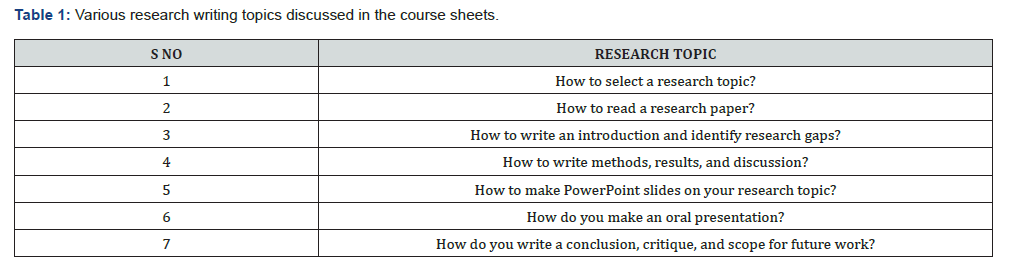
Implementation Methodology: The implementation methodology for the Content and Language Integrated Learning (CLIL) course, situated within a research-driven context, spanned 14 weeks. Alternate weeks were designated for focused course study and for engaging with game-based dynamics, thereby addressing both research competencies and language acquisition goals within the CLIL-EFL framework. Seven different course sheets on various research writing basics were developed, along with worksheets where the students learned the course sheets independently beforehand, and in the classroom, worksheets were provided for students to use the research templates provided in the course sheet for their research topic, with ample scaffolding on the language from the teacher. The course sheet topics are given in Table 1. There were two game sessions for the students, where one involved a peer discussion and presentation of the results using different diagrams, and the second game was used to measure the content knowledge of the learners.
Innovative Learning Methods
Students engaged in independent study using curated course sheets, allowing them to explore diverse, self-selected research topics aligned with their academic interests. In-class worksheets were introduced to guide students in drafting their research term papers. These worksheets incorporate: research templates for structured writing, step-by-step prompts to scaffold academic writing Integrated language support to reinforce EFL development. The instructor provided ongoing language support throughout the course, ensuring that students could articulate complex ideas while developing academic English proficiency. A Socratic approach was employed to deepen students’ critical thinking. Through guided questioning, students refined their research questions, clarified their arguments, and strengthened their analytical reasoning. The BPIP (Bilateral Peer Immersion Program) component was redesigned to emphasize physics-based experiments and research topics. This marked a shift from earlier implementations that focused more on food and games, aligning the course more closely with scientific inquiry and disciplinary literacy
Results
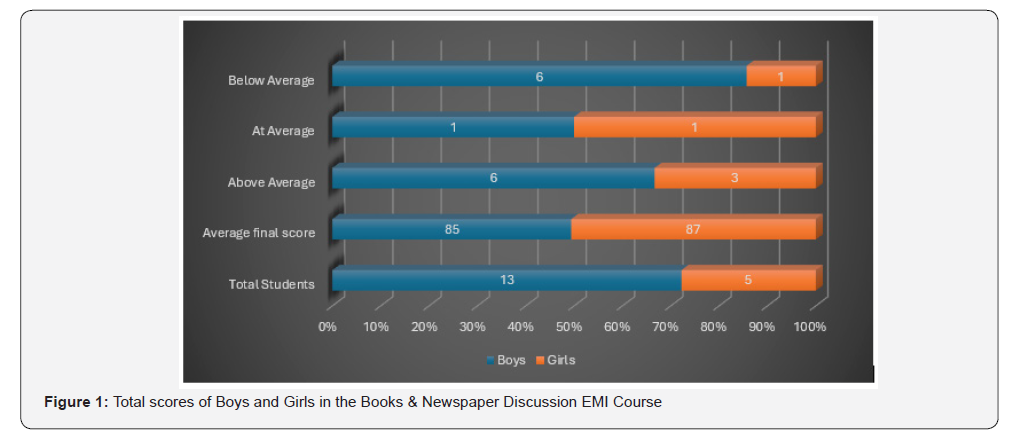
The Books & Newspaper Discussion Course in English as a medium of instruction (EMI) course had 21 students, of whom 3 decided not to attend the classroom sessions, and the results of the 18 students, with 13 boys and 5 girls who attended the EMI course, are given below in Figure 1. The Speaking and Writing skills of the boys and girls in the B&N Discussion EMI Course are given in Figure 2. The formative and summative assessment averages for boys and girls are given below in Figure 3.
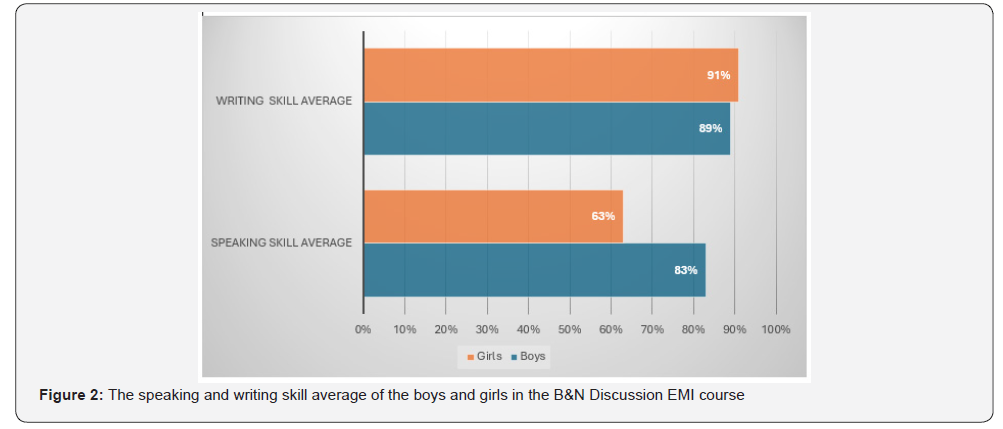
From Figure 2, we can see that the girls in the B&N Discussion EMI Class outperformed boys in writing by 2% but were outperformed by boys in speaking by a significant 20%. This result is not just a statistical contrast, but a window into deeper systemic and sociocultural dynamics, especially when viewed through the lens of STEM education. Girls excel in Structured, Reflective Tasks where writing often allows for planning, revision, and scaffolding— skills that align well with the strengths girls tend to develop in supportive academic environments. Girls may feel more confident expressing ideas in written form, especially in high-stakes or evaluative contexts. The 20% gap in speaking could reflect broader challenges girls face in STEM, including
(1) A lack of confidence or voice in male-dominated spaces: Girls may hesitate to speak up or assert ideas in STEM contexts due to implicit biases or fear of judgment. (2) Stereotype threat: The internalized belief that they are less competent in STEM can affect performance, especially in spontaneous or public speaking tasks. (3) Fewer role models: Without visible female figures confidently communicating in STEM, girls may lack aspirational templates. (4) Cultural expectations: In some contexts, girls are socialized to be more reserved, especially in technical discussions, which can impact oral performance. The educational implications are threefold: (1) Speaking tasks in STEM (e.g., presentations, oral defenses, group discussions) may unintentionally favor students who are already confident in asserting their ideas, often boys, due to social conditioning. (2) Girls may benefit from scaffolded speaking opportunities that build confidence gradually (e.g., peer rehearsals, structured debates, reflective oral journals). (3) Integrating female STEM communicators as models or mentors could help bridge the confidence gap.
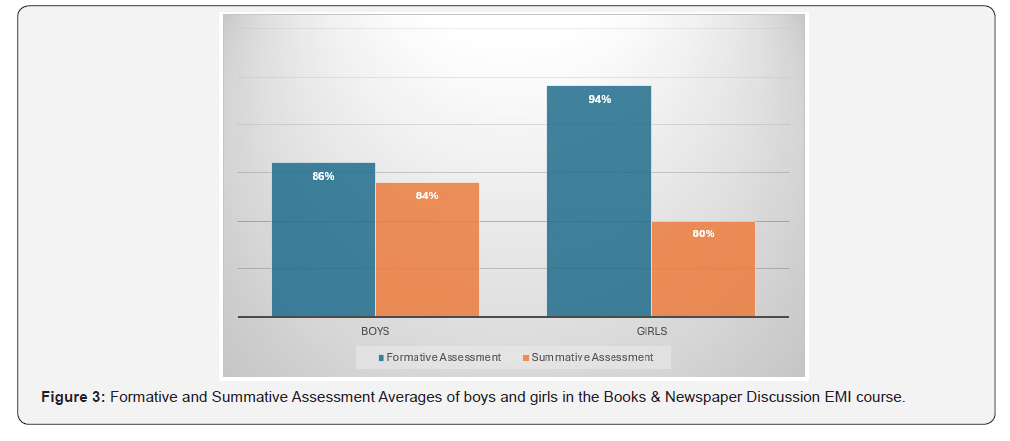
From Figure 3, we can see that the girls show a Larger Drop from Formative to Summative. A 14% drop suggests that girls performed significantly better in continuous, internal assessments than in the final exam. This could indicate: (1) Greater comfort with coursework, projects, or scaffolded tasks, (2) Possible test anxiety or lower performance under exam conditions, (3) Misalignment between internal and external assessment formats or expectations. We can also see that the boys show consistent performance. A small 2% drop suggests boys maintained similar performance across both assessment types. This may imply: (1) Better adaptation to summative exam formats, (2) Less reliance on scaffolding or continuous feedback, and (3) More stable performance across different assessment contexts. The Pedagogical Implications can relate to three factors: (1) Assessment Design: The internal assessments may be more supportive or better aligned with girls’ learning styles (e.g., collaborative, reflective, process-oriented). (2) Exam Readiness: Girls may benefit from targeted support in test-taking strategies, time management, or stress reduction. (3) Instructional Alignment: There may be a misalignment between what is practiced during the semester and what is tested in the final exam, especially for girls. The theoretical implications are three-fold: (1) The gap for girls may suggest a misalignment between learning activities and summative assessment. (2) Girls may be excelling in tasks that reward process and effort but may need more exposure to the demands of summative evaluations. (3) Some research suggests that girls may prefer continuous, feedback-rich environments, while boys may be more accustomed to competitive or high-stakes testing. A pretest questionnaire was administered to all 18 students on the life and work of Max Planck, which was a reading comprehension with scaffolding phrases in English to help them better understand difficult words in English, with open-ended questions on their motivation to study the English language and their plans after completion of the course on whether they would continue in research or move to working in the industry. All 18 students answered the Max Planck questions correctly, achieving a 100% score thanks to the scaffolding support. Their motivation primarily stemmed from a desire to improve their communication skills, broaden their access to global knowledge, and connect with people from different cultures, ultimately enhancing their career opportunities, as English is widely used in business, science, and technology. At the end of the course, a post-test questionnaire was administered to all 18 students. This questionnaire included various questions about the learning methods used in the 14-week Books & Newspaper Discussion EMI course, featuring a five-point Likert scale for responses. The results on Learning Effectiveness are presented in Figures 4 and 5.
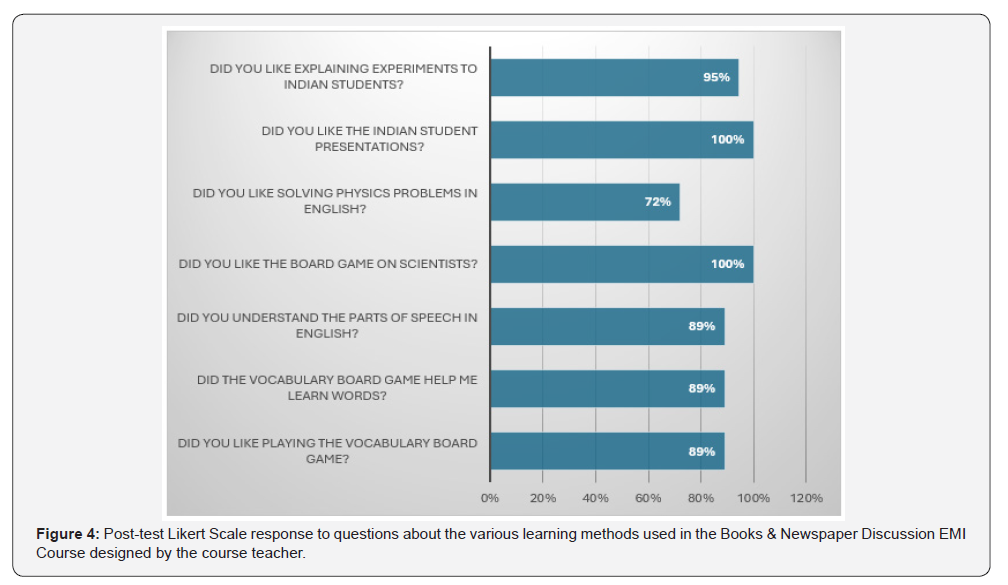
From Figure 4, we can see that the complete approval (100%) for the Indian students’ research presentations suggests that Taiwanese students highly valued structured academic exchange. This may reflect a growing preference for intellectually stimulating peer interactions. The board games on scientists maintained universal appeal, indicating that gamification of academic content remains a powerful tool for engagement and retention. The 95% approval for explaining experiments—both through digital and physical means—highlights the effectiveness of multimodal communication in cross-cultural STEM education. The important inference from this feedback is to consider formalizing the research presentation and lab demonstration components as core pillars of the BPIP. To expand the board game model to include more STEM topics or integrate collaborative game design as a task. To offer bilingual scaffolding tools (e.g., vocabulary sheets, experiment glossaries) to further support comprehension and confidence during lab demonstrations.
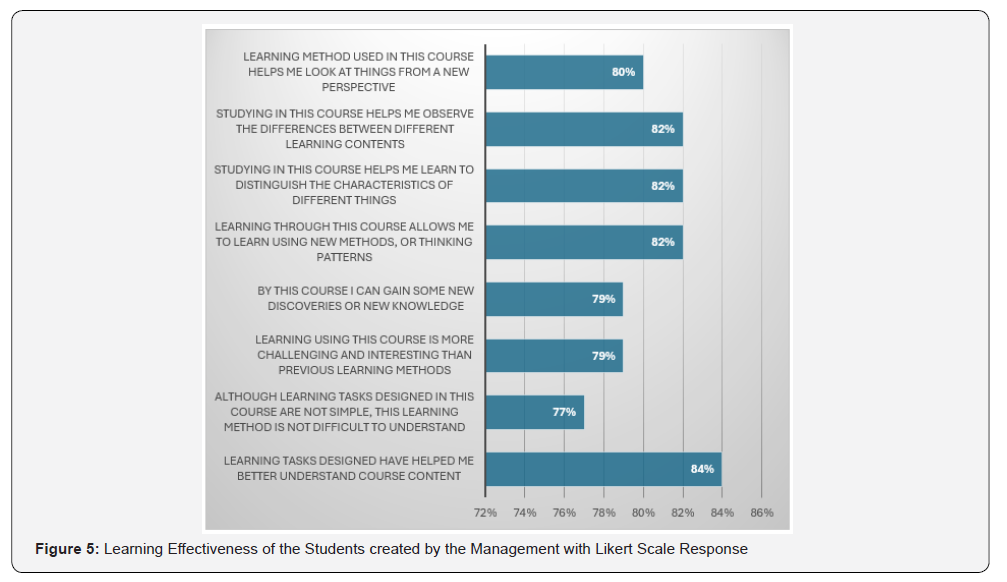
From Figure 5, we can see that the 84% agreement on improved course understanding suggests that the research-focused immersion enhanced conceptual clarity and relevance. The 82% response on learning through newer methods validates the shift from traditional cultural immersion to academic and experimental collaboration. The ability to differentiate learning contexts and distinguish characteristic points to higher-order thinking—a key goal in CLIL and interdisciplinary education [1,2].
Conclusion
This research-driven CLIL course represents a significant evolution in the design and implementation of interdisciplinary, multilingual education. By shifting the focus of the Bilateral Peer Immersion Program (BPIP) from informal cultural exchanges to structured academic collaboration, the course addressed a critical insight: students communicate more confidently in English when anchored in familiar disciplinary content. The integration of physics- based research presentations and quantum optics demonstrations provided a cognitively rich and linguistically purposeful context for English use, transforming English from a barrier into a bridge for scientific dialogue. At the same time, the course tackled a deeper pedagogical challenge—how to reconcile individualized research trajectories with the collective goals of language learning. Through the development of targeted course sheets, structured research templates, and scaffolded worksheets, the course offered a dual pathway: fostering independent academic inquiry while cultivating shared linguistic competencies. The alternating rhythm of focused study and game-based interaction further enriched this balance, allowing students to engage both analytically and playfully with content and language.
The instructor’s role evolved into that of a linguistic and cognitive mediator, guiding students through the complexities of academic English while supporting their disciplinary thinking. The use of Socratic questioning not only enhanced critical thinking but also empowered students to take ownership of their research narratives.
In sum, this course demonstrates that CLIL, when thoughtfully adapted, can thrive even in research-intensive, multilingual classrooms. It underscores the value of disciplinary anchoring, structured scaffolding, and pedagogical flexibility in fostering both academic and linguistic growth. The redesigned BPIP stands as a model for how cross-cultural academic exchange can be both intellectually rigorous and linguistically empowering, transforming not just how students learn English but how they learn through English.
Funding: This work was fully supported by the private university grant No. 1679: Tabletop Physics
Acknowledgement: I thank the Department of Physics, National Taiwan Normal University, for providing me with a generous fellowship
References
- Himanka J (2024) Modelling the connection between teaching, research, and learning. European Journal of Higher Education 15(2): 245-262.
- Maisano DA, Mastrogiacomo L, Franceschini F (2023) Empirical evidence on the relationship between research and teaching in academia. Scient metrics 128(8): 4475-4507.

























