




 OAJELS Home



Abstract
This paper gives evidence of increased teacher candidate self-efficacy when a new model of literacy field placement was piloted in an initial teacher education program at a small university in southeastern Ontario. Using an eight-question on-line survey that candidates completed at the end of their literacy field placement, preliminary findings suggest that the pilot project elementary candidates reported higher levels of self-efficacy and greater knowledge and positive beliefs about using inclusive pedagogies with a push in model of literacy instruction vs a pull-out model of literacy tutoring. An extended residency model of placement showed particular benefit to elementary teacher candidate growth. The impact of educational reform in literacy instruction and how this is rolled out across Ontario elementary and secondary classrooms, student learning gaps from COVID-19, and initial teacher education program structures are areas we suggest require further exploration to foster positive attitudes and knowledge of inclusive pedagogies for new teachers.
Keywords:Inclusive education; initial teacher education; literacy instruction
Understanding Inclusion
John Goodland [1] wrote that the role of education is to support “mutual caring developed to the level of habit, caring that comes to embrace human diversity” (p.20). In inclusive classrooms, all students can participate fully within the age-appropriate learning environment [2]. For persons with exceptionalities, the environment in an inclusive classroom is specifically adapted to their individual needs (Mittler, 2003). Research indicates that inclusive classrooms enhance student engagement, offer more opportunities for social interaction, and advance academic growth more readily than segregated settings for students with exceptionalities [3]. Additionally, although research indicates that these settings are preferable for collective and individual student achievement, for the benefits to be seen, successful inclusive classrooms actively require adequate support from qualified professionals, quality instruction, and an educator with a disposition supportive of inclusion [4]. Frequently, however, in practice this is not the case. In Ontario, for example, 87% of K-12 students with exceptionalities were placed in a regular classroom as their primary placement in the 2021-2022 academic year [5]. In the largest school board partnered with Trent University, children and youth are most likely to be placed in a mainstream regular education classroom [6]. In a 2016 CBC interview, an educator from Atlantic Canada said, “In a class with students on [standard and inclusive] programming, no matter how much planning a teacher does, it is IMPOSSIBLE for the needs of all students to be met adequately” [7]. We suggest that an that many teachers share this experience, highlighting the need to begin to address this challenge of inadequate training, lack of resources and very diverse learners with new teachers early on in their teacher education program and induction years. Therefore, building teacher candidate capacity and awareness, together with successfully including students with exceptionalities in their regular mainstream classrooms, is critical to addressing teacher belief systems about the inclusion of students with special needs as a need for growth across the teaching profession [8].
The purpose of this paper is to present the findings from a small pilot project that re-imagined an established literacy tutoring experience embedded within a course (Supporting Literacy & Learners with Special Education Needs) in a small School of Ed ucation in southeastern Ontario. We were curious if leveraging a conventional tutoring placement experience, provided by the School of Education, might better prepare teacher candidates for the reality of inclusive classrooms.
Preparing Teacher Candidates for Inclusive Classrooms
Educators who view students with exceptionalities as part of their professional duty are more successful at supporting these students in inclusive classroom settings [9]. Further, this body of research found that challenging pre-service educators’ epistemologies and beliefs about their roles and responsibilities regarding inclusion is necessary in teacher education. Equally important, “teachers with special education training held more positive views about inclusion than regular education teachers” [8] To better prepare new teachers, Schools of Education must challenge pre-service educators’ conceptions in three ways: by examining pedagogies, challenging teacher candidates’ beliefs about their roles and the pedagogies they use, and having teacher candidates examine their beliefs and conceptions about the reality, and social constructions, of “disability”. The following section will provide a brief introduction to the three areas to be challenged.
Shifting Teacher Candidate Beliefs Towards Inclusion
The intersection between a teacher candidate’s epistemology and ontology is complex, comprising their attitudes, beliefs, and professional practice [9]. For inclusion to become valued and enacted by teachers, beliefs, and attitudes about inclusion, in general, must be shifted, ideally before the teacher candidates first field placement experience [10]. Research indicates that teacher candidates whose “epistemological beliefs about ability as a more static entity are strongly predictive of their negative beliefs about inclusive education” [11]. To challenge these beliefs, ableism in general, and to foster genuinely inclusive school communities, we must seek opportunities to embed core findings from critical disability studies into our teacher education programs [12, 13]. However, in 2010, a study conducted by Trent University found that “one of the most striking findings is that although the courses and the tutoring program appeared to open up some new ideas about literacy, ideas about dis/ability were much more difficult to destabilize.” [14]. Therefore, the first step in shifting perspectives is to create cognitive dissonance amongst the teacher candidates so they begin to challenge their thinking [15]. Teacher candidates enter Schools of Education with varying understandings of disability, ableism, and critical disability studies thereby requiring a differentiated approach to supporting growth.
Building Knowledge of Pedagogies
Pedagogical knowledge, the specialized knowledge for creating effective instructional and learning environments, strongly predicts instructional quality [16]. Empirical research indicates that pedagogical decisions rest on the ability of an educator to integrate situational cues with content knowledge, making this skill paramount for quality classroom instruction [17]. Teacher candidates working in inclusive classrooms need opportunities to build their knowledge and experience of instructional approaches, management strategies, Universal Design for Learning, and differentiated instruction simultaneously. The opportunity to practice these skills with an inclusion-oriented associate teacher strongly correlates with teacher-candidate success [17]. Further, a disposition of reflexivity and reflectivity in teacher candidates promotes thoughtful integration of pedagogical and content knowledge in inclusive classrooms [18]. We must unpack these experiences in teacher education programs to support consolidation of inclusive practices and beliefs [19].
Building Self-Efficacy
Teacher self-efficacy has a significant impact on teacher beliefs about inclusion and is one of the most influential predictors on whether or not teachers will carry out inclusive practice and education reform more generally [17]. Self-efficacy for educators is “beliefs in one’s capabilities to organize and excuse the courses of action required to produce given attainments” [19]. Simply, this describes an educator’s belief that they can impact student outcomes [21]. Mastery experiences, ones in which teacher candidates can experience excellence, are considered the most powerful influence on developing self-efficacy [22]. It is critical to seek opportunities for teacher candidates to reflect on the connections between their perceptions and experiences [7, 23]..
Field Experience Placements & Attitudes Towards Inclusion
When we consider the role that pre-service teacher education programs can play in building the mindset for inclusion, the integration of fieldwork experience has increased the effectiveness with which students’ perceptions of students with learning disabilities shifted [24,25]. In teacher education, the challenge is ensuring that teacher candidates have practical experiences that provide opportunities to examine challenges and foster their beliefs and values on addressing diversity within the classroom [9]. More importantly, we need teacher candidates to reflect upon these experiences in a supported setting [19,23]. In three separate studies, direct teaching experience was the preferred approach to learning about special education (Avramidis & Norwich, 2002; Jobling & Moni, 2004; Peebles & Mendalgio, 2014). Specifically, Peebles Mendalgio (2014) found that self-efficacy was enhanced when teacher candidates had opportunities to provide direct instruction to persons with special needs.
When the Trent School of Education opened its doors twenty years ago, the Supporting Literacy Tutoring placement was included in the curriculum for Bachelor of Education students [26]. The placement’s fundamental premise is that when working from a child’s assets, tutors can support that child’s learning and foster independence [27]. In turn, the teacher candidate and the student benefit; the teacher candidate learns how to plan responsive, individualized, asset-oriented lessons, and the student’s literacy skills are improved. Previous studies on this course and its connected placement have explored teacher candidate conceptions about disability (Graham & Iannacci, 2016; [14, 28], but to date, research on how this placement experience shapes a teacher candidate understanding of inclusion and inclusive classroom practices has not been studied.
In striving towards the course objective to build teacher candidates’ “foundational knowledge regarding literacy including reading theory, processes, assessment, and responsive instruction” [29], Learning Outcome 2), the Supporting Literacy and Learners with Special Education Needs we wanted to explore alternative methods to prepare teacher candidates for inclusive classroom environments, particularly when considering the evolving needs in Ontario’s public education system. The hands-on experiences provide an opportunity to apply theoretical knowledge of inclusive education through hands-on experience interacting with diverse learners, making the theory-to-practice connection apparent (Jordan et al., 2010). Further, the opportunity for teacher candidates to build their self-efficacy, foster positive conceptions about learners’ abilities, and shift their perspectives on the role of the teacher in supporting all learners in the inclusive classroom promotes coherence between our program aims and the practice of inclusion [30]. We now turn to how we implemented a new approach to the tutoring field experience that became a small pilot project, and the focus of our analysis in this paper, within an initial teacher education program.
Context of the Study
The School of Education at Trent University has a course taken by all Bachelor of Education teacher candidates called Supporting Literacy & Learners with Special Education Needs (EDUC4133 & EDUC 4233). The course involves a 1:1 tutoring placement with local elementary or high school students. This year, we piloted a cohort of teacher candidates who, instead of pulling students out for 1:1 tutoring, pushed into the classroom, and worked with small groups of students to support their literacy needs. This change was prompted by feedback from both teacher candidates and partner schools; the feedback indicated that the traditional model was not effective in meeting the learning objectives for teacher candidates nor the learning needs of students in schools. The aims of the program remained the same. Our pilot project simply shifted the location and structure of the support. Additionally, it allowed classroom teachers to become part of the mentoring experience rather than peripheral to it.
Methodology
As previously stated, all year-one teacher candidates at Trent University must participate in a tutoring placement connected to their Supporting Literacy and Students with Special Education Needs course (EDUC 4133 or EDUC 4233) as a requirement for their Bachelor of Education degree. The tutoring placement “enables teacher candidates to understand how to respond to learner diversity by planning and implementing individualized literacy programs” (Trent University School of Education, n.d., paragraph 1). Historically, this placement required the teacher candidate to tutor two individuals; however, in the fall of 2023, our Supporting Literacy Pilot Program randomly placed some teacher candidates into a pilot program where they supported small groups of students within the classroom.
To investigate the pilot program’s effectiveness, we collected data using an eight-question online survey delivered in person. A survey was chosen as the measuring instrument as it has the advantage of flexibility, allowing the researchers to ask both qualitative and quantitative questions efficiently [31]. Further, given that one of the researchers is the course instructor, an online survey offered enhanced confidentiality and anonymity to study participants. The survey aimed to gather teacher candidates’ perceptions of their experience of the Supporting Literacy Tutoring placement.
Informed study consent was embedded into the survey. As the first survey question, individuals were required to read the consent and agree to before proceeding with the remainder of the survey. Individuals who did not agree to participate were thanked for their responses and not presented with any of the survey questions. If an individual abandoned the survey prior to completion, their incomplete results were not included in the dataset.
After consent was obtained, the confidential and anonymous
survey included qualitative and quantitative questions. The three
quantitative questions consisted of:
Asking the teacher candidate to identify which course
they were registered in (EDUC 4133 is the course taken by Primary/
Junior teacher candidates, while EDUC 4233 is the course
taken by Intermediate/Senior teacher candidates);
A closed response question about whether they participated
in the pilot program or the traditional program; and
A Likert question asking teacher candidates to self-assess
how well they think they can help children learn to read, after
this placement. This question allowed teacher candidates to
respond using a range from “not well at all” to “extremely well”.
The open-ended qualitative questions allowed teacher candidates
opportunities to share their ideas, opinions, and perceptions
and to self-assess their positionality as educators. These
three questions asked:
How did your experiences in this course’s placement
impact your understanding of teaching literacy? Please share as
much detail as you can;
How well do you think you can help students learn to
read? Why do you believe this?
What does the phrase “students with special needs”
mean to you?
To investigate the pilot program’s effectiveness, our data col lection survey was administered in a face-to-face setting approximately seven weeks after the supporting literacy placement ended (one of February 5, 6, or 7, 2024, depending on the section of EDUC 4133/4233 they attended). Participants were given thirty minutes at the end of class to complete the survey and were informed that they may leave as soon as the survey was complete. The course instructor (Dr. Terri Jackson) introduced the study and provided contextual information and key definitions to help frame the survey for participants before administering it. It was indicated that participation was voluntary. The primary researchers were the course instructor, Dr. Terri Jackson, and the Dean of the School of Education, Dr. Sarah Twomey. The findings from our three stages of analysis are presented in the following section.
Participants
The participants in the study were the 148-year one teacher candidates registered in EDUC 4133 or EDUC 4233. Because participation was voluntary, only 85 of the 148 students chose to begin the survey. That is a 57% response rate. 10 of the submitted surveys were discarded as they were incomplete. Many students were absent from class the day surveys were administered. Data is summarized below in Table 1.
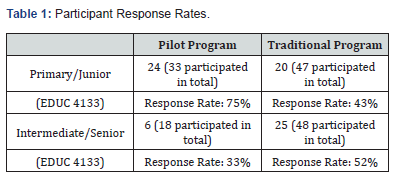
Participation rates were lower than anticipated, particularly since teacher candidates completed the survey at the end of the class. In particular, the variation in response rates between primary/ junior teacher candidates and intermediate/senior teacher candidates who participated in the pilot program was notable. The response rate could have been lower than anticipated for many reasons, including finishing the placement some weeks prior to the administration of the survey, so teacher candidates no longer felt connected to the placement experience. Further, the survey was administered at a busy point in the semester, so exhausted teacher candidates may have chosen to leave the classroom rather than complete the survey. Particularly in the intermediate/senior courses, the opportunity to leave early would have enticed teacher candidates who have extraordinarily long instructional days. A handful of students were absent from class (n=11), and a small number of students who participated in the supporting literacy placement had withdrawn from the program before the survey was administered (n=7). When these numbers were removed, the response rate jumped to 65%.
Method of Analysis
A thematic analysis was used to analyze the results. Thematic
analysis, a method of analyzing qualitative data, is often applied
to open-ended survey questions as researchers look to identify
common themes or patterns in sets of data [32]. In this instance,
thematic analysis was powerful in seeking to understand the
teacher candidates’ experiences, views, and opinions. In this instance,
data was coded using an inductive approach. By allowing
the data to determine themes, the researchers aimed to minimize
confirmation bias from the research process. The process of data
analysis included:
1. Familiarization: Data were downloaded from the Qualtrics
server and placed onto a spreadsheet. Here, the data was
read in its entirety by the primary researcher.
2. Sorting: Data was then parsed into four sets to allow for
analysis: primary/junior (pilot), primary/junior (traditional), intermediate/
senior (pilot), and intermediate/senior (traditional).
3. Coding: Using a two-column model, data was read again
(in sets), and themes that emerged were highlighted based on
what emerged from the data. When similar themes were noted
across responses, the highlighted colour was consistent.
4. Generating Themes: All themes were gathered based
on patterns that emerged, and were reviewed, named, and sorted
accordingly. There were correlations between emerging themes
and the capacities for teachers of inclusion noted by the Canadian
Council on Learning (2009), so three of our categories were variations
on these themes: attitudes, knowledge, self-efficacy, and
perception.
5. Triangulation of Themes: Generated themes were reviewed
by a second researcher to triangulate findings.
Although a range of responses existed, included quotes were chosen to highlight the themes and patterns generated in the findings and to show the range of responses.
Findings
The following section describes the main findings of our
study. The open-ended qualitative question structure allowed
teacher candidates to be analytical about their experience. In this
section, we capture the main themes emerging from data analysis.
Through a thematic analysis of the open-ended question, “How
did your experiences in this course’s placement impact your understanding
of teaching literacy? Please share as much detail as you
can.” Four overarching themes emerged:
Teacher candidate attitudes and perceptions towards
special education, inclusion, and learners with exceptionalities;
Knowledge of pedagogies connected to literacy instruction;
Teacher candidate self-efficacy or identity formation;
and
Overall perceptions of the placement experience or program
structure.
When coding, a teacher candidate’s response could have been coded into one, two, three, or four of the above categories, depending on the response. Each thematic category is explored in its section below. Teacher Candidate Attitudes and Perceptions Towards Special Education, Inclusion, and Learners with Exceptionalities
In considering the impact of teacher candidate attitudes towards special education, inclusion, and learners with exceptionalities, some respondents commented on the impact of pedagogical structures to support inclusion (i.e., Universal Design for Learning, differentiated instruction). In contrast, others spoke about the impact of the educator mindset and the importance of knowing one’s students (i.e., deep knowledge of individual students, relationship building, personalization of experience). More than half of the teacher candidates responded with comments coded to this category. Table 2 summarizes these findings.
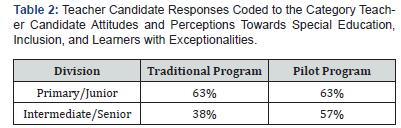
Proportionally, more primary/junior teacher candidates
mentioned special education-related topics in their anecdotal
comments. One sample response indicative of teacher candidate
learning connected to pedagogical structures and teacher candidate
attitudes and perceptions towards special education, inclusion,
and/or learners with exceptionalities:
I witnessed how every student is on their literary journey. Although
they may all be the same age and in the same class with the
same instruction, each student absorbs information and gains understanding
differently and at varying rates. For this reason, I can
see how important it is to utilize universal design for learning and
differentiated instruction within the classroom.
Most comments were similar and were not evaluative, simply reporting the benefit of instructional design and student success.
Several teacher candidates, particularly those in the traditional program, commented on the importance of knowing one’s learners. One teacher candidate commented that instruction “... looks different depending on the students and their needs.” Another teacher candidate in the primary/junior program was more specific, indicating, “The lessons were designed and planned based on the student’s unique needs and meet their particular learning needs.” These responses indicate a growing understanding of the impact of a learner-focused orientation.
A few teacher candidates made evaluative comments connected to observed gaps far greater than anticipated. These comments were particularly prevalent in the intermediate/senior cohort, where multiple students commented on “eye-opening … the disparity between curriculum level learners and those who are behind.” These comments indicate the acknowledgment of a gap between teacher candidate expectations about supporting literacy and the reality of the placement experience. It is important to acknowledge that myriads of factors influence student learning gaps, however, a body of research indicates that pandemic-related gaps are more significant in middle and high school students than in other demographic groups [33].
Knowledge Connected to Literacy
In considering data connected to teacher candidates’ pedagogical knowledge of literacy instruction, researchers coded data in this section into literacy pedagogies and instructional tools or resources. The division further sorted data the teacher candidate is enrolled in and by the type of placement experience each participated in. This category had the highest number of responses coded to it across all four categories. Table 3 summarizes these findings.
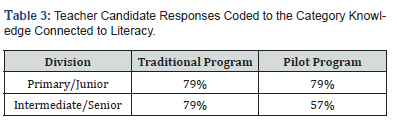
As previously indicated in the research of Graham and Iannacci (2016) and Iannacci & Graham [14], this study confirms the impact this placement has on teacher candidates who reported gains in their understanding of literacy and literacy pedagogies. Most teacher candidates, 79% in three subgroups, wrote comments on literacy pedagogies and/or tools/resources. The interesting outlier is that the intermediate/senior pilot program commented only 57% of the time on this subcategory. The unique experience in this pilot (which will be discussed later) resulted in fewer opportunities for teacher candidates to dig into the pedagogies or resources for literacy instruction. A further explanation could be the phenomenon that intermediate/senior teacher candidates with English teachable may not have noted increased capacity in this domain, as it is part of their initial teacher education program.
A common trend noted in the responses, and indicated in this
sample response, is that teacher candidates recognized the complexity
of teaching literacy and the importance and impact of multiple
instructional approaches. One response that highlights this
finding is:
My experience in the placement demonstrated to me that teaching
literacy is not as straightforward as texts and theory may indicate.
Each student is at their own unique stage and has specific
needs in their reading, writing, and communication. Though there
are many tools and resources available, these cannot fully prepare
the educator for a student’s personal needs.
This response indicates an emerging understanding of both pedagogies for literacy instruction and the importance of thoughtful consideration of the tools and resources used to provide instruction.
Content area literacy and the shared responsibility for literacy instruction are particularly important for Ontario high school educators, given that graduation requirements in Ontario include a high-stakes literacy test [34]. For many intermediate/senior teacher candidates whose teachable subject is not English, a barrier to engagement in the placement experience is their perception of the utility of a literacy placement. One teacher candidate commented, “My understanding of teaching literacy expanded to include cross-curricular opportunities.” Indications of content-area literacy pedagogies supported a growing understanding of literacy- related knowledge. Another commented that “I was able to understand what it means to teach literacy and this placement taught me the foundational knowledge needed to teach in general”.
Teacher Candidate Self-Efficacy and Identity Formation
Key patterns emerging when researchers coded data on teacher candidate self-efficacy and identity formation included comments correlated with educator confidence and educator acknowledgment of their growth. In some cases, negative self-efficacy was reported; these reports were included in the dataset. The division further sorted data the teacher candidate is enrolled in, and by the type of placement experience each participated in. There were significant variations in the report of self-efficacy across programs and divisions. Table four summarizes these findings and supports previous research that shows that all teacher candidates benefit from the opportunity to support persons with exceptionalities, however, results indicate that elementary pre-service educators generally have more positive beliefs about inclusion than do their secondary counterparts [35]. Table 4
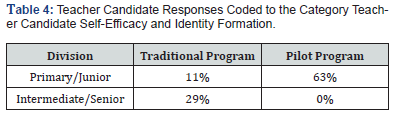
The pilot program’s positive impact reported by primary/ junior teacher candidate self-efficacy is a noted outlier. 63% of primary/junior teacher candidates who participated in the pilot made comments coded to the self-efficacy category. In these teacher candidates’ comments, they say that the connection to the teacher and classroom makes them “…feel much more confident when it comes to teaching literacy during my practicum Block A placement.” Comments connected to self-efficacy were particularly common in primary/junior educators who could continue in the same classroom for their Block A practicum placement, a four-week full-time practicum that began immediately after this part-time literacy-focused placement ended. This supports the research showing how a residency model, where teacher candidates had opportunities to build longer-term relationships with mentor teachers, increased self-efficacy ratings among teacher candidates concerning literacy [25].
Teacher candidates who acknowledged their growth in their comments typically indicated how the placement opportunity “... eyes to the struggles of learning literacy.” Further, a comment mirrored by many teacher candidates was, “I think this was one of my areas of growth - being able to see what wasn’t working, adapt it, try new things to see what stuck with my group of learners.” An emerging sense of self-efficacy is highly correlated to a willingness to use inclusive pedagogies [9].
A small number (n=4) of teacher candidates reported a negative impact on their teacher self-efficacy due to this experience. One comment that stood out by a primary/junior teacher candidate was a desire to have the placement moved to later in the year because they felt “we did not have much knowledge about being a “literacy tutor” going into the placement.”
Overall Perceptions of the Program or Placement Experience
To better understand the placement experience holistically, researchers coded data in this section to include any comments referencing the placement, the experience, or the placement structure. Both positive and negative experiences of the placement were coded. The division further sorted data the teacher candidate is enrolled in and by the type of placement experience, each participated in. Table five summarizes these findings.
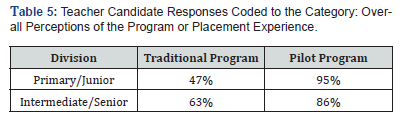
Teacher candidates in the primary/junior division reported positive experiences with their supporting literacy placement, regardless of placement type. Some noted challenges in the beginning, including logistical issues, student attendance issues, and difficulties in schools adjusting to the expectations of the pilot program. All but one respondent who participated in the pilot program and commented on the program structure reported a positive experience with the opportunity for push-in small group support. One teacher candidate commented, “With the Pilot Program, I was able to dip my toes into a more realistic teaching setting rather than facilitating one-on-one sessions.” Another indicated, “I really enjoyed the aspect of learning how to create and run a small literacy group because I feel like it is what we are actually going to do when we are teaching”. This speaks to the positive impact that supporting literacy placement has on primary/junior teacher candidates. The primary/junior teacher candidate who reported a negative experience indicated that, “I don’t feel that this placement helped my ability to teacher literacy. I felt unprepared and non-resourceful having little previous education on how to teach literacy, especially to those who are struggling”.
The findings in the intermediate/senior division were significantly different. Many intermediate/senior teacher candidates commented on frustrations with student attendance, inconsistent expectations from the host teachers, and fewer opportunities to engage with classroom teachers. One teacher candidate in the traditional program reported no contact with the host teacher or the school-based reading associate. For teacher candidates participating in the pilot, a few commented that they felt like educational assistants, supporting students in the classroom rather than leading lessons with small groups. Many teacher candidates in the intermediate/senior division were unsatisfied with this placement opportunity. One teacher candidate commented, “I personally did not like this placement. It added so much stress to my life.” Those teacher candidates who shared positive experiences often reported that despite having to drive over an hour to placement, “I still think this was a meaningful experience, and I understand why it is part of the program and appreciate that it is included.” Although the negative experiences expressed more consistently in intermediate/senior teacher candidates are saddening, it is not alarming. Research indicates, as previously stated, that practicing secondary school teachers are less likely to support inclusive education practices [11] further the structure of intermediate and high school classrooms does not easily lend themselves to either program model.
Overall, positive comments outweigh the negative. Positive comments were connected to the opportunity to have part-time experience before the first full-time placement. Others appreciated the opportunity to learn to deeply differentiate instruction for “the students who often get lost in larger classrooms.” Others, particularly in the intermediate/senior panel, appreciate the “eye-opening experience of seeing the disparity in learning levels between students in the grade nine classroom.” Given that the province of Ontario has moved towards de-streaming in grade nine classrooms, teacher candidates benefit from opportunities to build their capacity with inclusive practices [36]..
A further measure of teacher candidate self-efficacy was collected, and teacher candidates were asked (using a Likert-style question) to evaluate how well they felt they could teach students to read. 84% of respondents indicated they felt they could teach students to read “moderately well or more”. One respondent indicated they felt “not well” about their ability to teach students to read. Table 6 (below) summarizes these results..
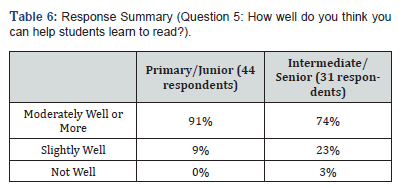
Most teacher candidates felt better able to support students in learning to read after their nine-week supporting literacy placement, regardless of the placement setting. As indicated in Iannacci & Graham [14], teacher candidates who participated in this placement are increasingly able to recognize the “quality and nature of instruction in so far as its ability to capitalize on learners‟ assets” (p. 59). Further, teacher candidates’ self-efficacy in supporting literacy is enhanced. Close reading of this data indicates that stronger connections to an inclusion-oriented educator’s assets would enhance teacher candidates’ learning experience.
Limitations
The low response rate, particularly in the intermediate/senior cohort, should be considered a limitation of the study. Further, despite the survey being administered anonymously, it is possible that teacher candidates felt the need to confirm their professor’s wishes. The results are still valid, however, as patterns in the data were evident.
Discussion
This study evaluated how the Trent University School of Education can leverage tutoring placement to better prepare teacher candidates for the reality of inclusive classrooms. Analyzing the teacher candidates’ perceptions of their experiences using a thematic analysis allowed researchers to examine their conceptions and connect to the capacities identified in research as supporting inclusion. Examining pedagogies, challenging teacher candidates’ beliefs about their roles and the pedagogies they use, and having teacher candidates examine their beliefs about disability are connected to the research of Jordan [9] and guided the study. Further, a fourth theme, comparing the experiences in the traditional versus pilot placement, provided comparison points between the two placement styles. The decision to sort data by program type (primary/ junior and intermediate/senior) aims to highlight differences in the experiences of teacher candidates in each program.
Summary & Interpretation
Overall, results indicate that teacher candidates built their theoretical and practical understanding of teaching literacy and supporting learners with diverse learning needs during this placement. Although there are a few outliers, results indicate that most teacher candidates feel better equipped to teach students to read after this placement. Primary/Junior teacher candidates were more likely to indicate an increased self-efficacy. Qualitative data illustrates an increased awareness of literacy pedagogies, tools, and resources due to this placement. Teacher candidates recognize the challenges in teaching literacy and are building strategies and support to design environments for learners. Our results indicate net benefits to supporting literacy placement in building teacher candidate understanding of the pedagogies for literacy instruction.
Increased understanding of special education, Universal Design for Learning, differentiated instruction, and learners with exceptionalities were noticeable, particularly for teacher candidates in the primary/junior program. Interestingly, teacher candidates in the intermediate/senior panel who worked one-on-one with students in the traditional program should have indicated more frequently these skills in their responses. Given previous study data, it is possible that these responses are indicative of a larger challenge in secondary school education, the reduced understanding of and desire to support inclusive education [11].
The highest reports of enhanced self-efficacy came from teacher candidates in the primary/junior program who participated in the pilot program. Teacher self-efficacy is highly correlated with increased inclusive education practices in the classroom (Schwab & Alnahdi, 2020). This was noticeably increased in individuals who indicated that their Block A placement, which is teacher candidate’s first full time practicum, continued in the same classroom setting, speaking to the value in longer placements as previously indicated in research by Mazzye et al. [25]. This seems to indicate that when opportunities are present to maintain relationships in a space, comfort, risk-taking opportunities, and overall benefits are present.
In the primary/junior panel, the supporting literacy pilot program was successful. Teacher candidates benefited from the opportunity to push into the classroom and connect deeply with the teacher. For teacher education programs to enhance teacher candidate self-efficacy, an understanding of the developmental stages of teachers, opportunities to support critical reflection, and feedback can support this process [37]. Individuals who continued their placement for Block A indicated enhanced learning opportunities and the feeling of confidence heading into this placement. When classroom design included small group instruction, centers, and seat work, the pilot program was particularly successful. In settings where the classroom teacher led whole group instruction during tutoring time, the management of student groups were reported to be more challenging. The residency experience researched by Mazzye et al. [25] indicated that long placements supported growth in teacher candidates’ knowledge of literacy; our study seems to mirror this finding as teacher candidates who participated in the pilot program and stayed in this school for their block A placement reported significantly higher rates of self-efficacy, a strong indicator of inclusion orientation in teachers.
In the intermediate/senior panel, the pilot program was less successful. Communal learning opportunities, rather than small group instruction, are the norm in most high school classrooms, reducing opportunities for teacher candidates to interact with small groups [38]. This resulted in teacher candidates in high school classrooms moving about the space, supporting those students who asked for help. This resulted in fewer meaningful connections and reduced opportunities to practice and plan for literacy instruction. Due to the incongruence between classroom practices and pilot design, the supporting literacy pilot is not a good fit for the high school classroom. Going forward, intermediate/ senior teacher candidates should have their supporting literacy placement occur in an intermediate (grade 7 and/or 8) classroom.
Implications & Recommendations
As indicated in the research of Iannacci & Graham [14] and corroborated in this study, the supporting literacy placement provides an important opportunity for teacher candidates to build their capacity in literacy, and pedagogies for inclusion, and to enhance their developing teacher self-efficacy. Results would indicate that teacher candidates gain the most in their ability to use the pedagogies, resources, and tools of literacy instruction. Regardless of placement type, teacher candidates reported enhanced literacy skills following this placement. A continuation of the supporting literacy placement is beneficial to teacher candidates.
While some comments, particularly by intermediate/senior teacher candidates do not show a commitment to inclusive pedagogies, most teacher candidates commented on the use of Universal Design for Learning, differentiated instruction, and/or personalizing learning in their responses. Mentioning these inclusive pedagogies indicates an understanding of the supports necessary for an inclusive classroom. Implementation of an inclusive design framework as a planning element may further enhance teacher candidate inclusion of these approaches in future cohorts.
For teacher subgroups, reports of enhanced self-efficacy were the lowest skill reported. Given the importance of self-efficacy to foster positive conceptions about learners’ abilities and shifted their perspective role of the teacher in supporting all learners in the inclusive classroom [12] Jordan et al., 2010) further study should be considered specifically on how self-efficacy can be enhanced. Given that teacher candidates in the primary/junior pilot program were most likely to report enhanced self-efficacy, particularly if given the opportunity to continue in this placement location for their block A placement, further exploration of this would be warranted. In the intermediate/senior division, we would recommend a second pilot in the intermediate/senior division but only in a school that had a successful primary/junior pilot. This would allow intermediate (grade 7 and 8) educators to see the strengths in the primary/junior model and hopefully apply this learning across divisions. We would not recommend continuing this model in the high school setting. Further research could look at the teacher self-efficacy rankings at the beginning of the program, at the end of the supporting literacy placement, and at the end of practicum Block A, seeking to deduce correlations between teacher candidate self-efficacy and the maintenance of placement.
Overall, results indicate that teacher candidates built their theoretical and practical understanding of teaching literacy and supporting learners with diverse learning needs during this placement. Further, results indicate that the self-efficacy of teacher candidates is enhanced by the opportunity to complete this placement. The pilot program was extraordinarily successful with primary/junior teacher candidates.
Further Considerations/Limitations
Systemic barriers, including learner profile, increasing concerns around mental health and well-being in schools, attendance, and reduced classroom support, must be acknowledged as potential barriers impacting the program and study results. Further, as mentioned previously, post-pandemic learning gaps are notable. We suggest that practicing teacher attitudes towards educational reform may also have impacted the student experience as a new literacy curriculum in Ontario has significantly shifted the literacy landscape through a Science of Reading framework. This phenomenon certainly warrants further study in the context of initial teacher preparation in the field of language and literacy.
Conclusion
As we seek to build skills for inclusion, teacher candidates benefit from the opportunities presented in the supporting literacy placement. Through engaging in this placement, teacher candidate reported enhanced understanding of literacy pedagogies, support for inclusion and in many cases enhanced self-efficacy. The pilot program, particularly in the primary/junior divisions, offered enhanced opportunities for this growth, particularly when teacher candidates could stay in the same setting for their block A placement. The residency model enhanced opportunities for teacher candidates to engage with learners and host teachers, resulting in greater opportunities for learning. In many ways, taking a new approach to a literacy field experience supported inclusive education as a new opportunity, rather than a threat [8] and the critical opportunity to create conditions for teacher candidates to shift their beliefs and practices about inclusion [39-45].
References
- Goodland JI (1997) In Praise of Education. New York: Teachers College Press.
- Katz J, Porath M, Bendu C, Eoo B (2012) Diverse voices: Middle years students’ insights into life in inclusive classrooms. Exceptionality Education International 22(1): 2-16.
- Lindsay S, Proulx M, Thomson N, Scott H (2013) Educators’ challenges of including children with autism spectrum disorder in mainstream classrooms. International Journal of Disability, Development, and Education 6 (4): 347-362.
- Canadian Council on Learning (2009) State of Learning in Canada.
- (2024) Special education in Ontario.
- Unnamed District School Board (n.d.) Special education plan.
- Barry G (2016). Inclusive education the top concern of N.L. teachers, report says. CBC News.
- Dignath C, Rimm-Kaufmann S, van Ewijk R, Kunter M (2022) Teacher’s beliefs about inclusive education and insights on what contributes to those beliefs: a meta-analytical study. In Educational Psychology Review 34: 2609-2660.
- Jordan A, Schwartz E, McGhie-Richmond D (2009) Preparing teachers for inclusive classrooms. Teaching and Teacher Education 25(4): 535-542.
- Specht J, McGhie-Richmond D, Loreman T, Mirenda P, Bennett S, et al. (2015) Teaching in inclusive classrooms: Efficacy and beliefs of Canadian preservice teachers. International Journal of Inclusive Education 20: 1-15.
- Metsala JL, Harkins MJ (2020) An Examination of Preservice Teachers’ Self-Efficacy and Beliefs About Inclusive Education. Teacher Education and Special Education 43(2): 178-192.
- Cosier M, Pearson H (2016) Can we talk? The underdeveloped dialogue between teacher education and disability studies. SAGE Open, 6 (1).
- Iannacci L (2018) Reconceptualizing disability in education. Lanham: Lexington Books.
- Iannacci L, Graham B (2010a) Intersections between and understandings of literacy and disability in a B.Ed program: Discourses, tensions, and curriculum. Language & Literacy 12(2): 52-70.
- Krishnan S (2024) Reframing teacher candidates’ views on disability through the writings of disabled authors. Research and Practice for Persons with Severe Disabilities 49(1): 20-35.
- OECD (n.d.) Teachers’ Pedagogical Knowledge and the Teaching Profession.
- Massouti A (2021) Pre-service teachers’ perspectives on their preparation for inclusive teaching: Implications for organizational change in teacher education. The Canadian Journal for the Scholarship of Teaching and Learning 12 (1).
- Thorius KAK (2016) Stimulating tensions in special education teachers figured world: An approach toward inclusive education. International Journal of Inclusive Education 20 (12): 1326-1343.
- Janis S, Schmeichel M, McAnulty J, Grace C, Wegrzyn K (2022) Assessing teacher candidates’ pedagogical judgment: An analysis of clinically based instructional assignments. Journal of Educational Supervision 4(3).
- Bandura A (1997) Self-efficacy: The exercise of control. New York, NY: Freeman.
- Tschannen-Moran M, Woolfolk Hoy A, Hoy WK (1998) Teacher efficacy: Its meaning and measure. Review of Educational Research 68(2): 202-248.
- Tschannen-Moran M, Woolfolk Hoy A (2001) Teacher efficacy: Capturing an elusive construct. Teaching and Teacher Education 17(7): 783-805.
- Ostrowdun CP (2020) Representations of inclusion: How pre-service teachers understand and apply inclusion across situations. Exceptionality Education International 30(3): 102-123.
- Greenfield RA, Mackey M, Nelson G (2016) Pre-service teachers’ perceptions of students with learning disabilities: Using mixed methods to examine effectiveness of special education coursework. Qualitative Report 21(2): 330.
- Mazzye DL, Duffy MA, Lamb RL (2023) Teacher candidate self-efficacy and ability to teach literacy: A comparison of residency and traditional teacher preparation models. Journal of Global Education and Research 7 (2): 146-165.
- Trent University (n.d.). Supporting literacy program.
- Berrill DP (2009). Try tutoring first.
- Iannacci L, Graham B (2010b) Mind the gap: Destabilizing dominant discourses and beliefs about learning disabilities in a Bachelor of Education program. Alberta Journal of Educational Research 56(3): 274-290.
- Jackson T (2023) EDUC4133: Supporting literacy and learners with special education needs. [Syllabus]. Peterborough: Trent University.
- Darling-Hammond L (2006) Constructing 21st-century teacher education. Journal of Teacher Education 57(3): 300-314.
- Braun V, Clarke V, Boulton E, Davey L, McEvoy C (2021) The online survey as a qualitative research tool. International Journal of Social Research Methodology 24(6): 641-654.
- Braun V, Clarke V (2006) Using thematic analysis in psychology. Qualitative research in psychology 3(2): 77-101.
- CPRE (2023) The state of the American student we are failing the older students: Bold ideas to course change.
- Education Quality & Accountability Office. (2024). Ontario Secondary School Literacy Test.
- Specht JA, Metsala JL (2018) Predictors of Teacher Efficacy for Inclusive Practice in Pre-Service Teachers. Exceptionality Education International 28(3): 67.
- Ontario (2020) Introduction to effective teaching practices for the de-streamed grade 9 math classroom.
- Black GL (2015) Developing teacher candidates’ self-efficacy through reflection and supervising teacher support. in education 21(1): 78-98.
- Shanahan on Literacy (2018 September). What do you think of guided reading in secondary schools?
- Charles E, Metsala J, Specht J (2023) Gains in pre-service teacher efficacy for inclusive education: contributions of initial beliefs and practicum length. International Journal of Inclusive Education 1-18
- Graham B, Iannacci L (2014) Reconceptualizing “special education” curriculum in a Bachelor of Education program: Teacher candidate discourses and teacher educator practices. Canadian Journal of Disability Studies 2(2).
- Jackson T (2019) Differentiated Induction: An Enhanced Model for the New Teacher Induction Program. The Organizational Improvement Plan at Western University 84.
- Dyson A (2003) Working towards inclusive education: Social contexts. European Journal of Special Needs Education 18 (1): 125-128.
- Sokal L, Katz J (2015) Oh, Canada: Bridges and barriers to inclusion in Canadian schools. Support for Learning 30 (1): 42-54.
- Specht J (2016) Pre-service teachers and the meaning of inclusion. Journal of Research in Special Educational Needs 16: 894-895.
- Stouffer J, Van Dyke J (2023) Stones from a glass house: The paradoxical condemnation of Reading Recovery in the Ontario Human Rights Commission’s Right to Read Report. Journal of Teaching and Learning 17(1): 52-71.

























