




 OAJELS Home




Abstract
In the present study, the researcher aimed to study the comparison of the study habits among senior secondary students with different levels of intelligence by using two-way ANOVA. The causal-comparative survey method was applied in this study. A simple random sampling method was used for data collection. A sample of 142 senior secondary students in Prayagraj district has been selected. The researcher uses the Samoohik Mansik Yogyata Pariksha developed by Dr. R. K. Tandon, and the study habits scale developed by Dimple Rani and M. L. Jaidka was used. Researchers found that gender has a small but statistically significant effect on study habits, with boys demonstrating better study habits than girls. Intelligence levels (high, moderate, and low) do not significantly influence study habits, and there is no significant interaction between gender and intelligence. The type of school (government or private) also does not significantly impact study habits. However, students with high intelligence perform better in government schools, while those with low intelligence show better habits in private schools, indicating a nuanced interaction between intelligence and school type. Locality (urban vs. rural) does not significantly affect study habits, but urban students with high intelligence show the best habits, while rural students with low intelligence perform better.
Keywords:abstract thinking; academic success; active learning; note-taking; time management
Abbreviations: Gen= Gender; LI= Level of Intelligence; Na S. = Nature of Schools’; Loc = Locality of Schools
Introduction
Study habits are considered crucial for academic success and overall educational development. They encompass a range of behaviors, practices and strategies that students employ to facilitate learning and improve performance. Effective study habits not only enhance the retention and understanding of knowledge but also foster lifelong learning skills [1]. In the context of senior secondary education, where students prepare for higher academic pursuits and professional careers, the establishment of sound study habits becomes particularly significant. Tribal student’s study practices are often shaped by various factors including intelligence, motivation, socio-economic background and environmental influences [2]. Good study habits involve strategies such as time management, organization, note-taking, and active learning.
Intelligence, a significant predictor of academic performance, has been shown to influence Students ‘ approaches to studying. High levels of intelligence often correlate with better problem-solving skills, abstract thinking and the ability to grasp complex concepts quickly. However, it is not the sole determinant of academic success, as study habits play a complementary role in maximizing intellectual potential [3].
Understanding how study habits vary across different levels of intelligence can provide insights into the diverse learning needs of students. It can help educators identify the specific areas where students may require additional support or alternative strategies to enhance their academic outcomes [4]. Given crucial role that the senior secondary stage plays in shaping future educational and career trajectories fostering effective study habits during this period is particularly significant [5]. Moreover, research has shown that intelligence contributes to academic success. It is not the sole determinant factors such as motivation, time management and study strategies are equally important [6]. Thus, an understanding of the interaction between intelligence and study habits can lead to more targeted and personalized interventions. Examining the patterns of study habits among Students with different intelligence levels aims to contribute to the development of differentiated instructional strategies that can accommodate Students’ unique learning profiles [7]. By recognizing the variability in tribal student’s study approaches based on their intelligence, educators can design programs that encourage all students to adopt productive study behaviors thereby potentially reducing the achievement gap across different intelligence levels [8].
Reviews of related literature
Mehta and Singh (2022) found that students who utilize digital tools such as educational apps and e-learning platforms tend to have more organized and efficient study routines, contributing to improved academic performance. Verma and Sharma [9] suggested that intelligence moderates the relationship between study habits and academic performance with high-intelligence Students benefiting less from study habits compared to their lower-intelligence peers. Gupta and Patel [10] studied the effect of stress on study habits and found that students with better study habits are more resilient in managing exam pressure and perform better academically. Yadav and Kaur [11] found that female students generally employ more systematic and disciplined study habits compared to their male counterparts, resulting in better academic performance. Mishra and Sharma [12] found that students who adapted to the online learning environment by organizing their study routines showed better academic outcomes than those who struggled to adjust. A study by Rao and Jain [13] revealed that study habits had a stronger predictive power for students with average intelligence than for students with high intelligence. Sharma and Mehta [14] explored the influence of social media on study habits and found that excessive social media use negatively affects students’ study habits, leading to poorer academic performance. Joshi and Prasad [15] concluded that students who engaged in group study sessions tended to have more effective study routines, contributing to higher academic performance.
Patel and Sinha [16] found that students with higher socioemotional skills were more likely to develop effective study routines especially those with average intelligence, suggesting that these skills can compensate for moderate cognitive abilities. Singh and Kapoor [17] showed that students who maintained regular sleep patterns had better study habits and higher academic achievement, regardless of their intelligence level. Poor sleep quality, on the other hand, was linked to disorganized study routines and lower performance. Jain and Mehta [18] found that higher expectations from parents were associated with more structured and consistent study habits, particularly among students with lower intelligence, who benefited from the external motivation to adopt effective study routines.
Kumar [19] indicated that students with irregular sleep patterns tend to have less effective study habits, which negatively impacts their academic success. Mishra and Kumar [20] highlighted that students with higher intelligence were more adept at minimizing distractions whereas those with average or below-average intelligence showed significant declines in study effectiveness due to frequent digital interruptions.
Objectives of the study
• To compare the study habits of senior secondary
students having high, moderate and low level of intelligence with
respect to gender.
• To compare the study habits of senior secondary
students having high, moderate and low level of intelligence with
respect to nature of schools.
• To compare the study habits of senior secondary
students having high, moderate and low level of intelligence with
respect to locality.
Hypothesis of the study
• There is no significant difference in the study habits of
senior secondary students having high, moderate and low level of
intelligence with respect to gender.
• There is no significant difference in the study habits of
senior secondary students having high, moderate and low level of
intelligence with respect to nature of schools.
• There is no significant difference in the study habits of
senior secondary students having high, moderate and low level of
intelligence with respect to locality.
Research Methodology
The causal-comparative survey approach of descriptive research was applied in this investigation. The population of the present study consists of all senior secondary students in the Prayagraj District of Uttar Pradesh. Simple random sampling method was used for data collection. Sample of 142 senior secondary students in Prayagraj district has been selected. The researcher has used the Samoohik Mansik Yogyata Pariksha developed by Dr. R. K. Tandon and the study habits scale developed by Dimple Rani and M.L. Jaidka. To analyze the data two-way analysis of variance statistical techniques was used.
Date Analysis and Interpretation To compare the study habits of senior secondary students having high, moderate and low level of intelligence with respect to gender
H0: there is no significant difference among high, mod and low level of intelligence on study habits.
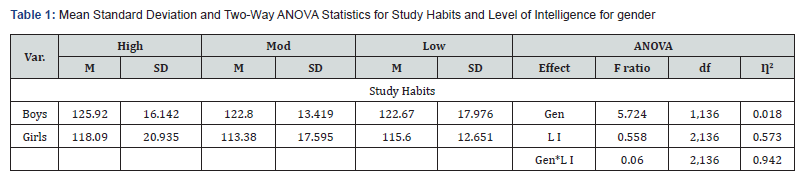
Note. N= 142. ANOVA= analysis of variance; Gen= Gender, L I= level of intelligence, Gen*L I= gender* level of intelligence * p<.05
According to table 1 testing of the null hypothesis “There is no significant difference in the study habits of senior secondary students having high, moderate and low level of intelligence with respect to gender.” The null hypothesis is tested in three following sub hypothesis-
H01.1: There is no significant difference between boys and girl’s students on study habits.
Main Effect of Gender (Gen): According to table 1 the analysis revealed a statistically significant main effect of gender on study habits, F (1,136) =5.724, p<.05, with an effect size (η2) of 0.018. This indicates that gender has a small but statistically significant effect on study habits, suggesting that boys’ and girls’ students differ in their study habits. Mean effect of study habits on the basis of gender shown in given below table 2.

According to the table 2 the mean scores show that boys have a higher average study habits score (M = 123.798, SE = 2.306) compared to girls (M = 115.690, SE = 2.483). The 95% confidence intervals further support this difference. The boys’ confidence interval ranges from 119.237 to 128.359. Confidence interval of girls ranges from 110.780 to 120.600. The confidence intervals do not overlap, suggesting a meaningful difference between boys and girls, in which boys consistently scoring higher study habits.
H01.2: There is no significant difference among high, moderate and low level of intelligence on study habits.
Main Effect of Level of Intelligence (LI): According to table 2 the main effect of the level of intelligence was not statistically significant, F (2,136) =.558 p>.05 with a very small effect size (η2) of 0.573. This implies that the different levels of intelligence (High, Moderate, and Low) did not significantly influence the study habits of the senior secondary students.
H01.3: The effect of high, moderate and low level of intelligence on study habits for boys and girls at senior secondary students.
Interaction Effect (Gen*LI): According to table 1 the interaction between gender and the level of intelligence was not statistically significant, F (2,136) =.060, p>.05 with an effect size (η2) of .942. This indicates that the combined effect of gender and level of intelligence on study habits was not significant, meaning that the influence of intelligence levels on study habits did not differ by gender.
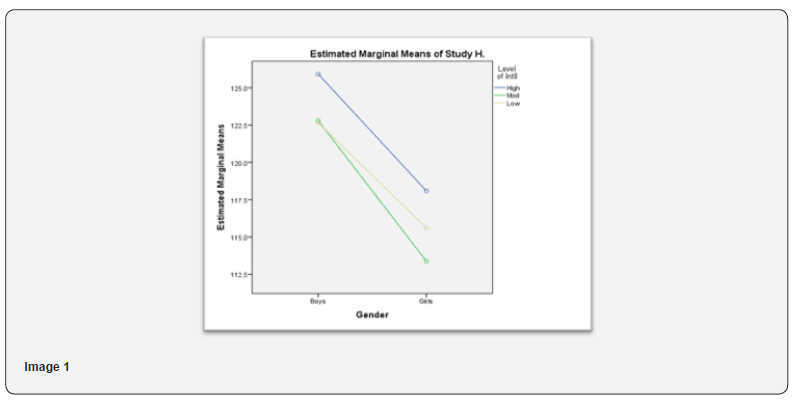
Interaction Effect Interpretation: The lines for highintelligence students show a much steeper decline from boys to girls compared to the lines for moderate and low-intelligence. For students with moderate and low intelligence, the difference in study habits between boys and girls is less pronounced but still shows a consistent trend where boys outperform girls.
The interaction between gender and intelligence level shows that gender differences in study habits are more significant at the high intelligence level. Boys, particularly those with high intelligence, tend to have better study habits compared to girls, while the gap between boys and girls narrows for those with moderate and low intelligence.
To compare the study habits of senior secondary Students having high, moderate and low level of intelligence with respect to nature of schools
H0: There is no significant difference in the study habits of senior secondary students having high, moderate and low level of intelligence with respect to nature of schools.
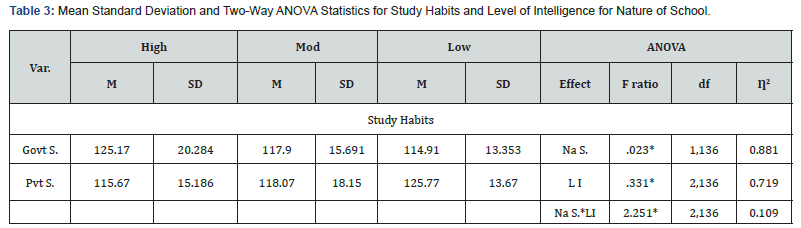
Note. N= 142. ANOVA= analysis of variance; Govt S. = government school, Pvt S. = Private school, Na S. = nature of school, LI= level of intelligence, Na S.*L I= nature of school* level of intelligence *p<.05
According to table 3 testing of the null hypothesis “There is no significant difference in the study habits of senior secondary students having high, moderate and low level of intelligence with respect to nature of schools.” The null hypothesis is tested in three following sub hypothesis-
H0 2.1: There is no significant difference between Government and Private school students on study habits.
Main Effect of Nature of Schools (Na S.): According to table 3 the main effect of the nature of the school (government vs. private) on study habits was not statistically significant F (1,136) =0.023, 𝑝>.05, with an effect size (𝜂2) of 0.881. This indicates that the type of school did not significantly influence senior secondary student’s study habits.
H0 2.2: There is no significant difference among high, moderate and low level of intelligence on study habits.
Main Effect of Level of Intelligence (LI): According to table 3 the main effect of the level of intelligence was also not statistically significant, 𝐹 (2,136) =0.331, 𝑝>.05 with an effect size (𝜂2) of 0.719. This result suggests that different levels of intelligence (high, moderate, & low) did not significantly affect tribal student’s study habits.
H0 2.3: The effect of high, moderate and low level of intelligence on study habits for boys and girls at senior secondary students.
Interaction Effect (Na S. * LI): According to table 3 the interaction effect between the nature of the school and the level of intelligence was not statistically significant 𝐹 (2,136) =2.251, 𝑝>.05 with an effect size (𝜂2) of 0.109. This indicates that the combined effect of the school type and intelligence levels did not significantly impact study habits.
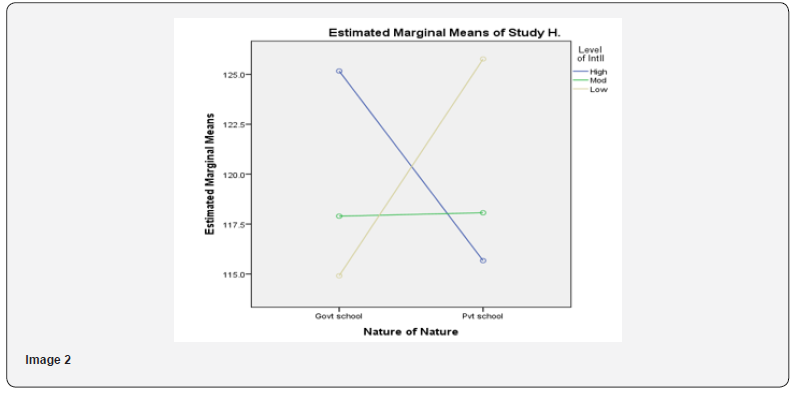
Interaction Effect Interpretation: The plot shows that students with high levels of intelligence have higher study habits in government schools but lower study habits in private schools. Conversely, students with low intelligence levels exhibit higher study habits in private schools than in government schools as shown by the steep upward slope of the yellow line (representing low intelligence). Students with moderate intelligence (green line) show relatively stable study habits across both school types, with little variation between government and private schools.
This suggests that there is an interaction effect between the nature of the school and intelligence level on study habits. The study habits of students with high and low intelligence appear to be influenced differently based on the type of school they attend. In particular, high-intelligence students perform better in government schools, while low-intelligence students perform better in private schools. However, students with moderate intelligence do not show much variation in study habits across the two school types.
To compare the study habits of senior secondary students having high, moderate and low level of intelligence with respect to locality.
H0: There is no significant difference in the study habits of senior secondary students having high, moderate and low level of intelligence with respect to locality.
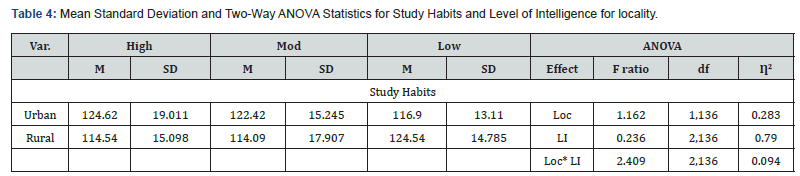
Note. N= 142. ANOVA= analysis of variance; Loc= locality, L I= level of intelligence, Loc*L I= locality* level of intelligence *p<.05
According to table 4 testing of the null hypothesis “There is no significant difference in the study habits of senior secondary Students having high, moderate and low level of intelligence with respect to locality.” The null hypothesis is tested in three following sub hypothesis-
H0 1.1.: There is no significant difference between urban and rural senior secondary students on study habits.
Main Effect of locality (Loc): According to table 4 the main effect of locality on study habits was not statistically significant, F (1,136) =1.162, p>.05, with an effect size (η2) of 0.283. This indicates that there is no significant difference in study habits between students from urban and rural areas.
H01.2: There is no significant difference among high, moderate and low level of intelligence on study habits.
Main Effect of Level of Intelligence (LI): According to table 4 the main effect of the level of intelligence was also not statistically significant, F (2,136) =0.236, p>.05, with an effect size (η2) of 0.790. This suggests that the different levels of intelligence (high, moderate & low) did not significantly influence the study habits of the students.
H01.3: The effect of high, moderate and low level of intelligence on study habits for urban and rural senior secondary students.
Interaction Effect (Loc*LI): According to table 4 the interaction between locality and the level of intelligence was not statistically significant, F (2,136) = 2.409, p>.05 with an effect size (η2) =094. This indicates that the combined effect of gender and level of intelligence on study habits was not significant, meaning that the influence of intelligence levels on study habits did not differ by locality.
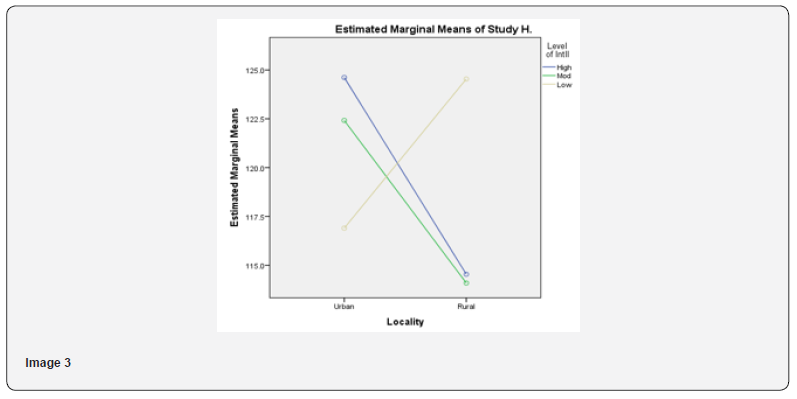
Interaction Effect Interpretation
There is a significant interaction effect between locality and intelligence level on study habits. While urban students with high intelligence show the highest study habits, rural students with low intelligence exhibit the highest study habits in their group. The steep slopes of the lines particularly the blue (high intelligence) and yellow (low intelligence) lines show that the study habits of Students with different intelligence levels vary more across localities indicating a strong interaction between these factors. The interaction effect suggests that the impact of intelligence level on study habits differs based on whether students are from urban or rural areas. Urban students with high intelligence tend to have better study habits while rural students with low intelligence perform better in terms of study habits. This crossover pattern highlights that locality plays a key role in moderating the relationship between intelligence levels and study habits.
Conclusion
The present study examined the influence of gender,
intelligence levels, school type, and locality on study habits among
senior secondary students by utilizing a 2×3 factorial design. The
findings are as follows:
Gender was found to have a small but statistically significant
effect on study habits, where boys demonstrated better study
habits than girls. However, the level of intelligence (high, moderate,
and low) does not significantly impact Students ‘ study habits.
Additionally, the interaction between gender and intelligence is
not significant, though boys with higher intelligence tend to show
better study habits compared to girls at the high intelligence level.
Students from government and private schools do not significantly
differ in their study habits based on the type of school. Similarly,
the level of intelligence does not significantly influence study
habits across different school types. However, the interaction
effect suggests that students with high intelligence performed
better in government schools, while those with low intelligence
showed better study habits in private schools, highlighting a
nuanced relationship between school type and intelligence. Lastly,
the locality (urban vs. rural) does not significantly affect study
habits. Yet, the interaction effect between locality and intelligence
is noteworthy. Urban students with high intelligence exhibit the
best study habits, whereas rural students with low intelligence
perform better in terms of study habits. The findings suggest
that Students ‘ location moderates the relationship between
intelligence levels and study habits. Overall, these findings
contribute valuable insights into how various factors intersect to
influence study habits in senior secondary students.
Educational Implication
The present study highlights the need for a more gendersensitive approach to fostering better study habits among senior secondary students. Given that boys demonstrate significantly better study habits than girls, schools should implement targeted interventions to support girls in improving their study strategies and time management skills. Additionally, although intelligence levels do not significantly influence study habits, educators should recognize that students with varying intellectual abilities may require different types of academic support. Schools especially in rural areas should focus on enhancing study habits for students with low intelligence through personalized learning plans. Moreover, the findings suggest that the type of school (government or private) and locality (urban or rural) do not directly impact study habits, so efforts should focus on promoting effective study behaviors across all school types and regions to ensure equal opportunities for academic success.
References
- Kumar P (2020) Study habits and their impact on student achievement: A review of literature. International Journal of Educational Development 55: 102-108.
- Singh R, Kaur J (2018) Factors influencing the study habits of secondary school students: A case study. International Journal of Educational Research and Development 12(2): 55-68.
- Rao N, Sharma S (2021) Intelligence as a predictor of study habits: A meta-analytic approach. Indian Journal of Psychology, 63(4): 458-470.
- Sharma D (2022) Effective study habits: A guide for senior secondary students. Educational Practices 39(3): 149-165.
- Verma S (2021) The senior secondary years: preparing students for academic and career success. Indian Journal of Education 63(1): 45-58.
- Patel R, Singh L (2020) Influence of intelligence and study habits on academic outcomes among secondary students. Journal of Cognitive Development 44(1): 102-114.
- Jain M (2019) Study habits and academic performance: A closer look at the role of individual differences. Educational Research Journal 52(4): 213-228.
- Kaur P (2020) Bridging the achievement gap: The role of study habits in academic success. International Journal of Educational Policy and Leadership 37(2): 78-92.
- Verma P, Sharma R (2020) Intelligence as a moderator in the relationship between study habits and academic achievement. Educational Research Quarterly 37(3): 22-35.
- Gupta V, Patel R (2020) Managing exam stress: The role of study habits in high-stakes testing environments. Indian Journal of Education 59(2): 104-117.
- Yadav M, Kaur G (2021) Gender differences in study habits: A comparative analysis of male and female senior secondary students. Journal of Gender and Education 33(2): 134-147.
- Mishra P, Sharma D (2021) Adapting to online learning: The impact of COVID-19 on study habits. Journal of Educational Technology 48(2): 113-127.
- Rao S, Jain K (2021) Study habits as predictors of success: intelligence and academic achievement among secondary school student. Journal of Applied Educational Research 35(4): 54-66.
- Sharma A, Mehta P (2020) The influence of social media on study habits and academic achievement: A mixed-methods study. Journal of Educational Technology 47(3): 134-147.
- Joshi R, Prasad K (2022) Collaborative learning and its impact on study habits of senior secondary students. Journal of Learning Sciences 41(2): 212-226.
- Patel M, Sinha R (2024) Socio-emotional skills and their influence on study habits and academic success across intelligence levels. Journal of Applied Educational Research 55(3): 134-147.
- Singh A, Kapoor R (2024) Sleep quality, study habits, and academic outcomes: exploring the connections across intelligence levels. Journal of Cognitive Development 66(4): 92-105.
- Jain P, Mehta R (2024) Parental expectations and the development of study habits in students with varying levels of intelligence. Journal of Family and Educational Studies 45(2): 100-112.
- Kumar S (2022) The impact of sleep patterns on students’ study habits and academic performance. International Journal of Educational Psychology 61(3): 145-158.
- Mishra P, Kumar D (2024) Digital distractions and their impact on the study habits of senior secondary students. International Journal of Educational Technology 60(1): 45-58.