




 JPFMTS Home



Abstract
Background: Poomsae and Kyorugi represent distinct Taekwondo disciplines with different technical and competitive requirements; however, whether these differences are associated with different levels of executive functioning remains unclear. Therefore, this study aimed to compare executive functioning between Poomsae and Kyorugi Taekwondo athletes.
Methods: This cross-sectional comparative study included 60 female Taekwondo athletes aged 18–25 years, comprising 30 Poomsae and 30 Kyorugi athletes. Participants had at least 3 years of regular Taekwondo training and recent competitive experience at the provincial or national level. Executive functioning was assessed using the Barkley Deficits in Executive Functioning Scale (BDEFS), which evaluates domains including time management, self-organization, self-control, self-motivation, and self-regulation. Between-group differences were examined using the Mann-Whitney U test, with statistical significance set at p < 0.05.
Results: No significant differences were observed between Kyorugi and Poomsae athletes in any assessed domain of executive functioning. Specifically, no significant between-group differences were found in time management (p = 0.91), self-organization (p = 0.32), self-control (p = 0.80), self-motivation (p = 0.73), or self-regulation (p = 0.70).
Conclusion: These findings suggest that, within this competitive sample, Taekwondo specialization was not associated with differences in broad self-reported executive functioning. Future studies should combine self-report measures with objective and sport-specific assessments of inhibitory control, cognitive flexibility, working memory, processing speed, and decision-making to determine whether discipline-specific differences emerge in more specific executive processes.
Keywords: executive functioning; Taekwondo; Poomsae; Kyorugi; athletes
Introduction
Executive functioning is an essential component of athletic performance, particularly in sports that require athletes to process complex information, select appropriate responses, and execute precise motor actions under time constraints [1]. Beyond physical capacities such as strength, speed, flexibility, and endurance [2], successful sport performance depends on higher-order regulatory processes that enable athletes to maintain goal-directed behavior, inhibit inappropriate responses, adapt to changing demands, and effectively organize and monitor their actions [3]. Core components of executive functioning include inhibitory control, cognitive flexibility, working memory, planning, organization, self-regulation, and decision-making [4]. These processes are particularly relevant in sports environments in which athletes must rapidly respond to task demands while maintaining precise motor control. Taekwondo represents a relevant model for investigating the relationship between sport participation and executive functioning because competitive performance requires the integration of perceptual, cognitive, and motor processes [5]. Athletes must rapidly identify relevant information, interpret movement-related cues, select appropriate responses, and coordinate complex motor actions with high levels of temporal and spatial precision. However, the specific executive demands may differ according to the competitive discipline. The two principal disciplines of Taekwondo, Poomsae and Kyorugi, are characterized by distinct performance environments and task requirements.
Poomsae involves the performance of standardized sequences of Taekwondo techniques that require athletes to reproduce predetermined movement patterns with accuracy, balance, and technical precision [8]. Executive processes related to working memory, organization, and self-monitoring may therefore contribute to the effective execution of Poomsae routines [9], particularly under competitive conditions in which technical precision and consistency are essential. In contrast, Kyorugi is an interactive combat discipline in which athletes continuously respond to an opponent's actions while simultaneously planning and executing offensive and defensive technique [10]. Kyorugi requires athletes to monitor a dynamically changing environment, identify relevant movement cues, anticipate an opponent's actions, select appropriate responses, inhibit inappropriate responses, and rapidly modify their behavior when circumstances change [11]. The continuously changing and unpredictable nature of Kyorugi may therefore impose executive demands that differ from those associated with the more structured and predetermined movement sequences of Poomsae.
The differences in task structure and competitive demands between Poomsae and Kyorugi provide a rationale for examining whether athletes specializing in these disciplines demonstrate different patterns of executive functioning. Previous research has investigated executive functioning in athletes with different levels of expertise and across sports characterized by varying perceptual, decision-making, and motor demands [1,12]. However, direct comparisons of executive functioning between Poomsae and Kyorugi athletes remain limited. Therefore, the present study aimed to compare executive functioning between Poomsae and Kyorugi Taekwondo athletes using a cross-sectional comparative design. By comparing these two specialized Taekwondo populations, the study sought to characterize differences in executive functioning associated with distinct competitive and training demands within the same sport.
Materials and Methods
This study employed a cross-sectional comparative design to compare executive functioning between female Poomsae and Kyorugi Taekwondo athletes. The study population consisted of young female Taekwondo athletes specializing in either Poomsae or Kyorugi. A total of 60 athletes were targeted, with 30 participants recruited for each group. Participants were selected using a convenience sampling based on the predefined eligibility criteria. The sample size was initially estimated using G*Power version 3.1 based on findings from a previous study [13]. Assuming a significance level of 0.05, statistical power of 0.80, and a comparison of two independent means with reported means and standard deviations of 4.87 ± 0.92 and 6.39 ± 2.03, respectively, a minimum total sample of 36 participants was estimated. However, because the present study involved field-based cognitive assessment and to increase the statistical power and robustness of the group comparison, the recruitment target was increased to at least 30 participants per group.
Eligibility Criteria
Participants were eligible if they met all of the following criteria: female athletes aged 18–25 years; at least 3 years of regular training experience in either Poomsae or Kyorugi; active participation at the provincial or national competitive level during the preceding 2 years; no use of medications known to affect the central nervous system, including antidepressants, sedative-hypnotic medications, or stimulants, during the preceding 2 weeks; and provision of written informed consent before participation. Participants were excluded if they met any of the following criteria: uncorrected visual or hearing impairment; insufficient sleep (<6 hours) or participation in strenuous exercise during the 24 hours preceding cognitive assessment; failure to adequately understand the cognitive-test instructions, as indicated by substantial errors or insufficient attention during the practice phase; withdrawal of consent or unwillingness to continue participation at any stage of the study.
Assessment of Executive Functioning
4 Barkley Deficits in Executive Functioning Scale
Executive functioning was assessed using the Barkley Deficits in Executive Functioning Scale (BDEFS) [14]. The BDEFS is a self-report instrument developed by Barkley to assess everyday executive functioning deficits in adolescents and adults. The instrument evaluates difficulties associated with executive self-management across several domains, including time management, organization and problem solving, self-restraint, self-motivation, and emotional regulation. Participants responded to the items using a Likert-type response scale ranging from never to very often. Higher scores indicate greater difficulties in executive functioning. The BDEFS has demonstrated high internal consistency, with reported Cronbach's alpha coefficients ranging from approximately 0.91 to 0.96 [15], as well as acceptable test-retest reliability in previous research. The validated version appropriate for the study population was administered according to the standardized instructions provided for the instrument.
Data Analysis
Statistical analyses were performed using appropriate statistical software. Descriptive statistics, including mean and standard deviation (SD), were calculated for participant characteristics and study variables. The distributional characteristics of the continuous variables were examined using the Shapiro-Wilk test. When the assumption of normality was not met, the Mann-Whitney U test was used. Statistical significance was set at p < 0.05 for all analyses.
Results
Between-Group Comparison of Executive Functioning
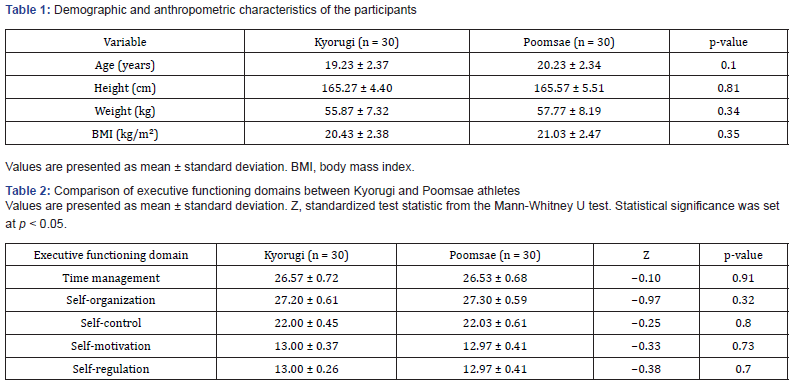
The results of the Mann-Whitney U tests comparing executive functioning between Kyorugi and Poomsae athletes are presented in Table 2. No significant differences were observed between the two groups in any of the assessed domains of executive functioning. Specifically, the groups did not differ significantly in time management (p = 0.91), self-organization (p = 0.32), self-control (p = 0.80), self-motivation (p = 0.73), or self-regulation (p = 0.70).
Discussion
The present study examined executive functioning in female Poomsae and Kyorugi Taekwondo athletes and found no statistically significant differences between the two groups across any of the assessed domains of executive functioning, including time management, self-organization, self-control, self-motivation, and self-regulation. These findings suggest that, within the characteristics of the present sample, specialization in Poomsae or Kyorugi was not associated with measurable differences in everyday executive functioning as assessed by the BDEFS. Although the two disciplines differ considerably in their performance environments, both require sustained training, goal-directed behavior, self-monitoring, and the regulation of performance demands. The absence of significant between-group differences may therefore indicate that common characteristics of competitive Taekwondo participation are more relevant to these broad aspects of executive functioning than the specific competitive discipline.
The comparable executive-functioning scores observed in the two groups are noteworthy given the contrasting characteristics of Poomsae and Kyorugi. Poomsae requires athletes to learn and reproduce predetermined sequences of technically demanding movements while maintaining precision, rhythm, balance, and consistency [9]. Kyorugi requires continuous adaptation to an opponent's actions, rapid selection of responses, and regulation of behavior under unpredictable competitive conditions. Despite these differences, both disciplines require athletes to establish performance goals, adhere to structured training schedules, monitor their performance, manage errors, and maintain behavioral control during training and competition. One possible explanation for the absence of group differences is that prolonged participation in competitive Taekwondo may expose athletes from both disciplines to broadly similar demands related to discipline, practice adherence, performance monitoring, and goal-directed behavior. Previous research has suggested that regular participation in sport is associated with aspects of executive functioning and emotional regulation [16]. For example, research involving Taekwondo athletes has reported differences in certain executive and emotional-regulation measures compared with non-athletic populations, suggesting that participation in Taekwondo may be relevant to higher-order behavioral regulation [17]. However, such findings should not be interpreted as evidence that Poomsae and Kyorugi differ from one another, particularly when different cognitive instruments and comparison groups are used. Moreover, time management reflects the ability to organize activities and allocate time toward goal-directed behavior. Both competitive disciplines require athletes to maintain regular training schedules, prepare for competitions, balance multiple training demands, and adhere to structured practice routines. Consequently, similar exposure to these demands may contribute to comparable levels of perceived time-management ability in both groups. Similarly, self-organization did not differ between the two disciplines. Poomsae athletes must organize the learning and execution of complex movement sequences, whereas Kyorugi athletes must organize and adjust tactical and motor responses according to rapidly changing competitive situations. Although the nature of these demands differs, both require athletes to structure behavior around performance goals. The present findings therefore suggest that specialization in either discipline was not associated with a detectable difference in self-reported organization and problem-solving abilities. The absence of a significant difference in self-control was also notable. Kyorugi involves direct interaction with an opponent and requires athletes to regulate impulsive responses [18], particularly when responding to rapidly changing attacks and defensive actions. Poomsae requires athletes to maintain behavioral and emotional control while performing technically demanding sequences under close evaluation. In both settings, uncontrolled or inappropriate responses may interfere with performance. Athletes must maintain concentration throughout the routine, control movement execution, respond to performance errors, and regulate emotional reactions to evaluation and competition. Thus, different performance environments may impose different forms of self-control rather than producing clearly different overall levels of this executive domain. No significant difference was observed in self-motivation between the two groups. Maintaining long-term participation in competitive Taekwondo requires sustained engagement with repetitive and physically demanding training, continuous skill refinement, and preparation for competition. These demands are present in both Poomsae and Kyorugi, even though the technical and tactical content of training differs. The comparable self-motivation scores may therefore reflect common motivational characteristics associated with competitive athletic participation [19]. Athletes who have maintained at least several years of regular training and competitive involvement, as required by the eligibility criteria of the present study, may already represent a relatively committed athletic population. Consequently, differences that might exist between less experienced athletes or between recreational and competitive participants may not be apparent in a sample consisting exclusively of competitive athletes. Self-regulation did not differ significantly between Poomsae and Kyorugi athletes. Self-regulation involves monitoring one's behavior and performance, maintaining goal-directed actions, and adjusting behavior when circumstances or performance demands change. Although Kyorugi requires frequent adaptation to an opponent, Poomsae also requires continuous monitoring and correction of movement execution to maintain technical accuracy. The similarity between the two groups may therefore reflect the fact that both disciplines require athletes to regulate their behavior toward clearly defined performance goals. Importantly, however, the BDEFS assesses executive functioning primarily from an everyday self-report perspective. It does not directly measure sport-specific response inhibition, reaction time, tactical decision-making, or real-time adaptation during Taekwondo performance. Therefore, the absence of a difference in BDEFS scores should not be interpreted as evidence that Poomsae and Kyorugi athletes have identical executive demands during actual competition.
Clinical and practical implications
The present findings have several practical implications for coaches, sport scientists, and practitioners working with Taekwondo athletes. The absence of significant differences suggests that broad executive-functioning profiles, as assessed by the BDEFS, may not be sufficiently different between Poomsae and Kyorugi athletes to justify fundamentally different executive-functioning interventions solely on the basis of discipline. However, this does not imply that cognitive or executive training should be identical across the two disciplines. Rather, practitioners may benefit from assessing the specific executive demands of each discipline. For Kyorugi athletes, training may incorporate situations requiring rapid response selection, inhibition of inappropriate responses, anticipation, and adaptation to unpredictable stimuli [20]. For Poomsae athletes, interventions may place greater emphasis on sequential motor planning, attentional consistency, self-monitoring, error correction, and maintaining performance under evaluative pressure. From a clinical and performance perspective, the BDEFS may also provide useful information about athletes' everyday self-regulatory functioning, particularly when difficulties with organization, motivation, emotional regulation, or behavioral control interfere with training adherence or competitive preparation. Nevertheless, BDEFS results should be considered complementary to, rather than a replacement for, objective sport-specific cognitive assessment.
Limitations
Several limitations should be considered when interpreting the findings. First, the cross-sectional design prevents conclusions regarding causality. Therefore, it cannot be determined whether participation in Poomsae or Kyorugi influences executive functioning or whether athletes with particular executive-functioning characteristics are more likely to specialize in one discipline. Second, the study used purposive and convenience sampling, which may limit the generalizability of the findings to other Taekwondo populations. The participants were also exclusively female athletes aged 18–25 years, and the findings may not generalize to male athletes, younger or older populations, recreational participants, or athletes at different competitive levels. Third, executive functioning was assessed using a self-report measure. Self-reported executive functioning may be influenced by participants' self-perception, response tendencies, and awareness of their own behavior. Objective neuropsychological or computerized measures could provide complementary information and may be more sensitive to subtle differences in specific executive processes. Fourth, although the study controlled several immediate factors, including insufficient sleep and strenuous exercise before testing, other potentially relevant variables such as training volume, years of competitive experience, competition level, academic demands, psychological stress, nutritional status, and time since the last competition were not comprehensively controlled. These factors may influence executive functioning and could contribute to between-participant variability. Finally, the present study assessed broad domains of everyday executive functioning rather than sport-specific cognitive processes. Future studies should therefore combine self-report measures such as the BDEFS with objective assessments of inhibitory control, cognitive flexibility, working memory, processing speed, reaction time, attention, and decision-making, ideally under sport-specific or ecologically valid conditions.
Conclusion
In conclusion, the present study found no significant differences in the assessed domains of executive functioning between competitive Poomsae and Kyorugi Taekwondo athletes. Future longitudinal and experimental studies incorporating both standardized neuropsychological measures and ecologically valid Taekwondo-specific tasks are warranted to clarify the relationship between Taekwondo specialization and executive functioning.
References
- Ren S, Shi P, Feng X, Zhang K, Wang W (2025) Executive Function Strengths in Athletes: a Systematic Review and Meta-Analysis. Brain Behav 15(1): e70212.
- Ebrahimi E, Soltani F, Nourbakhsh SA, Masoumi F, Bahiraei S, et al. The Effect of Core Stability Exercises on Agility Performance in Young Athletes: A Systematic Review and Meta-Analysis. Physical Treatments-Specific Physical Therapy Journal.
- Bravi R, Gavazzi G, Benedetti V, Giovannelli F, Grasso S, et al. (2022) Effect of different sport environments on proactive and reactive motor inhibition: A study on open- and closed-skilled athletes via mouse-tracking procedure. Front Psychol 13: 1042705.
- Diamond A (2013) Executive functions. Annu Rev Psychol 64: 135–68.
- Ebrahimi E, Tabatabaee SM, Dadarkhah A, Najafi S (2026) NASM-based Core Stability Training Using Taekwondo Movements in Male Individuals With Hyperlordosis. USWR 16(1): 73.
- Ebrahimi E, Rashidi P, Tabatabaei N, Soleymani N (2024) The Effectiveness of Six Weeks of Core Stability Exercises on Q Angle and Flatfoot in Female Taekwondo Athletes. iauh-biomech 10(3): 216.
- Ebrahimi E, Mozafari S (2024) The Effect of Six Weeks of Core Stability Training on Balance and Performance Improvement Among Male Taekwondo Athletes. iauh-biomech 10(2): 160.
- Yi K-h, Lee KH, Kim SH (2007) Complete Taekwondo Poomsae: The Official Taegeuk, Palgwae, and Black Belt Forms of Taekwondo: Turtle Press.
- Kadri A (2021) The Poomsae in Taekwondo is an effective therapy for executive function in children with Attention Deficit Hyperactivity Disorder. Scholarena Journal of Case Reports 8: 1-11.
- Fachrezzy F, Maslikah U, Hermawan I, Jariono G, Nugroho H (2024) Physical training methods to improve the physical condition components of elite Taekwondo athletes in the Kyorugi category: A systematic review. Physical Education Theory and Methodology 24(5): 829-41.
- Cardozo LA, Ochoa-Reyes N, Cuervo-Forero M, Gaviria-Arias A, Mendoza-Buitrago L, et al. (2026) Association between psychological traits and physical performance in Kyorugi Taekwondo athletes. Journal of Physical Education and Sport 26(3): 435-46.
- Ball JD (2022) Special Section: Relationships Between Executive Function and Sports / Exercise. Perceptual and Motor Skills 129(4): 969-76.
- Ebrahimi E, Sheikhhoseini R, Mohammadi F, Piri H (2026) Better gait kinematics and balance, worsen body posture: Comparing goalball athletes with non-athletes with visual impairments. British Journal of Visual Impairment 44(2): 462-74.
- Barkley RA (2011) Barkley deficits in executive functioning scale (BDEFS): Guilford Press.
- Kamradt JM, Nikolas MA, Burns GL, Garner AA, Jarrett MA, et al. (2021) Barkley Deficits in Executive Functioning Scale (BDEFS): Validation in a Large Multisite College Sample. Assessment 28(3): 964-76.
- Carcelén-Fraile MDC, Hita-Contreras F, Mesas-Aróstegui MA, Aibar-Almazán A (2025) Effects of Physical Activity on Executive Function and Emotional Regulation in Children and Adolescents with Neurodevelopmental Disorders: A Systematic Review and Meta-Analysis. Healthcare (Basel) 13(19): :2415.
- Baruah D, Scholar, Rani A (2023) Effects of Taekwondo Training Program on Executive Function Among School Female Adolescents of Bahrain.
- Ying L, Yang Q (2025) The impact of combat sports on undergraduate students' subjective well-being: chain mediation effects of emotional intelligence and self-esteem. Front Psychol 16: 1659084.
- Deng J, Wang Z, Chen H, Song B (2025) Relationship between growth mindset and competitive motivation: a moderated parallel mediation model and feature importance analysis. Front Psychol 16: 1576649.
- Hosseini SN, Mahrouqi SM, Norouzi R, Samaei P, Ebrahimi E (2026) Taekwondo-Based Core Stability Exercises Improve Functional Movement Screen Scores and Lumbar Sagittal Curvature in Individuals with Hyperlordosis: A Quasi-Experimental Study. Middle East J Rehabil Health Stud 13(3): e171681.

























