




 JPFMTS Home



Summary
The paper presents an analysis of the participation of football goalkeepers in professional football leagues, as a result of their morphological characteristics and chronological age. In order to better determine the factors that are essential for the success of soccer goalkeepers, researchers have been following certain morphological characteristics of top soccer goalkeepers and their chronological age for many years. Football, as a complex sport, requires great physical effort from the participants, accordingly also from the football goalkeeper, which represents a significant economic component in the club's work. In order to determine the goal of the research, the paper asserts that the success of soccer goalkeepers in soccer leagues: Germany, Spain, and Croatia is expressed through morphological characteristics, while chronological age throughout the career does not necessarily represent a basic variable related to sports success. The results of the research determined that the morphological characteristics and chronological age of football goalkeepers represent only a partial variable expressed for sports success, which is important for the economic status of the club. The research determined that the results depend significantly on the league and the country in which the competition is held. Since the aim of the research is to establish relationships, that is, to establish statistical dependence and indicators of the strength of such dependence, regression analysis was used, which analytically expresses the relationship between phenomena.
Keywords: football, goalkeeper, economic importance, morphological characteristics, chronological and biological age.
Introduction
According to its structure, football belongs to the group of complex sports activities characterized by complexes of simple and coordinated movements of one or more athletes in the conditions of sports competition between individuals or teams [1]. In the football game, the goalkeeper is the only player who is allowed to use his hands, but only in his marked area (the penalty area), and outside of it the same rules apply as for the players. Therefore, the goalkeeper moves on the field differently from the other players in the team, and his technical - tactical and fitness preparation differ from the rest of the team [2]. According to its dynamics, modern football demands more from goalkeepers than it did in the beginnings of the football game, both in the field of technique, tactics, motor and functional abilities, psychosomatic traits and morphological characteristics. In this paper, the focus is on goalkeepers, because they have the same importance for the team as all other individuals and participants in a football match. On a sample from three first division football leagues (Croatian, German and Spanish leagues), the author processed the characteristics. Similar researches that stimulated the research are in related fields, Kurelić et al. (1975), Pejčić and Malacko (1992), Delija and Horvat (2001), Kondrič, Mišigoj-Duraković and Metikoš (2002), Jozić and Hrženjak (2006), Čorić (2010), Jerkovića (2011), Erceg et al. (2013). The aim of the work is to determine the relationship between the variables that are considered important for the formation of a football goalkeeper in the field of morphological characteristics [3], expressed through body height and mass, and chronological age (year of birth), i.e. the month of the year when the goalkeeper was born . The hypothesis put forward in this paper is the assertion that morphological characteristics are important for football goalkeepers in football leagues: Germany, Spain and Croatia, while chronological age does not necessarily represent a basic variable related to sports success. The results of the research showed that morphological characteristics are important for sports success, while the chronological age of the observed football goalkeepers represents only a partial significance for the sports result and significantly depends on the league and the country where the competition is held. The results of the research can affect the economic strength of the sports club, due to the investment in soccer goalkeepers by the sports club.
Universal Soccer Dictionary
In modern football, there are certain determinants that represent it, and they are expressed, for example, through paradigms such as: there is no correct way of playing football that brings sporting success. If such mechanisms existed, soccer would be a boring and predictable sport [4]. Modern football requires quality, objective and concrete universal communication expressed through verbal and symbolic expression. The determinants of modern football are: reduced space, vertical play, speed, intensity, technical perfection and tactical automation. What makes each of the game modes equally correct are the mechanisms within the chosen method and style of play, of all players, including the soccer goalkeeper. The mechanisms of the game offer control, and control in the match is the best way to victory and a quality presentation of the football game. To be able to implement this, players with certain characteristics are needed [5]. The goalkeeper in modern football is one of the most important links in the football game, because he mostly decides which team will lose and which will win. The optimal morphological characteristics of athletes largely depend on the type of sport, but in general better results are achieved by those whose body structure is adapted to the requirements of a particular sport. The need for the aforementioned adaptation is more pronounced the higher the athlete's level of competition. Due to the evolution of football, nowadays football goalkeepers are considered more of a player in the field, because in the attack phases they become a player who participates and helps the team, and in the defense phases they become the last player. With the inclusion of goalkeepers in the game, the football game has gained a higher dimension, so today more and more coaches are required that goalkeepers participate and contribute to the game. For this reason, it is necessary that the goalkeeper's training process perfects the basic elements of technique that are carried out with the players and carries out specialization for his basic role. Despite all that, in order to be able to justify my role and the tasks set by him, the modern goalkeeper must be well-conditioned, technically, tactically and psychologically prepared and possess certain morphological characteristics [6]. Therefore, it should be concluded that certain demands are placed on goalkeepers, and the following facts and problems arise from theory and practical knowledge: is the goalkeeper familiar with the demands of his coach in the game, are these demands repeatedly verbalized for all phases, transfer of knowledge by the coach to goalkeepers, the way to convey information for goalkeepers, how to train goalkeepers, how to integrate goalkeepers, determine the nature of problems during the training process.
Anthropological aspects, traits and abilities
From the aspect of kinesiology, it can be said that man is an anthropological being consisting of his own traits and abilities. In terms of characteristics and abilities, each person is different from another, which means that every athlete, soccer player, goalkeeper is characteristic thanks to his characteristics and abilities [7]. Anthropological traits and abilities need to be explained and known in order to be able to act using kinesiology processes and exercise systems. The success of athletes and football players is determined by the level and structure of a large number of abilities, knowledge and traits that can be measured and analyzed, and then improved with appropriate means and methods during the athlete's sports career [8]. The anthropological status changes through growth and development, as a result of the action of the environment and as a result of the action of kinesiological transformation stimuli. Knowledge also defines the differences between athletes and although it is not included in the anthropological model, it is very necessary, and the most important are motor skills [8]. Specificity according to roles, positions and game conditions are significantly different. A number of factors influence the success of football players, so it should not be expected that according to the positions and roles in the teams, they will present themselves with the same dynamics. Due to anthropological predispositions, the roles of goalkeepers and field players are significantly different. Due to the lack of information about anthropological characteristics, people tend to compare different types of football players according to positions in football. In order to constantly monitor certain dimensions of the goalkeeper's anthropological status, it is necessary to carry out specific measurements and to know all the dimensions that affect football performance.
Morphological characteristics
Success in sports certainly depends on the morphological characteristics of the athlete, the basic ones being body height and mass, which are valorized with regard to the athlete's current age. The aforementioned is extremely important to respect during the growth and development of athletes, when chronological and biological age are often not aligned, and this is usually the period when a future top athlete is profiled. The best results are achieved by athletes whose body structure is adapted to the requirements of the sport they play, and the morphological characteristics of athletes largely depend on the type of sport they play. If the athlete is at a higher competitive level, the adaptation will be more pronounced. According to [9], goalkeepers differ significantly from midfielders and forwards in terms of body height and body weight compared to forwards. A goalkeeper's success largely depends on morphological characteristics, the main of which are body height and weight, which are valued with regard to current biological and chronological age. In football, many studies have been conducted on football players of different levels of competition with regard to their quality. The research also includes research aimed at determining the morphological characteristics of football players. The body composition of soccer players depends on individual characteristics and the specifics of the position they play. Goalkeepers differ from other players in terms of body mass and body fat percentage, as well as height. For many years, researchers have followed certain morphological characteristics in order to define the factors most necessary for the success of soccer goalkeepers. As for young Croatian players, he claims that significantly higher body height and weight values are typical for goalkeepers up to the age of 13, and as far as somatotype is concerned, mesomorphic and ectomorphic components prevail. Likewise, according to [10], comparing goalkeepers with other players on the field under the age of 15, it can be seen that goalkeepers in this category are somewhat heavier and taller, but also have higher BMI values. Also, this category confirms the type of somatotype, like the previous one (meso-ectomorph). From the point of view of comparing different positions in the team, according to [11] measured 13 anthropometric variables 65 on a sample of 57 soccer players from the first Croatian soccer league. Goalkeepers were the tallest and heaviest (182.9 +/- 4.3 cm; 80.1 +/- 5.1 kg ) and had a significantly higher percentage of body fat (20.2% goalkeepers, and 13-15% other players.
Functional and motor skills
The area of functional and motor abilities is only tentatively covered in the paper, given that the paper deals with morphological characteristics and chronological age. According to [10], we determine the functional abilities of goalkeepers based on data on maximum oxygen intake, anaerobic threshold and sprioergometric indicators. The distance that the goalkeeper covers during the match depends on aerobic capacity, but it is necessary to note that the goalkeeper depends mostly on anaerobic capacity. It draws energy from carbohydrates and fats, and the restorative processes take place while the goalkeeper is standing, walking or trotting. Aerobic and anaerobic abilities are fundamental to a goalkeeper's endurance.
Motor skills are an indispensable part of every athlete and represent a group of traits, thanks to which it is possible to perform motor tasks. A characteristic of motor skills is that they can be measured. Goalkeepers' motor skills and their development greatly affect performance during a soccer game [12]. According to the equation of the specification of success in football, from this representation we see several of the most important sportsman's abilities, namely: endurance (30%), speed (25%), strength (20%), coordination (15%) and mobility (10%). [8] defines motor skills as the ability that enables the realization of all types of movement, the basis of which lies the efficiency of organic systems, especially the nervous-muscular system, which is responsible for the intensity, duration and regulation of movement. These abilities enable strong, fast, long-term, precise and coordinated performance of various motor tasks.
Chronological and biological age
According to [12], the entire sports community deals with the issue of finding talent in a particular sport as well as the selection process. In football, the situation, considering its spread and popularity, is such that the process of selecting and finding talents began to take place from an early age. Young athletes, soccer players and even soccer goalkeepers are mostly grouped by age (chronologically from January to December of a given year) for one or even two years [13] Thus, players of nominally the same chronological age perform in the same rank of the competition, although there can be a 12 or even 24 month difference between them [14]. The terms that define the processes of growth, development and biological maturation are often used as synonyms, although there are fundamental and semantic differences in their mutual relationship, and it is important to emphasize that these processes occur simultaneously and interact with each other (Baxter-Jones et al., 2005). Development in the general biological sense represents the process of the overall anatomical, morphological, functional and reproductive formation of a person from conception to full sexual maturity, and certain developmental stages are not necessarily accompanied by the growth of the organism and vice versa. If we look at development primarily through the psychosocial and behavioral aspects, it can extend to the mature age of an adult, that is, to around 40 chronological years. According to[15], biological maturation refers to the process of progression of a child's growth up to the adult stage and is not related to time in a chronological sense [13]. During childhood and adolescence, young people of the same chronological age can differ significantly in their degree of biological maturity. The maturation process involves two components: time and pace. The process of biological maturation takes place continuously during childhood and adolescence. The effects associated with the biological maturation of a young person are very often hidden and may be greater than the effects associated with exercise or sports training [13]. In recent years, there has been more and more research in the field of sports training for children and adolescents, and the question arises for scientists: how to separate the independent effects of growth and development from those related to external factors. Auxology tries to offer an answer based on the study of the general principles of human growth, maturation and development. Today's concept of growth and biological maturation is based on the works of eminent auxologists who long ago recognized the differences in biological maturation [16]. Although the period of adolescence is difficult to define in terms of chronological age due to differences in developmental periods (Malina et al., 2004), adolescents are considered to be girls from 12 to 18, or boys from 14 to 18 chronological years. Period 12-14. the chronological age of young people is characterized by distinct differences in morphological, motor and functional features. In sports training, it is necessary to respect the fact that children of the same chronological age can be superior or inferior in relation to their peers due to unequal degrees of biological age.
The effect of relative age means significant differences in the proportions of football players born in the first and second half of the year, differences in the proportions born by quarters or differences in the proportions born by months of a calendar year [13]. Relatively older children have more developed cognitive, functional and motor abilities, they are taller and heavier, they are more emotionally balanced and stable, so like biological accelerators they are selected as talents for better teams, while relatively younger children due to worse results, less minutes in the game and other circumstances more often they give up sports and/or end up as amateurs [17]. and they satisfy some basic settings of the soccer game related to handling the ball, the basic technique of leading and receiving and hitting the ball. Considering the layers of the game itself, and the constant changes of attack and defense, a certain degree of perception, anticipation and recognition of the football game itself is required. According to many, the second stage of selection is crucial and takes place around 14, 15 years of age and occurs approximately at the transition from pioneer to cadet age [15].
According to Helsen et al. (2005), the effect of relative age in sports, more precisely the selection of relatively older children as more talented and being placed in better teams, although there are no signs of decline, on the contrary, recent research suggests that this effect becomes more and more serious as time goes on and as financial structures in sports improve and the concurrence and desire for early success of both coaches and players grows [18].
Research
The author analyzed the characteristics of 122 goalkeepers in the field of morphology (body height and weight) and chronological age on a sample from three football first division leagues (Croatia, Germany and Spain) and conducted research. 33 goalkeepers from the Croatian Football League are included in the work and are in the above sample, 61 goalkeepers from the Spanish Football League and 28 goalkeepers from the German League. It is evident from the research that most goalkeepers come from the Spanish league, because these are the goalkeepers that their sports clubs have registered for the competition.
Metode, cilj i varijable Methods, objective and variables
For the purposes of this paper, a regression analysis was performed with the aim of determining the influence of individual elements as predictors of the overall influence on sports success expressed through participation in senior teams. Therefore, regression analysis is described as a statistical procedure for evaluating the relationship between variables. Since the goal of this work is to determine the relationship between variables, that is, to determine statistical dependence and indicators of the strength of such dependence, and the basis of regression analysis is a regression model that analytically expresses the relationship between phenomena, the method was used as such. The aim of the paper is to determine the relationship between the variables that are considered important for shaping a football goalkeeper in the area of morphological characteristics expressed through body height and mass, and chronological age, i.e. the month in which the goalkeeper was born. The sample of variables for the assessment of morphological characteristics included standard anthropometric measures, measured according to the instructions of the International Biological Program (IBP).
Data processing methods
The input and processing of all results was done with the help of the statistical data processing computer program Statistica ver. 10.0. (StatSoft, Inc. USA). In order to determine the influence of certain morphological characteristics and biological and chronological age on sports performance, regression analysis was applied.
Results
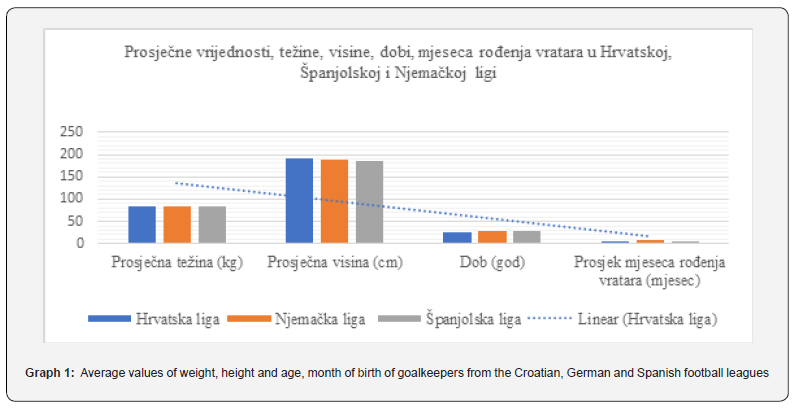
The results of the paper, which were reached by analysis, on a sample of three first-division football leagues (Croatian, German and Spanish leagues) in which the authors processed the characteristics of 122 goalkeepers (Table 2). Descriptive statistics shown in the table show average values and comparisons of results in leagues. The average value represents the sum of all observed sample data divided by the total number of data. The arithmetic mean acts as a "balance point" in the set, and the fact that its value is affected by extreme values (outliners) is considered a disadvantage. It is calculated as the ratio of the sum of all values of a variable and the total number of entities.
Regression analysis
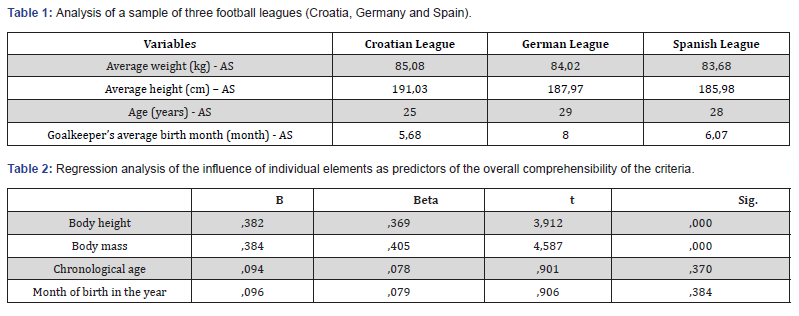
In is stated in the research that the results of the research show that the stated evaluation criteria body height, body mass, chronological age and month of birth in the year explain 48.7% of the variation in the total comprehensibility of the sports evaluation criteria (R2 = 0.487, F(89) = 29.156, p =0.000). Furthermore, it is shown that body height (β = 0.369, p = 0.000) and body mass (β = 0.405, p = 0.000) are significant positive predictors of overall intelligibility, while chronological age does not show a significant contribution (β = 0.078, p = 0.370). ) and month of birth in the year (β = 0.079, p = 0.384) (Table 2).
The hypothesis put forward in this paper is the assertion that the success of football goalkeepers in the football leagues of Germany, Spain and Croatia are important morphological characteristics, while chronological age does not necessarily represent a basic variable related to top sports success. The results of the research showed that the morphological characteristics and chronological age of football goalkeepers represent only a partial variable expressed for a top sports result and significantly depends on the league and the country where the competition is held, which significantly affects the economic strength of the sports club.
Discussion
The results obtained after the statistical analysis of the sample data (122 goalkeepers) from three first-division football leagues (Croatia, Germany and Spain) indicate that the success of football goalkeepers in the football leagues of Germany, Spain and Croatia is dominantly not exclusively linked to the observed variables. Studying the literature, the author came to the realization that goalkeepers in modern senior football have 57% of offensive activities, and 43% of defensive activities from the total activities during a football match, of which 81% are successful actions while 19% are unsuccessful. In the case of the younger categories in the U-19 category, this is expressed in a percentage of 60/40%, from the check, successful and unsuccessful actions are in the ratio of 31/69%. With this, we can present data on the dimension studied by kinesiology, and in this connection, looking at the morphological dimension, goalkeepers deviate from the average morphological dimensions of the entire population. According to the research results [17], the average height is in the range of 180-195 cm, while the body weight is in the range of 77-86 kilograms, and the average body fat is in the range of 11%-20% [19]. Descriptive statistics shown in table 2 show average values and comparisons of results in leagues, it is indicated that d.d. are the tallest goalkeepers in Croatia (191.03 cm) then in Germany (84.02 cm), while they are the lowest on average in the Spanish league. Goalkeepers had the highest mass in Croatia (85.08 kg), Germany (84.02) and then in the Spanish league (83.68 kg). The results showed that goalkeepers in the Croatian League are taller than other leagues, which can perhaps be attributed to the genetic potential of the wider area in which the Croatian League draws its potential. Looking at the results of the research, it should be emphasized that the results of some of the goalkeepers have markedly higher results than other goalkeepers who play in the Spanish (Oblak) and German (Ljubičić, Koubek) leagues and come from the wider region, from which the Croatian Football League draws its potential.
[13] state in their research that chronological and biological age are important for the development of a soccer goalkeeper. With the results of the research presented in the paper through chronological age, it should be emphasized that the oldest goalkeepers are in Germany (29 years old), Spain (29 years old) and finally in the Croatian league (25 years old). The results indicate that the Croatian football league is a more developed league, where young goalkeepers get a chance sooner than in the German and Spanish leagues, which are economically much "stronger", so clubs have the option of hiring well-known experienced goalkeepers, which significantly affects the economic characteristics of the sports club. It should also be emphasized that the results of the month of birth indicate that goalkeepers born in the first half of the chronological year in the younger categories have a "greater chance" to begin with, while in senior football this is evened out and is not extremely dominant or important.
[6] state that a statistical analysis of matches in the Bundesliga, including the roles of goalkeepers, indicate that the chronological age of goalkeepers in the German league affects participation in clubs competing in the Bundesliga. The results of the research in the paper (Table 3) on the influence of individual elements as predictors of the overall comprehensibility of the criteria, show that the stated evaluation criteria body height, body mass, chronological age and month of birth in the year explain 48.7% of the variations in the overall comprehensibility of the sports evaluation criteria (R2 = 0.487 , F(89) = 29.156, p=0.000). Furthermore, it is shown that body height (β = 0.369, p = 0.000) and body mass (β = 0.405, p = 0.000) are significant positive predictors of overall intelligibility, while chronological age does not show a significant contribution (β = 0.078, p = 0.370). ) and month of birth in the year (β = 0.079, p = 0.384).
Conclusion
The results of the research after the statistical analysis of the sample data (122 goalkeepers) from three first division football leagues (Croatia, Germany and Spain league) indicate that the success of football goalkeepers in the football leagues of Germany, Spain and Croatia is dominantly not exclusively linked to the observed variables. Results expressed through morphological characteristics represent the basis, while chronological age does not necessarily represent a dominant variable related to top sports success. The results of the research showed that morphological characteristics, height and weight represent only a basic feature in certain leagues, and the chronological age of football goalkeepers represents only a partial variable expressed for a top sports result and significantly depends on the league and the country in which the competition is held. Research has established that chronological age is important at the very beginning of a goalkeeper's sports career, while it is then reduced by equating chronological and biological age through physiological maturation. The authors expected bigger differences that are statistically significant, but the tendencies of modern football also refuted that, which significantly affects the economic strength of the sports club. On the basis of the results obtained in this work, it is possible to conclude a well-known thesis important for shaping football goalkeepers in the field of morphological characteristics expressed through body height and mass, and chronological age. The observed variables are important but not exclusive if they are within the average values stated for the needs of modern football. In accordance with the obtained results that indicate the importance of the observed variables, it is important to emphasize the need for further research by experts and scientists in the field, and not the economic aspects of the development of the sports club.[20-25]
References
- Milanović D (2013) Training Theory. Zagreb: Faculty of Kinesiology, University of Zagreb
- Bašić D, Barišić V, Jozak R, Dizdar D (2015) Notational analysis of football matches. Zagreb: Leonardo media.
- Keros P, Pećina, M Keros (2006) Functional anatomy of the locomotor system Kostović, I. (1986). Human anatomy: central nervous system, Zagreb: Faculty of Medicine, University of Zagreb.
- Barišić V (2007) Kinesiological analysis of tactical means in football (doctoral dissertation). Zagreb, Faculty of Kinesiology, University of Zagreb.
- Sporiš G (2002) Analiza nogometne igre u funkciji planiranja i programiranja fizičke pripreme. (Diplomski rad). Zagreb: Kineziološki fakultet Sveučilišta u Zagrebu.
- Yue Z, Broich H, Mester J ( 2014) Statistical analysis of the soccer matches of the first Bundesliga. International Journal of Sports Science & Coaching 9(3).
- Miočić J, Androja L, Kovačević S (2021) Women’s football prospects in city of Zadar and Zadar county. Sportske nauke i zdravlje 11(2): 245-249
- Milanović M, Milanović L, Lukenda Ž (2010) Application of the results of the diagnostic procedure for directing individual fitness training of a gifted football player U 19: 270-275.
- Budim I (2020) Analysis of differences in morphological characteristics of cadet football players with respect to their playing position. (Diploma thesis). Taken from
- Rak J, Milić M, Erceg M, Grgantov Z, Sivrić H (2014) Inter-positional differences in somatotype among young soccer players. U S. Pantelić (ur.), Book of Proceedings XVII Scientific Conference “FIS COMMUNICATIONS 2014” in physical eduction, sport and recreation.Niš, Serbia: Faculty of sport and physical education, University of Niš, 103-111. Hrvatska Znanstvena Bibliografija i MZOSSvibor.
- Matković B, Mišigoj-Duraković M, Matković B, Janković S, Ružić L, et al. (2003) Morphological differences of elite Croatian players according to the team position. Collegium antropologicum 27(1): 167-174.
- Parus P, Chmura P, Konefal M, Andrezejewski M, Kowalczuk E, et al. (2017) Distance covered below and above the anaerobic treshold by elite german goalkeepers. Central European Journal of Sport Sciences and Medicine 17(1): 25-32.
- Deprez D, Coutts AJ, Fransen J, Deconinck F, Lenoir M, et al. (2013) Relative age, biological maturation and anaerobic characteristics in elite youth soccer players. International journal of sports medicine 34(10): 897-903.
- Arapović T (2018) Indicators of situational efficiency of goalkeepers in the attack phase in younger age categories (Diploma thesis). Taken from
- Williams JH (2010) Relative age effect in youth soccer: analysis of the FIFA U17 World Cup competition. Scandinavian journal of medicine & science in sports 20(3): 502-508.
- Androja L, Terzić V (2020) Planning and programming of training during the competitive period in women's football. Sport i Zdravlje 18(1): 49-58.
- Di Salvo V, Benito PJ, Calderon FJ, Di Salvo M, Pigozzi F (2008) Activit profile of elite goalkeepers during football match-play. Journal of Sports Medicine and Physical Fitness 48(4): 443.
- Rađa A (2016) Analiza nekih dimenzija antropološkog statusa mladih nogometaša u odnosu prema biološkoj i kronološkoj dobi, igračkim linijama i situacijskoj uspješnosti (Doctoral dissertation, University of Split. Faculty of Kinesiology).
- Krišto K (2013) Characteristics of top female soccer players (Master's thesis).
- Achten J, Jeukendrup AE (2003) Heart rate monitoring: applications and limitations. Sports Med 33(7): 517- 38.
- Bisanz G, Gerisch G (1984) Fußball – Training, Technik, Taktik, Reinbek Bompa, OT, Carrera O (1994) Theory and methodology of training.
- Bompa, Tudor Olimpius (2006) Periodization: Theory and methodology of training. Champaign. IL: Human Kinetics
- preuzeto 19.07.2022.
- preuzeto 11.08.2022.
- (preuzeto 12.09.2022).

























