




 JPFMTS Home



Abstract
Eventing is a high-risk equestrian sport where riders frequently sustain concussions due to falls, yet there is limited research on their injury experiences, recovery processes, and return-to-play decisions. Understanding the challenges eventing riders face in concussion management is crucial for improving medical guidance, education, and safety protocols within the sport. This study aims to investigate concussions among event riders, explore riders’ knowledge of concussion management and return-to-play protocols, and assess the long-term implications of such injuries. Using semi-structured interviews with 11 event riders. The discussions were transcribed and analysed using qualitative content thematic analysis. The results highlight five higher-order themes:
(1) Mechanism of injury;
(2) Treatment and advice received;
(3) Return to play decisions;
(4) Long-Term psychological and physical impacts; and
(5) Awareness and education on concussions.
Lower order themes revealed that concussions typically resulted from falls, often during training rather than competition, with helmets reducing but not preventing injuries. Treatment experiences varied, with inconsistent medical advice and riders returning to riding earlier than recommended due to the equestrian culture, responsibility to exercise the horse and competition pressures. Long-term effects included anxiety, reduced confidence, and persistent physical symptoms such as headaches and fatigue, with lower-level competitors experiencing greater psychological distress. Participants highlighted a significant lack of concussion awareness and inconsistent enforcement of protocols outside of competition. They emphasized the need for improved education, standardized return-to-play guidelines, and stronger enforcement of concussion protocols, particularly in training environments. These findings highlight the urgent need for increased concussion education and support systems within eventing to ensure safer recovery and return-to-play decisions.
Keywords: Concussion; Eventing; Return-to-play protocol
Introduction
Concussions, also known as mild traumatic brain injuries (mTBI), a head injury that temporarily affects brain function, are a growing concern across all sports due to their short and potential long-term consequences. Defined as a complex pathophysiological process affecting the brain, concussions are induced by biomechanical forces, typically resulting from direct or indirect impacts to the head (McCrory et al., 2017) [1]. While contact sports such as rugby, American football, and hockey have garnered significant attention for their high rates of concussive injuries, equestrian sports, particularly eventing, also pose a significant risk of head trauma. Despite this, concussions in equestrian sports remain under-researched and often underreported, contributing to a lack of comprehensive data and guidelines specific to the unique challenges faced by riders. Although equestrian sport governing bodies like the Fédération Equestre Internationale (FEI) and British Eventing (BE) have made strides in improving safety standards, including the use of certified helmets, frangible devices on cross-country (XC) fences and concussion protocols, these measures have not been consistently applied or enforced across all levels of the sport. For instance, while riders injured in competitive events are typically required to seek medical clearance before returning to competition after a head injury, this rule is difficult to enforce during non-competitive training or recreational riding, where the majority of concussions are thought to occur (Kuhl et al., 2014) .
The issue of concussion in equestrian sports is multifaceted. Concussions occur when the brain is subjected to sudden acceleration or deceleration, leading to the brain impacting the inside of the skull. This can result in a range of symptoms, from headaches and dizziness to more severe cognitive and emotional disturbances. The effects of a concussion can be exacerbated if the rider sustains multiple concussions in a short period, a phenomenon known as Second Impact Syndrome (SIS), which can lead to rapid brain swelling and, in severe cases, death (Dessy et al., 2015) . Additionally, Chronic Traumatic Encephalopathy (CTE), a progressive neurodegenerative condition linked to repeated head injuries, has raised significant concern across all sports, yet its implications for equestrian athletes remain underexplored (Khurana & Kaye, 2012) [2]. Eventing, often referred to as the equestrian triathlon, comprises dressage, show jumping, and cross-country, with the latter being recognized as one of the most dangerous disciplines for both horse and rider (Bennet, Cameron- Whytock, & Parkin, 2022; Murray et al., 2006; O’Brien, 2016) [3,4,5]. The cross-country phase involves navigating up to 45 solid fences and technical obstacles at speeds reaching 570 meters per minute (Demarie et al., 2022; FEI Eventing Rules, 2025) [6,]. Despite advancements in safety measures, such as improved fence designs and the introduction of frangible pins (Gates & Lin, 2020; Bennet, Cameron-Whytock, & Parkin, 2022ab) [7,3], eventing remains a high-risk sport. Between 2007 and 2013, 45 rider fatalities were recorded in cross-country competitions worldwide (Cameron-Whytock, Brigden, & Whytock, 2016) [8], and from 2008 to 2018, 3.5% of competitors at international-level eventing competitions experienced a rider fall, with 1.5% suffering a horse fall (Bennet, Cameron-Whytock, & Parkin, 2022) [9]. One of the most severe accident types, rotational falls, occurs when a horse strikes a solid obstacle with its forelimbs, causing it to somersault and potentially land on the rider (Murray et al., 2006; O’Brien, 2013; Thompson & Nesci, 2016; Gates & Lin, 2020) [4,10,7], with 24% of such falls at FEI competitions in 2021 resulting in serious rider injury (FEI, 2021) [11]. In addition to acute injuries, event riders frequently experience musculoskeletal injuries and chronic pain, which may impair their riding performance by reducing mobility, increasing fatigue, and affecting concentration, all of which could elevate the risk of falls (Lewis & Baldwin, 2018) [12]. Given the inherent dangers of cross-country riding and the prevalence of falls, there is a critical need to investigate concussion in event riders, particularly in relation to injury incidence, ris perception, and adherence to medical guidelines following head trauma. This study aims to address the research gap by investigating the experiences of event riders who have sustained concussions, their knowledge of concussion management, and their adherence to return-to-play protocols. Furthermore, it explores the implications of these injuries on riders’ physical and psychological well-being. By focusing on event riders, who are exposed to heightened risks due to the nature of their sport, this research contributes to a growing body of literature that seeks to inform better safety practices and concussion management protocols tailored specifically to the equestrian community.
Methods
This study employed a qualitative research approach to investigate the experiences of event riders who have sustained concussions, their knowledge of concussion management, and their adherence to return-to-play protocols. A qualitative approach was selected to provide in-depth insights into the personal experiences, attitudes, and behaviors of riders following concussive injuries, allowing for a richer understanding of the challenges faced by athletes in managing such injuries.
Measure
Following institution ethical approval ETHICS2022-192-LR. The research was conducted using semi-structured interviews, which allowed participants to share their experiences in a flexible and open-ended format while also ensuring that key areas of interest such as the mechanism of injury, treatment received, return-to-play decisions, and long-term impacts were consistently explored across all interviews. This method was chosen to capture the nuanced and varied experiences of riders, who may have different perspectives based on factors such as competition level, or access to medical care. The semi-structured format enabled the interviewer to probe deeper into specific areas while allowing participants to discuss aspects of their experience that might not have been anticipated.
Participants
A total of 11 adult event riders were recruited for the study
through purposive sampling. This technique was used to ensure
that participants had direct experience with concussions
while engaging in Eventing activities. The inclusion criteria for
participants required that they:
- Be over the age of 18.
- A member of British Eventing.
- Have experienced at least one concussion during
competition, training, or recreational riding.
Participants were recruited through social media platforms, word-of-mouth referrals, and contacts within local Eventing competition yards.
Interview Process
Interviews were conducted individually, either over the
telephone or via Microsoft Teams. Each interview lasted
approximately 20-30 minutes, a length chosen to balance
comprehensive data collection with participant comfort and
engagement. The interview guide was developed based on
existing literature on concussion in sports, with particular focus
on the unique aspects of equestrian sports. The guide included
open-ended questions that encouraged participants to describe
their experiences with concussions in detail. Key areas of inquiry
included:
1. The mechanism of injury that led to the concussion.
2. The symptoms experienced and how long they persisted.
3. The treatment sought, including medical advice received.
4. The decision-making process around returning to sport.
5. Long-term impacts of the concussion on their riding
performance, confidence, and overall well-being.
Prompts were used to encourage participants to elaborate on specific aspects, such as whether they followed medical advice, how they felt about the return-to-play protocols, and whether their understanding of concussions had changed after the experience. This approach allowed participants to reflect on their experiences holistically, offering insights into both immediate and long-term consequences of their injuries.
Data Collection and Transcription
All interviews were audio recorded with the participants’ consent and subsequently transcribed verbatim to ensure an accurate representation of their experiences. Transcripts were anonymized to protect participants’ identities, and any potentially identifiable information (e.g., specific locations, names of coaches or healthcare professionals) was redacted. Each participant was assigned a unique identifier (e.g., Participant A, Participant B) for analysis and reporting purposes.
Data Analysis
Transcripts were analyzed using qualitative content analysis, following the method of Braun and Clarke, (2006). The analysis focused on condensing and interpreting meanings. First, the transcripts were read in full, and then key sentences and phrases were identified as meaning units and coded. These codes were organized into lower-order themes and challenges to reflect their content. Finally, the codes were filtered and grouped by topic to summarize the participants’ discussions and conclusions.
Results
Thematic analysis of interviews. All interviews were
transcribed and analysed. They were coded to identify recurring
discussion points, which were then sorted into sub themes to then
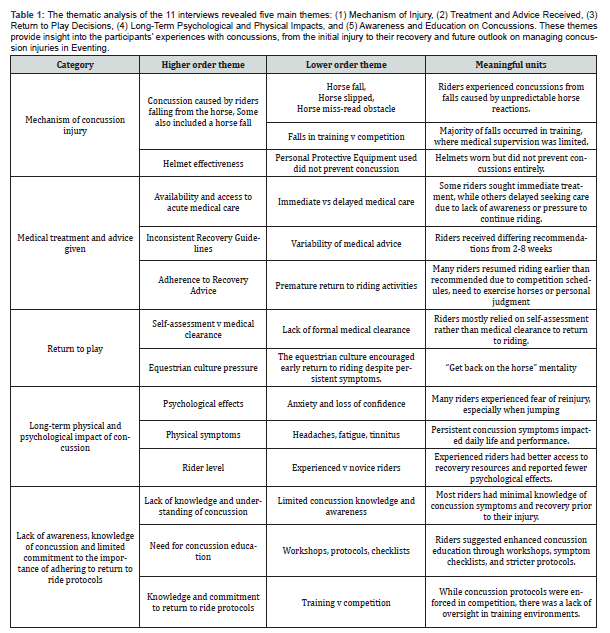
create 5 main themes. The thematic analysis of the 11 interviews
revealed five main themes:
(1) Mechanism of Injury,
(2) Treatment and Advice Received,
(3) Return to Play Decisions,
(4) Long-Term Psychological and Physical Impacts, and
(5) Awareness and Education on Concussions.
These themes provide insight into the participants’ experiences with concussions, from the initial injury to their recovery and future outlook on managing concussion injuries in Eventing.
Mechanism of Injury
All participants experienced concussions resulting from falls, often during the jumping phases of Eventing. The majority of the falls occurred when horses slipped, misjudged obstacles, or reacted unpredictably, leading to riders being thrown from their mounts. One rider described a rotational fall during cross-country where the horse misjudged the second part of a combination jump, resulting in both horse and rider hitting the ground. Another participant noted that their horse panicked during showjumping warm-up, leading to a sudden fall that caused them to lose consciousness momentarily. Several riders reported that these falls occurred during training rather than competition. All riders were wearing helmets at the time of their injuries, but none felt their helmets completely prevented the concussions. As noted by one rider, “The helmet helped with the severity, but I still blacked out after I hit the ground.”
Treatment and Advice Received
The advice and treatment received by participants following their concussions varied significantly. Some riders were taken to the hospital immediately after the fall, particularly when unconsciousness or severe symptoms were present. One participant described being airlifted to a hospital after losing consciousness during a cross-country fall, where they were diagnosed with a concussion and advised to rest for four weeks. However, not all riders received immediate medical attention. Several participants described situations where they did not seek medical care right away, either because they did not recognize the symptoms of a concussion or felt pressure to continue riding. Inconsistent advice on recovery was also reported. Some riders were told by healthcare providers to take 2-3 weeks off riding, while others were advised to rest for as long as six weeks before returning to the sport. However, adherence to this advice was inconsistent, with many riders returning to the saddle earlier than recommended. “I was told to rest for six weeks, but I started light riding again after two,” one participant noted. This inconsistency in advice highlights a key issue in managing concussions in equestrian sports, where professional medical follow-up is not always guaranteed.
Return to Play Decisions
Most participants made independent decisions about when to return to riding, often based on how they felt rather than medical clearance. Only two riders followed the recommended return-toplay guidelines provided by healthcare professionals. Many others returned to riding earlier than advised, either due to upcoming competitions or pressure to maintain horse fitness. One rider noted, “I had a competition coming up, so I got back on the horse within a week. I knew I wasn’t 100%, but I didn’t want to miss it.” Participants also mentioned the absence of medical professionals in training environments, which meant there was no formal oversight to ensure that concussion protocols were followed outside of competition. This lack of monitoring was concerning, as most riders indicated they were responsible for self-assessing their readiness to return to the sport. The “get back on the horse” culture was frequently cited as a reason for resuming riding prematurely, even when lingering symptoms such as headaches or dizziness persisted.
Psychological and Physical Impacts
Concussions had significant psychological and physical effects on many participants. Several riders reported experiencing anxiety and loss of confidence, particularly when returning to jumping after their injury. One rider explained, “Every time I approach a jump now, I hesitate. It’s like I’m waiting for something bad to happen.” This anxiety often led riders to alter their riding style, approach jumps more cautiously or avoid certain phases of Eventing altogether. Participants at higher competition levels reported fewer issues with confidence upon returning to riding. These riders often had more experience managing injuries and more access to resources such as coaches and physiotherapists, which may have helped in their recovery. Conversely, riders with less competition experience reported more severe psychological impacts, such as fear of reinjury. In addition to the psychological effects, physical symptoms lingered for many participants. These included recurring headaches, memory issues, and, in one case, tinnitus. One rider reported that their symptoms persisted for 18 months before they were correctly linked to the concussion. Another rider noted long-term fatigue and difficulty concentrating in their daily life, which affected their ability to perform well in competitions and maintain their usual training routine.
Awareness and Education on Concussions
There was a clear consensus among participants that more education is needed on the risks and management of concussions in equestrian sports. Most riders acknowledged that, prior to their injury, they had little knowledge of concussion symptoms or the importance of proper recovery. “I knew concussions were serious, but I didn’t realize how long the effects could last,” one rider admitted. Several participants emphasized that concussion awareness should be increased at all levels of Eventing, from grassroots riders to elite competitors. Riders also expressed a desire for better communication of concussion protocols by governing bodies, particularly during training and at noncompetitive events. Suggestions for improving awareness included distributing concussion symptom checklists, offering workshops for riders and coaches, and incorporating more stringent medical assessments after falls, regardless of whether they occur in competitions or training. One rider noted that while British Eventing’s concussion protocols are effective in competitive settings, similar enforcement is needed outside of competition. “We have great rules at events, but in training, there’s no one making sure you follow the guidelines.” This highlights the need for more robust, year-round enforcement of concussion protocols, especially in unsupervised environments.
Discussion
The results of this study highlight critical gaps in the awareness, management, and long-term understanding of concussion injuries among event riders. Despite the presence of concussion protocols enforced by governing bodies such as British Eventing, the findings suggest that riders often rely on personal judgment or incomplete information when making return-to-play decisions. This contrasts sharply with more organized team sports, where concussions are typically diagnosed and monitored by trained medical personnel on the sidelines, both during competition and training. This also results in athletes in other sports subject to stringent, medically supervised return-to-play protocols (McCrea et al., 2004) [13]. The lack of such structured medical oversight in equestrian sports, outside competitive environments, places riders at higher risk for premature return to sport and subsequently the risks associated with this.
Inconsistent Knowledge and Awareness of Concussion Risks
One of the most significant findings of this study was the inconsistency in riders’ understanding of concussions and their long-term effects. This aligns with previous research in equestrian sports, which found that many riders, particularly at the amateur level, were not adequately informed about concussion risks (Kuhl et al., 2014) . Despite improvements in concussion protocols in sports like rugby and football, where awareness campaigns and mandatory concussion assessments have been implemented (McCrory et al., 2017) [1], equestrian sports have lagged behind in both education and enforcement. Many participants in this study were unaware of the cumulative risks associated with multiple concussions, a particularly troubling gap in knowledge given the potential for severe long-term health consequences. Studies in other sports have shown that repeated concussions, especially when a second concussion occurs before the first has fully healed, can lead to conditions such as Second Impact Syndrome (SIS) and Chronic Traumatic Encephalopathy (CTE), both of which carry serious, life-altering consequences (Guskiewicz et al., 2003; Dessy et al., 2015). While these conditions are rare, they underscore the critical importance of adhering to strict return-to-play protocols, a practice not consistently followed by the riders in this study.
Equestrian Culture
The reluctance of event riders to adhere to medical and returnto- play guidelines following a head injury may be attributed to the deeply ingrained culture of risk within equestrian sport, which normalizes pain and injury as inherent to participation. Nixon (1993) highlighted that athletes often rationalize pain as a necessary component of sporting success, fostering an environment where continuing to compete despite injury is both accepted and, in some cases, glorified. This attitude is reflected in equestrian discourse, with phrases such as “you are not a rider until you have fallen off 10 times” reinforcing the expectation of resilience in the face of injury. Such cultural norms align with findings from other sports; for example, Cavallerio, Wadey, and Wagstaff (2016) [14] observed that rhythmic gymnasts concealed pain due to the perception that it signified weakness, a mindset that may similarly influence equestrian athletes. Additionally, Thompson, Kibarska, and Jague (2011) suggested that athletes might employ ‘pathological dissociation’ to manage injuries while maintaining high performance levels, a strategy that could explain why riders return to training before concussion symptoms fully resolve. The extensive commitment required in equestrianism, where caring for horses is often considered a ‘way of life’ rather than merely a sport (Dashper, 2017; McConn-Palfreyman et al., 2019) [15,16], may further drive riders to disregard medical advice in favor of fulfilling their responsibilities. Similar attitudes towards injury have been documented in industries such as agriculture (Volkmer & Lucas Molitor, 2019) [17] and the military (Hauret et al., 2010) [18], suggesting that shifting these entrenched beliefs may require targeted behavioural interventions within the equestrian community.
The Role of Helmets in Concussion Prevention
All participants in this study wore helmets at the time of their injuries, yet concussions still occurred. While helmets are mandatory in most equestrian disciplines and reduce the severity of head injuries, research suggests that helmets use in contact sports may not be as effective in preventing mild TBI and concussion (Sone al., 2017) [19]. Research investigating TBI in American Football has identified that the mechanism of injury is the brain rotational acceleration resulting from oblique impact and that traditional helmet design does not eliminate these forces (Hoshiziki et al., 2014; Sone al., 2017; Abram et al., 2020) [20,19,21]. Research by Connor et al. (2019) suggest that equestrian helmet design may not be as effective at preventing TBI and concussion as similar forces are observed. The design of helmets used in equestrian sports is largely based on linear drop tests, which simulate a rider falling straight down onto a hard surface. However, the reality of many falls in Eventing involves oblique impacts with softer surfaces such as grass, sand, or turf, where the forces exerted on the brain may be different (Connor et al., 2020) [22]. These oblique impacts generate rotational forces that are a primary cause of concussive brain injuries (Meredith et al., 2019; Clarke et al., 2020) [23,24] and Connor et al., (2019) [22] concluded that equestrian helmet design are too stiff relative to the impact surface to reduce the risk of a TBI. The data from this study suggests that current helmet standards may not adequately protect riders from concussions, despite reducing the risk of more severe injuries. Improvements in helmet design, possibly incorporating new materials or multi-directional impact protection systems (MIPS) that are used in American Football helmets (Guitnike et al., 2022) [25], could better address the rotational forces that lead to concussions. Furthermore, riders should be made more aware of the importance of replacing helmets after a fall, as repeated impacts can degrade the helmet’s protective capabilities, even when no visible damage is present (Connor et al., 2019) [22].
Premature Return to Play and Lack of Monitoring/b>
Another key finding from this study was the premature return to play among many riders. Although British Eventing (2025) mandates a 21-day suspension from competition and British Equestrian (2023) [26] suggests not riding at all during this period, following a concussion diagnosis, riders in this study, returned to riding far sooner than this period, often without medical clearance. Riders cited external pressures, such as upcoming competitions, maintaining horse fitness, and the financial costs of missing events, as reasons for resuming riding prematurely. This premature return places riders at increased risk for a second concussion, which, as noted, can have more severe consequences than the initial injury (Kushner et al., 2001; Musumeci et al., 2019; Wetjen et al., 2021) [27,28,29]. In comparison to team sports, where athletes are closely monitored by medical professionals during recovery, event riders often make these decisions independently, particularly when injuries occur outside of competition. This self-regulation, combined with a lack of follow-up from healthcare providers, poses a significant risk to rider safety. In professional sports such as rugby and football, athletes must undergo a graded return-to-play protocol, with medical professionals assessing cognitive and physical recovery at each stage. This structured approach helps to ensure that athletes do not return to sport until they are fully recovered. The absence of such a system in equestrian sports underscores the need for stricter monitoring and enforcement of concussion recovery protocols, especially outside the competitive setting (McCrea et al., 2004; McCrory et al., 2017) [1].
Psychological and Long-Term Effects of Concussions
The psychological impact of concussions was another significant theme identified in this study. Several participants reported increased anxiety, particularly when approaching jumps or other high-risk scenarios, after sustaining a concussion. This anxiety, combined with a loss of confidence, can affect rider performance and potentially increase the risk of further injury, as anxious riders may make decisions that exacerbate dangerous situations (Podlog et al., 2011) [30]. Additionally, some participants reported experiencing long-term cognitive symptoms, such as memory loss, headaches, and tinnitus, even months after the initial injury. The long-term cognitive effects of concussions have been well-documented in other sports, with research showing that repeated head injuries can lead to neurodegenerative diseases such as long-term behaviour changes (Daneshvar et al., 2010) [31], post-concussion syndrome (Canu et al. 2007) [32] Chronic Traumatic Encephalopathy (CTE) (Mckee et al., 2009) [33], CTE with Motor Neuron Disease (Mckee et al. 2010 ) [34], Alzheimer’s and Parkinsons diseases (Khurana & Kaye, 2012) [2]. While this study did not explore neurodegenerative outcomes specifically, the persistent symptoms reported by participants suggest that further research is needed to understand the longterm health implications of concussions in equestrian athletes. This is particularly important given equestrian participation is not restricted to age and even at the elite level it is not uncommon for riders to be in their 50’s or 60’s (Dumbell et al., 2018) [35] where it is likely riders may sustain multiple concussions over their riding careers.
The Need for Improved Education and Communication
One of the most consistent findings was the riders’ acknowledgment of the need for improved education on concussion risks and management. Many participants admitted that, at the time of their injury, they did not fully understand the seriousness of concussions or the importance of adhering to medical advice. Research in other sports (football, rugby) identified moderate concussion knowledge, safe attitudes, and good concussion symptom recognition, however, players reported unsafe concussion behaviours despite accurately identifying the potential risks (Williams et al., 2016; h van Vuuren et al., 2020; Silve et al., 2025) [36,37,38]. Riders expressed the need for more accessible information from governing bodies, with suggestions ranging from clearer guidelines on return-to-play protocols to the distribution of concussion awareness materials at events and in training settings. This need for greater education is not unique to equestrian sports. Other high-risk sports have successfully implemented education campaigns that include compulsory workshops or e-learning courses to raise awareness about concussion risks. For example, rugby’s “HEADCASE” campaign and football’s “Recognize and Remove” initiative have been instrumental in promoting concussion awareness among players, coaches, and parents (England Football, 2025; England Rugby, 2025) [39,40]. Equestrian governing bodies could adopt similar strategies to ensure that all stakeholders riders, coaches, parents, and trainers are equipped to recognize and manage concussions effectively.
Conclusion
This study highlights significant gaps in understanding, management, and attitudes to concussion among event riders. Despite the high risk of head injuries in Eventing, there is inconsistent awareness of the severity of concussions and the long-term health implications of returning to riding prematurely. The “get back on the horse” culture, combined with a lack of medical oversight outside of competition, often leads riders to make independent return-to-play decisions based on subjective feelings rather than medical guidance. Many riders in this study returned to riding before fully recovering, putting them at risk for further injury, including the potentially severe consequences of Second Impact Syndrome and Chronic Traumatic Encephalopathy. The psychological impact of concussions, particularly anxiety and loss of confidence, was a common theme, affecting riders’ performance and overall well-being long after the initial injury. The findings also suggest that higher-level riders may have more resources and support for recovery, while less experienced riders face greater challenges in managing the physical and mental consequences of their injuries. To address these issues, there is a clear need for better education on concussion risks, symptoms, and proper recovery protocols within the equestrian community. Governing bodies must improve communication of concussion guidelines and ensure that riders, coaches, and medical personnel are equipped with the knowledge to recognize and manage concussions effectively. Consistent enforcement of concussion protocols across both competitive and training environments is critical to reducing the long-term health risks associated with head injuries in Eventing. Future research should explore the long-term health outcomes of repeated concussions in equestrian sports and investigate the effectiveness of current helmet designs in preventing concussions. Additionally, efforts should be made to develop and implement more structured, accessible, and medically supervised return-to-play protocols to protect riders’ health and performance. By taking these steps, the equestrian community can mitigate the risks of concussion and improve the safety and well-being of event riders.
References
- McCrory P, Feddermann-Demont N, Dvořák J, Cassidy JD, McIntosh A, Vos PE, et al. (2017) What is the definition of sports-related concussion: a systematic review. British journal of sports medicine 51(11): 877-887.
- Khurana VG, Kaye AH (2012) An overview of concussion in sport. Journal of Clinical Neuroscience 19(1): 1-11.
- Bennet ED, Cameron‐Whytock H, Parkin TD (2022) Fédération Equestre Internationale eventing: Fence‐level risk factors for falls during the cross‐country phase (2008–2018). Equine veterinary journal 55(3): 463-473.
- Murray JK, Singer ER, Morgan KL, Proudman CJ, French NP (2006) The risk of a horse‐and‐rider partnership falling on the crosscountry phase of eventing competitions. Equine veterinary journal 38(2): 158-163.
- O’Brien D (2016) Look before you leap: what are the obstacles to risk calculation in the equestrian sport of eventing?. Animals 6(2): 13.
- Demarie SD, Galvani C, Donatucci B, Gianfelici A (2022) A pilot study on Italian eventing prospective Olympic horse riders physiological, anthropometrical, functional and asymmetry assessment. Central European Journal of Sport Sciences and Medicine 37: 77-88.
- Gates JK, Lin CY (2020) Head and spinal injuries in equestrian sports: update on epidemiology, clinical outcomes, and injury prevention. Current sports medicine reports 19(1): 17-23.
- Cameron-Whytock H, Brigden C, Whytock R (2016) Risk factors for horse falls in the cross-country phase of national level British Eventing one day events.
- Bennet ED, Cameron‐Whytock H, Parkin TD (2022) Fédération Equestre Internationale eventing: Risk factors for horse falls and unseated riders during the cross‐country phase (2008‐2018). Equine veterinary journal 54(5): 885-894.
- Thompson K, Nesci C (2016) Over-riding concerns: Developing safe relations in the high-risk interspecies sport of eventing. International review for the sociology of sport 51(1): 97-113.
- Fédération Equestre Internationale. Eventing Risk Management Programme Statistics 2010-2021.
- Lewis V, Baldwin K (2018) A preliminary study to investigate the prevalence of pain in international event riders during competition, in the United Kingdom. Comparative Exercise Physiology 14(3): 173-181.
- McCrea M, Guskiewicz K, Randolph C, Barr WB, Hammeke TA, et al. (2009) Effects of a symptom-free waiting period on clinical outcome and risk of reinjury after sport-related concussion. Neurosurgery 65(5): 876-883.
- Cavallerio F, Wadey R, Wagstaff CR (2016) Understanding overuse injuries in rhythmic gymnastics: A 12-month ethnographic study. Psychology of sport and exercise 25: 100-109.
- Dashper K (2016) Human-animal relationships in equestrian sport and leisure. Routledge.
- McConn-Palfreyman W, Littlewood M, Nesti M (2019) A lifestyle rather than a job. A review and recommendations on mental health support within the British horse racing industry. Liverpool John Moores University, Liverpool, UK. A-lifestyle-rather-than-a-job.
- Volkmer K, Lucas Molitor W (2019) Interventions addressing injury among agricultural workers: a systematic review. Journal of agromedicine 24(1): 26-34.
- Hauret KG, Jones BH, Bullock SH, Canham-Chervak M, Canada S (2010) Musculoskeletal injuries: description of an under-recognized injury problem among military personnel. American journal of preventive medicine 38(1): S61-S70.
- Sone JY, Kondziolka D, Huang JH, Samadani U (2017) Helmet efficacy against concussion and traumatic brain injury: a review. Journal of neurosurgery 126(3): 768-781.
- Hoshizaki TB, Post A, Oeur RA, Brien SE (2014) Current and future concepts in helmet and sports injury prevention. Neurosurgery 75(4): S136-S148.
- Abram DE, Wikarna A, Golnaraghi F, Wang GG (2020) A modular impact diverting mechanism for football helmets. Journal of biomechanics 99: 109502.
- Connor TA, Clark JM, Brama P, Stewart M, Ní Annaidh A, et al. (2020) An evidence basis for future equestrian helmet lateral crush certification tests. Applied Sciences 10(7): 2623.
- Meredith L, Ekman R, Thomson R (2018) Horse-related incidents and factors for predicting injuries to the head. BMJ open sport & exercise medicine 4(1): e000398.
- Clark JM, Adanty K, Post A, Hoshizaki TB, Clissold J, et al. (2020) Proposed injury thresholds for concussion in equestrian sports. Journal of science and medicine in sport 23(3): 222-236.
- Goutnik M, Goeckeritz J, Sabetta Z, Curry T, Willman M, et al. (2022) Neurotrauma prevention review: improving helmet design and implementation. Biomechanics 2(4): 500-512.
- British Equestrian (2023) CONCUSSION AND RETURN TO RIDING GUIDELINES BEF_concussion_guidance.
- Kushner DS (2001) Concussion in sports: minimizing the risk for complications. American family physician 64(6): 1007-1015.
- Musumeci G, Ravalli S, Amorini AM, Lazzarino G (2019) Concussion in sports. Journal of functional morphology and kinesiology 4(2): 37.
- Wetjen NM, Pichelmann MA, Atkinson JL (2010) Second impact syndrome: concussion and second injury brain complications. Journal of the American College of Surgeons 211(4): 553-557.
- Podlog LW, Kory TSgt, WC, Brown LTC WJ (2016) Management and Rehabilitation Strategies Following IED Related Mild Traumatic Brain Injury in Civilian Settings-What to Expect and How to Optimize Recovery From mTBI 1(1): 1003-1016.
- Daneshvar DH, Riley DO, Nowinski CJ, McKee AC, Stern RA, et al. (2011) Long term consequences: effects on normal development profile after concussion. Physical medicine and rehabilitation clinics of North America 22(4): 683-700.
- Cantu RC, Herrin, SA, Putukian M, American College of Sports Medicine (2007) Concussion. The New England journal of medicine 356(17): 1787-1789.
- McKee AC, Cantu RC, Nowinski CJ, Hedley-Whyte ET, Gavett BE, et al. (2009) Chronic traumatic encephalopathy in athletes: progressive tauopathy after repetitive head injury. Journal of Neuropathology & Experimental Neurology 68(7): 709-735.
- McKee AC, Gavett BE, Stern RA, Nowinski CJ, Cantu RC, et al. (2010) TDP-43 proteinopathy and motor neuron disease in chronic traumatic encephalopathy. Journal of Neuropathology & Experimental Neurology 69(9): 918-929.
- Dumbell LC, Rowe L, Douglas JL (2018) Demographic profiling of British Olympic equestrian athletes in the twenty-first century. Sport in Society 21(9): 1337-1350.
- Williams JM, Langdon JL, McMillan JL, Buckley TA (2016) English professional football players concussion knowledge and attitude. Journal of sport and health science 5(2): 197-204.
- Van Vuuren H, Welman K, Kraak W (2020) Concussion knowledge and attitudes amongst community club rugby stakeholders. International Journal of Sports Science & Coaching 15(3): 297-305.
- Silver D, Faull-Brown R, McClusky R, Brown N, Patterson S, et al. (2025) Concussion knowledge and attitude of English youth rugby players: the RUCKAS-YOUTH survey. BMJ Open Sport & Exercise Medicine 11(1).
- England Football (2025) Concussion e-learning course. Concussion Guidelines | England Football Learning.
- England Rugby (2025) Headcase e-learning. HEADCASE E-Learning | Rugby Football Union.
- Clark JM, Connor TA, Williams C, Clissold J, McGoldrick A, et al. (2020) Analysis of helmet damage and associated head injuries arising from real-world equestrian fall accidents. Journal of Testing and Evaluation 48(3): 2185-2195.
- Thomas A Connor, J Michio Clark, Jayaratnam Jayamohan, Matt Stewart, Adrian McGoldrick, et al. (2019) Do equestrian helmets prevent concussion? A retrospective analysis of head injuries and helmet damage from real-world equestrian accidents. Sports Med - Open 5(1): 19.
- Gould S, Roy IR, Gabriel FD, Lowe R, Lin CY (2025) Equestrian Sports Safety: An Update on Safety Equipment and Event Medical Coverage. Current Sports Medicine Reports 24(1): 11-17.
- J Michio Clarka, Kevin Adanty, Andrew Post, Jerry Hillf, Aisling Ni Annaidha, et al. (2020) Proposed injury thresholds for concussion in equestrian sports, Original research 23(2): 222-236.
- McCrea M, Barr WB, Guskiewicz K, Randolph C, Marshall SW, et al. (2005) Standard regression-based methods for measuring recovery after sport-related concussion. Journal of the International Neuropsychological Society 11(1): 58-69.
- McCrea M, Broglio S, McAllister T, Zhou W, Zhao S, et al. (2020) Return to play and risk of repeat concussion in collegiate football players: comparative analysis from the NCAA Concussion Study (1999–2001) and CARE Consortium (2014–2017). British journal of sports medicine 54(2): 102-109.
- McKee AC, Stein TD, Nowinski CJ, Stern RA, Daneshvar DH, et al. (2013) The spectrum of disease in chronic traumatic encephalopathy. Brain 136(1): 43-64.
- Onsen LT, Ravella KC, Wiesen BM, Hutchinson MR, Hart MV (2022) Equestrian (Dressage, Eventing, Jumping) Sports-Specific Injuries and Unique Mechanisms in Equestrian Athletes. In Specific Sports-Related Injuries pp: 261-271.
- Stern RA, Daneshvar DH, Baugh CM, Seichepine DR, Montenigro PH, et al. (2013) Clinical presentation of chronic traumatic encephalopathy. Neurology 81(13): 1122-1129.
- Yount DL, Jesunathadas M, Plaisted TE, York S, Edwards ED, et al. (2021) Performance of a novel football helmet technology on head impact kinematics. Sports Engineering 24(1): 18.

























