




 JPFMTS Home



Investigating the Reliability of a Novel Method to Assess Knee Function
Brian Serrano1* and Matthew Comer2
1D.C. Ph.D., CCSP, ATC, CSCS, RSCC, OPE-SC, CES, NREMT, Chicago Bulls Organization, Chicago, USA
2MS, ATC, CSCS, Chicago Bulls Organization, Chicago, USA
Submission: March 17, 2023; Published: March 28, 2023
*Corresponding author:Brian Serrano, D.C. Ph.D., CCSP, ATC, CSCS, RSCC, OPE-SC, CES, NREMT, Chicago Bulls Organization, Chicago, USA
How to cite this article: Brian Serrano and Matthew Comer. Investigating the Reliability of a Novel Method to Assess Knee Function. J Phy Fit Treatment & Sports. 2023; 10(2): 555782. DOI: 10.19080/JPFMTS.2023.10.555782
Abstract
The return to performance spectrum has become more embedded in objectivity and technology. Within the realm of sport, it is not uncommon to see hop tests, isokinetic tests, and other functional tests being implemented to assess an athlete’s health status. The literature points to a plethora of tests in the lower extremity to assess strength, power, and overall readiness. In the upper extremity, handgrip dynamometry and isometric force plate testing have become popular in clearing athletes to return to play as well. Additionally, psychometric testing aims to assess the mental state of the athlete since fear of injury and movement avoidance may become habitual during the rehab process. From a global perspective, the primary types of sports technology used are dynamic, isometric, and isokinetic. The purpose of this study was to assess the reliability of an isometric device (VALD Force Frame, Brisbane, Australia) in measuring knee function. Participants were seated during both procedures to assess knee flexion and knee extension with their lower extremity at a 90-degree angle.
Participants were tested at the same period of day to reduce any diurnal variations. The testing positions were created after the gold standard to assess knee function which is isokinetic testing (Biodex Medical Systems, Shirley, New York). A correlation analysis was run between each testing position and showed a reliability of (r=.92) for knee flexion (hamstrings strength) and (r=.93) for knee extension (quadriceps strength) (p-value < .01, CV: 2.8%). These results give the user great-excellent reliability and signify the Force Frame as a reliable tool to assess knee function. Specifically, the Force Frame can be used as part of a battery of tests on an athlete’s return to performance. Practitioners in the high-performance setting may use this isometric test in conjunction with other dynamic and functional tests. It is important to remember the multi-factorial nature of rehabilitation and return to performance process. Practitioners should take an integrated approach to measuring athlete readiness, of which the Force Frame may play a role in assessing strength.
Keywords:Sports; Investigation; Athletic Shoulder
Abbreviations:LSI: Limb Symmetry Index; AST: Athletic Shoulder Test; HHD: Handheld Dynamometry; PCC: Pearson Correlation Coefficient
Introduction
Performance has become more integrated than ever before in respect to objectivity and positive complexity [1]. For example, rehabilitation used to be solely based on the timed criteria from anatomical studies. Tendon research shows structural healing after 8-12 weeks, ligament 12-16 weeks, and muscle tissue from 6-8 weeks [2]. This research was expanded to when a structure would be stable enough to experience loading, followed by multi-directional loading before returning to play. The difficulty with this schema is that not all loading is created equally, particularly when looking at rehabilitation and performance. The loading for team training looks different during off-season and in-season [3]. In the rehab process, early phase loading is different than later stage loading. Thus, findings remain inconclusive about when it is ‘safe’ to return to sport.
This is evident in ankle sprain rehab where a typical timeframe is 2-6 weeks, hamstring strains (4-6 weeks), and ACL tears (6-18 months) [4]. Even within the field of strength and conditioning, programming philosophies differ due to the concept of muscular function through 1-RM testing. In the rehabilitation setting, an athlete will usually go through a battery of tests before returning to play. Using the ACL-R as an example, the battery of tests will include hope, strength, and functional testing applicable to the sport [5]. Historically, force plates have become a staple in rehab and performance settings due to their ability to measure variables such as limb asymmetry, force production, and eccentric forces [6]. In rehab, the most practical application is looking at limb symmetry index (LSI) of which the general accepted threshold seems to be 95% of non-involved limb.
In performance, looking at jump height and force development at certain time constraints can indirectly measure readiness or overall neuromuscular fatigue. By looking at trends over time, practitioners can see how athletes are responding to stress and manage accordingly [7]. Recently, isometric testing has also re-surfaced as a viable tool in the rehab and performance space. In rehab, LSI can be calculated through average force, peak force, and ratios. In the upper extremity, Ashworth et al. [8] created the athletic shoulder test (ASH) to look at upper extremity function in rugby players returning to the pitch [8]. Mc Vickers et al. (2022) expanded on this study to create positions more specific to overhead athletes. Where the original ASH test includes the I-Y-T prone testing positions, the Kerlan-Jobe functional shoulder test adds in external and internal rotation at 90 degrees. Both tests are valid and reliable in assessing upper extremity function. In the lower extremity, isometric testing using the Biodex has routinely been set as the gold standard in measuring function. However, cost, space, and technical requirements are obstacles for practitioners. In response to this, handheld dynamometry (HHD) has emerged as a tool to measure isometric strength [9]. While intra-user reliability has shown to be good-great, inter-rater reliability is fair-good due to HHD placement and tester counter-pressure cited as impacting factors. Thus, VALD (Brisbane, Australia) produced an isometric testing unit consisting of paddles which act as force gauges placed at strategic positions to measure upper and lower extremity function. Specific to knee injury, it seems important to test muscles that cross the joint such as adductors, hamstrings, quadriceps, and calves. Of these muscle groups, quadricep and hamstring function correlate highly with both knee injury and function [10]. The portability, user-friendly interface, and connection with other sport technology prompted investigation of knee function with the VALD Force Frame. This study will investigate the reliability of the Force Frame in assessing quadriceps and hamstring function.
Methods
This study is an original study with a test-retest reliability methodology. The purpose was to establish reliability at both 3 days, 5 days, and 7 days between all subjects and both positions. Subjects were instructed to follow their normal dietary and physical activity regimens to reduce protocol bias. The subjects were staff members of the organization and testing was conducted at the same time of day to minimize diurnal variation. Testing was performed at 1pm CST (+/-15 minutes) at an environmental temperature of 70 degrees (+/2 degrees F). The subjects were males with a training history of at least 2 years and no active spinal or lower extremity injuries. Subjects were excluded if they had an active injury, injury to the spine or lower extremity within the last 6 months or were not cleared for physical participation.
2 males (25 years, 185 lbs., 65 inches) were tested in three positions. Position 1 was used to assess quadriceps strength; the subject was seated in a chair with their tibia at a 90-degree angle and force sensor position right above the talar dome. Position 2 was used to assess hamstring strength in the seated position at 90-degrees. The subjects were seated, and the sensor was placed directly at the heel of the feet. Position 3 was also used to assess hamstring strength in the supine position with hips and knee at 90-degrees. The sensor was placed directly underneath the heel of the foot. In each position, subjects were given 3 repetitions with each repetition lasting 5 seconds of maximal voluntary contraction. Subjects were given 30 seconds of rest between each repetition and 2 minutes when transitioning from limbs. Verbal encouragement was given to subjects throughout the entire testing session. This study was approved by the University of Medical Sciences Arizona Institutional Review Board (#487WD) (Figure 1).
Results
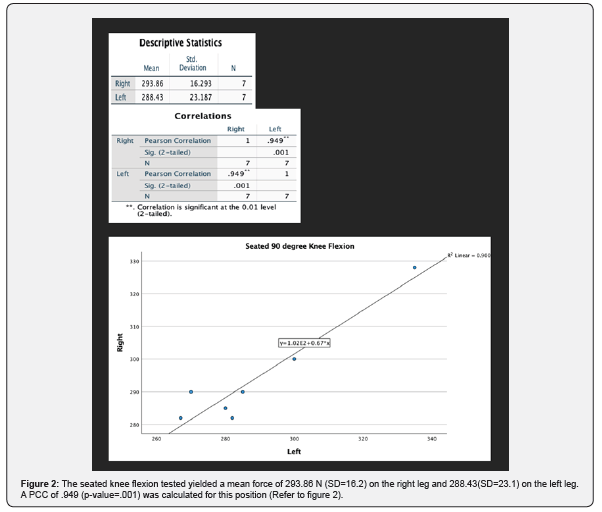
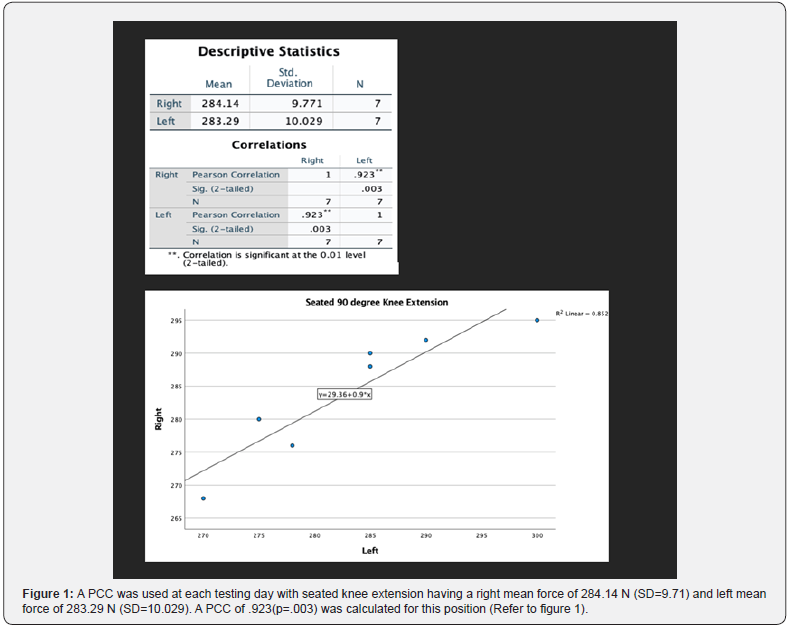
All participants were able to complete the study along with pertinent post-testing follow-up instructions/debrief. These instructions explained the method behind the study and allowed for participants to ask the researchers questions. Additionally, they were given resources should they be interested in learning or integrating isometric training into their program from a qualified professional. An independent t-test was used to explore differences between the supine and seated knee flexion position for hamstring testing. This revealed that the seated knee flexion position had a higher peak and average force (p-value <.05, CI 95%). Thus, the seated knee flexion variables were used in the final analysis. A Pearson correlation coefficient (PCC) was used to explore the relationship between the different days (Day 1, Day 3, Day 5, Day 7) between limbs since the data was parametric. Due to the reliability nature of the study, an ANOVA was not used to explore causation. A PCC was used at each testing day with seated knee extension having a right mean force of 284.14 N (SD=9.71) and left mean force of 283.29 N (SD=10.029). A PCC of .923(p=.003) was calculated for this position (Figure 1). The seated knee flexion tested yielded a mean force of 293.86 N (SD=16.2) on the right leg and 288.43(SD=23.1) on the left leg. A PCC of .949 (p-value=.001) was calculated for this position (Figure 2).
Discussion
Most of the literature in isometric testing has investigated either performance or return to play. Bui et al. [11] looked at quadriceps strength as an outcome for chronic obstructive pulmonary disease (COPD) using an HHD that was validated against a Biodex system in a pilot study [11]. The HHD was found to be both reliable and valid in testing quadriceps strength. Lienhard et al. [12] also looked at the clinical population and quadriceps function [12]. Twenty-nine total knee arthroplasty (TKA) patients were measured with isometric, isokinetic, and isoinertial settings in a Biodex using the seated position. Results showed all three styles of resistance were valid and reliable in assessing quadriceps strength. Using these results, it seems feasible that an HHD may also provide reliable isometric strength data. Hansen et al. [13] used a belt stabilized HHD to investigate validity, but also any discomfort associated with the sensor placement [13].
The authors found that a modified HHD approach which fastened the sensor to the leg of the table so only a foam pad was in contact with the subject’s leg was more comfortable than traditional placement. Both placements were also found to be valid and reliable alternatives to Biodex testing. Lesnak et al. [14] investigated rate of torque development using an HHD using Pearson product-moment correlation coefficients and Spearman’s rank correlation [14]. This was supplemented with Bland-Altman Plots to explore the agreement. This study showed that an HHD was a reliable way to measure peak torque and rate of torque development. When referring to the VALD Force Frame, most of the literature investigates isometric strength testing of the hip. Nielsen al. [15] looked at using the Force Frame as a potential alternative to the Copenhagen squeeze test for groin pathology [15].
Interestingly, the Force Frame testing yielded less groin pain and lower adduction strength. The testing positions for both are equal with tester forearm substituting for the force sensors. The lack of agreement may have been due to the larger space in subjects’ legs between the 5-second squeeze test vs the Force Frame alternative. These findings seem to be supported by O’Connor et al. [16] who compared the Force Frame to a sphygmomanometer in measuring hip adduction strength [16]. It was found both devices were valid in measuring strength, but Force Frame may be more beneficial since it gives a greater range of measures along with unilateral measures. These results were supported by Kadlec et al. [17] who found excellent testretest reliability on hip addiction (ICC .90-.92; CV% 5.0-5.7) and abduction (ICC .86-.91; CV% 6.2-6.9) [17]. Secomb et al. [18] expanded hip isometric testing by adding in joint angles [18]. The authors added 4 different joint angle-specific positions (0, 25, 50, 90) and found each position was not only valid but explained 46% of sprint performance and 85% of 505 agility time. Lastly, McBride et al. [19] found good-to-excellent intra-rater reliability when testing isometric neck strength in the quadruped position [19]. In support of the research by Ashworth et al. [4] and McVickers et al. (2022), Couch et al. [20] investigated internal and external strength on the Force Frame [20]. Results found good to excellent test-retest reliability (ICC .854-.916). These studies support our findings of excellent test-reliability when using the Force Frame to assess isometric strength, although this study looked at the hamstrings and quadriceps strength [21-23].
Conclusion
This paper shows the excellent test-retest reliability of the Force Frame isometric testing device for quadriceps and hamstrings strength. It is important to note the limitations of this study. The small sample size makes the power of the findings difficult to interpret. Similarly, the sample studies were not involved in organized sport which may lead to weakness when translating results to a team sport. Also, since this study is the first of its kind at the time of this writing, the testing apparatus and position may not have been ideal. The novelty of this experiment lies within its ability to use an established isometric device (Force Frame) to measure lower extremity strength. For example, the Force Frame has been validated in hip strength (adduction, abduction) and being able to also add in the quadriceps and hamstrings would be an efficient use of time. In future research, this paper will lay the foundation to allow researchers to recruit larger sample sizes specific to sports. Lastly, the authors are undergoing a validation study of the Force Frame to the Biodex. Force Frame provides a reliable and alternative method to assess quadriceps and hamstring isometric strength.
References
- Doege J, Ayres JM, Mackay MJ, Tarakemeh A, Brown SM, et al. (2021) Defining Return to Sport a Systematic Review. Orthop J Sports Med 9(7).
- Thomopoulos S, Williams GR, Soslowsky LJ (2003) Tendon to Bone Healing: Differences in Biomechanical, Structural, and Compositional Properties Due to a Range of Activity Levels. Journal of Biomechanical Engineering 125(1): 106-113.
- Rossi FE, Landreth A, Beam S, Jones T, Norton L, et al. (2017) The Effects of a Sports Nutrition Education Intervention on Nutritional Status, Sport Nutrition Knowledge, Body Composition, and Performance during Off Season Training in NCAA Division I Baseball Players. Journal of Sports Science & Medicine 16(1): 60-68.
- Hickey JT, Timmins RG, Maniar N, Williams MD, Opar DA (2017) Criteria for Progressing Rehabilitation and Determining Return-to-Play Clearance Following Hamstring Strain Injury: A Systematic Review. Sports Medicine 47(7): 1375-1387.
- Gustavsson A, Neeter C, Thomeé P, Grävare Silbernagel K, Augustsson J, et al. (2006) A test battery for evaluating hop performance in patients with an ACL injury and patients who have undergone ACL reconstruction. Knee Surgery Sports Traumatology Arthroscopy 14(8): 778-788.
- Królikowska A, Czamara A, Szuba Ł, Reichert P (2018) The effect of longer versus shorter duration of supervised physiotherapy after ACL reconstruction on the vertical jump landing limb symmetry. BioMed Research International.
- Roe G, Darrall-Jones J, Till K, Phibbs P, Read D, et al. (2016). Between-Days Reliability and Sensitivity of Common Fatigue Measures in Rugby Players. International Journal of Sports Physiology and Performance 11(5): 581-586.
- Ashworth B, Hogben P, Singh N, Tulloch L, Cohen DD (2018) The Athletic Shoulder (ASH) test: reliability of a novel upper body isometric strength test in elite rugby players. BMJ Open Sport & Exercise Medicine 4(1): e000365.
- Koblbauer IFH, Lambrecht Y, Van Der Hulst ML, Neeter C, Engelbert RHH, et al. (2011). Reliability of maximal isometric knee strength testing with modified hand-held dynamometry in patients awaiting total knee arthroplasty: Useful in research and individual patient settings? A reliability studies. BMC Musculoskeletal Disorders 12: 249.
- Yoshida Y, Mizner RL, Ramsey DK, Snyder-Mackler L (2008) Examining outcomes from total knee arthroplasty and the relationship between quadriceps strength and knee function over time. Clinical Biomechanics 23(3): 320-328.
- Bui KL, Mathur S, Dechman G, Maltais F, Camp P, et al. (2019) Fixed Handheld Dynamometry Provides Reliable and Valid Values for Quadriceps Isometric Strength in People with Chronic Obstructive Pulmonary Disease: A Multicenter Study. Physical Therapy 99(9): 1255-1267.
- Lienhard K, Lauermann SP, Schneider D, Item-Glatthorn JF, Casartelli NC, et al. (2013) Validity and reliability of isometric, isokinetic and isoinertial modalities for the assessment of quadriceps muscle strength in patients with total knee arthroplasty. Journal of Electromyography and Kinesiology 23(6): 1283-1288.
- Hansen EM, McCartney CN, Sweeney RS, Palimenio MR, Grindstaff TL (2015) Hand‐held Dynamometer Positioning Impacts Discomfort During Quadriceps Strength Testing: A Validity and Reliability Study. International Journal of Sports Physical Therapy 10(1): 62-68.
- Lesnak J, Anderson D, Farmer B, Katsavelis D, Grindstaff TL (2019) Validity of Hand-Held Dynamometry in Measuring Quadriceps Strength and Rate of Torque Development. International Journal of Sports Physical Therapy 14(2): 180-187.
- Nielsen MF, Thorborg K, Krommes K, Thornton KB, Hölmich P, et al. (2022) Hip adduction strength and provoked groin pain: A comparison of long-lever squeeze testing using the Force Frame and the Copenhagen 5-Second-Squeeze test. Physical Therapy in Sport 55: 28-36.
- O Connor C, McIntyre M, Delahunt E, Thorborg K (2023) Reliability and validity of common hip adduction strength measures: The Force Frame strength testing system versus the sphygmomanometer. Physical Therapy in Sport 59: 162-167.
- Kadlec D, Jordan MJ, Snyder L, Alderson J, Nimphius S (2021) Test Re-test Reliability of Single and Multi-joint Strength Properties in Female Australian Footballers. Sports Medicine Open 7(1): 1-5.
- Secomb JL, Dascombe BJ, Nimphius S (2021) Importance of joint angle-specific Hip strength for skating performance in semiprofessional ice hockey athletes. Journal of Strength and Conditioning Research 35(9): 2599-2603.
- McBride L, James RS, Alsop S, Oxford SW (2022) Intra and Inter-Rater Reliability of a Novel Isometric Test of Neck Strength. Sports 11(2).
- Couch J, Sayers M, Pizzari T (2021) Reliability of the Force Frame with and Without a Fixed Upper-Limb Mold in Shoulder Rotation Strength Assessments Compared with Traditional Hand-Held Dynamometry. Journal of Sport Rehabilitation 30(8): 1246-1249.
- Mann B (2021) Velocity-Based Training. Strength and Conditioning for Sports Performance pp. 529-534.
- Mcvicker Z, Cady A, Serrano B, Banffy M. Research Article Advances in Orthopedics and Sports Medicine, Kosmos Publishers, USA.
- Simmons L (2007) The Westside Barbell Book of Methods 2 The Westside Barbell Book of Methods.

























