




 JOJPH Home



Introduction
Extreme heat is now a recurrent and increasingly predictable public health emergency, particularly in low- and middle-income countries with limited cooling, water, housing, and occupational protections [1]. The World Meteorological Organization (WMO) confirmed 2024 as the warmest year on record, with the global mean surface temperature about 1.55°C above the 1850-1900 pre-industrial baseline [2]. In the same year, Pakistan experienced severe heat events, including temperatures exceeding 52°C in Sindh; Mohenjo-Daro recorded 52.2°C in May 2024 [3]. During the 2024 Sindh heatwave response period, the Provincial Disaster Management Authority Sindh documented 15,715 heatstroke cases treated, 66 casualties, and 167 livestock losses as of 30 July 2024 [4]. National Disaster Management Authority (NDMA) advisories also warned of heatwave conditions across southern and central Pakistan, with daytime temperatures expected to reach 46-50°C in several districts [5].
These figures should not be read as exceptional summer statistics. They signal that heat stroke, dehydration, acute kidney injury, and worsening chronic disease are becoming recurrent, predictable, climate-sensitive health threats and that health-system preparedness remains insufficient.
Heat stroke is the most severe form of heat-related illness. It is generally characterized by severe hyperthermia and central nervous system dysfunction, such as confusion, delirium, seizures, or coma. It may progress to multiorgan failure if cooling and supportive care are delayed [6,7]. Classic heat stroke occurs during environmental heat exposure, while exertional heat stroke affects individuals performing strenuous activity in hot conditions. Classic heat stroke is particularly relevant for older adults and chronically ill persons, while exertional heat stroke is relevant for outdoor workers, athletes, and emergency responders. Both forms are relevant to Pakistan, where heatwaves affect urban households, outdoor workers, and populations with constrained access to cooling.
Heat stroke burden and vulnerability in Pakistan
The burden of heat-related illness is unevenly distributed. Outdoor workers, agricultural labourers, construction workers, traffic police, sanitation staff, street vendors, brick-kiln workers, informal waste pickers, and delivery riders remain exposed during the hottest hours because their income depends on daily work. Older adults, infants, children, pregnant women, people with cardiovascular, renal, respiratory, or metabolic disease, persons with disabilities, and those taking medicines that impair thermoregulation carry a higher physiological risk. The Lancet Countdown Pakistan profile estimated 26 billion potential Labour hours lost to heat exposure in 2023 and documented markedly increased heatwave day exposure in infants and adults over 65 years compared with the 1986-2005 reference period [8,9]. In low-income urban settlements, risk is further amplified by overcrowded rooms, metal roofs, poor ventilation, unreliable electricity, limited water supply, and no access to safe cooling spaces. Heat illness is therefore not only a clinical emergency, but it is also a problem of poverty, housing, Labour protection, and urban governance.
Pakistan’s heat vulnerability reflects geography, climate, urbanization, poverty, and infrastructure constraints. Much of the country is naturally hot during pre-monsoon months, but climate change is increasing the probability of more severe and persistent heat extremes. The World Bank’s Climate and Health Vulnerability Assessment identifies extreme heat as a major climate-related health risk in Pakistan, with future increases in heat-related mortality and Labour productivity losses expected under highemissions scenarios [10].
Urban heat islands in major cities and hot urban centres, including Karachi, Lahore, Multan, Hyderabad, Jacobabad, and Sukkur, intensify night-time heat exposure and reduce physiological recovery, particularly in dense settlements with limited green space and poor ventilation. The 2015 Karachi heatwave, in which more than 1,200 people were estimated to have died over a few days, illustrated how quickly urban heat island effects, power outages, water shortages, and fragmented emergency services can combine to overwhelm a city’s capacity to respond [11]. Pakistan’s vulnerability also raises concerns of climate injustice. The country’s contribution to historical global greenhouse gas emissions is small, yet it faces major climate impacts, including heatwaves, floods, droughts, and water insecurity. Pakistan’s National Climate Change Policy recognizes that the country’s contribution to global emissions is limited, but that adaptation is an immediate and pressing national priority [12]. Heat-related illness is therefore not only a hospital problem; it is a marker of the health system’s capacity to adapt to a warming climate.
Surveillance and reporting gaps
Despite recurrent heat emergencies, Pakistan lacks a standardized national surveillance system for heat illness, as reflected in the current national priority disease notification list [4]. Seasonal advisories and provincial situation reports are important, but they do not substitute for routine, casebased, nationally comparable reporting. Hospital-level data are often fragmented across emergency departments, outpatient departments, ambulance systems, private hospitals, public hospitals, disaster management authorities, and mortality registries. Diagnostic labels may vary, with heat exhaustion, dehydration, fever, syncope, renal injury, or sudden death recorded without attribution to heat exposure, particularly among older patients and those with chronic disease. Informal workers may delay or avoid care because loss of daily wages competes with care-seeking.
Current priority disease notification in Pakistan is largely oriented toward infectious diseases, outbreak-prone conditions, and zoonotic conditions for surveillance and response; heat stroke is not listed as a priority condition [13]. The National Institute of Health’s Integrated Disease Surveillance and Response system provides valuable infrastructure for outbreak detection and data management, but without a standard heat illness case definition and a reporting requirement, severe heat illness remains inconsistently captured [14]. During Sindh’s 2024 heatwave, provincial authorities documented 15,715 heatstroke cases treated, 66 casualties, and 167 livestock losses across affected districts. These figures illustrate both the scale of service demand during prolonged heat events and the need to convert emergency reporting into routine, comparable, national heat-health surveillance [4].
Why heat stroke should be notifiable
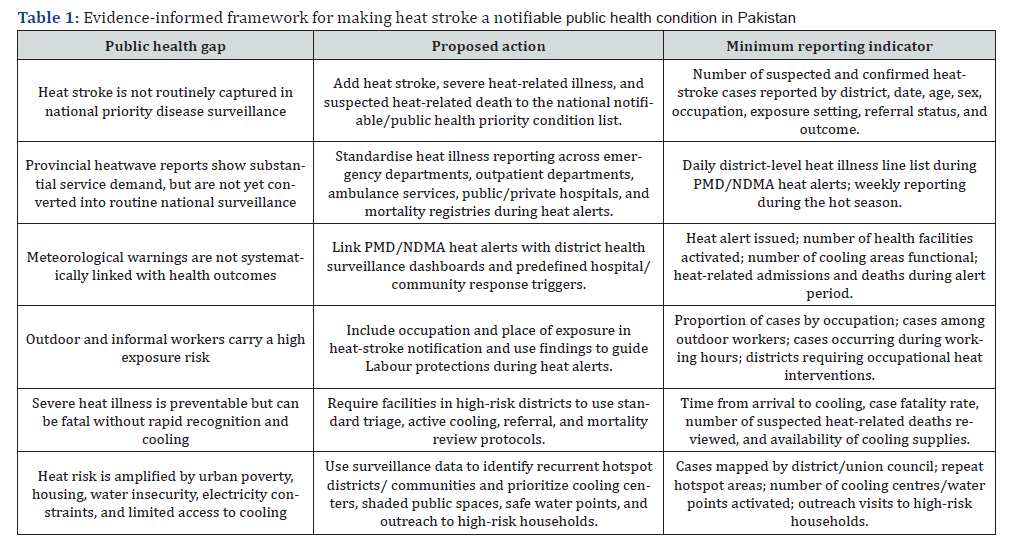
Making severe heat illness, heat stroke, and suspected heatrelated death nationally notifiable would provide several concrete public health benefits. First, it would enable early detection of unusual case clusters. A rise in emergency presentations during a heat alert could trigger pre-positioned cooling supplies, ambulance readiness, hospital surge staffing, and targeted outreach to vulnerable communities before a surge becomes unmanageable. Second, case-based data would improve resource allocation, allowing districts with recurrent heat stroke clusters to be prioritized for shaded public spaces, emergency cooling equipment, occupational inspections, and water access points.
Third, notifiable status would strengthen mortality prevention. Heat stroke can be fatal but is often preventable when risk is recognized early, and treatment, including active cooling, hydration, and urgent referral, begins without delay, especially where rapid cooling protocols and referral pathways are standardized. Fourth, a notifiable system would institutionalise coordination between the Pakistan Meteorological Department, the National Institute of Health, federal and provincial health departments, disaster management authorities, Labour departments, and local governments. Meteorological warnings without health outcome data remain incomplete; health data without climate linkage miss opportunities for prevention. A reportable system creates a bridge between the two.
Pakistan already has relevant surveillance infrastructure that could be adapted. The country has used DHIS2-based platforms for flood-related disease monitoring during emergencies [15]. Severe heat illness could be integrated into DHIS2/IDSR-linked reporting through standardized suspected and confirmed case definitions, daily district reporting during heat alerts, and a mortality review module for suspected heat-related deaths. WHO and WMO guidance emphasizes that effective heat-health warning systems require close operational collaboration between meteorological and health services and must be embedded within broader heat-health action plans, not issued as separate seasonal advisories [16].
Towards a national heat-health action plan
Surveillance reform is necessary but not sufficient. Healthsystem preparedness must begin before the hot season arrives. District hospitals in high-risk areas should have designated heatstroke management areas equipped with thermometers, cooling sheets, fans, ice packs, cold water for evaporative cooling, oral rehydration solution, intravenous fluids, and basic laboratory support. Emergency staff must be trained to recognize heat stroke early and start active cooling immediately, without waiting for transfer. Primary care teams and community health workers, currently underused in heatwave response, can identify high-risk households, check on older people living alone, guide families on warning signs, and direct them to cooling centers or safe public spaces.
Occupational heat protection is equally urgent but remains insufficiently institutionalized and weakly enforced. WHO and the International Labour Organization have both emphasized that rising temperatures are already causing measurable harm to workers’ health and productivity, particularly in manual Labour sectors [17,18]. Pakistan needs enforceable heat protections for outdoor and high-heat indoor workers during heatwave alerts: adjusted working hours, mandatory shaded rest areas, safe drinking water, scheduled breaks, emergency response training, and protection against wage loss when work is paused during dangerous heat. Without such protections, the poorest workers will continue to carry the highest heat-related health risk while having the fewest choices about exposure.
Long-term prevention must also address environmental conditions that make heat more dangerous. Air pollution can worsen cardiopulmonary vulnerability during heat events; therefore, heat-health planning should be integrated with cleanair and climate policies [19]. For Pakistan, reducing air pollution is not separate from heat-stroke prevention; it is part of protecting health in a warming climate.
Conclusion
Heat stroke in Pakistan is a predictable, preventable, and measurable climate-sensitive public health priority that requires more than seasonal warnings. Its burden is shaped by extreme heat, urban design, poverty, occupational exposure, water insecurity, electricity constraints, and chronic disease, but the absence of standardized national reporting leaves decision-makers without timely information on where severe illness and death are occurring, who is most affected, and which interventions are effective. Declaring heat stroke and suspected heat-related death as nationally notifiable conditions is a practical, achievable first step. By linking notifiable surveillance to hospital readiness, community outreach, occupational protection, urban planning, and cleaner air, Pakistan can move from reactive crisis management to genuine prevention. This would be a practical step toward climate-resilient public health planning. The next severe heatwave should not find the health system, workers, or vulnerable communities as unprepared as the last one did.
Acknowledgements: None
Conflict of interest: The author(s) declared no competing interests
Ethical considerations: Not applicable. This Perspective does not involve human participants, animal subjects, human tissue, or identifiable personal data.
Authors’ contribution / CRediT: Conceptualization: Syed Jawad Ali Bukhari and Sania Jahan, Data curation: Syed Jawad Ali Bukhari and Sania Jahan, Investigation: Syed Jawad Ali Bukhari and Sania Jahan, Writing-original draft: Syed Jawad Ali Bukhari and Sania Jahan, Writing-review & editing: Syed Jawad Ali Bukhari and Sania Jahan
Funding: No funding was received for this work
References
- Hundessa S, Huang W, Xu R, Yang Z, Zhao Q, et al. (2025) Global excess deaths associated with heatwaves in 2023 and the contribution of human-induced climate change. The Innovation 6(10): 1-17.
- WMO confirms 2024 as warmest year on record at about 1.55°C above pre-industrial level.
- Soomro A, Shahid A (2024) Pakistan temperatures cross 52°C in heatwave. Reuters.
- Provincial Disaster Management Authority Sindh. Situation report for heatwave 2024: as of 30 July 2024. Karachi. Government of Sindh.
- National Disaster Management Authority (2025) Heat wave survival guide and best practices. Islamabad, Pakistan: Pakistan Meteorological Department, National Weather Forecasting Centre.
- Bouchama A, Knochel JP (2002) Heat Stroke. N Engl J Med 346(25): 1978-1988.
- Epstein Y, Yanovich R (2019) Heatstroke. Longo DL editor N Engl J Med 380(25): 2449-2459.
- Romanello M, Walawender M, Hsu SC, Moskeland A, Palmeiro-Silva Y, et al. (2024) The 2024 report of the Lancet Countdown on health and climate change: facing record-breaking threats from delayed action. The Lancet 404(10465): 1847-1896.
- Romanello M, Napoli CD, Green C, Kennard H, Lampard P, et al. (2023) The 2023 report of the Lancet Countdown on health and climate change: the imperative for a health-centred response in a world facing irreversible harms. The Lancet 402(10419): 2346-2394.
- World Bank (2024) Pakistan-Climate and Health Vulnerability Assessment. Washington, DC: World Bank.
- Ministry of Climate Change (2015) Technical report on Karachi heat wave June 2015. Islamabad Government of Pakistan, Ministry of Climate Change.
- Government of Pakistan, Ministry of Climate Change (2021) National Climate Change Policy 2021. Islamabad: Ministry of Climate Change.
- Government of Pakistan, Ministry of National Health Services, Regulations and Coordination. Notification of priority diseases in Pakistan. Islamabad. MoNHSRC 2020.
- National Institute of Health Pakistan (2024) Integrated Disease Surveillance and Response weekly bulletin. Islamabad, Pakistan. (Public Health Bulletin).
- Chikwado (2023) Pakistan uses Integrated Outbreak Analytics with DHIS2 to respond to flood-related disease outbreaks. DHIS2.
- McGregor GR, Bessemoulin P, Ebi KL, Menne B (2015) Heatwaves and health: guidance on warning-system development. Geneva: World Meteorological Organization: World Health Organization.
- International Labour Organization (2024) Heat at work: implications for safety and health. Geneva: International Labour Organization Pp: 1-106.
- WHO (2025) Workplace heat stress: questions and answers. Geneva: WHO.
- WHO (2026) Air quality, energy and health. WHO.

























