




 JOJPH Home



Introduction
For most, if not all, transgender persons, the gender
transitioning process involves numerous steps, many of which
are, oftentimes, complicated and complex. Typically, the
transitioning process takes place over the span of several years
[1,2]. For many transgender individuals, transitioning becomes a
life-long endeavor that is never brought to a point of completion.
Some transgender persons, for example, choose not to undergo
certain gender-conforming surgical procedures or to take genderaffirming
hormones, whereas other transgender individuals
actively seek out these medical assistance strategies to help
facilitate the physical aspects of their transitioning. For a variety
of reasons, some transgender persons choose to live part-time
as members of their gender assigned at birth (depending upon
the social situation/context at hand, the people they are with,
etc.) and part-time as members of their affirmed gender, whereas
other transgender individuals actively strive toward living a life
in which they live full-time as a member of their affirmed gender
[3]. For transgender persons who reach a point where they are
living full-time as a member of their affirmed gender, an identity
adjustment must be made whereby the persons in question come
to identify themselves as a transgender person who will live solely
as a member of their affirmed gender. Belamghari [4] put it well:
To provide their psychological and physical security, individuals
are inclined toward adopting and adapting to the culture, behaviors,
social values, ethics, or doxas of their community. The result is an
identity that comprises shared values, norms, and morals by which
a community comes to identify itself. By identity, people seek to
differentiate themselves from others, all for the sake of forming a
new offshoot of identity that is common to a group of people who
experience the world in the same way. . . . Hence, to acquire an
identity one must either identify oneself with someone and/or be
perceived as different from someone else.
Sometimes, this type of identity is referred to as “the crystallized self” [5] or the associated behaviors as “crystallized behaviors.” The crystallized self and crystallized behaviors are the ways that people think of themselves and the things that they do that are not subject to modification based on specific circumstances or the people with whom one interacts. Thus, when transgender individuals begin living full-time as members of their affirmed gender, they are demonstrating crystallized behaviors that reflect the true identity inherent in their crystallized self. Moreover, what many transgender persons refer to as living authentically (i.e., living their lives as their true transgender selves) may also be construed as a manifestation of “self-verification.” “Self-verification” is a process in which “people strive for consistency between how they view themselves and how others react and respond to them, including to their social identities” [6]. It is a process that allows people to construe their life experiences as being more orderly and more comprehensible than they otherwise would be [7].
Given the momentousness of the transitions from living as a member of one’s gender assigned at birth to living part-time as a member of one’s affirmed gender to living full-time as a member of one’s affirmed gender, it is surprising that very little research has been conducted to examine people’s life experiences in the aftermath of making these important life transitions. Indeed, little is known about how making this particular life transition affects transgender persons. One exception to this is the work done by Doyle [6], who noted that, subsequent to their gender transitioning, some transgender individuals suffer from a loss of identity within the broader LGBTQ community. Doyle [6] also made a point of highlighting the fact that there has been very little research examining identity affirmation among transgender persons, and noted that research focusing on the psychosocial factors relating to gender identity affirmation is an understudied area that would be beneficial for future researchers to explore. Bockting [8] also stated that much more research examining the relationship between transitioning and mental health outcomes is needed.
Accordingly, this is the subject of the present research. Specifically, in this paper, the present authors focus on the first two years of transgender people’s lives after they have begun living full-time as members of their affirmed gender. As people who are new to full-time transgender living, in this article, these individuals are referred to as “newbies”-implying not that they are new to having a transgender identity but rather that they are new to living full-time with this identity. Coinciding with this, some persons in the present research are designated as “long-timers”- that is, persons who have been living for ten or more years as a member of their affirmed gender.
This study examines the following research questions: (1) Among transgender adults, how prevalent is living full-time as a member of their affirmed gender? Along with this, among people who are living full-time as a member of their affirmed gender, for how many years have they been living this way? (2) Are there differences between “newbies” and persons who have been living for a longer period of time as members of their affirmed gender when it comes to their levels of psychological distress? (3) Are there differences between “newbies” and persons who have been living for longer periods of time as members of their affirmed gender when it comes to suicidal ideation? (4) When the impact of other key independent variables is controlled, does being a “newbie” still have an impact on transgender persons’ likelihood of experiencing psychological distress? (5) When the impact of other key independent variables is controlled, does being a “newbie” still have an impact on transgender person’s odds of experiencing suicidal ideation?
Methods
Data and Procedures
The data for the present research came from the 2015 U.S. Transgender Survey (USTS2015) [9]. Data were collected during the summer of 2015, from a total sample of 27,715 transgender persons residing anywhere in the United States or one of its territories, or who were living overseas while serving actively in the U.S. military. In the present study, most of the analyses were completed using data only data for persons who said that they were living full-time as a member of their affirmed gender (n=16,580). At the time it was undertaken, it was the largest study of its kind ever having been undertaken to understand transgender persons’ lives. Access to the survey was centralized via a single online portal/website, and all persons completed the survey online. It could be completed via any type of web-enabled device (e.g., computer, tablet, smart phone, etc.) and was available both in English and Spanish language versions.
The questionnaire collected information pertaining to a wide variety of types of harassment, discrimination, and violence that transgender persons may have experienced in a wide variety of settings, such as work, school, public restrooms, public places, governmental offices, while serving in the military, among others. The USTS2015 questionnaire contained some information pertaining to substance use/abuse and mental health functioning. It also captured information about various aspects of the transitioning process, including social aspects of transitioning (e.g., divulging information about one’s transgender identity to partners, friends, family members, coworkers, etc.), taking hormone treatments, and various surgical procedures that might be undergone to facilitate gender identity integration. Detailed demographic data about each respondent were also collected.
Participants were offered the opportunity to win either a $500 participation grand prize (n=1) or a $250 participation prize (n=2), chosen by random at the end of the data collection period. More than one-third (35.2%) of the eligible persons opted not to enter in the prize drawing. If they did not enter the raffle or were not one of the three prize winners chosen at random, then participation entailed receiving no other rewards/incentives/ remunerations.
Extremely detailed information about the study, its content, its initial development, and its implementation may be found in James et al. [9]. The original USTS2015 study received institutional review board approval from the University of California-Los Angeles prior to implementation. The present research for the secondary analysis of the USTS2015 data received institutional review board approval from [REDACTED FOR REVIEW].
Measures Used
In these analyses, the main independent variable of interestlength of time living as a member of one’s affirmed gender-was derived from three questionnaire items. First, respondents were asked the yes/no question “Do you currently live full-time in a gender that is different from the one assigned to you at birth?” Second, people who responded “yes” to this item were asked “How old were you when you started to live full-time in a gender that is different from the one assigned to you at birth?” Third, that item, in turn, was combined with their current age to derive a measure indicating the length of time, in years, that they had been living full-time as a member of their affirmed gender. In total, data are available for 16,524 persons who reported living full-time as a member of their affirmed gender and who had provided valid responses to the question about their current age.
In the analyses that follow, respondents who reported having lived for less than two years as a full-time member of their affirmed gender are referred to as “newbies,” indicating that they are persons who are relatively new to full-time living as a member of their affirmed gender. Conversely, people who reported having lived for ten or more years as a member of their affirmed gender are referred to as “long-timers,” indicative not of their age per se but rather of the amount of time that they have been living fulltime as a member of their affirmed gender.
Psychological distress was assessed using the Kessler-6 Scale [10]. It consists of six items, summed to create an overall level of psychological distress score. Each item inquired how frequently, during the previous 30 days, people felt (1) so sad that nothing could cheer them up, (2) nervous, (3) restless or fidgety, (4) hopeless, (5) that everything was an effort, and (6) worthless. Each item had four ordinal responses, including “never” (scored 0), “a little of the time” (scored 1), “some of the time” (scored 2), “most of the time” (scored 3), and “all of the time” (scored 4). The scale is reliable, with a Cronbach’s alpha of 0.91. In the present research, scores on the Kessler-6 scale were converted to a dichotomous measure indicating “serious psychological distress” or “no serious psychological distress,” based on the criteria set forth by Prochaska and colleagues [11]. “Serious psychological distress” was defined as a scale score of 13 or greater.
Suicidal ideation was assessed using a single item indicating whether or not the person had considered ending his/her/their life during the previous year.
Numerous variables were used as covariates in the multivariate analyses undertaken in conjunction with this research. First, several sociodemographic variables were examined: age (continuous), gender identity (dichotomous, male or female), binary versus nonbinary identity (dichotomous), educational attainment (dichotomous, at least a college education versus less education), relationship status (dichotomous, married or “involved” with someone versus not married/“involved”), living situation (dichotomous, lives alone versus lives with at least one other person), overall health (self-assessed, ordinal), lives near or below the poverty line (dichotomous, yes/no), and visual conformity with one’s affirmed gender (a dichotomous measure coded yes/no in these analyses, based on a recording of the original ordinal questionnaire item asking respondents how often people can tell that they are transgender even if the respondent had not informed them of that).
Second, the extent to which people experienced antitransgender discrimination, harassment, and/or violence during the previous year was used as another covariate in the present study’s multivariate analyses. It is a scale measure comprised by 20 items, each scored 0 (did not happen) or 1 (happened). These were: (1) no family support or very low level of family support for being transgender, (2) leaving or being ejected from a religious/ faith community due to being transgender, (3) experienced transgender-related discrimination or problems with one’s health insurance company, (4) experienced discrimination, harassment, or substandard care from a doctor or other healthcare professional because of being transgender, (5) a general perception of being treated unequally as a result of being transgender, (6) experienced verbal harassment from others due to being transgender, (7) was physically attacked by another person due to being transgender, (8) being harassed or threatened when using a public restroom, (9) terminated from a job due to being transgender, (10) being forced or feeling coerced to leave a job due to being transgender, (11) not being hired for a job or not being promoted as a result of being transgender, (12) feeling a need to take specific steps at work in order to avoid transgender-related problems or confrontations, (13) having problems with one’s work supervisor as a result of being transgender, (14) was physically assaulted or attacked at work due to being transgender, (15) experienced housing-related discrimination or harassment due to one’s gender identity or gender expression, (16) feeling a need to avoid utilizing public services just to minimize the chances of experiencing transgenderrelated discrimination or harassment, (17) experienced bullying or other types of transgender-related harassment in school prior to high school graduation, (18) experienced bullying or other types of transgender-related harassment in college, (19) was treated unequally or harassed by Transportation Security Administration (TSA) personnel when trying to travel, and (20) was treated unequally or harassed by members of the police force as a result of being transgender. This scale is reliable, with a Cronbach’s alpha coefficient of 0.76.
Third, in other published works (REDACTED FOR REVIEW), the present authors determined that various transition milestones are related to overall level of psychological distress, serious psychological distress, and suicidal ideation among transgender people. Accordingly, in the present study, six such measuresall scored dichotomously as “milestone reached” or “milestone not reached”-were included as covariates in the multivariate analysis: (1) disclosed being transgender to all of one’s family members, (2) disclosed being transgender to all of one’s friends, (3) disclosed being transgender to all of one’s coworkers/ classmates, (4) changed one’s name and/or gender on one’s legal documents, (5) began taking gender-affirming hormones, and (6) had any gender-conforming surgical procedures. Each of these transition milestones measures was derived from separate items in the questionnaire, each inquiring about different aspects of respondents’ gender transitioning experiences.
Statistical Analysis
Due to the large sample size used in this study, throughout this paper, results are reported as being statistically significant whenever p<.01 instead of the more-commonly-used p<.05. Using a more-rigorous standard for construing a finding as being indicative of statistical significance is advisable in a study such as the present one, in which a relatively large sample size is used. The use of this level of increased scientific rigor is supported by statisticians who have discussed the merits and drawbacks of adopting various p-value thresholds [12,13].
Both parts of Research Question #1 rely upon descriptive statistics for answers. For Research Question #2, the emphasis was on levels of psychological distress, with the aim to determine whether there are differences between “newbies” and people who have been living for a longer period of time as a full-time member of their affirmed gender. Since the independent variable was dichotomous in nature and the dependent variable was continuous, this question was examined via Student’s t test. Comparable analysis was undertaken to compare “long-timers” with persons who have been living for fewer than ten years as a full-time member of their affirmed gender. Additionally, analyses also involved examination of serious psychological distress, which was a dichotomous measure. For those comparisons, odds ratios (OR) were computed with 95% confidence intervals (CI95) being reported.
For Research Question #3, the focus was on suicidal ideation (a dichotomous variable) and whether or not there were differences between “newbies” and persons who have been living longer as a full-time member of their affirmed gender, or between “longtimers” and those who have been living fewer years as a full-time member of their affirmed gender. For these analyses, odds ratios (OR) were computed with 95% confidence intervals (CI95) being reported.
Both Research Question #4 and Research Question #5 entailed undertaking multivariate analysis. For both questions, the “newbies”-versus-all-others measure was entered as one of the covariates, alongside the demographic measures, transition milestones items, and anti-transgender harassment, discrimination, and violence measure described above. For Research Question #4, for which the outcome measure was a continuous variable, multiple regression was used. For Research Question #5, for which the outcome measure was a dichotomous variable, multivariate logistic regression was used.
As will be noted in the Results section below, the results obtained from these analyses indicated that it might be valuable to undertake a structural equation analysis as well, in an effort to determine the true nature of the role that being a “newbie” plays in helping to understand psychological distress and suicidal ideation in this population. Accordingly, the results obtained in the multivariate analyses were mapped into a structural equation model, which then was subjected to testing for its goodness-of-fit and overall suitability as a way of representing the relationships amongst the variables in the model. A structural equation model is said to be a good representation of the data when four criteria are met: (1) the model has a goodness-of-fit index of 0.90 or greater, (2), the root mean squared error approximation value is no greater than 0.05, (3) the Bentler-Bonett normed fit index has a value of 0.90 or greater, and (4) the chi-squared test for the model is statistically nonsignificant.
Results
Prevalence Information
Slightly more than one-half of the USTS2015 participants (59.8%) reported living full-time as a member of their affirmed gender. The remaining individuals have been excluded from the analyses conducted/reported in this paper.
Almost one-third (31.2%) of the persons who reported living full-time as a member of their affirmed gender said that they have been doing so for less than two years. An additional 24.8% of the study participants reported having lived as a member of their affirmed gender for two or three years, and 14.3% said that they had been living as a member of their affirmed gender for four or five years. Approximately one person in six (16.9%) reported having lived as a member of his/her/their affirmed gender for ten years or longer.
Psychological Distress
Transgender people who had been living less than two years full-time as a member of their affirmed gender experienced higher overall levels of psychological distress than their counterparts who had been living full-time as a member of their affirmed gender for a longer period of time (10.94 versus 9.78, t=11.29, p<.0001). Newbies were significantly more likely than people who had been living full-time as a member of their affirmed gender for a longer period of time to experience serious psychological distress (OR=1.30, CI95=1.21-1.39, p<.0001). Figure 1 shows that these differences were relatively linear in nature: The more years that people had been living full-time as a member of their affirmed gender, the lower their overall levels of psychological distress tended to be and the less likely they were to report experiencing serious psychological distress (p<.0001 for both measures). Figure 1
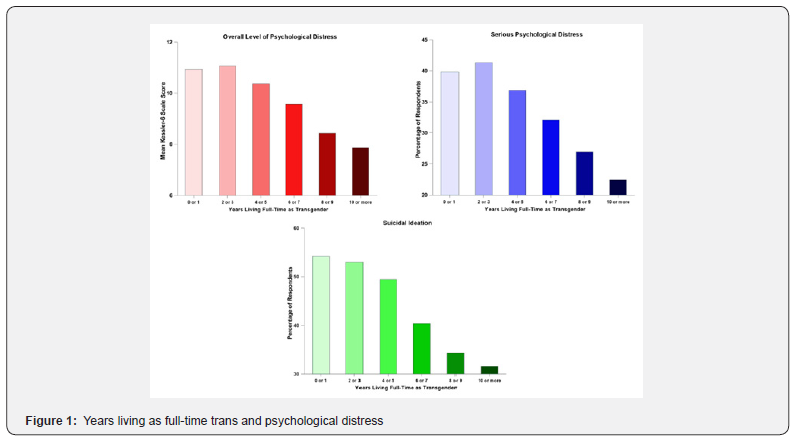
Conversely, long-timers reported significantly lower overall psychological distress levels when compared to all persons who had been living for fewer years as a full-time member of their affirmed gender (7.86 versus 10.60, t=21.57, p<.0001). They were also much less likely to report experiencing serious psychological distress (OR =0.47, CI95=0.42-0.51, p<.0001).
Intergroup differences were particularly pronounced when comparisons were made between newbies and long-timers. Newbies had much higher overall psychological distress scores than long-timers did (10.94 versus 7.86, t=21.97, p<.0001). They were also more than twice as likely to report experiencing serious psychological distress (OR=2.29, CI95=2.06-2.55, p<.0001).
Suicidal Ideation
Newbies were significantly more likely than people who had been living more than two years full-time as transgender to experience suicidal ideation (OR=1.49, CI95=1.39-1.59, p<.0001). Conversely, long-timers were significantly less likely to thinking about dying by suicide when compared to persons who had been living full-time as transgender for fewer than ten years (OR=0.45, CI95=0.42-0.49, p<.0001). Once again, the differences between newbies and long-timers were particularly pronounced, with the former being more than twice as likely as the latter to experience suicidal ideation during the preceding year (OR=2.56, CI95=2.32- 2.82, p<.0001). Figure 1 shows that these differences were linear in nature: The more years that people had been living full-time as a member of their affirmed gender, the less likely they were to report experiencing suicidal ideation (p<.0001).
Multivariate Analyses
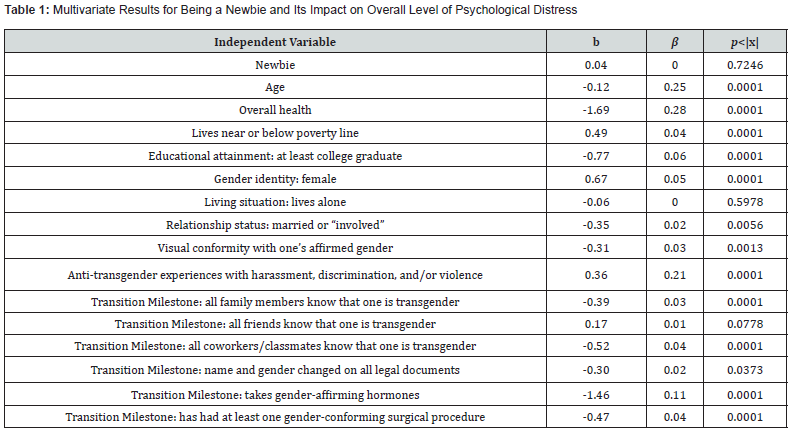
Table 1 presents the findings obtained for the multivariate analyses examining the factors related to overall level of psychological distress. Of the sixteen variables entered into the equation, twelve were found to be predictive of respondents’ level of psychological distress. These were: (1) age (b=-0.12, β=0.25, p<.0001), (2) overall health (b=-1.69, β=0.28, p<.0001), (3) living near or below the poverty line (b=0.49, β=0.04, p<.0001), (4) educational attainment (b=-0.77, β=0.06, p<.0001), (5) gender identity (b=0.67, β=0.05, p<.0001), (6) relationship status (b=-0.35, β=0.02, p=.0056), (7) visual conformity with one’s affirmed gender (b=-0.31, β=0.03, p=.0013), (8) anti-transgender experiences with harassment, discrimination, and/or violence (b=0.36, β=0.21, p<.0001), (9) the transition milestone of telling family members that one is transgender (b=-0.39, β=0.03, p<.0001), (10) the transition milestone of telling coworkers and/or classmates that one is transgender (b=-0.52, β=0.04, p<.0001), (11) the transition milestone of taking gender-affirming hormones (b=-1.46, β=0.11, p<.0001), and (12) the transition milestone of having had at least one gender-conforming surgical procedure (b=-0.47, β=0.04, p<.0001). Taken together, the items in this multivariate model explained 36.1% of the total variance. Of importance to the present paper, the “newbie” measure was not among the statistically-significant predictors of psychological distress. Table 1
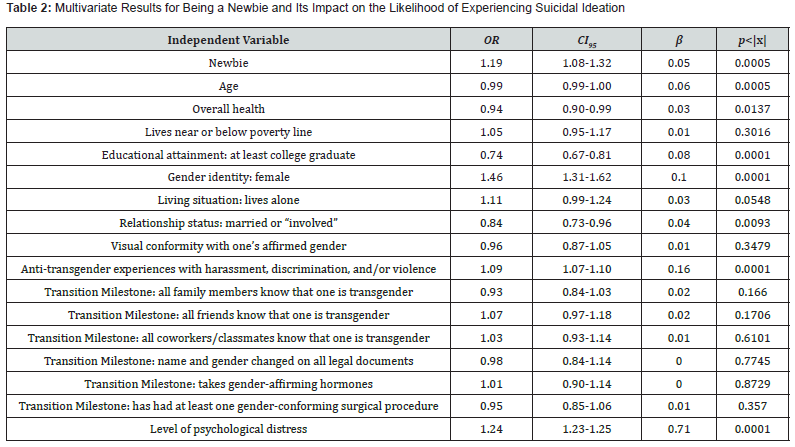
Table 2 presents the findings obtained for the multivariate analyses examining the factors related to whether or not people had experienced suicidal ideation during the previous year. Of the sixteen variables entered into the equation, eight were found to be predictive of whether or not respondents had thought about dying by suicide during the preceding year. These were: (1) whether or not one was a “newbie” (OR=1.19, CI95=1.08-1.32, β=0.05, p=.0005), (2) age (OR=0.99, CI95=0.99-1.00, β=0.06, p=.0005), (3) educational attainment (OR=0.74, CI95=0.67-0.81, β=0.08, p<.0001), (4) gender identity (OR=1.46, CI95=1.31-1.62, β=0.10, p<.0001), (5) relationship status (OR=0.84, CI95=0.73-0.96, β=0.04, p=.0093), (6) anti-transgender experiences with discrimination, harassment, and/or violence (OR=1.09, CI95=1.07-1.10, β=0.16, p<.0001), (7) level of psychological distress (OR=1.24, CI95=1.23- 1.25, β=0.71, p<.0001), and overall health (OR=0.94, CI95=0.90- 0.97, β=0.08, p<.0001). Taken together, these items explained 41.0% of the total variance.
Structural Equation Analysis
Figure 2 presents the structural equation model that was tested to determine whether being a “newbie” was influential in determining people’s likelihood of experiencing suicidal ideation. The model demonstrates that being a “newbie” was, indeed, a key, direct predictor of suicidal ideation (p<.001), along with age (younger, p<.001), educational attainment (less than a college graduate, p<.0001), gender identity (female, p<.0001), psychological distress (greater, p<.0001), anti-transgender experiences with harassment, discrimination, and/or violence (more, p<.0001), and relationship status (not being married or “involved,” p<.01).
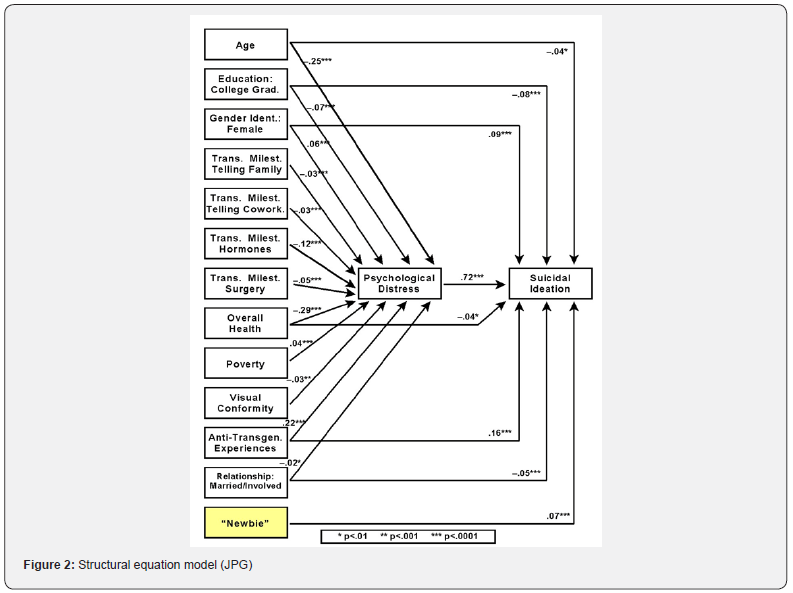
The model depicted in Figure 2 has a goodness-of-fit index value of 0.999. The root mean square error approximation value is 0.006. The chi-square test for this model was statistically nonsignificant (as desired), with p=.207. The Bentler-Bonett normed fit index for this model is 0.999. Therefore, this model is an excellent fit for the data and represents an excellent way of depicting the relationships among the variables used in the analysis. Figure 2
Discussion
This paper has demonstrated that the length of time that transgender individuals have been living full-time as a member of their affirmed gender has a major impact upon their mental health. The longer they have been living full-time as a member of their affirmed gender, the less they tend to be affected adversely by psychological distress and the less likely they are to have thought about dying by suicide. These relationships are fairly linear in nature, and differences between “newbies”-that is, persons who have been living as a member of their affirmed gender for less than two years-and “long timers”-that is, persons who have been living as a member of their affirmed gender for at least ten years-are particularly noteworthy and sizable. This highlights the importance of providing support to transgender individuals as they transition from their gender assigned at birth to part-time living in their gender of identity to full-time living as a person of their affirmed gender. It also speaks to the fact that, with time and experience living full time as a member of their affirmed gender, many transgender people “settle into” their burgeoning identity and become more comfortable with themselves and with their lives as transgender persons.
Intriguingly, almost nothing has been written in the
scholarly literature relating to the amount of time that
transgender individuals have been living full-time as a member
of their affirmed gender, or how more versus less time impacts
transgender persons’ lives. Fein and colleagues [14] examined the
relationship between the amount of time elapsing between first
self-identifying as transgender and its impact upon preferences
for sexual partners. Their research, however, is related only
tangentially to the present study. Somewhat more relevant to the
present research is the work published by Reynolds and Goldstein
[15], who focused their attention on life changes brought about by
gender transitioning and the processes involved in rediscovering
one’s identity and establishing a new(ish) life post-transitioning.
Their work, however, did not focus on issues surrounding length
of time post-transitioning or how the passage of time affects
transgender persons’ lives. One small study (n=20) conducted in
the Netherlands [16] found that transgender individuals reported
improved psychological well-being after completing their
transitioning, but that these persons also continued to experience
various types of life challenges. For transgender women in
their study, for example, socioeconomic challenges arose posttransition.
A different reality existed for the transgender men in
their study, however:
Participants who identified as (trans) men also reported positive
experiences regarding their social status as a man. They indicated
that, after the transition, they felt more heard and seen during
conversations, in contrast to their former experiences as a female
assigned at birth (p. 225). In addition, the authors noted (p. 224)
that, in addition to enjoying the outcomes of their transition, most
participants mentioned uncertainty about living in their gender
identity due to their limited knowledge about issues related to their
gender. Moreover, Beside the “gains” after transition participants
reported losses in terms of their sexuality, contact with friends,
work, and their partner (p. 225).
Verbeek and colleagues [16] also pointed out that there were numerous other benefits and drawbacks associated with the post-transition period for participants in their research, with substantial differences in experiences/challenges occurring for transgender men versus transgender women. Unlike the present study, however, one thing that Verbeek et al. [16] did not do is examine how these experiences and challenges, both positive and negative alike, changed over time post-transition. This is one of the important contributions that the present research makes to the scholarly literature.
One intriguing and unexpected finding from the present study is that, despite the strong bivariate relationship between being a “newbie” and experiencing higher levels of psychological distress, this relationship washed out in the multivariate analysis. In no small part, this appears to be due to the impact of the transition milestones measures on respondents’ level of psychological distress. In the multivariate analysis, four of the transition milestones measures (namely, having told family members that one is transgender, having told coworkers/classmates that one is transgender, taking gender-affirming hormones, having undergone gender-conforming surgery) were retained as statistically-significant predictors of psychological distress, showing that reaching these particular milestones was associated with lower levels of psychological distress. Anti-transgender experiences, as well, were found to be potent predictors of people’s level of psychological distress. Thus, it appears that, when trying to develop an understanding of transgender persons’ level of psychological distress, being a “newbie” takes a back seat to other, more salient experiences in terms of its predictive ability. In other work published by the present authors (REDACTED FOR REVIEW), evidence has been presented about the importance of reaching various transition milestones when it comes to transgender persons’ mental health functioning.
The present analyses are consistent with those findings. This study’s analyses are also consistent with the findings of other researchers who have examined the importance of reaching specific transition milestones on mental health-related outcomes among transgender persons. The most commonly studied topics in this arena pertain to the benefits derived from taking genderaffirming hormones and undergoing gender-conforming surgical procedures, which have been shown to reduce depressive symptomatology, reduce anxiety, alleviate eating disorders, improve overall quality of life, among other positive mental health-related outcomes [17-21]. As the present authors have pointed out previously, more work needs to be done to understand the nuances of transition milestones and the role that they play in transgender persons’ lives. The findings obtained in this study support that contention even more.
Finally, despite not having a direct impact upon psychological distress, the present study found that being a “newbie” did have a direct impact upon the likelihood of experiencing suicidal ideation. This relationship was a robust one that held up even when the influence of other key measures (including age) was taken into account. This begs two key questions: First and foremost, what is it about being new to the experience of living full-time as a member of one’s affirmed gender that places transgender people at greater risk of thinking about dying by suicide? Second, what is missing from their lives and/or what is happening to transgender people during those first few years of full-time living in their affirmed gender that is heightening their odds of experiencing suicidal ideation?
One possible explanation might be that, at least in part, there is some measure of backlash from family members who are not yet prepared to accept the transgender person’s transition to living full-time as a transgender individual. Previous research from the United States and other countries has demonstrated that lower levels of family support are associated with higher levels of psychological distress and higher levels of interpersonal distress [22-26]. Lampis and colleagues (2023: 1336) put it well when they wrote . . . the current data confirm that the support and acceptance of one’s partner and family of origin play a crucial role in promoting well-being and represent an important protective factor in terms of negative health outcomes.
It is interesting and important to note that the large majority
of the studies published on family support among transgender
persons has focused on transgender youth, with comparatively
little attention having been focused on the adult transgender
population and the ongoing value of supportiveness from one’s
family members in adult transgender persons’ lives. The present
authors believe that this would be an ideal topic on which future
researchers might wish to develop and implement intervention
projects. As Lampis et al. (2023: 1339) noted:
Interventions that view social support as a central protective
factor and that promote better relationships between transgender
individuals and their families may prevent their vulnerabilities and
improve their quality of life.
This is a point previously made by Seibel and colleagues [27] based on their own research on the impact of parental support and various outcomes among transgender individuals. It is also a point raised by McNamara-O’Brien and colleagues [28] shortly before that. Another possible explanation might be that transgender persons find themselves receiving less overt support from their friends than they anticipated regarding their decision to live fulltime as a member of their affirmed gender. As with family support, the existing literature on the impact of friendships on transgender persons’ lives has shown supportive friendship relationships to be highly beneficial and protective against adverse mental health outcomes [6,29-32]. One likely culprit in the area of transgender persons’ friendships is microaggressions, particularly the manifestation of unexpected, unanticipated microaggressions from otherwise-well-meaning friends.
Microaggressions are subtle, often unintentional, forms of prejudice that are not intended to hurt anyone but, once done or said aloud, they serve as reminders that the person who is on the receiving end of the microaggression comment or action is not fully accepted or understood by the person saying/doing the microaggression [33]. Numerous types of microaggressions perpetrated against transgender persons have been identified [34]. Included among these are: asking transgender people what their real name is, what their preferred pronouns are (the word “preferred” may be construed as minimizing by many transgender individuals, whose query preference would be ‘What are your pronouns?’ instead of ‘What are your preferred pronouns?’), using words like ‘normal’ or ‘regular’ to refer to sexual orientation or gender identity, expressing excessive interest in and/or asking or intrusive questions about transgender persons’ bodies or their sexual behaviors, focusing on gender identity or sexual orientation when those topics are irrelevant to the conversation at hand, expressing cisnormative assumptions about transitioning, making assumptions about the “types of people” transgender individuals might date, among others [34].
Circling back to the present discussion of friendships and the role that they play in “newbie” transgender persons’ lives, it is possible that these types of microaggressions from friends begin to surface with greater frequency when transgender individuals begin to live full-time as members of their affirmed gender because full-time living in this manner represents a change that the friend has not yet accepted or understood or adjusted to. Future research is needed to determine the extent to which this potential interpretation is true, and in general, to understand the dynamics of friendship interactions prior to the transition to fulltime living in one’s affirmed gender and after this transition has occurred.
A third possible explanation might be that living full-time as a member of their affirmed gender, especially during the first year or two, entails life adjustments that “newbie” transgender individuals did not anticipate/expect. Are they subjected to increased amounts of harassment or discrimination-particularly from strangers or casual acquaintances-because of the transition to full-time life as a member of their affirmed gender? Are there medical issues that occur during the transitioning process that catch transgender persons “off guard” in such a manner as to influence their experiences when initially living full-time as a member of their affirmed gender? Could understanding this phenomenon be as simple as bearing in mind that change, whether positive or negative, is stressful? That is, transgender individuals who make the change from living part-time as a member of their affirmed gender to living full-time as a member of their affirmed gender are making a positive, yet major, life change-the exact type of change that brings with it stress and various types of adjustment needs. Previous research has noted that positive stress and negative stress alike influence how people respond to stressors [35-37] and the present research findings appear to be consistent with those findings. Little has been written about the first few years of transitioning and the earlier stages of transitioning to full-time life as a transgender person, and much more work needs to be done in this critical, understudied area. [38-40]
Limitations of This Research
One limitation of this study is that this research is based on data that are approximately ten years old. Although the main findings of this study are unlikely to have changed in the years since the data were collected, having updated data would be beneficial, particularly in light of the ever-changing and, in recent years, ever-worsening sociopolitical climate in the United States with regard to transgender persons and their rights and protections [36,37]. A second potential limitation of this research is its operational definition of suicidal ideation.
Although it is commonplace for researchers to use lifetime suicidal ideation rates or past-year suicidal ideation rates in their work, other time frames (e.g., past thirty days, past week) could have been used; and, had they been used, different findings might have been obtained. Likewise, the yes/no coding of this measure might have had an impact upon the findings obtained compared to those that might have been obtained had the question been asked “How often, during the past year, did you give serious thought to ending your life?” or something to that effect. A third potential limitation of this research is that any number of other independent variables could have been chosen for inclusion in the multivariate analysis. Clearly, not every conceivable control variable was included in these analyses, and that might have had some effect on the findings obtained. The present authors contend, however, that all of the most important variables were included as covariates in this part of the analysis. One final limitation is that there might be some variability from respondent to respondent in terms of how they interpreted the question pertaining to “living full-time” as a member of their affirmed gender. The extent to which this was problematic and/or influential on the present study’s findings is something that cannot be assessed with the existing data.
Conclusion
Despite these potential limitations, the present authors believe that this research still has much to offer regarding the subject of being a “newbie” when it comes to living fulltime as a member of one’s affirmed gender. This study has demonstrated that being new to living full-time as a member of one’s affirmed gender is associated with higher levels of psychological distress and an increased risk for experiencing suicidal ideation compared to persons who have been living for a longer period of time as a member of their affirmed gender. While the finding for psychological distress was not robust enough to sustain in a multivariate analysis controlling for the effects of other key variables, the finding for suicidal ideation was robust. Structural equation analysis confirmed that the relationship between being a “newbie” and experiencing an elevated risk for suicidal ideation was a direct one. Importantly, this relationship remained significant even when controlling for the effects of other independent variables, including age. The main implication of this finding is that transgender people who are new or relatively new to living full-time as a member of their affirmed gender are at elevated risk for experiencing poor mental health outcomes and, therefore, constitute a group that is in need of targeted intervention and support efforts that can make their transition to be a smoother one.
References
- Planned Parenthood (2025) What do I need to know about transitioning?
- net (2025) The transgender pre-and post-transition timeline: What to expect.
- Nolan IT, Kuhner CJ, Dy GW (2019) Demographic and temporal trends in transgender identities and gender confirming surgery. Translational Andrology and Urology 8: 184-190.
- Belamghari M (2020) The fragmentation of identity formation in the age of globalization. SAGE Open 10(2): 1-12.
- Tracy SJ, Town S (2020) Real, fake, and crystallized identities. In: A.D. Brown (Ed.). The Oxford handbook of identities in organizations. Oxford: Oxford University Press Pp: 391-407.
- Doyle DM (2022) Transgender identity: Development, management and affirmation. Current Opinion in Psychology 48: 1-6.
- Swann WB, Milton LP, Polzer JT (2000) Should we create a niche or fall in line? Identity negotiation and small group effectiveness. Journal of Personality and Social Psychology 79: 238-250.
- Bockting W, Coleman E, Deutsch MB, Guillamon A, Ettner R (2016) Adult development and quality of life of transgender and gender nonconforming people. Current Opinion in Endocrinology and Diabetes and Obesity 23: 188-197.
- James SE, Herman JL, Rankin S, Keisling M, Mottet L, et al. (2016) The report of the 2015 U.S. Transgender Survey. Washington, DC: National Center for Transgender Equality.
- Kessler RC, Andrews G, Colpe LJ, Hiripi E, Mroczek DK, et al. (2002) Short screening scales to monitor population prevalences and trends in non-specific psychological distress. Psychological Medicine 32: 959-976.
- Prochaska JJ, Sung HY, Max W, Shi Y, Ong M (2012) Validity study of the K6 scale as a measure of moderate mental distress based on mental health treatment need and utilization. International Journal of Methods in Psychiatric Research 21: 88-97.
- Kim JH, Choi I (2021) Choosing the level of significance: A decision-theoretic approach. ABACUS 57: 27-71.
- Zhu W (2016) P<.05, <.01, <.001, <.0001, <.00001, <.000001, <.0000001 . . . Journal of Sport and Health Science 5: 77-79.
- Fein LA, Salgado CJ, Sputova K, Estes CM, Medina CA (2018) Sexual preferences and partnerships of transgender persons mid- or post-transition. Journal of Homosexuality, 65: 659-671.
- Reynolds HM, Goldstein ZG (2014) Social transition. In: L. Erickson-Schroth (2nd Ed.). Trans bodies, trans selves: A resource for the transgender community. New York: Oxford University Press Pp: 124-154.
- Verbeek MJA, Hommes MA, Stutterheim SA, Van Lankveld JJDM, Bos AER (2020) Experiences with stigmatization among transgender individuals after transition: A qualitative study in the Netherlands. International Journal of Transgender Health 21: 220-233.
- Goetz TG, Arcomano AC (2023) ‘Coming home to my body’: A qualitative exploration of gender-affirming care-seeking and mental health. Journal of Gay and Lesbian Mental Health 27: 380-400.
- McNichols CHL, O’Brien Coon D, Fischer B (2020) Patient-reported satisfaction and quality of life after trans male gender affirming surgery. International Journal of Transgender Health 21: 410-417.
- O’Leary KB, Garcia-Altieri MA (2022) The impact of gender-affirming hormone therapy on anatomic structures of the brain among transgender individuals. Journal of Psychiatric Practice 28: 328-334.
- Rowniak S, Bolt L, Sharifi C (2019) Effects of cross-sex hormones on the quality of life, depression and anxiety of transgender individuals: A quantitative systematic review. JBI Database of Systematic Reviews and Implementation Reports 17: 1826-1854.
- Tucker RP, Testa RJ, Simpson TL, Shipherd JC, Blosnich JR, et al. (2018) Hormone therapy, gender affirmation surgery, and their association with recent suicidal ideation and depression symptoms in transgender veterans. Psychological Medicine 48: 2329-2336.
- Lampis J, DeSimone S, Lasio D, Serri F (2023) The role of family support and dyadic adjustment on the psychological well-being of transgender individuals: An exploratory study. Sexuality Research and Social Policy 20: 1328-1344.
- Malpas J, Pellicane MJ, Glaeser E (2022) Family-based interventions with transgender and gender expansive youth: Systematic review and best practice recommendations. Transgender Health 7: 7-29.
- Matsuno E, Israel T (2018) Psychological interventions promoting resilience among transgender individuals: Transgender Resilience Intervention Model (TRIM). The Counseling Psychologist 46: 632-655.
- Pariseau EM, Chevalier L, Long KA, Clapham R, Edwards Leeper L, et al. (2019) The relationship between family acceptance-rejection and transgender youth psychosocial functioning. Clinical Practice in Pediatric Psychology 7: 267-277.
- Sievert EDC, Schweizer K, Barkmann C, Fahrenkrug S, Becker Hebly I (2021) Not social transition, but peer relations and family functioning predict psychological functioning in a German clinical sample of children with gender dysphoria. Clinical Child Psychology and Psychiatry 26: 79-95.
- Seibel BL, Silva B, Fontanari AMV, Catelan RF, Costa AB, et al. (2018) The impact of the parental support on risk factors in the process of gender affirmation of transgender and gender diverse people. Frontiers in Psychology 9: 1-9.
- McNamara O’Brien KH, Putney JM, Hebert NW, Falk AM, Aguinaldo LD (2016) Sexual and gender minority youth suicide: Understanding subgroup differences to inform interventions. LGBT Health 3: 248-251.
- Cardona ND, Nauphal M, Pariseau EM, Clapham R, Edwards Leeper L, et al. (2025) Social supports, social stressors, and psychological functioning in a sample of transgender youth seeking gender-affirming clinical services. Psychology of Sexual Orientation and Gender Diversity 12: 241-250.
- Kaplan SC, Butler RM, Devlin EA, Testa RJ, Horenstein A, et al. (2019) Rural living environment predicts social anxiety in transgender and gender nonconforming individuals across Canada and the United States. Journal of Anxiety Disorders 66.
- Pardue Bourgeois S, Cerel J, Tucker RP (2023) From and for folks: Relationship between forms of social support and suicidal thinking in transgender and gender diverse adults. Psychology of Sexual Orientation and Gender Diversity 10: 522-528.
- Pflum SR, Testa RJ, Balsam KF, Goldblum PB, Bongar B, et al. (2015) Social support, trans community connectedness, and mental health symptoms among transgender and gender nonconforming adults. Psychology of Sexual Orientation and Gender Diversity 2: 281-286.
- Cleveland Clinic (2022). What are microaggressions? what-are-microaggressions-and-examples.
- Lighthouse (2023) Seven micro transgressions trans people face in health and mental healthcare settings.
- Liu JJW, Reed M, Vickers K (2019) Reframing the individual stress response: Balancing our knowledge of stress to improve responsivity to stressors. Stress and Health 35: 607-616.
- Parker K, Horowitz JM, Brown A (2022) Americans’ complex views on gender identity and transgender issues.
- Trans Legislation Tracker (2023) 2023 anti-trans bills tracker.
- Gomes HV, De Jesus LA, Da Silva CPG, Freire SEA, De Araujo LF (2022) Suicide and trans population: A scoping review. Ciencias Psicologicas 16: 1-16.
- Klein H, Washington TA (2023a) Transition milestones and psychological distress in transgender adults. Urban Social Work 7: 69-87.
- Klein H, Washington TA (2023b). Transition milestones, psychological distress, and suicidal ideation among transgender adults: A structural equation analysis. OMEGA: Journal of Death and Dying Pp: 1-23.

























