




 JOJO Home



Abstract
Vision rehabilitation is an important aspect of eye care that helps visually impaired individuals achieve greater independence and improve their quality of life. Optometrists and optometry intern students play a significant role in identifying, counselling, managing, and referring visually disabled patients for rehabilitation services. The present study was conducted to assess the knowledge, attitude, and practice regarding vision rehabilitation among optometrists and optometry intern students in Uttar Pradesh. A prospective cross-sectional survey was conducted using a structured online questionnaire consisting of 23 close-ended questions. The questionnaire was distributed through online platforms such as WhatsApp and Gmail. A total of 86 responses were collected, including 43 practicing optometrists and 43 optometry intern students in 3 months. The questionnaire included demographic details, interaction with visually impaired patients, knowledge regarding vision rehabilitation, awareness of government schemes, and attitude toward visually disabled individuals.
The results showed that both optometrists and intern students possessed satisfactory theoretical knowledge regarding vision rehabilitation. Most participants were aware of the difference between low vision and vision rehabilitation, and the majority agreed that rehabilitation improves the quality of life of visually impaired individuals. However, only a small number of optometrists were actively working in low vision services. Although many participants frequently interacted with visually disabled patients, referral and rehabilitation practices remained limited. The study concludes that while awareness and knowledge regarding vision rehabilitation are positive, practical implementation and rehabilitation-oriented clinical practice require improvement through enhanced education, workshops, clinical exposure, and specialized training programs.
Keywords: Vision Rehabilitation; Optometrists; Optometry Interns; Low Vision; Knowledge Attitude and Practice (KAP)
Abbreviations:KAP: Knowledge Attitude and Practice; NPCBVI: National Program for Control of Blindness and Visual Impairment
Introduction
Visual impairment and blindness are major public health problems worldwide and affect individuals’ lives in a negative way. They affect quality of life and lead to lack of independence. They can also prevent individuals from continuing with their education and from gaining and keeping employment. In many cases, they can also have a negative effect on the mental health of individuals. The World Health Organization [1] defines visual impairment based on two parameters: visual acuity and visual field. Visual impairment can be described as a person having a visual acuity worse than 6/18 but equal to or better than 3/60 in the better eye with best correction, or a visual field of less than 20 degrees. Blindness is defined as a person having a visual acuity worse than 3/60 or a visual field of less than 10 degrees in the better eye with best correction. Visual disability not only affects the individual but also influences the family and the community, placing an emotional, social and economic burden on them.
Visual impairment affects millions of people around the world and is considered a significant global public health problem [2]. According to World Health Organization [1] more than 2.2 billion people in the world are suffering from some form of vision loss. More than one billion cases of visual impairment are preventable or have yet to be addressed [2]. In addition to impacting the individual, visual impairment can place a significant emotional, social and economic burden on the families and society at large. It can affect a person’s mobility, ability to communicate, participate in education and gain productive employment. It can also have a negative impact on a person’s mental health and overall quality of life as it can deprive them of their independence and ability to perform daily living tasks. In addition, visual impairment can have a significant impact on the global economy in terms of lost productivity and increased health care and rehabilitation needs.
India bears a huge global burden of blindness and visual impairment. According to National Program for Control of Blindness and Visual Impairment (NPCBVI) numbers of people suffering from avoidable blindness and low vision in the country are in millions [3]. This situation is due to a variety of factors like growing population, growing aging population of country, lack of awareness, in accessibility to eye care services and several other socio-economic constraints [4]. In the country people with visual impairment face challenges of moving around, communication, education, and gaining employment. Vision rehabilitation plays a crucial role in improving the functional ability and independence of individuals with visual impairment.
Vision rehabilitation is a comprehensive process that enables visually impaired individuals to maximize the use of their residual vision through appropriate interventions, assistive devices, counselling, environmental modifications, orientation and mobility training, and visual skills training [5]. The primary aim of vision rehabilitation is not merely to restore vision but to help individuals achieve greater independence and improve their quality of life [6]. Rehabilitation services are generally provided through a multidisciplinary team consisting of optometrists, ophthalmologists, occupational therapists, rehabilitation specialists, counsellors, mobility trainers, and special educators [7]. Various organizations, including the National Association for the Blind [8], work extensively for the welfare of visually impaired individuals by providing integrated education, vocational training, rehabilitation services, and assistive resources such as audiobooks and mobility support.
These programs help visually impaired individuals become socially and economically independent and improve their participation in society [8]. However, despite the availability of rehabilitation programs, many visually impaired individuals remain unaware of these services or fail to access them due to inadequate referral systems and limited awareness among healthcare professionals [9]. Optometrists are primary eye care professionals and often serve as the first point of contact for patients with visual problems. Therefore, optometrists play an essential role in the identification, management, counselling, and referral of visually impaired patients for rehabilitation services. Their knowledge, attitude, and clinical practice toward vision rehabilitation significantly influence the quality of care provided to visually disabled individuals. Adequate knowledge regarding low vision aids, rehabilitation techniques, referral criteria, and counselling methods is necessary for effective patient management.
Similarly, a positive attitude toward people with visual disabilities is important for ensuring compassionate and patientcentred care. However, several studies have reported gaps in knowledge and practice among eye care professionals regarding vision rehabilitation services [10]. In many cases, optometrists may possess theoretical knowledge but fail to apply it effectively in clinical practice due to lack of training, limited exposure, insufficient rehabilitation facilities, or poor awareness regarding referral pathways. Additionally, misconceptions and inadequate attitudes toward disability may negatively affect patient outcomes and limit the utilization of rehabilitation services [11]. Optometry interns, who represent future eye care professionals, also require adequate educational and clinical exposure to vision rehabilitation to develop competency in managing visually impaired patients effectively [12].
Assessing the knowledge, attitude, and practice (KAP) regarding vision rehabilitation among optometrists and optometry interns is therefore important to identify existing gaps and educational needs. Understanding these factors may help improve optometric education, clinical training, and rehabilitation services. It may also assist institutions and policymakers in designing targeted educational programs, workshops, and continuing professional development activities related to vision rehabilitation [13]. Therefore, the present study aims to assess the knowledge, attitude, and practice toward vision rehabilitation among optometrists and optometry interns. The findings of this study may contribute to improving awareness and strengthening rehabilitation-oriented eye care services. Furthermore, identifying areas of weakness in knowledge and clinical practice may help enhance the quality of rehabilitation services provided to visually impaired individuals and ultimately improve their independence and quality of life.
Methodology
The present study was conducted as a prospective crosssectional survey to assess the knowledge, attitude, and practice (KAP) regarding vision rehabilitation among practicing optometrists and optometry intern students. The survey-based research design was selected because it allows the collection of information from many participants within a short duration and helps evaluate the current level of awareness, perception, and clinical practice related to vision rehabilitation services. The study aimed to identify the existing strengths and weaknesses in knowledge and rehabilitation-oriented practice among eye care professionals and students associated with the field of optometry. The study population consisted of practicing optometrists and optometry intern students from various colleges, hospitals, clinics, and eye care institutions in Uttar Pradesh.
Both male and female participants who were actively involved in clinical optometry practice or internship training were included in the study. Participants were selected based on their willingness to participate and their involvement in eye care services. Optometry students from first, second, and third academic years and non-registered optometrists were excluded from the study. Responses that were incomplete or incorrectly submitted were also excluded from the final analysis. A convenience sampling method was used for participant recruitment. The questionnaire link was circulated through different online platforms and social networking applications to maximize participant accessibility and participation. The sample size included all participants who voluntarily responded to the survey and fulfilled the inclusion criteria during the study period. A total of 86 responses were collected, including 43 practicing optometrists and 43 optometry intern students.
Data were collected using a self-administered, closeended online questionnaire developed through internet-based survey tools. The questionnaire was designed after reviewing relevant literature related to visual disability, low vision care, rehabilitation services, and optometric practice. The language of the questionnaire was kept simple and understandable to ensure clarity and ease of response for all participants. The questionnaire consisted of 23 multiple-choice questions divided into different sections. The first section included 10 questions related to demographic information such as age, gender, educational qualification, workplace, professional status, and area of clinical practice. The second section contained 2 questions assessing the frequency and extent of interaction with visually impaired patients in clinical settings.
The third section consisted of 9 knowledge-based questions regarding visual disability, low vision rehabilitation, referral criteria, low vision devices, rehabilitation services, and multidisciplinary management. The fourth section included 2 questions assessing awareness regarding government schemes and support services available for visually disabled individuals. The final section included 2 questions related to participants’ attitude, confidence, and comfort level while interacting with visually impaired patients in different situations. The questionnaire was distributed electronically through social media platforms such as WhatsApp and electronic mail services including Gmail. Before accessing the questionnaire, participants received a brief explanation regarding the purpose and objectives of the study along with an informed consent statement.
Participation in the study was entirely voluntary, and confidentiality of all responses was strictly maintained throughout the study. Participants were informed that no personal identifying information would be disclosed or used outside the research purpose. They were also informed about their right to withdraw from the study at any point without any consequences. To avoid duplication of responses, participants were requested to submit the questionnaire only once. The online survey approach was selected because it provided several advantages including wider accessibility, faster data collection, cost-effectiveness, and ease of communication with participants from different geographic locations. This method also allowed participants to respond conveniently according to their availability and comfort.
The collected data were entered into Microsoft Excel and analyzed using appropriate statistical methods. Descriptive statistics such as frequency, percentage, mean, and standard deviation were used to summarize demographic characteristics and questionnaire responses. Results were presented in the form of tables, graphs, and charts wherever appropriate. Associations between demographic variables and knowledge, attitude, and practice responses were analyzed using suitable statistical tests, and a p-value of less than 0.05 was considered statistically significant. The primary objective of the study was to evaluate knowledge, attitude, and practice regarding vision rehabilitation among optometrists and optometry intern students. The study also aimed to identify gaps in awareness, rehabilitation exposure, and clinical practice related to visually disabled patients. The findings of the study may help improve optometric education, clinical training, and rehabilitation-oriented eye care services for visually impaired individuals.
Results
A total of 86 responses were collected in the present study, including 43 optometry intern students and 43 practicing optometrists from various optometry colleges, hospitals, and institutes across Uttar Pradesh. The study evaluated the knowledge, attitude, and practice regarding vision rehabilitation among the participants. Among the 43 practicing optometrists, 24 participants were undergraduate optometrists, 8 were diploma-holder optometrists, 9 were postgraduate optometrists, 1 participant had completed M. Optom, and 1 participant had completed a fellowship program. Most practicing optometrists belonged to the younger age group of 20–40 years. Among optometry intern students, most participants were between 20–25 years of age, with female participants being comparatively higher in number than males.
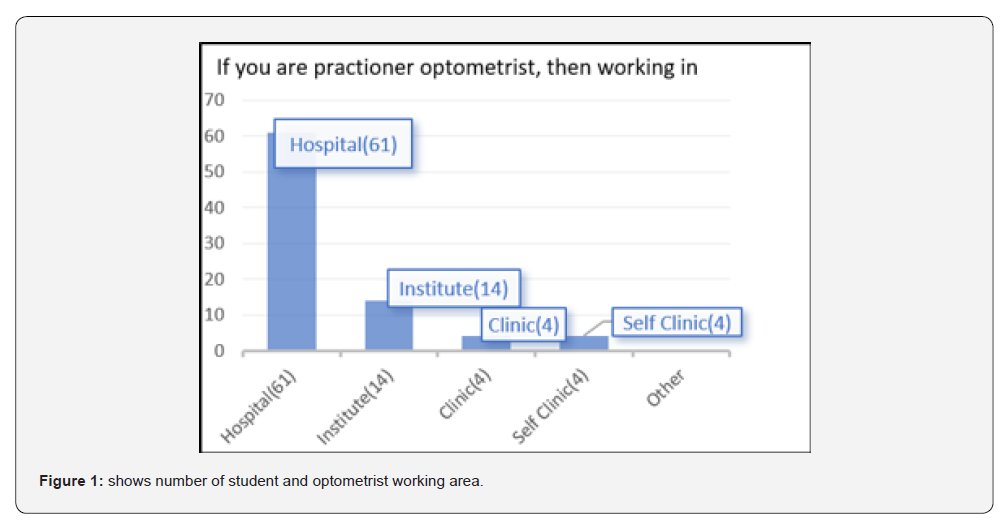
Regarding professional service areas, 21 practicing optometrists were involved in comprehensive eye care services, while 11 were working in subspecialty services and the remaining participants were associated with other practice settings. Among those working in subspecialty areas, 11 (34.4%) optometrists were working in diagnostic optometry, 6 (18.8%) in pediatric optometry, 3 (9.4%) in low vision services, and 3 (9.4%) in contact lens practice. These findings indicate that only a limited number of optometrists were directly involved in low vision rehabilitation services. The workplace distribution showed that most participants were working in hospitals and academic institutes. A smaller proportion were associated with private clinics or self-owned clinical practice settings (Figure 1).
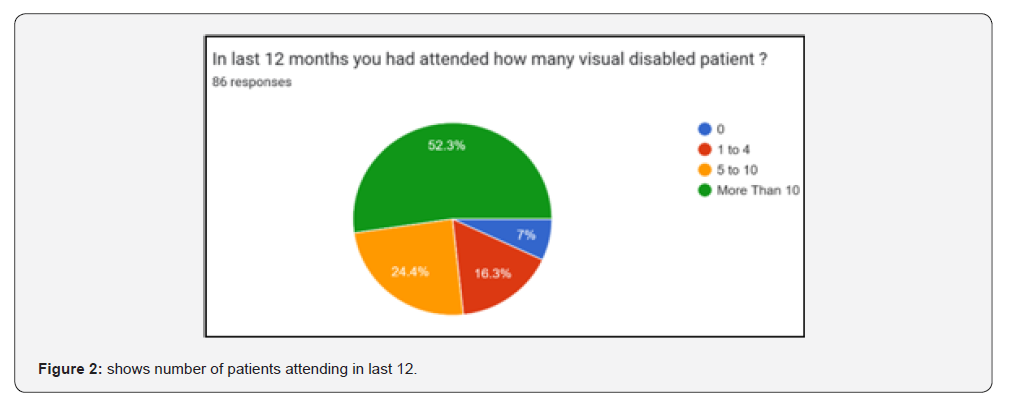
The study also assessed the frequency of interaction with visually impaired patients during the previous 12 months. It was found that 45 (52.3%) participants had attended to more than 10 visually impaired patients, while 21 (24.4%) participants had attended to 5–10 visually impaired patients during the same period. These findings suggest that participants had regular clinical exposure to visually disabled individuals. When asked about comfort while interacting with visually disabled individuals, 16 (37.2%) students reported feeling comfortable when familiar with the disability, while 17 (40.5%) optometrists reported comfort when they could imagine themselves having a similar disability (Figure 2)
Regarding discomfort, 14 (36.8%) students reported prior bad experiences as the main reason, whereas 10 (43.5%) optometrists felt uncomfortable when they did not know how to approach the person with disability (Tables 1,2). Knowledge-based responses showed good awareness regarding vision rehabilitation. Most participants, 76 (89.4%), were aware of the difference between low vision and vision rehabilitation, while 85 (98.8%) believed that vision rehabilitation improves quality of life. Awareness regarding government schemes for visually disabled individuals was reported by 72 (84.7%) participants, and 74 (88.1%) participants were aware of government services available in India for visually impaired individuals. Regarding blindness criteria, 21 (51.2%) practicing optometrists correctly identified visual acuity worse than <3/60 as blindness, whereas 18 (41.9%) students selected both <3/60 and perception of light denied as criteria.


For referral criteria related to low vision rehabilitation, most students 35 (81.4%) and 31 (73.8%) correctly identified both visual acuity and visual field as important referral parameters (Table 3). In clinical practice, most participants reported managing visually impaired patients by providing vision rehabilitation services, low vision devices, or best possible spectacle correction. However, referral to specialized rehabilitation centers was comparatively less frequent. Overall, the results suggest that both optometry intern students and practicing optometrists possess satisfactory theoretical knowledge and awareness regarding vision rehabilitation. However, practical involvement and specialized rehabilitation service delivery remain comparatively limited.
Discussion
The present study was conducted to assess the knowledge, attitude, and practice regarding vision rehabilitation among optometrists and optometry intern students. The findings of the study indicate that although participants possessed adequate theoretical knowledge regarding visual rehabilitation, there were noticeable limitations in practical implementation and rehabilitation-oriented clinical practice. Previous studies have reported varying levels of awareness and attitudes among eye care professionals toward individuals with disabilities. A study conducted by Dominick M Maino [14] reported that fourth-year optometry students demonstrated significantly more positive attitudes toward individuals with disabilities compared to students in earlier academic years. This suggests that increased academic exposure and clinical experience improve understanding and confidence while dealing with visually disabled individuals.
Similarly, studies conducted by Godwin O Ovenseri-Ogbomo and Waleed Alghamdi [15] reported poor knowledge, attitude, and practice among optometrists in Saudi Arabia regarding low vision rehabilitation services. Their findings highlighted deficiencies in referral practices, rehabilitation awareness, and low vision service delivery, which may negatively affect patient care. In contrast, the present study found no statistically significant difference in knowledge between optometry intern students and practicing optometrists regarding vision rehabilitation. This finding may indicate that both groups are receiving similar theoretical exposure related to visual disability and rehabilitation during academic and professional training. The occupational distribution of optometrists included in the study revealed that the majority were working in hospitals and academic institutions.
Among 43 practicing optometrists, 11 (34.4%) were working in diagnostic optometry, 6 (18.8%) in pediatric optometry, 3 (9.4%) in low vision services, and 3 (9.4%) in contact lens practice. The relatively small number of professionals working in the low vision specialty suggests limited interest and participation in the field of vision rehabilitation. This may be due to insufficient educational emphasis, limited clinical exposure, lack of specialized training centers, or inadequate awareness regarding career opportunities in low vision rehabilitation. Therefore, greater emphasis should be placed on vision rehabilitation education and clinical training to encourage more optometrists to participate in this important subspecialty. The study also explored the comfort level of participants while interacting with visually disabled individuals. Dominick M Maino [14] previously observed that students generally felt more comfortable interacting with people whose disabilities they were familiar with and felt uncomfortable when they were unsure how to approach individuals with disabilities.
However, findings from the present study differed slightly. Practicing optometrists reported feeling more comfortable when they could imagine themselves experiencing a similar disability, indicating a greater sense of empathy developed through clinical exposure. In contrast, optometry intern students expressed discomfort mainly when they had previous negative experiences or found it difficult to relate to the disability experience. These findings suggest that empathy, clinical interaction, and communication skills play an important role in improving attitudes toward visually impaired patients. The results further demonstrated that 45 (52.3%) participants had attended to more than 10 visually disabled patients during the previous 12 months, while 21 (24.4%) had attended to 5–10 patients within the same duration. This indicates that optometrists and interns have regular interaction with visually impaired individuals in clinical settings. Such interactions are important because they may positively influence professional confidence, awareness, and communication skills related to disability care [16-18].
Despite the relatively frequent patient interaction observed in the study, the findings also suggest that referral and rehabilitation practices remain inadequate. Although many visually impaired patients visit hospitals and eye care centers, only a limited proportion appear to receive specialized rehabilitation services. This highlights a gap between clinical exposure and rehabilitation practice. Lack of referral systems, insufficient rehabilitation infrastructure, poor awareness regarding available services, and inadequate multidisciplinary collaboration may contribute to underutilization of vision rehabilitation services. Overall, the findings of the present study emphasize the importance of strengthening practical training and rehabilitation-oriented education in optometry. Enhancing awareness regarding low vision services, improving referral practices, and increasing exposure to rehabilitation programs may help improve the quality of care provided to visually impaired individuals [19-21].
Conclusion
The findings of the present study suggest that both optometry intern students and practicing optometrists possess a generally positive level of knowledge regarding vision rehabilitation. However, despite adequate theoretical understanding, the practical application of rehabilitation services and referral practices was found to be comparatively limited. The study revealed that a significant number of visually impaired patients visit eye care facilities, yet the rehabilitation services provided to them remain insufficient. This indicates a gap between knowledge and clinical practice in the field of vision rehabilitation. The limited number of optometrists working in low vision specialty areas further highlights the need for increased awareness, professional interest, and specialized training in rehabilitation services. The results of the study suggest that vision rehabilitation education should be strengthened within the optometry curriculum.
Organizing workshops, conferences, continuing education programs, and clinical training sessions may help improve practical knowledge and professional competency related to visual rehabilitation. Inclusion of dedicated subjects and rehabilitationbased clinical exposure during optometry training may encourage students to develop greater interest and confidence in managing visually impaired patients. Additionally, intercollege academic collaborations, faculty exchange programs, and multidisciplinary rehabilitation training may further enhance the quality of education and clinical practice. Empathy-based training sessions should also be encouraged, as understanding the experiences and challenges faced by visually disabled individuals can improve communication, patient-centered care, and rehabilitation outcomes. Therefore, improving education, awareness, and practical exposure toward vision rehabilitation may ultimately enhance the quality of services provided to visually impaired individuals and contribute to better independence and quality of life for these patients.
References
- World Health Organization (2019) World report on vision. Geneva: World Health Organization.
- WHO (2026) Blindness and vision impairment. World Health Organization.
- Neena J, Rachel J, Praveen V, Murthy GV, Group RA (2008) Rapid Assessment of Avoidable Blindness in India. PLoS One 3(8): e2867.
- (n.d.). World report on vision.
- (2026) Vision Rehabilitation. National Eye Institute.
- Nispen RM, Virgili G, Hoeben M, Langelaan M, Klevering J, et al. (2020) Low vision rehabilitation for better quality of life in visually impaired adults. Cochrane Database of Systematic Reviews 1(1): CD006543.
- (n.d.). Overview of the PM&R Treatment Team. Johns Hopkins Medicine.
- (n.d.). National Association for the Blind, India Annual Report 2021-2022.
- Singh M, Khurana A, Radhika, Chauhan L (2023) Family perceptions and barriers towards rehabilitation of visually disabled people: A qualitative survey from Western Uttar Pradesh. Indian Journal of Clinical and Experimental Ophthalmology 9(4): 611-615.
- Sharma U, Majumder R, Biswas V, Awasthi S (2021) Awareness, knowledge, and barriers to vision therapy services among eye care practitioners. International Journal of Community Medicine and Public Health 12(3): 1055-1060.
- Slomski A (2021) Survey finds doctors have negative perception of patients with disability. Harvard Gazette.
- Kammer RL, Jamara RJ, Kollbaum E, Matchinski T, Flom R (2010) The Development of Entry Level Low Vision Rehabilitation Competencies in Optometric Education. Optometric Education 35(3).
- Narayanan A, Chande P, Satgunam P, Ramani KK, Srinivasan K, et al. (2025) Optometric education in India: addressing the needs of three billion eyes. Clinical and Experimental Optometry 108(3): 274-281.
- Dominick M, Maino OD, Gregg Steele, Shmaila Tahir, Radhika Sajja (2022) Attitude of optometry student towards individuala with disability 27(2).
- Godwin O, Ovenseri-Ogbomo, Waleed Alghamdi (2021) Knowledge,Attitudes, and Practices of Optometrists regarding Low vision services in saudi arabia 15.
- Rupert R A Bourne, Seth R Flaxman, Tasanee Braithwaite, Maria V Cicinelli, Aditi Das, et al. (2017) Magnitude, temporal trends, and projections of the global prevalence of blindness and distance and near vision impairment: a systematic review and meta-analysis. Lancet Glob Health 5(9): e888-e897.
- National Programme for Control of Blindness and Visual Impairment (2015) National blindness and visual impairment survey India 2015–2019. Ministry of Health and Family Welfare, Government of India.
- Alison M Binns, Catey Bunce, Chris Dickinson, Robert Harper, Rhiannon Tudor-Edwards, et al. (2012) How effective is low vision service provision? A systematic review. Surv Ophthalmol 57(1): 34-65.
- National Association for the Blind () Services for visually impaired individuals in India. Mumbai: NAB India.
- Ecosse L Lamoureux, Julie F Pallant, Konrad Pesudovs, Gwyn Rees, Jennifer B Hassell, et al. (2007) The effectiveness of low-vision rehabilitation on participation in daily living and quality of life. Invest Ophthalmol Vis Sci 48(4): 1476-1482.
- Keeffe JE, Le Mesurier RT, Taylor HR (2017) Vision impairment and blindness in the Asia-Pacific region. Br J Ophthalmol 2002 Jun;86(6): 605-610.

























