




 JOJO Home



Abstract
Astigmatism, as the most prevalent type of refractive error worldwide, has a direct impact on patients’ visual quality and quality of life through its accurate evaluation and correction. Based on the fundamental formula of cylindrical refractive power, this study standardizes the core definition of astigmatic vectors from the perspective of mathematical derivation, clarifies the logical pathway of vector composition, and establishes two complementary analytical methods: complex vector mapping and refractive power scalar calculation. While maintaining theoretical rigor, these methods also consider clinical practicality, aiming to provide clinical ophthalmic practitioners with a clear, concise, and operable framework for astigmatism analysis through the systematic clarification and standardization of basic theory. Based on the refractive power formula on an arbitrary meridian of a cylindrical lens, 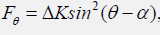 this method derives the astigmatic vector , Fθ −α , the magnitude of the astigmatic vector,
 and the double-angle phase 2(θ −α ), From these concepts, the composition of any two astigmatic vectors (with identical astigmatic values) is given by ΣF = F (θ −α ) + F (θ −β ). The astigmatic vector magnitude F (θ −α ) = ΔΚ defined by ANSI in 2006 lacks logical consistency. Previous astigmatic vector analysis tools (Alpins and Thibos) did not clearly define the astigmatic vector magnitude
  or the double-angle representation 2(θ −α ), and instead incorrectly used F (θ −α ) = ΔΚ , equating the astigmatic vector magnitude with the astigmatic value. This method logically defines the astigmatic vector F (θ −α ) and the meaning of the composition of any two astigmatic vectors.
Keywords: Diabetic Retinopathy; Yao Ethnic Group; Health Education; Screening Adherence; Cultural Adaptation
Abbreviations:DR: Diabetic Retinopathy; T2DM: Type 2 Diabetes Mellitus; FBG: Fasting Blood Glucose; VTDR: Vision-Threatening DR
Introduction
This method newly defines astigmatic vectors, the pathway of vector composition, and their clinical ophthalmic applications from a mathematical perspective.
Theory and Methods
Definition of core parameters: Based on real clinical refractive examination scenarios, the physical meanings of the core parameters in this study are clarified:
ΔΚ : the difference between cylindrical power and spherical power (for example, in the clinical prescription -3.00 DS/-1.50 DC × 180°, ΔΚ = -1.50 D), reflecting the refractive power magnitude of astigmatism;
α ,β ,ϕ : astigmatic axes (in clinical measurement, the horizontal meridian is taken as 0°, increasing counterclockwise, with a range of 0°~180°);
θ : the angle of any meridian on the ocular surface, used to describe the distribution characteristics of refractive power;
double-angle phase 2(θ −α ) : the double-angle parameter of the astigmatic vector, reflecting the phase characteristics of a twodimensional vector and serving as a key parameter for vector composition.e incorporated to enhance audience engagement and acceptance.
Part 1. Starting from the refractive power formula on an arbitrary meridian of a cylindrical lens: F (θ −α ) = ΔKsin∧ 2(θ −α ),
where α is the astigmatic axis and θ is an arbitrary meridian;  represents
the spherical component, and
represents
the spherical component, and 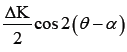 is the projection of the astigmatic vector on the x-axis; the negative sign only indicates a phase relationship. Then, the projection of the astigmatic vector on the y-axis is
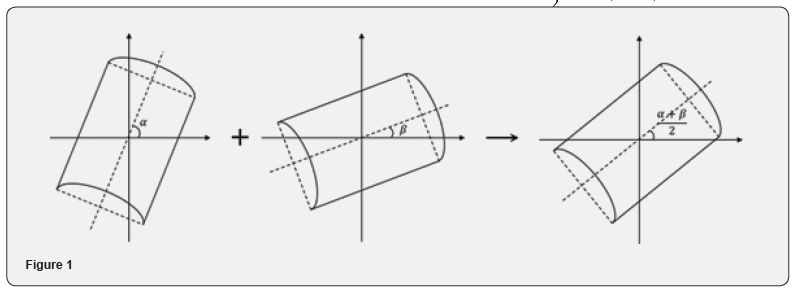
 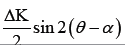 (Figure 1& 2).
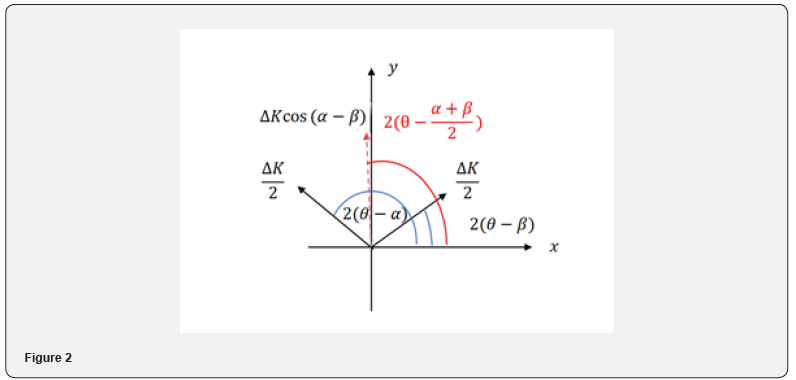
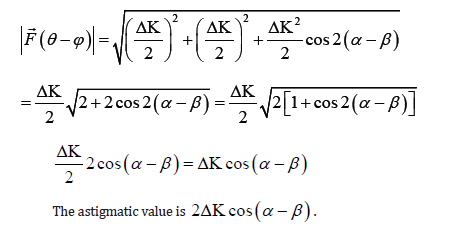
Representation of the astigmatic vector: 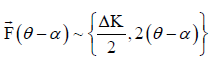 .Vector form:
 Considering the mapping relationship between vectors and points on the
complex plane, the astigmatic vector can be regarded as a complex vector
Considering the mapping relationship between vectors and points on the
complex plane, the astigmatic vector can be regarded as a complex vector  .
The modulus of the complex vector is
.
The modulus of the complex vector is , and the phase is 2(θ −α)
Composition of any two complex vectors:
 Using sum-to-product formulas, we obtain:

According to the previous definitions, the magnitude of the resultant astigmatism is 2ΔΚ cos(α −β ) , and the astigmatic axis is α +β/2. Through the above calculation results, the magnitude and axis of the combination of any two astigmatisms can be obtained, but this method cannot provide the change in spherical power after astigmatic combination.
Part 2. Scalar Calculation of Refractive Power on Two Meridians and Separation of Astigmatic Vectors
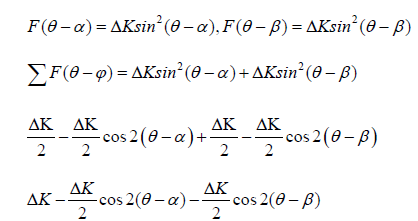
Using sum-to-product formulas:
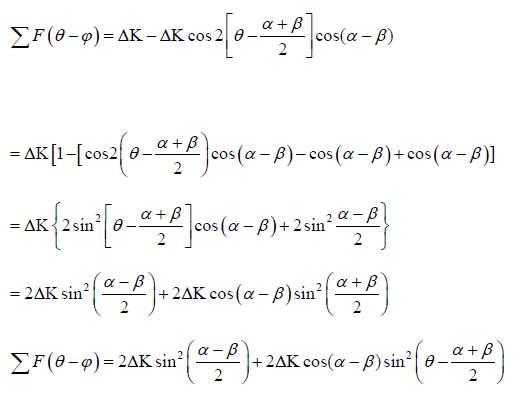
Thus, the spherical component of the combination of the two vectors 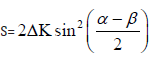 , and the astigmatic component
  . The astigmatic magnitude is 2ΔΚ cos(α −β ) , and the axis is
  . The results of refractive power scalar calculation are the same as those of astigmatic vector calculation, while also providing the change in the spherical component.
Result
Complex vector method: the mathematical basis is the mapping relationship between complex vectors and vectors in Cartesian coordinates.
Result presentation: vector method:

Refractive power scalar calculation method: algebraic operations of refractive power (based on Gaussian optics).
Result presentation of the scalar refractive power method:
 After scalar calculation, the astigmatic magnitude and axis
can be clearly determined, with astigmatic magnitude = 2ΔΚ cos(α −β ) and axis
After scalar calculation, the astigmatic magnitude and axis
can be clearly determined, with astigmatic magnitude = 2ΔΚ cos(α −β ) and axis  , directly presenting the spherical component and astigmatic component after astigmatic combination.
Method Comparison and Advantage Analysis
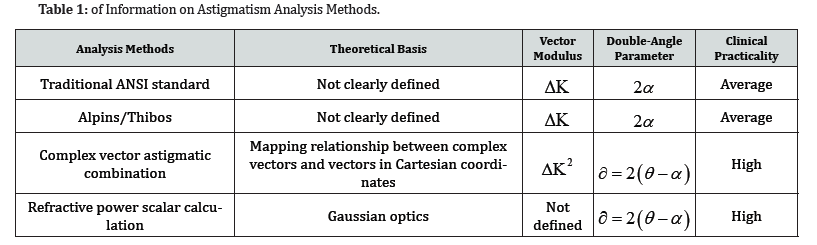
Discussion
Both methods start from the refractive power formula and fully define astigmatic vectors (magnitude and phase), with complete logical consistency. The refractive power scalar calculation method directly presents the spherical component and astigmatic component after astigmatic combination, making it more intuitive and convenient to use [1-4].
Conclusion
As a complex optical phenomenon, astigmatism involves intrinsic periodic variations of meridional refractive power that require more precise mathematical tools to be characterized. Starting from the basic formula of cylindrical refractive power, this study standardizes the core definition of astigmatic vectors through rigorous mathematical derivation, clarifies the logical pathway of vector composition, and establishes two complementary analytical methods: complex vector mapping and refractive power scalar calculation. This theory not only resolves logical deficiencies in traditional methods but also provides more accurate and reliable analytical tools for clinical practice, which is of significant value for improving the quality of astigmatism correction and enhancing patients’ visual experience. In the future, with the development of digital tools and the deepening of clinical applications, astigmatic vector analysis methods will provide stronger theoretical support for clinical ophthalmology.
References
- (2023) World Health Organization. Global Visual Impairment: A Comprehensive Review. Geneva: WHO Press.
- Alpins N A (1993) A New Method of Analyzing Astigmatism. J Cataract Refract Surg 19(4): 524-533.
- Wang (2024) Vector Analysis-Based Management of Post-Cataract Surgery Astigmatism. American Journal of Ophthalmology 258: 112-120.
- Liu (2023) Early Detection and Intervention of Astigmatism in Children Using Vector Analysis. Chinese Journal of Ophthalmology 59(4): 287-293.

























