



 JOJNHC Home




Emerging Non-Traditional Methods in Pediatric Oral Health Education (A Narrative Review)
Ushna Shameen1*, Elavarasi Kuppusamy1, Farinawati Yazid1, Haslina Rani1, Muneer Gohar Babar2 and Muhammad Khan Asif3,4
1Department of Family Oral Health, Faculty of Dentistry, Universiti Kebangsaan Malaysia, Kuala Lumpur, Malaysia
2Clinical Oral Health Sciences, School of Dentistry, IMU University, Kuala Lumpur, Malaysia
3Department of Oral and Maxillofacial Radiology, Faculty of Dentistry, MAHSA University, Jenjarom, Malaysia
4Department of Forensic Odontology and Research, Shifa College of Dentistry, Shifa Tameer-e-Milla University, Islamabad, Pakistan
Submission: September 28, 2026Published:October 09, 2026
*Corresponding author: Ushna Shameen, Department of Family Oral Health, Faculty of Dentistry, Universiti Kebangsaan Malaysia, Kuala Lumpur, Malaysia
How to cite this article: Ushna S, Elavarasi K, Farinawati Y, Haslina R, Muneer Gohar B. Emerging Non-Traditional Methods in Pediatric Oral Health Education (A Narrative Review). JOJ Nurse Health Care. 2026; 14(4): 555892..DOI:10.19080/JOJNHC.2025.14.555892
- Opinion
- Abstract
- Drinking Patterns and the Vicious Cycle of Intergenerational Economic Mobility
- References
- World Health Organisation (2022) Global oral health status report. World Health Organization.
- Elsadek YE, Edwebi S, Turner A, Vinall CK, Csikar J, et al. (2023) A systematic review of school-based student peer-led oral health interventions to promote the oral health of school children. BMC Oral Health 23(1): 742.
- Tinanoff N, Baez RJ, Diaz GC, Donly KJ, Feldens CA, et al. (2019) Early childhood carries epidemiology, aetiology, risk assessment, societal burden, management, education, and policy: Global perspective. International Journal of Paediatric Dentistry 29(3): 238-248.
- Alsadat FA, Alamoudi NM, El Housseiny AA, Felemban OM, Dardeer FM, et al. (2021) Oral and dental manifestations of celiac disease in children: A case- control study. BMC Oral Health 21(1): 669.
- DFebria N, Femilian A, Yosi AD, Hasnasari HA, Kristin RA, et al. (2024) Increasing children’s dental health knowledge with educational games. E3S Web of Conferences 570: 03003.
- Angelova SP (2023) non-formal education for child health: What are the opportunities? Education & Technologies 14: 57-63.
- Ismayanti I, Nurkholipah WS, Rahmasuli R, Sulistiani D, Dwisuhardjono W, et al. (2021) Efektivitas media ular tangga dalam pendidikan kesehatan gigi dan mulut siswa SDN 1 Gereba Kabupaten Ciamis. Kolaborasi: Jurnal Pengabdian Masyarakat 1(2): 104-111.
- Cahyani MA, Sudaryanto A (2024) Dental odyssey: A comprehensive literature review on global strategies, behavioural programs, and creative approaches for ages 6–12 years. Jurnal Ilmiah Kesehatan Sandi Husada 13(1): 9-18.
- Zaror C, Mariño R, Atala AC (2021) Current state of serious games in dentistry: A scoping review. Games for Health Journal 10(2): 95-108.
- Abiel B (2020) Effectiveness of play method health education on oral hygiene among selected school children. International Journal of Research in Engineering, Science and Management 3(1): 621-622.
- Rahmasari S, Arini M, Khairani R (2024) Assessing the potential impact of an oral health education package integrated with augmented reality on improving oral health knowledge in children: A pre-post study design. Padjadjaran Journal of Dentistry 36(2): 270-283.
- Aliyu TK, Titus OS, Bernard OT, Alade OT, Ehizele AO, et al. (2025) Cultural themes related to oral health practices, beliefs, and experiences in Nigeria: A scoping review. ORAL 5(2): 23.
- Bankole OO, Ibiyemi O, Lawal FB (2019) A health education video in an indigenous Nigerian language to dispel misconceptions associated with reversal of eruption sequence of anterior teeth. African Journal of Biomedical Research 22(1): 97-100.
- Alhayek AIA, Alsulaiman MJ, Almuhanna HA, Alsalem MA, Althaqib MA, et al. (2018) The effect of conventional oral health education versus animation on the perception of Saudi males in primary school children. Journal of International Oral Health 10(3): 121-126.
- Shruti T, Govindraju HA, Sriranga J (2021) Incorporation of storytelling as a method of oral health education among 3–6-year-old preschool children. International Journal of Clinical Pediatric Dentistry 14(3): 349-352.
- Angelopoulou MV, Kavvadia K (2018) Experiential learning in oral health education. Journal of Education and Health Promotion 7(1): 70.
- Aljafari A, Gallagher JE, Hosey MT (2017) Can oral health education be delivered to high-caries-risk children and their parents using a computer game? A randomized controlled trial. International Journal of Paediatric Dentistry 27(6): 476-485.
- Hashemi ZS, Khorsandi M, Shamsi M, Moradzadeh R (2021). Effect of combined learning on oral health self-efficacy and self-care behaviours of students: A randomized controlled trial. BMC Oral Health 21(1): 342.
- Bayraktar NC, Coşgun A, Şahin ND, Altan H (2025) Primary school children’s oral hygiene knowledge assessed with different educational methods: A cross-sectional study. BMC Oral Health 25: 148.
- Nguanjairak R, Duangsong R, Patcharanuchat P, Muangsom N, Bradshaw P, at al. (2016) Effectiveness of multimodal dental health education with animated cartoons for improving knowledge, attitudes, oral hygiene practices and reducing dental plaque in 7–9-year-old children in Khon Kaen Province. Journal of Public Health and Development 14(3): 69-82.
- Fagbule OF, Emenyonu UK, Idiga E, Oni OO, Ijarogbe OA, et al. (2023) Using traditional rhyme (folk song) as a tool for oral hygiene promotion (UTRATOHP) among children in rural communities in Nigeria: A protocol for a randomized controlled trial. PLOS ONE 18(6): e0280856.
- Hapsari GI, Mutiara GA, Chaidir R (2022) Dental health education game based on the IRVO model in augmented reality technology. Jurnal Infotel 14(2): 108-115.
- Rahmasari R, Primawati RS, Robbihi HI (2022) Dental health education using dance and song media on the knowledge of preschool children. The Incisor (Indonesian Journal of Care’s in Oral Health) 6(2): 415-422.
- Alwadi MA, AlJameel A, Baker S, Owens J (2024) Heard and seen: Developing inclusive activities for enabling the voices of children with disabilities in oral health research. Journal of Disability Research 3(2): e20240016.
- Astuti ESY (2022) The role of non-pharmacological behaviour management on the success of children’s dental care. Makassar Dental Journal 11(2): 211-213.
- Aulia H, Laksmiastuti SR, Widhianingsih D (2023) Children’s knowledge level about oral health before and after watching dental health education (DHE) videos. Denta: Jurnal Kedokteran Gigi 17(2): 47-51.
- Kashyap P, Reddy LVK, Sinha P, Verma I, Adwani J, et al. (2022) Effectiveness of game-based oral health education method on oral hygiene performance of 12-year-old private school children in Lucknow City: A field trial. Journal of Indian Association of Public Health Dentistry 20(1): 43-48.
- Lipsky MS, Singh T, Zakeri G, Hung M (2024) Oral health and older adults: A narrative review. Dentistry Journal 12(2): 30.
- Simon KA, Hegele JM, Gerling K, Hellwig E, Woelber JP (2023) Can serious games educate children in oral health knowledge? A qualitative controlled pilot study. JMIR Preprints.
Aim: Traditional oral health education (OHE) methods do not always engage children actively. Therefore, researchers have increasingly explored innovative, non-traditional approaches. This narrative review aimed to assess how non-traditional OHE methods may encourage children to adopt and maintain good oral hygiene practices.
Materials and Methods: This review included 16 studies examining game-based learning, digital media, music, puppetry, mobile phone applications, and experiential learning approaches. Most studies used pre–post intervention designs, whereas others used randomised controlled or quasi-experimental designs.
Results: Overall, the included studies suggested that non-traditional methods, particularly game-based and interactive digital interventions, may improve children’s oral health knowledge, attitudes, and behaviours. These approaches appeared to promote active participation, improve information recall, and encourage positive behavioural changes. The studies also highlighted the importance of age-appropriate content, cultural adaptation, and parental involvement in improving the effectiveness of OHE interventions. However, several limitations were reported, including small sample sizes, short follow-up periods, limited assessment of long-term behavioural outcomes, and a lack of standardisation in outcome measures.
Conclusion: This review highlights the potential of integrating technology and innovative teaching approaches into oral health promotion. These findings may inform the development of OHE strategies for children in different settings.
Keywords: health education; children; health promotion; non-traditional educational methods; educational technology; digital health tools
Abbreviations: OHE: Oral Health Education; WHO: World Health Organization; AR: Augmented Reality; SGs: Serious Games
Introduction
Dental caries (tooth decay) is one of the most common ailments around the globe. The World Health Organization (WHO) defines oral health as integral to essential functions and psychosocial well-being. Global oral health highlights the prevalence of oral diseases, affecting 3.5 billion people, with a significant impact on low- and middle-income countries WHO [1]. Despite being preventable diseases, dental caries and periodontal diseases remain widespread, contributing to long-term consequences in children's cognitive development Elsadek [2]. Inadequate oral health can significantly impact the well-being of children, resulting in a decline in overall health. Children experiencing poor oral health are more prone to school absenteeism compared to those with good oral health. Pain, discomfort, sleep disturbances, and missed school or workdays are commonly encountered issues for numerous children and adults globally Tinanoff [3]. Studies indicate that children’s oral health awareness is greatly influenced, especially by education and personal hygiene practices Saadah [4]. Regular brushing and flossing are crucial in maintaining oral health. By doing so, we can prevent dental diseases such as cavities and gum disease from occurring, which can cause discomfort, pain, and even tooth loss. Having good oral hygiene can also reduce the risk of developing other illnesses, including diabetes, heart disease, and stroke.
The expenditure on treating diseases can be quite high in every country but taking simple and easy steps as preventive measures will help to avoid such expenses. Education always plays an essential role in decreasing the risk of oral diseases. The main goal of OHE is to promote overall health practices by providing information and guidance. These efforts aim to reinforce clinical results and encourage comprehensive oral health Dwi Febria [5].
The connection between traditional and non-traditional methods in dental health education reveals significant differences in effectiveness and engagement. Non-formal education methods emphasize the child’s psychological and physical growth, incorporating health education within wider educational frameworks Angelova [6]. Traditional methods often depend on lectures and non-interactive presentations, while non-traditional approaches integrate interactive and participatory elements, boosting learning environments. This overview will analyze the key aspects of both methods. Forms of learning, especially in oral health, have immense potential through interactive media like games, augmented reality (AR), and stories. These media increase the degree of motivation and interest among children, and learning becomes fun and more effective. With the inclusion of play and interactivity, these new approaches capture children's interests and allow for better retention of oral health facts. Health education games can enhance children's health awareness regarding healthy behaviours. For instance, a game was developed in a study, and children were empowered to identify chronic disease risk factors, thus improving co-responsibility for health (Fonseca 2013). This review aims to provide a comprehensive overview of the current state of non-traditional methods in OHE for children. It evaluates the effectiveness of various interventions and identifies areas for future research. The review also explores the theoretical underpinnings of these methods and discusses their potential to address the challenges associated with traditional OHE.
Methods
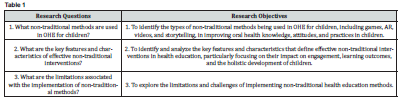
We conducted a narrative review of studies examining non-traditional methods of OHE for children. A narrative research strategy was used to locate relevant literature on current knowledge related to non-traditional methods of OHE for children. We searched PubMed, Google Scholar, and relevant oral health and paediatric journals for studies published between 2018 and 2025. We considered studies published in English, regardless of study design. While this type of review typically employs a non-systematic review strategy, it still plays a vital role by providing readers with up-to-date knowledge about a specific topic. A narrative review can efficiently summarise much information about the subject into just a few pages (Martin et al. 2024). To obtain a detailed view of non-traditional methods in OHE for children, research questions and objectives are listed in Table 1. We included papers focused on non-traditional methods in OHE for children. We excluded secondary studies published as abstracts, tutorials or posters.
Search strategy
The search strategy used the following Boolean search terms: (“oral health education” OR “dental health education”) AND (child* OR children) AND (game OR “augmented reality” OR video OR music OR storytelling OR “non-traditional”)
Study selection and data extraction
All identified references were imported into Zotero database reference management, and duplicate records were eliminated. Titles and abstracts of studies reviewed using a search strategy were screened independently by authors to identify studies that potentially met the criteria.
Results
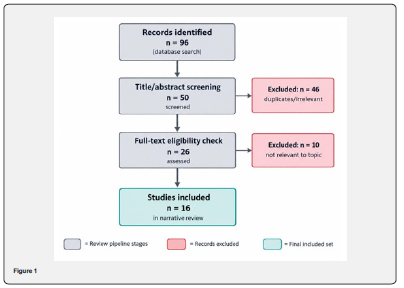
A total of 96 records were identified through database searching. Following title and abstract screening, 50 records were screened, and 46 were excluded because they were duplicates or irrelevant to the topic. The remaining 26 records underwent full-text eligibility assessment, ofwhich 10 were excluded because they were not relevant to the review topic. A total of 16 studies were included in the narrative review, as shown in (Figure 1).
Games as a Tool for Enhancing Children's OHE
Games have emerged as an engaging and effective tool for educating children about oral health. These interactive activities not only hold children’s attention but also make learning enjoyable, enhancing oral health message retention.
Snakes and ladders
Snakes and Ladders have been utilized as an educational tool to improve children's understanding of dental health. A study by Ismayanti [7] highlighted its effectiveness in helping children grasp dental and oral health concepts. Cahyani & Sudaryanto [8], also emphasized the game's potential in fostering awareness and promoting behaviours related to dental hygiene. Ismayanti [7], demonstrated that incorporating Snakes and Ladders in an educational setting led to a significant improvement in oral health knowledge in the experimental group, compared to a control group. The game's format, combining chance and learning, makes understanding oral health fun and educational. Additionally, the competitive aspect motivates children to actively participate and retain information.
Serious games (SGs)
Serious games (SGs) are designed with specific learning objectives in mind, making them an effective medium for delivering OHE. Zaror [9], explored the use of SGs to teach children about oral hygiene, the impact of diet on oral health, and the importance of regular dental visits. Abiel [10] used the play-way method, a form of serious gaming, to teach dental hygiene. SGs offer interactive experiences that enhance knowledge acquisition and skill development, and their interactive nature enables children to actively engage with content and receive immediate feedback, reinforcing learning.
Augmented reality (AR) in OHE for children
Augmented Reality (AR) is another innovative technology that provides children with a more immersive and engaging learning experience. By integrating virtual elements with the real world, AR offers a dynamic way for children to interact with educational content.
Interactive and engaging AR-based tools
S. Rahmasari [11], explored AR-based tools to provide interactive and engaging OHE for children. AR applications allow children to visualize concepts in 3D, making it easier to grasp abstract ideas. These applications can be particularly effective in teaching proper brushing techniques or demonstrating the harmful effects of bacteria on teeth. By engaging in multiple senses, AR tools help create a more memorable learning experience, ensuring that children retain important information about maintaining good oral hygiene.
The role of videos in OHE for children
Videos have become essential in OHE, providing a visually stimulating and dynamic way to present information. Videos in educational settings have proven effective in enhancing children's understanding of oral hygiene practices and promoting healthy behaviours.
Educational and culturally relevant videos
Aulia [12] found significant improvements in children's understanding of oral health through educational videos. Bankole [13] developed culturally relevant videos to address the specific needs of different populations, highlighting the importance of tailoring educational content to cultural contexts. Alhayek [14] also utilized animated videos to convey oral health messages effectively.
The use of music in promoting OHE
Music has been explored as a creative and effective strategy for promoting OHE, particularly by creating emotional connections with the content. Music can reinforce positive behaviours and make oral health messages more memorable.
Music as an emotional and educational tool
Cahyani & Sudaryanto [8] Highlighted music as an effective tool for improving children's understanding of dental hygiene. Music, through songs and rhythms, can make oral health education more memorable, while also helping to teach specific techniques, such as proper brushing methods and timing, in a fun and engaging way.
Storytelling as a powerful tool in OHE
Storytelling is a traditional yet powerful method for engaging children and conveying health messages in a relatable and memorable way. Stories can serve as an educational tool by modelling positive behaviours and emphasising the importance of oral health.
Storytelling to enhance oral health knowledge and practices
Shruti [15] found that storytelling was effective in improving preschool children's knowledge, attitudes, and practices regarding oral health. Stories, which often involve characters and scenarios children can relate to, help convey health messages engagingly and meaningfully. Storytelling enables children to understand the importance of oral hygiene enjoyably and memorably, ultimately encouraging them to adopt positive health behaviours.
Discussion
Non-traditional and traditional methods show positive results in improving children's oral health behaviours. Game-based learning and e-health applications have become efficient in engaging children and making oral health education more interactive. Angelopoulou & Kavvadia [16], Aljafari [17], highlights methods that increase children's oral health knowledge and practices, frequently exceeding the effect of traditional methods. Animation-based tools and digital storytelling further support such learning, sparking children's interest and grabbing their attention regarding OHE Hashemi [18]. These practices, like non-traditional methods in health education, such as animations and games, improve children's self-assurance and oral hygiene behaviours Bayraktar Nahir [19]. Such methods in health education are more effective in improving oral hygiene practices and knowledge than traditional ones. Another study by Nguanjairak [20] found improvement in plaque scores and OHE practices after using methods like multimodal education, including animated cartoons among children.
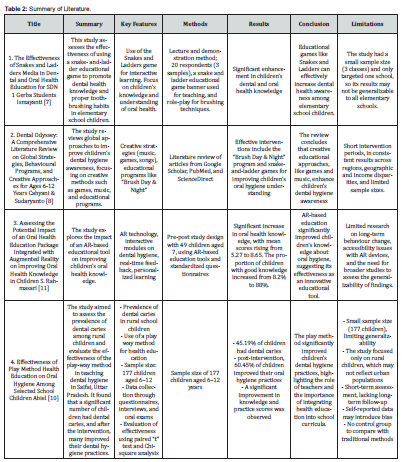
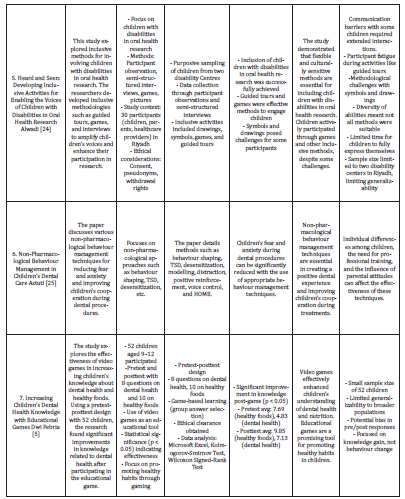
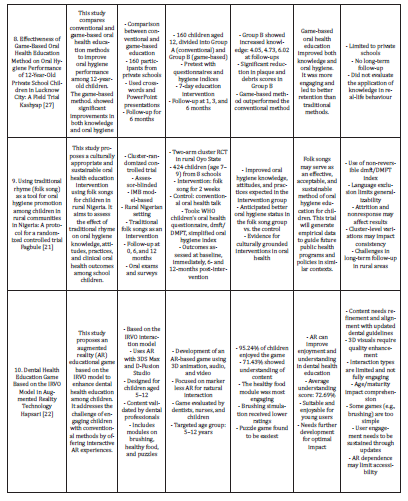
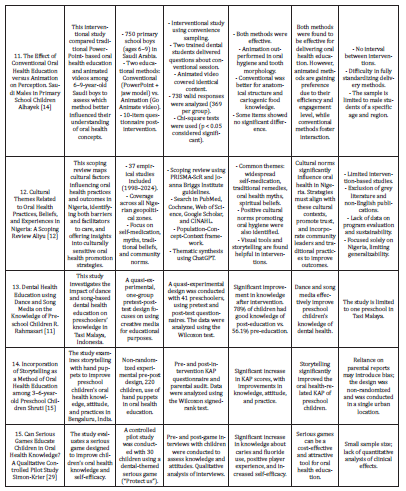
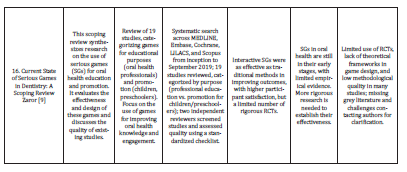
Some methods like puppetry, storytelling, folk songs, or cultural songs promote engagement and cultural competence. A study in Nigeria mentioned in Table 2 by Fagbule [21] also supports this, though as noted above, that study is a trial protocol and its outcomes are anticipated rather than confirmed. However, methodological differences among studies, including different sample sizes, follow-up periods, and outcomes, challenge comparability. Some of them lack long-term evaluation, leaving questions about the sustainability of behaviour change. Despite these limitations, the growing evidence supports including non-traditional methods as an effective supplement to traditional OHE. This success lies in promoting creativity, engagement and emotional resonance. Future research should focus on studies that combine both traditional and non-traditional methods as hybrid models. Collaboration with families, educators, and health professionals is key to strengthening interventions and incorporating them into school systems.
Limitations
This review has several limitations. As a narrative rather than systematic review, we did not conduct a formal risk-of-bias or quality appraisal of included studies, and study selection, while independent, was not fully systematic. The search was restricted to English-language publications from 2018–2025 across a limited set of databases (PubMed, Google Scholar, Elsevier, and select oral health/pediatric journals), which may have excluded relevant non-English or older literature. Only one of the sixteen included studies Fagbule [21] is a trial protocol rather than a completed study, so its outcomes remain projected rather than confirmed. Finally, heterogeneity in study designs, sample sizes, and outcome measures across the included literature limits the ability to draw quantitative, pooled conclusions.
Implementation Barriers and Equity
Several included studies point to practical barriers that affect real-world scale-up of non-traditional methods: device and technology accessibility for AR-based tools Hapsari [22], S. Rahmasari [23], the need for teacher or facilitator training, and resource constraints in rural or low-income settings (Abiel [10], Fagbule [21]). Several of the strongest examples of culturally adapted, low-cost interventions, folk songs in rural Nigeria and dance and song in Indonesia, came from resource-limited settings, suggesting that non-traditional methods need not depend on expensive technology to be effective, and that culturally grounded, low-tech approaches deserve equal attention alongside digital and AR-based interventions in future research and policy [24-29].
Conclusion
Non-traditional methods like games, digital tools, and storytelling are great ways to get children interested in dental health and assist them in developing healthier routines. These fun and engaging approaches can greatly inspire children and enhance their enjoyment of dental care education. While research shows they work well in the short term, more studies are needed to understand their effectiveness over time and standardize outcome measures. Bringing these innovative approaches to community and school initiatives could make OHE more interesting and meaningful for kids in future.