




 JOJNHC Home



Effect of Lifestyle Alteration of Pregnant Women with Mild Preeclampsia on Maternal and Fetal Status
Sabah Lotfy Mohamed El Sayed* and Mervat Mostafa Abd-El Menem Desoky
Department of Obstetrics & Gynecology Nursing, Faculty of Nursing, Zagazig University, Egypt
Submission: November 20, 2018; Published: January 03, 2019
*Corresponding author: Sabah Lotfy Mohamed El Sayed, Assistant Professor, Department of Obstetrics and Gynecology Nursing, Faculty of Nursing, Zagazig University, Egypt
How to cite this article: Sabah Lotfy Mohamed El Sayed, Mervat Mostafa Abd-El Menem Desoky. Effect of Lifestyle Alteration of Pregnant Women with Mild Preeclampsia on Maternal and Fetal Status. JOJ Nurse Health Care. 2019; 555777. DOI: 10.19080/JOJNHC.2019.10.555777
Abstract
Background: Hypertension with pregnancy causes the perfusion of vital organs and may extend to severe problems leading to the death of the mother and her fetus. Aim: Assess the effect of healthy lifestyle alteration of pregnant women with mild preeclampsia on the maternal and fetal status.
Method: A quasi-experimental study design was done on 80 pregnant women at the high-risk pregnancy outpatient clinic at Zagazig University Hospital, and the private clinic, Zagazig City, Al-Sharkia Governorate, Egypt via a purposive sample. Data collection tools: Monitoring the maternal (blood pressure, and body weight) and fetal condition (USG and Daily fetal movements count chart).
Results: A highly statistically significant difference was observed between pre and post counselling sessions related to maternal and fetal status. Conclusion: The study appeared counselling sessions of lifestyle alteration had a positive correlation on the status of pregnant women with mild preeclampsia.
Keywords: Daily Fetal Movements Count; Lifestyle Alteration; Preeclampsia
Introduction
Preeclampsia can be divided into two types. Systolic blood pressure (SBP) more than or equals to 140 mmHg / diastolic blood pressure (DBP) more than or equals to 90 mmHg and protein > 300mg / 24 hr as a mild type. The most dangerous type is characterized by high blood pressure (SBP > 160 mm Hg or DBP > 110 mm Hg), and proteinuria (<5 g / 24 hr) or signs of damage to vital organs Dhariwal & Lynde [1] Pre-eclampsia is the major causing of maternal death worldwide (14%) and estimated that 192 individuals die every day due to hypertensive disorders in pregnancy. It affects 2-8% of all pregnancies worldwide Gongora & Wenger, [2] & Say et al. [3]. Also, it influences about 7–10% of all pregnancies and associated with morbidity and mortality of the mother and fetus Ahmad & Samuelsen [4].
It affects nearly one-fifth of all maternal deaths and increasing the risk of adverse outcomes. The ratio of motherly death was 5.6 deaths per 100,000 live births. Approximately, there were 15 maternal deaths per 2 million live births due to pre-eclampsia or its complications, 12.4% of all maternal deaths Tessier et al. [5]. About, 62,000 to 77,000 of pregnant women death worldwide each year due to pre-eclampsia and its complications. That is almost 18% of all maternal deaths, most of these in developing countries Enkhmaa et al. [6]. Lifestyle is the way that individuals, families and communities can live healthy or unhealthy in terms of personal behaviors such as nutrition, physical activity and stress management. The healthy lifestyle can improve health and happiness. In contrast, an unhealthy lifestyle can lead to disease or morbidity Saffari et al. [7]. Thus, these risk factors can be addressed by changing and modifying the lifestyle, which in turn will reduce morbidity and mortality from chronic diseases Mahdipour et al. [8].
Significance of the Study
Preeclampsia causes extensive disorder and spasm in the lining of the blood vessels that occur after 20 weeks of pregnancy. It represents 22% of maternal deaths, and 18% of all premature births worldwide Sahar [9]. The early counseling for a patient is critical to maternal and fetal outcomes. All hospital health care personnel (nurses, doctors, and pharmacists) are responsible for controlling this problem. Guidelines through the health care team are valuable to provide the best patient care Peres et al. [10]. There are no uniform national rules and follow-up according to some international guidelines in hospitals. Therefore, nursing counseling for the management of preeclampsia is of importance.
Aim of the Study
The current study was conducted to assess the effect of health lifestyle alteration of pregnant women with mild preeclampsia on maternal and fetal status.
Research Hypotheses
Lifestyle change for women with mild pre-eclampsia can improve the status outcome of maternal and fetal.
Subjects & Method
Research Design
A quasi-experimental design was utilized for the study.
The Setting of Study
The sample size was in based on the SD of the health subdomains that promoted a lifestyle (0.54) in a study of the Stark & Brinkley [11]. Eighty participants were calculated with an acceptable error (0.05) around the mean (3.09) the test power is 0.8 was selected using non-probable purposive sampling.
Study Population
The eligibility criteria for the study:
i. Pregnant women who suffer from slight preeclampsia (systolic blood pressure < 160 mmHg and diastolic blood pressure < 110 mmHg with proteinuria ± 2 in the urine test strip)
ii. Pregnancy with a single viable fetus.
iii. The age of women ranged from 20 to 40 years.
iv. The absence of medical or obstetric complications, e.g., IUFD or vaginal bleeding, the deterioration of the case in severe form, conduct for delivery during the study period.
v. Exclude those who use antihypertensive drugs.
vi. The desire of maternal to participate in the study.
Data Collection Tools
It organized by the researchers based on the relevant literature reviews, and included the following:
Part (I): Monitoring maternal status It was assessed as follows:
a. Interview questionnaire sheet It included characteristics of pregnant women who suffer from mild pre-eclampsia, such as: age, education level, occupation, residence place and income level properties. Moreover, the gravidity, parity, history of abortions, the previous mode of delivery and history of pre-eclampsia.
b. Physical Assessment Questionnaire sheet. The researchers measured maternal systolic blood, diastolic blood pressure (mmHg) and body weight (kg).
Part (II): Monitoring fetal status. It was evaluated as follows:
a. Assessment of fetal status. The fetal condition was assessed using ultrasonography (USG) to evaluate gestational age (GA) / weeks, fetal body weight estimation (EFBW) /gm, fetal heartbeat (min) and amniotic fluid index (AFI) / cm.
b. Daily Fetal Movement Counting (DFMC) Chart. Maternal perception of fetal movement is an inexpensive, noninvasive method of assessing fetal well-being. The DFMC was used to record the number of fetal movements for one hour after meals (breakfast, lunch, dinner). Fetal movements are considered enough if the number is about three to five times within one hour. A period of 12-hours without at least 10 perceives a movement is a warning signal. If the result is unsatisfactory, the patient should be assessed with the USG.
Part (III): Maternal lifestyle alteration:
Counselling guidelines was designed on the basis of an instruction guideline was developed after wide review of literature which includes the counseling on nutrition (9 points) and slow breathing exercises (8 points). Breathing technique: Subjects were guided to do 20 deep diaphragmatic respirations, which took around 5 min. BP was measured from the right hand at the level of the heart after 5 min, resting in a chair in the sitting position. The first Korotkoff sound was regarded as the systolic BP and the last was considered as the diastolic BP (Aalami et al., 2016).
The procedure of data collection
i. Obtain the approval of the Ethics Committee at the Faculty of Nursing and the directors of clinics, Zagazig University to conduct the study and collect the necessary data.
ii. The validity of the questionnaire was reviewed by a panel of 6 experts (3 of nursing staff members and 3 of obstetricians) to test its content validity. The required modifications were made in order for the accuracy of the content items. As well as, the validity of this survey has been used in the study of Mohamad et al. 2013.
iii. The reliability of the questionnaire was assessed using the alpha Cronbach coefficient (0.89) thru the test and re-test method after conducting.
iv. The experimental study was directed on 10% of the sample (10 of patients diagnosed with mild preeclampsia) and excluded from the main sample. It was done to test the tools of the study in terms of feasibility, clarity and application, as well as the time required for the questionnaire. After the pilot study, the necessary modifications were made to the questionnaire in the final form.
v. The average time over of each session took was 30-45 minutes, where it was given a weekly session for 4 continuous weeks and follow-up the cases for another 8 weeks.
vi. Ethical considerations were taken at all stages of the study as follows:
Oral consent was obtained for all participants in the study after the aim was explained by the researchers.
The researchers confirmed that there was no harm to them or carrying them. Women in the study have the right to withdraw from the study sample. Also, they will be assisted them if needed.
vii. The study was conducted through the counseling sessions prepared and presented by the researchers. Continuation of doing breathing exercises was followed by phone calls. The symptoms of severe pre-eclampsia were checked both by phone calls and at the beginning of each session. It was carried out as follows:
vii. The study was conducted through the counseling sessions prepared and presented by the researchers. Continuation of doing breathing exercises was followed by phone calls. The symptoms of severe pre-eclampsia were checked both by phone calls and at the beginning of each session. It was carried out as follows:
b. Second meeting. Women’s blood pressure was measured by researchers twice from the right arm using the standard mercury pressure gauge with the appropriate size cuff in the sitting position after 5 minutes of rest. The average of these two values was used as a rule for blood pressure. Women were also weighed without shoes and heavy clothes. The researchers explained, breathing techniques slowly for women at this session. Where women sit on a comfortable chair to ensure their relaxation. They also taught women slow breathing, stopping after inhalation and slowly exhaling.
c. Third meeting. The researchers explained to women, the food pyramid and the optimal diet based on the dietary approach to stop high blood pressure (DASH). Reduce consumption of salt and fat with increased consumption of cereals, vegetables, fresh fruits and complex carbohydrates (European Society of Hypertension [12]). Maternal blood pressure and weight were assessed. Monitoring fetal movement using the daily fetal movement chart (Saastad et al. [13]).
d. The fourth session. It included a review of the previous points and the results of counseling after participating in sessions by evaluating the maternal and fetal state as in the previous session of the counseling.
e. Data were collected over 3 months, from March to May 2018.
viii. Data analysis was performed using SPSS version 22. Descriptive statistics including frequency, percentage, mean and standard deviation were used to describe the characteristics of pregnant women with preeclampsia. The relationship between pre and post counseling sessions was determined using statistical tests such as Pearson correlation coefficient and level of significant. It ranges from −1 to 1. A value of 1 indicates that a positive the relationship between counseling sessions and maternal and fetal status. A value of −1 denotes that a negative the relationship. A value of 0 indicates that there is no correlation between the sessions and maternal and fetal status. The t-test was used to assess the differences between the average scores of pre and post sessions. The P value was used to examine the level of significance between the pre and post counseling sessions. The level of significance was determined at 0.05.
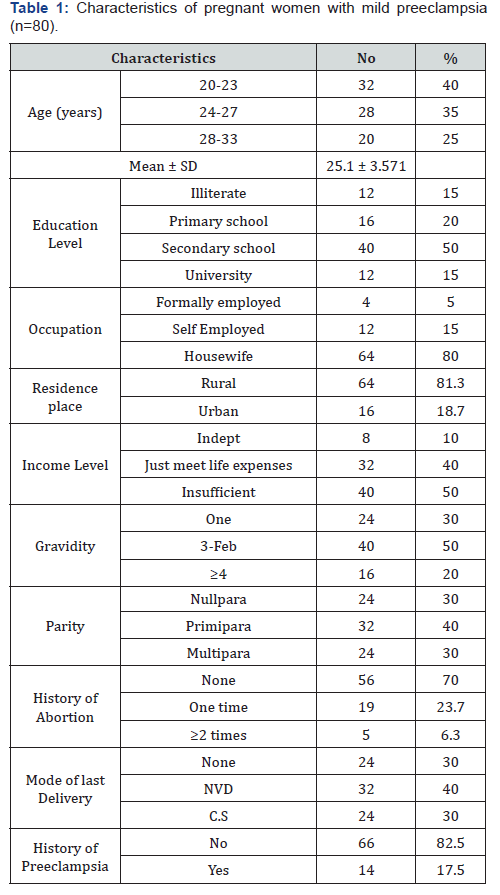
NVD: Normal vaginal delivery C.S: Cesarean section
Results
The characteristics of the studied sample are presented in Table 1. More than one third (40%) of pregnant women with preeclampsia were in the age group of 20-23 years with the mean (SD) age of 25.1 (3.571) years, and half (50%) of them were secondary education. The majority (80% and 81%) of them were housewives and residents of rural areas, respectively. A half (50%) of them didn’t have enough income.
Regarding the number of pregnancies, half of the pregnant women with pre-eclampsia (50%) had 2 to 3 pregnancies. More than a third (40%) were primiparous, while more than two-thirds (70%) hadn’t previous abortion. With regards to the mode of the last delivery, more than one-third (40%) were vaginal. Moreover, most (82.5%) of them do not have a history of pre-eclampsia.
Table 2 clarifies that the total mean scores of maternal systolic blood pressure pre-counseling was 147.15±5.356 mmHg compared to the post-counseling (142.58±2.514 mmHg). Furthermore, the diastolic blood pressure was 97.0±2.465 mmHg compared to the post-counseling (90.83±1.719mmHg). Meanwhile, maternal weight pre-counseling session was 75.85±6.767 kg compared to the post-counseling sessions (76.94±6.475 kg). There are a highly statistically significant differences were observed between pre and post counseling sessions (P = 0.000, P = 0.000, and P = 0.000, respectively).


r: Pearson correlation coefficient
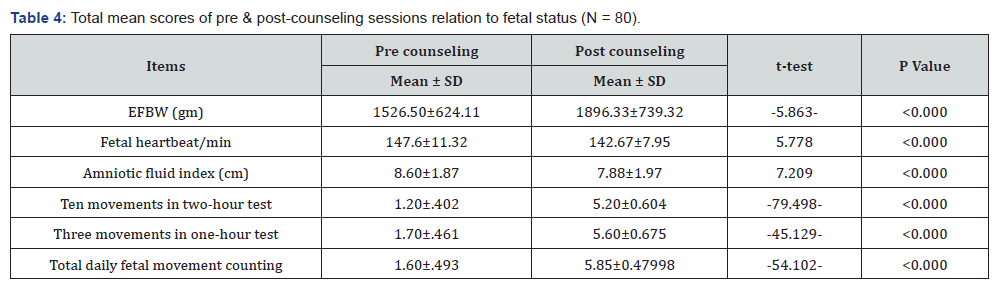
EFBW: Estimated Fetal Body Weight
Pearson’s correlation of the pre and post counseling regarding blood pressure and weight of the study sample, there is a highly significant positive correlation (P <0.001) (Table 3). Table 4 clarifies that the total mean score of EFBW pre-counseling sessions was 1526.5 ± 624.108 gm compared to the post-counseling session (1896.3±739.324gm). Moreover, ten movements in two hours test pre-counseling sessions was 1.2 ± 0.402 compared to the postcounseling session (1.73±.201). Meanwhile, three movements in one-hour pre-counseling session were 1.7±.461 compared to the post-counseling session (1.87±.22). Moreover, Total daily fetal movement counting pre-counseling session was 1.6±.493 compared to the post-counseling session (1.97±.1006). There are a highly statistically significant differences were observed between pre and post counseling sessions (P = <0.000, P < 0.000, P < 003 and P < 0.000, respectively). Concerning correlation between the pre and post counseling sessions of fetal condition assessment, there is a significant positive correlation in relation to estimated fetal body weight, amniotic fluid index, and ten fetal movements count (r = 0. 967 & r = 0. 667, p < 0.00). Meanwhile, there is insignificantly correlation in relation to, three and total daily fetal movements count (Table 5).

Discussion
Preeclampsia defined as an increase in blood pressure (two readings of blood pressure separate b 6 hours at least is more than or equal 140/90 mmHg taken) and proteinuria (more than or equal 1+ on dipstick test in two urine samples / more than or equal 300 mg of protein in a 24 hour urine sample) after 20 weeks of pregnancy. Mild preeclampsia was defined as elevated blood pressure (≥ 140/90 mmHg and <160/110 mmHg) and proteinuria (≥ 1+ and <2+ on a dipstick test in two urine samples) (Wang et al. [14]). Preeclampsia remains a threat, chiefly in underdeveloped countries where its rates and mortality rates are higher. In these countries, there is a crucial need in health policies to promote the proper care of women who suffer from the preeclampsia Peres et al. [15]. Hypertension can be treated through lifestyle changes and medications. Proposed dietary modifications to lower blood pressure include reduced salt intake, increased potassium intake, and moderation of alcohol consumption Appel et al. [16].
The present study showed that more than one-third of women with pre-eclampsia were in the age group of 20-23 years old. With regards to socio-demographic characteristics in the present study, pre-eclampsia was associated with secondary education. Furthermore, most of them were housewife and inhabitant in rural places. Concerning the level of income and the number of pregnancies, the current study found that half of the study sample had insufficient income and 2-3 pregnancies. While less than half were primiparous and delivered by vaginal. Also, the present findings observed that the highest percentage of them hadn’t a history of abortion or preeclampsia. However, Verma et al. [17] who observed that maternal age >30 years was associated with the risk of preeclampsia Bej et al. [18] showed that socio-economic risk factors such as maternal age, paternal age, education level, family income, occupation, type of family were not significantly associated with the development of PE. Additionally, a history of pre-eclampsia in the previous pregnancy identified as a risk factor for pre-eclampsia. On the contrary, the study was done by Verma et al. [17] found that most cases of pre-eclampsia had the previous history of abortion. The reasons for variation may be due to differences of selected criteria or different to maternal characteristics.
Lifestyle changes, in particularly slow breathing exercises and dietary modifications, were the basic management of women with hypertensive. The Present findings showed a statistically significant improved in maternal blood pressure after providing counselling (P < 0.000). A meta-analysis of 17 randomized controlled trials evaluated the current evidence on the effect of dietary patterns on BP in adults. A significant reduction of 4.26 mm Hg in SBP and 2.38 mm Hg in DBP was observed (Ndanuko et al. [19]). Williams et al. [20] reported that exercises have a great impact on reducing systolic blood pressure and diastolic blood pressure by 6/4 mmHg points for hypertensive patients. This can be explained by relaxation decreases the heart rate, decreases the respiratory rate, decreases blood pressure in people who have normal or mildly elevated blood pressure and decreases oxygen consumption.
Achkar et al. [21] demonstrated that women who developed pre-eclampsia had a significantly lower vitamin D concentration at 14 weeks compared with women in the control group (p<0.0001). They suggested that maternal vitamin D deficiency may be an independent risk factor for the development of preeclampsia. A randomized controlled trial investigating the use of early low-dose dietary calcium supplementation in women who have had previous developed pre-eclampsia did not demonstrate a significant benefit in the reduction of blood pressure or subsequent risk of pre-eclampsia (Hofmeyr et al. [22]).
The study revealed that there was effective in reducing both systolic and diastolic pressure after breathing exercise therapy among pre-eclamptic women. Slow breathing increases baroreflex sensitivity and reduces sympathetic activity and the chemoreflex activation, a potentially beneficial effect in hypertension; where, baroreflex is the system in the body that regulates blood pressure by controlling the heart rate, the strength of heart contractions, and diameter of blood vessels. Slow breathing reduces blood pressure and enhances baroreflex sensitivity in hypertensive patients. These effects appear potentially beneficial in the management of hypertension Mohamed et al. [23].
Low calcium concentration in the diet and serum is associated with preeclampsia. It has been shown that high-dose calcium supplementation reduces preeclampsia in women from areas with low dietary calcium intake Hofmeyr et al. [22]. Additionally, Selby-Nelson [24] stated that there was a highly significant reduction in systolic and diastolic blood pressures in pregnant women with mild PE who received the relaxation in the form of breathing exercise. As for the maternal weight, a statistically significant increase was observed in the weight regarding postcounseling sessions (P= 0.000). This increase in weight might be due to fetal growth and weight. A nutritious and well-balanced diet may enhance functionality and efficiency of the maternal and fetal metabolism through substrate availability, reductive capacity, immunologic mechanisms, and insulin sensitivity, and the metabolic stress induced by disturbed placentation could possibly be attenuated or counterbalanced by a high-quality diet Barker et al. [25]. In a meta-analysis of Thangaratinam et al. [26] investigating the potential effects of dietary interventions on the risk of adverse pregnancy outcomes, interventions which generally improve diet quality pregnancy were associated with a reduced risk of pre-eclampsia.
The current study found that the counseling given to pregnant women who suffer from mild preeclampsia had a significant positive correlation with decreased systolic and diastolic blood pressure, as well as the maternal weight of the study sample (P < 0.001). Slow breathing is an active technique to reduce blood pressure it opens blood vessels, relaxing muscles in the diaphragm. The study concluded that the practice of slow breathing exercise was an effective method in the reduction of blood pressure Mahtani et al. [27]. The current study concluded that patients, who receive a device to guide slow breathing, significantly lowered their systolic blood pressure. An experimental study to evaluate the effectiveness of breathing therapy on mild pregnancy induced hypertension. Samples were 50 antenatal mothers with mild pregnancy induced hypertension. A quasi-experimental study was adopted in the study to evaluate the effectiveness of breathing therapy on mild pregnancy induced hypertension. One group pre and post-test research design was selected for the study. The results revealed that there was a significant difference in pre and post counseling. The study concluded that breathing therapy on mild pregnancy induced hypertension was an effective method in the reduction of blood pressure Reshma et al. [28].
The results of the present study showed a statistical significance after the counseling sessions with respect to the estimated fetal weight, amniotic fluid index and the count of fetal movements. Maternal perception of reduced fetal movements has clinical significance as a predictor of fetal compromise, but a relatively low positive predictive value of 2% to 7% for stillbirth Unterscheider & O’Donoghue, [29]. In an Australian cross-sectional survey of fetal movements maternal qualitative assessment of fetal activity was demonstrated to be of value to clinicians Raynes-Greenow et al. [30]. Counting fetal movement is a way for a woman to determine the number of movements that feel to assess the condition of the baby’s Mangesi et al. [31]. This finding supports the idea that perceived fetal activity may be indicative of fetal status. Inquiring counts the movements of the fetus is a routine part of prenatal care Flenady et al. [32]. Pregnant women often seek information about fetal movements, reporting any concerns about fetal activity and wanting to know if their progress is normal Bondas & Eriksson [33].
Regarding the correlation between the pre and post counseling sessions of fetal condition assessment, there was a strong positive significant correlation in relation to estimated fetal body weight, amniotic fluid index, and ten fetal movements counting. May et al. (2010) examined the main effect of maternal exercise, found that maternal exercise was associated with significantly lower fetal HR and higher vagal input. The authors did not observe a group difference in the frequency band ratios, similar to our previous report on the effects of maternal exercise on fetal cardiac autonomic control. This study suggested that maternal exercise does not change the fetal sympathovagal balance [34].
Conclusion
Based on the results of the study, there was a positive correlation between counselling sessions for the healthy lifestyle of pregnant women with mild preeclampsia and the maternal and fetal state. Therefore, the health care team should provide guidelines on a healthy lifestyle of women with preeclampsia in order to early control of subsequent complications.
References
- Dhariwal N K, Lynde G C (2017) Update in the Management of Patients with Preeclampsia. Anesthesiology clinics 35(1): 95-106.
- Gongora M, Wenger N (2015) Cardiovascular complications of pregnancy. International journal of molecular sciences 16(10): 23905- 23928.
- Say L, Chou D, Gemmill A, Tunçalp Ö, Moller A B, et al. (2014) Global causes of maternal death: a WHO systematic analysis. The Lancet Global Health 2(6): e323-e333.
- Ahmad A S, Samuelsen S O (2012) Hypertensive disorders in pregnancy and fetal death at different gestational lengths: a population study of 2 121 371 pregnancies. BJOG: An International Journal of Obstetrics & Gynaecology 119(12): 1521-1528.
- Tessier D R, Yockell‐Lelièvre J, Gruslin A (2015) Uterine Spiral Artery Remodeling: The Role of Uterine Natural Killer Cells and Extravillous Trophoblasts in Normal and High‐Risk Human Pregnancies. American journal of reproductive immunology 74(1): 1-11.
- Enkhmaa D, Wall D, Mehta P K, Stuart J J, Rich-Edwards, et al. (2016) Preeclampsia and vascular function: a window to future cardiovascular disease risk. Journal of Women’s Health 25(3): 284-291.
- Saffari M, Amini N, Ardebili HE, Sanaeinasab H, Mahmoudi M, et al. (2013) Educational intervention on health related lifestyle changes among Iranian adolescents. Iranian journal of public health 42(2): 172-181.
- Mahdipour N, Shahnazi H, Hassanzadeh A, Tabaraie Y, Sharifirad G (2013) Relationship between various aspects of lifestyle in middleaged women. Bull Environ Pharmacol Life Sci 3: 68-74.
- Sahar M Yakout (2016) Impact of Physical Stretching Exercise on Feto- Maternal Outcomes Among Mild Preeclamptic Pregnant Women in Egypt. American Journal of Nursing Science 5(3): 114-121.
- Peres G M, Mariana M, Cairrão E (2018) Pre-Eclampsia and Eclampsia: An Update on the Pharmacological Treatment Applied in Portugal. Journal of cardiovascular development and disease 5(1): 3.
- Stark M A, Brinkley R L (2007) The relationship between perceived stress and health-promoting behaviors in high-risk pregnancy. The Journal of perinatal & neonatal nursing 21(4): 307-314.
- European Society of Hypertension (2013) Counseling for the management of arterial hypertension. European Heart Journal 2185- 2186.
- Saastad E, Winje B A, Pedersen B S, Frøen J F (2011) Fetal movement counting improved identification of fetal growth restriction and perinatal outcomes–a multi-centre, randomized, controlled trial. PloS one 6(12): e28482.
- Wang Y, Zhao N, Qiu J, He X, Zhou M, et al. (2015) Folic acid supplementation and dietary folate intake, and risk of preeclampsia. European journal of clinical nutrition 69(10): 1145- 1150.
- Peres G M, Mariana M, Cairrão E (2018) Pre-Eclampsia and Eclampsia: An Update on the Pharmacological Treatment Applied in Portugal. Journal of cardiovascular development and disease 5(1): 3.
- Appel L J, Brands M W, Daniels S R, Karanja N, Elmer P J, et al. (2006) Dietary approaches to prevent and treat hypertension: a scientific statement from the American Heart Association. Hypertension 47(2): 296-308.
- Verma M K, Kapoor P, Yadav R, Manohar R K (2017) Risk Factor Assessment for Preeclampsia: A Case Control Study. International Journal of Medicine and Public Health 7(3).
- Bej P, Chhabra P, Sharma A K, Guleria, K (2013) Determination of risk factors for pre-eclampsia and eclampsia in a tertiary hospital of India: a case control study. Journal of family medicine and primary care 2(4): 371-375.
- Ndanuko R N, Tapsell L C, Charlton K E, Neale E P, Batterham M J (2016) Dietary patterns and blood pressure in adults: a systematic review and meta-analysis of randomized controlled trials. Advances in Nutrition 7(1): 76-89.
- Williams B, Mancia G, Spiering W, Agabiti Rosei E, Azizi, et al. (2018) 2018 ESC/ESH Counseling for the management of arterial hypertension. European heart journal 39(33): 3021-3104.
- Achkar M, Dodds L, Giguère Y, Forest J C, Armson B A, et al. (2015) Vitamin D status in early pregnancy and risk of preeclampsia. American journal of obstetrics and gynecology 212(4): 511-e1.
- Hofmeyr G J, Seuc A H, Betrán A P, Purnat T D, Ciganda A, et al. (2015) The effect of calcium supplementation on blood pressure in non-pregnant women with previous pre-eclampsia: An exploratory, randomized placebo-controlled study. Pregnancy Hypertension: An International Journal of Women’s Cardiovascular Health 5(4): 273- 279.
- Mohamed LAE, Hanafy N F, El-Naby A G A (2014) Effect of slow deep breathing exercise on blood pressure and heart rate among newly diagnosed patients with essential hypertension. J Educ Pract 5(4): 36- 45.
- Selby-Nelson E M (2011) The Application of the Lamaze Method in the Management of Acute Pain: A Comparison of Non-pharmacological Pain Management Techniques. A Dis-sertation Submitted to the Graduate College of Marshall University In Partial Fulfillment of the Requirements for the degree of Doctor of Psychology Department of Psy-chology 48106-1346: 6-7.
- Barker D J P, Lampl M, Roseboom T, Winder N (2012) Resource allocation in utero and health in later life. Placenta 33: e30-e34.
- Thangaratinam S, Rogozińska E, Jolly K, Glinkowski S, Roseboom T, et al. (2012) Effects of interventions in pregnancy on maternal weight and obstetric outcomes: meta-analysis of randomised evidence. Bmj 344: e2088.
- Mahtani K R, Nunan D, Heneghan C J (2012) Device-guided breathing exercises in the control of human blood pressure: systematic review and meta-analysis. Journal of hypertension 30(5): 852-860.
- Reshma S S, Salins A, Kiron S S, Saritha M (2012) Effect of Relaxation Therapy on Mild Pregnancy Induced Hypertension. International Journal of Pharmaceutical and Chemical Sciences 1(3): 1428-1437.
- Unterscheider J, O’Donoghue K (2012) Reduced fetal movements. In From preconception to postpartum, Dr. Stavros Sifakis (Ed.,) (p. 314) InTech.
- Raynes-Greenow C H, Gordon A, Li Q, Hyett J A (2013) A cross-sectional study of maternal perception of fetal movements and antenatal advice in a general 117 pregnant population, using a qualitative framework. BMC Pregnancy and Childbirth 13(1): 32.
- Mangesi L, Hofmeyr G J, Smith V, Smyth R M (2015) Fetal movement counting for assessment of fetal wellbeing. Cochrane Database of Systematic Reviews (10).
- Flenady V, MacPhail J, Gardener G, Chadha Y, Mahomed K, et al. (2009) Detection and management of decreased fetal movements in Australia and New Zealand: A survey of obstetric practice. Australian and New Zealand Journal of Obstetrics and Gynaecology 49(4): 358–363.
- Bondas T, Eriksson K (2001) Women’s lived experience of pregnancy: a tapestry of joy and suffering. Qualitative Health Research 11(6): 824–840.
- Hofmeyr G J, Belizán J M, Dadelszen P V (2014) Low‐dose calcium supplementation for preventing pre‐eclampsia: a systematic review and commentary. BJOG: An International Journal of Obstetrics & Gynaecology 121(8): 951-957.

























