




 JOJMS Home




Abstract
Polymer dispersed liquid crystal (PDLC) films are widely investigated for electrically switchable optical applications, where morphology and electro-optical performance depend strongly on material composition and processing conditions. In this study, the effect of liquid-crystal concentration on the electro-optical properties of flexible PDLC films before and after natural aging was investigated. PDLC formulations containing 35-40 wt% Q142 liquid crystal were prepared by the polymer-induced phase separation (PIPS) method and UV-cured between ITO-PET substrates. The electro-optical properties of as-made and 30-day naturally aged films were characterized in terms of on-state haze, minimum and maximum optical transmission, hysteresis and threshold and saturation voltages. The rationale for 30-day natural aging was that it provides sufficient transient time for stabilization of PDLC performances
The results show that natural aging affected the electro-optical response in a concentration-dependent manner. On-state haze decreased after aging for all formulations, while the changes in minimum and maximum transmission and contrast ratio were comparatively smaller. The threshold and saturation voltages exhibited formulation-dependent changes after aging, whereas hysteresis decreased for all compositions. Image-based estimates of the phase-separated liquid-crystal fraction increased from approximately 19.4% to 27.6% as the nominal Q142 concentration increased from 35 to 40 wt%. These results indicate that both liquid-crystal concentration and natural aging should be considered when establishing formulation–morphology–electro-optical relationships for flexible PDLC films.
Keywords: Polymer-dispersed liquid crystal; PDLC; Natural aging; Liquid-crystal concentration; Electro-optical properties; Phase separation; Flexible film
Introduction
Polymer Dispersed Liquid Crystal (PDLC) has been the subject of many academic and industrial research and development for more than four decades. At the industrial scale, understanding the effects of materials and process parameters on morphology and electro-optical properties is essential for manufacturing high-quality PDLC products.
Among these parameters, the chemical structure, composition, and physical properties of the raw materials, phase separation and curing kinetics, curing temperature and time, and film thickness are important factors governing PDLC performance. Previous studies have demonstrated that PDLC morphology and electro-optical properties depend strongly on key material and process parameters [1-18] Accordingly, the interdependent relationships among material and process parameters must be evaluated experimentally to correlate the microstructure of the liquid-crystal/polymer system, the size and shape of liquid-crystal domains, and the anchoring of liquid-crystal molecules within droplets with the resulting electro-optical performance [19-22]. The effect of material composition on morphology and electro-optical properties in various PDLC formulations has also been reported in earlier and more recent studies [23-31].
The present study formed part of an industrial R&D program intended to establish empirical relationships among curing parameters, morphology and electro-optical performance for eventual scale-up and manufacturing of PDLC film products. In this work, the effect of liquid-crystal concentration on the optical transmission and switching voltages of as-made and naturally aged UV-cured PDLC films prepared by the polymer-induced phase separation (PIPS) method was investigated.
Experimental
Materials and preparation
The PDLC materials consisted of commercial QYPDLC142 (Q142) liquid crystal mixture (Qingdao), NOA65 (N65) pre-polymer resin (Norland Optical Adhesive), acrylic acid (AA) index-matching additive (Kaitai), Tinuvin-400 (T400) UV absorber (BASF) Irgacure-819 (Irg819) and Irgacure-184 (Irg814) photo-initiators (Ciba), 25µm Nano-Micro (NM) micro-spacers (Suzhou) and 175µm ITO-PET transparent conductive films (Eastman). The formulations were prepared by weighing the corresponding amounts of the individual materials. The composition was Q142/N65/AA/T400/Irg819/Irg184/NM (X/52/4/4/0.5/1/0.6wt%), where X = 35, 36, 37, 38, 39, and 40wt% Q142.
The uncured PDLC mixture was preheated at 45°C for 10 min and then coated into the vertical gap between two ITO-PET rolls using a custom-made coater/laminator system (Sigma Sivo). A pressure roll was used to ensure uniformity of the PDLC layer. The uncured film was subsequently cured using a custom-made UV-IR conveyor system at a UV intensity of 165mW/cm² and a line speed of 0.15 m/min. The 25μm micro-spacers were used to maintain the PDLC layer thickness. Further details concerning the effects of material and process parameters on PDLC morphology and electro-optical properties have been reported elsewhere [29-31].
Methods and measurement
The electro-optical properties were measured for as-made and 30-day naturally aged samples. The on-state haze (Hon) was measured using a BYK-Gardner DRK122 Haze-Meter. The minimum and maximum optical transmissions (Tmin and Tmax), threshold and saturation voltages (V10 and V90), and hysteresis at 50% transmission (Hys50) were measured using a specially constructed photometric system consisting of a white-light source, sample chamber, photometer, amplifier, function generator, and electronic data-acquisition system. Measurements were performed using a 100 Hz AC square-wave voltage. Further details of the measurement setup have been reported elsewhere [30,31].
Results and Discussion
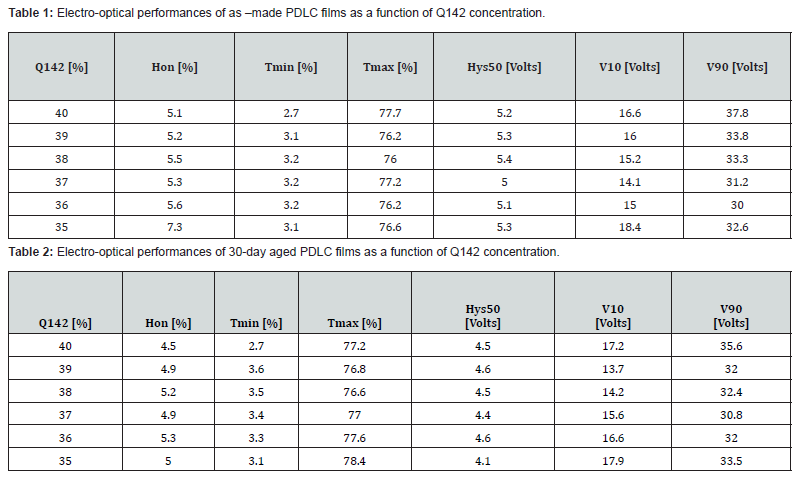
The electro-optical data for the as-made and 30-day naturally aged PDLC films were compared to evaluate the effect of natural aging on optical transmissions and switching voltages within 35-40 wt% of studied Q142 liquid crystal concentration range. The numerical results of these experiments on as-made and 30-day aged PDLC films are tabulated in Table 1 and Table 2, respectively.
Effect of aging on optical transmissions
The effect of Q142 concentration on optical transmissions Hon, Tmin and Tmax for as-made and aged PDLC films are listed in Table 1, Table 2 and plotted in Figure 1. Accordingly, for the as-made samples, Hon ranged from 5.1% to 7.3% over the investigated Q142 concentration range. After 30 days of natural aging, Hon ranged from 4.5% to 5.3%. Thus, haze decreased after aging for every formulation. The largest absolute and relative decrease occurred for the 35% Q142 formulation, for which Hon decreased from 7.3% to 5.0%, corresponding to approximately 32% reduction. The concentration dependence of Hon before and after aging demonstrates the effect of natural aging on optical haze.
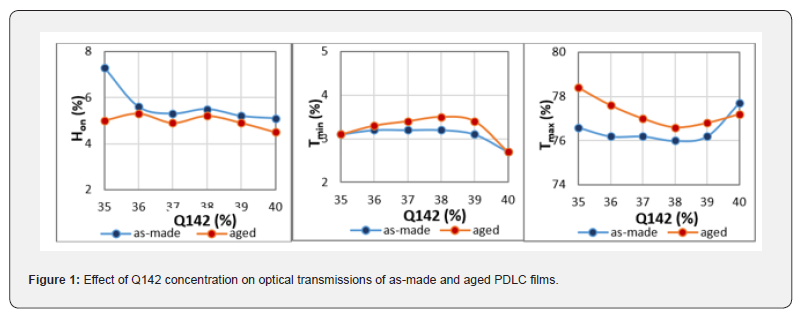
According to the results presented in Figure 1, Tmin remained within 2.7–3.2% for the as-made films and 2.7–3.6% after aging, while Tmax ranged from 76.0–77.7% before aging and 76.6–78.4% after aging. The corresponding optical transmission trends further indicate that natural aging produced comparatively small changes in Tmin and Tmax optical transmission values. These results indicate that natural aging produced comparatively small changes in the limiting optical transmission values, although the magnitude and direction of the changes varied somewhat with Q142 concentration.
Effect of aging on switching voltages
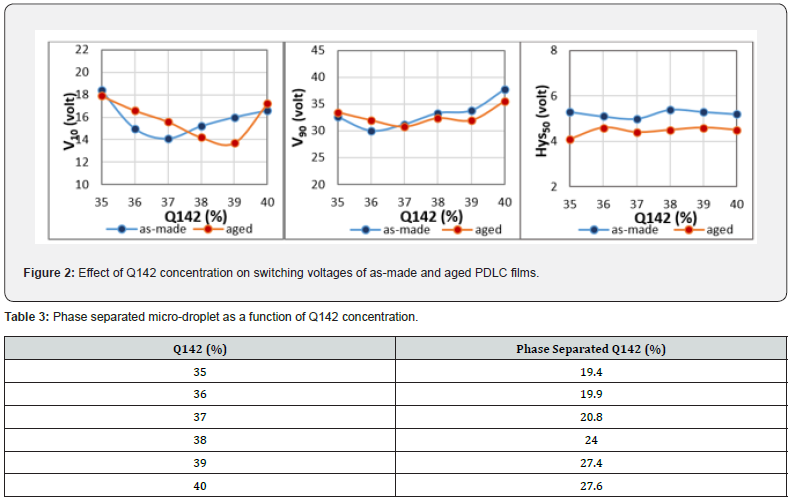
The switching-voltages (V10 and V90) and hysteresis (Hys50) data for as-made and aged PDLC films as a function of Q142 concentration are also listed in Table 1, Table 2 and presented in Figure 2. For the as-made PDLC films, the threshold voltage V10 ranged from 14.1 to 18.4 volt, whereas the aged samples exhibited values from 13.7 to 17.9 volt. The concentration-dependent changes in V10 further demonstrate that the aging response depended on Q142 concentration. However, the changes in V10 after aging were not monotonic with Q142 concentration. For example, in the as-made PDLC formulations, V10 decreased within 35-37wt% and increased within 39-40wt% formulations. Whereas the in the aged PDLC formulations, V10 decreases within 35-39wt% range and increased only within 39-40wt% Q142 concentration range. This behavior indicates that natural aging affected the switching response through a combination of concentration-dependent structural and interfacial effects rather than through a single monotonic trend.
Also, according to Figure 2, the saturation voltage V90 ranged from 30.0 to 37.8 volt for the as-made PDLC samples and from 30.8 to 35.6 volt after aging. The corresponding concentration dependence further demonstrates the formulation-dependent effect of aging on V90. Namely, after aging the V90 decreased for the 35-37wt% formulation range, changed only slightly for 37wt%, and increased for the 38, 39 and 40wt% formulations.
Also, with respect to data of Figure-2, the hysteresis (Hys50) values for the as-made PDLC films were between 5.0 and 5.4 volt, whereas the naturally aged samples exhibited values between 4.1 and 4.6 volt. Hysteresis decreased for every Q142 concentration after 30 days of natural aging, where the largest reduction occurred for the 35wt% formulation, where Hys50 decreased from 5.3 to 4.1 volt.
Effect of Q142 concentration on phase-separated morphology
The approximate phase-separated Q142 liquid-crystal fraction was evaluated by counting the liquid-crystal droplets visible in the Scanning Electron Microscope (SEM) images. As tabulated in Table 3, the estimated values showed an increase in the phase-separated liquid-crystal fraction with increasing Q142 concentration. The phase-separated fraction increased from approximately 19.4% at Q142 35wt% to 27.6% at 40wt% Q142. The estimated phase-separated fraction increased progressively with increasing Q142 concentration. The increase was relatively gradual from 35 to 37wt% Q142 and became more pronounced at higher concentrations, particularly between 38% and 39wt%. The SEM observations indicate that increasing the liquid-crystal content was associated with the formation of larger micro-droplets and a less uniform morphology. Because the values were obtained by image-based droplet counting, they should be regarded as approximate estimates rather than absolute volume fractions.
Relationship between Q142 concentration and aging
Taken together, the experimental results show that liquid-crystal concentration and natural aging jointly influence the electro-optical behavior of the PDLC films. The response to aging was not represented by a single monotonic change in all electro-optical parameters. Haze and hysteresis decreased consistently after aging, whereas Tmin, Tmax, V10 and V90 exhibited smaller and formulation-dependent changes. The morphology results provide a useful structural context for these observations because the estimated phase-separated liquid-crystal fraction increased with nominal Q142 concentration.
These observations support the need to consider formulation and aging together when establishing empirical relationships between PDLC composition, morphology and electro-optical performances. The present study is limited to two measurement states (as-made and 30-day naturally aged) and therefore does not provide a time-resolved aging profile or a controlled-temperature aging study. Additional measurements of droplet-size distributions and longer-term aging would help clarify the mechanisms responsible for the observed changes.
Conclusion
The effect of natural aging on flexible PDLC films containing 35–40wt% Q142 liquid crystal was investigated. The electro-optical properties of as-made and 30-day naturally aged films were compared, and the approximate phase-separated liquid-crystal fraction was evaluated from SEM images. Natural aging reduced the on-state haze and hysteresis for all investigated formulations, while changes in minimum and maximum transmission were comparatively limited. The threshold and saturation switching voltages exhibited concentration-dependent changes after aging rather than a single monotonic trend.
The estimated phase-separated Q142 fraction increased with nominal liquid-crystal concentration, from 19.4% at 35wt% to 27.6% at 40wt%. The SEM observations further indicated that higher liquid-crystal concentrations were associated with larger droplets and less uniform phase-separated morphology. Overall, the results demonstrate that both liquid-crystal concentration and natural aging need to be considered when developing formulation–morphology–electro-optical relationships for flexible PDLC products.
Acknowledgment
This study was internally funded by Gauzy Ltd., Tel Aviv, Israel. The author would like to acknowledge Dr. Koby Kfir, who carried out the experimental work under the author’s supervision at Gauzy’s R&D laboratories during 2015-2016 period.
References
- Doane JW, Golemme A, West JL, Whitehead JB, Wu BG (1988) Mol Cryst Liq Cryst 165 (1): 511.
- Bouteiller PL, Barny L (1996) Polymer-dispersed liquid crystals: Preparation, operation and application. Liquid Crystals V21(2): 157.
- Cheng SX, Bai RK, Zou YF, Pan CY (1996) J Appl Phys 80.
- Hoppe E, Galante MJ, Oyanguren PA, Williams RJJ (2002) Polymer-Dispersed Liquid Crystals with Co-continuous Structures Generated by Polymerization-Induced Phase Separation of EBBA−Epoxy Solutions. Macromolecules 35(16): 6324.
- Mucha M (2003) Polymer as an important component of blends and composites with liquid crystals. Progress in Polymer Science 28(5): 837.
- Hoppe CE, Galante MJ, Oyanguren PA, Williams RJJ (2004) Optical properties of novel thermally switched PDLC films composed of a liquid crystal distributed in a thermoplastic/thermoset polymer blend. Mat Sci Eng 24(5): 591-594.
- Bronnikov S, Kostromin S, Zuev V, Macromol (2013) Polymer-Dispersed Liquid Crystals: Progress in Preparation, Investigation, and Application. J Sci Part B Physics 52(12): 1718.
- Zhang C, Wang D, Cao H, Song P, Yang C, et al. (2013) Preparation and electro-optical properties of polymer dispersed liquid crystal films with relatively low liquid crystal content. Polym Adv Tech 24(5): 453.
- Yamaguchi R, Sakurai S (2014) Cell Thickness Dependence on Electric Optical Property of Reverse Mode Liquid Crystal Display. Jouranl of Photopolymer Science & Technology 27(3): 287.
- A Y, Guo X, Zhang S, Du Z (2014) Advanc ed Material Research 1015: 89.
- Kim J, Han I (2014) Electronic Materials Letters 10(3): 607-610.
- Sannier H, Siddiqi M, Maschke U, Dumon M (2016) Mol Cryst Liq Cryst 638(1):103.
- Hak H (2019) Mol Cryst Liq Cryst 681(1): 12.
- Hakemi H (2019) Mol Cryst Liq Cryst 689(1): 34.
- Hakemi H (2020) Mol Cryst Liq Cryst 703(1): 1.
- Hakemi H (2020) The Effect of Curing Temperature on the Morphology and Electro-Optical Properties of a Flexible UV-Cured Polymer Dispersed Liquid Crystal (PDLC). Recent Progress in Materials 2(4): 11.
- Chen G, Hu W, Zhou L, Zhang H, Wang L, et al. (2021) Crystals 11: 576.
- Wonsool K, Ha (1999) Korean Polym J 7:130.
- He J, Bin Y, Wang X, Yu B, Wang Y (2007) Eur Polym J 43: 4037.
- Li W, Cao Y, Kashima M, Kong L, Yang H (2008) Effects of the structures of polymerizable monomers on the electro-optical properties of UV cured polymer dispersed liquid crystal films. J Polym Sci Part B: Polym Phys 46(13): 1369.
- Ahmad F, Jamil M, Jeon Y, Wo o LJ, Jung JE, et al. (2011) J Appl Pol Sci 121: 1424.
- Lackner AM, Margerum JD, Ramos E, Lim KC (1989) V1080 Proceed Liquid Crystal Chem Phys & Applications.
- Kłosowicz SJ, Aleksander M (2004) Opto - Electronics Review 12(3): 305.
- Bulgakova SA, Mashin AI, Kazantseva IA, Kashtanov DE, Jones MM, et al. (2008) Nezhdanov Russian J Applied Chemistry 81: 1446.
- Lu L, Lu SY, Chien LC (2009) Proceedings, Emerging Liquid Crystal Technologies IV 72327: 23204.
- Kim J, Han JI (2014) Electronic Materials Letters 10: 607.
- Jayoti D, Malik P (2015) Soft Matters, Special Issue: Soft Materials 357(1): 148.
- Chen G, Zhou L, Wang L, Zhu S, (2021) The Electro-Optical Properties and Adhesion Strength of Epoxy-Polymercaptan-Based Polymer Dispersed Liquid Crystal Films. Crystals 11(6): 576.
- Hakemi H (2021) Mat Sci & Eng Intern Journal 5(5): 153.
- Hakemi H (2022) Intern J Mod Res Eng Tech 7(2): 1.
- Hakemi H (2023) Mat Sci Eng Intern 7(5): 217.