




 JOJMS Home



Introduction
It is estimated that 60-80% of chronic human bacterial infections are caused by bacterial biofilms [1].
Recent research has shown that atmospheric pressure plasma, containing reactive oxygen species, can stop and even prevent biofilm growth [1,2] by surface modification.
Stainless steel has numerous applications in different industries such as automotive, aerospace and other manufacturing technologies [3]. In addition, due to stainless steel’s unique properties of good corrosion resistance and biocompatibility, it is used as a biomaterial in manufacturing of medical implants.
Atmospheric pressure non-thermal “cold” plasma alters the surface properties of a material while leaving the bulk characteristics unchanged [3-5], The surface functionalities and morphologies of a substance can be modified using plasma treatment [6-11]. In cold plasma processing, the sample is exposed to excited atomic, molecular, ionic, and free-radical species. The interaction between the excited and reactive species and the sample will determine the chemical and physical modification that will take place. In order to most efficiently take advantage of the plasma-specific chemistries and physical phenomena of non-equilibrium plasmas, understanding the relationship between the process parameters and material properties is critical. Atmospheric pressure plasma produces this result by increasing the surface energy of a material, making it more hydrophilic and thereby less likely to support biofilm growth [2,3]. However, such treatment is not limited to the biomedical field as it has been shown to increase adhesion strength between various materials including stainless steel, polymers, and cotton fabric [12,13]. As such atmospheric pressure plasma treatment applications continue to develop, further research is needed to understand the underlying treatment mechanisms and to determine plasma operating parameters that are most effective and efficient for each specific application [14-16].
In the work reported here, we focused on the surface treatment of 330 stainless steel using an oxygen-enriched helium atmospheric pressure plasma. We used optical emission spectroscopy to measure the relative concentrations of species in the atmospheric plasma jet, and employed a water droplet contact angle technique [14] to measure the change in hydrophilicity of the stainless-steel surfaces. We assessed the effect of varying several plasma operating parameters including treatment time, input power, and O2 secondary gas flow rate. Relaxation time, or the time interval over which treated samples return to their pre-treatment hydrophilicity was also assessed. A specific goal of this work was to evaluate the importance of reactive oxygen species (ROS) in increasing stainless steel hydrophilicity. This was achieved by first demonstrating via optical emission spectroscopy that ROS concentrations could be controlled by adjusting O2 flow rate, and subsequently demonstrating via contact angle measurements that treatment with higher ROS concentrations results in greater increases of hydrophilicity.
Materials and Methods
Plasma jet surface treatment
In our experiment, test samples were treated using an atmospheric pressure cold plasma jet from an AtomfloTM 250 reactor from Surf Technologies, Inc. described in detail in [16,17,18]. With the AtmofloTM the plasma is generated within a remote showerhead plumbed to the main power supply via RF power and gas lines. The showerhead Figure 1a consists of two perforated rectangular plate electrodes separated by a 1.6 mm gap [19]. An electric field is generated using a 13.56MHz radio frequency power supply connected to these two electrodes with the electrode closest to the shower head exit at supply ground. The plasma shower head exit aperture is 6.35mm wide by 25.4mm in length.
A diagram of the plasma treatment set up is shown in Figure 1b. To ensure uniform exposure over the surface of the samples and precise exposure times, samples were scanned underneath the plasma jet using a programmable motorized carousel (sample motion perpendicular to the long dimension of the plasma). For the measurements reported here, the showerhead was maintained at a distance of 5mm from the sample. The atmospheric pressure plasma jet was generated with an input power of 40W, a fixed He flowrate of 20.4L/min, and an O2 secondary gas flowrate that was varied between 0.1 and 0.3 L/min. Surface temperature was measured using a thermocouple as plasma was applied to the sample, Samples were uniformly polished prior to the experiment and cleaned with IPA before and in between treatments in order to reset the surface energy.
Measurement of stainless-steel surface hydrophilicity
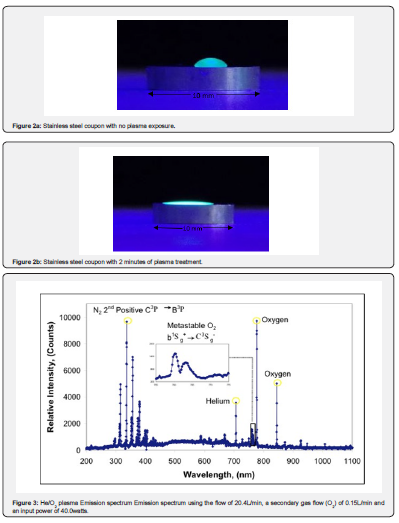
The hydrophilicity of the stainless-steel surface was studied using contact angle measurements. Stainless steel coupons were all prepared in the same manner by polishing on an abrasive lap, and cleaning with Isopropyl alcohol (IPA). Contact measurements were done on each sample immediately before and after treatment (with the exception of the recovery time tests for which multiple contact angle measurements were taken at varying post-treatment time intervals as discussed below). The contact angle measurement platform was located adjacent to the plasma treatment carousel and samples were transferred between the two using tweezers. The contact angles of the treated samples were observed by standardized water droplets. The droplet was applied using a syringe pump pipette (New Era, NE-100) set at 4.0μL and placed 3mm above the center of the surface of the treated sample. The water droplets used for the contact angle test consisted of de-ionized water and florescent dye solution. The fluorescent dye in the droplets was illuminated using a black light to more easily measure the contact angle. ImageJ software was used to analyze each of the water droplet/surface interface and the images were captured using a DSLR camera. Figure 2a shows an image of a stainless-steel coupon with no exposure to plasma. Figure 2b shows an image of a stainless-steel coupon with 2 minutes of treatment.
Measurements were taken to determine the dependence of contact angle on plasma treatment (exposure) time, and on the flowrate of the O2 secondary gas. For the measurements at varying exposure times, a fixed 0.15L/min oxygen flow rate was used, and for the measurements at varying O2 flow rates a fixed exposure time of 5 seconds was used. For each of these combinations of treatment time and flowrate, four samples were run and the resulting changes in contact angle averaged. In addition, recovery time measurements (i.e. the time required for the surface energies of treated samples to return to their pre-treatment levels) were taken based on a 1-minute coupon exposure with contact angle tested at increasing post-exposure time intervals for up to 6 hours.
Optical emission spectroscopy studies
Plasma jet emission spectroscopy studies were carried out for different plasma conditions including plasma input power, and O2 flow rate. For these measurements we used an Ocean Optics HR-4000CG-UV-NIR spectrometer with 0.7nm resolution, a 300 lines/mm grating, a CCD detector, and a spectral range of 200nm-1000nm. Spectral data from the spectrometer CCD are recorded with a computer data acquisition system.
Light emitted from the plasma jet was collected through a fiber optic cable and focused directly onto the entrance slit of the monochromator.
Results and Discussion
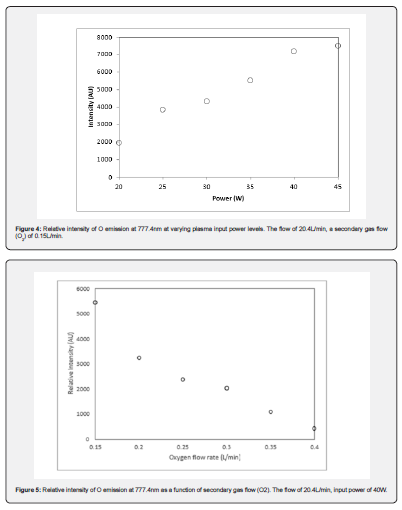
Spectroscopic analysis was carried out to determine the atomic and molecular species present in the He/O2 plasma. A characteristic emission spectrum is shown in Figure 3. Some mixing of the plasma jet with the ambient atmosphere is also evident based on emissions associated with nitrogen (e.g., the prominent N2 peak at 340nm) and water (As evident from lines associated with molecules containing nitrogen-, and hydrogen-containing molecules). Atomic and molecular oxygen are key characteristic radicals present in the plasma, as indicated by spectral peaks at the oxygen transitions at 777.4nm (atomic) and 844.6nm (molecular). The molecular oxygen band around 762nm was observed as well. Electron impact excitation of ground-state molecular and atomic oxygen leads to emission at 844.6 and 777.4nm, which is described by the following mechanisms: dissociative excitation

and direct impact excitation

where O∗ refers to the O(3p5P) state which emits at 777.4nm and to the O(3p3P) state which emits at 844.6nm [20,21].
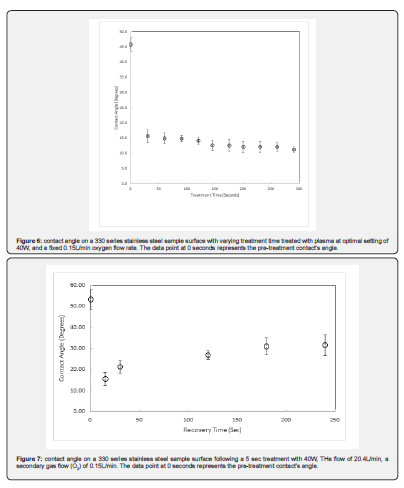
We compared ROS concentrations (using 777.4nm line intensity as an index) at varying plasma input power levels, and O2 secondary gas flow rates. ROS concentrations were found to generally increase with input power up to about 40W as shown in Figure 4. At input powers beyond 40W, ROS concentrations appear to plateau, although at these power levels the plasma jet becomes unstable and extinguishes within a few seconds, making such a plateau difficult to characterize. ROS concentrations decrease with increasing O2 secondary gas flow rates as shown in Figure 5. This decrease is consistent with the observations of [2], and is attributed to the recombination of active species [2].
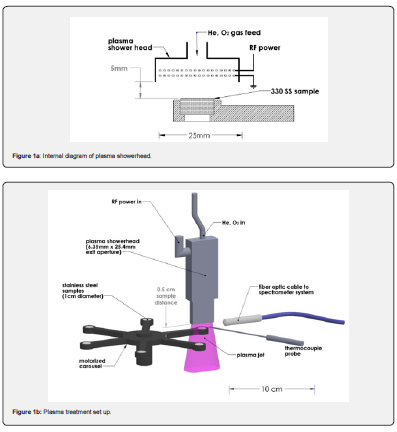
Figure 6 shows changes in the contact angle on a 330 series stainless steel sample surface when treated with plasma at 40W input power and 0.15L/min O2 flow rate. Prior to plasma treatment, a control contact angle (no plasma treatment as represented by the point at 0 seconds treatment time) was measured at 50±5 degrees contact angles for samples prepared by polishing and cleaning with IPA as described in Section II were typically within this range. As is evident from Figure 6, the greatest increase in hydrophilicity (i.e., decrease in contact angle) occurred within the first 30 seconds of treatment. Further changes in subsequent intervals were far more gradual.
Figure 7 shows how long the effects of 5 second treatment lasted. Six hours after treatment, the contact angle returned to 65% of the original contact angle.
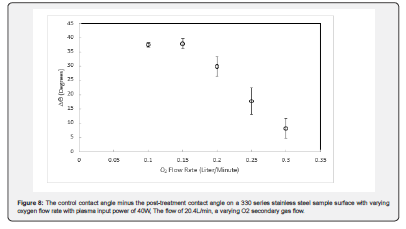
We varied the oxygen flow rate for the following flow rates: 0.1, 0.15, 0.2, 0.25, and 0.3L/min and measured the resulting surface energy. Figure 8 displays the data collected from this procedure. The y-axis indicates the change in surface energy, represented by Δ𝜽𝜽 (i.e., the control contact angle minus the post-treatment contact angle). We found that at lower flow rates, when there were more reactive oxygen species, the change in contact angle was greater, indicating a more hydrophilic surface, and higher surface energy. The ions and electrons present in the plasma quickly recombine outside the jet and are probably not active in surface modification [22].
These findings are consistent with a review of existing literature which leads to the conclusion that in most cases, the main mechanism responsible for surface modification is the free radical and neutral reactions
where a material is exposed to atmospheric pressure plasma [23,24] discussed the effect of O2 plasma jet on the surface properties of stainless steel, and it was proved the surface of stainless steel was more hydrophilic because new functional groups appeared after N2 and O2 plasma treatment. X-ray photoelectron spectroscopy (XPS) characterization of the chemical composition of the treated surfaces performed. confirmed the existence of new oxygen-containing functional groups contributing to the change in the hydrophilic nature of the surface [25,26] suggested these new functional groups were generated by surface reactions caused by reactive oxidation of substrate species [27-29].
Conclusion and Future Plans
We have demonstrated that atmospheric pressure oxygen-enriched helium plasma is an effective tool for increasing the surface energy of 330 series stainless steel. Additionally, we find that more reactive species are present at lower oxygen flow rates where the most effective surface modification is observed, as indicated by the largest change in contact angle. This result suggests that reactive oxygen species (ROS) in the plasma play a significant role in increasing the hydrophilicity of the stainless-steel surface. We plan for a deeper analysis into the interactions between ROS and surfaces including studying of aging effects on the angle contact in function of the operating conditions of the plasma treatment and investigating the synergetic effects that can be suggested with other particles present in the plasma. This would make it possible to tailor plasma treatment parameters to specific applications, including biofilm destruction and prevention, prevention of corrosion, and adhesion improvement of polymers.
Acknowledgement
The authors would like to thank the Achieve Scholars Program at Cal Poly Pomona as well as the Mogge scholarship. The authors would also like to thank Seth Wieman (University of Souther California), Joanne Sohn (Cal Poly Pomona), Peter Siegel (Cal Poly Pomona), and Barbara Hoeling (Hochschule Landshut University of Applied Sciences) for critically reviewing the manuscript.
References
- Ulrich K (2004) Microstructural Aspects of Crack Initiation and Propagation in Metallic Materials, Habilitation Thesis, Department of Mechanical Engineering of the University of Siegen, Germany, pp. 467-922.

























