




 JOJMS Home



Abstract
In a research project, investigation on durability of steel components in LLF long life fatigue have started. The designated durability is above 100 Mio. cycles, using the steel Ck101 (1.1274) in thin-walled structures. During experiments reproducible failure occurs on the side wall of the components far below the expected lifetime.
This type of failure can be described, not typical for fatigue, as an initial brittle crack forming a lateral lancet through the center plane of the material sheet, followed by continuous cyclic crack growth. Examinations of the material show minor segregations. Nevertheless, a correlation between the load case and the specific failure to the segregations can be assumed.
Finite element analysis for prediction of the critical stress state and prediction of failure is under development.
Keywords: Fatigue testing; Long life fatigue; Initial brittle fracture; Steel; Segregation
Introduction
During investigation on long life fatigue on a small steel specimen, unexpected initial cracks are detected. The initial crack is brittle and spontaneous. It stops at a certain size and is followed by typical cyclic crack growth. This new type of fatigue fracture mechanism is described and examined by microscopy and stress state analysis, using finite element methods.
Test Setup
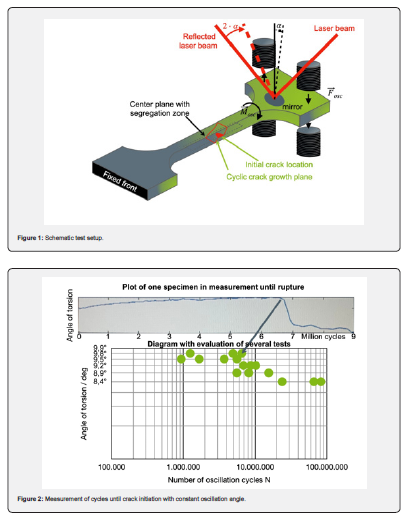
Thin-walled structures, made of valve sheet material 1.1274 Ck101 are tested under torsion, Figure 1.
The torsion is introduced by symmetric electromagnetic fields at the end of the structure. The front of the structure is fixed. The strength of the electromagnetic fields is controlled and constant throughout the test.
The load to the structure is measured indirect by using the angle of torsion optical with reflection of a laser.
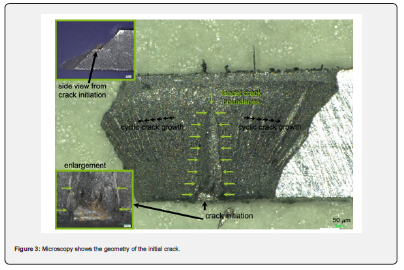
The angle 𝛂 is representing the torsion angle of the profile, resulting 2·𝛂 is the measurable angle of the deflected laser beam. The frequency of the test is very close to the natural frequency of the component Figure 2.
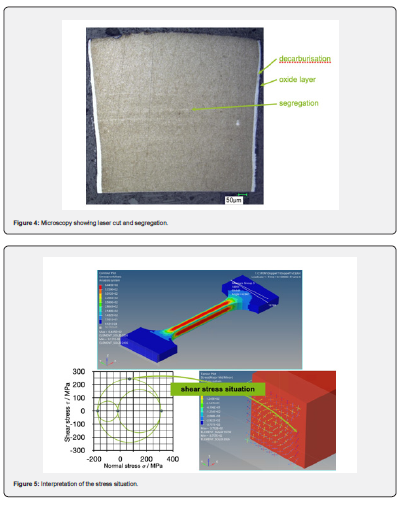
Typical natural frequencies are above 5000 Hz. Hence a very low electromagnetic induction for the oscillation is used. The test ends with the detection of the crack. The cyclic growth crack plane can also be seen in the side view of Figure 3.
Numerous tests show a clear correlation between the height of the load (angle) and the lifetime until crack initiation. A typical measurement shows, that the angle suddenly reduces significantly, Figure 2. This can be explained, by a loss of stiffness due to the crack initiation.
It is to mention, that crack occurs spontaneous and in full length, showing a lancet geometry. The bar is not yet broken. After the spontaneous crack, the cyclic crack growth starts. This spontaneous crack behavior has never occurred before in experiments to determine durability of a component. Neither, this cracking procedure is in accordance to the typical crack initiation and crack growth mechanisms, described in literature [1].
As the preliminary intention of the tests was the determination of the durability, at that point the stimulation by the electromagnetic inducers is increased by factor 10 to provoke final rupture. This is the crack surface for later examination, Figure 3.
The spontaneous crack is showing a lancet geometry regarding the boundaries of the crack plane. For this spontaneous crack, typically a hydrostatic stress state, according to Griffith’s theory of brittle cracks, is to be expected. A small crack initiation at the surface is required to confirm this theory. At the crack initiation point, a small crack surface can be seen.
The crack plane is located in the center of the plate. It is precisely horizontal. This can be seen in the side view. It is to be assumed, that the crack starts from the side walls, visualized in the enlargement. Crack stop can be assumed to synchronize with sudden breakdown of the actual stress state at the crack boundaries. This is caused by the high-frequent oscillation and the loss in stiffness. Adjacent to the crack plane boundaries, cyclic crack growth can be observed on both sides. The cyclic crack growth leaves the center plane and proceeds under an angle of approximately 45°, indication, that the stress state now also is dominated by shear stresses.
Aspect of Segregation and Manufacturing Technology
Microscopic examinations show a minor enrichment of impurities in the center plane of the metal sheet, Figure 4. This content of segregation is strictly within the tolerances, given by the standard. Nevertheless, it is a clear indication, that the development of the crack reproducibly lies within this center plane. The embrittlement of the impurities is obviously making the difference to provide a plane for the spontaneous crack growth.
It is also visible, that the preparation of the specimen was done by laser cutting. This definitely leads to an embrittlement of the lateral surface layer by oxidation and decarburization. In the decarburized zone, the lateral shear stresses are able to produce micro cracks open to the surface. This helps to explain, that the stress state can initiate the micro crack, it does not explain the brittle crack proceeding in depth.
Aspect of Stress State
A finite element simulation model shows the calculated stress state at the moment of maximal amplitude in the torsion. At the relevant position, the stress state is dominated by shear stresses at the surface lateral, correlating with the expectations from calculation according to the approximation of St. Vernant. This stress state is initial for the crack start, Figure 5.
High stresses, calculated by using von Mises equivalent stresses, are observed at the lateral surfaces. A detailed view in a relevant cross section provides information about the major stresses. At the relevant position center of the lateral surface, Mohr’s circle interpretation shows the domination of shear stresses. Summarizing all described mechanisms, the crack initiation is caused by shear stresses, inducing a micro crack in the decarburized zone at the lateral surface.
Once, this micro crack is reaching a critical depth, Griffith’s theory explains the spontaneous crack growth, leading to a brittle crack with the lancet geometry. Cyclic crack growth follows finally and results in a complete destruction of the cross section.
Conclusion
The segregation of this high strength valve steel, designed for high durability, is typically not causing any problems. Bending these plates, keeping the segregation in the center plane in a neutral position, does not lead to crack initiation. The torsion of a thin structure produces a lateral stress situation. The lateral stress is dominated by shear stresses. These stresses, applied to the center plane, containing the segregations, produces a sudden and early failure of the specimen. Investigations to explain the crack initiation, the crack propagation and the crack stop in detail with fracture mechanical approaches and comparative finite element simulations are ongoing. The expected outcome of this investigation is to determine the level of embrittlement in comparison to material unaffected by segregations.
Acknowledgement
This research was funded by ZIM Program within AiF as member of BMWi (Bundesministerium für Wirtschaft und Energie, Germany) with grant number KK5107103SY0 under the abbreviation LinRes2D. The experimental work was performed in cooperation with Femotech GmbH, D-35756 Mittenaar.
References
- Ulrich K (2004) Microstructural Aspects of Crack Initiation and Propagation in Metallic Materials, Habilitation Thesis, Department of Mechanical Engineering of the University of Siegen, Germany, pp. 467-922.

























