




 JOJMS Home



Abstract
As the demand of application of aluminum alloy in various industries such as automotive, aerospace and construction increase, the necessity to study the effect of rare earth elements on aluminum alloys are become a pressing issue to ensure that the aluminum alloys able to fulfil the market’ needs. In this study, the effect of the rare earth element Yttrium (Y), Holmium (Ho) and Zirconium (Zr) on the microstructure properties of the aluminum alloy was reviewed. The case study method was conducted by referring from previous research and journal articles. Both additives improved the microstructure properties of aluminum alloys, but different types of aluminum alloys have different compositions which makes the optimum weight percentage of yttrium holmium and zirconium addition to differ too.
Keywords:Earth elements; Aluminum alloy; Zirconium; Yttrium; Scandium
Introduction
The global aluminum industry has indeed shown remarkable growth because of the increased use of aluminum packaging, transportation, construction, and electrical engineering [1]. Aluminum alloys are known as a highly adaptable material since it can be widely used in various applications due to its unique combination properties such as lightweight, corrosion resistant, high strength-to-weight ratio, etc. These properties make aluminum alloy become a structural metal used apart from steel. The industrials are favored Aluminum alloys because of its lightweight nature and high strength-to-weight ratio. Therefore, to improve fuel efficiency and performance, aluminum alloy seems to be the most suitable choice.
To enhance the mechanical, thermal and chemical properties of aluminum alloys, micro-alloying would be the ordinary method. The rare earth elements are a group of metallic elements that are difficult to extract economically, which can be used as an alloying agent to improve the properties of aluminum alloy. Generally, aluminum alloy can be categorized into eutectic, hypoeutectic and hypereutectic according to the compositions relative to the eutectic point in a binary phase diagram. As a hypereutectic aluminum alloy, LM30 (Al-Si17 Cu4 Mg) contains the highest silicon content among the three types of aluminum alloys. This high silicon concentration gives it properties that differ significantly from those of eutectic and hypoeutectic aluminum alloys. To obtain desirable properties, the use of rare earth elements with aluminum alloys are needed.
To intensify a material’s mechanical properties, there are several methods including element modifications, heat treatment, and others. Among these methods, alloying is one of the effective methods to achieving the modification of an element to increase the mechanical characteristics of aluminum alloys. The use of rare earth elements such as Yttrium and Scandium has been proved to enhance the properties of aluminum alloys [1-3]. However, there is still lack of exploration on the effect of rare earth elements to the microstructure and hardness properties of LM30 alloy. Therefore, studying the effects of Yttrium, Holmium, and Zirconium on the microstructure and hardness properties of LM30 aluminum alloy is crucial, as it can serve as a reference for engineers in the modification of aluminum alloys.
Despite that, the combination of aluminum alloys with different rare earth elements will lead to varying effects on their microstructure and mechanical properties. Therefore, identifying the actual type and composition of rare earth addition is an absolute must when attributing the effect of rare earth addition to the alloy properties.
Research Methodology
Aluminum alloy LM30 is used as the main material to produce samples, and the chemical composition is expressed in weight percent, wt. %. LM30 alloy is melted into the crucible furnace and yttrium (Y), holmium (Ho) and Zirconium (Zr) additive is added at a temperature around 730°C±. During the melting process, yttrium (Y), holmium (Ho) and Zirconium (Zr) is added to the molten metal and stirred to ensure homogeneity of the composition. The melted alloys were poured into the preheated steel mold and cooled down under room temperature. The chemical compositions of LM30 that are used in this study are displayed in Table 1 below. Microstructural analysis of as-cast samples was performed to determine the modification effect of Y, Ho and Zr addition.

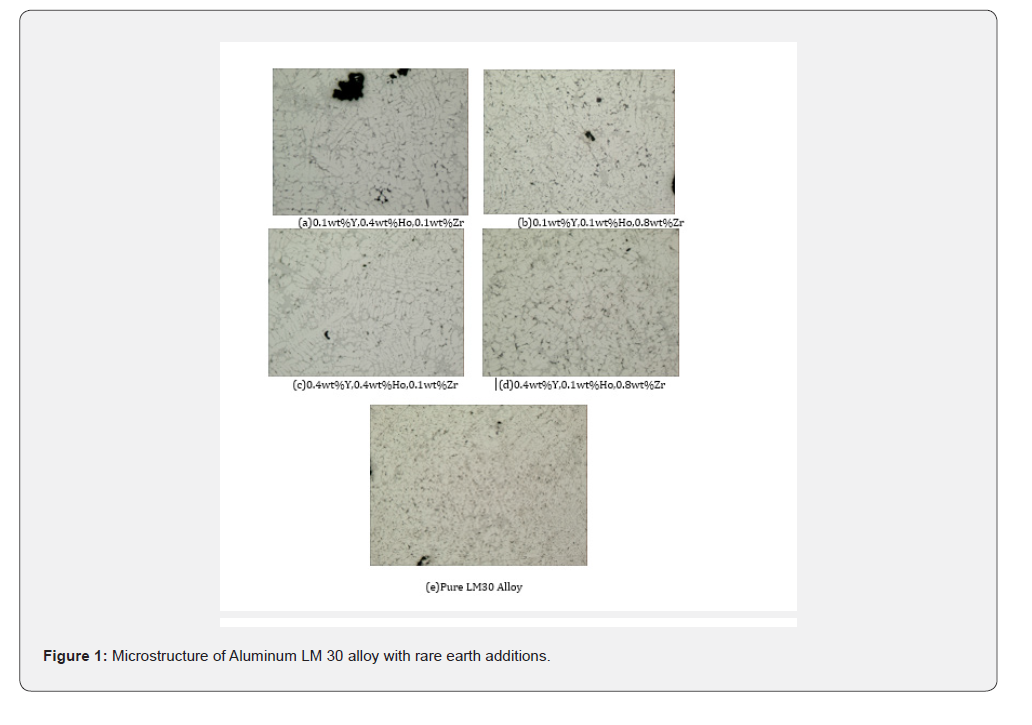
The samples were cut into small pieces to undergo microstructural analysis. The surface of the samples was ground and polished before being inspected under an optical microscope at various magnifications to observe the change of the grain boundaries with and without Y, Ho and Zr addition. To reveal the microstructure of polishing samples, Keller’s reagent is used as an etchant so the microstructure can be observed clearly.
Results
Figure 1 shows the microstructure of LM30 alloy with different compositions of Yttrium (Y), Holmium (Ho) and Zirconium (Zr). In Figure 1(e), the grain boundary of unmodified LM30 alloy shows coarse and irregular microstructure. When the rare earth elements Yttrium, Holmium and Zirconium are added, the microstructure has been changed as shows in Figure 1(a)-1(d).
In Figure 1(a) & 1(b), different amounts of Yttrium but the same amount of Holmium and Zirconium are added to the LM30 alloy which are 0.4wt% and 0.1wt% respectively. Compared with Figure 1(e), the coarse dendritic α-Al grains have been refined and the microstructure become uniform in Figure 1(a) where 0.1wt% of Yttrium is added. When the amount of Yttrium increases to 0.4wt%, further refinement is observed, and the eutectic Silicon has transformed to finer fibrous morphology. When the amount of Holmium and Zirconium has changed to 0.1wt% and 0.8wt% while the amount of Yttrium remains unchanged at 0.1wt%, the microstructure has shown in Figure 1(b). The α-Al grains structure looks similar, but Figure 1(b) has a more uniform dendritic network.
By comparing Figure 1(b) & 1(d), the grain boundary in Figure 1(d) seems to be increasing and the primary Silicon and eutectic structure distributed more evenly. The dendritic structure shows in Figure 1(b) has been modified when 0.4wt% of Yttrium is added while the percentage of Holmium and Zirconium keep the same. Meanwhile, when compared to Figure 1(c) which has shown a uniform microstructure, the changes in percentage of Holmium and Zirconium added while the percentage of Yttrium remain unchanged has brought more significant effect to the microstructure shown in Figure 1(d). From these results. It seems that the addition of 0.4wt% Yttrium, 0.4wt% of Holmium and 0.1wt% of Zirconium has a significant modification effect on the microstructure of LM30 alloy.
The result obtained has shown similarity to other rare earth elements. When 0.2wt% of Erbium is added to as-cast Al-Mg- Mn-Zr alloys, it does not lead to grain refinement. However, the grain size reduced significantly when the concentration of Erbium increases to 0.4wt% [4]. Besides that, a study on effect of cerium additions on the AlSi17 casting alloy shows that the addition of 1wt% of Cerium modified the size of the primary silicon grains but does not show any refinement when the concentration of Cerium increases to 4.5wt% [5].
Conclusion
The effect of the addition of Y, Ho and Zr on microstructure and
mechanical properties of Aluminum base alloy was investigated.
From the case study analysis, the conclusion can be summarized
as the points below:
i. Yttrium and holmium additives refined the
microstructure of the aluminum base alloys by reducing the
average grain size.
ii. Addition of yttrium and holmium leads to the formation
of additional intermetallic phases that distributed along the grain
boundaries.
References
- Abdullahi T, Harun Z, Othman MHD, Blaou ABY, Nuhu AH, et al. (2019) Effect of Yttrium on the microstructure and mechanical properties of A5083 secondary aluminum alloy. J Adv Res Fluid Mech Therm Sci 62(2): 168-78.
- Li HZ, Liang XP, Li FF, Guo FF, Zhou LI, et al. (2007) Effect of Y content on microstructure and mechanical properties of 2519 aluminum alloy 17(6): 1194-1198.
- Lei Z, Wen S, Huang H, Wei W, Nie Z (2023) Grain Refinement of Aluminum and Aluminum Alloys by Sc and Zr. Metals 13(4): 751.
- Wen S, Xing Z, Huang H, Li B, Wang W, et al. (2009) The effect of erbium on the microstructure and mechanical properties of Al–Mg–Mn–Zr alloy. Materials Science and Engineering A 516(1-2): 42-49.
- Kores S, Vončina M, Kosec B, Mrvar P, Medved J (2010) Effect of cerium additions on the AlSi17 casting alloy. Mater Tehnol 44(3): 137-140.

























