




 JOJMS Home



Abstract
In this study, fly ash, cement and desulfurization wastewater of coal-fired power plant with different water quality including raw water from desulfurization tower are used, the effluent of the raw water after three-box treatment and the high-salt water from evaporation of the effluent are compared with the deionized water used in the preparation of fly ash-based products (for example, fly ash brick). Under the ratio of desulfurization wastewater and fly ash-cement composite powder of 0.28, two fly ash-cement ratios were used: 7:3 and 9:1, and the samples were cured for 28 days, the influence of cement content and different water quality on its compressive strength and flexural strength was studied.
The results show that the compressive strength and flexural strength of the samples with fly ash-cement ratio of 7:3 are higher than 9:1, and the strengths of the samples using high salt water are the lowest, as consistent with the expectation. In the aspect of flexural strength, the raw water of two different fly ash-cement ratios is the highest, which has no obvious difference with the deionized water, and is higher than the effluent, and far higher than the high salt water. In the aspect of compressive strength for the fly ash-cement ratio of 7:3, the effluent is the highest, higher than raw water which has no obvious difference with deionized water. At the fly ash-cement ratio of 9:1, the raw water is the highest, higher than the effluent, the effluent is higher than the deionized water. According to the strength grade requirements of the JC239-2001“Fly ash brick” standard, fly ash-based products were prepared by using fly ash and desulfurization wastewater with different water quality as raw materials and appropriate cement dosage can meet the strength requirement of MU10 and achieve the goal of using waste (fly ash) to treat waste (desulfurization wastewater).
Keywords:Desulfurization wastewater; Fly Ash brick; Fly ash
Introduction
In order to meet the national requirements for sulfur dioxide (SO2) emission which requires less than 35mg/m3 of flue gas, most of the coal-fired power plants adopt wet desulfurization process. The main ionic components of desulfurization wastewater include Na+, Cl-, SO4 2- ions, etc. At present, after water treatment, the desulfurization wastewater can be discharged in accordance with the requirements after meeting the discharge standards. There are three treatment methods for desulfurization wastewater that do not meet discharge standards: 1) mixing with fly ash to reduces dust emission during fly ash transportation, and finally as landfill, but also increases the landfill cost due to weight gain; 2) treatment of flue gas by desulfurization wastewater, which may increase the content of chloride ions and other heavy metals in fly ash, and reduce the utilization of fly ash as a resource, especially for cement and concrete; 3) evaporation or crystal water treatment technology, which is the most safe and reliable treatment technology but the highest cost, produces a small amount of high-salt water or concentrated liquid which may be considered as hazardous waste category. In this study, fly ash brick was prepared by using fly ash from coal-fired power plant and desulfurization wastewater of different water quality as raw materials, using ordinary cementitious materials (such as cement) at the fly ash to cement ratio of 7:3 and 9:1, respectively. The effect of different water quality on strength was studied by using waste (fly ash) to treat waste (desulfurization wastewater) to realize both wastes as resource [1].
Experimental
Raw material
i. Ordinal Portland Cement 42.5 R: purchased from Ningxia
Building Materials Group.
ii. fly ash: original fly ash obtained from Yuanyanhu power
plant Phase II with average particle size of 90μm, see Table 1.
iii. desulfurization wastewater: raw water obtained from
Yuanyanhu power plant Phase II with its ion concentration listed
in Table 4.
iv. effluent: treated desulfurization wastewater obtained
from Yuanyanhu power plant Phase II with its ion concentrations
listed in Table 4.
v. high salt water: 50% evaporation of the effluent water
obtained from Yuanyanhu power plant Phase II with its ion
concentrations listed in Table 4.
vi. deionized water: provided by the laboratory at National
Institute of Clean-and Low-carbon Energy




Characterization of raw materials
Particle size distribution
The particle size distribution measured by the laser particle size meter and the sieve allowance measured by the 45-micron sieve method according to GB 1596 of fly ash obtained from Yuanyanhu power plant are shown in Table 1 [2]. The fly ash meets the fineness of grade GB 1596 III ash.
Chemical composition
The chemical composition of fly ash from Yuanyanhu power plant was characterized by XRF. The results are shown in Table 2.
Particle morphology
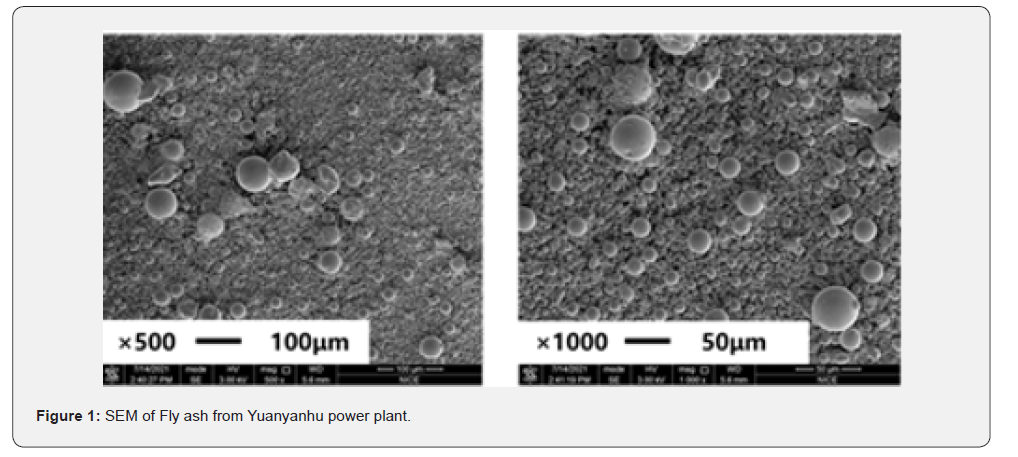
The morphology of fly ash particles from Yuanyanhu power plant was characterized by SEM below, as shown in Figure 1. The particle shape of pulverized coal ash of Yuanyanhu power plant is spherical [3].
Mineral phase characterization
Glass phase content and mineral phase composition of fly ash from Yuanyanhu power plant were characterized by XRD, as shown in Table 3. The glass phase content of fly ash is 65.7%. The main crystalline phase includes mullite, quartz, magnetite, and lime. The content of quartz is the highest. The chemical composition of quartz is SiO2, the chemical composition of mullite is SiO2 and Al2 O3. In other mineral phases, fly ash contains lime. The pH value of fly ash is 11.51, which belongs to high alkaline aluminosilicate [4].
Characterization of desulfurization wastewater
The ion concentration data of raw water, effluent and high salt wastewater from the Yuanyanhu power plant Phase II are listed in Table 4. The main ions in the raw water of desulfurization wastewater are anions, including 9,262mg/L sulfate ion and 3,013mg/L chloride ion, while for cations, magnesium ion is the highest, 2,531mg/L, sodium ion is 768mg/l, calcium ion is 321mg/l and potassium ion is 23mg/L. The anions and anions of the effluent were obviously increased, while the anions and cations of the high salt water, except calcium ion, were doubled [5].
Equipment
The following are the sample preparation and maintenance
equipment used in this experiment.
i. mixer: JJ-5, Wuxi Jianyi Instrument Machinery Co., Ltd.
ii. cement concrete standard curing box: model HBY-40A,
effective volume 0.4 m3,65 × 50 × 130cm, Wuxi Jianyi Instrument
Machinery Co., Ltd.
iii. compression and bending equipment: TYE-300D cement
mortar bending and compression testing machine, Wuxi Jianyi
Machinery Co., Ltd.
Experimental procedure
According to a certain ratio of cement and fly ash mixture, while taking a certain amount of desulfurization wastewater or deionized water (water-powder ratio of 0.28) [6]. Pour the measured water into the mixing pot, then add the measured fly ash and cement powder mixture into the mixing pot, put it on the mixing equipment, and turn on the automatic program (slow stirring in 60s, fast stirring in 60s, intermittent stirring in 60s, fast stirring in 60s), mixing; put the well-stirred material into the jumping-table to test its fluidity. Complete mixing to form a uniform paste, when the fluidity reaches 190mm. The paste is poured into the sample triple mold to form the test samples. The formed triple mold is wrapped with the fresh-keeping plastic film, and put into the curing box with the temperature of 20±2C and the humidity above 90% to maintain, maintain for 28 days and test its compressive and flexural strength [7].
Sample curing
Samples were formed in the triple mold, wrapped with freshkeeping plastic film, cured in the curing box with temperature of 20±2C and humidity over 90%. After curing for 1 day, the sample was placed in a vessel containing distilled water and immersed for 28 days.
JC 239-2001 standard strength requirements for fly ash brick
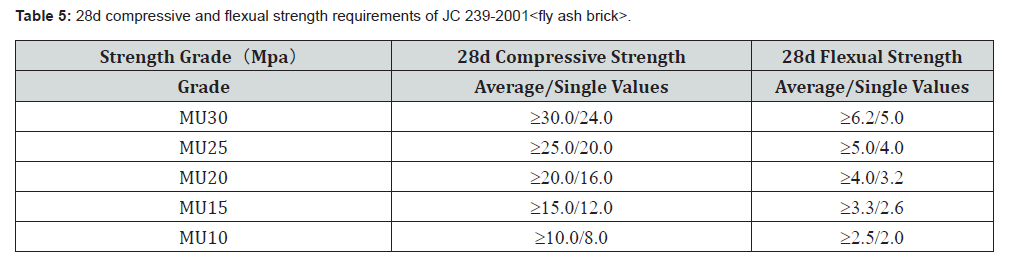
According to JC 239 standard 28-day compressive and flexural strength requirements, it has five grades: MU10, MU15, MU20, MU25 and MU30, see Table 5.
Experimental Results and Discussion
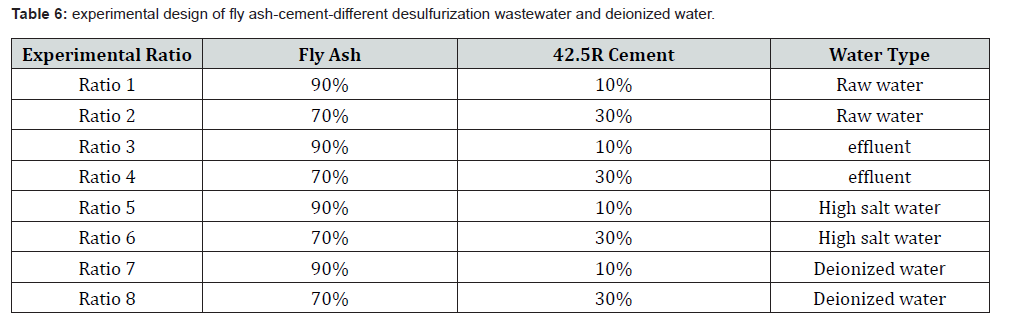
Table 6 shows the experimental schemes of two fly ash-cement ratios using three different types of desulfurization wastewater with water-composite powder ratio of 0.28, and also compared with deionized water [8].
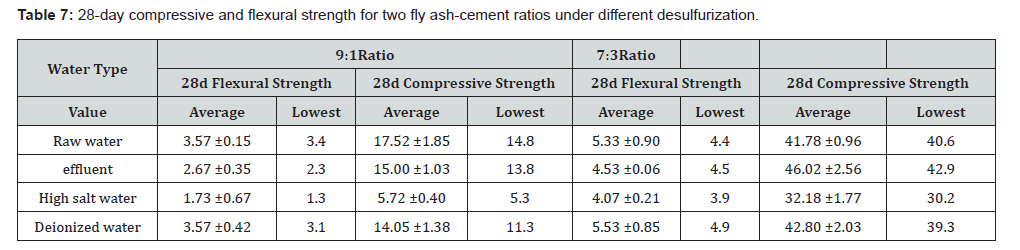
The average and lowest single values of flexural and compressive strength of deionized water for 28 days were compared under different desulfurization wastewater for fly ash-cement ratios of 9:1 and 7:3, as listed in Table 7. The number of samples for measuring compressive strength and flexural strength were 6 and 3, respectively [9]. The results show that the compressive strength and flexural strength of fly ash-cement ratio of 7:3 are higher than 9:1, and the strength of high salt water is the lowest, as consistent with the expectation. In the aspect of flexural strength, the raw water of two different fly ash-cement ratio is the highest, which has no obvious difference with the deionized water, and is higher than the effluent, and far higher than the high salt water [10]. In the aspect of compressive strength, the fly ash-cement ratio of 7:3, the effluent is the highest, higher than raw water which has no obvious difference with deionized water [11]. At the fly ashcement ratio of 9:1, the raw water is the highest, higher than the effluent, the effluent is higher than the deionized water. According to the above data, the use of different desulfurization wastewater under the appropriate fly ash-cement ratio can meet JC 239“Fly ash brick” MU10 strength grade requirements [12].
Conclusion
Under the same water-composite power ratio (0.28) at two
different fly ash: cement ratios (7:3 and 9:1), the strength of fly ashbased
products prepared from desulfurization wastewater with
different water quality is affected with the following conclusions:
i. the compressive strength and flexural strength of fly
ash-based products increase with the increase of the amount of
cement used;
ii. under the same fly ash-cement ratio, the strength of fly
ash-based samples using high salt water is the lowest;
iii. In the aspect of flexural strength, two different fly ashcement
ratios show raw water is the highest and has no significant
difference to deionized water, but higher than the effluent, and far
higher than high salt water.
iv. In the aspect of compressive strength, at the fly ash:
cement ratio of 7:3, effluent is the highest, higher than raw water
which has no significant difference to deionized water; while at the
fly ash: cement ratio of 9:1, raw water is the highest, higher than
effluent water which has no significant difference to deionized
water.
v. the fly ash-based products using fly ash and
desulfurization wastewater as raw materials can meet the MU
10 grade strength requirements of JC 239
References
- Hwan TT (2007) Preparation of modified fly ash and its application in wastewater containing Cu2 +, Zn2+ and Cr6 +. Master of Kunming University of Science and Technology Thesis.
- Ma Zuo (2008) Study on adsorption of F- and Hg2+ on modified fly ash. Master of North China Electric Power University thesis.
- Lu Zhijiang (2008) Study on removal of heavy metal ions from wastewater by modified fly ash. Master of Hunan University Degree Thesis.
- Lu Jun (2009) Study on modification of fly ash and fluoride removal performance of modified fly ash. Master of Inner Mongolia University of Technology.
- Wei HZ, Zheng W, jie WZ (2018) Research progress on desulphurization wastewater treatment technology in coal-fired power plants. Coal and Chemicals 6: 156-160.
- Jianhua Z, Yufei C, Yijin Z (2020) Application and prospect of desulphurization wastewater treatment technology in coal-fired power plant. Industrial Water Treatment (5): 1-13.
- kit LS (2019) Study and application of desulphurization wastewater treatment technology in coal-fired power plant. Process and Equipment 45: 72-74.
- Chen MS, Jialin C, Cheng WZ (2019) Research status and development of cement fixation technology for high-salt desulphurization wastewater. Advances in Chemical Engineering 38(9): 4275-4283.
- Shuangchen M, Xiang, Jianning C, Zhongcheng Z, Jingrui Z, et al. (2019) basic experimental study on cement fixation of high-salt desulphurization wastewater. Journal of Power Engineering 39(9): 9-15.
- Chen MS, Ning CK (2019) Basic Experiment on solidification of high-salt desulphurization wastewater in coal-fired power plant. Journal of Coal 44(8): 2596-2602.
- Xiang (2019) experimental study on cement fixation of high-salt wastewater. North China Electric Power University Master Thesis.
- Renew J, Huang C, Burns S, Carrasquillo ME (2016) Immobilization of heavy metals by solidification/stabilization of co-disposed flue gas desulfurization brine and coal fly ash. Energy & Fuels 30(6): 5042-

























