




 JOJMS Home



Abstract
Commercial Alumina and local Zabirah clay were used as starting raw materials. The mixture of Alumina and Metakaolin with 55.6wt.% Alumina, 44.4wt. % Metakaolin was prepared by ball milling technique. The material properties, such as porosity and density, and thermal expansion of the composites were characterized by X-ray diffraction (XRD), Differential thermal analysis (DTA)/ thermogravimetric analysis (TGA), and the dilatometer measurements. DTA graph showed that the optimum crystallization is at 993.1°C. The melting started afterward. The XRD patterns of the sample after sintering at 1750°C-2hrs show that the Clay-Alumina mixture was transformed to Mullite with small patterns of Corundum (Al2O3). The porosity of the sample is 8.39% and the density is 2.51 g/cm3. CTE is increased when the temperature is increased and the increase is with a small rate with temperature (5.33E-06 at 1000°C, 5.84E-06 at 1300°C).
Keywords: Mullite; Alumina; Metakaolin; Thermal expansion
Abbreviations: XRD: X-Ray Diffraction; DTA: Differential Thermal Analysis; TGA: Thermogravimetric Analysis
Introduction
Mullite is an alumino-silicate material widely used in traditional refractory applications. Since they include clay and silicon as starting materials, most traditional ceramic products have Mullite as part of their final phase composition. Although Mullite is among the traditional refractory materials, it has started to gain importance as a candidate material for advanced ceramics applications in recent years [1]. Kaolin is an alumina-silicate that has been used as a combination SiO2 and Al2O3 source. The key component of kaolin is kaolinite, which has the chemical composition Al2Si2O5 (OH)4 (39.8% alumina, 46.3% silica, 13.9 % water) and is a two-layer crystal (silicon-oxygen tetrahedral layer joined to alumina octahedral layer exist alternately) [2-3]. As a result, kaolin is an important raw material in the ceramics industry. Even though kaolin has been used for several years, exploring the complexities of its phase transformation and microstructural evolution at elevated temperatures remains a challenging job [4].
Metakaolin is produced from a naturally occurring mineral and is mainly used in the cement industry. Metakaolin is usually produced by thermal treatment, which involves calcining kaolin clays within a specific temperature range [5]. In the SiO2-Al2O3 system, the stoichiometric 3:2 Mullite (3Al2O3.2SiO2) is a thermodynamically stable phase [6].
The amount of SiO2 in kaolinite is much higher than in Mullite; the excess SiO2 in kaolinite, combined with impurities, forms a glass phase, and cristobalite forms at temperatures greater than 1000°C following Mullite formation [7]. When kaolinite is fired to temperatures above 1500°C, the cristobalite can also become glassy [8]. The amount of SiO2 absorbed in the glassy process can be reduced by adding Al2O3. In addition, the SiO2 in glass and Al2O3 reaction product is also a Mullite phase. Therefore, the addition of Al2O3 will reduce the glass phase amount and increase the amount of Mullite [9]. When alumino-silicate minerals are heated above 1400°C, they react to form primary Mullite and SiO2. The alumina reaction of kaolinite is of interest in the production of sintering of the Mullite reaction [10]. The secondary formation of Mullite occurs at a temperature above 1400°C by the dissolution of alumina into the transitory liquid phase, followed by the precipitation of Mullite crystals [11].
In both traditional and advanced ceramics, Mullite has significant importance. This is due to its high thermal stability and favorable properties including conductivity and low thermal expansion, high creep resistance, and corrosion stability, as well as mechanical strength and fracture toughness [12-18]. Mullite has good high-temperature properties as well as excellent electrical insulating performance, making it potentially useful in applications ranging from refractories to electronic substrates [19].
The objective of this study is to investigate Mullite's thermal properties. Mullite has high melting points that allow wide temperature ranges to be measured. Five different temperatures were tested for thermal expansion characteristics.
Materials and Experiment Method
Commercial Alumina (Al2O3 94% Purity) was supplied from ZHENGZHOU RONGSHENG REFRACTORYCO in China and Zabirah clay were used as starting raw materials. The chemical composition of the Zabirah kaolin was taken from an earlier analysis from ALS minerals, Canada. XRF standard. Heat treatment of Zabirah Clay to prepare Metakaolin at 0°C - 900°C.
The mixture of Alumina and Metakaolin with 55.6wt.% Alumina, 44.4wt. % Metakaolin was prepared by ball milling technique using ZrO2 balls for 1 hour. Heat-treated mix batch up to 1200°C. Mix batch well in a ball mill to 7h.
For Differential thermal analysis (DTA)/ thermogravimetric analysis (TGA) (Shimadzu Corporation, Kyoto, Japan) model DTG - 60H. The samples were heated from room temperature up to 1500°C at a heating rate of 10°C/min. The DTA scans were conducted using Alumina crucibles. Prepare discs with 12 tons’ pressure, then heat-treated at 1750°C @ 10°C/min, holding time 2hrs.
The apparent porosity and density of the sintered sample were determined by the Archimedes method with water as liquid media.
where:
WD = is the wt. of the dried sample (g).
Ws = is the wt. of the sample measured in water (g).
Ww= is the wt. of water-soaked after 24 hours (g).
Thermal expansion was investigated using a dilatometer (DIL 402 PC, NETZSCH Geratebau GmbH, Germany) in the temperature range 25-1300°C [20]. To calculate the Coefficient of Thermal Expansion (CTE) the following equation was used:
αl=εl /dT = (dl /l) /dT [21]
where αl is the thermal expansion coefficient for the parameter l, εl = dl/l is the strain for the parameter l, and T is the temperature.
Sintered samples were ground into powder through milling for X-ray analysis. The powder was placed on a sample holder and was irradiated from an X-ray tube by a monochromatic X-ray beam. The samples were examined using scanning electron microscopy (Mini Flex 600, Rigaku, Japan) operated at 20kV. Cu-Kα radiation passed through nickel filter was used. The range of scanning angle (2θ) used was 0-70. XRD of 1750oC – 2hrs sintered sample was done to see the Mullite phase.
Results and Discussion
Chemical analysis
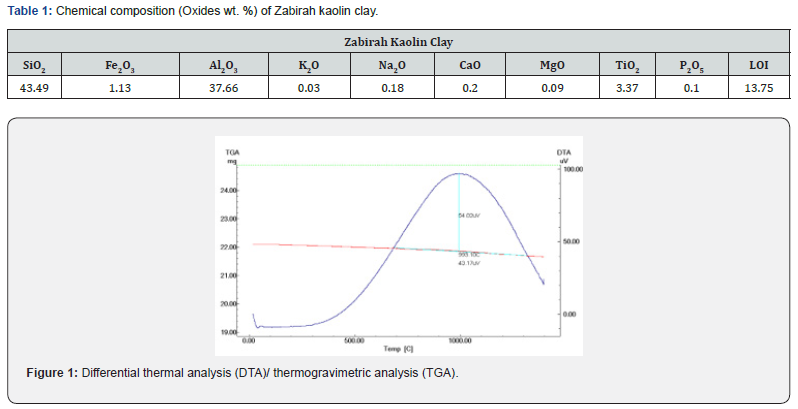
The chemical composition of Zabirah clay is given in the form of weight percentage (wt. %) of oxides in Table 1. The Zabirah clay is mainly composed of SiO2 (43.49wt. %), Al2O3 (37.66wt. %), TiO2 (3.37 wt. %) and Fe2O3, (1.13wt. %) in addition to very small percentages of CaO and MgO. The loss of ignition of Zabirah clay is about 13.75wt. % it is due to structural water and organic substance. The particle size of clay was below 20µm.
Differential thermal analysis (DTA)/ thermogravimetric analysis (TGA)
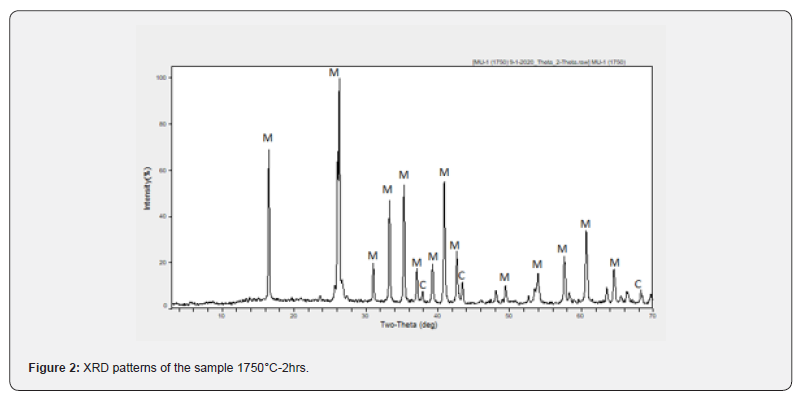
DTA graph Figure 1 showing that when heating started, rearrangement of grains started in the form of glass transition (Tg) and crystallization in between 500°C to 1100°C. The optimum crystallization is at 993°C. The melting started afterward. For TGA there is a small amount of weight loss in this range of temperature.
Phase composition by X-Ray Diffraction (XRD)
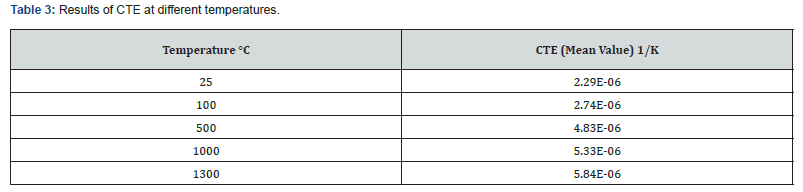
Figure 2 shows the XRD patterns of the sample after sintering at 1750°C-2hrs by Milling for 7 hours. The Clay-Alumina mixture was transformed to Mullite with small patterns of Corundum (Al2O3). This observation finds similarity with the work of [22].
Porosity and density
Porosity and Density of the sintered sample at 1750°C-2hrs and 12ton are given in Table 2. The porosity of the sample is 8.39% and the density is 2.51 g/cm3.

Thermal expansion
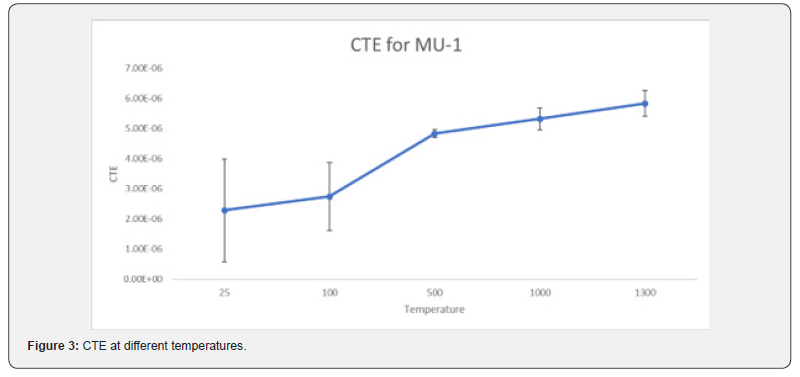
Results of calculated CTE are shown in Table 3 and Figure 3, CTE is increased when the temperature is increased and the increase is with a small rate with temperature (5.33E-06 at 1000°C, 5.84E-06 at 1300°C). The CTE is very important for high-temperature applications since the lower the coefficient, the longer the lifetime of the material. Pure Mullite has a very low coefficient of linear thermal expansion, but its resistance decreases with the rise in temperature compared to other materials when applied under compressive stress.
This observation of increasing the CTE with increasing the temperature finds similarity with the work of [23].
Conclusion
The present study shows that Zabirah clay and alumina can prepare Mullite with small patterns of Corundum (Al2O3).
The advantage of using local raw materials is mainly the economic viability. The downside is sintering at a very high temperature. DTA graph showing that the optimum crystallization is at 993.1°C. The melting started afterward. For TGA there is a small amount of weight loss in this range of temperature.
The porosity of the sample is 8.39% which will help with mechanical properties if investigated because if the porosity is low then the strength should be better also its due to the high temperature sintering and the density is 2.51 g/cm3. CTE is increased when the temperature is increased (2.29E-06 at 25°C, 5.84E-06 at 1300°C), The lower the coefficient, the longer the lifetime of the material.
References
- Gizem T (2018) Production and characterization of Mullite zirconia composites by slip casting method. Dumlupınar University Press, Turkey, pp. 2-40.
- Zheng S, Sun S, Zhang Z, Gao X, Xu X (2005) Bulletin of the Catalysis Society of India 4: 12-17.
- Varga G (2007) Epitoanyag. Evf 59: 6-9.
- Carty WM, Senapati U (1998) Porcelain-Raw Materials, Processing, Phase Evolution, and Mechanical Behavior. Journal of the American Ceramic Society 81(1): 3-20.
- Ilic B, Mitrovic A, Milicic L (2010) Thermal treatment of kaolin clay to obtain metakaolin. Chemical Industry Hemijska industrial 64(4): 351-356.
- Aksaf IA, Pask JA (1975) Stable and Metastable Equilibria in the System SiO2-Al2O3. Journal of the American Ceramic Society 58(11-12): 507-512.
- Pask JA, Tomsia AP (1991) Formation of Mullite from Sol-Gel Mixtures and Kaolinite. Journal of the American Ceramic Society 74(10): 2367-2373.
- Chen C, Lan G, Tuan W (2000) Microstructural evolution of Mullite during the sintering of kaolin powder compacts. Ceramics International 26(7): 715-720.
- Chen C, Lan G, Tuan W (2000) Preparation of Mullite by the reaction sintering of kaolinite and alumina. Journal of the European Ceramic Society 20(14-15): 2519-2525.
- Liu KC, Thomas G, Caballero A, Moya J, Aza SD (1994) Mullite formation in kaolinite-α-alumina. Acta Metallurgica et Materialia 42(2): 489-495.
- Rezaie H, Rainforth W, Lee WE (1997) Mullite evolution in ceramics derived from kaolinite, kaolinite with added α-alumina, and sol-gel precursors.
- Schneider H, Komarneni S (2005) Characteristic Studies on Whisker-Reinforced Borosilicate Glasses. Mullite Weinheim: Wiley-VCH 9(2).
- Schneider H, Schreuer J, Hildmann B (2008) Structure and properties of Mullite-A review. Journal of the European Ceramic Society 28(2): 329-344.
- Anggono J (2005) Mullite Ceramics: Its Properties, Structure and Synthesis. Journal Teknik Mesin 7(1): 1-10.
- Sadik IE C, Amrani A, Albizane J (2014) Asian Ceram Soc 2(2): 83-96.
- Sadik IEC, Amrani A, Albizane J (2014) Asian Ceram Soc2 (4): 310-316.
- Okada K, Otsuka N, Somiya S (1991) Am Ceram Soc Bull 70(10): 1633-1640
- Cividanes LS, Campos TMB, Rodrigues LA, Brunelli DD, Thim GP (2010) Review of Mullite synthesis routes by sol-gel method. Journal of Sol-Gel Science and Technology 55: 111-125.
- Ebadzadeh T, Lee W (1998) Processing-microstructure-property relations in Mullite-cordierite composites. Journal of the European Ceramic Society 18(7): 837-848.
- ASTM E228-17 (2023) Standard Test Method for Linear Thermal Expansion of Solid Materials with a Push-Rod Dilatometer, ASTM International. West Conshohocken, USA.
- Belousov RI, Filatov SK (2007) Algorithm for calculating the thermal expansion tensor and constructing the thermal expansion diagram for crystals. Glass Physics and Chemistry 33: 271-275.
- Zhou W, Yan W, Li N, Li Y, Dai Y, et al. (2018) Preparation and characterization of Mullite foam ceramics with porous struts from white clay and industrial alumina. Ceramics International 44(18): 22950-22956.
- Sahnoune F, Saheb N (2010) Mechanical behavior of Mullite-zirconia composites. EPJ Web of Conferences 6: 20005.

























