




 JOJMS Home



Abstract
The paper presents the results of evaluating the possibility of using powder metallurgy methods to produce a homogeneous heat-resistant alloy of the 57Nb-10Cr-5Al-21Ti-7Mo (at. %) system from a mixture of elementary powders and studying the mechanical characteristics of the sintered alloy at different temperatures. It is shown that grinding the initial powder mixture leads to an increase in the porosity of the compacts obtained from such a charge with an increase in the duration of grinding, but it contributes to a significant intensification of shrinkage during sintering. A particularly noticeable decrease in porosity is observed for samples produced from powders milled for 30 and 60min. After sintering the compacts from a mixture of elementary powders at 16000С, a single-phase alloy with bcc structure is formed. The yield strength of the sintered alloy at test temperatures up to 600 0C exceeds 1000 MPa, at 8000C it is about 700MPa, but when the temperature is further increased to 1000-11000C, it decreases to 200-120MPa.
Keywords:Heat-resistant alloy; Niobium; Powder metallurgy; Mechanical activation; Sintering; Structure; Yield strength
Introduction
One of the ways to increase the efficiency of gas turbine engines is to use of new materials in the hot section of the engines, which have a lower density, can withstand higher operating temperatures than the nickel-based superalloys widely used today, and meet the requirements for the level of strength, creep at high temperatures and resistance to oxidation [1-3].
Niobium-based alloys or in situ composites based on niobium silicide belong to this class of materials that can largely meet the requirements stated above [2-5].
Thus, in particular, the authors [6] believe that alloys based on the Nb–Si system, due to the high level of mechanical properties at temperatures above 12000C, have excellent prospects for use in hot sections of engines at operating temperatures of 1200–14000C, which exceeds the maximum operating temperature of single-crystal superalloys of the third generation Ni based alloys. However, despite the noted positive characteristics of alloys of this category, today the prospects for their wide industrial use are significantly limited due to the low values of the fracture toughness and plasticity characteristics at room temperature [6].
In recent years, a number of publications devoted to the development of ternary Nb-Ti-Si system-based alloys [7–11] have also appeared, which, according to their authors, have good combinational properties. However, they still do not provide the required level of fracture toughness at room temperature and sufficient resistance to oxidation at high temperatures.
The analysis of the above-mentioned publications allows us to conclude that it is the presence of a significant content of silicide phases in the composition of alloys based on the Nb-Si system, which provide an increased level of their high-temperature characteristics, however leads to a critical drop in the fracture toughness values at room temperature.
This led to the expediency of finding ways to obtain silicon-free (or low-silicon) niobium alloys, which, under the conditions of ensuring a high level of high-temperature mechanical characteristics, would have sufficient strength and fracture toughness even at room temperature.
For example, [12] provides data on a sintered heat-resistant alloy based on the double Nb-Ti system with a density of about 5.6 g/cm3, which is characterized by sufficiently high values of tensile strength (900-1000MPa) and plasticity (18-25%)) at room temperature and suitable for work under conditions of cyclic exposure to temperatures up to 1200 0C due to high resistance to high-temperature oxidation.
At the same time, in [13] a new method of controlling the phase composition and mechanical properties of niobium-based alloys is proposed, the main idea of which is to use multicomponent materials with an increased content of components, in which the high entropy of mixing ensures the formation usually of only one phase - a solid solution substitution of bcc or fcc structure. A feature of such high-entropy alloys is thermal stability to high homologous temperatures, high strength, wear resistance and corrosion resistance.
With the use of such approaches, [14] showed the possibility of creating promising heat-resistant alloys based on the Nb-Ti-Al system alloyed with Cr, Zr, Mo, and Si with a specific gravity of 6.3–7.4 g/cm3, which caused the interest of manufacturers of the aerospace industry. It was established that varying the chemical activity of the components, the ratio of their atomic radii and the value of the entropy of mixing by changing the composition and ratio of the alloy components of this system makes it possible to transition from single-phase bcc solid solutions to eutectic alloys and ensure high heat resistance of alloys in the temperature range of 800-1100°C.
One of the promising alloys of this series, previously produced by the method of arc melting in argon, is the alloy 57Nb-10Cr- 5Al-21Ti-7Mo (at. %). In the cast state, it forms a single-phase bcc solid solution. However, as the results of the experiments showed, the use of traditional casting technology leads to the formation of inhomogeneities of composition and microstructure across the casting cross-section, characteristic for the cast alloys of this class, due to macro segregation of components, coarse dendritic phases and the occurrence of scattered casting porosity, which largely limits their wide industrial use.
At the same time, the authors [15,16] point to the promising application of powder metallurgy methods for obtaining hightemperature niobium-based alloys. The use of powder metallurgy technology, as they believe, allows to obtain additional degrees of freedom, to increase the homogeneity of the alloy from the point of view of both chemical composition and microstructure.
Considering the above, the purpose of this work was to evaluate the possibility of using powder metallurgy methods for production of homogeneous heat-resistant alloy of 57Nb- 10Cr-5Al-21Ti-7Mo (at. %) system from a mixture of elementary powders and to evaluate the mechanical characteristics of the sintered alloy.
Research Materials and Methods
Commercial powders of niobium, titanium, aluminum, molybdenum and electrolytic chromium were used as starting materials for the production of the alloy. The initial powder mixture was prepared by mixing of the powders in a drum mixer with a diagonal axis for 60min. with the addition of ethyl alcohol to the mixture.
In order to mechanically activate the powders, some of them were milled in a planetary mill varying the duration of the process in the range of 15 - 60 minutes. The ratio of the mass of the powder mixture to the mass of grinding bodies is 1:8. The working drums and grinding bodies (balls with a diameter of 7–14mm) are made of SHH-15 bearing steel. The speed of rotation of the drums of the mill was about 800rpm. In order to prevent oxidation and segregation of powder particles, grinding was carried out in the environment of ethyl alcohol.
The granulometric composition of the initial mixture of powders and charge after different durations of grinding was studied using laser granulometry Mastersizer 2000 device.
The technological mode for the producing of the alloy included the consolidation of powder mixtures under a pressure of 700MPa and their subsequent sintering of the preforms in a vacuum at a temperature of 16000C. The sintering temperature was chosen taking into account the results of our previous studies, which showed that the sintering of this composition of powder compacts at lower temperatures does not provide a sufficient level of density of the sintered samples, while exceeding the sintering temperature above 1620-16500C leads to their melting and loss of their original shape.
The microstructure of the alloys was studied using an optical microscope (XJL-17) and a JEOL Super probe 733 scanning electron microscope. Samples for metallographic studies were etched using an aqueous solution of 10% HF + 15% HNO3.
Mechanical compression tests were performed on samples with dimensions of 4×4×6mm on testing machines of type 1236- U10 (in air up to 7000С) and type 1246 (in a vacuum of 2•10-3 Pa up to 1000 and 11000С). The rate of deformation during the tests was 2•10-3 c-1.
The Results of the Experiment and their Discussion
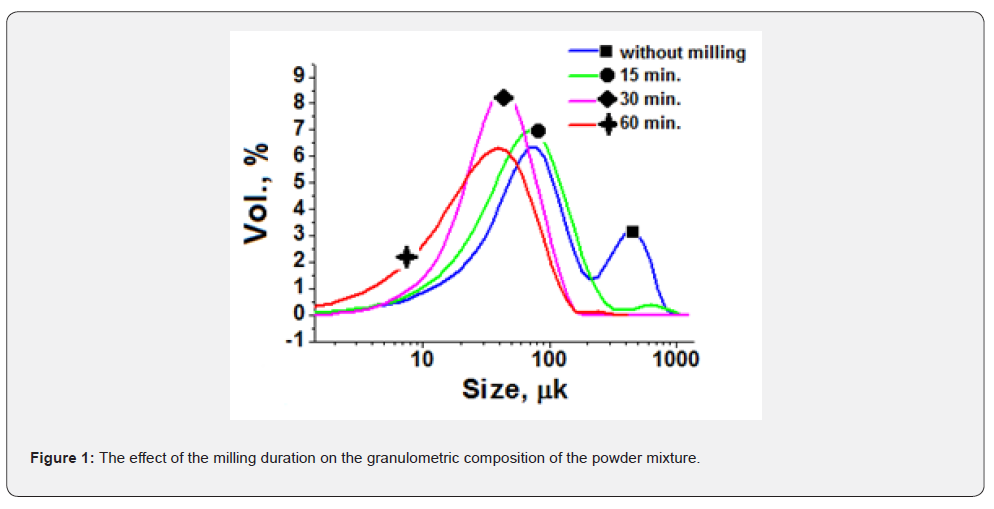
The results of the study of granulometric composition of the powder charge after milling showed that the particle size distribution curve of the original (unmilled) mixture is characterized by the presence of two maxima at the level of about 80 and 500μm Figure 1. Milling for 15 minutes. leads to the almost complete disappearance of the maximum in the region of 500μm. There is an increase in the height and broadening of the peak in the region of 80μm, which indicates that at this stage there is grinding mainly of large particles without a significant increase in the content of highly dispersed fractions of the charge.
The study of the original mixture and the one that was subjected to grinding morphology peculiarities showed that after grinding the shape of the powder particles becomes largely scaly which is typical for powders of plastic materials.
Milling for 60 minutes does not significantly change the position of the maximum of the size distribution of particles, however, the height of the maximum decreases significantly, and the range of size distribution noticeably expands in the direction of increasing the content of the more dispersed component.
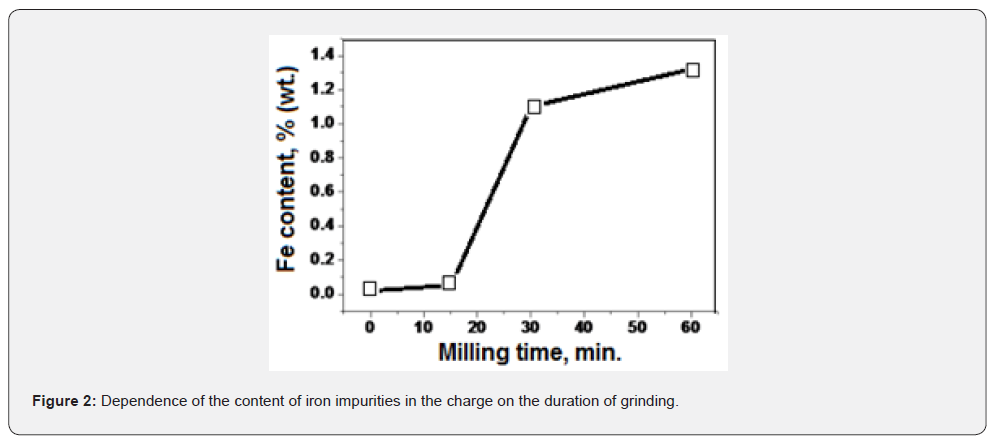
At the same time, the results of the chemical analysis of the charge after grinding in a drum with grinding bodies made of bearing steel showed that the grinding process is accompanied by the appearance of iron impurities in the charge and their concentration increases with the increase in the duration of the process. So, if after 15min. grinding and subsequent magnetic separation the iron content in the charge did not exceed 0.1 %, then already after 30min. grinding the latter significantly increases to 1.1 %, and after 60min. is almost 1.4 % Figure 2.
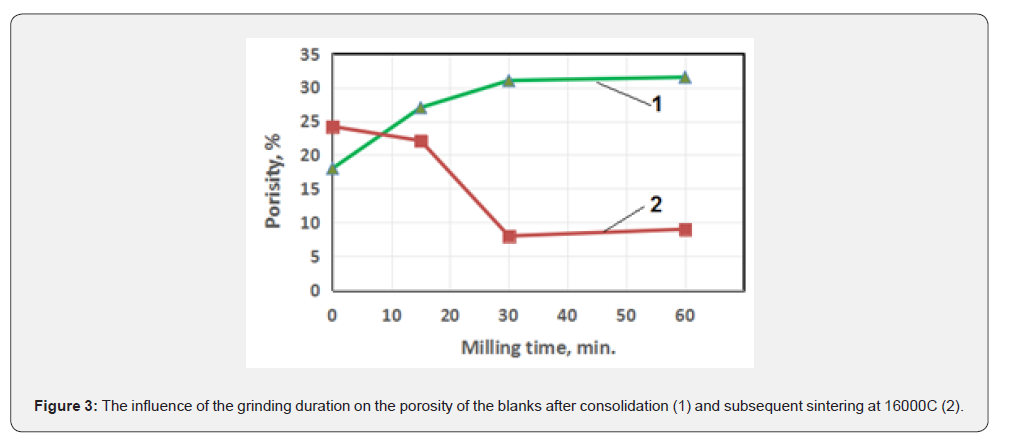
Dispersity, morphology as well as the degree of cold work hardening of powder particles after grinding also significantly affect the press ability of powder mixtures. Research has shown that increasing the duration of grinding leads to a monotonous increase in the porosity of blanks after their consolidation at 700MPa: the porosity of the blanks from the powder mixture that was not subjected to grinding is 18%, while after grinding for 30- and 60min. porosity increases to 30-31% Figure 3. The noted effect is explained both by the change in the morphology of the powder particles and by their significant deformation hardening acquired during the grinding process. An increase in consolidation pressure over 700MPa leads to delamination of the preforms. The use of grinding of powder mixtures, as well as the increase in its duration, also significantly affected the nature of the change in the porosity of the compacts after vacuum sintering at 16000C. Thus, if the samples produced from the original mixtures without grinding show an increase in porosity from the initial 18% to 24% after sintering, then the samples from the milled powder show the opposite effect - during the sintering process their shrinkage occurs and the porosity decreases. A particularly noticeable decrease in porosity is observed for samples made from powders milled for 30 and 60min Figure 3.
The mechanism that determines the observed regularity of significant dependence of the amount of shrinkage on the modes of original powder mixture pretreatment is obviously related to the following. The process of sintering of the compacts from a mixture of elementary powders is accompanied by the manifestation of two competing effects: the formation of secondary porosity as a result of the Kirkendall effect [17], which is realized due to the difference in the hetero diffusion coefficients of the elements of the powder mixture - on the one hand, and the increase in the number of intergranular contacts and the intensification of diffusion processes due to mechanical activation of the mixture during grinding - from the second. It is obvious that the Kirkendall effect is the predominant factor during the sintering of the unmilled charge, while as a result of grinding and increasing its duration, the Kirkendall effect is inhibited, and sintering is intensified due to mechanical activation.
Taking into account the fact that the sintering of the unmilled charge failed to obtain a material of relatively high density, only the alloy produced from the charge subjected to grinding for 30min was considered further.
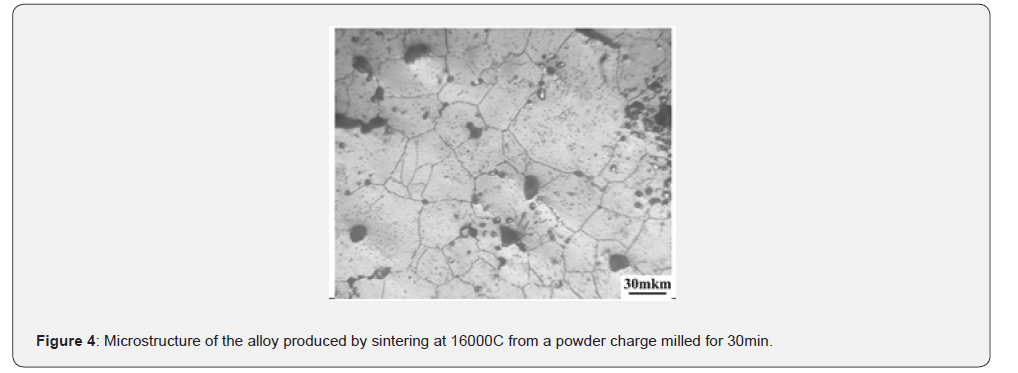
As the research results showed, the structure of the sintered samples is characterized by a high degree of homogeneity and consists of grains of mainly equiaxed shape. The predominant size of alloy grains is from 25 to 50μm Figure 4.
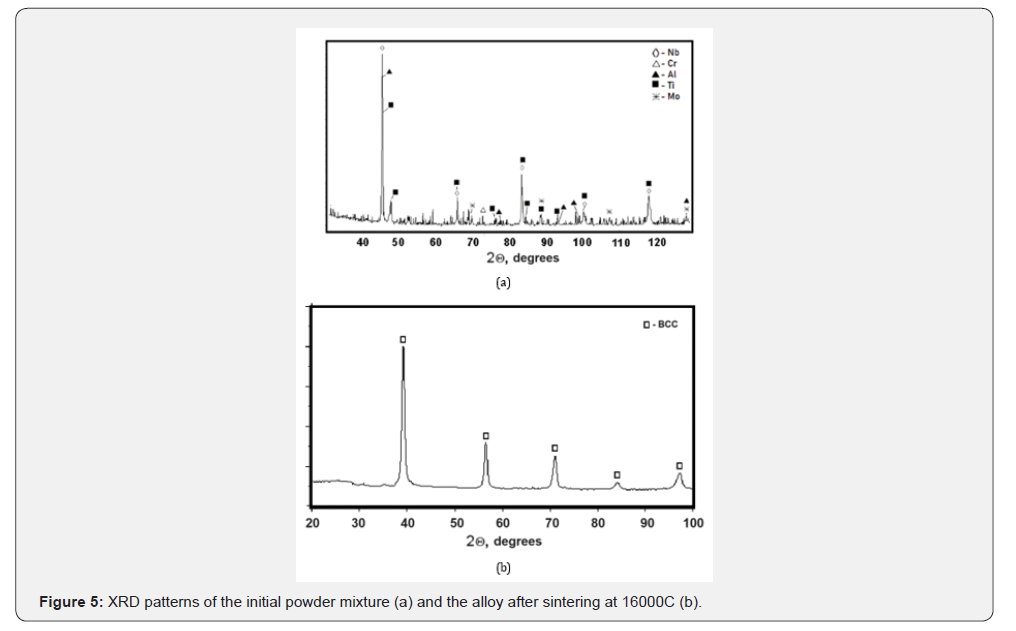
The high degree of homogeneity of sintered alloys is also confirmed by the results of X-ray phase analysis of the studied materials Figure 5. As can be seen from Figure 5a, the phase composition of the initial powder mixture is expected to include only the lines of elementary chemical elements - components of the charge, while after sintering at 1600 0С a single-phase alloy with bcc structure is formed Figure 5b, which indicates the achievement of almost complete homogenization of the material.
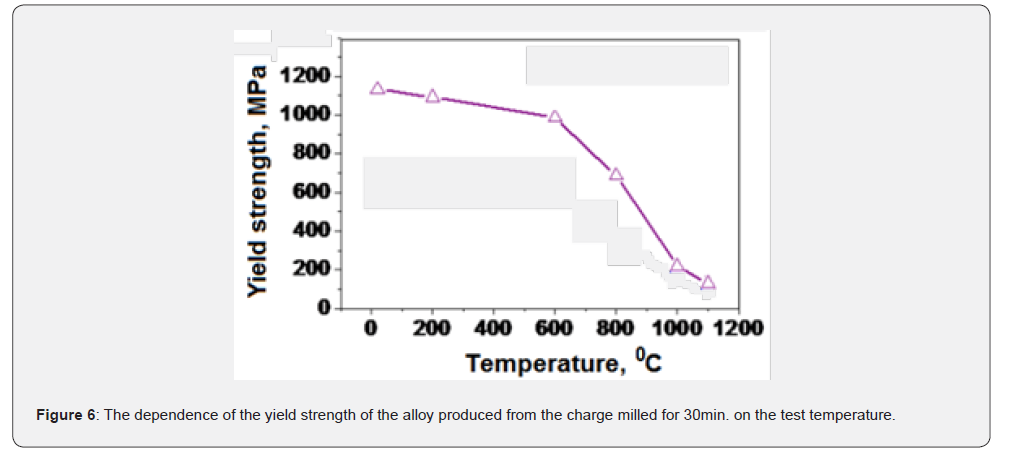
The assessment of the level of the sintered alloy mechanical properties at different temperatures showed that, despite the presence of noticeable porosity (8%), at test temperatures up to 6000С, the alloy is characterized by a fairly high level of yield strength values σ0,2 , which exceeds 1000 MPa. At the test temperature of 8000C, the value of σ0,2 is about 700MPa, but when the temperature is further increased to 1000-11000C it sharply decreases to 200-120 MPa Figure 6. At the same time, the given data on the level of the alloy mechanical characteristics allow us to reasonably assume that in case of application of additional hot plastic deformation of sintered preforms (for example, hot forging, which allows to increase the relative density of the material to a practically non-porous state [18,19]), the application of powder metallurgy methods will ensure the production of a sintered heatresistant alloy competitive in terms of mechanical properties [20].
Conclusion
i. Using powder metallurgy methods, a multicomponent
sintered heat-resistant alloy of the Nb-Cr-Al-Ti-Mo system was
produced from a mixture of elementary powders.
ii. It is shown that intensive milling of the initial powder
mixture leads to a significant monotonous increase in the porosity
of the compacts produced from this charge with an increase in the
duration of milling.
iii. During the sintering of the compacts produced from
the original mixtures without grinding, an increase in porosity
is observed, while in the samples from the milled powder the
opposite effect is manifested - during the sintering process their
shrinkage occurs and the porosity decreases.
iv. After sintering the compacts from a mixture of
elementary powders at 1600 0C, a single-phase alloy with bcc
structure is formed, which indicates the achievement of almost
complete homogenization of the material.
v. According to the results of mechanical tests, it was
established that at test temperatures up to 6000С the alloy is
characterized by a fairly high level of yield strength values, which
exceeds 1000MPa. At the test temperature of 8000C, the value
of yield strength is about 700MPa, but when the temperature is
further increased to 1000-11000C, it decreases to 200-120MPa.
References
- Zhao JC, Westbrook JH (2003) Ultrahigh-temperature materials for jet engines MRS Bull 28: 622-627.
- Tsakiropoulos P (2022) Alloys for application at ultra-high temperatures: Nb-silicide in situ composites: Challenges, breakthroughs and opportunities. Progress in Materials Science 123: 100714.
- Graham SJ, Gallagher E, Baxter GJ, Azakli Y, Weeks J, et al. (2024) Powder production, FAST processing and properties of a Nb-silicide based alloy for high temperature aerospace applications. Journal of Materials Research and Technology 28: 3217-3224.
- Tsakiropoulos P (2018) On the Nb silicide-based alloys: Part I The bcc Nb solid solution. Journal of Alloys and Compounds 708: 961-971.
- Tsakiropoulos P (2017) On the Nb silicide-based alloys: Journal of Alloys and Compounds. Part II Journal of Alloys and Compounds 748: 569-576.
- Bewlay BP, Jackson MR, Subramanian PR (2003) A review of very-high-temperature Nb-silicide-based composites. Metall Mater Trans A 34: 2043-2052.
- Ma R, Guo X (2021) Influence of molybdenum contents on the microstructure, mechanical properties and oxidation behavior of multi-elemental Nb–Si based ultrahigh temperature alloys. Intermetallics 129: 107053.
- Qiao Y, Guo X, Zeng Y (2017) Study of the effects of Zr addition on the microstructure and properties of Nb-Ti-Si based ultrahigh temperature alloys. Intermetallics 88: 19-27.
- Kang YW, Qu SY, Song JX, Huang Q, YF Han (2012) Microstructure and mechanical properties of Nb–Ti–Si–Al–Hf–xCr–yV multi-element in situ composite. Mater Sci Eng A 534: 323-328.
- Grammenos I, Tsakiropoulos P (2010) Study of the role of Al, Cr and Ti additions in the microstructure of Nb–18Si–5Hf base alloys. Intermetallics 18(2): 242-253.
- Zelenitsas K, Tsakiropoulos P (2005) Study of the role of Al and Cr additions in the microstructure of Nb–Ti–Si in situ Intermetallics 13(10): 1079-1095.
- Li Zh, Luo L, Wang B, Su B, Luo L, et al. (2023) Cooperative effects of Mo and B additions on the microstructure and mechanical properties of multi-elemental Nb-Si-Ti based alloys. Part A Materials Characterization 206: 113421.
- Solntsev VP, Skorokhod VV, Frolov GA (2016) Development of a heat-resistant alloy based on niobium for thermal protection of rocket and space technology products. Bulletin of Engine Building 2: 198-206.
- Senkov ON, Senkova SV, Miracle DB, Woodward C (2013) Mechanical properties of low-density, refractory multi-principal element alloys of the Cr-Nb-Ti-V-Zr system. Mater Sci & Engineering: A 565: 51-62.
- Brodnikovskyi MP, Kuznetsova TL, Rokytska OA, Krapivka MO (2018) Features of the formation of the cast structure of multicomponent niobium alloys of the Nb-Ti-Al system doped with Cr, Zr, Mo and Si. Physical metallurgy and metal processing 3: 56-61.
- Kimura Y, Yamaoka H, Sekido N, Mishima Y (2005) Processing, Microstructure, and Mechanical Properties of (Nb)/Nb5Si3 Two-Phase Alloys. Metallurgical and materials transactions A 36: 483-488.
- Drawin S, Monchoux JP, Raviart JL, Couret A (2011) Microstructural properties of Nb-Si based alloys manufactured by powder metallurgy. Advanced Materials Research 278: 533-538.
- Nakajima H (1997) The Discovery and Acceptance of the Kirkendall Effect: The Result of a Short Research Career. JOM 49: 15-19.
- Fischmeister HF, Arén B, Easterling KE (2014) Deformation and densification of porous preforms in hot forging. Powder Metallurgy 14(27): 144-163.
- Baglyuk GA, Tolochin AI, Tolochina AV, Yakovenko RV, Gripachevckii AN, et al. (2016) Effect of Process Conditions on the Structure and Properties of the Hot-Forged Fe3Al Intermetallic Alloy. Powder Metall Met Ceram 55(5): 297-305.

























