




 JOJMS Home



Abstract
Based on the phase fraction calculations assisted by CALPHAD, Sn1Ag0.7Cu5BixIn (x = 4, 8, 15, 17, referred to as xIn) alloy were designed to meet the requirements of long-term high-temperature service requirements. Bi and In were added to balance the comprehensive performance loss brought by lowing Ag content away from eutectic composition. By fixing Bi content to be 5wt.%, this study investigated the effects of xIn doping on the melting characteristics of the Sn1Ag0.7Cu5Bi alloy as well as the microstructure, mechanical properties, and fracture mechanisms of the corresponding joints. The results showed that with increasing In content, the Bi-rich phase particles disappeared, and when the In content exceeded 15wt.%, the InSn4 phase began to appear in the matrix. The intermetallic compound (IMC) at the solder/Cu interface transformed into Cu6(Sn, In)5 from Cu6 Sn5. The phase fractions of the InSn4 phase and secondary phases increased with higher in content. During isothermal aging at 170°C, For the 4In solder joint, Cu accumulates near the interface, forming a Cu-rich layer that leads to stress concentration within the compound. The abrupt concentration gradient induces localized tensile or shear stresses, causing cracks to initiate and propagate at the interface between Cu-enriched and In-depleted regions. In the 8In solder joint, the continuous diffusion of Cu and in transformation of Cu6(Sn, In)5 to Cu3(Sn, In), accompanied by volume shrinkage and In-rich layer formation, induce residual stresses, resulting in cracks forming closer to the Cu substrate. For high-In solder joints, the significant reduction in melting point brings the solder close to a liquid state, accelerating element diffusion and IMC formation rates. The Cu6(Sn, In)5 solid solution formed reduces brittleness and delays the transformation to Cu3 Sn. This study holds significant practical value for controlling interfacial compound growth and stabilizing solder joint structures..
Keywords:In-doped low silver SAC joints; Microstructure; Mechanical properties; IMC
Abbreviations:UTS: Ultimate Tensile Strength; IMCS: Intermetallic Compounds; SEM: Scanning Electron Microscopy; XRD: X-Ray Diffraction
Introduction
Solder plays a crucial role in the assembly and interconnection of electronic products [1]. As a connecting material [2], solder provides various functions [3] such as electrical transmission pathways, thermal paths, and mechanical continuity support [4]. This necessitates that the solder possesses excellent wettability and solderability to the solder pad on the substrate [5]. Since the shift to lead-free soldering, Sn-Ag-Cu (SAC) series has become the primary solder materials in consumer electronic components, due to its superior conductivity and mechanical properties [6,7]. Various SAC solders with different Ag contents, including SAC105(Sn-1.0Ag-0.5Cu) [8], SAC205(Sn-2.0Ag-0.5Cu) [9], SAC3 05(Sn-3.0Ag-0.5Cu) [10], and SAC405(Sn-4.0Ag-0.5Cu) [11], have been extensively studied and widely applied in the electronics industry.
However, all of these SAC alloys contain significant amounts of silver, which costs approximately 30 times more than tin. This implies that reducing the silver content by 1% in solder alloys can lower the total solder cost by more than 15%. Additionally, SAC alloys with different silver contents have their own advantages and disadvantages, and are suitable for different application scenarios [12]. For instance, in mobile electronics, increased drop and high-impact failures have been observed due to the rigidity of high-silver SAC alloy. Furthermore, when the Ag content exceeds 3.2wt.%, primary Ag3Sn phases may form [13], and the brittle Ag3Sn phase significantly reduces the reliability of solder joints during isothermal aging. However, lower Ag [14] content can result in degradation of thermomechanical fatigue performance and shorter creep rupture life [15], as low-Ag alloys exhibit poorer creep resistance under high stress levels. Therefore, the development of low-silver SAC solder alloys [16] that meet the requirements of electronic products has attracted significant attention.
After nearly a decade of research, it has been found that the drawbacks of low-silver solders can be addressed by balancing the IMC formation and the solidification through adding alloying elements [17]. The silver content in SAC107(Sn-1.0Ag-0.7Cu) [18] solder is only 1wt.%, which provides more room to add other trace alloying elements compared to traditional SAC305 [19] and SAC405, without affecting the main component ratios of the solder [20]. Additionally, the lower silver content allows for better control over the distribution and interaction of microalloying elements. For example, adding Bi to SAC107 [20] can enhance creep resistance and fatigue resistance, while adding in [22] can improve ductility and thermal fatigue resistance. The reduction in silver content leads to a more uniform distribution of Bi and in in the alloy, minimizing mutual interference and helping these elements to fully exert their modifying effects [23]. These characteristics give SAC107 a unique advantage in developing lowcost, high-performance solder alloys. Therefore, the Ag content is set at 1% by weight, and the Cu content is increased to 0.7% by weight [24] (representing the saturated solid solubility of Cu in Sn), serving as the basic alloy for optimizing the SAC alloy [25].
The research from [26] showed that the addition of Bi improved the mechanical properties of SAC305/Cu solder joints. When the Bi content is greater than or equal to 2wt.%, Bi precipitation will form in the β-Sn matrix, the solid solution strengthening and precipitation strengthening mechanisms in the β-Sn matrix increase the ultimate tensile strength and microhardness of the alloy from 35.7MPa and 12.6HV to 55.3MPa and 20.8HV, respectively, but reduce the elongation from 24.6% to 16.1%. Additionally, the incorporation of Bi lowers the melting point of SAC alloys and improves their wettability [27,28] also confirmed that adding Bi to SAC157(Sn-1.5Ag-0.7Cu) can significantly enhance the solubility effect of Bi and refine the β-Sn phase, resulting in a notable increase in hardness and tensile strength of SAC157 solder when the Bi content is raised to 5wt.%.
[29] and colleagues found that the addition of in improves the performance of lead-free solder alloys, significantly lowering the melting point, increasing the melting range, and enhancing the wettability of the solder on substrates. For instance, adding a small amount of in can improve the bending performance of solder/ Cu joints and significantly suppress interfacial crack growth and excessive growth of intermetallic compounds (IMCs) after longterm aging. [30] and colleagues used a combination of CALPHADguided alloy design and experimental methods to study the relationship between microstructure and mechanical properties of Sn-In-based solders during low-temperature soldering. The results indicated that as the in-content decreases, both the maximum shear strength and ultimate tensile strength (UTS) initially increase and then decrease, reaching their maximum at 8wt.%In. Additionally, the reduction in elongation for low in content alloys (18 wt.% In) is significantly less than that for 42In and 35In alloys. Therefore, low In content alloys (8-18wt.%) can achieve an optimal combination of strength and ductility.
This study investigates the relationship between the microstructure and mechanical properties of the low-silver solder SAC107 [31], which contains 5wt.%Bi and indium (4- 17wt.%). Four different alloy phase types were selected aided by phase calculations (CALPHAD method) [32], and corresponding experiments were conducted to verify the accuracy of the model. Subsequently, a quite high temperature isothermal aging at 170 °C was then carried out to reveal thermal stabilities, microstructure evolution, the shear mechanical performance degradation, and failure modes with time prolonging. Also, the influence of phase types and phase compositions on the mechanical properties was systematically discussed. The findings of this study offer a valuable reference for designing low-silver alloys that maintain high reliability even after aging.
Experiments
Sample preparation
The joint preparation for microstructure observation and shear test was prepared includes the following three steps: solder paste, solder ball and solder joint preparations.
i. Solder paste preparation: Using high-purity Cu and Sn powders, along with SAC305, Sn58Bi, and Sn52In alloy powders, Sn1Ag0.7Cu5BixIn solder paste were prepared. The corresponding alloys, hereafter referred to as xIn (x = 4, 8, 15, and 17 respectively). After uniformly mixing the alloy powders, flux (with a proportion of 13wt.%) was added, and the mixture was stirred again. Once the paste turned into a dark gray paste-like consistency, stirring was stopped, and the solder paste preparation was completed.
ii. Solder ball preparation: The solder paste prepared above was printed onto a ceramic substrate using a stencil. The substrate was then placed on a heating platform at 275oC, where the paste absorbed heat and shrank into spherical shapes, completing the formation of the solder balls. Finally, a mesh screen was used to shift out small balls with a diameter of 0.59mm for further use.
iii. Solder joint preparation: Solder balls were placed on a copper substrate board (FR4 Cu-OSP (Organic Solderability Preservatives)) coated with an appropriate amount of flux, with the solder joint diameter being 800μm. The substrate board was then placed in a reflow oven (TORCH-T2OOC+) for reflow soldering, with the peak temperature set 40°C higher than the tested melting point.
Differential scanning calorimetry (DSC) test
DSC can provide the sample with any combination of temperature conditions and a constant flow of atmospheric environment, allowing for the measurement of various thermal parameters of the sample. For alloy samples, it is mainly used to measure the solidus and liquidus temperatures, peak temperature, supercooling, and melting range. The instrument used in this study is the NETZSCH STA 449F5, following the JIS Z3198 industrial standard. The sample is placed in an alumina crucible under high-purity argon gas, with a heating and cooling rate of 5°C/min. The temperature range for heating/cooling is between 30°C and 250°C. The resolution for temperature and weight is 0.001°C and 0.1 μg, respectively.
Scanning electron microscopy (SEM) analysis
First, the solder joint samples were encapsulated using epoxy resin. After encapsulation, the samples underwent grinding and polishing treatment until the solder joint interface was bright and free of scratches.
The samples were divided into two groups for microstructure testing: one before etching and the other after etching with FeCl3 solution. A high-resolution field emission scanning electron microscope (FE-SEM; Hitachi, SU-8010), tungsten filament scanning electron microscope (JSM-6480), and energydispersive spectroscopy (EDS; IXRF 550ix) were used to scan the microstructure of the solder joints in the resin-encapsulated samples.
X-ray diffraction (XRD) analysis
Microstructural performance analysis was carried out using a Smart Lab (9KW) intelligent rotating anode X-ray diffractometer. The alloy was soldered onto a 1.5cm × 1.5cm copper plate, and the surface was ground and polished to ensure a flat cross-section for accurate testing. The test was conducted under an argon atmosphere, with a 2θ scanning range of 20° to 80° and a scan rate of 0.01°/s.
Shear test
The shear test samples were subjected to solder joint shear testing using a PTR-1102 solder joint strength tester, with a shear speed of 0.1mm/s and a fixed shear height of 50μm. For each alloy, 6 to 10 solder joints were tested under the same conditions. After the shear tests were completed, the fracture surfaces were preserved for further analysis. The fracture surfaces were then examined using scanning electron microscopy (SEM) to study the microstructure and fracture characteristics.
Solid-state aging test
The reflow-soldered joints were placed in a thermostatic drying oven (101-0B) for thermal aging treatment. The aging temperature was set to 170°C, and the aging times were 250 hours and 750 hours, respectively. After aging, the microstructure of the cross-sections of the solder joints was observed, and shear strength tests were conducted. The fracture surfaces after the shear tests were also examined for further analysis.
Results and Discussion
Phase calculation
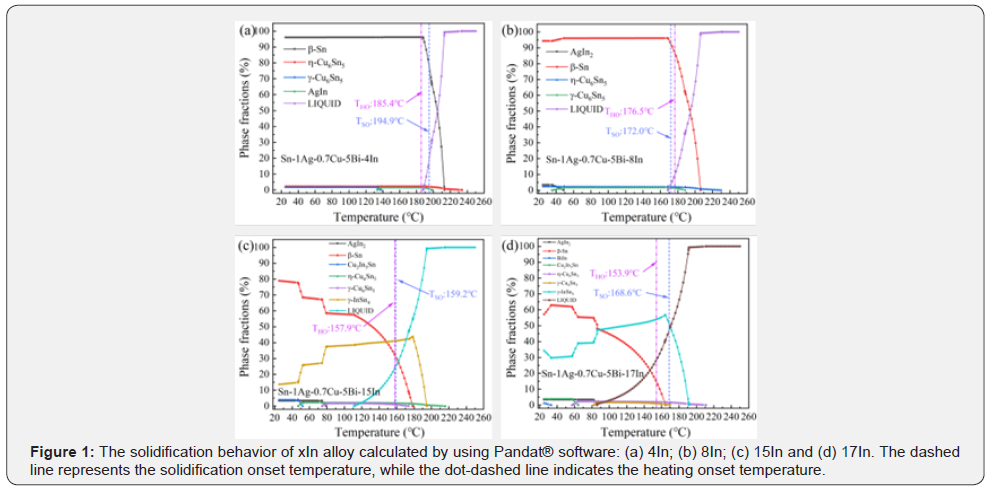
The solidification process and the types of precipitated phases for 4In, 8In, 15In, and 17In alloys were simulated using Pandat software, and the results are shown in Figure 1. For 4In alloy, the precipitation sequence during the cooling process is: L → L1 + η-Cu6 Sn5 → L2 + β-Sn + η-Cu6 Sn5 → β-Sn + η- Cu6 Sn5 + γ- Cu6 Sn5 + HCP_A3 → β-Sn + η- Cu6 Sn5 + γ- Cu6 Sn5. When the content increases to 8 wt.% in the 8In alloy, the phase sequence in the liquid state remains almost the same, but differences appear in the solid state. Unlike the 4In alloy, the 8In alloy forms the AgIn2 phase: β-Sn + η- Cu6 Sn5+ γ- Cu6 Sn5 → β-Sn + η- Cu6 Sn5 + AgIn2. When the content is further increased to 15wt.%, the matrix phase changes from a single β-Sn phase to a dual-phase structure of β-Sn and γ-InSn4. At equilibrium, as the temperature decreases, the high-temperature phases η- Cu6 Sn5 and γ- Cu6 Sn5 in both 8In and 15In alloys transform into the low-temperature phases Cu2In3Sn and AgIn2.
When the content reaches 17wt.%, the precipitation sequence is: L → L1 + η- Cu6 Sn5 → L2 + η-Cu6 Sn5 + γ-InSn4 → L3 + η- Cu6 Sn5+ γ-InSn4 + γ- Cu6 Sn5 → L4 + η- Cu6 Sn5 + β-Sn + γ-InSn4 → β-Sn + γ-InSn4 + AgIn2 + Cu2 In3 Sn + BiIn. Additionally, the blue dashed line represents the solidification onset temperature, while the purple dashed-dotted line represents the heating onset temperature. As the content increases, the temperature difference between the solidification onset and the heating onset gradually increases but remains relatively small, indicating that the actual and theoretical temperature differences are minimal.
Thermal properties
Figure 2a shows the DSC curves of the xIn alloys, where multiple endothermic peaks are observed for each alloy, indicating that the phase transitions in this system are relatively complex. The 4In alloy exhibits two endothermic peaks, with the first lowtemperature precipitated phases being Ag9 In4 and Ag2(In, Sn), and the more prominent peak corresponding to the primary β-Sn/γ-InSn4 phase. The 4In alloy has a single exothermic peak at 192.3°C, corresponding to the phase reaction L → β-Sn + η- Cu6 Sn5 + γ- Cu6 Sn5. The 8In alloy, like the 4In alloy, also exhibits two endothermic peaks. There is a single exothermic peak at 171.8°C, which corresponds to the phase transition L → β-Sn + η- Cu6 Sn5 + γ- Cu6 Sn5 as indicated in the phase diagram. As the content increases, three endothermic peaks appear in the DSC curves of both the 15In and 17In alloys, suggesting the possibility of incomplete crystallization during melting. The 15In alloy has an exothermic peak at 159.1°C, corresponding to the calculated reaction L → β-Sn + η- Cu6 Sn5 + γ- Cu6 Sn5 + γ-InSn4. The 17In alloy exhibits an exothermic peak at 168.3°C, which is related to the phase transition L3 → η- Cu6 Sn5 + β-Sn + γ-InSn4. Overall, the phase transition temperature trends align with the calculated results as the content varies.
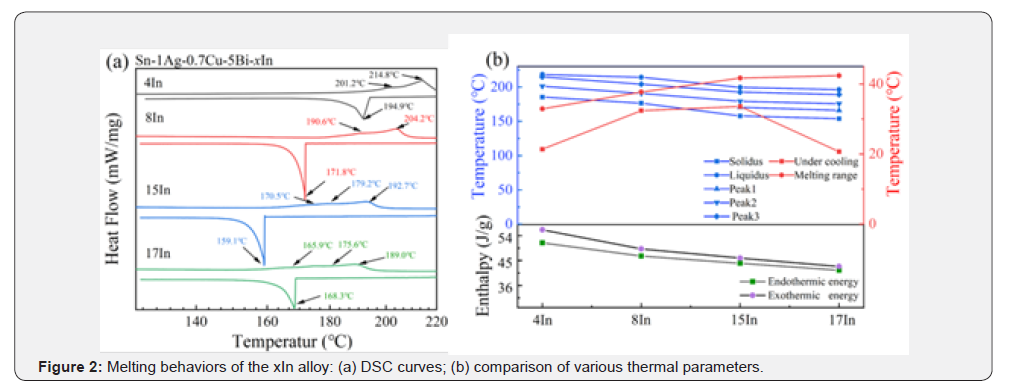
Figure 2b shows the solidus temperature, liquidus temperature, and melting point of the alloys gradually decrease with increasing in content. Simultaneously, as the content increases, the undercooling degree of the xIn alloy initially rises and then falls, spanning a range from 21.4 to 33.6℃, peaking at 15In with a maximum of 33.6℃. Although undercooling offers a certain driving force for the eutectic reaction, it prolongs the growth duration of intermetallic compounds (IMCs), resulting in their coarsening, which significantly affects the alloy’s microstructure. The melting range of the alloy widens with increasing In content, extending from 32.9 to 42.4℃. Consequently, as the content rises, it influences the phases within the interface and matrix, leading to coarsening and subsequently impacting the alloy’s reliability.
Effect of In doping on the microstructure of the solder joints
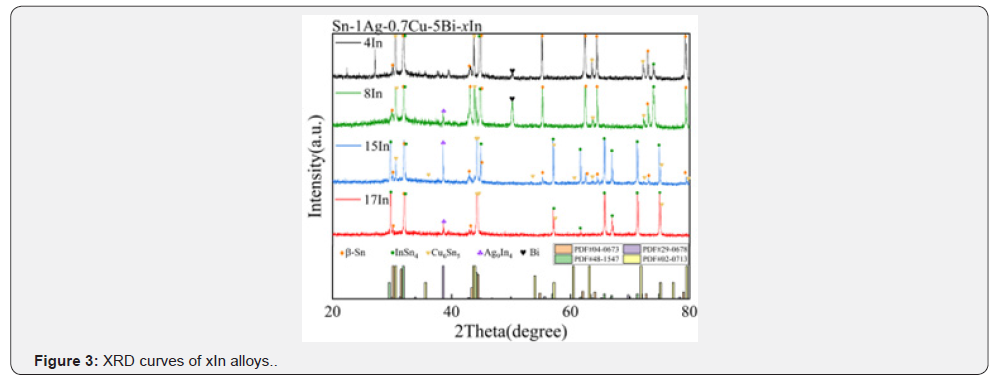
Figure 3 displays the XRD results of the xIn alloy. The figure reveals that the 4In alloy comprises the β-Sn, Cu6 Sn5, InSn4, and a trace amount of Bi. The microstructure of the 8In alloy closely resembles that of the 4In alloy. However, as the content increases, the microstructures of the 15In and 17In alloys diverge from their predecessors. Besides the β-Sn phase, Cu6 Sn5, and InSn4, the alloy also contains the Ag9 In4 phase. Furthermore, owing to the influence of In on Bi solubility, the Bi peak vanishes from the XRD results of high-In alloys.
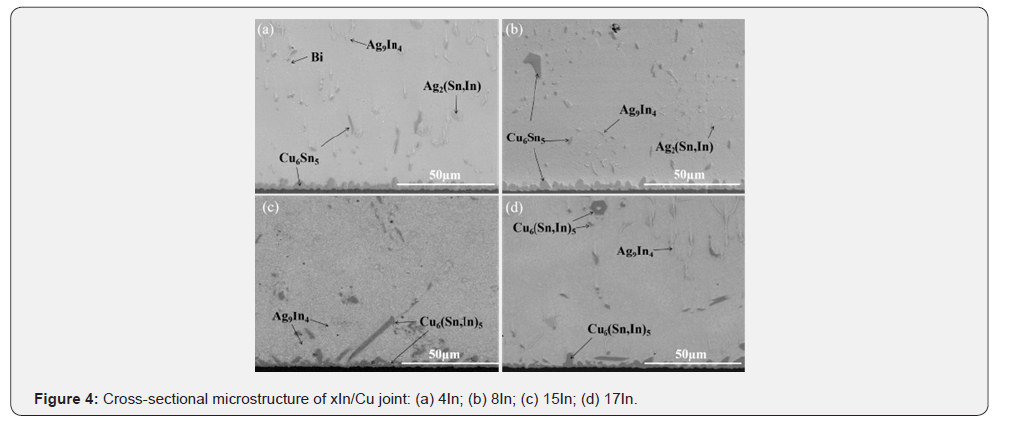
To more clearly illustrate the effect of content on phase changes, the microstructure of the solder joints was characterized. Figure 4(a-d) shows the microstructures of the xIn joints. The results indicate that in Figure 4a (4In), there are a few bright white Bi particles within the β-Sn matrix, accompanied by the Cu6 Sn5, Ag9 In4, and Ag2 (In, Sn). As the content increases to 8wt.%, the phase composition remains largely unchanged from that of 4In. When the fraction reaches 15wt.%, the matrix consists of β-Sn phase and γ-InSn4. At a content of 17wt.%, the Cu6 Sn5 vanishes from the secondary phase, leaving solely the Cu6(Sn, In)5, Ag9 In4, and Ag2(In, Sn) phases. Furthermore, the interfacial IMC between 4In and 8In appears as shell-like Cu6 Sn5, while for 15In and 17In, the interfacial IMC transforms into Cu6(Sn, In)5. Consequently, in doping increases the proportion of in the secondary phase and reduces the Sn proportion. The microstructural analysis aligns with the XRD findings.
Combining the results from the phase calculation, XRD, and microstructural observations, it can be concluded that in the 4In alloy, both Ag2(Sn, In) and Ag9 In4 phases coexist in the matrix. Therefore, in the phase calculation, the γ-(Cu, In) and AgIn2 phases correspond to the Ag2(Sn, In) and γ-(Ag9 In4) phases, respectively. The η-(Cu, In) phase in the phase calculation corresponds to the Cu6 Sn5 phase in the joint. In the 17In alloy, the low-temperature Cu2 In3 Sn phase did not form due to the mutual diffusion of Sn and Cu during the soldering process, leading to the formation of interfacial IMC, specifically Cu6(Sn, In)5. Notably, when the content reaches 15wt.% and 17wt.%, no BiIn phase was observed in the XRD or microstructure results. This is likely because Bi and In exist mainly in solid solution in the matrix, making the formation of the BiIn phase difficult during the soldering process. Additionally, no diffraction peaks corresponding to the Ag2(Sn, In) phase were observed in the XRD spectra, which could be due to significant substitution of In atoms, causing peak shifts, thus preventing the appearance of the expected diffraction peaks. In summary, the XRD and microstructural results align well with the theoretical phase calculations, confirming the consistency between the observed and predicted phases.
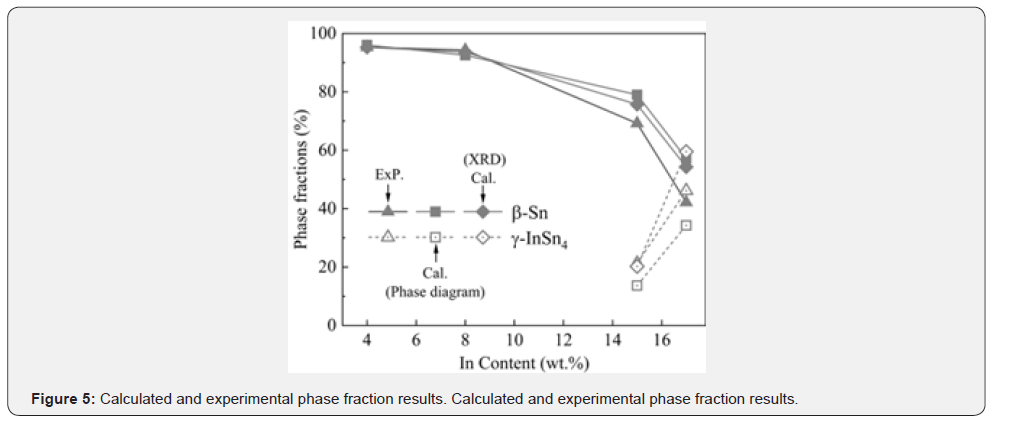
In this experiment, ImageJ software was used to measure the phase fractions in the xIn alloy, and PANDAT software was used for supplementary calculations. Figure 5 presents a comparison between the experimental results and the software calculations. The results show that in low-In alloys, almost no second phase precipitates. As the In content increases, the γ-InSn phase begins to appear in the matrix, reaching a fraction of 46.16% in the 17In alloy, which is consistent with the XRD results.
Shear performance
Figure 6a illustrates the force-displacement curve of the xIn/ Cu joints under shear load. Evidently, the xIn joints exhibit plastic deformation characteristics. Both 4In and 8In joints demonstrate comparable maximum shear strength and elongation, whereas 15In and 17In joints exhibit similar shear behavior. The average maximum shear force for 4In and 8In is nearly identical, standing at 32N. However, as the In content increases to 15wt.%, the average maximum shear force decreases by approximately 14N. In conjunction with XRD analysis and the microstructure of the solder joint, it is observed that when the in content reaches 15 wt.%, the matrix phase transitions from a singular β-Sn phase to a dual-phase structure comprising β-Sn and γ-InSn4 phases. The γ-InSn4 phase, being a soft phase, contributes to a reduction in mechanical properties.
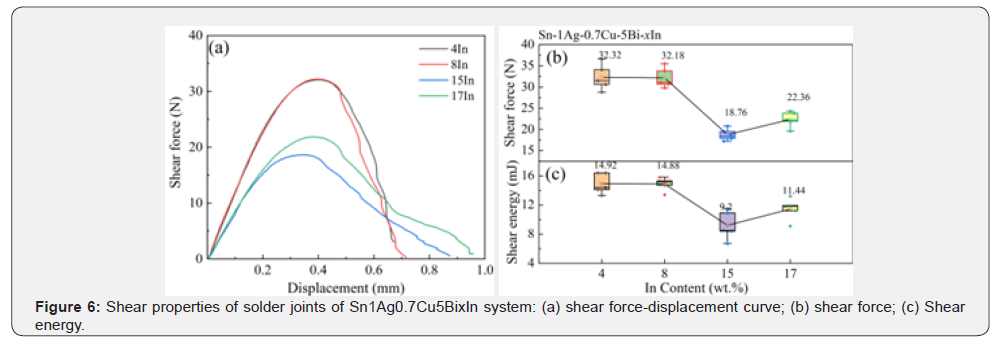
In this experiment, the anti-crack ability of the solder joint was tested by the influence of shear, and the shear energy of the second half of the shear was calculated, as shown in Figure 6c. The crack resistance of the joint was measured by the area under the shear curve after the maximum shear strength of the shear curve, obtained by integrating the shear force displacement. Among them, the shear energy of the low-In alloy was higher, which decreased by 5.6mJ at 15 wt.%. The shear energy of the solder joint is obtained by the sheer force-displacement integral, although the shear resistance of the alloy joint with high In content decreases sharply, its elongation performance is better, resulting in a decrease in the difference in shear energy.
Effect of in doping on solder joints during solid-state aging
Figure 7 illustrates the microstructural evolution and compositional distribution of the xIn/Cu joints after aging at 170°C for 750 hours. Through SEM morphology observations and EDS mapping comparisons, it reveals the influence of In content on the morphology and composition of the precipitated phases. At a low In content (4In, Figure 7a), the primary precipitated phase after aging is identified as the Ag9 In4 phase, appearing as uniformly distributed elongated structures. These elongated structures are relatively regular, with a high nucleation density. However, due to the low In content and limited diffusion capability, their growth is significantly restricted. Additionally, some fine spherical particles are observed in the microstructure, attributed to the segregation and precipitation of Bi. When the In content increases to 8In Figure 7b, aging at 170°C for 750 hours significantly promotes the growth of the precipitated phases. The Ag9 In4 phase transitions from initially uniform particles into larger precipitates. The aging process provides sufficient time and energy for the diffusion of Ag and In atoms, leading to a noticeable increase in particle size and the emergence of initial directional growth. At this stage, Bi remains dispersed within the matrix without forming distinct precipitates. This particle growth phenomenon indicates that the combination of increased In content and aging conditions significantly enhances the growth kinetics of the precipitated phases, although it begins to affect the overall uniformity of the matrix.
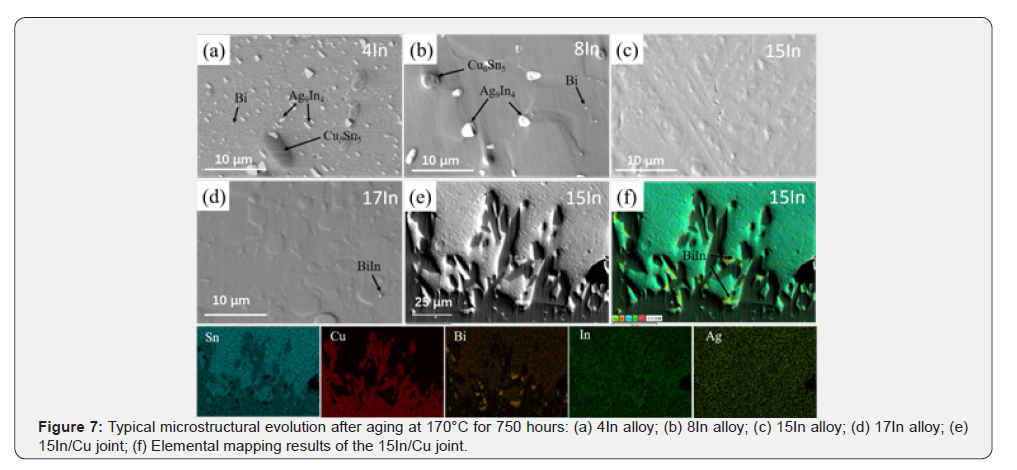
Under the condition of 15In Figure 7c-7f the microstructure undergoes substantial changes. The Ag9In4 phase develops into a complex dendritic structure due to the promotion of solute atom diffusion and the preferential growth of the precipitates under high In content and prolonged aging. Meanwhile, EDS mapping results show the emergence of BiIn precipitates within the matrix. These BiIn phases predominantly appear as small particles or localized aggregates, exhibiting high brightness and concentrating in specific regions. This indicates that under high In content, the interaction between Bi and In is strengthened, leading to the formation of independent BiIn precipitates during aging. The coexistence of Ag9In4 and BiIn phases makes the microstructure more complex but could potentially induce localized softening and stress concentration within the matrix. When the In content increases to 17In in Figure 7d, aging at 170°C for 750 hours further intensifies the microstructural evolution. The growth of the Ag9In4 phase stabilizes, displaying a plate-like morphology. This could be attributed to the excessive In content inhibiting further growth of the precipitates. Simultaneously, the BiIn phase becomes more prominent, manifesting as distinctly bright particles or aggregates within the matrix. This behavior suggests that the localized enrichment of Bi and In during aging reaches saturation, stabilizing in the form of independent BiIn precipitates. The Sn matrix remains evenly distributed, but the aggregation of BiIn phases may impact the overall mechanical properties and uniformity of the alloy.
Figure 8 shows the changes in the microstructure near the Cu substrate and at the interface of the xIn/Cu joints during isothermal aging. After 250h and 750h of aging, two intermetallic compound (IMC) layers formed at the interface, particularly in samples with lower In content, where the layering was more distinct, as observed in the Figure 8(a2-a3), 8(b2-b3). Based on EDS analysis, the darker layer closer to the Cu substrate is identified as the Cu3 Sn layer, while the lighter layer closer to the matrix is Cu6 (Sn, In)5. In the asreflowed state, the interface IMC consists of a single layer. For In content below 15wt.%, the IMC is Cu6 Sn5; however, when the In content reaches 15wt.%, the IMC changes to Cu6(Sn, In)5. During aging, thermal aging provides a driving force for the substitution of Sn atoms by In atoms. As a result, in samples with relatively lower In content, the interface IMC after aging also transforms into Cu6(Sn, In)5. The addition of Ag helps suppress the formation of the Cu3Sn layer in some solder joints. This combined effect of Ag and other elements results in solder joints with higher In content showing almost no Cu3 Sn formation even after long-term thermal aging. However, an increase in Ag content during aging was found to promote Bi segregation instead of preventing it. As aging time increases, large Bi particles precipitate in the Sn grain boundaries of the 4In alloy solder joints after 250h of aging. After 750h, these large Bi particles split into more, smaller particles. Similarly, in the 8In sample, Bi segregation started to appear after 750h of aging. In this system, once the In content reaches 15wt.%, the BiIn phase begins to form.
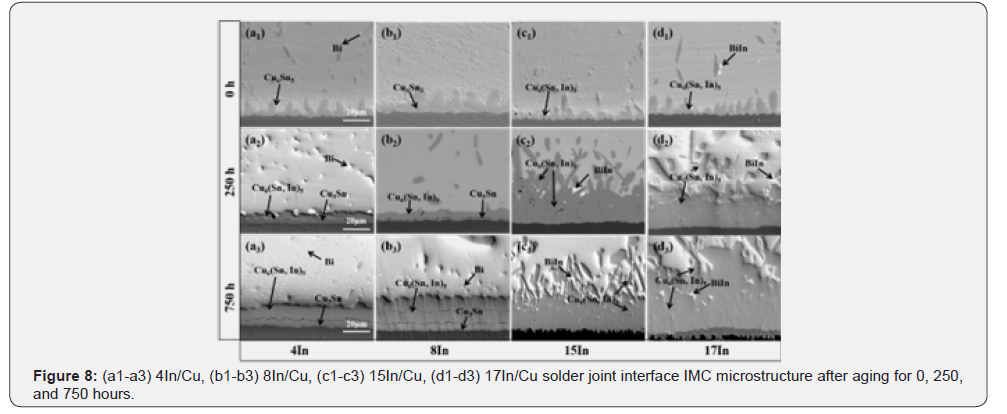
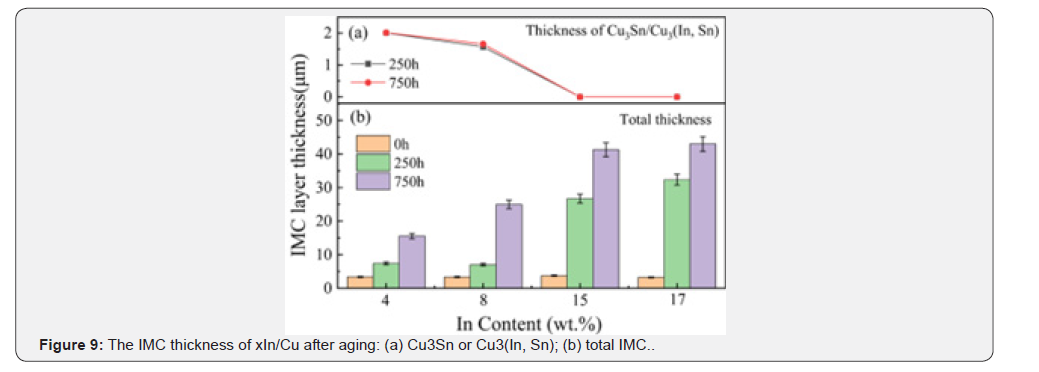
Figure 9 shows the IMC thickness of the xIn/Cu joints after different aging times. From the statistical data of Figure 9a & 9b, it is clear that the trend aligns with the microstructural analysis mentioned earlier. The thickness of the Cu3 Sn/Cu3(In, Sn) layer reaches its maximum value of 2.01μm when the In content is 4wt.%. As the In content increases, the thickness of the Cu3Sn/ Cu3(In, Sn) layer decreases, and by the time the In content reaches 17wt.%, this layer disappears entirely. This result is consistent with the findings from the EDS spectra. The total IMC thickness increases with aging time, reaching its maximum value when the In content is 17wt.%. After 250 hours of aging, the total IMC thickness reaches 32.3μm, and after 750 hours, it increases to 43.0 μm. In contrast, the total IMC thickness in the 4In-8In solder joints shows little change before and after aging, indicating that lower In content helps suppress the growth of the IMC layer.3.6 Strength Degradation and Fracture of xIn/Cu Solder Joints at 170°C.
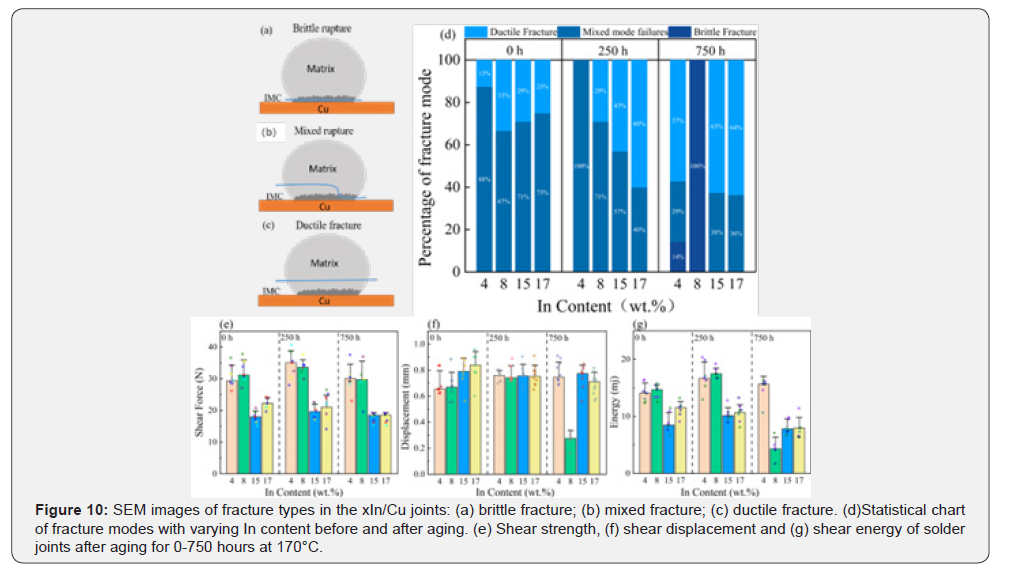
The shear fracture modes observed in the experiments can be categorized into three types, as shown in Figure 10a,10c: (a) brittle Fracture: This occurs when the solder joint fractures at the interface. (b) Mixed Fracture: this refers to a fracture that occurs between the matrix and the interface. (c) Ductile Fracture: this occurs when the fracture happens within the matrix of the solder joint. Seven points were selected for shear testing for each alloy composition before and after aging. The proportion of each fracture mode was determined by combining force-displacement curves and fracture surface morphology, as shown in Figure 10d. At 0h (before aging), the fracture mode of all four alloys was predominantly mixed fracture. After 250h of aging, the fracture mode remained largely unchanged, with mixed fractures still dominant. However, in the two higher In-content solder joints (15In and 17In), the proportion of ductile fractures increased. This is because thermal aging promoted the growth of the Cu6(Sn, In)5 layer, which resulted in a more ductile fracture mode. After 750h of aging, the 4In/Cu joints showed the highest proportion of ductile fractures, reaching 70%. In contrast, the 8In/Cu joints exhibited 100% brittle fractures. This is due to the formation of a thick, brittle Cu3Sn layer at the interface after prolonged aging, which significantly increased the brittleness of the solder joint. The results demonstrate that longer aging times tend to promote brittle fracture in lower In-content alloys, while higher In-content alloys (like 15In and 17In) experience an increase in ductile fractures due to the growth of the more ductile Cu6(Sn, In)5 layer, improving the mechanical properties of the joints.
Figure 10e & 10g compare the shear force, shear displacement, and shear energy of the solder joints before and after aging. Across all three aging times, the solder joints with 4In and 8In consistently exhibited higher shear force. Notably, the sheer force of the 4In/Cu joints actually increased after aging. By analyzing the microstructure images, it can be observed that the Bi particles precipitated in the 4In/Cu joints after aging are uniformly distributed and fine in size. These Bi particles contribute significantly to strengthening the solder joint, which explains the improved shear force after aging. The uniform and fine distribution of Bi particles enhances the mechanical performance of the joint by providing additional reinforcement, thus preventing the joint from weakening even after prolonged thermal aging.
Cracks caused by stress
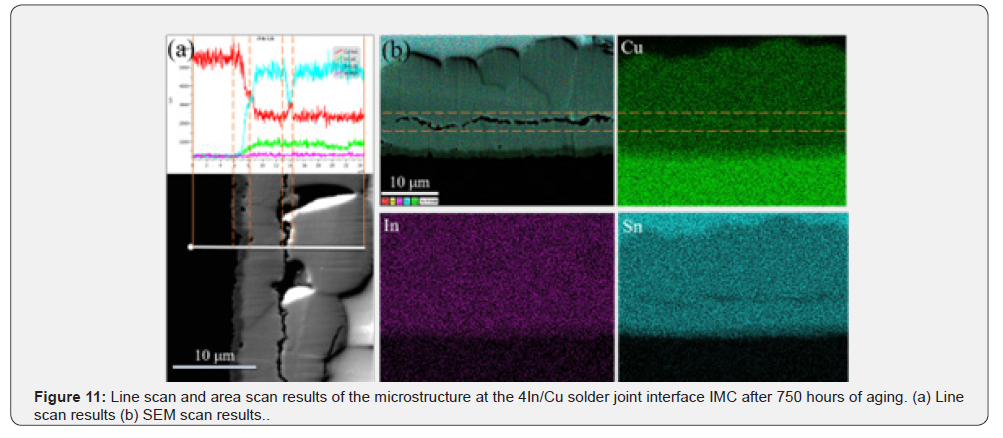
From Figure 8a3, it can be observed that after aging the 4In/ Cu solder joint at 170°C for 750 hours, significant cracks formed at the interface. To investigate the mechanism of crack formation, this section systematically analyzes the phenomenon based on the line scanning and area scanning results of the 4In/Cu solder joint interface. The analysis focuses on elemental diffusion behavior, interfacial reaction processes, and structural changes, aiming to elucidate the fundamental causes of crack formation. From the line scan results shown in Figure 11a, it is evident that near the crack path, the signal intensity of Cu increases significantly, while the signal intensity of In remains stable.
From the line and area scanning results in Figure 11a & 11b, it can also be observed that the distribution of In within the solder joint is relatively uniform. However, Cu accumulation is detected near the crack region, which is likely caused by the difference in diffusion rates of Cu and Sn elements within the interfacial compounds. This results in the formation of a Cu-rich layer near the interface. The presence of this Cu-rich layer leads to stress concentration within the compound. Such abrupt changes in concentration induce localized tensile or shear stresses, which facilitate the initiation and propagation of cracks at the interface between Cu-enriched and In-depleted regions.
Similarly, cracks are also observed in the intermetallic compound (IMC) layer at the interface of the 8In/Cu solder joint after aging for 750 hours. Elemental mapping and line scanning analyses were conducted at the crack site, as shown in Figure 12a & 12b, respectively. From these results, it can be seen that an In elemental peak is present at the crack location, indicating the accumulation of In in this region. Compared to the 4In/Cu solder joint, the crack position in the 8In/Cu solder joint is closer to the Cu substrate. This can be attributed to structural changes in the interfacial compound layer during aging, driven by the continuous diffusion of Cu from the substrate. The corresponding reaction is as follows equation (1):
Cu6 (Sn, In)5+9Cu→5Cu3(Sn, In) (1)
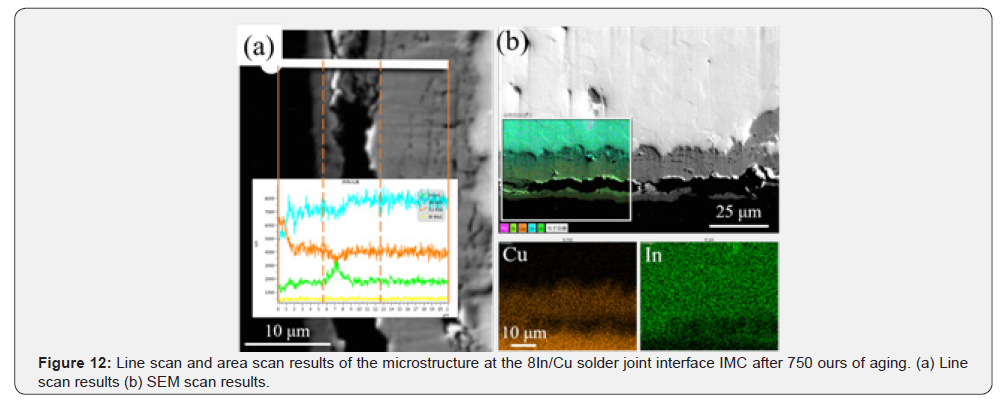

The transition from Cu6 Sn5 to Cu3 Sn is accompanied by significant volume shrinkage (approximately 10%-15%), which induces residual stresses at the interface. Such residual stresses are more concentrated in regions where the IMC layer thickness is uneven. Additionally, at relatively high aging temperatures, the smaller the difference between the solder alloy’s melting point and the aging temperature (ΔT=melting point-170°C), the higher the diffusion rates of the Cu, Sn, and In elements, accelerating the reaction kinetics and structural evolution of the solder during aging. For the 8In solder, the melting point differs from the aging temperature of 170°C by ΔT = 34.2°C, whereas the 4In solder has a larger difference (ΔT = 44.8°C). The smaller ΔT for the 8In solder leads to a faster diffusion rate of In, resulting in the formation of an In-rich layer within the compound. The presence of this In-rich layer increases the internal stress of the compound, making it more prone to crack formation during the aging process.
When the In content is further increased to 15In or 17In, the high In concentration significantly lowers the solder’s melting point (the melting point of 15In and 17In solders decreases to 190°C or lower). The difference between the melting point and the aging temperature of 170°C (ΔT≈15-20°C) is significantly reduced. With the melting point approaching the aging temperature, the solder is nearly in a semi-liquid state at 170°C. This localized thermal condition may result in partial melting. Under such conditions, the Cu, Sn, and In elements are in an activated state, with diffusion rates increasing exponentially. Consequently, the formation rate of intermetallic compounds (IMCs) is significantly enhanced. The proximity of Cu and Sn, facilitated by the addition of In, leads directly to the formation of a Cu6 (Sn, In)5 solid solution phase. This solid solution phase reduces the brittleness of Cu6 Sn5 and slows its transformation into Cu3 Sn. Although the IMC growth rate is high, the transformation into Cu3Sn is minimal. Instead, the IMC growth primarily occurs in a top-growth dominant manner, advancing freely toward the interior of the solder joint. This growth behavior reflects a more unrestricted and unconstrained morphology, contrasting with the typical growth patterns observed under lower In content.
Conclusion
The isothermal aging at 170°C was conducted to the xIn/Cu joints to reveal the thermal stabilities, microstructure evolution, the shear mechanical performance degradation, and failure modes with time prolonging. Also, the influence of phase types and phase compositions on the mechanical properties was systematically discussed. The following conclusions were drawn:
When the In content is less than 15 wt.%, the matrix phase is β-Sn, and the second phases are Ag2 (In, Sn), Ag9 In4, and Cu6 Sn5, with the interface containing Cu6 Sn5. Once the In content reaches 15wt.%, the matrix consists of β-Sn and InSn4 phases, and the second phases are Ag2 (In, Sn), Ag9 In4, and Cu6 (Sn, In)5, with the interface containing Cu6 (Sn, In)5. Additionally, doping with In increases the proportion of In in the second phase while decreasing the proportion of Sn.
After 0-750 hours of aging, the interfacial IMC layer in 4In/Cu and 8In/Cu solder joints transforms into Cu6 (Sn, In)5 and Cu3Sn, while the IMCs in 15In/Cu joints consist of Cu6 (Sn, In)5 and Cu3(In, Sn), and the IMC in 17In/Cu joints is Cu6 (Sn, In)5. The thickness of the Cu3Sn/Cu3(In, Sn) layer at the interface decreases with increasing In content. The total thickness of the interfacial Cu6 Sn5 and IMCs increases with aging time, and the increase in In content helps suppress the growth of IMCs.
For the 4In solder joint, after aging at 170°C for 750 hours, Cu accumulates near the interface, forming a Cu-rich layer that leads to stress concentration within the compound. The abrupt concentration gradient induces localized tensile or shear stresses, causing cracks to initiate and propagate at the interface between Cu-enriched and In-depleted regions. In the 8In solder joint, the continuous diffusion of Cu and the transformation of Cu6 (Sn, In)5 to Cu3(Sn, In), accompanied by volume shrinkage and In-rich layer formation, induce residual stresses, resulting in cracks forming closer to the Cu substrate. For high-In solder joints, the significant reduction in melting point brings the solder close to a liquid state, accelerating element diffusion and IMC formation rates. The Cu6 (Sn, In)5 solid solution formed reduces brittleness and delays the transformation to Cu3Sn.
Acknowledgment
The authors would like to thank Professor H. Zhou, P. J. Zhou and J. H. Wang from Jiangsu University of Science and Technology for the support and assistance in sample production, SEM and EDS tests.
Funding
The authors gratefully acknowledge the supports from the following funds: The Yunnan Fundamental Research Projects (No. 202301BC070001-001) funded by the Yunnan Provincial Department of Science and Technology; The project was supported by the Natural Science Foundation of Inner Mongolia (No.2022MS05042).
Author Contribution
Hao Yang: Data curation, Formal analysis, Writing - original draft; Yuhang Wang: Writing - review & editing, Discussion; Chen Liu: Writing - review & editing, Discussion, Xiaojing Wang: Formal analysis, Writing - review & editing; Shanshan Cai: Writing -review & editing, Discussion and Conceptualization; Ning Liu: Writing - review & editing, Discussion; Xulei Wu: Formal analysis and Discussion; Yanlai Wang: Review & editing, Discussion.
Data and Code Availability
The data used to support the findings of this study are available from the corresponding author upon request.
Declaration
Conflicts of interest or competing interests
The authors declare that they have no known competing financial interests or personal relationships that could have appeared to influence the work reported in this paper.
Ethical approval
Experiments in this paper don’t involve in any vivo testing on animal subjects, human subjects, or human tissue.
References
- Ernst B, Kubaschinski P, Schiessl A, Waltz M, Höppel HW, Tetzlaff U (2024) Comparison of the Young’s modulus of the lead-free solder alloy Sn-Ag3.8-Cu0.7 determined by hot tensile tests, ultrasonic measurements and formula omitted]-Sn single crystal calculations. Mater Sci Eng A 916: 147354-147354.
- He H, Huang SY, Xiao Y, Goodall R (2020) Diffusion reaction-induced microstructure and strength evolution of Cu joints bonded with Sn-based solder containing Ni-foam. Mater Lett 281: 128642.
- Li ZC, Li CM, Cai SS, Wang X, Meng Z, et al. (2025) Influence of minor Co addition on microstructural and mechanical behavior of Sn3.0Ag0.7Cu solder joints, Mater. Today Commun 44: 111984.
- Koleňák R, Kostolný I, Drápala J, Drienovský M, Drápala J (2019) Research on joining metal-ceramics composite Al/Al2O3 with Cu substrate using solder type Zn–In–Mg. J Compos Mater 53(10): 1411-1422.
- Wang Q, Ding Y, Wang F (2020) Effect of a Nano-zno Addition on the Wettability and Interfacial Structure of Sn-based Pb-free Solders on Aluminum. Materials and technology 54(1): 79-83.
- Wang JX, Lin PR, Yao QB, Huang Y, Xie X, et al. (2024) Transient liquid phase bonding of Sn-Pb solder with added Cu particles. Journal of Physics: Conference Series 2671: 012022.
- Xu SW, Jing XY, Zhu PY, Jin H, Paik KY, et al. (2023) Equilibrium phase diagram design and structural optimization of SAC/Sn-Pb composite structure solder joint for preferable stress distribution. Mater Charact 206: 113389.
- Wu CJ, Zhang L, Sun L, Huang P, Guo X (2024) Interfacial reaction and strengthening mechanism of thermo-compression bonding foam Ni reinforced SAC105 and SAC105–0.3Ti solder joints. Mater Charact 215:114216-114216.
- Daly AAE, Taher AME (2013) Evolution of thermal property and creep resistance of Ni and Zn-doped Sn–2.0Ag–0.5Cu lead-free solders. Materials and Design 51: 789-796.
- Yang WH, Huang X, Zhang SY, Xie, C, Huang Z, et al. (2024) High performance Cu/SAC305 solder low temperature bonding using Ti3C2 MXene interlayer. Mater Lett 373: 137124-137124.
- Anuar RAM, Osman SA (2020) The formation of intermetallic layer structure of SAC405/Cu and SAC405/ENImAg solder joint interfaces. Soldering & Surface Mount Technology 33(2): 75-85.
- Daly AAE, Taher AME (2014) Novel Bi-containing Sn–1.5Ag–0.7Cu lead-free solder alloy with further enhanced thermal property and strength for mobile products. Materials and Design 65: 796-805.
- Cui Y, Xian JW, Zois A, Marquardt K, Yasuda H, et al. (2023) Nucleation and growth of Ag3Sn in Sn-Ag and Sn-Ag-Cu solder alloys. Acta Mater 249: 118831.
- Wang Z, Zhang QK, Chen YX, Song ZL (2019) Influences of Ag and in alloying on Sn-Bi eutectic solder and SnBi/Cu solder joints. Journal of Materials Science: Materials in Electronics 30: 18524-18538.
- Lu X, Zhang L, Wang X (2022) Structure and properties of low-Ag SAC solders for electronic packaging. Journal of Materials Science: Materials in Electronics 33: 22668-22705.
- Li L, Cai SS, Wang XJ, Ma R, Amin M, et al. (2024) Electrochemical noise analysis of corrosion sensitivity of Pb-free solders in 5wt% citric acid solution. Adv Compos Hybrid Mater 7: 42.
- Akkara FJ, Hamasha S, Alahmer A, Evans J, Belhadi M, et al. (2022) The Effect of Micro-Alloying and Surface Finishes on the Thermal Cycling Reliability of Doped SAC Solder Alloys. Materials 15(19): 6759-6759.
- Wang XJ, Li QZ, Zhang YC, Cai S, Hessien MM, et al. (2024) Comparison of strength degradation for SnAgCu solders with various Ag contents during thermal cycling. Adv Compos Hybrid Mater 8: 23.
- Wang XJ, Zhang SH, Zhang JH, Cai S, Liu N, et al. (2024) A synchronous improvement of strength and elongation caused by solid solution in low-silver SAC solder with superior necking resistance properties. Journal of Materials Research and Technology 33: 6397-6407.
- Li QZ, Li CM, Wang XJ, Cai S, Peng J, et al. (2024) Microstructure and Shear Properties Evolution of Minor Fe-Doped SAC/Cu Substrate Solder Joint under Isothermal Aging. Acta Metall Sin 37: 1279-1290.
- Wang Q, Cai SS, Yang SY, Wan Y, Peng J, et al. (2024) Comparison of high-speed shear properties of low-temperature Sn-Bi/Cu and Sn-In/Cu solder joints. Journal of Materials Science: Materials in Electronics 35: 576.
- Zhang JH, Zhao YH, Wang XJ, Cai S, Peng J, et al. (2024) Microstructures and shear properties of antimony- and indium-strengthened Sn5Bi/Cu joints. Adv Compos Hybrid Mater 7: 78.
- Anderson IE, Foley JC, Cook BA (2001) Alloying effects in near-eutectic Sn-Ag-Cu solder alloys for improved microstructural stability. J Electron Mater 30: 1050-1059.
- Wang JJ, Peng JB, Cai SS, Harringa J, Terpstra RL, et al. (2023) The effect of solvents on thermal stability of solder pastes in reflow process. J Mater Sci 58: 2347-2359.
- Liu C, Peng JB, Hu JT, Cai S, Wang X (2023) Effects of phosphorus and germanium on oxidation microstructure of Sn–0.7Cu lead-free solders. Journal of Materials Science: Materials in Electronics 34: 20.
- Chantaramanee S, Sungkhaphaitoon P (2022) Combined effects of Bi and Sb elements on microstructure, thermal and mechanical properties of Sn-0.7Ag-0.5Cu solder alloys. Trans Nonferrous Met Soc China 32(10): 3301-3311.
- Long ZY, Liu SF, Liu L, Tan Y, Wang Z, et al. (2022) Microstructure refinement, thermodynamic characteristic, wettability and shear strength of Bi-added rapid solidification SAC305 solder. Journal of Materials Science: Materials in Electronics 33: 8016-8026.
- Ali HE, Taher AME, Algarni H (2024) Influence of bismuth addition on the physical and mechanical properties of low silver/lead-free Sn-Ag-Cu solder. Mater. Today Commun 39: 109113.
- Tian S, Li SP, Zhou J (2017) Effect of indium addition on interfacial IMC growth and bending properties of eutectic Sn–0.7Cu solder joints. Journal of Materials Science: Materials in Electronics 28: 16120-16132.
- Luo XB, Peng JB, Zhang WB, Xue F, Cao R, et al. (2022) Calphad-guided alloy design of Sn–In based solder joints with multiphase structure and their mechanical properties. Mater Sci Eng 860: 144284.
- Che FX, Pang JHL (2012) Characterization of IMC layer and its effect on thermomechanical fatigue life of Sn–3.8Ag–0.7Cu solder joints. J Alloy Compd 541: 6-13.
- Mikolajczak P, Genau A, Janiszewski J, Ratke L (2017) Thermo-Calc Prediction of Mushy Zone in AlSiFeMn Alloys Met 7(11): 506.

























