




 JOJMS Home



Abstract
The study focuses on the processes of hydrogen absorption in porous ceramic materials and the main approaches to addressing the problem of hydrogen storage. Various modern methods for storing hydrogen in different states of aggregation are described, including storage in a liquefied form at low temperatures and in chemically bound forms such as metal hydrides. The results include the synthesis of porous materials for hydrogen absorption, proposing various types of hydrogen absorbers in the form of porous materials. The study demonstrates the dependence of the degree of hydrogen absorption on the composition of the absorber and the temperature of hydrogen sorption. A ceramic porous material of zeolite composition, sodium aluminosilicate (AlSiNaO), has been developed, exhibiting a high hydrogen absorption coefficient of 13.2wt.%.
Keywords:Hydrogen; Production; Storage; Hydrides; Absorbers; Porous ceramics
Introduction
Hydrogen, which has a unique set of physical and chemical properties, is widely used in various technological processes. High specific energy intensity (142MJ/kg or 39kWh/kg, which is three times more than traditional liquid hydrocarbons), the absence of harmful products from the oxidation of hydrogen with oxygen and the possibility of using it in fuel cells with an efficiency of more than 50%. This contributes to the rapid growth of research in the field of hydrogen energy technologies.
However, one of the main problems preventing the practical use of hydrogen in many areas is the low efficiency of its storage and transportation.
Fuel cell power plants demonstrate the highest efficiency to date - up to 80%, and the average annual productivity of a fuel cell is 19710kWh at a cost of 0.0766$/kWh [1].
Despite the fact that this cost exceeds the price of electrical energy supplied from the city power grid, the approach under consideration is of interest in conditions of shortage of electrical energy and natural gas. Modern research focuses on the problem of storing hydrogen as a promising energy carrier. If hydrogen is established as the main energy resource of the future, the issue of its efficient storage comes to the fore [2]. Particular attention should be paid to hydrogen storage systems as they provide longterm energy storage that is not subject to self-discharge and is not affected by temperature changes, unlike other electrochemical systems such as batteries [3].
The work [4] substantiates the feasibility of using a solid-state storage device – a hydrogen absorber from the point of view of its storage capacity, operating temperature and pressure ranges, resistance to contamination, long-term cyclic stability and cost.
Physical hydrogen storage methods [5], such as compression and liquefaction, are the main approaches in this field. In the first case, gas cylinders, underground tanks, and glass microspheres are used, providing convenience and relative ease of storage. The second method, liquefaction, allows hydrogen to be stored in a liquid state in stationery and transport cryogenic containers.
Chemical methods of hydrogen storage are based on sorption processes in materials such as metal hydrides, zeolites, activated carbon, carbon nanomaterials, fullerenes, ammonia, titanium sponge and iron. However, these methods are not without drawbacks associated with additional technological processes that require significant financial and energy costs. For example, metal hydride materials require special sterile chambers with high vacuum to ensure their effectiveness. Additionally, the effectiveness of these storage methods varies. For example, metal hydrides such as MgH2 and AlH3 can accommodate hydrogen at levels up to 7% and 11% by weight, respectively, indicating the need for further improvements in this area.
It is important to note that determining the effectiveness of hydrogen absorber materials is based on several criteria: the ability to retain large quantities of hydrogen at room temperature, rapid release at moderate temperatures, resistance to cyclic use, and cost-effectiveness.
To date, there is no material that would fully satisfy all these requirements. The search for new materials and various proposed solutions to this problem are actively discussed in recent review articles [1-5].
The goal of this work was to develop a hydrogen absorber based on an inexpensive porous material of zeolite composition.
As part of our materials synthesis research, many compositions have been tested to produce porous ceramics. To achieve this goal, we used the method of introducing burnable additives into the matrix of ceramic mass based on kaolin and diatomite. The chemical composition of the components is presented in Table 1.

Experimental Part
Kaolin was melted in a solar furnace. The fused material was wet ground in a ball mill to a fineness of 63 microns.
The choice of diatomite is not accidental. Since it usually has a loose structure, its porosity reaches up to 92%. The SiO2 content by weight ranges from 62 to 97%. The following may be present as impurities: fine sand (no more than 10%), clay minerals and organic matter (in small quantities).
We used coal, coke, mulberry sawdust, rice husk, and PVA as burn-out additives. Batch compositions were prepared on the basis of selected raw materials Table 2.

The technology for producing porous ceramics included the following operations;
i. preparation of a charge of a given composition
ii. wet grinding in a ball mill
iii. drying at 200oC
iv. molding into tablets with a diameter of 20mm
v. firing at a temperature of 1150°C for 2hrs;
vi. slow cooling in the oven.
Results and Discussion
The resulting materials of aluminosilicate composition, synthesized from raw materials melted in a solar furnace, had the following indicators
i. density 375–550 кг/м3;
ii. specific surface 2500 см2/г SSA=6/(ρ∙d)
iii. exhibit compressive strength of 3.7–4.9MPa
i. density 375–550 кг/м3; ii. specific surface 2500 см2/г SSA=6/(ρ∙d) iii. exhibit compressive strength of 3.7–4.9MPa
These data, taking into account the hydrogen density value of 0.09 kg/m3 under normal conditions (300K, 1atm), make it possible to calculate the aspect number for a porous material under normal conditions.

In table 3 shows the water absorption values for the developed compositions.
The porosity of materials is a priori related to the property of water absorption. For materials of this composition, water absorption ranged from 10 to 23%, which indicates the corresponding porosity of the material. Thus, the higher the porosity, the more hydrogen the material absorbs. The aspect number turned out to be strongly dependent on the relative density and specific surface area of the absorber material.

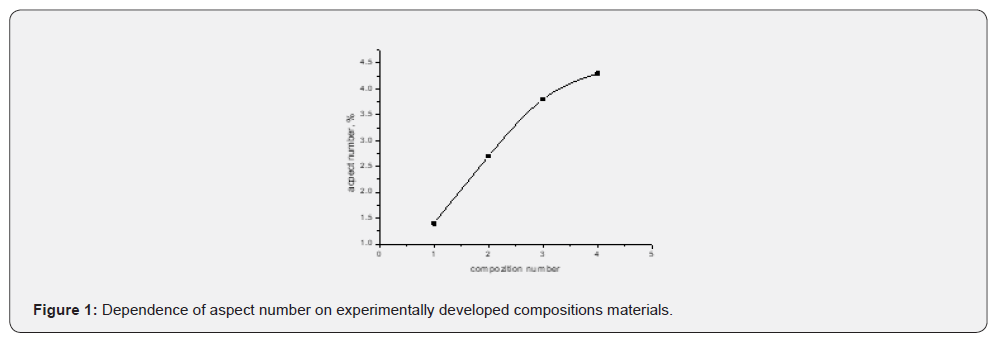
So, in Figure 1 shows the dependence of the aspect number on the experimentally developed compositions of materials. From Figure 1 it is clear that the aspect number, i.e. the ability of a material to absorb hydrogen at 200°C varies from composition to composition. The maximum value of the aspect number (4.3wt.%) corresponds to composition IV, i.e. the ability to absorb hydrogen is strongly related to the content of diatomite 70wt.% and burnable additives 20wt.%.
At the next stage of experiments, a material based on aluminum oxide was developed. The initial raw materials used to produce porous ceramics corresponded to the chemical composition given in table 4. Chemical analysis was carried out at the installation of the Tashkent Institute of Chemical Technology. As can be seen from table 4, the main components in the ceramic material are aluminum oxide 67wt%, silicon oxide 25.2wt%, and sodium oxide 6.9wt%.

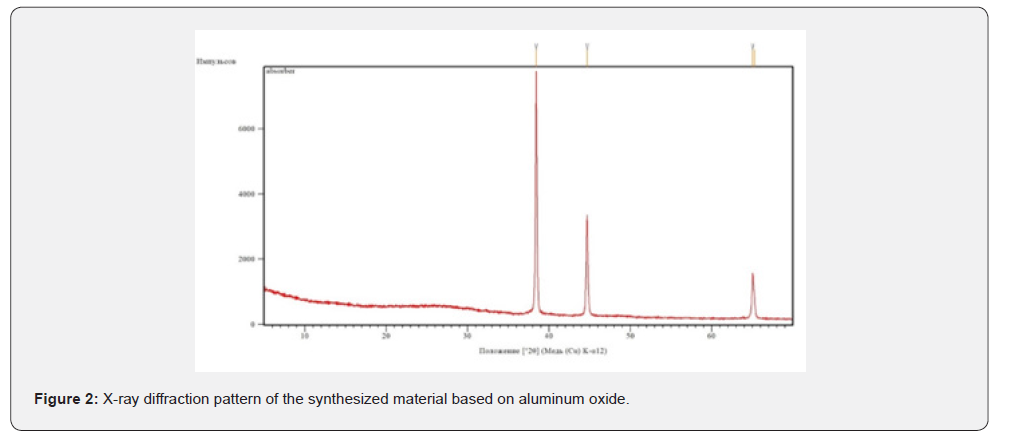
It shows an X-ray diffraction pattern of the synthesized material based on aluminum oxide Figure 2.
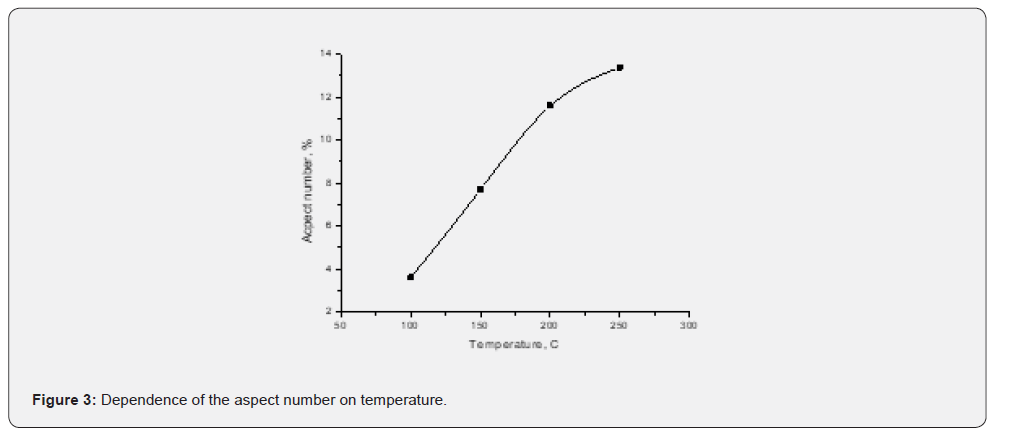
X-ray diffraction analysis shows that the material is singlephase and has a zeolite structure of sodium aluminosilicate AlSiNaO with a lattice parameter a = 4.056nm, space group Fm3 m. The dependence of the aspect number on the temperature of hydrogen absorption. An increase in the value of the aspect number with increasing temperature is observed: from 3.5wt.% at 100°C to 13wt.% at 190°C.This material is a good hydrogen absorber at a temperature of 190°C and the aspect number for it was 13.24wt.% Figure 3.
Now it is possible to evaluate the effectiveness of using ceramic porous absorbers in steel reactors. Let’s say a cylindrical steel reactor with a height of 400 mm and a diameter of 300mm has an internal volume of 0.028 m3.
At a given density of porous ceramics - 450kg/m3, the mass of porous ceramics placed in the reactor: 0.028×450 = 12.6kg.
This volume contains 450 x 0.028 = 12.6kg of porous ceramics. If you saturate it with hydrogen at a pressure of 100 atm, then you can introduce up to (12.6 x 13.24)/100 = 1.67kg of hydrogen into it. If you use a steel cylinder as a container for storing hydrogen, then at a pressure of 80 atm you can introduce 9 x 0.028 = 0.25kg of hydrogen into it.
Conclusion
So, materials of alamo-silicate composition AlSiNaO with specific surface area of 2500 gr/cm2 can be used as hydrogen absorber far the physical binding of hydrogen in porous by Van der Valls force at high (30 – 50atm) pressure.
It has been revealed what an aspect number is, i.e. the ability of a material to absorb hydrogen at 200°C, changing the composition of the composition. The maximum value of the component number (4.3wt.%) corresponds to the material with the addition of 70wt.% diatomite and 20wt.% burnable additives.
It has been revealed what an aspect number is, i.e. the ability of a material to absorb hydrogen at 200°C, changing the composition of the composition. The maximum value of the component number (4.3wt.%) corresponds to the material with the addition of 70wt.% diatomite and 20wt.% burnable additives.
References
- Armaroli N, Bandini E, Barbieri A (2024) Hydrogen as an energy carrier: constraints and opportunities. Pure and Applied Chemistry 96(4): 479-485.
- Dornheim M, Baetcke L, Akiba E, Ares JR, Autrey T, et al. (2022) Research and development of hydrogen carrier-based solutions for hydrogen compression and storage. Progress in Energy 4(4): 042005.
- Fruchart D, Jehan M, Skryabina N, Rango PD (2023) Hydrogen solid state storage on MgH2 compacts for mass applications. Metals 13(5): 992.
- Jaiswal A, Sahu S (2023) Hydrogen Storage Challenge in the Hydrogen-Based Civilization, in Hydrogen Fuel Cell Technology for Mobile Applications. IGI Global, pp: 25.
- Nazir G, Rehman A, Hussain S, Aftab S, Heo K, et al. (2022) Recent advances and reliable assessment of solid‐state materials for hydrogen storage: a step forward toward a sustainable H2 Advanced Sustainable Systems 6(11): 2200276.

























