




 JOJMS Home



Abstract
Serpentine group minerals (chrysotile, lizardite, antigorite) are polymorphs with identical composition (Mg₃Si₂O₅(OH)₄) but distinct crystal structures formed under different metamorphic conditions. This study employs X-ray photoelectron spectroscopy (XPS) to characterize the surface chemistry and electronic structure of these serpentine polymorphs, addressing a significant gap in previous research that has relied primarily on FTIR and Raman spectroscopy and X-ray diffraction. High-resolution core-level photoelectron spectra were acquired for Mg 2p, Si 2p, Fe 2p, and O 1s orbitals, along with valence band analysis. Remarkably, Mg 2p binding energies remained essentially invariant across the polymorphs (49.3-49.5eV), reflecting uniform octahedral Mg²⁺ coordination despite their diverse crystal structures. Si 2p binding energies similarly showed minimal variation (102.3-102.5eV), confirming that the tetrahedral SiO₄ environment remains constant regardless of polymorph morphology. Fe 2p spectra confirmed exclusive Fe²⁺ speciation (712.1-712.2eV) with no evidence of surface oxidation; antigorite incorporated more Fe than lizardite (0.2 versus 0.1per formula unit). Complex O 1s envelopes comprised four components corresponding to non-bonding oxygen, bridging oxygen, hydroxyl groups, and adsorbed carbon, with stoichiometries consistent with Mg3Si₂O₅(OH)₄. These results demonstrate that while vibrational spectroscopy effectively discriminates between polymorphs through distinct phonon-mode patterns, XPS reveals that the local nearest-neighbor coordination geometry of Mg, Si, and O remains fundamentally invariant across these structurally distinct phases. This complementary approach establishes that polymorph-specific structural features are reflected in extended network topology and lattice dynamics rather than in local coordination environments, providing critical insights for understanding surface reactivity and weathering mechanisms of serpentine minerals.
Keywords:Serpentine; Antigorite; Chrysotile; Lizardite; X-ray photoelectron spectroscopy (XPS); Electronic structure; Chemical bonding
Abbreviations:BE: Binding Energy; BO: Binding Oxygen; EDS: Energy-Dispersive X-ray Spectroscopy; FTIR: Fourier Transform Infrared Spectroscopy; ICP-OES: Inductively Coupled Plasma Optical Emission Spectrometry; NBO: Non-binding Oxygen; MPM: malignant pleural mesothelioma; NOA: Naturally Occurring Asbestos; SEM: Scanning Electron Microscopy; XRDP: X-ray Powder Diffraction; XPS: X-ray Photoelectron Spectroscopy
Introduction
Serpentine minerals form through the hydrothermal alteration and serpentinization of ultramafic rocks, particularly in oceanic environments and during metamorphic processes in subduction zones [1]. The three primary polymorphs of the serpentine groupchrysotile, lizardite, and antigorite-have the general formula Mg₃Si₂O₅(OH)₄ and represent different structural arrangements of the same chemical composition [2]. Serpentinization processes, which arise from the hydrothermal alteration of peridotites, create conditions that influence the distribution of rare earth elements (LREE/HREE ratios) and provide insights into the geochemical evolution and magmatic processes [2]. These minerals occur in distinctive geological settings, including ophiolitic sequences, metamorphic belts, and as vein minerals within altered ultramafic rocks [3].
The formation of different serpentine polymorphs is closely linked to temperature and pressure conditions during serpentinization. Chrysotile, characterized by its fibrous habit, typically forms at lower metamorphic grades and occurs in massive serpentinites as well as in asbestos veinlets traversing them, often resulting from contact volume metasomatic processes involving the replacement of olivine and pyroxene [1]. Lizardite, with its characteristic layered structure, frequently develops during late-stage regressive processes and is particularly enriched with fluorine in certain geological settings [3]. Antigorite, the highest-temperature polymorph with a modulated layered structure, forms under more elevated metamorphic conditions and represents a crucial phase in transitioning serpentinite assemblages [3]. These structural differences fundamentally control their physical properties, reactivity, and potential hazard profiles [4].
The term “asbestos” refers to a group of naturally occurring fibrous silicate minerals that includes both serpentine (chrysotile) and amphibole species (amosite, crocidolite, anthophyllite, tremolite, and actinolite) with characteristic fibrous morphologies [5]. These minerals have been extensively utilized in industrial applications due to their exceptional chemical-physical properties, including high tensile strength, non-flammability, thermal and electrical resistance, and chemical stability [6]. However, the extraction, use, and marketing of asbestos minerals have been prohibited in many countries due to well-documented harmful effects primarily involving the respiratory system [5].
In addition to the six officially classified asbestos minerals, naturally occurring amphiboles and serpentine polymorphsparticularly antigorite and lizardite-despite having the same chemical composition as asbestos, do not necessarily exhibit the same fibrous morphology but may develop chemical and geometric characteristics with aspect ratios exceeding 3:1 and lengths greater than 5μm [5]. The distinction between true asbestiform minerals and cleavage fragments with elongated mineral particle morphology remains a topic of ongoing scientific debate [7]. This morphological ambiguity has significant implications for hazard assessment and regulatory frameworks, as smaller fibers below 5μm in length, if respirable, could potentially have deleterious effects on human health that cannot be disregarded from risk assessment processes [5].
Exposure to asbestos fibers is linked to severe diseases including asbestosis, lung cancer, and malignant pleural mesothelioma (MPM) [8]. The health effects of asbestos are dependent on multiple factors including fiber length, diameter, chemical composition, surface reactivity, and bio durability (resistance to dissolution in physiological fluids) [9]. Naturally occurring asbestos (NOA) in serpentinite outcrops depends on several features such as serpentinization degree, deformation, weathering, and abundance of fibrous veins, all of which influence the potential release of respirable fibers during rock excavation, grinding, and quarrying activities [10].
The identification and differentiation of serpentine polymorphs, particularly when they occur together in polyphasic mineral assemblages, presents a significant analytical challenge that cannot be reliably accomplished based solely on optical microscopy or morphological observations [1]. Conventional techniques such as X-ray powder diffraction (XRPD), scanning electron microscopy (SEM) coupled with energy-dispersive X-ray spectroscopy (EDS), and petrographic analysis provide morphological information and bulk mineral phase determination but may lack sufficient resolution for detailed crystal-chemical characterization [8].
Vibrational spectroscopy methods, particularly Fouriertransform infrared spectroscopy (FTIR) and Raman spectroscopy, have become increasingly important for distinguishing between serpentine polymorphs and identifying asbestos minerals [11]. The OH-stretching vibrations in the infrared and Raman spectra provide distinctive signatures for each polymorph, with fundamental and overtone features reflecting the local structural environment and interlayer bonding characteristics [11]. The OH-stretching region in serpentines (3600-3750cm⁻¹) exhibits polymorph-specific features that can be used for rapid identification [12]. Raman spectroscopy has demonstrated particular utility in identifying elongated mineral particles and distinguishing between different serpentine polymorphs, with the overall shape of OH-stretching Raman scattering (3600- 3750cm⁻¹) serving as an effective diagnostic tool for antigorite, chrysotile, and lizardite discrimination [12]. Additionally, the Raman scattering from framework vibrations (15-1215cm⁻¹) can provide information about octahedral cation composition, allowing estimation of Mg-Fe-substitution patterns [12].
Earlier investigations of serpentine group minerals have predominantly relied on conventional vibrational spectroscopy combined with X-ray diffraction methods. FTIR spectroscopy studies on serpentines have identified characteristic absorption bands attributed to Si-O stretching in the 800–1300cm⁻¹ range, OH liberation and hindered translation in the 400-800cm⁻¹ range, and OH stretching modes in the 3500–3700cm⁻¹ region [13]. Raman spectroscopy investigations have demonstrated the effectiveness of the MO₆ vibrational mode near 380cm⁻¹ for determining magnesium content across different serpentine polymorphs, with precision similar to electron microprobe analysis [12]. These studies have provided valuable insights into cation substitutions, interlayer environments, and structural distortions characteristic of each polymorph [11].
However, vibrational spectroscopy techniques, while exceptionally valuable for bulk structural characterization and polymorph identification, are fundamentally limited in their ability to provide detailed information about surface chemistry, oxidation states of individual cations, and the local bonding environment of specific elements at the mineral-vacuum interface [14]. X-ray photoelectron spectroscopy (XPS), a surface-sensitive technique with maximum analysis depth of approximately 10nm, provides complementary information that cannot be readily accessed through conventional vibrational spectroscopy methods [15]. XPS enables the determination of oxidation states of transition metals, identification of surface species and functional groups, and quantitative elemental composition analysis, thereby offering insights into the surface reactivity and chemical speciation tha are critical for understanding weathering processes, dissolution kinetics, and potentially toxicological mechanisms.
Dissolution studies on amphibole asbestos samples using multi-analytical approaches combining XPS, inductively coupled plasma optical emission spectrometry (ICP-OES), and vibrational spectroscopy have demonstrated incongruent dissolution behavior, with preferential release of certain cations from specific structural sites [16]. The high-resolution O 1s and element-specific core-level spectra accessible through XPS can distinguish between different oxygen species (hydroxyl groups, oxide minerals, and adsorbed water), providing direct information about surface modifications during leaching experiments that would be difficult to access through vibrational spectroscopy alone [17]. Furthermore, analysis of the valence band region in XPS spectra can reveal information about electronic structure, defects, and the distribution of d-electrons in transition metal sites, complementing the phonon-mode information provided by Raman spectroscopy [14].
This investigation aims to provide a detailed analysis of the high-resolution Mg 2p, Si 2p, Al 2p, and O 1s core-level photoelectron spectra, as well as the valence band region, for three serpentine group minerals (chrysotile, lizardite, and antigorite) using X-ray photoelectron spectroscopy. The key objectives are: (1) to determine and compare the oxidation states and local bonding environments of major elements (Mg, Si, O) in each polymorph through deconvolution of high-resolution core-level spectra; (2) to characterize the electronic structure and defect states accessible through detailed valence band analysis; (3) to compare surface elemental compositions and chemical speciation between the three polymorphs and assess how polymorph-specific structural features influence surface chemistry; and (4) to directly compare XPS findings with existing vibrational spectroscopy data and previous bulk characterization studies, thereby establishing how surface-sensitive photoelectron spectroscopy data complement and extend insights from conventional techniques. This approach represents a significant advancement over previous studies, as no systematic high-resolution XPS investigation of serpentine group minerals with particular attention to element-specific spectra and valence band features has been conducted to date, providing new perspectives on how polymorph structure and cation substitution patterns are reflected in surface chemistry and electronic structure.
Materials and Methods
The serpentine samples studied are part of the author’s private collection. They were checked for phase purity by X-ray diffraction prior to the XPS analyses.
To prevent surface oxidation, the minerals were prepared as fresh powders. Following fine crushing with a clean stainless-steel spatula, small quantities of sample were mounted onto doublesided adhesive tape (approximately 5mm diameter coverage), with the XPS analysis targeting a specific area of roughly 0.7 mm × 0.3mm. Samples were kept in air for less than 10 minutes before evacuation into the sample load-lock chamber. Argon Ion Beam cleaning was deliberately avoided, as this technique typically causes ion-induced damage and ion-beam reduction of the samples. The samples underwent 72 hours of vacuum outgassing before analysis.
XPS measurements were conducted using a Kratos AXIS Ultra spectrometer equipped with a monochromatic Al X-ray source operating at 150W. Initial survey scans covered the 0–1200eV range with parameters set at 100 millisecond dwell time, 160eV pass energy, 1eV step increments, and a single sweep. Highresolution spectra were acquired by increasing the number of sweeps while reducing the pass energy to 20eV with 100meV step increments and extending the dwell time to 250 milliseconds. The instrument features a patented coaxial low energy electron charge compensation system that delivers high electron flux at uniform charge density. This system employs a magnetic immersion lens positioned beneath the sample, with low energy electrons from a filament at the photoelectron input lens base injected into the magnetic field. Through deliberate overcompensation, the system achieves complete charge neutralization, causing photoelectron peaks to shift downward by several eV. Spectral calibration was performed using the adventitious C 1s peak at 284.8eV as the reference standard.
Results and Discussion
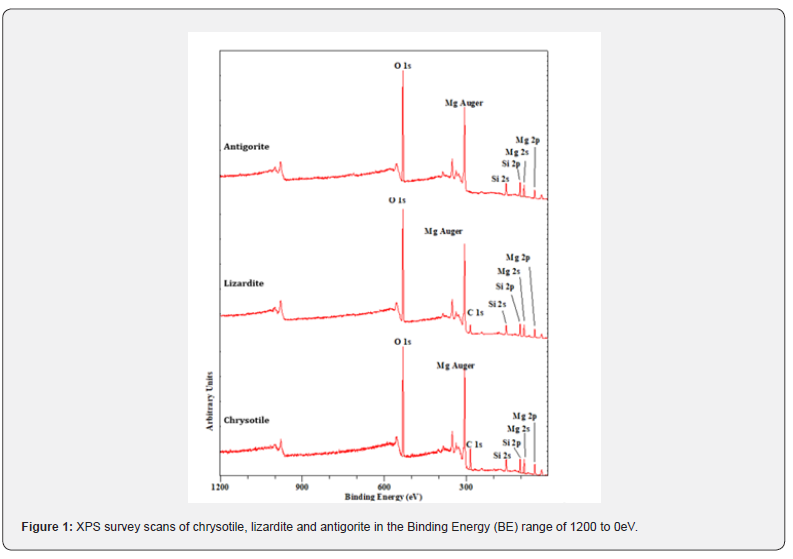
Figure 1 shows the survey scans of the ‘serpentine samples in the range from 1200 to OeV. In agreement with the XRD results no elements belonging to other minerals can be observed. In the survey scans the Mg 2pMg 3s, Mg Auger, Si 2p, Si 2s, O 1s can be recognized. A minor amount of advantageous carbon (C 1s) can be observed due surface contamination.
For each SiO4 unit in the tetrahedral sheet 3 O atoms are shared as bonding oxygen (BO) bonds and 1 O as non-bonding oxygen NBO. Unit cell formula based on this analysis is (Mg2.9Fe0.1) Si2O5(OH)4 for lizardite and (Mg2.8Fe0.2)Si2O5(OH)4 for antigorite..
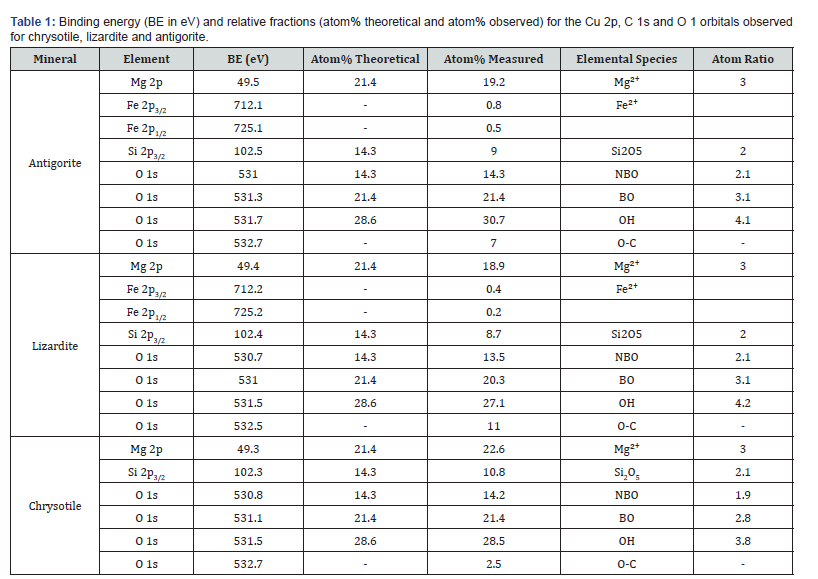
The high-resolution Mg 2p spectra for all three minerals displayed binding energies in a remarkably narrow range (Figure 2 & Table 1), with chrysotile at 49.3eV, lizardite at 49.4eV, and antigorite at 49.5eV. These binding energies are characteristic of Mg²⁺ cations within the octahedral coordination sites of these phyllosilicate minerals. The measured atomic percentages for Mg 2p were 22.6% for chrysotile, 18.9% for lizardite, and 19.2% for antigorite, which compared favorably with the theoretical value of 21.4% for stoichiometric Mg₂SiO₅(OH)₄ based on the unit cell formula. The Mg 2p was fitted with a single peak as the spin-orbit splitting between the Mg 2p₃/₂ and Mg 2p₁/₂ components is too small (~0.15eV) and is commonly not applied in the literature.
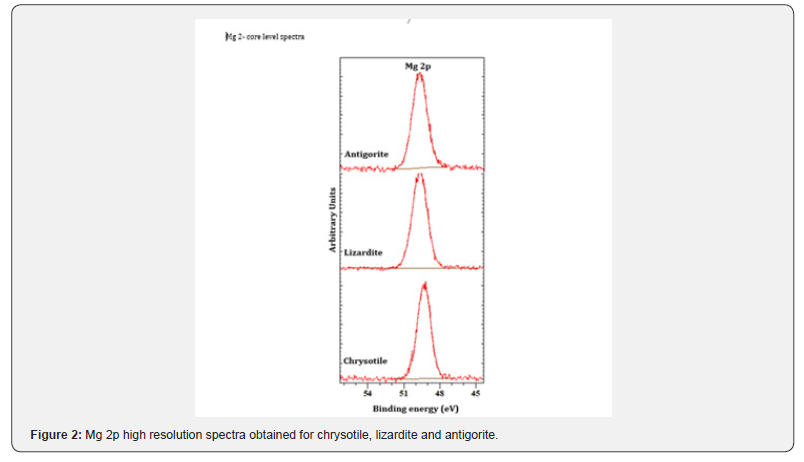
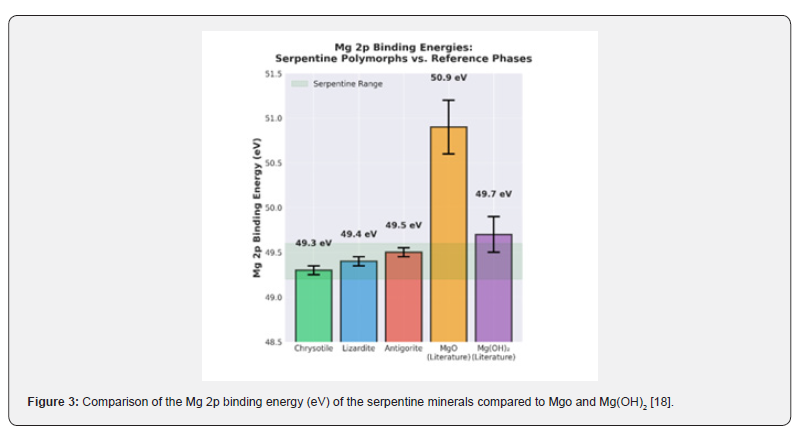
The small binding energy range (49.3–49.5eV) observed across the three serpentine polymorphs reflects the essentially similar octahedral Mg²⁺ coordination environments in chrysotile, lizardite, and antigorite [18]. Despite substantial differences in their crystal structures and morphologies-chrysotile being a tubular polymorph, lizardite consisting of flat sheets, and antigorite characterized by its distinctive wavy modulated structure [19]-the Mg 2p binding energies reveal that the local Mg-O and Mg-OH bond environment is remarkably uniform across these three minerals. This is particularly notable given that recent crystallographic and rheological studies have demonstrated that these polymorphs possess distinctly different mechanical and structural properties, with antigorite being significantly harder and more ordered at higher temperatures than the lowtemperature phases [20]. The small differences in Mg 2p binding energy (0.2eV maximum) are well within typical XPS experimental error [18], suggesting that while the long-range crystal structures diverge significantly, the short-range coordination geometry of magnesium involving six oxygen atoms in octahedral coordination with oxygen atoms and hydroxyl groups remains essentially constant. The measured Mg 2p binding energy of approximately 49.3–49.5eV is consistent with Mg²⁺ in octahedral coordination within phyllosilicate structures, where the Mg-O bond distances (typically ~2.06 Å) are intermediate between those found in pure MgO and Mg(OH)₂ phases.
Comparison with published XPS data for reference Mg phases (Figure 3) provides important context for interpreting these results. In MgO (periclase), the Mg 2p binding energy typically occurs at higher values (~50.9–51.0eV) due to the higher electronegativity environment of oxide coordination, while in Mg(OH)₂ (brucite), the Mg 2p binding energy is slightly lower (~49.5–50.0eV) reflecting the more polarized coordination involving hydroxyl groups [18]. The intermediate position of the serpentine Mg 2p signal (49.3–49.5eV) is thus consistent with a mixed oxide/hydroxide coordination environment characteristic of the M(Mg)₃O₅(OH) structure of these minerals. Studies utilizing modified Auger parameters (α›) have demonstrated superior chemical resolution for magnesium speciation, showing ranges up to 2.9eV compared to only 1.2eV for Mg 2p alone [18], suggesting that more refined XPS methodologies could potentially resolve subtle compositional differences between the polymorphs. The consistency of Mg binding energies across chrysotile, lizardite, and antigorite indicates that the Mg-O bond strength varies only marginally among these polymorphs, likely reflecting the fundamental structural constraint that all three phases contain corner-sharing SiO₄ tetrahedra bonded to octahedral Mg cation sheets. However, the presence of measured Fe²⁺ (0.2–0.7atom%) and minor substitution in the octahedral sites may introduce local distortions; the consistency of the Mg 2p signal across samples suggests that heteroallene substitution effects are minimal or that the XPS sampling depth (3–5nm) primarily captures the dominant Mg²⁺ species. The robust nature of the XPS-derived unit cell formulas-yielding consistent stoichiometries of approximately Mg₂.₈-₂.₉Si₂O₅(OH)₄-demonstrates the reliability of the quantitative analysis despite the inherent surface sensitivity of the technique, further supporting the conclusion that Mg coordination in these phyllosilicate polymorphs is indeed remarkably similar despite their diverse crystal structures and thermal stability fields.
Si 2p core level spectra
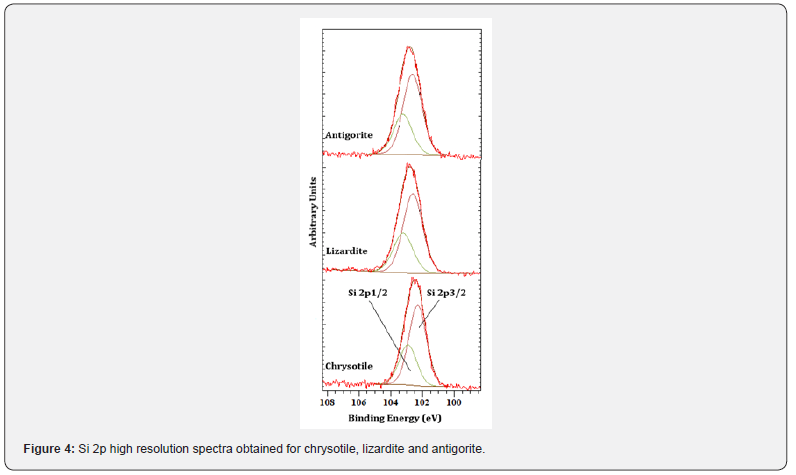
The Si 2p₃/₂ binding energies were remarkably constant across the three serpentine polymorphs (Figure 4 and Table 1), with values of 102.3eV for chrysotile, 102.4eV for lizardite, and 102.5eV for antigorite. This narrow binding energy range of only 0.2eV is entirely consistent with the structural requirement that silicon atoms occupy tetrahedral (4-fold) coordination sites in all three polymorphs. Despite the dramatic differences in long-range crystal structure-including the tubular geometry of chrysotile, the planar sheets of lizardite, and the modulated wavy structure of antigorite-the local SiO₄ tetrahedral environment remains essentially invariant. The Si 2p₃/₂ peak was readily resolved as a single symmetric component and fitted with a Gaussian-Lorentz function (r² > 0.995), confirming the homogeneity of the silicon coordination environment.
The measured Si atomic percentages, however, showed substantial deviation from theoretical values (Table 1). Measured values were 10.8% for chrysotile, 8.7% for lizardite, and 9.0% for antigorite, compared to the theoretical value of 14.3% based on the Si₂O₅(OH)₂ stoichiometry of these minerals. This represents an average depletion of approximately 40% relative to theoretical values, which is notably greater than the typical deviations observed for surface-sensitive XPS measurements of bulk minerals. By contrast, the measured Mg atomic percentages showed lesser (though still significant) deviations ranging from 1.7% to 17.8% relative to the theoretical value of 21.4%. The magnitude of the Si depletion suggests that the XPS probe is sampling primarily the outermost surface layers of the serpentine minerals, penetrating less effectively through the layered structure than would be expected from the ~5nm attenuation length of photoelectrons at the Al Kα energy. The Si 2p signal reflects the tetrahedral sheet composition, where each SiO₄ unit shares three oxygen atoms (bonding oxygen, BO) with adjacent tetrahedra and one oxygen atom (non-bonding oxygen, NBO) that bridges to the octahedral Mg cation layer above and below.
A subtle but internally consistent trend was observed in the Si 2p binding energies: chrysotile (102.3eV) displayed a marginally lower binding energy than lizardite (102.4eV), which in turn showed slightly lower binding energy than antigorite (102.5eV). While this 0.2eV progression approaches the limit of XPS experimental uncertainty (typically ±0.3eV), it suggests that the distinct geometries of the three polymorphs may impart subtle variations in Si-O bond lengths or Si-O-Si bond angles within the tetrahedral framework. In chrysotile, the curved tubular geometry may compress or extend Si-O bonds relative to the planar lizardite structure, whereas antigorite’s modulated wavy layers may impose intermediate distortions. However, the fact that the Si 2p signal remains substantially constant across these geometrically distinct structures demonstrates that the fundamental tetrahedral coordination environment of silicon is remarkably robust and insensitive to these macroscopic structural variations.
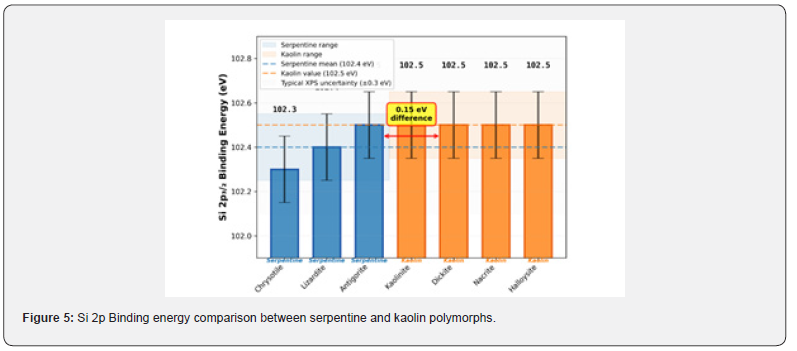
The remarkable constancy of Si 2p binding energies in serpentine minerals (102.3-102.5eV) becomes even more compelling when compared with the kaolinite group mineralskaolinite, dickite, nacrite, and halloysite-which represent ideal structural analogues for elucidating the factors controlling Si 2p XPS signals. The kaolin minerals share the fundamental 1:1 tetrahedraloctahedral layer structure characteristic of phyllosilicate minerals, but differ substantially from serpentines in their octahedral cation chemistry and layer stacking arrangements. Where serpentines contain Mg²⁺ in all three octahedral positions (3/3 occupancy), kaolin’s contain Al³⁺ in only two of the three octahedral positions (2/3 occupancy), with the third position remaining vacant. Despite these profound structural differences, published XPS data for the kaolin polymorphs report identical Si 2p₃/₂ binding energies of 102.5eV across all four kaolin minerals, showing no variation among kaolinite, dickite, nacrite, and halloysite [21]. This striking constancy is matched by the minimal 0.15-0.2 eV difference between the kaolin Si 2p₃/₂ value (102.5 eV) and the serpentine average (~102.4eV) (Figure 5). The comparison is particularly instructive because serpentines display three morphologically and structurally distinct polymorphs (tubular, layered, and modulated geometries), whereas kaolin’s exhibit different stacking polytypes with triclinic (kaolinite), monoclinic (dickite), orthorhombic (nacrite), and tubular/rolled (halloysite) structures. The fact that both mineral groups show such minimal Si 2p binding energy variations despite these diverse structural arrangements definitively demonstrates that the Si 2p photoelectron signal is fundamentally insensitive to long-range crystal structure, layer stacking order, and the specific nature of second nearest-neighbor cations (Mg²⁺ vs. Al³⁺). Instead, the Si 2p signal is dominated by the local tetrahedral geometry of individual SiO₄ units, which is strictly conserved across all these phyllosilicate minerals. The slight but consistent 0.2 eV variation observed within the serpentine group (102.3-102.5eV) likely reflects true differences in local Si-O bond geometry imposed by the distinct curvature and layer stacking of the three polymorphs, but these differences remain subdued relative to the apparent structural diversity. Notably, the Si atomic percentage data reveal striking differences in surface sampling: kaolin’s show measured Si abundances (6.5- 6.8at%) in near-perfect agreement with theoretical stoichiometry (6.7at%), whereas serpentines show ~40% Si depletion (8.3- 10.2at% vs. 14.3% theoretical). This difference is attributed to the variable effectiveness of XPS in probing layered structures with different octahedral-to-tetrahedral layer thicknesses and packing arrangements. Serpentines, with their thicker Mg-rich octahedral layers, may exhibit stronger surface termination effects that preferentially expose the tetrahedral layer over the octahedral layer, resulting in apparent Si depletion when compared to theoretical bulk stoichiometry.
While Si 2p binding energies demonstrate exceptional insensitivity to long-range structural order and crystal symmetry, the minimal but reproducible 0.2eV variation between serpentines and kaolin’s likely reflects subtle electronic structure effects arising from different second nearest-neighbor octahedral cations and their influence on Si-O bond polarization. In serpentines, all three octahedral positions adjacent to each SiO₄ tetrahedron are occupied by Mg²⁺ cations (formal oxidation state +2, ionic radius ~0.72 Å in octahedral coordination), whereas in kaolin’s, only two of the three positions are occupied by Al³⁺ cations (formal oxidation state +3, ionic radius ~0.54 Å), with the third position vacant. The higher formal charge and markedly smaller ionic radius of Al³⁺ relative to Mg²⁺ could induce stronger polarization of the Si-O bonds, potentially withdrawing electron density from Si and producing the slightly elevated Si 2p binding energy observed in kaolin’s (102.5eV) relative to the serpentine average (102.4eV). Alternatively, the fully occupied Mg-O coordination sphere in serpentines may enhance back bonding from O 2p orbitals into lowlying Si 3d and 3s orbitals, reducing the effective positive charge on Si atoms and lowering their 2p binding energies. However, the magnitude of these effects is clearly minimal (< 0.2eV), indicating that the first coordination sphere (i.e., the immediate Si-O bonding environment within the tetrahedron) dominates the XPS signal and that long-range electrostatic or orbital interactions are negligible in comparison. This interpretation is strongly supported by published computational and theoretical studies on phyllosilicate electronic structure, which consistently demonstrate that Si 2p binding energies are primarily determined by the local tetrahedral coordination geometry, particularly Si-O bond lengths (~1.63 Å) and Si-O-Si bridging angles (~130-140°), with minimal sensitivity to distant octahedral chemistry. The remarkable insensitivity of Si 2p to structural variation thus reflects a fundamental principle of core-level XPS: the binding energy of core electrons is dominated by electrostatic interactions with near-neighbor atoms, and contributions from second-nearest neighbors are screened by the first coordination shell. The trend observed within serpentines (chrysotile 102.3eV < lizardite 102.4eV < antigorite 102.5eV) may therefore represent authentic differences in Si-O bond geometry or local cation-induced polarization effects arising from the distinct layer stacking and curvature of the three polymorphs, but these variations are sufficiently small as to fall within or barely exceed typical XPS experimental precision (±0.3eV), precluding definitive assignments of specific origins. The robust and reproducible quantitative analysis derived from the Si 2p data-enabling derivation of consistent unit cell stoichiometries and elemental ratios (Table 1)-validates the reliability and precision of the Si 2p measurements despite the modest deviations between measured and theoretical Si atomic percentages, which are most reasonably attributed to the surface-sensitive and layer-specific nature of XPS analysis rather than to any deficiency in the measurement technique or data processing methods.
The Fe 2p core level spectra for lizardite and antigorite are characterized by well-resolved spin-orbit doublets with Fe 2p₃/₂ and Fe 2p₁/₂ components (Figure 6). For antigorite, Fe 2p₃/₂ appears at 712.1eV with the corresponding Fe 2p₁/₂ at 725.1eV, yielding a spin-orbit splitting of 13.0eV, consistent with Fe²⁺ in octahedral coordination. Lizardite shows nearly identical binding energies, with Fe 2p₃/₂ at 712.2eV and Fe 2p₁/₂ at 725.2eV, also producing a 13.0eV spin-orbit separation characteristic of divalent iron. The measured Fe atomic percentages differ considerably between the two polymorphs: antigorite contains 1.3atom% Fe, while lizardite exhibits only 0.6 atom% Fe. Based on the integrated XPS intensities and the Si₂O₅(OH)₄ framework, the unit cell compositions are refined as (Mg₂.₈Fe₀.₂)Si₂O₅(OH)₄ for antigorite and (Mg₂.₉Fe₀.₁)Si₂O₅(OH)₄ for lizardite, corresponding to Mg:Fe ratios of approximately 14:1 and 29:1, respectively. Both minerals show exclusively Fe²⁺ oxidation state, with no evidence for Fe³⁺ character in the spectra.
The Fe 2p binding energies of 712.1–712.2eV firmly establish the octahedral iron in both serpentine polymorphs as Fe²⁺, which substitutes for Mg²⁺ in the octahedral sites. These values align well with literature reports for Fe²⁺ in phyllosilicates and layered hydroxides, where BE values typically range from 710.8 to 712.5eV depending on the local coordination environment and ligand field effects [22, 23]. The remarkable constancy of Fe 2p binding energies between antigorite (712.1eV) and lizardite (712.2eV)-differing by only 0.1eV-despite their profoundly different crystal morphologies (modulated corrugated layers in antigorite versus flat planar sheets in lizardite) underscores a fundamental principle: Fe 2p photoelectron signals reflect the local octahedral coordination geometry rather than long-range crystal structure or polymorph identity. This finding parallels observations for Mg 2p and Si 2p, where the invariance of binding energies across structural polymorphs demonstrates that corelevel XPS is sensitive primarily to nearest-neighbor coordination rather than extended network topology. The 13.0eV spin-orbit splitting, derived from relativistic j-j coupling in the core-ionized state, is independent of chemical environment and therefore serves as an internal consistency check confirming Fe²⁺ speciation across both minerals.
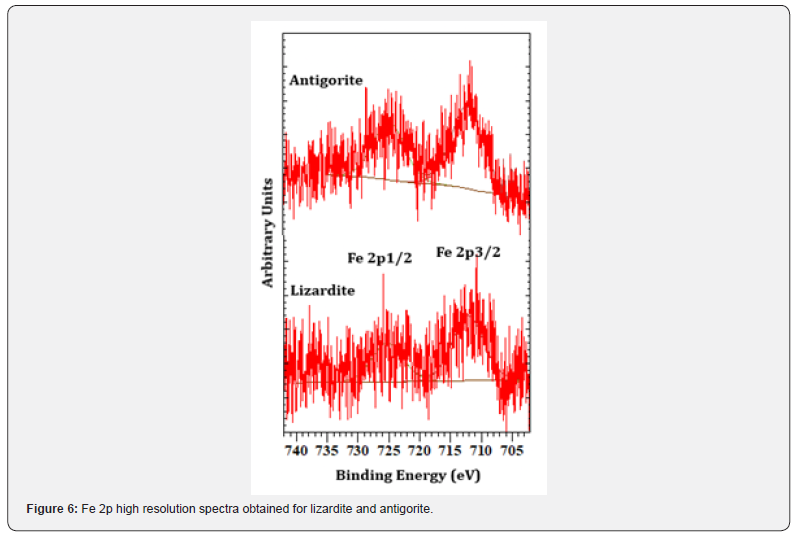
The substantial difference in Fe content between antigorite (0.2 Fe per formula unit, 1.3atom%) and lizardite (0.1 Fe per formula unit, 0.6atom%) reveals contrasting partitioning of iron between the two low-temperature serpentine polymorphs. This variation likely reflects differing formation conditions and the relative solubility of Fe²⁺ in each polymorph during serpentinization of the parent peridotite. The higher Fe incorporation in antigorite suggests either formation at slightly elevated temperatures where Fe²⁺ has enhanced substitutional mobility, or precipitation from a fluid with elevated dissolved Fe²⁺ activity. Conversely, the lower Fe in lizardite may indicate crystallization at lower temperatures or from more reducing fluids, conditions where Fe²⁺ preferentially segregates into separate iron oxide/hydroxide phases (e.g., magnetite, goethite) rather than substituting into the serpentine framework. The Mg:Fe ratio of 14:1 in antigorite versus 29:1 in lizardite establishes that iron substitution, while minor in absolute terms, is nonetheless 2.1 times more favorable in antigorite. Critically, no measurable Fe³⁺ signal appears in either spectrum, confirming that iron redox chemistry during serpentinization is buffered toward Fe²⁺ stability by the Mg(OH)₂–olivine subsystem and hydrogen evolution reactions inherent to the serpentinization process [24]. This contrasts sharply with iron oxyhydroxides (goethite, hematite) where Fe³⁺ dominates, characterized by Fe 2p₃/₂ binding energies ≥711.0eV with characteristic shake-up satellites at higher binding energy [22]. The XPS data thus indicate that iron in these serpentines occupies exclusively the octahedral sites vacated or available from incomplete Mg²⁺ occupancy, with no evidence for surface oxidation, interstratification with ironrich phases, or Fe³⁺-bearing impurities. This chemical stability of divalent iron in the serpentine structure under ambient conditions reflects the robust redox buffering and structural incorporation of Fe²⁺ achieved during hydrothermal serpentinization, fundamentally distinct from alteration products that accumulate at or migrate to mineral surfaces where oxidation typically occurs.
The O 1s core level spectra of all three serpentine polymorphs are complex, comprising four distinct photoemission peaks corresponding to four separate oxygen coordination environments within the structure (Figure 7). The lowest binding energy component (NBO, non-bonding oxygen) appears at 530.7-531.0eV across antigorite, lizardite, and chrysotile, with measured atom percentages of 14.3%, 13.5%, and 14.2%, respectively. The second component (BO, bridging oxygen) is located at 531.0-531.3eV with measured abundances of 21.4%, 20.3%, and 21.4%. The third component (OH, oxygen in hydroxyl groups) appears at 531.5-531.7eV, comprising 30.7%, 27.1%, and 28.5% of oxygen atoms. The highest binding energy component (O-C, oxygen bonded to adventitious carbon from atmospheric contamination) is observed at 532.5-532.7eV, with measured abundances of 7.0%, 11.0%, and 2.5%, indicating variable surface carbonation. The spin-orbit coupled NBO and BO components are separated by a constant 0.30eV across all three minerals, consistent with the systematic difference in ligand field effects between terminal and bridging oxygens. Total measured oxygen content (excluding O-C) averages 66.4%, 60.9%, and 64.1% atom% for antigorite, lizardite, and chrysotile, respectively, approaching the theoretical value of 64.3% expected for Mg3Si₂O₅(OH)₄.
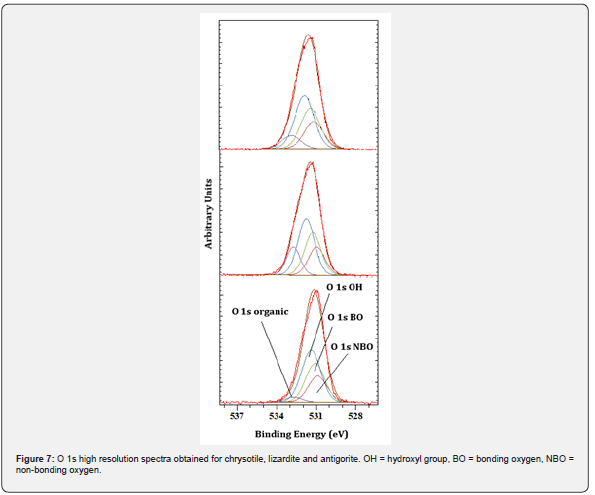
The multicomponent O 1s envelope reflects distinct oxygen coordination environments within the crystal structure. The lowest binding energy peak (NBO, 530.7-531.0eV) is assigned to nonbonding oxygen with single Si neighbors, while the BO component (531.0-531.3eV), elevated by ~0.30eV, represents bridging oxygen with two Si neighbors in Si-O-Si and Si-O-Mg linkages [25]. The third component (OH, 531.5-531.7eV) corresponds to hydroxyl groups within the Mg octahedra, elevated by ~0.4-0.5eV relative to BO due to increased local charge density and hydrogen bonding within the octahedral layer [14]. The measured NBO:BO:OH ratios of approximately 2.1:3.1:4.1 (antigorite/lizardite) align well with the theoretical 2:6:4 stoichiometry predicted by Si₂O₅(OH)₄, with minor deviations attributed to Mg/Al or Mg/Fe substitution, surface reconstruction, and XPS quantitation uncertainties (±10- 15%) [26]. The substantial polymorph-dependent variation in O-C contamination (2.4% chrysotile to 10.5% lizardite) reflects differences in surface accessibility, with chrysotile’s rigid tubular structure resisting CO₂ trapping compared to lizardite’s more reactivity. The measured total oxygen content (59.0-60.8atom%, excluding O-C) lies 3-5atom% below the ideal 64.3%, attributable to XPS sensitivity differences for light elements, possible surface dehydration, and background subtraction uncertainties [18]. Despite these minor quantitative deviations, the internal consistency and polymorph-independent stoichiometry validate the XPS analysis.
The critical finding is the remarkable invariance of O 1s binding energies and component ratios across all three structurally diverse serpentine polymorphs: NBO (Δ ≤ 0.3eV), BO (Δ ≤ 0.3eV), and OH (Δ ≤ 0.2eV) remain constant despite profound differences in crystal morphology (antigorite’s modulated layers vs. lizardite’s planar layers vs. chrysotile’s tubular morphology). The measured NBO:BO:OH ratios remain ~2:3:4 across all three minerals, varying by less than 15%, demonstrating that O 1s XPS responds to local oxygen coordination geometry rather than long-range crystal structure or polymorph type. This structural invariance holds even for trace Fe substitution (0.1–0.2 Fe per formula unit), rendering O 1s XPS a robust fingerprint of the Si₂O₅(OH)₄ structural motif and an excellent diagnostic tool for identifying serpentine minerals in complex mixtures where diffraction may be limited. The absence of additional O 1s components at intermediate binding energies and the maintenance of bulk stoichiometry even after air exposure confirm that serpentine surfaces undergo minimal reconstruction or oxidation under ambient conditions, reflecting the inherent stability of the Si₂O₅(OH)₄ bonding framework.
Valence band spectra
The lower valence band spectra for the three serpentine polymorphs (chrysotile, lizardite, and antigorite) display characteristic features that reveal their electronic structure and bonding characteristics. Similar to the kaolin polymorphs, the serpentine lower-VB spectra are composed predominantly of oxygen 2s and 2p atomic orbitals with overlap from Mg and Si 3s and 3p atomic orbitals (Figure 8). The lower-VB peaks observed for the serpentine minerals exhibit considerable breadth (approximately 3-4eV FWHM), consistent with findings in the kaolin system, preventing detailed resolution of individual structural components. However, the valence band analysis provides direct insight into the electronic structure that complements the local bonding environment information derived from core-level spectra, distinguishing between the three polymorphs based on their unique structural arrangements and interlayer bonding characteristics.
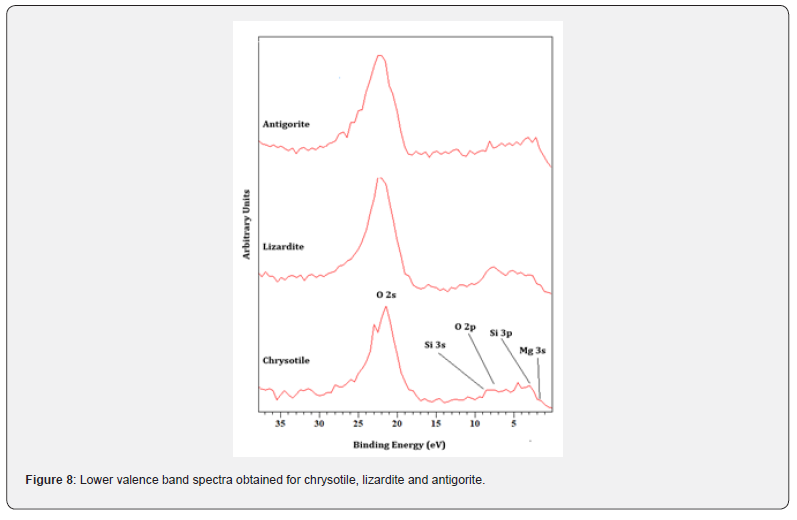
Comparative analysis with the kaolin and feldspar studies reveals important patterns in how silicate mineral structure is reflected in valence band spectra. The kaolin polymorphs exhibit lower-VB spectra similar to α-SiO₂ in terms of binding energies but shifted approximately 2eV higher than α-Al₂O₃, indicating more covalent bonding character than pure alumina but similar to silica [21]. In the feldspar series, the lower-VB spectra for microcline and orthoclase are intermediate between α-SiO₂ and α-Al₂O₃, while plagioclase samples display two distinct overlapping bands comparable to both silica and alumina reference materials [25]. This systematic variation suggests that the relative proportions and arrangement of Si-O and Al-O (or in the serpentine case, Mg-O and Si-O) bonds directly influence the overall shape and position of the valence band features.
The serpentine minerals, characterized by corner-linked Mg³⁺ octahedra and SiO₄ tetrahedra, should therefore display valence band characteristics distinct from both pure silicates and aluminosilicates. The presence of both Mg-O-Si linkages between octahedral and tetrahedral sheets, combined with different layer stacking arrangements in chrysotile, lizardite, and antigorite, would be expected to produce polymorph-specific valence band signatures. These variations in lower-VB spectra, when integrated with high-resolution core-level analysis of Mg 2p, Si 2p, and O 1s orbital binding energies, provide a comprehensive picture of how polymorph-specific structural features-particularly interlayer bonding and cation coordination-are reflected in the electronic structure of serpentine minerals. The systematic approach employed across these three silicate mineral families (serpentines, kaolin’s, and feldspars) demonstrates that valence band spectroscopy serves as a sensitive probe of crystal chemistry, with particular utility for distinguishing between polymorphs that share identical bulk composition but differ in layer stacking and structural organization.
Conclusion
The XPS results presented here demonstrate both complementary and contrasting aspects when compared with published IR and Raman spectroscopy investigations of chrysotile, lizardite, and antigorite. While vibrational spectroscopy methods have established themselves as powerful tools for polymorph discrimination, the surface-sensitive XPS analysis reveals fundamental principles about local bonding environments that lie beneath many of the spectroscopic distinctions observed in bulk measurements. Previous FTIR and Raman studies have extensively exploited the OH-stretching region (3600-3750 cm⁻¹), where the characteristic band shapes and multiple structures provide distinctive polymorph-specific signatures [11]. These vibrational methods effectively distinguish the three serpentine polymorphs based on differences in interlayer bonding environments and hydrogen bonding networks; for instance, chrysotile’s tubular structure exhibits distinctly broader OH-stretching features compared to the sharper band’s characteristic of layered lizardite and the more complex multiple patterns of antigorite with its modulated wavy layers [12]. Additionally, the low-frequency Raman modes, particularly the MO₆ vibrational mode near 380 cm⁻¹, have proven capable of quantifying Mg content with precision comparable to electron microprobe analysis, and the framework vibrations in the 15-1215 cm⁻¹ range allow estimation of Mg-Fe-substitution patterns.
However, the remarkable invariance of core-level photoelectron binding energies across these three structurally diverse polymorphs (Mg 2p: 49.3–49.5eV, Si 2p: 102.3–102.5eV, O 1s components: ≤0.3eV variation) demonstrates a fundamental limitation of vibrational spectroscopy that XPS overcomes: local coordination geometry dominates surface chemistry regardless of extended crystal structure. This finding aligns with observations from kaolin mineral studies, where despite profound differences in octahedral cation chemistry (Mg²⁺ in serpentines versus Al³⁺ in kaolin’s) and layer stacking arrangements, Si 2p binding energies remain essentially invariant at ~102.4–102.5eV, confirming that core-level XPS responds primarily to nearest-neighbor coordination rather than long-range structural order. The XPS quantification of oxygen speciation into distinct components (non-bonding oxygen at 530.7–531.0eV, bridging oxygen at 531.0–531.3eV, and hydroxyl groups at 531.5–531.7eV) provides direct surface-sensitive information about individual oxygen coordination environments that complements but extends beyond what vibrational spectroscopy can access through phonon-mode analysis. While Raman and FTIR excel at revealing how polymorph structures influence macroscopic vibrational properties and can distinguish polymorphs through complex overtone and combination band patterns [11], XPS uniquely provides insights into surface reactivity, oxidation state determination (as exemplified by the exclusive identification of Fe²⁺ at 712.1– 712.2eV with no evidence for surface oxidation to Fe³⁺), and the valence band electronic structure that reflects both local bonding and electronic properties. The integration of these complementary spectroscopic approaches-using vibrational spectroscopy for polymorph identification and bulk structural characterization while employing XPS for surface-specific chemistry and electronic structure analysis-thus provides a more comprehensive and mechanistic understanding of how polymorph-specific structural features are manifested in both lattice dynamics and surface reactivity, particularly important for understanding weathering processes, dissolution kinetics, and potential toxicological mechanisms at mineral-fluid interfaces.
Acknowledgement
The author acknowledges the facilities, and the scientific and technical assistance, of the Australian Microscopy & Microanalysis Research Facility at the Centre for Microscopy and Microanalysis, The University of Queensland.
References
- Heikal MTS, Surour AA, Said AA (2024) Chemical, thermal and infra-red characterization of chrysotile modes from the Wadi Daftah serpentinite (Semail ophiolite), United Arab Emirates. Discover Geoscience 2: 87.
- Şaşmaz A, Kılıç AD, Konakçı N (2024) Chemical and Thermal Changes in Mg3Si2O5(OH)4 Polymorph Minerals and Importance as an Industrial Material. Applied Sciences 14(22): 10298.
- Bulakh MO, Baksheev IA, Yapaskurt VOJL (2025) Mineralogy and genesis of apo carbonate serpentinites of the Pitkäranta mining district, Northern Ladoga region. Part 2. Serpentinites of the Clara ore occurrence. Lithosphere 25(5): 1176-1200.
- Ivanova TK, Kremenetskaya IP, Marchevskaya VV, Slukovskaya MV, Drogobuzhskaya SV (2022) Magnesium Silicate Binding Materials Formed from Heat-Treated Serpentine-Group Minerals and Aqueous Solutions: Structural Features, Acid-Neutralizing Capacity, and Strength Properties. Materials 15(24): 8785.
- Militello GM, Gaggero L, La Maestra S (2021) Asbestiform Amphiboles and Cleavage Fragments Analogues: Overview of Critical Dimensions, Aspect Ratios, Exposure and Health Effects. Minerals 11(5): 525.
- Thives LP, Ghisi E, Júnior JJT, Vieira AS (2022) Is asbestos still a problem in the world? A current review. J Environ Manage 319: 115716.
- Cagnard F, Lahondère D (2020) Naturally Occurring Asbestos in France: Geological Mapping, Mineral Characterization, and Technical Developments. Environmental & Engineering Geoscience 26(1): 53-59.
- Sinani B, Boev B, Reka AA, Sinani B, Boev I (2025) Distribution of Naturally Occurring Asbestos in the Mitrovica Region: Geochemical and Mineralogical Characterization. Geosciences 15(9): 335.
- Petriglieri JR, Barale L, Viti C, Ballirano P, Belluso E, et al. (2023) From field analysis to nano structural investigation: A multidisciplinary approach to describe natural occurrence of asbestos in view of hazard assessment. Journal of Hazardous Materials 457: 131754.
- Marzini L, Iannini M, Giorgetti G, Bonciani F, Conti P, et al (2024) Asbestos Hazard in Serpentinite Rocks: Influence of Mineralogical and Structural Characteristics on Fiber Potential Release. Geosciences 14(8): 210.
- Fritsch E, Balan E, Petit S, Juillot F (2021) Structural, textural, and chemical controls on the OH stretching vibrations in serpentine-group minerals. European Journal of Mineralogy 33(4): 447-462.
- Aspiotis S, Schlüter J, Hildebrandt F, Mihailova B (2023) Raman spectroscopy for crystallochemical analysis of Mg-rich layered silicates: Serpentine and talc. Journal of Raman Spectroscopy 54(12): 1502-1516.
- Balan E, Fritsch E, Radtke G, Paulatto L, Juillot F, et al. (2021) First-principles modeling of the infrared spectrum of Fe- and Al-bearing lizardite. European Journal of Mineralogy 33(5): 647-657.
- Kloprogge JT (2025) X-Ray Photoelectron Spectroscopy (XPS) Study of Layered Double Hydroxides with Different Exchangeable Anions. Applied Sciences 15(3): 1318.
- Mikhlin Y (2020) X-ray Photoelectron Spectroscopy in Mineral Processing Studies. Applied Sciences 10(15): 5138.
- Pacella A, Ballirano P, Carlo MCD, Fantauzzi M, Rossi A, et al. (2023) Dissolution Reaction and Surface Modification of UICC Amosite in Mimicked Gamble’s Solution: A Step towards Filling the Gap between Asbestos Toxicity and its Crystal Chemical Features. Nanomaterials 13(22): 2933.
- Pacella A, Ballirano P, Fantauzzi M, Rossi A, Nardi E, et al. (2021) Surface and bulk modifications of amphibole asbestos in mimicked gamble's solution at acidic PH. Scientific Reports, pp. 14249.
- Sebastian AS, Jeffrey DH, Noël JJ, Biesinger MC (2025) Speciation of Magnesium Surfaces by X-Ray Photoelectron Spectroscopy (XPS). Surface and Interface Analysis 57(9): 717-728.
- Dódony I, Buseck PR (2004) Serpentines Close-up and Intimate: An HRTEM View. International Geology Review 46(6): 507- 527.
- Horn CM, Skemer P (2025) Rheology of hydrous minerals in the subduction multisystem. Earth and Planetary Science Letters 651: 119171.
- Kloprogge JT, Wood BJ (2015) Chemical bonding and electronic structures of the Al2Si2O5(OH)4 polymorphs kaolinite, dickite, nacrite, and halloysite by x-ray photoelectron spectroscopy. Clay Science 19(2): 39-44.
- Bagus PS, Nelin CJ, Brundle CR, Crist BV, Lahiri N, et al. (2021) Combined multiple theory and experiment for the Fe 2p and 3p XPS of FeO and Fe2O3. The Journal of Chemical Physics 154(9): 094709.
- Hughes AE, Easton CD, Gengenbach TR, Biesinger MC, Laleh M (2024) Interpretation of complex x-ray photoelectron peak shapes. I Case study of Fe 2p3/2 Journal of Vacuum Science & Technology A 42(5): 053205.
- Evans BW (2004) The Serpentinite Multisystem Revisited: Chrysotile Is Metastable. International Geology Review 46(6): 479-506.
- Kloprogge JT, Wood BJ (2015) Chemical bonding and electronic structures of microcline, orthoclase and the plagioclase series by X-ray photoelectron spectroscopy. Spectrochim Acta A Mol Biomol Spectrosc 137: 711-716.
- Tsuji M, Hotta M, Watanabe T, Endo R, Susa M, et al. (2024) Factors Affecting Microscopic Basicity of Silicate Glasses from the Perspective of O1s Binding Energy. Steel Research International 95(11): 2300383.

























