




 JOJMS Home



Abstract
This study evaluates the technical performance and environmental profile of recycled aggregates (RA) derived from waste concrete and considers their practical deployment in sustainable construction systems. Laboratory testing on locally sourced demolition concrete quantified particle‑size distribution, specific gravity, water absorption, Los Angeles abrasion, alkali–silica reactivity, organic content, freeze–thaw resistance, methylene‑blue index, and drying shrinkage. As expected, RA exhibited slightly lower density and higher water absorption than natural aggregates (NA), yet remained within ranges compatible with road bases, drainage layers, backfills, and select concrete applications when mix design and moisture conditioning are optimized. A cradle‑to‑gate life‑cycle assessment (ISO 14040/44; 1‑ton functional unit) compared RA with NA across CML categories and showed consistent reductions in global warming potential and abiotic resource depletion, with sensitivity dominated by transport radii and plant energy intensity. A Fine–Kinney operational review mapped key hazards in crushing-screening (unguarded drives, dust/ noise exposure, falls, electrical risks, and mobile‑equipment interactions) to engineering and administrative controls (fixed guarding, exclusion zones, dust suppression, health surveillance, competence‑based training). Building on these findings, the paper outlines a deployment pathway: locating fixed or mobile recycling capacity near demolition clusters; using economic instruments that disincentivize disposal and reward recovery; linking laboratory results to clear end‑use specifications for RA; and, where practicable, adopting minimum‑use quotas supported by awareness programs. Project delivery hinges on site securing, plant selection, engineering design, and financing of CAPEX/OPEX, with RA sales underpinning viability. Treating waste concrete as a marketable material rather than a disposal burden can markedly reduce logistics costs while supplying local projects with lower‑impact aggregates.
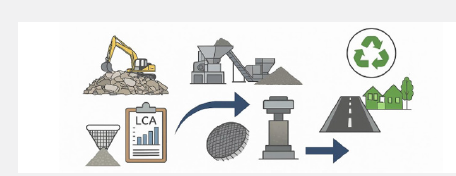
Graphical Abstract
Keywords:Recycled aggregates; Concrete waste; Material properties; Environmental sustainability; Demolition waste; Compressive strength reductions
Abbreviations:RA: Recycled Aggregates; NA: Natural Aggregates; CDW: Construction and Demolition Waste; P: Probability; S: Severity; F: Frequency; LOTO Lock-Out/Tag-Out; RPE: Respiratory Protective Equipment
Introduction
Construction and demolition waste (CDW) is a major challenge in rapidly urbanizing regions; concrete dominates this stream and, if unmanaged, imposes heavy environmental, logistical, and public‑health burdens [1]. In Türkiye, the urgency became acute after the 2023 Kahramanmaraş earthquakes, which generated tens of millions of tons of debris, compressing local landfill capacity and foregrounding circular approaches such as on‑site and near‑site recycling to produce recycled aggregates (RA) from concrete waste [2].
International evidence indicates RA can displace a significant portion of natural aggregates (NA), particularly in road bases, drainage layers, backfills, and non‑structural concretes, achieving lower life‑cycle impacts than NA under typical logistic scenarios [3,4]. Yet, reservations persist regarding heterogeneity, adhered mortar, high water absorption, and consequent effects on concrete rheology and strength [5,6].
Literature Background
Meta‑analyses and reviews consistently show that RA’s specific gravity is lower and water absorption higher than NA due to adhered mortar; compressive strength reductions of ≈10– 20% are commonly reported at high replacement ratios unless mix designs are adapted [7,8]. Mechanical penalties can be mitigated through improved processing (multi‑stage crushing, pre‑soaking), surface treatments (e.g., carbonation, resins), and optimized binder systems [9,10].
Comparative LCAs report lower GWP, AP, and resource depletion for RA‑based concretes/aggregates when transport and extra cement demand are controlled [11,4]. Recent syntheses emphasize allocation choices, transport radii, and cement content as the dominant drivers [12].
EU studies estimate high technical potential but heterogeneous circularity, with net environmental benefits of shifting concrete/ brick fractions from landfill to advanced recycling pathways [13]. Japan’s Construction Material Recycling Law institutionalizes selective demolition and mandatory sorting/recycling for specified scales, accelerating RA streams into higher‑value uses (MoE Japan, 2001/2003; Sum ikura & Katsumi, 2022). Germany’s long‑standing CDW infrastructure and regulatory evolution toward closed‑loop recycling for concrete are well documented [14].
Materials and Methods
This chapter details the materials, sampling and preprocessing workflow, and the standardized test methods used to characterize recycled aggregates (RA) produced from concrete waste and natural aggregates (NA). It also presents the data structures and acceptance criteria applied to evaluate usability in low-risk concrete, pavement, and geotechnical applications.
Sources and types of aggregates
i. Recycled aggregate (RA). Produced from processed
concrete debris originating from urban renewal, demolition, postearthquake
debris, fire-damaged elements, defective concrete
production, and discarded laboratory specimens. After primary
selection, feedstock was crushed and screened to obtain defined
size fractions.
ii. Natural aggregate (NA). Reference aggregates produced
by conventional quarrying and crushing (fixed or mobile plants).
Sampling strategy
Representative bulk samples (≥ 30kg per size fraction) were collected at the plant discharge conveyors after steadystate operation was reached. Sampling followed a “multiple increments–one composite” approach to reduce bias from gradation fluctuations. Each composite sample was immediately sealed in moisture-tight containers and labeled with date, source, line, and fraction.
Preprocessing and fractionation
Incoming concrete waste was visually inspected to remove
non-conformities (wood, plastics, metals, gypsum). The waste was
then passed through:
i. Primary crushing (jaw/impact) to < 75mm.
ii. Secondary/tertiary crushing as required.
iii. Multi-deck screening to generate test fractions (e.g.,
0–0.25, 0.25–0.5, 0.5–1, 1–2, 2–4, 4–8, 8–16mm).
All test portions were oven-dried at 105±5°C to constant mass unless the standard required a different moisture condition (e.g., pre-soaking prior to density/absorption).
Test methods and acceptance criteria
Each fraction was tested to confirm grading conformance and to quantify fines (≤ 0.075mm). Results informed suitability for specific end-uses and supported mix design envelopes.
Standards referenced in this program:
i. Particle size distribution: EN 933-1–series (sieve
analysis)
ii. Specific gravity & water absorption: TS EN 1097-6
iii. Mechanical resistance (Los Angeles abrasion): TS EN
1097-2
iv. Alkali–silica reactivity (ASR) screening: ASTM C227
v. Organic impurities: TS EN 1744-1
vi. Freeze–thaw resistance: TS EN 1367-2
vii. Drying shrinkage of aggregates: TS EN 1367-4
viii. Clay/fines indicator: Methylene blue test (laboratory
procedure; threshold described below)
Apparent particle density and 24h water absorption was determined. RA was pre-soaked where relevant to reflect field batching practice. These parameters served as key inputs for mixture water correction and predicted permeability.
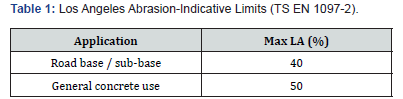
Mechanical resistance to impact/abrasion was measured using the standardized charge and drum rotations. Compliance thresholds are summarized in Table 1.
RA in the 5-12mm band generally satisfies these limits when produced under controlled crushing and screening.
Across studies, RA water absorption is consistently higher and LA resistance generally lower than NA, while densities remain within a usable range for many applications. Where fines (≤ 0.075mm) approach ~19%, the methylene blue test becomes critical for clay control prior to use in concrete.
Concrete waste collected from demolition/stockpile sites was processed through crushing– screening trains in Table 2. RA and NA were characterized via sieve analysis (EN 933‑1 equivalent), specific gravity & water absorption (EN 1097‑6), Los Angeles abrasion (EN1097‑2), alkali–silica reactivity (ASTM C227), organic content (EN 1744‑1), freeze–thaw (EN 1367‑2), methylene blue, and drying‑shrinkage.
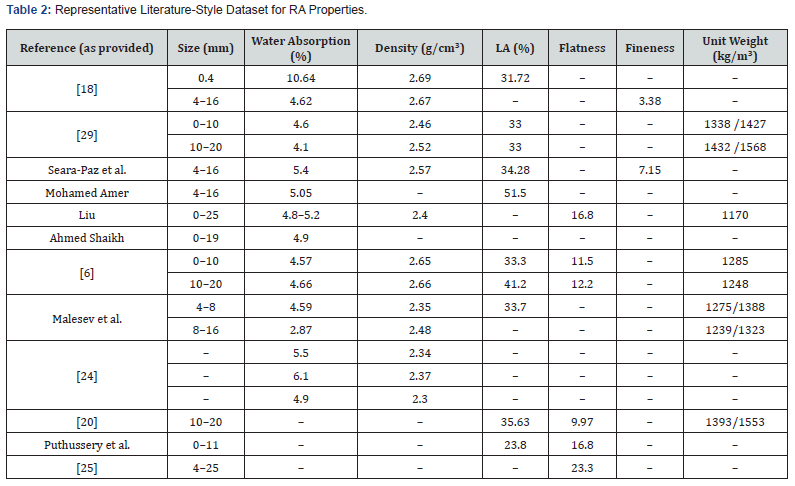
Measured specific gravity for RA ranged 2.18–2.59 g/cm³ vs 2.45–2.68 g/cm³ for NA; water absorption for RA rose from ≈2.5% (8–16 mm) to ≈19% (0–0.25 mm), while NA remained≈0.5–2.4%. Los Angeles abrasion values for RA lay ~31–51%, satisfying road‑base criteria and some concrete uses. These ranges align with independent studies on RA classification and performance envelopes [7,15].
The study focused on aggregate properties; consistent with literature, strength losses at high RA contents are expected unless water demand is managed and mix rheology is tuned Evangelista & de Brito, 2007 [5].
It is implemented that, an ISO 14040/44‑aligned cradle‑to‑gate LCA with the functional unit of 1ton of aggregate, comparing NA (quarry extraction + processing) and RA (collection + crushing/ screening). Impact assessment followed CML 2001 categories with local inventories for fuel/electricity/water and site logistics; sensitivity to haul distances and electricity mix was examined. The approach and key drivers are consistent with recent LCA meta‑studies [12,4].
For NA production, blasting (ANFO/dynamite), loading/ hauling, and crushing dominated energy/emissions; for RA, avoidance of blasting and shorter collection‑to‑plant distances moderated impacts but electricity for crushing/screening remained material.
Risk identification
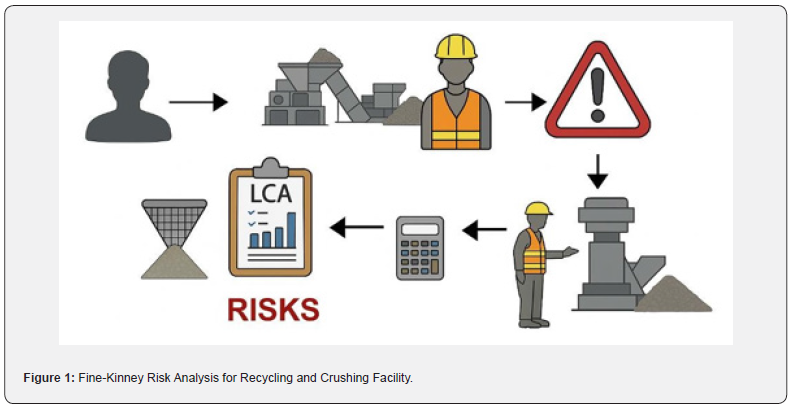
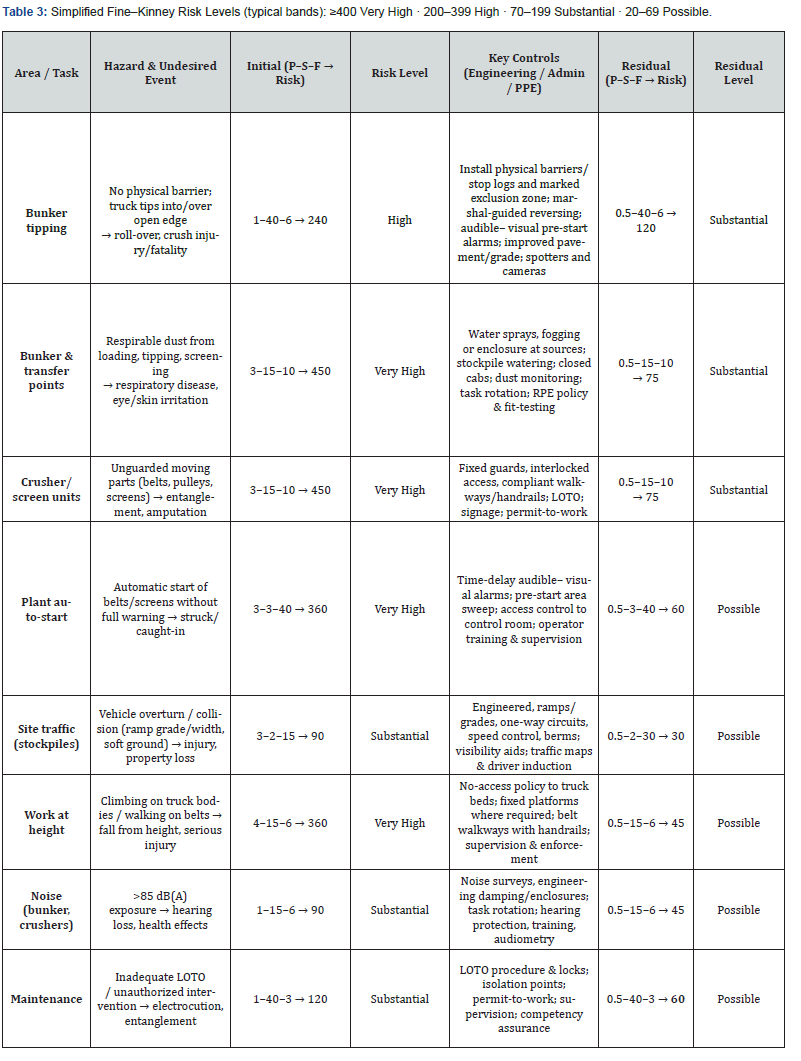
The risk assessment aimed to systematically identify hazards within the aggregate recycling and crushing facility, evaluate the associated risks using the Fine–Kinney method, and eliminate or reduce them to acceptable, controlled levels through engineering, administrative, and PPE measures. Preventive and corrective actions were derived in line with applicable occupational health and safety regulations and good practice. The assessment covered four operating areas-waste concrete reception/loading, primary bunker and tipping zone, crushing–screening units, and stockpiles/vehicle circulation-based on the operating principles of a fixed crusher plant similar to the one at Çekmeköy-Ömerli quarry. The study is shown schematically in Figure 1.
Risk identification drew on-site inspections, records of past incidents, equipment/process reviews, and current legal requirements. A total of 36 hazards were evaluated via Fine– Kinney (Risk = Probability × Severity × Frequency), supported by field observations of material flows (loading–tipping–crushing– stockpiling), environmental aspects (dust, noise), and worker– equipment interactions.
Results
i. Very-high and high risks were concentrated in Table 3:
ii. Mobile equipment a n d
tipping operations (truck roll-over, falling objects,
unauthorized personnel near moving plant),
iii. Crushing–screening machinery (unguarded moving
parts, auto-start of belts/screens, emergency stops),
iv. Airborne dust (respirable dust exposure during loading,
tipping, transfer, and screening),
v. Noise (sustained >80–85 dB(A) exposures near bunker
and crushers),
vi. Work at height/unsafe access (climbing on truck bodies,
walking on belts),
vii. Electrical/grounding and maintenance controls (LOTO
discipline, earthing integrity).
As immediate priorities, barriers and exclusion zones at
the bunker front, machine guarding (fixed guards, walkways/
handrails), automated audible–visual pre-start alarms, LOTO for
maintenance, segregated traffic routes, and dust/noise exposure
controls were instituted. Dust suppression (fixed sprays and
water trucks on stockpiles, enclosure/hooding of transfer points)
was adopted as the most effective primary control, complemented
by closed-cab equipment and fit-for-purpose RPE where
required. Noise risk was mitigated via exposure measurements,
task rotation, engineering damping/enclosures, and hearing
protection with audiometric surveillance. Simplified Fine–Kinney
Risk Register (Priority Items) resulted as Eq. 1.
Scale: Risk = P × S × F. (Eq. 1)
Residual risk reflects planned controls.
Targeted dust and noise controls results showed that:
i. Dust: Source-based control (sprays/fogging at hopper,
crusher, transfer points), stockpile watering by fixed system or
tanker, hooding/enclosure of high-emission points, housekeeping
on haul roads, closed-cab mobile plant, and exposure monitoring
linked to corrective actions.
ii. Noise: Exposure measurements (dB(A)), engineering
controls (enclosures/damping, isolators), task rotation, and
mandatory hearing protection with baseline and periodic
audiometry.
iii. PPE and supervision: Fit-tested RPE for dusty tasks;
hearing protection; enforcement by H&S team; induction and
toolbox talk tailored to tipping, isolation, and access control.
iv. Global Warming Potential (GWP): The study found
304kg CO₂e/ton for NA vs 288kg CO₂e/ton for RA (≈5–8%
reduction), contingent on transport radii and plant energy
v. Intensity: Comparative studies report similar directional
outcomes, with parity thresholds governed by additional cement
(in RAC) and increased transport for RA streams [11,4].
Abiotic depletion (fossil), acidification, ecotoxicity. It is reported lower ATPf/AP/ecotoxicity for RA, reflecting avoided blasting and moderated haulage; electricity usage remained the main lever. Meta‑reviews corroborate transport and cement content as dominant levers [12].
Its cost allocation suggested broadly similar cost shares for RA vs NA (materials ~75%, electricity ~9%, transport ~10%), with RA advantaged where recycling plants are proximate to urban demolition zones and disposal fees are high. International experience shows RA is competitive in pavements/unbound layers and precast non‑structural elements when quality control and logistics are optimized [15,16].
Conclusion
Locating recycling capacity next to demolition hot spots is pivotal; depending on demand volatility and site access, plants may be modular mobile units or compact fixed lines. A coherent policy mix should make disposal the expensive option (higher tipping/landfill fees) while rewarding recovery through municipal leadership and targeted incentives for contractors engaged in urban renewal. Clear specification pathways are needed so that laboratory results map directly to permitted end‑uses of recycled aggregates, accompanied by outreach that helps client sectors adopt RA-ideally with minimum‑use quotas where practicable [17-20]. Project delivery hinges on site securing, plant selection, engineering design, and financing for both CAPEX and OPEX; revenue from RA sales can underpin long‑term viability. Crucially, marketing waste concrete into the local materials loop rather than hauling it to dumps can sharply reduce transport and disposal outlays, turning a recurring cost into a regional supply advantage [21-25].
The evidence confirms that recycled aggregates from concrete waste are technically adequate for numerous civil works and environmentally preferable to virgin aggregates per ton delivered when logistics and power intensity are controlled [26- 33]. RA’s broader climate benefit depends on where it is applied (unbound layers vs RAC), how it is processed, and how far it travels. Embedding selective demolition, quality protocols, and market instruments will accelerate uptake-especially salient for post‑earthquake rebuilding [34-39]. Future work should couple process‑level energy upgrades with mix‑design optimization (e.g., low‑clinker binders+ RA, carbonation treatments), and integrate social cost of carbon into public procurement to reflect RA’s avoided burdens.
References
- Brown C, Milke M, Seville E (2011) Disaster waste management: A review. Waste Management 31(6): 1085-1098.
- Atakok G, Sumer G (2024) Production of Recycled Aggregates from Concrete Waste and Investigation of Their Contributions to Sustainable Environment, 4th International Congress on Engineering and Sciences. Guven Plus Groups Consultancy Inc.
- Malešev M, Radonjanin V, Marinković S (2010) Recycled concrete as aggregate for structural concrete production. Sustainability 3(2): 465-468.
- Knoeri C, Mengual ES, Althaus HJ (2013) Comparative LCA of recycled and conventional concrete for structural applications. International Journal of Life Cycle Assessment 18: 909-918.
- Behera M, Bhattacharyya SK, Minocha AK, Deoliya R, Maiti S (2014) Recycled aggregate from C&D Waste-Review. Construction and Building Materials 68: 501-516.
- Brito J, Saikia N (2013) Recycled Aggregate in Concrete: Use of Industrial, Construction and Demolition Waste. London: Springer.
- Silva RV, Brito JD, Dhir RK (2014) Properties and composition of recycled aggregates from CDW suitable for concrete production. Construction and Building Materials 65: 201-217.
- Rakshvir M, Barai SV (2006) Studies on recycled aggregates-based concrete. Waste Management & Research 24(3): 225-233.
- Silva RV, Silva A, Neves R, Brito JD (2016) Statistical modelling of carbonation in RAC. Journal of Materials in Civil Engineering 28(1).
- Zhu J, Wu S, Zhong J, Wang D (2012) Investigation of asphalt mixture containing demolition waste obtained from earthquake-damaged buildings. Construction and Building Materials 29: 466-475.
- Marinković S, Radonjanin V, Malešev M, Ignjatović I (2010) Comparative environmental assessment of natural and recycled aggregate concrete. Waste Management 30(11): 2255-2264.
- Xing W, Tam VWY, Le KN, Hao J, Wang J (2023) LCA of sustainable concrete with RA and SCMs. Resources, Conservation & Recycling 193: 106947.
- Caro D, Lodato C, Damgaard A, Garcia JC, Foster G, et al. (2024) Environmental and socio-economic effects of CDW recycling in the EU. Science of the Total Environment 908: 168295.
- Weil M, Jeske U, Schebek L (2006) Closed-loop recycling of CDW in Germany. Waste Manag Res 24(3): 197-206.
- Cardoso R, Silva, RV, Brito JD, Dhir R (2016) Use of recycled aggregates from construction and demolition waste in geotechnical applications: A literature review. Waste Manag 49: 131-145.
- Pourkhorshidi S, Sangiorgi C, Torreggiani D, Tassinari P (2020) Using Recycled Aggregates from Construction and Demolition Waste in Unbound Layers of Pavements. Sustainability 12(22): 9386.
- Amer AMA, Ezziane K, Adjoudj M (2021) Evaluation of coarse recycled concrete aggregates effect on the properties of fresh and hardened concrete. Asian Journal of Civil Engineering 22(6): 1173-1184.
- Tuncay BE, Köken, E, Kilınçarslan Ş (2022) Prediction of Concrete Strength Properties Using Surface Response Method, Genetic Algorithm, And Artificial Neural Network. Journal of Engineering Sciences and Design 10(2): 429-441.
- Rao MC (2018) Effect of parent concrete: Properties of RA and RAC. Asian Journal of Civil Engineering 19(1): 103-110.
- Durmuş G, Şimşek O, Dayı M (2009) Effect of recycled coarse aggregates on concrete properties. Journal of Gazi University Faculty of Engineering and Architecture 24(1): 183-
- Fonteboa BG, Abella FM, López JE, Paz SS (2011) Effect of RCA on damage of recycled concrete. Materials and Structures 44(10): 1759-1771.
- Fonteboa BG, Paz SS, Brito JD, Taboada IG, Abella FM, et al. (2018) RAC with coarse RA: Overview and analysis. Materials of Construction 68(330): e151.
- Taboada IG, Fonteboa BB, Abella FM, Paz SS (2020) Self-consolidating RAC rheology over time. ACI Materials Journal 117(1): 3-14.
- Gökçe HS, Şimşek O (2013) The effects of waste concrete properties on recycled aggregate concrete properties. Magazine of Concrete Research 65(14): 844-854.
- Kim JH, Sung JH, Jeon CS, Lee SH, Kim HS (2019) A study on the properties of recycled aggregate concrete and its production facilities. Applied Sciences 9(9): 1935.
- Kittipongvises S (2017) LC Assessment of Environmental Impacts of Limestone Quarrying Operations in Thailand A of limestone aggregate in Thailand. Environmental and Climate Technologies 20(1): 67-83.
- Leite FC, Motta RS, Vasconcelos K, Bernucci, LLB (2011) Laboratory evaluation of recycled CDW for pavements. Construction and Building Materials 25(6): 2972-2979.
- Mandal A, Shiuly A (2025) Mechanical characteristics of recycled concrete aggregates from demolition waste: advancements, challenges, and future directions for sustainable construction: a review: Discover Civil Engineering 2: 33.
- Padmini AK, Ramamurthy K, Mathews MS (2009) Influence of parent concrete on the properties of recycled aggregate concrete. Construction and Building Materials 23(2): 829-836.
- Pani L, Francesconi L, Rombi J, Mistretta F, Sassu M, et al. (2020) Effect of parent concrete on RAC. Sustainability 12(22): 9399.
- Pavlů T, Pešta J, Fořtová K, Řepka J (2025) Recycled concrete in foundations: Mechanical & environmental insights. Buildings 15(8): 1237.
- Paz SS, Fonteboa BG, Abella FM, López DC (2018). Long‑term flexural performance of reinforced concrete beams with recycled coarse aggregates. Construction and Building Materials 176: 593-
- Paz SS, Fonteboa BG, Abella FM, Taboada IG (2016) Time‑dependent behavior of structural concrete made with recycled coarse aggregates: Creep and shrinkage. Construction and Building Materials 122: 95-
- Secco MP, Bruschi GJ, Vieira CS, Cristelo N (2022) Geomechanical behavior of recycled CDW. Sustainability 14(11): 6719.
- Silva RV, Brito JD, Dhir RK (2019) Use of recycled aggregates arising from construction and demolition waste in new construction applications. Journal of Cleaner Production 236: 117629.
- Xiao J, Xie H, Zhang C (2012) Building waste and reclaim in Wenchuan area. Resources, Conservation & Recycling 61(4): 109-117.
- Xing W, Tam VWY, Le KN, Hao J (2021) Environmental impacts for RAC (LCA)-conference chapter. In Proc. 25th
- Yehia S, Helal K, Abusharkh A, Zaher A, Istaitiyeh H (2015) Strength and durability evaluation of RAC. International Journal of Concrete Structures and Materials 9(2): 219-239.
- Zheng Y, Li Q, Zhou L, Gao F, Deng Z, Wang J, et al. (2025) Lifecycle Assessment and Lifecycle Cost Analysis of Sustainable Concrete Incorporating Recycled Aggregates 17(5): 1779.

























