




 JOJMS Home



Abstract
In this study, the effective role of computer-aided design (CAD) software in the design, analysis and prototyping processes of mechanical systems is comprehensively discussed. Three-dimensional (3D) part and assembly models were created using the screw jack system as an example, especially through the SolidWorks program, which is widely used in engineering design. These models, completed in the CAD environment, were physically produced using rapid prototyping techniques and a concrete prototype was obtained. Technical difficulties encountered throughout the design process, main points to be considered in the transition from the modeling phase to production, and compatibility problems during assembly were evaluated in detail. It was discussed how CAD-based modeling applications contribute to the development of students’ design skills in educational environments and to increasing production efficiency in industrial processes. In addition, important advantages such as testing the suitability of designs made in digital environments for production, early detection of errors, and saving time and cost were emphasized. This study shows how important CAD technologies are, especially for engineering education, research projects and applied design studies. The benefits of 3D models developed with software such as SolidWorks have been demonstrated in terms of visual clarity, detailed analysis, testing the design in terms of manufacturability, and rapid prototyping. The findings prove that CAD-based modeling processes can be used as an effective and reliable tool in the transition from digital design to physical product. In this respect, the study can guide students and those interested in engineering design.
Keywords:Computer Aided Design (CAD); Engineering design; Rapid prototyping; 3D Assembly design
Abbreviations:FEA: Finite Element Analysis; FOS: safety factor; CAD: computer-aided design; FDM: Fused Deposition Modeling; PLA: Polylactic Acid; PLA: Polylactic Acid
Introduction
Today, engineering design processes have become fast, flexible and low-cost thanks to the integration of digital technologies. Especially in the field of mechanical engineering, computeraided design (CAD) systems have become an integral part of the product development process and have begun to be used effectively in many stages from conceptual design to production [1]. Three-dimensional (3D) assembly models developed with CAD software offer significant advantages to engineering students and professionals in terms of both visual accuracy and technical functionality [2].
One of the most important contributions of CAD-based 3D modeling is that it facilitates the conversion of assemblies created in a virtual environment into physical prototypes. In this context, rapid prototyping technologies (especially 3D printing) accelerate the implementation of design processes and provide costeffectiveness [3]. These methods enable the physical production of complex geometries and create practical learning environments in education [4].
The integration of 3D assembly designs of machine elements and mechanical systems into the educational process provides students with not only theoretical knowledge but also a practical engineering perspective. In fact, studies show that CAD-based modeling and prototyping applications improve students’ design-oriented thinking skills [5,6]. Teaching machine elements, especially bearing systems, shafts, splines and gears, with the support of physical models contributes to the concretization of abstract concepts.
[7] investigated a method based on three-dimensional digital image correlation (3D-DIC) technology to measure the transmission error of the screw jack mechanism. The method in question offers the advantage of measuring the position and orientation of the surface in full-field. The developed method was applied in two different test scenarios; positioning errors and the forward-backward displacements of the nut on the screw were successfully detected. The results showed that the method can effectively characterize the transmission accuracy [7].
[8] investigated the development of a screw jack prototype specifically designed for lifting light objects. The research aims to increase the efficiency and safety of lifting operations in small-scale applications by examining the design, material and usage aspects of the screw jack. The developed prototype can lift objects with a capacity of 2 tons; its safety has been verified and the materials used are locally sourced. However, it is emphasized that the design is only suitable for light loads, different designs are required for heavy loads. The study also draws attention to the importance of usage and safety measures appropriate to the capacity of the device, and suggests future improvements [8].
[9] investigated the development of an automatic screw jack with Bluetooth control to facilitate tire changing operations. The system aims to reduce user effort by being controlled via mobile devices [9].
[10] investigated the comparison of unconventional alloys (20Mn2, 35Mn2Mo28, 35Mn2Mo48) with conventional carbon steels (C50 and C60) for power screw (shaft). Total deformation, equivalent stress and safety factor (FOS) were investigated using Finite Element Analysis (FEA). Gray cast iron, phosphor bronze and stainless-steel materials were preferred for parts other than power screw. According to the analysis results, total deformation and safety factor were found to be similar, so equivalent stress was decisive for material selection. In this direction, 35Mn2Mo28 alloy showed the most suitable performance among other materials [10].
[11] investigated to develop an educational screw jack suitable for experimental use by engineering students and researchers. The developed screw jack was designed to demonstrate basic engineering principles such as mechanical advantage, speed ratio, and mechanical efficiency under different loads. In addition, it was aimed to create a model that can be used to experimentally present the efficiency, mechanical advantage of the lifting device, and the relationship between the effort applied during lifting and the load to science students. Material selection, cost effectiveness, and ease of use were prioritized in the design process. The screw jack was tested under different loads of 50N, 100N, 150N, 200N, and 250N. For each load, the applied effort, the distance the load moved, and the effort values were measured and recorded at certain intervals. Using the obtained data, effort-load and efficiency-load graphical relationships were created. The results showed that the applied effort increased as the load increased and the efficiency of the screw jack was approximately above 50% [11].
[12] investigated the design and modeling of an automobile screw jack controlled by a mobile application via the Internet of Things platform using Android programming. The developed system enables the motorized and hydraulically assisted screw jack to lift heavy loads effortlessly by reducing user effort. The system is controlled with a Wi-Fi module (ESP8266) and Arduino Uno and is operated using 60 RPM DC motors. The design provides fast and sensitive response while reducing physical fatigue of operators. Experimental results show that the proposed model offers higher efficiency and accuracy compared to Bluetoothbased systems [12].
[13] investigated the potential of the conventional automobile jack in active structural control applications. The screw jack was evaluated as a low-cost and low-energy alternative [13].
[14] investigated the design and evaluation of a manual screw jack motorized. The aim is to reduce labor and increase operational efficiency [14].
[15] investigated the design of a screw jack that provides rapid lifting with gearing to solve the ergonomic problems of the traditional scissor jack. The design aims to reduce labor and increase efficiency [15].
[16] investigated experimentally the lifting performance of screw piles for photovoltaic poles in seasonal frost regions. The performances of different screw pile types were compared according to the frost depth and soil types [16,17] investigated presented the design of a hand pump using a quick-turn crank mechanism to solve the ergonomic problems of the India Mark III pump. This design aimed to reduce user fatigue and increase pump capacity [17].
Teaching mechanical systems and machine elements is one of the basic building blocks of engineering education. However, when these systems are mostly conveyed with theoretical formulas and 2D technical drawings, it becomes difficult to provide permanent and functional learning to students. Especially the issues related to the transmission of rotary motion in a screw jack and the mechanical interaction between the screw shaft and the nut cannot be adequately understood without visual and physical support due to their abstract structure. This situation limits the students’ ability to analyze, interpret and produce complex systems [5]. However, the fact that CAD systems widely used in the industry are not used in an adequately functional and practical way in educational environments leads to graduates entering the sector with a lack of practical equipment. In addition, the fact that theoretical knowledge is not supported by physical prototypes negatively affects the development of design thinking and threedimensional spatial perception [6].
The purpose of this study is to present the process of threedimensional (3D) modeling, assembly and physical prototype production of a screw jack system using computer-aided design (CAD) software. Thanks to this model, the structural relationships of the machine elements that make up the screw jack mechanism (e.g. screw, nut, body, carrier surface, etc.) have been made physically observable; the operating logic of the system has been clarified both visually and functionally. In this context, the research aims to contribute to applied learning in engineering education and to evaluate the educational and developmental effects of CAD-based design and rapid prototyping. In addition, it is aimed to contribute to the development of design-oriented thinking, problem solving and production skills by presenting the process from technical drawing to physical model in a holistic manner to students.
Materials and Methods
In this study, SolidWorks software was preferred for CADbased 3D modeling. First, the functional parts of the system were modeled separately, then the complete system was created by combining them in the assembly environment. The basic components for the screw jack system consist of; Body, Nut, Screw, Cup, Washer, Fixing Screw, Arm (Tommy Bar) elements.
The following steps were followed in the modeling process:
i. The dimensions of each part were determined in
accordance with technical standards and usage.
ii. The parts were drawn in the SolidWorks environment
and material assignment was made to each part.
iii. The parts were brought together in the assembly file;
axis alignments, rotation limits and connection restrictions were
defined.
iv. The prepared 3D assembly model was converted to STL
format and prepared for prototype production on a 3D printer.
v. FDM (Fused Deposition Modeling) method was used in
the prototyping phase and PLA material was preferred.
Screw jack system
Screw jack performs high load lifting with low force based on
the principle of mechanical advantage. The basic principle of the
system is the screw-drill mechanism:
i. Screw shaft (Screw) is rotated with the help of the user
arm (Tommy bar).
ii. The rotating screw moves up/down by matching the
toothed nut (Nut) inside the body.
iii. The upper cup (Cup) part contacts the vehicle and lifts it.
iv. Washer and fixing parts reduce friction and increase
safety.
Screw jack system consists of basic mechanical components that perform the load lifting process. The body, which forms the main structure of the system, provides the assembly of all parts and ensures structural durability. Screw shaft is the main element that converts mechanical torque into linear motion and lifts or lowers the load while rotating on the nut. The nut moves together with the screw shaft and ensures the controlled lifting of the load. The cup and washer contribute to the efficient operation of the system by reducing friction. The fixing screw ensures that the screw shaft and nut remain in the correct position and prevents movement slippage. The arm (tommy bar) enables manual movement by transmitting the applied torque to the screw shaft. The connecting elements ensure that all components are held together correctly and safely. In this system, the force is magnified by the inclination and rotation angle of the screw threads. The non-return feature prevents the jack from lowering itself; this provides a great advantage in terms of safety.
Prototype production process
The prototype production process involves the conversion of the screw jack model designed for educational purposes from digital to physical reality. This process begins with the review of the 3D model completed in the SolidWorks environment in terms of manufacturability. The dimensions, tolerances and surface properties of each designed part are adapted to 3D printer technology.
As a first step, all components of the model are converted to STL (Stereolithography) format. This file format is a format widely used in 3D printers and represents the surface of the part with triangular networks. STL files are transferred to slicing software before production. Here, parameters such as layer height, printing speed, infill ratio and support structure requirements are determined [3,18].
FDM (Fused Deposition Modeling) type 3D printers are generally preferred in prototype production. This technology creates the physical model by melting thermoplastic material and laying it on top of each other layer by layer. Suitable, economical and environmentally friendly filaments such as PLA (Polylactic Acid) or ABS are used in the prototype for educational and presentation purposes [19].
After each part is printed separately, the support structures are cleaned and the surface quality is improved in the areas deemed necessary (sanding, surface smoothing processes, etc.). The parts are then assembled in accordance with the design and the screw jack mechanism is made functional.
This physical prototype serves as an important educational material in terms of both visual presentation and understanding of mechanical working principles. At the same time, factors such as the ergonomics of the design, ease of assembly and compatibility of moving parts can also be evaluated through the prototype.
Design phase
First, a detailed 3D modeling process covering all components of the screw jack mechanism was carried out. In this process, each part was modeled separately and designed parametrically using SolidWorks CAD (Computer-Aided Design) software. Both aesthetic and mechanical functionality were taken into account during the design phase, and the model was dimensioned and configured in accordance with its real-life operation.
The design process was based on the principles of ease of assembly and manufacturability. Appropriate tolerances were left between the parts, ensuring that they came together harmoniously during assembly. In this way, the need for additional post-production processing was minimized, and the margin of error during assembly was reduced.
Considering the mechanical principles of the screw jack, all elements such as the carrier screw, body, nut, bushing, washer and fixing screws were modeled to be compatible with each other. In particular, details affecting the operation of gear systems (such as tooth pitch, screw profile) were created precisely with SolidWorks’ detailed modeling tools.
In addition, by assigning material properties appropriate to each part’s function, a virtual prototype close to reality was obtained in terms of both visual and engineering analyses. This approach provides a solid foundation for future strength, motion and friction analyses.
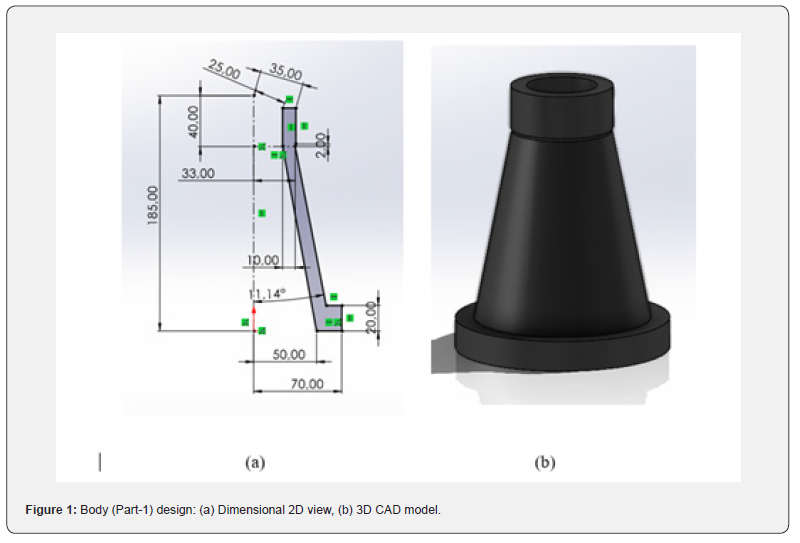
Body (Part-1) design
The most basic component of the screw jack mechanism, the body (Body- Part-1), is the main structural element that carries the load of the entire system and allows the parts to be assembled together. This part was designed in detail using SolidWorks CAD software, considering durability and ease of assembly. During the design process, the interaction of the part with other components, assembly holes, screw holes, bearing surfaces and thickness transitions for strength were carefully modeled. Since the body is at the center of the system, it was optimized to have both the strength to carry static loads and the appropriate geometric features in terms of manufacturability. This model not only provides visual and dimensional accuracy, but also has been prepared to form the basis for strength and assembly analyses that can be performed in the SolidWorks environment.
After the 2D sketch is completed in SolidWorks Figure 1a, the Revolve feature is utilized to generate a three-dimensional model by rotating the profile around a defined axis Figure 1b.
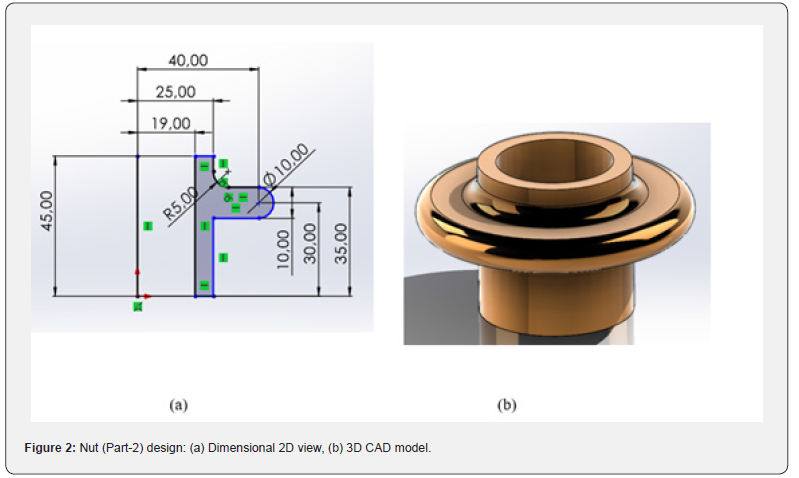
Nut (Part-2) design
In screw jack mechanisms, the nut part is a machine element that has critical importance in force transmission. This part provides the function of lifting or lowering the load by converting the rotational motion of the screw shaft into linear motion. The nut, which is designed to be compatible with the internal tooth profile of the gear shaft in the system, is fixed against rotation and moves in the axial direction with the rotation of the screw shaft. The nut part in this design is modeled in a way that it can be fixed to the body with the flange structure on its outer surface and has an internal gear structure that will perform axial movement with the rotation of the central screw shaft. The conical form of the structure was preferred for ease of assembly and to increase mechanical compatibility with the body. As a result, the nut design in screw jack systems is a vital component that must be optimized in terms of both loads carrying capacity and the overall efficiency of the system.
After the 2D sketch is completed in SolidWorks Figure 2a, the Revolve feature is utilized to generate a three-dimensional model by rotating the profile around a defined axis Figure 2b.
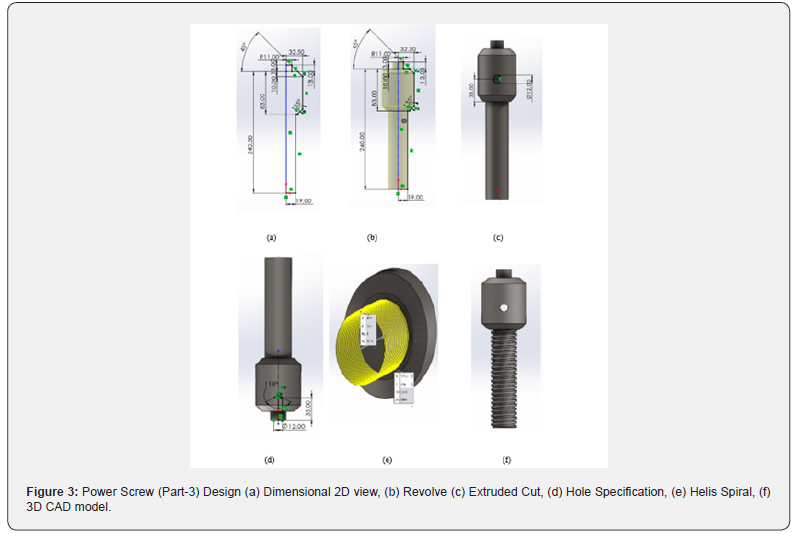
Power screw (Part-3) design
In screw jack systems, the power screw converts the rotational motion of the system into linear motion, allowing the load to move up or down. The torque given by the jack arm or the motor rotates this screw shaft. With the rotation of the screw shaft, linear motion occurs in the fixed nut, thus lifting or lowering the load.
This part:
i. Is directly responsible for carrying the load,
ii. Provides linear transformation of rotational movement,
iii. Provides safe position fixation by preventing slipping
back (self-locking feature),
iv. Carries all mechanical forces of the system.
Power screw is the basic element that plays the most critical role in the operation of the screw jack, transmitting force and directing the movement.
After the 2D sketch is completed in SolidWorks Figure 3a, the Revolve feature is utilized to generate a three-dimensional model by rotating the profile around a defined axis Figure 3b. Then, we draw the hole with the Extruded Cut by casting a 32.5mm plane Figure 3c. Hole Specification/Standard (Ansi Metric)/Type (Dowel Holes)/Size(Ø12)/End Condition (Blind /35mm) is set at the top of the power screw Figure 3d. A Ø38 circle is drawn at the bottom of the power screw and arcs are drawn on it by selecting Defined By /Height and Pitch/Parameters/Height 157mm/Pitch 7mm/ Start angle 180 deg clockwise with the Helis/Spiral1 command. Finally, the path is drawn with Swept Cut/Sketch Profile/Helis Spiral. Figure 3e. The final state of the power screw is as shown in Figure 3f.
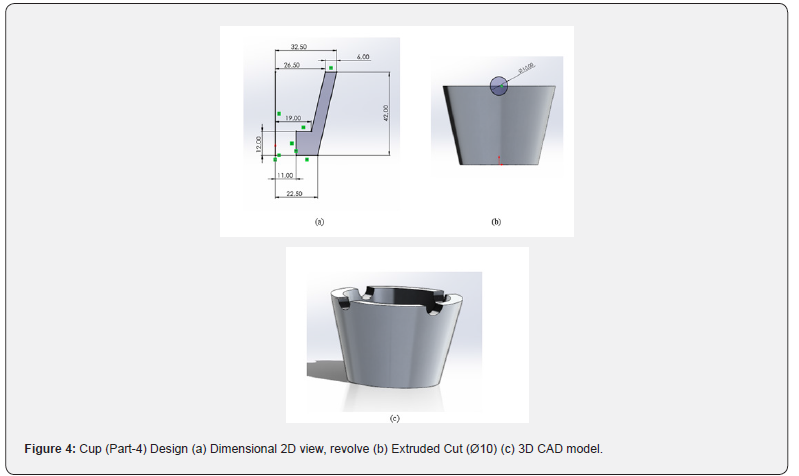
Cup (Part-4) design
In screw jack mechanisms, the cup part is a machine element that is usually positioned at the upper end of the screw shaft and is in direct contact with the load. This part is responsible for transmitting the axial force from the screw shaft to the carrier surface in a smooth manner [20]. The cup part has an important role in ensuring that the load transfer is safe, balanced and efficient throughout the system.
Functions of the cup part i. Providing load distribution
It prevents the load carried from concentrating in a point contact and distributes it over a wider surface. This prevents both the load-carrying surface and the tip of the screw shaft from being exposed to excessive stresses.
ii. Creating a contact surface
The point where the jack carries the load is usually the upper surface of the cup part. This surface makes contact with the carrier system (for example, a vehicle body) and ensures that the load is transmitted in a balanced manner.
iii. Directing and guiding
In some designs, the cup part supports more controlled operation of the system by restricting or directing the movement of the load in a certain direction.
iv. Wear and impact protection
The tip of the screw shaft may be exposed to external environmental conditions and mechanical impacts. The cup part protects this area, extending the life of the system and reducing the need for maintenance [21].
After the 2D sketch is completed in SolidWorks Figure 4a, the Revolve feature is utilized to generate a three-dimensional model by rotating the profile around a defined axis. Then, four semicircular holes with a diameter of Ø10mm are machined at equal intervals on the upper surface of the cup piece using the Extruded Cut command Figure 4b. Following these operations, the model is completed and a three-dimensional (3D) solid model is created Figure 4c.
Washer (Part-5) design
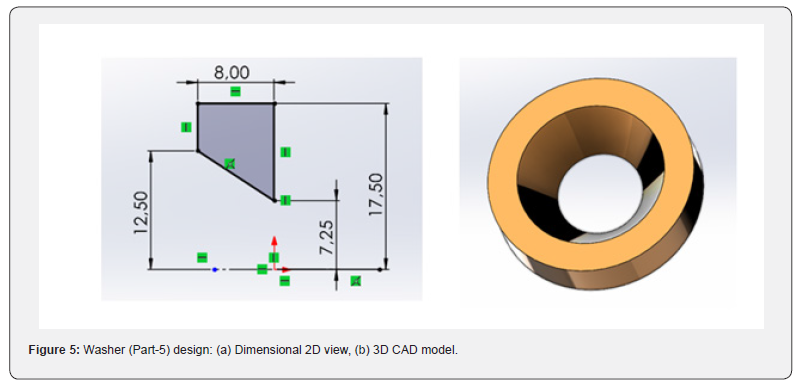
In screw jack mechanisms, Washer is a thin and flat disk located between the load-bearing surfaces in the screw jack system. It is usually placed under the screw shaft or on the load-bearing surface. In jack systems, especially in areas where rotational movement and axial forces are present, the use of washer is important for both mechanical and safety reasons [22].
The functions of the washer part i. Load distribution
The washer allows the axial force applied by the screw or nut to be spread over a larger surface. This reduces stress concentration, especially on soft or deformable surfaces.
ii. Wear prevention
It extends the life of the parts by preventing wear caused by friction that may occur over time on surfaces in contact with rotating elements.
iii. Surface protection
The washer prevents the screw head or nut from directly damaging the workpiece during the tightening process.
iv. Friction reduction and ease of rotation
During the rotational movement, a more stable and lowfriction contact is created thanks to the washer surface.
v. Loosening prevention (in some types)
Spring or serrated washer types can also serve to prevent loosening of screw connections due to vibration [22].
After the 2D drawing is completed in the SolidWorks environment Figure 5a, the profile is rotated around the defined axis by applying the Revolve command, thus obtaining a threedimensional solid model (Figure 5b).
Screw (Part-6) design
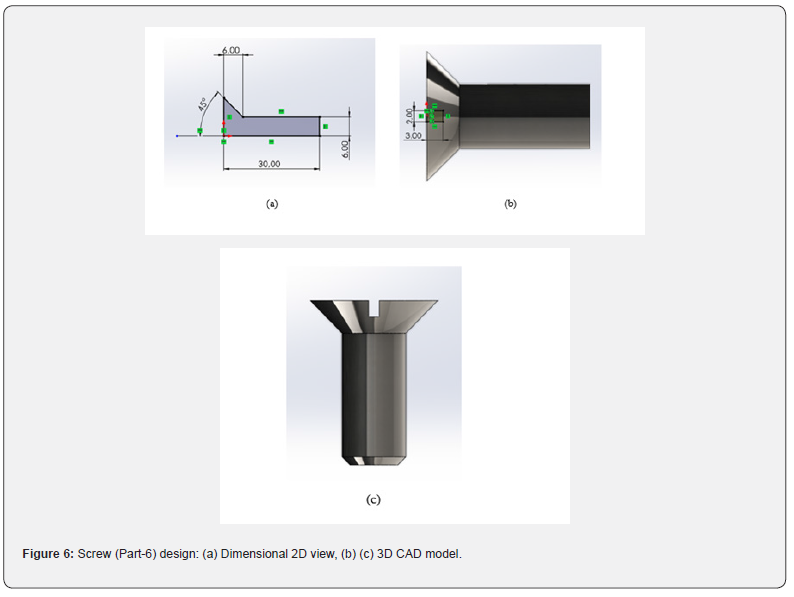
In screw jack mechanisms, Screw, namely the screw shaft, is the main carrier element that converts the rotational motion of the screw jack mechanism into linear motion. It usually has a trapezoidal or square gear structure and is designed to have a high load carrying capacity.
Functions of the screw part i. Converting rotational motion to linear motion
The rotational force applied to the jack converts into an axial motion on the screw, allowing the load to move upwards or downwards.
ii. Carrying and transferring load
The vertical load from the upper parts is transmitted to the nut via the screw and from there to the body. Therefore, the screw must have the structural strength to withstand large axial loads.
iii. Providing self-locking
Thanks to the structure of the screw teeth, the system resists rotation. This ensures that the jack remains stable under load.
iv. Providing precise motion control
Depending on the tooth pitch, a precise rise/lower motion is obtained. This allows the lifting process to be done in a controlled manner [21,22].
After the 2D drawing is completed in the SolidWorks environment Figure 6a, the profile is rotated around the defined axis by applying the Revolve command. A rectangular section protrusion is designed on the upper part of the screw shaft Figure 6b. Thus, a solid model is created Figure 6c.
Tommy bar (Part-7) design
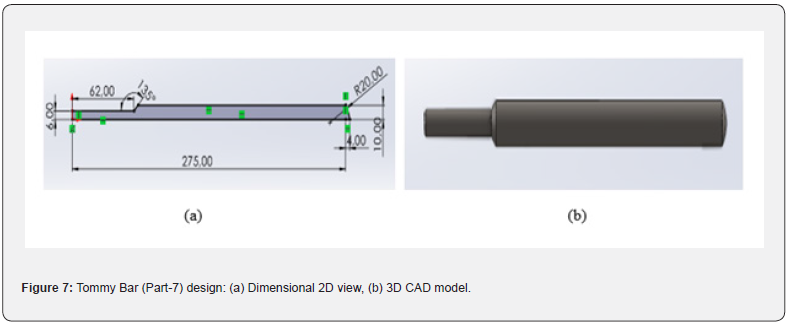
A tommy bar is a hand-cranked bar used by fitting into the hole in the head of a screw on a screw jack. It is a simple levershaped bar used to turn a screw by hand. When turned, the screw moves up or down, thus raising or lowering the load [22].
The modeling process with SolidWorks consists of three basic stages. First, each part is drawn separately in 3D according to the dimensions given in the technical drawings. Basic modeling commands such as Extrude, Revolve, Cut and Fillet are generally used in this stage [23].
In the second stage, the drawn parts are transferred to the assembly environment and combined with each other in a suitable way Figure 7. This combination process is carried out with relationships called mate.
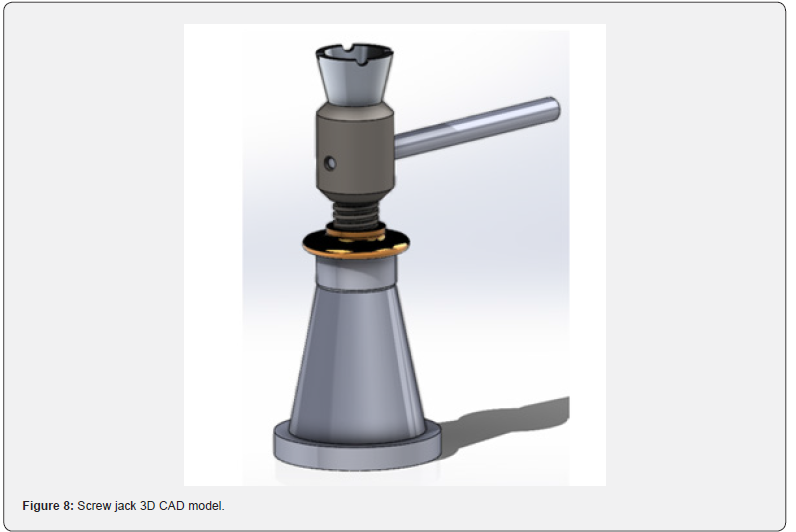
In the last stage, the model is visually enriched by assigning material and surface properties. At the end of this process, both the structure of the parts and the working principle of the system are clearly modeled in the SolidWorks environment Figure 8.
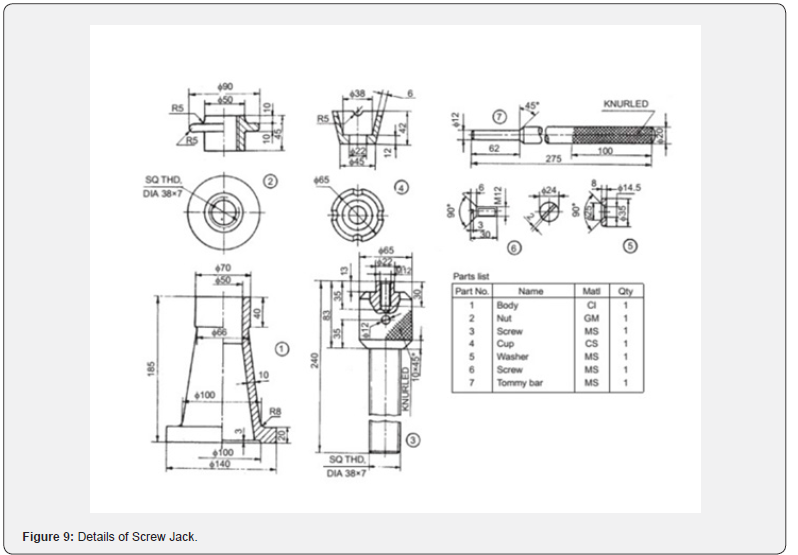
Figure 9 shows the details of the screw jack. In this screw jack, the screw (3) is turned using the tommy bar (7). The screw moves inside the nut (2). The up/down movement of the screw either raises or lowers the load on top. This movement is carried by the body (1). The cup (4) makes direct contact with the load, allowing the force to be applied. The washer (5) reduces friction; the screw (6) provides fixation.
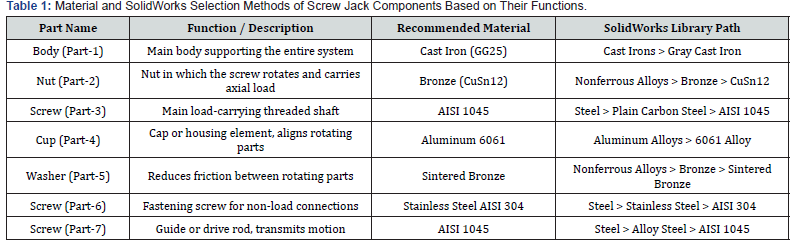
Table 1 describes the materials that are appropriate for the functions of the screw jack mechanism parts modeled in SolidWorks and how to select these materials in the SolidWorks material library.
Manufacturing method and material Selection
3D printing technology was used in the production of the prototype. This method was preferred because it allows for the rapid and cost-effective production of complex geometries. PLA (Polylactic Acid) thermoplastic filament was selected as the material used, considering its durability and workability.
Production stages
i. The design of the screw jack model was carried out in
the 3D CAD environment in the SolidWorks program.
ii. After the design was completed, it was converted to STL
format and transferred to the Realty printer slicer program for
printing preparation.
iii. Printing parameters were set as; layer thickness 0.2mm,
infill ratio 15%, printing speed 200 mm/s.
iv. The model was produced on the Reality K1C 3D printer
using FDM (Fused Deposition Modeling) technology. The printer’s
printing table dimensions are 220 x 220 x 250mm, and the
prototype parts were printed within this volume limit.
v. After the printing was completed, the support materials
were carefully cleaned and the surface roughness of the model
was removed with sandpaper.
vi. The parts were assembled on the assembly table.
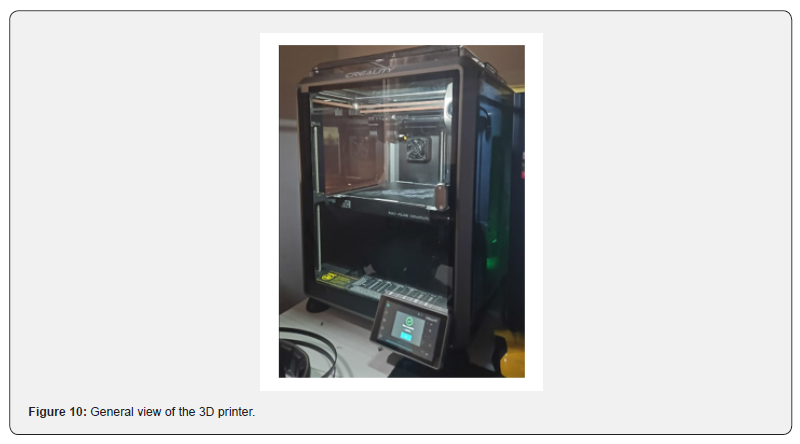
Here, the components of the screw jack mechanism were modeled in the SolidWorks environment and produced using PLA material with an FDM type 3D printer. After production, each part was cleaned and assembled in accordance with the assembly sequence, free of support structures Figure 10.
Explanation of part and assembly images after 3D printing 3D Printed parts for screw jack mechanism
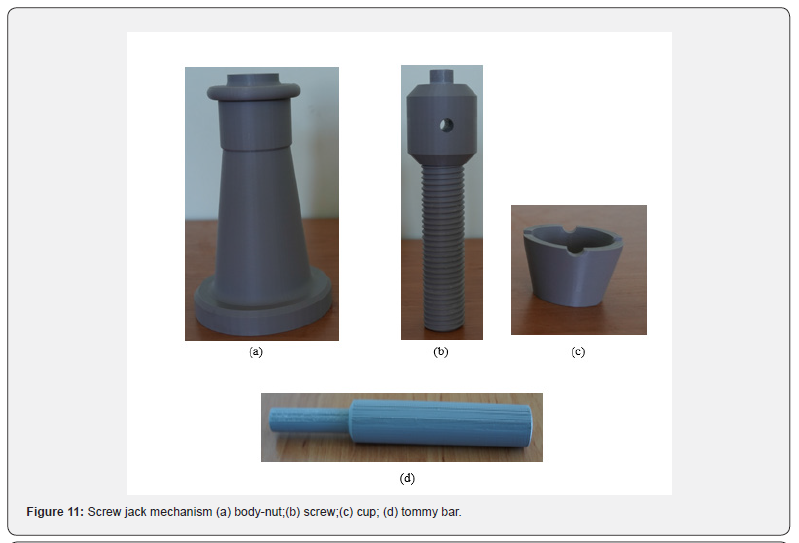
Here, all the basic parts that make up the mechanism are located separately. The parts include body-nut, screw, cup and tommy bar. All components are cleaned from their support structures after production and visual clarity is provided Figure 11.
Group assembly of screw jack parts
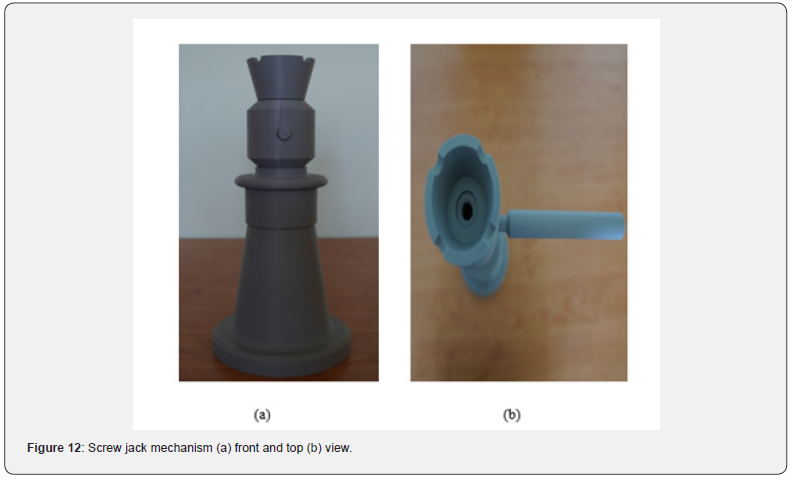
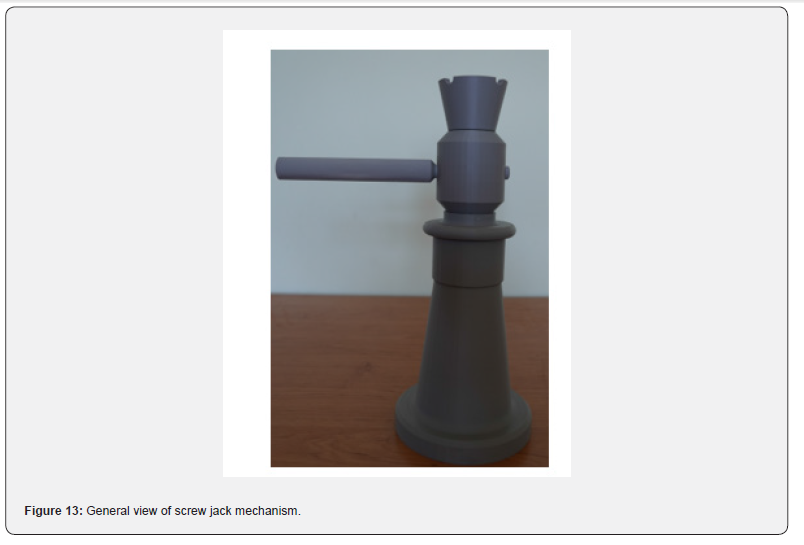
In this step, the compatibility of the parts was checked and tolerance compatibility was tested. Figure 12 shows the front and side views of the screw shaft being placed in the carrier body and the mounting of the swing arm to the axis. Figure 13 shows the general view of the screw jack mechanism with the completed assembly process. The visual shows that the parts are functionally integrated and the conformity assessment of the mechanism’s working principle can be made.
After assembly, the moment when the rotational movement of the mechanism and the load lifting function were tested is shown. During this test, the rotational arm was turned and the linear movement of the screw shaft was observed. After the prototype production, the system was examined visually and functionally. The linear movement of the nut was successfully provided with the rotational movement of the screw shaft, and it was observed that the mechanism could fulfill its basic functions. In addition, during the assembly process, the tolerance compliance between the parts and the effect of surface defects that may occur after 3D printing were also analyzed.
Discussion and Conclusion
In this study, the design of the screw jack mechanism developed for educational purposes was carried out in a 3D CAD environment and the prototype production was completed. The design model created using SolidWorks software clearly reflects the basic components and operation of the mechanism. In the design process, especially the assembly compatibility between parts, motion transfer and manufacturability criteria were taken into consideration.
Thanks to the prototyping process using a 3D printer, students were able to concretely observe mechanical systems and learn the operating principle of a classical machine element such as a screw jack by experiencing it. The prototype successfully fulfilled the basic functions; the linear movement of the nut was obtained by rotating the screw shaft and the mechanism worked with the desired accuracy.
As a result, this study contributes to both the development of design-oriented thinking skills and the support of applied learning in engineering education. In addition, it has been demonstrated once again that low-cost 3D printer technologies can be used effectively in educational environments. The developed model also serves as a reference for the examination and development of similar mechanical systems for educational purposes.
In addition
i. The strength and performance analyses of the developed
screw jack model can be supported by numerical methods and the
design accuracy can be evaluated more comprehensively.
ii. Instead of the PLA material used in prototype production,
the load carrying capacity can be increased by manufacturing
with engineering plastics or metallic materials with different
mechanical properties.
iii. By applying various loading scenarios to the mechanism,
performance data can be collected through experimental tests;
this data can be compared with simulation results and the validity
of the model can be increased.
iv. In order to facilitate use in educational environments, the
parts of the mechanism can be designed as modular, so that they
can be disassembled and reassembled. In this way, students are
encouraged to directly participate in the assembly-disassembly
processes.
References
- Groover MP (2016) Automation, production systems, and computer-integrated manufacturing. Pearson Education India.
- Schilling PJ, Shih RH (2010) Parametric Modeling with SolidWorks 2010. SDC Publications, p. 501.
- Gibson IGI, Rosen D, Stucker B (2015) Additive manufacturing technologies. 3D printing, rapid prototyping, and direct digital manufacturing.
- Bártolo PJ (2011) Stereolithography: materials, processes and applications. Springer Science & Business Media.
- Alias M, Gray DE, Black TR (2016) The Relationship between Spatial Visualization Ability and Problem-Solving in Engineering Education. International Education Journal 6(3): 1-12.
- Dym CL, Agogino, AM, Eris O, Frey DD, Leifer LJ (2005) Engineering Design Thinking, Teaching, and Learning. Journal of Engineering Education 94(1): 103-120.
- Hu X, Chen G, Huang Z, Wang C, Cheng X (2025) Transmission Accuracy Measurement of Screw Jack Mechanism Based on Digital Image Correlation. In International Conference on Mechanical Manufacturing Technology and Material Engineering. Springer Nature Singapore, pp. 64-76.
- Faulve MNM (2024) Design and development of a screw jack: an input repair tool for light vehicles. Advances in Research on Teaching 25(1): 105-116.
- Ogidan OK, Joseph OI, Aghaukwu C, Jonathan F (2023) Development of a Bluetooth-controlled automated screw-jack: A mobile device to reduce tyre replacement drudgery. International Journal of Engineering and Technology 8(2).
- Khawate VH (2022) Optimization of Power Screw Material used in Screw Jack. International Journal of Emerging Trends in Research I: 78-79.
- Abdulafeez O, Muhammed KO, Dike PC (2021) Development and Performance Investigation of a Laboratory Screw Jack. International Journal of Innovative Research and Development 10(1).
- Babu SR, Monith V, Kumar JN, Naveen R, Kumar RM (2021) Design and manufacturing of internet of things based mobile application-controlled automobile screw jack. In IOP Conference Series: Materials Science and Engineering. IOP Publishing 1145(1): 012030).
- Noormohamed A, Mercan O, Sorkhabi AA (2019) Optimal active control of structures using a screw jack device and open-loop linear quadratic gaussian controller. Frontiers in Built Environment 5: 43.
- Paliwal VD, Pajai AB, Patil SC, Badve JV (2018) Study and Evaluation of Automated Motorized Jack. IJIRT 4(8): 443-446.
- Ezurike B, Okwu M (2017) Modified screw jack for lifting operation in industrial setting. Int J Engr & Techn 13: 39-50.
- Wang T, Liu J, Zhao H, Liu X, Shang Y (2016) Experimental study on the anti-jacking-up performance of a screw pile for photovoltaic stents in a seasonal frozen region. Journal of Zhejiang University Science A 17: 512-524.
- Okoronkwo CA, Ezurike BO, Uche R, Igbokwe JO, Oguoma ON (2016) Design of a hand water pump using a quick-return crank mechanism. African Journal of Science, Technology, Innovation and Development 8(3): 292-298.
- Beura S, Chakraverty AP, Pati SN, Pradhan DD, Thatoi DN, et al. (2023) Effect of salinity and strain rate on sea water aged GFRP composite for marine applications. Materials Today Communications 34: 105056.
- Chua CK, Leong KF, Lim CS (2010) Rapid prototyping: Principles and applications (3rd edn). World Scientific Publishing, pp. 540.
- Ngo TD, Kashani A, Imbalzano G, Nguyen KTQ, Hui D (2018) Additive manufacturing (3D printing): A review of materials, methods, applications and challenges. Composites Part B: Engineering 143: 172-196.
- Norton RL (2011) Machine design: an integrated approach, 2000.
- Shigley JE, Mischke CR, Budynas RG (2015) Shigley's mechanical engineering design (10th edn). McGraw-Hill Education.
- Prasad LV (1995) Handbook of mechanical design. Tata McGraw-Hill Education.

























