




 JOJMS Home



Abstract
The unique electrical, thermal, and mechanical properties of graphene-containing materials (GCMs) have led to their growing use in medical applications. Concerns about their potential effects on the environment and biology at the end of their lifecycle are brought up by their extensive use. (GCMs) are increasingly used in medical technologies, including sensors, coatings, drug-delivery platforms, and disposable diagnostic components. Their accelerated adoption raises a critical but underexplored challenge to manage end-of-life streams that combine carbon nanomaterials with biological contaminants, polymers, metals, and process additives. This mini review summarizes current post-use processing and recycling options for graphene-containing medical materials, with emphasis on four major pathways: chemical, thermal, solvent-assisted, and mechanical recovery. Finally, priority research directions are identified for circular deployment of graphene in healthcare, notably integrated pre-sorting protocols, mild decontamination chemistry, and harmonized techno-economic assessment frameworks. This mini-review provides a concise roadmap for translating graphene-enabled medical innovation into safer and more sustainable end-of-life management.
Keywords:Graphene-containing medical materials; End-of-life management; Recycling; Circular economy
Abbreviations:GO: Graphene Oxide; RGO: Reduced Graphene Oxide
Introduction
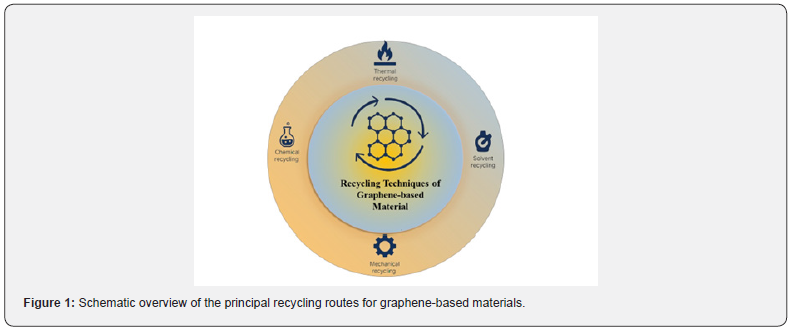
Graphene and its derivative have changed the field of biomedical engineering, as they are used in things like drug delivery systems, biosensors, wound healing devices, and tissue engineering supports [1-4]. They are excellent candidates for next-generation medical materials due to their exceptional surface area, electrical conductivity, and molecular functionalization. These applications provide innovative answers to long-standing medical problems, like scaffolds for tissue regeneration with better mechanical qualities, high-sensitivity diagnostics for biosensing, and controlled drug release. The environmental and health effects of these materials after their useful lives are over are becoming increasingly recognized as these technologies move from research settings into commercial and clinical use [5]. Traditional waste disposal systems are often not equipped to handle nanoengineered materials, especially those integrated into complex medical devices. GCMs are particularly problematic due to their persistence, chemical stability, and potential to cause harm if released into the environment in uncontrolled forms [6]. Getting rid of GCMs is tricky because they are stable, might be toxic, and are hard to separate from other materials like plastics or organic substances. Moreover, medical devices that incorporate GCMs often become contaminated with biological matter, raising the risk of infection and making disposal even more complicated. These issues are compounded by a lack of standardized protocols and limited regulatory guidance for handling GCM waste, particularly in clinical environments. Given the increase in medical waste from single-use or short-lifespan devices, developing recycling strategies is not only environmentally imperative but economically advantageous. Creating a circular lifecycle for GCMs in medical applications where materials are recovered, reused, or repurposed can significantly reduce environmental burdens and manufacturing costs. This paper explores current methods and future opportunities for processing and recycling GCMs Figure 1.
Graphene in Medical Application
Graphene’s amazing physical, chemical, and biological properties
have made new medical discoveries possible. It can interact
with biological systems and can be used in many different ways
which has led to a wide range of healthcare uses. Graphene and
its derivatives are changing the way medicine works, from finding
diseases early to developing advanced treatments. Some of the
most promising areas are discussed in this section.
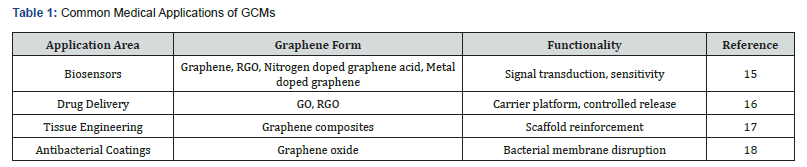
i. Biosensors: Graphene-based biosensors provide rapid
and sensitive detection of biomarkers due to their high electrical
conductivity and large surface area. This allows real-time monitoring
of glucose, cholesterol, uric acid, cancer markers, and more
[7-10].
ii. Drug delivery systems: Graphene Oxide (GO) and Reduced
Graphene Oxide (RGO) are used as nanocarriers due to
their layered structure, which can encapsulate and release therapeutic
agents in a controlled manner [11]. Functional groups on
GO facilitate targeted delivery, improving drug efficiency while reducing
side effects.
iii. Tissue engineering: Graphene composites are incorporated
into scaffolds for bone, cartilage and nerve regeneration
[12]. These scaffolds not only mimic the extracellular matrix but
also provide superior mechanical and electrical properties that
promote cell adhesion and growth.
iv. Wound healing and antibacterial surfaces: GO’s ability
to disrupt bacterial membranes makes it a potent antimicrobial
agent [13]. Its incorporation into bandages and coatings reduces
infection risk and accelerates healing.
v. Imaging and photothermal therapy: Functionalized
graphene can be used for imaging and targeted cancer therapy
through photothermal effects, where it converts near-infrared
light into heat to destroy tumor cells [14].
Table 1 As the scope of graphene-based medical technologies continues to expand, so does the importance of understanding how to safely and sustainably manage these materials after their functional use [15]. The next sections explore the specific challenges and emerging solutions to the recycling and end-of-life processing of these advanced biomaterials [16].

Importance of Graphene Recycling in Medical Applications
Graphene-based materials offer unique performance advantages in medical applications, including biocompatibility, strength, conductivity, and flexibility. However, improper disposal of graphene-containing waste can lead to environmental contamination and adverse health effects. Thus, recycling and recovery strategies are vital to manage these advanced materials responsibly [17].
Current processing and recycling techniques
Several methods are available for recycling graphene-containing materials, each having its own advantages and limitations:
i. Mechanical recycling
Mechanical recycling refers to the physical processing of graphene-containing materials into reusable forms without altering their chemical structure. This process involves physically crushing, grinding, or shredding graphene-based materials, followed by separation techniques. Shredding and milling Breaks down materials (e.g., graphene-enhanced PPE or plastics) for reuse as fillers or additives. Regrinding used for bulkier composite parts to be reintroduced into new polymer blends. Ultrasonication disperses graphene fillers from degraded products into solvents for reuse [18].
ii. Chemical recycling
This technique uses solvents, acids, or oxidants to break down the matrix or separate components in graphene composites, allowing for the recovery of both graphene and polymer precursors. Oxidative degradation converts polymer matrices into simpler molecules while preserving or modifying graphene (e.g., converting rGO to GO). Solvolysis or depolymerization uses chemical reagents to break down resins or polymers (e.g., epoxy or polyester) in biosensors or flexible circuits. Chemical leaching extracts graphene oxide from coatings or filters, often using strong acids or alkalis [19].
iii. Thermal recycling
This method involves subjecting graphene-based medical waste to high temperatures to break down polymer matrices and recover carbonaceous residues, including graphene structures. Pyrolysis decomposes organic matrix materials under high temperatures to recover graphene. Thermal annealing is also used to remove organic binders and partially restore the structure of degraded graphene [20].
iv. Solvent recycling
It is a promising and increasingly important technique in the processing of graphene-based composites, especially those used in medical applications. Many graphene-containing products such as coatings, films, and polymer composites are manufactured or processed using organic solvents (e.g., NMP, DMF, ethanol, acetone) to disperse or stabilize graphene or graphene oxide (GO). At end-of-life, recovering both the graphene content and the solvents used in manufacturing or dissolution can contribute to material circularity and environmental safety [21] Table 2.
Challenges in Graphene Recycling from Medical Applications
Most of the time, graphene-containing medical products are thrown away as hazardous waste when they are no longer useful. There are a number of unique problems that come up when trying to recycle graphene from medical uses that need to be carefully thought through. One big worry is that graphene used in medical settings could get contaminated by bodily fluids, pathogens, or drug residues, making it potentially biohazardous. Also, medical products often use graphene in complicated composites with polymers, metals, and other materials, which makes it hard to separate and recover the materials. In addition to the technical problems, any recycling method must also follow strict medical and environmental rules to make sure that hazardous materials are handled safely, sterilized, and properly throughout the recycling process [22].
Economic and Environmental Aspects and Future Direction
Sustainable recycling practices reduce environmental impacts and enhance economic viability by conserving valuable materials. Economically, recovered graphene can offset initial production costs, incentivizing recycling adoption. Developing eco-friendly chemical recycling methods. Innovating selective separation processes for complex medical composites. Creating robust closedloop recycling protocols integrating medical application lifecycles. Effective recycling of graphene-containing materials from medical applications is essential to harness graphene’s full potential sustainably. Integrating advanced processing techniques, addressing challenges, and aligning regulatory frameworks will significantly enhance sustainability in healthcare technology. Effective recycling of graphene-containing materials from medical applications is essential to harness graphene’s full potential sustainably. Integrating advanced processing techniques, addressing challenges, and aligning regulatory frameworks will significantly enhance sustainability in healthcare technology.
References
- Lazanas AC, Prodromidis MI (2024) 2D Nanomaterials as Electrochemical (Bio)Sensing Transducers in the Post-Graphene Era. TrAC Trends in Analytical Chemistry 172: 117610.
- Lu T, Sun M, Zhou Y, Tu W, Ni Z, et al. (2024) Self-Powered Chitosan/Graphene Oxide Hydrogel Band-Aids with Bio adhesion for Promoting Infected Wounds Healing. International Journal of Biological Macromolecules 283: 137374.
- Farani MR, Zare I, Mirshafiei M, Gholami A, Zhang M, et al. (2025) Graphene Oxide-Engineered Chitosan Nanoparticles: Synthesis, Properties, and Antibacterial Activity for Tissue Engineering and Regenerative Medicine. Chemical Engineering Journal 509: 160852.
- Saharan R, Paliwal SK, Tiwari A, Babu MA, Tiwari V, et al. (2024) Beyond Traditional Hydrogels: The Emergence of Graphene Oxide-Based Hydrogels in Drug Delivery. Journal of Drug Delivery Science and Technology 94: 105506.
- Lin H, Thurnherr TB, Kaur J, Wick P, Pelin M, et al. (2024) Environmental and Health Impacts of Graphene and Other Two-Dimensional Materials: A Graphene Flagship Perspective. ACS Nano 18 (8): 6038-6094.
- Kordahi MA, Ayoub GM, Zayyat RM (2024) A Critical Review of Current Research on Cyanobacterial Cells and Associated Toxins in Aquatic Environments: Occurrence, Impact, and Treatment Methods. Journal of Environmental Chemical Engineering 12 (5): 113931.
- Mahalakshmi D, Nandhini J, Meenaloshini G, Karthikeyan E, Karthik K, et al. (2025) Graphene Nanomaterial-Based Electrochemical Biosensors for Salivary Biomarker Detection: A Translational Approach to Oral Cancer Diagnostics. Nano Trans Med 4: 100073.
- Wang Z, Bi X, Tang L, Sun H, Cao Z, et al. (2025) In-Situ Generation of Co-Fe Bimetallic Electrocatalysts on Lignosulfonate-Derived Graphene by Direct Laser Writing for Wearable Glucose Biosensors. Sensors and Actuators B: Chemical 432: 137506.
- Chugh V, Bhattacharjya T, Das C, Tripathy K, Bhattacharjee M (2024) Flexible Electrochemical Sensing Label for the Detection of Glucose Adulteration in Honey. IEEE Sensors J 24 (9): 13823-13830.
- Ye C, Shi D, Zhu Y, Shi P, Zhao N, et al. (2025) Graphene Electrochemical Biosensors Combining Effervescent Solid-Phase Extraction (ESPE) for Rapid, Ultrasensitive, and Simultaneous Determination of DA, AA, and UA. Biosensors and Bioelectronics 268: 116899.
- Zhu H, Feng R, Li D, Shi M, Wang N, et al. (2025) A Multifunctional Graphene Oxide-Based Nanodrug Delivery System for Tumor Targeted Diagnosis and Treatment under Chemotherapy-Photothermal-Photodynamic Synergy. Colloids and Surfaces B: Bio interfaces 248: 114479.
- Li D, Zhao J, Wang Y, Wang J, Sun Z, et al. (2025) Recent Advances in the Design and Structural/Functional Regulations of Biomolecule‐Reinforced Graphene Materials for Bone Tissue Engineering Applications. Small Science 5 (1): 2400414.
- Zhang Y, Chai Z, Ji K, Lei X, Deng H (2025) A Flash Graphene Composite Hydrogel for the Photothermal Therapy of Bacterial Infected Wound Healing. Materials Today Communications 42: 111279.
- Zhu X, Lei J, Jiang C, Fang Z, Zhang W, et al. (2025) Two-Dimensional Graphene Nanomaterials for Combined Photothermal and Chemotherapy-Enhanced Targeted Therapy of Breast Cancer. Materials Today Bio 32: 101668.
- Nalepa MA, Panáček D, Dědek I, Jakubec, P, Kupka V, et al. (2024) Graphene Derivative-Based Ink Advances Inkjet Printing Technology for Fabrication of Electrochemical Sensors and Biosensors. Biosensors and Bioelectronics 256: 116277.
- Liu J, Cui L, Losic D (2013) Graphene and Graphene Oxide as New Nanocarriers for Drug Delivery Applications. Acta Biomaterialia 9 (12): 9243-9257.
- Sayyar S, Murray E, Thompson BC, Gambhir S, Officer DL, et al. (2013) Covalently Linked Biocompatible Graphene/Polycaprolactone Composites for Tissue Engineering. Carbon 52: 296-304.
- Janković A, Eraković S, Sekulić M, Stanković VM, Park SJ, et al. (2015) Graphene-Based Antibacterial Composite Coatings Electrodeposited on Titanium for Biomedical Applications. Progress in Organic Coatings 83: 1-10.
- Rebecca PNB, Durga Lakshmi D, Balakumar S, Rakkesh RA (2022) Biomass‐Derived Graphene‐Based Nanocomposites: A Futuristic Material for Biomedical Applications. Chemistry Select 7(5): e202104013.
- Fernando KAS, Thakuri R, Schroeder ALB, Ruiz ON (2024) Chemical Method for Recovery and Regeneration of Graphene Oxide. ACS Appl. Bio Mater 7 (1): 315-324.
- Liu Y, Yu J, Zhao Y, Lai J, Li J, et al. (2024) Valorization of Waste Graphite in Spent Lithium-Ion Batteries to Graphene via Modified Mechanical Exfoliation and the Mechanism Exploration. Journal of Cleaner Production 449: 141823.
- Salavagione HJ, Sherwood J, Bruyn MD, Budarin VL, Ellis GJ, et al. (2017) Identification of High-Performance Solvents for the Sustainable Processing of Graphene. Green Chem 19 (11): 2550-2560.

























