




 JOJHA Home




Closing the Wood Resource Loop: Innovative Recycling and Valorization of Tree Biomass for a Circular Bioeconomy
Kashaf*
Department of Botany, GCWUF, Faisalabad, Pakistan
Submission:September 21, 2026;Published: October 28, 2026
*Corresponding author: Kashaf, Department of Botany, GCWUF, Faisalabad, Pakistan
How to cite this article: Kashaf. Closing the Wood Resource Loop: Innovative Recycling and Valorization of Tree Biomass for a Circular Bioeconomy. JOJ Horticulture & Arboriculture, 6(4). 555692. DOI: 10.19080/JOJHA.2026.06.555692.
Abstract
Tree biomass residues generated from forestry operations, urban pruning, orchard management, timber processing, and landscape maintenance represent a substantial but frequently underutilized renewable resource. Conventional disposal through open burning, uncontrolled decomposition, or low-value dumping can result in material loss and environmental burdens, whereas systematic recycling can transform lignocellulosic residues into valuable bio-based resources. This review explores an integrated wood resource loop in which discarded tree biomass is recovered, characterized, fractionated, biologically or thermochemically transformed, and returned to agricultural, environmental, and industrial systems. Particular attention is given to emerging approaches including cascade fractionation, hydrothermal conversion, microwave-assisted processing, fungal enzymatic degradation, engineered wood derived carbon, nutrient loaded biochar, activated carbon, cellulose based materials, and hybrid biological thermochemical processing. The review further proposes new recycling strategies based on biomass classification, decentralized conversion, carbon nutrient coupling, multi product biorefineries, and design-for-second-life principles. Rather than considering recycling as a single conversion step, the proposed framework treats tree biomass as a continuously recoverable resource whose cellulose, hemicellulose, lignin, extractives, minerals, and residual carbon can be directed toward different value-added pathways. Integration of these approaches could reduce biomass disposal, recover carbon and nutrients, generate renewable materials, and strengthen circular resource management. Future research should emphasize life-cycle assessment, techno-economic feasibility, process optimization, product safety, long-term environmental performance, and scalable decentralized recycling systems. Closing the wood resource loop therefore offers a multidisciplinary pathway toward resource-efficient production, carbon management, sustainable agriculture, and a circular bioeconomy.
Keywords: Tree biomass; wood waste; Biomass recycling; Circular bioeconomy; Lignocellulose; Resource recovery; Cascade valorization; Biochar; Carbon sequestration; Nutrient recovery; Sustainable agriculture; Waste-to-resources
Introduction
Increasing urbanization, forestry activities, agricultural intensification, orchard management Gollin [1]. and timber processing continuously generate branches, bark, sawdust, wood chips, pruning residues, and other lignocellulosic materials Fortunati Although these materials originate from renewable biological resources, their disposal is frequently treated as a waste-management problem rather than an opportunity for resource recovery Lipper [2]. Open burning can release particulate matter and greenhouse gases, while uncontrolled accumulation occupies space and may alter local environmental conditions Cheng [3]. At the same time, wood biomass contains structurally valuable polymers, particularly cellulose, hemicellulose, and lignin, together with extractives, minerals, and carbon that can potentially be recovered through appropriately designed recycling systems Sun [4]. The chemical architecture of wood makes it particularly attractive for circular conversion Hidalgo [5]. Cellulose provides a relatively pure polysaccharide platform for biomaterials and biochemical production, hemicellulose contains diverse carbohydrate fractions that can be converted into valuable intermediates, and lignin represents an abundant renewable aromatic polymer with applications extending beyond conventional energy recovery Qiang [6].
Instead of destroying these components through uncontrolled combustion, cascading utilization can separate and direct different fractions toward applications according to their chemical properties. Such an approach changes the fundamental concept of wood management from waste disposal to resource circulation Hossain [7]. Conventional recycling routes include mulching, composting, particleboard manufacture, combustion, pellet production, and conventional biochar preparation Sinha [8]. These pathways remain useful, but they do not necessarily maximize the value of every biomass component He [9]. A major opportunity therefore exists in integrating multiple conversion technologies rather than relying on a single end product. Mechanical pretreatment can reduce particle size, biological processes can modify lignocellulosic structures, chemical or hydrothermal processes can fractionate biomass, and thermochemical conversion can stabilize residual carbon Barakat [10]. The resulting products may subsequently enter agricultural, environmental, construction, packaging, energy, or material-manufacturing systems Pajonk [11]. An emerging concept is the wood resource loop, in which tree residues are recovered and transformed into products that subsequently return nutrients, carbon, materials, or functional services to human and natural systems Huang [12]. For agriculture, wood derived materials may contribute to soil organic carbon, water retention, nutrient conservation, and remediation. In environmental applications, activated and engineered carbon materials can act as adsorbents for pollutants Diehl [13].
In industry, cellulose- and lignin derived materials can replace portions of fossil-derived raw materials. Thus, recycling tree biomass can simultaneously address waste reduction, renewable-material production, soil improvement, and carbon management Jahanzad [14]. However, significant scientific challenges remain. Biomass varies among tree species, tissues, ages, growing environments, and processing histories. Bark may contain different mineral and extractive concentrations from stem wood, while urban wood can contain contaminants that restrict agricultural application. Moisture content strongly influences conversion efficiency, and thermochemical processes require optimization of temperature, heating rate, residence time, and atmosphere. Biological pathways may be environmentally attractive but can require longer processing periods. Therefore, future wood recycling systems require feedstock specific technology selection rather than a universal conversion method. The central objective of this review is to examine innovative pathways for recycling tree biomass and to develop an integrated framework connecting waste generation, biomass characterization, fractionation, conversion, product recovery, application, and resource regeneration. Particular emphasis is placed on innovative techniques and strategies that can transform wood residues into multifunctional resources while reducing material loss. The review also identifies research opportunities for combining carbon recovery, nutrient recycling, biotechnology, nanotechnology, digital monitoring, and circular economy principles into next-generation wood recycling systems.
Methodology
This review can be developed using a structured literature synthesis approach covering scientific studies on tree biomass recycling, wood waste valorization, lignocellulosic fractionation, biological conversion, thermochemical processing, biochar, activated carbon, cellulose derived materials, lignin valorization, nutrient recovery, soil applications, carbon sequestration, and circular bioeconomy systems Salvador [15]. Literature should be retrieved from multidisciplinary scientific databases using combinations of terms such as wood waste recycling, tree biomass valorization, forestry residues, lignocellulosic biomass, wood-derived carbon, cascade utilization, biorefinery, hydrothermal carbonization, pyrolysis, fungal degradation, nutrient recovery, and circular bioeconomy Muscat [16]. Publications should preferably be screened according to relevance, methodological quality, technological maturity, environmental implications, and potential for resource recovery. The review methodology should classify recycling pathways into mechanical, biological, chemical, hydrothermal, thermochemical, and hybrid technologies Singh [17]. For each pathway, information should be compared regarding feedstock requirements, processing conditions, principal products, resource efficiency, potential applications, limitations, scalability, and environmental implications. Particular attention should be given to studies reporting measurable outcomes such as carbon recovery, product yield, nutrient retention, adsorption capacity, energy demand, greenhouse-gas implications, soil responses, or material performance Fu [18]. Technologies should then be evaluated within a cascading framework rather than independently, allowing identification of opportunities where one process residue becomes the feedstock for another process. Finally, research gaps should be synthesized into proposed strategies for decentralized processing, carbon nutrient coupling, multi product recovery, digital process optimization, and life-cycle-based technology selection Liu [19].
Innovative Techniques
Cascade Fractionation
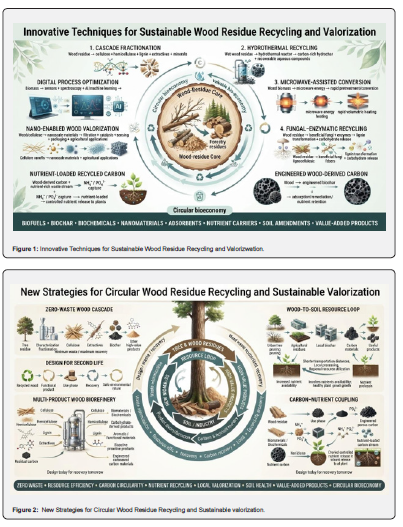
Cascade fractionation represents a shift from converting the entire wood residue into one low-value product toward sequential recovery of its major components Wang [20]. Cellulose, hemicellulose, lignin, extractives, and mineral fractions can be separated or selectively transformed. The remaining fractions can subsequently enter secondary conversion pathways, reducing the quantity of material ultimately lost Zhang [21].
Hydrothermal Recycling
Hydrothermal processing offers an attractive pathway for relatively wet biomass because water can function as the reaction medium under elevated temperature and pressure Hitzl [22]. Hydrothermal carbonization can convert wet wood residues into carbon rich hydrocar while producing an aqueous fraction containing soluble compounds. Further recovery of these fractions could increase overall resource efficiency.
Microwave-Assisted Conversion
Microwave-assisted processing can provide rapid volumetric heating and may accelerate selected pretreatment and conversion reactions Nuchter [23]. Integration with biomass pretreatment or carbonization could provide opportunities for reducing processing duration and improving process control Berge [24].
Fungal–Enzymatic Recycling
Wood degrading fungi naturally possess enzymatic systems capable of modifying complex lignocellulosic structures Goodell [25]. Laccases, lignin peroxidases, and manganese peroxidases can participate in lignin transformation, while cellulolytic enzymes contribute to carbohydrate release. Controlled fungal pretreatment could therefore reduce dependence on severe chemical processing Tian [26].
Engineered Wood-Derived Carbon
Rather than treating biochar as a final product, its surface chemistry and pore structure can be deliberately engineered. Activation, surface modification, and functional-group enrichment can create materials suitable for adsorption, nutrient retention, remediation, and another applications Kashaf [27].
Nutrient-Loaded Recycled Carbon
A particularly promising pathway is coupling wood recycling with nutrient recovery. Wood derived carbon can potentially capture ammonium or phosphate from nutrient-containing waste streams and subsequently function as a controlled nutrient-release material. This links biomass recycling with nutrient recycling Sun [29].
Nano-Enabled Wood Valorization
Wood derived carbon and cellulose can serve as precursors for nanoscale and high-surface-area materials. Such materials may have applications in adsorption, filtration, catalysis, packaging, sensing, and agricultural technologies. Their development should, however, be accompanied by careful assessment of environmental safety and scalability Anter [30].
Digital Process Optimization
Sensors, spectroscopy, process modelling, and machine-learning approaches could be used to characterize biomass and predict suitable conversion conditions. Feedstock specific prediction of moisture, lignin content, ash, and conversion behavior could improve process efficiency and reduce unnecessary energy consumption Maraphum [28].
New Strategies
Zero Waste Wood Cascade
The proposed zero-waste strategy follows:
Tree residue → characterization → fractionation → high-value products → residual conversion → carbon recovery → final application
The goal is to minimize disposal by assigning each fraction to an appropriate use Hua [32].
Wood to Soil Resource Loop
A recycled wood product can be incorporated into a broader agricultural cycle:
Wood waste → carbon material → nutrient capture → soil application → nutrient availability → plant production → biomass return
This creates a connection between forestry residues and agricultural resource management Yang [31].
Decentralized Tree Waste Recycling
Urban pruning residues and agricultural tree residues are often generated in geographically dispersed locations. Small-scale or modular conversion systems could process biomass near its source, reducing transportation requirements and allowing locally produced recycled materials to serve nearby agricultural or industrial users Lan [32].
Carbon Nutrient Coupling
Wood recycling can be combined with nutrient recovery to produce multifunctional materials. Instead of recovering carbon and nutrients through separate waste-management systems, engineered wood-derived carbon could potentially act as a carrier for recovered nutrients Niu [33].
Multi Product Wood Biorefinery
A future wood biorefinery should not be designed around a single product. Instead: Cellulose → biomaterials/biochemicals Hemicellulose → carbohydrate-derived products Lignin → aromatic and functional materials Extractives → bioactive products Residual carbon → engineered carbon materials
This maximizes resource recovery Liao [34].
Design for Second Life
Wood-derived products should be designed with their subsequent reuse in mind. A material produced from recycled wood should ideally have a defined pathway for further recycling, recovery, or safe environmental return rather than becoming a new waste stream (Foth et al., 2009).
Novel Techniques and Integrated Approaches
A next-generation recycling platform could combine biological pretreatment with thermochemical conversion. Biological processing could partially disrupt the lignocellulosic matrix, followed by controlled thermal conversion of the remaining carbon-rich fraction. This hybrid pathway may provide greater flexibility than relying exclusively on either biological or thermal processing. Another promising concept is nutrient-assisted carbon engineering, in which recycled wood carbon is produced with surface characteristics designed specifically for nutrient adsorption. The resulting material could then be evaluated for nutrient-release kinetics, soil retention, plant uptake, and carbon persistence. Such a system would transform wood waste into a material simultaneously supporting carbon management and nutrient-use efficiency. A further innovation is adaptive recycling, in which the conversion route is selected according to feedstock characteristics. Instead of processing all tree residues identically, biomass could first undergo rapid chemical and physical characterization. Clean, cellulose-rich material could be directed toward biomaterial production, lignin-rich fractions toward aromatic products, and unsuitable residual material toward thermochemical carbon recovery.
Smart Characterization → Smart Separation → Smart Conversion → Smart Application → Resource Recovery This approach could make future recycling systems more efficient and less dependent on fixed processing protocols.
Future Prospects
Future research should move from laboratory-scale demonstrations toward integrated recycling systems capable of operating with heterogeneous real-world tree residues. Long-term studies are particularly needed to determine the stability, safety, and environmental fate of wood-derived products under agricultural and environmental conditions. Research should also distinguish between clean forestry residues and potentially contaminated urban wood because their appropriate recycling pathways may differ considerably. Life-cycle assessment should become an essential component of technology evaluation. A recycling process should not be considered sustainable solely because it produces a recycled product; energy consumption, transportation, chemical inputs, emissions, water use, product lifetime, and end-of-life behavior should also be considered. Techno-economic assessment is similarly necessary to determine whether promising laboratory technologies can become economically viable at commercial scale.
Future systems may increasingly combine artificial intelligence, spectroscopy, automation, biotechnology, nanotechnology, and thermochemical processing. Real-time feedstock characterization could enable automated adjustment of conversion parameters, while predictive models could help select the most appropriate pathway for different biomass compositions. Another major research opportunity is the development of regional wood-recycling hubs in which pruning residues, forestry waste, sawdust, and other compatible biomass streams are collected and converted into multiple products. Such hubs could integrate material recovery, carbon production, nutrient recovery, and agricultural applications within a geographically connected circular system. The strongest future direction is therefore not simply “recycling wood,” but developing a closed-loop wood-resource ecosystem in which waste generation is minimized, biomass components are repeatedly recovered, carbon is retained where appropriate, and residual materials are safely returned to productive systems.
Conclusion
Tree biomass waste should no longer be viewed exclusively as a disposal burden. Its lignocellulosic architecture provides multiple opportunities for recovery of carbon, structural polymers, biochemical intermediates, functional materials, and agricultural resources. Innovative approaches including cascade fractionation, hydrothermal conversion, fungal–enzymatic processing, engineered wood-derived carbon, nutrient-loaded materials, nano-enabled valorization, and digital process optimization can expand the value obtained from recycled tree biomass. The proposed wood–resource loop integrates these technologies into a cascading system in which different biomass fractions are directed toward appropriate value-added applications and residual carbon is subsequently recovered. Combining wood recycling with nutrient recovery, soil restoration, carbon management, and renewable-material production can broaden the environmental and economic benefits of biomass recycling. Future progress will depend on feedstock-specific processing, life-cycle assessment, techno-economic validation, product safety, and scalable decentralized technologies. Ultimately, the transition from “wood waste management” to “wood resource regeneration” represents a fundamental step toward a circular bioeconomy. By giving tree biomass multiple productive lives rather than treating it as a single-use material, innovative recycling systems can contribute particularly to SDG 12 (Responsible Consumption and Production) while also supporting SDG 2, SDG 13, and SDG 15.
References
- Gollin D, Jedwab R, Vollrath D (2013) Urbanization with and without Structural Transformation. mimeograph, George Washington University.
- Fortunati E, Luzi F, Puglia D, Torre L (2016) Extraction of lignocellulosic materials from waste products. Multifunctional polymeric nanocomposites based on cellulosic reinforcements 1-38.
- Lipper L, McCarthy N, Zilberman D, Asfaw S, Branca G (2017) Climate smart agriculture building resilience to climate change p. 630.
- Jahanzad E, Holtz BA, Zuber CA, Doll D, Brewer (2020). Orchard recycling improves climate change adaptation and mitigation potential of almond production systems. PLoS One 15(3): e0229588.
- Sun D, Lv ZW, Rao J, Tian R, Sun SN (2022) Effects of hydrothermal pretreatment on the dissolution and structural evolution of hemicelluloses and lignin: A review. Carbohydrate polymers 281: 119050.
- Salvador R, Barros MV, Donner M, Brito P, Halog, et al. (2022) How to advance regional circular bioeconomy systems Identifying barriers challenges drivers and opportunities. Sustainable Production and Consumption 32: 248-269.
- Qiang H, Wang J, Liu H, Zhu Y (2023) From vanillin to biobased aromatic polymers Polymer Chemistry 14(37): 4255-4274.
- Hossain MU, Wang L, Iris KM, Tsang DC (2018) Environmental and technical feasibility study of upcycling wood waste into cement bonded particleboard. Construction and Building Materials 173: 474-480.
- Sinha P, Paul S, Maity S, Banerjee S (2026) Recent advances in plastic recycling from conventional recycling to dynamic covalent strategies. Current Opinion in Chemical Engineering 53: 101290.
- He Q, Chen E, An R Li Y (2013). Above ground biomass and biomass components estimation using LiDAR data in a coniferous forest. Forests 4(4): 984-1002.
- Pajonk A, Prieto A, Blum U, Knaack U (2022) Multi material additive manufacturing in architecture and construction A review. Journal of Building Engineering 45: 103603.
- Huang Y, Löschke S, Proust G (2026) Effect of loop recycling on mechanical performance of wood-plastic composites: a systematic review. Materials & Design 266: 116102.
- Diehl P, Mazzarino MJ, Funes F, Fontenla S, Gobbi M (2003) Nutrient conservation strategies in native Andean‐Patagonian forests. Journal of vegetation science 14(1): 63-70.
- Jahanzad E, Holtz BA, Zuber CA, Doll D, Brewer (2020) Orchard recycling improves climate change adaptation and mitigation potential of almond production systems. PLoS One 15(3): e0229588.
- Salvador R, Barros MV, Donner M, Brito P, Halog, et al. (2022) How to advance regional circular bioeconomy systems Identifying barriers challenges drivers and opportunities. Sustainable Production and Consumption 32: 248-269.
- Muscat A, De Olde EM, Ripoll Bosch R, Van Zanten HH, Metze TA, et al. (2021) Principles, drivers and opportunities of a circular bioeconomy. Nature Food 2(8): 561-566.
- Singh R, Krishna BB, Mishra G, Kumar J, Bhaskar T (2016) Strategies for selection of thermo-chemical processes for the valorisation of biomass. Renewable Energy 98: 226-237.
- Fu Z, Li D, Hararuk O, Schwalm C, Luo, et al. (2017) Recovery time and state change of terrestrial carbon cycle after disturbance. Environmental Research Letters 12(10): 104004.
- Liu D, Wang S, Zhao L, Tan W (2026) Synergistic pathways of composting and hydrothermal carbonization for livestock manure valorization From molecular mechanisms to carbon neutral applications. Journal of Environmental Chemical Engineering 14(2): 121464.
- Wang F, Zhang Y, Shao L, Wang C, Ling Z, Zeng, et al. (2026) Sustainable biorefinery for cascade fractionation of moso bamboo into furfural, glucan oligomers and less-condensed lignin. Green Chemistry 28(2): 873-882.
- Zhang X, Yang, W, Blasiak W (2011) Modeling study of woody biomass interactions of cellulose hemicellulose and lignin. Energy & Fuels 25(10): 4786-4795.
- Hitzl M, Corma A, Pomares F, Renz M (2015) The hydrothermal carbonization (HTC) plant as a decentral biorefinery for wet biomass. Catalysis Today 257: 154-159.
- Nüchter M, Ondruschka B, Bonrath W, Gum A (2004) Microwave assisted synthesisa critical technology overview. Green chemistry 6(3): 128-141.
- Berge ND, Ro KS, Mao J, Flora JR, Chappell MA, et al. (2011) Hydrothermal carbonization of municipal waste streams. Environmental science & technology 45(13): 5696-5703.
- Goodell B, Winandy JE, Morrell JJ (2020) Fungal degradation of wood: Emerging data new insights and changing perceptions. Coatings 10(12): 1210.
- Tian XF, Fang Z, Guo F (2012) Impact and prospective of fungal pretreatment of lignocellulosic biomass for enzymatic hydrolysis. Biofuels Bioproducts and Biorefining 6(3): 335-350.
- Kashaf Anwar S, Shafiq F, Kausar A, Khan S, Ashraf M, et al. (2026) Nitrogen Enriched Nanobiochar Enhances Spinach Growth via Improved Nitrogen Retention and Uptake Mechanisms. Nitrogen 7(1): 11.
- Maraphum K, Phoomwarin K, Khongthon N, Posom J (2025) Eliminating effect of moisture content in prediction of lower heating value and ash content in sugarcane leaves biomass. Energies 18(13): 3352.
- Sun J, Wang Y, Fan L, Tan Z, Qu H, Mu J (2024) Wood derived carbon electrodes containing carbonized wood fibers with high specific surface area for high areal performance supercapacitors. Journal of Analytical and Applied Pyrolysis 183: 106736.
- Anter N, Hannioui A, Medaghri Alaoui A, Ghazoui M (2025) Cellulose and wood derived activated carbons from Pinus sylvestris comparative performance in methylene blue adsorption. RSC advances 15(58): 49780-49795.
- Yang N, Wang L, Ji Y, Feng Y, Wang B, Shi L (2025) Closing the phosphorus loop Turning aquaculture wastewater into slow-release fertilizer with an amine-modified wood fiber. Chemical Engineering Journal 528: 172217.
- Hua LS, Fatriasari W, Chen LW (2025) Wood cascading a brief review on principles, impacts and limitations. Global Forest Journal 3(1): 1-8.
- Niu S, Song L, Wang J, Luo Y, Yu G (2023) Dynamic carbon-nitrogen coupling under global change. Science China Life Sciences 66(4): 771-782.
- Liao Y, Koelewijn S F, Van den Bossche G, Van Aelst J, et al. (2020) A sustainable wood biorefinery for low carbon footprint chemicals production. Science 367(6484): 1385-1390.