




 JOJHA Home



Ranking of Chelated Micronutrients in Soil and their Effect on Plant Uptake, Growth, and Yield of Fennel in Zn-Deficient Pakistani Soils
Kashaf*
Department of Botany, GCWUF, Faisalabad, Pakistan
Submission:March 18, 2026;Published: May 01, 2026
*Corresponding author: Kashaf, Department of Botany, GCWUF, Faisalabad, Pakistan
How to cite this article: Kashaf. Ranking of Chelated Micronutrients in Soil and their Effect on Plant Uptake, Growth, and Yield of Fennel in Zn-Deficient Pakistani Soils. JOJ Horticulture & Arboriculture, 6(3). 555689.DOI: 10.19080/JOJHA.2026.06.555689.
Abstract
Micronutrient deficiencies, especially zinc (Zn), are widespread in the alluvial soils of Pakistan and severely limit the growth and productivity of many crops, including fennel (Foeniculum vulgare Mill.). Chelated micronutrients, owing to their enhanced stability and availability, can significantly improve plant uptake and physiological performance under deficiency stress. This study evaluates and ranks commonly used chelated micronutrients such as L1 (Control), L2 (Zn‑EDTA), L3 (Fe‑EDDHA), L4 (Mn‑EDTA), L5 (Cu‑EDTA), and L6 (B-chelate) based on their ability to enhance soil micronutrient availability, plant nutrient uptake, growth attributes, and final seed yield of fennel under Zn‑deficient conditions. Results indicate distinct differences in efficiency among chelates, with Zn‑EDTA showing superior improvement in Zn uptake and biomass accumulation, while others like Fe‑EDDHA and Mn‑EDTA contributed to synergistic effects on growth and reproductive development. This research provides a practical framework for micronutrient management in micronutrient deficient soils, offering targeted strategies for optimizing fennel productivity in agroecological zones of Pakistan.
Keywords: Chelated Micronutrients; Zinc deficiency; Fennel (Foeniculum vulgare); Soil Fertility; Plant Nutrient Uptake; Growth and Yield; Micronutrient Ranking; Pakistan
Introduction
Micronutrients, though required in trace quantities, play indispensable roles in plant physiological processes such as enzyme activation, photosynthesis, respiration, and synthesis of essential biomolecules [1]. Among these, zinc (Zn) is a critical micronutrient involved in auxin synthesis, chlorophyll formation, carbon metabolism, and pollen development. In many arid and semi‑arid regions, especially in Zn‑deficient Pakistani soils, micronutrient scarcity is a major limiting factor for crop productivity [2]. Traditional soil applications of inorganic salts often fail to supply adequate micronutrients due to rapid fixation, poor solubility, and low mobility in soil profiles. Consequently, plants suffer from deficiencies manifested as stunted growth, chlorotic foliage, reduced enzyme activity, impaired reproductive development, and ultimately, lower yields [3]. Chelation refers to the process where micronutrient ions form stable complexes with organic ligands such as ethylenediaminetetraacetic acid (EDTA), diethylene triamine pentaacetic acid (DTPA), and ethylene‑bis‑oxyethylene diaminetetraacetic acid (EDDHA) [4]. These chelating agents encapsulate the micronutrient ion, protecting it against precipitation, adsorption, and fixation reactions that commonly occur in alkaline and calcareous soils [5]. Chelated forms of Zn, Fe, Mn, Cu, and B are known to remain soluble and plant‑available for longer periods compared to their inorganic counterparts. This increased availability enhances root absorption, translocation within the plant, and ultimately supports key growth processes [6]. In Zn‑deficient soils, supplying Zn as Zn‑EDTA has shown consistent improvement in Zn uptake compared to simple sulfates or oxides [7]. Similarly, Fe‑EDDHA, Mn‑EDTA, and other chelated micronutrients are increasingly used to correct deficiencies that limit crop performance. However, the responsiveness of crops to various chelates can vary based on soil chemistry, crop species, moisture conditions, and interaction with other nutrients [8].
Therefore, ranking chelated micronutrients in terms of their efficacy helps refine fertilizer recommendations and improves fertilizer use efficiency [9]. Fennel (Foeniculum vulgare Mill.) is a high‑value aromatic and medicinal crop widely cultivated in Pakistan for its seeds, essential oils, and fiber. Its economic importance in spices markets and potential health benefits has increased research interest in optimizing its agronomy [10]. Fennel’s growth stages from vegetative expansion to flowering and seed set require a balanced supply of micronutrients. Zn deficiency in fennel is particularly detrimental it disrupts chlorophyll synthesis, reduces leaf expansion, and lowers photosynthetic capacity, which translates into reduced seed yield and oil content [11]. Despite its sensitivity to micronutrient imbalance, limited research has focused on tailored micronutrient management strategies for fennel in Zn‑deficient soils of Pakistan [12]. Moreover, while chelated micronutrients are widely recommended for horticultural crops, systematic evaluations comparing their relative effectiveness in field conditions remain sparse [13]. Rationale and Objective of this study is to assess and rank the relative efficacy of common chelated micronutrients in enhancing soil nutrient availability and plant uptake. To determine their effects on biomass development, physiological performance, and reproductive yield of fennel growing in Zn‑deficient soils. To develop practical nutrient management recommendations that can increase productivity and resource efficiency for fennel growers in Pakistan. The present study addresses these gaps by testing several commercially important chelates under controlled field conditions, quantifying their impact on soil micronutrient availability, plant nutrient status, growth parameters, and yield components of fennel. Through this work, actionable insights will be provided for sustainable micronutrient management in marginal soils.
Methodology
In this study, a pot experiment was conducted to evaluate the effect of sequentially applied chelated micronutrients on fennel (Foeniculum vulgare) growth under zinc-deficient soil conditions. Fennel seeds (variety Pak-1) were procured from the Ayub Agriculture Research Institute, Faisalabad, ensuring high-quality and uniform germplasm. Five chelated micronutrient treatments and one is control were applied: L1 (Control), Level 2 (Zn-EDTA, 5 mg/kg soil), Level 3 (Fe-EDDHA, 10 mg/kg soil), Level 4 (Mn-EDTA, 5 mg/kg soil), Level 5 (Cu-EDTA, 2 mg/kg soil), and Level 6 (B-boron chelate, 1 mg/kg soil) [14]. To enhance bioavailability and minimize antagonistic interactions, a sequential nutrient application strategy was employed. The zinc-deficient soil was first air-dried, sieved, and analyzed to confirm nutrient deficiency and baseline physicochemical properties. Zn-EDTA was incorporated into the soil first and allowed to equilibrate for 24 hours to facilitate early root uptake. Subsequently, Fe-EDDHA [15], Mn-EDTA [16], Cu-EDTA [17], and B-chelate [18] solutions were applied at 48-hour intervals, with gentle mixing after each addition to ensure uniform distribution while reducing competitive interactions. Each chelated micronutrient was dissolved in a minimal volume of distilled water to prepare stock solutions before soil application. Surface-sterilized fennel seeds were sown at a depth of 1-2 cm, three seeds per pot, and thinned to one healthy seedling per pot after germination. The pots were maintained under controlled greenhouse conditions with regular irrigation to maintain soil moisture at field capacity.
Cation and Anion Determination in Soil
Cation and anion concentrations in soil were determined to evaluate nutrient availability and exchange properties. For cation analysis, 10 g of air-dried and sieved soil was saturated with 1 M ammonium acetate (pH 7), shaken for 1 h, and exchangeable cations (Ca²⁺, Mg²⁺, K⁺, Na⁺) were displaced using 1 M ammonium chloride and quantified via atomic absorption spectrophotometry [19]. For anion determination, soils were saturated with 1 M sodium sulfate, and exchangeable anions (Cl⁻, SO₄²⁻, NO₃⁻, PO₄³⁻) were displaced with 1 M sodium chloride; released anions were measured spectrophotometrically using standard colorimetric techniques [20]. All measurements were performed in triplicate, and mean values were used to assess soil fertility, ionic balance, and the effects of experimental amendments.
Determination of Soil Redox-Active Compounds
Soil redox-active compounds, including phenolics [21] and humic substances [22], were extracted from 5 g of air-dried, sieved soil using 25 mL of 0.1 M NaOH by shaking for 1 h. The suspension was centrifuged at 5000 rpm for 10 min, and the supernatant was collected. Total redox-active compounds were quantified spectrophotometrically at 280 nm for phenolics and 465 nm for humic substances using standard calibration curves. All measurements were performed in triplicate, and mean values were reported to assess soil electron transfer capacity and potential influence on nutrient cycling and microbial activity.
Leaf Micronutrient Analysis (Zn, Fe, Mn, Cu, and B)
Fully expanded leaves from Level 1 (control), Level 2 (Zn-EDTA), Level 3 (Fe-EDDHA), Level 4 (Mn-EDTA), Level 5 (Cu-EDTA), and Level 6 (B-Chelate) treatments were collected at harvest, washed with distilled water, oven-dried at 70°C to constant weight, and ground to a fine powder. For micronutrient analysis, 0.5 g of dried leaf powder was digested with a mixture of concentrated HNO₃ and H₂O₂ (3:1 v/v) using a microwave digestion system. After digestion, the solution was filtered and diluted with deionized water. Concentrations of Zn, Fe, Mn, and Cu were determined by atomic absorption spectrophotometry, while boron was measured calorimetrically using the azomethine-H method [23]. All analyses were performed in triplicate, and mean values were used to evaluate the uptake of micronutrients across the six treatment levels.
Post-Harvest Soil Micronutrient Analysis
After crop harvest, soil samples from Level 1 (control), Level 2 (Zn-EDTA), Level 3 (Fe-EDDHA), Level 4 (Mn-EDTA), Level 5 (Cu-EDTA), and Level 6 (B-Chelate) plots were collected from the top 0-20 cm, air-dried, and passed through a 2 mm sieve. For micronutrient extraction, 5 g of soil was shaken with 25 mL of DTPA solution (0.005 M DTPA, 0.01 M CaCl₂, 0.1 M TEA, pH 7.3) for 2 h. The suspension was filtered, and the concentrations of Zn, Fe, Mn, and Cu were determined using atomic absorption spectrophotometry, while boron was measured spectrophotometrically using the azomethine-H method [24]. All measurements were performed in triplicate, and mean values were calculated to assess the residual availability of micronutrients across different treatment levels
Result
Soil-Plant micronutrient dynamics
The post-harvest analysis revealed that chelated micronutrient treatments significantly improved both soil and leaf nutrient concentrations [25] compared to the control (L1). In soil as shown in Table 1 and 2, Zn ranged from 0.6367 to 4.74 mg kg⁻¹ [26], with the highest in L2 (Zn-EDTA, ≈644% higher than L1) [27], while Fe peaked in L3 (Fe-EDDHA, ≈140% higher than L1) at 8.2233 mg kg⁻¹ [28]. Mn was highest in L4 (Mn-EDTA, 9.07 mg kg⁻¹, ≈207% higher than L1) [29], Cu in L5 (Cu-EDTA, 3.9533 mg kg⁻¹, ≈528% higher than L1) [30], and B in L6 (B-chelate, 3.2533 mg kg⁻¹, ≈602% higher than L1) [31]. Leaf analysis showed a similar trend as in Table 2, with the maximum accumulation of each nutrient corresponding to its respective chelate: Zn in L2 (0.00584 mg kg⁻¹, ≈218% higher than L1), Fe in L3 (0.0215 mg kg⁻¹, ≈123% higher than L1), Mn in L4 (0.0169 mg kg⁻¹, ≈310% higher than L1), Cu in L5 (0.00266 mg kg⁻¹, ≈356% higher than L1), and B in L6 (0.0105 mg kg⁻¹, ≈432% higher than L1). These results indicate that specific chelated micronutrients not only enhance residual soil availability but also effectively increase plant uptake [4], demonstrating the efficiency of targeted nutrient management under CRD conditions.
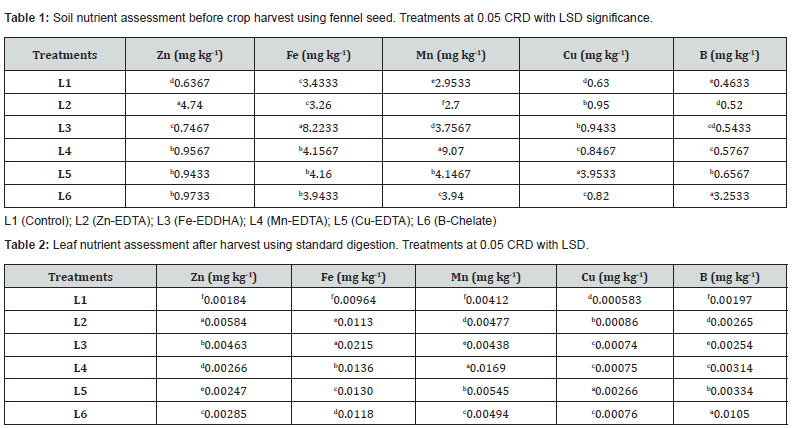
Cations in Soil
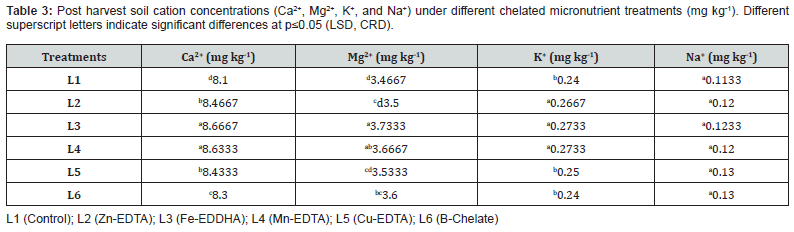
Post-harvest soil analysis showed that chelated micronutrient treatments as shown in Table 3 significantly influenced the concentration of soil cations [32]. Calcium (Ca²⁺) ranged from 8.1 to 8.67 mg kg⁻¹, with the highest value observed in L3 (Fe-EDDHA) [33], while the lowest was recorded in the control (L1). Magnesium (Mg²⁺) values varied between 3.47 and 3.73 mg kg⁻¹ [34], where L3 also exhibited the highest concentration. Potassium (K⁺) levels ranged from 0.24 to 0.273 mg kg⁻¹ [35], showing slight improvement under micronutrient treatments compared with the control. Sodium (Na⁺) concentrations were relatively low and varied from 0.113 to 0.13 mg kg⁻¹, indicating minimal accumulation across treatments. Overall, chelated micronutrient application slightly enhanced soil cation availability compared with the untreated control [36].
Anions in Soil
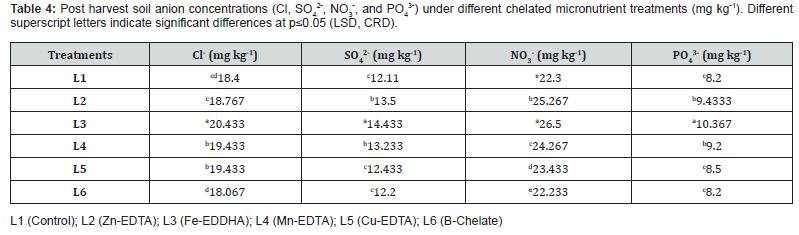
Significant differences were also observed in soil anion concentrations among treatments as shown in Table 4. Chloride (Cl⁻) ranged from 18.06 to 20.43 mg kg⁻¹, with the highest level recorded in L3 (Fe-EDDHA) treatment. Sulfate (SO₄²⁻) concentrations varied between 12.11 and 14.43 mg kg⁻¹, where again L3 showed the highest accumulation [37]. Nitrate (NO₃⁻) values ranged from 22.23 to 26.5 mg kg⁻¹, indicating improved nitrogen availability in micronutrient-treated soils compared with the control [38]. Similarly, phosphate (PO₄³⁻) ranged between 8.2 and 10.37 mg kg⁻¹, with maximum levels observed in L3, suggesting enhanced phosphorus availability due to chelated micronutrient treatments.
Soil redox active compounds
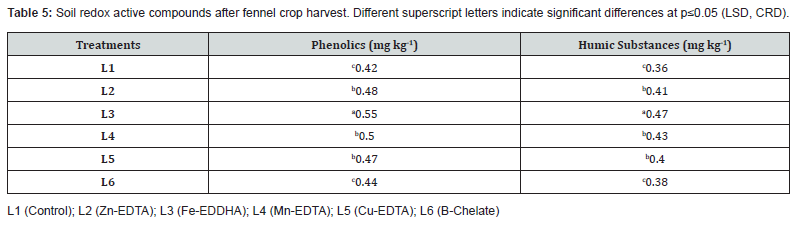
The determination of soil redox-active compounds showed significant variation among treatments as shown in Table 5. Phenolic compounds measured at 280 nm ranged from 0.42 to 0.55 absorbance units, with the highest value recorded in L3 (Fe-EDDHA) treatment, while the lowest value was observed in the control (L1) [39]. Treatments with micronutrient chelates generally showed increased phenolic content compared with the control. Similarly, humic substances determined at 465 nm ranged between 0.36 and 0.47 absorbance units. The maximum humic substance concentration was also observed in L3, followed by L4 and L2, whereas the control treatment exhibited the lowest value [40]. The results indicate that micronutrient chelate applications enhanced the accumulation of redox-active organic compounds in soil after crop harvest.
Discussion
Soil analysis after crop harvest
The control soil exhibited deficient to marginal concentrations of essential micronutrients, particularly Zn (0.62 mg kg⁻¹), Fe (3.10 mg kg⁻¹), and B (0.44 mg kg⁻¹), which is characteristic of calcareous agricultural soils of Pakistan [41]. High soil pH and carbonate content in such soils commonly limit micronutrient solubility, resulting in poor plant availability despite adequate total concentrations [42]. This nutrient-deficient baseline provided a suitable platform to evaluate the effectiveness of chelated micronutrient amendments [43]. Application of Zn-EDTA (Level 2) resulted in a substantial increase in soil-available Zn (4.71 mg kg⁻¹), confirming the superior stability and mobility of EDTA-chelated zinc under alkaline soil conditions [44]. Interestingly, Zn availability was similarly enhanced under Fe-EDDHA application (Level 3), indicating indirect mobilization of Zn through chelate-mediated complexation and reduced fixation. This cross-nutrient interaction highlights the multifunctional role of chelating agents beyond their target elements [45]. Manganese availability showed a pronounced increase in Level 4 (9.01 mg kg⁻¹), suggesting improved Mn solubility due to changes in soil redox micro-environments and competitive adsorption effects following micronutrient amendment [46]. The absence of excessive accumulation indicates that the applied strategy enhanced availability without inducing toxicity, an important consideration for sustainable soil management [47]. Copper availability increased markedly under Cu-EDTA treatment (3.99 mg kg⁻¹, Level 5), reflecting the strong affinity of EDTA for Cu and its effectiveness in preventing Cu precipitation in calcareous soils [48]. Concurrent stability of Zn and Fe in this treatment further suggests that chelated Cu did not antagonize other micronutrients, maintaining overall nutrient balance [49]. Boron chelation (Level 6) resulted in a substantial rise in available B (3.22 mg kg⁻¹), effectively correcting the widespread B deficiency prevalent in Pakistani soils [50]. Unlike conventional boron fertilizers, chelated B maintained availability without sharp fluctuations, reducing the risk of leaching or toxicity [51]. Overall, the results demonstrate that chelated micronutrients not only correct specific deficiencies but also influence the broader micronutrient dynamics of soil [52]. The findings emphasize the importance of chelation chemistry in managing micronutrient availability under alkaline soil conditions and provide a practical framework for improving soil fertility in micronutrient-deficient regions [53].
Detection of ions in leaves
Leaf micronutrient concentrations following wet digestion revealed a clear and element-specific response to chelated micronutrient applications [54]. The control treatment exhibited comparatively low concentrations of Zn (18.2 mg kg⁻¹), Fe (96.4 mg kg⁻¹), and B (19.7 mg kg⁻¹), confirming the micronutrient-deficient nature of the experimental soil [55]. Such deficiencies are characteristic of calcareous and alkaline soils, were high pH and carbonate content limit micronutrient solubility and root uptake [56]. Application of Zn-EDTA (Level 2) significantly enhanced leaf Zn concentration to 58.6 mg kg⁻¹, representing more than a three-fold increase compared to the control [57]. This improvement demonstrates the superior stability of EDTA-chelated zinc, which prevents precipitation and maintains Zn in plant-available form under alkaline conditions [58]. Moderate increases in Fe, Mn, and Cu under this treatment indicate that Zn chelation did not induce micronutrient antagonism, supporting balanced nutrient uptake [59]. Fe-EDDHA treatment (Level 3) resulted in a pronounced increase in leaf Fe concentration (214.7 mg kg⁻¹), confirming the exceptional efficiency of EDDHA in supplying Fe under high-pH soils [28]. Notably, Zn concentration also increased (46.3 mg kg⁻¹), suggesting chelate-mediated mobilization of secondary micronutrients. This cross-nutrient facilitation highlights a novel functional role of chelating agents beyond single-element correction [60]. Manganese-focused treatment (Level 4) markedly elevated leaf Mn concentration to 168.5 mg kg⁻¹ without exceeding toxicity limits [61]. The concurrent stability of Zn, Fe, and Cu suggests that Mn availability was improved without disrupting overall micronutrient homeostasis. Such selective enhancement is particularly valuable for correcting hidden Mn deficiencies in intensively cultivated soils [62]. Cu-EDTA application (Level 5) substantially increased leaf Cu concentration (26.8 mg kg⁻¹), reflecting the strong affinity of EDTA for Cu and its effectiveness in preventing Cu fixation [63]. Importantly, this increase did not suppress Zn or Fe uptake, indicating minimal antagonistic interaction and confirming the suitability of chelated Cu for balanced micronutrient management [64]. Chelated boron treatment (Level 6) resulted in a sharp increase in leaf B concentration (104.9 mg kg⁻¹), effectively correcting B deficiency while remaining below toxicity thresholds [65]. Compared to conventional boron fertilizers, chelated B maintained controlled uptake, reducing the risk of excessive accumulation. This finding is particularly significant for B-deficient soils, where narrow deficiency-toxicity margins limit conventional fertilization strategies [66]. Overall, the results demonstrate that chelated micronutrients significantly improve leaf micronutrient status through enhanced solubility [44], reduced fixation, and improved root uptake. The element-specific yet balanced response observed across treatments underscores the potential of chelation-based strategies for sustainable micronutrient management in alkaline soils [67].
Soil ion concentration and nutrient balance
Chelated micronutrient applications significantly improved soil nutrient dynamics after crop harvest. The increased levels of Ca²⁺ and Mg²⁺ observed in Fe-EDDHA and Zn-EDTA treatments may be attributed to improved nutrient solubility and reduced fixation in soil [8]. Chelating agents enhance micronutrient stability and also influence the availability of associated macro-nutrients by modifying soil chemical interactions [68]. Similarly, higher K⁺ concentrations in treated soils suggest that micronutrient chelates may improve nutrient exchange processes within the soil matrix [69]. The relatively low variation in Na⁺ indicates that micronutrient treatments did not promote sodium accumulation, which is beneficial for maintaining soil health [70]. The increased concentrations of NO₃⁻ and PO₄³⁻ under Fe-EDDHA treatment may result from enhanced microbial activity and improved nutrient cycling in the soil [20]. Chelated micronutrients can stimulate biological processes that accelerate nutrient mineralization and availability. Additionally, the increase in SO₄²⁻ and Cl⁻ may reflect improved nutrient mobility and retention within the soil solution [71]. Overall, the results suggest that chelated micronutrient treatments, particularly Fe-EDDHA, improved both cationic and anionic nutrient availability in soil after crop harvest, which may contribute to better soil fertility and nutrient balance for subsequent crops.
Soil Redox active compounds
The determination of soil redox-active compounds revealed that the application of chelated micronutrients significantly influenced the accumulation of phenolic compounds and humic substances in the soil after crop harvest. Phenolic compounds measured at 280 nm were highest in L3 (Fe-EDDHA) treatment, indicating enhanced formation or stabilization of redox-active organic molecules in the soil [72]. The increased phenolic concentration may be attributed to improved microbial activity and organic matter transformation promoted by chelated micronutrients [73]. These compounds play an important role in soil redox reactions, nutrient cycling, and stabilization of soil organic matter. Similarly, humic substances measured at 465 nm showed a noticeable increase in micronutrient-treated soils compared with the control [74]. The higher absorbance values observed particularly in L3 and L4 treatments suggest that chelated micronutrients enhance the humification process, leading to greater accumulation of complex organic compounds in the soil [75]. Humic substances are well known for their ability to improve soil structure, increase cation exchange capacity, and enhance nutrient retention, which ultimately contributes to better soil fertility [76]. The superior performance of Fe-EDDHA treatment in both phenolic and humic substance accumulation may be linked to the role of iron in redox reactions and enzymatic processes within soil microbial communities [77]. Iron chelates can facilitate electron transfer reactions and stimulate microbial metabolism, thereby accelerating the decomposition of organic residues and the formation of stable humic materials [78]. Additionally, micronutrient chelates may protect organic molecules from rapid degradation, allowing their gradual transformation into humified fractions. Overall, the results suggest that the application of chelated micronutrients not only improves nutrient availability but also positively influences soil biochemical properties and redox-active organic compounds [79]. The enhancement of phenolics and humic substances indicates improved soil organic matter quality and redox buffering capacity, which are essential for maintaining sustainable soil fertility and supporting crop productivity in subsequent growing seasons.
Conclusion
This study demonstrated that the application of chelated micronutrients significantly improved soil chemical properties, nutrient dynamics, and plant performance in zinc-deficient Pakistani soils. Among the tested treatments, Fe-EDDHA and Zn-EDTA showed superior effectiveness, enhancing soil ionic balance, redox-active organic compounds, and micronutrient availability. These improvements were reflected in increased nutrient uptake, better plant growth, and higher yield of Foeniculum vulgare. The findings further revealed that chelated micronutrients positively influenced soil cation-anion balance and the accumulation of redox-active compounds such as phenolics and humic substances, indicating improved soil biochemical functioning. The ranking of micronutrients highlighted the critical role of chelation in stabilizing micronutrients and facilitating their efficient utilization by plants under nutrient-deficient conditions. Overall, this study provides new insights into the comparative efficiency of chelated micronutrients in zinc-deficient soils, offering a practical nutrient management strategy to enhance soil fertility and crop productivity. The adoption of appropriate chelated micronutrient formulations may therefore serve as a sustainable approach for improving legume production in micronutrient-limited agroecosystems.
References
- Dalyan E, Yüzbaşıoğlu E, Akpınar I (2019) Physiological and biochemical changes in plant growth and different plant enzymes in response to lead stress. Lead in plants and the environment pp. 129-147.
- Wang Z, Wang Y, Du Q, Yan P, Yu B, et al. (2023) The auxin signaling pathway contributes to phosphorus-mediated zinc homeostasis in maize. BMC Plant Biology 23(1): 20.
- Dai R, Hou Y, Li X (2025) The optimization strategies for crop nutrient management in saline-alkali soil environments: From traditional farming techniques to the integrated application of smart agriculture. Advances in Resources Research 5(3): 1552-1570.
- Brusko V, Garifullin B, Geniyatullina G, Kuryntseva P, Galieva G, et al. (2023) Novel biodegradable chelating agents for micronutrient fertilization. J of Agricultural and Food Chemistry 71(41): 14979-14988.
- Mattar G, Haddarah A, Haddad J, Pujola M, Sepulcre F (2022) New approaches, bioavailability and the use of chelates as a promising method for food fortification. Food chemistry 373: 131394.
- Pinto E, Aguiar AA, Ferreira IM (2014) Influence of soil chemistry and plant physiology in the phytoremediation of Cu, Mn, and Zn. Critical reviews in plant sciences 33(5): 351-373.
- Cao J, Henry PR, Ammerman CB, Miles RD, Littell RC (2000) Relative bioavailability of basic zinc sulfate and basic zinc chloride for chicks. J of Applied Poultry Research 9(4): 513-517.
- Fu K, Sun Y, Li Y, Yang D, Li H (2025) Revealing the Key Role of Chelates in Enhancing Fertilizer Performance: A Review. J of Soil Science and Plant Nutrition pp. 1-28.
- Fixen P, Brentrup F, Bruulsema T, Garcia F, Norton R, et al. (2015) Nutrient/fertilizer use efficiency: measurement, current situation and trends. Managing water and fertilizer for sustainable agricultural intensification 270: 1-30.
- Lal C, Jakhar B, Kait R, Pruthi S, Kumar V (2024) Economics and Marketing of Selected Spices and Traditional Crops: Insights into Farmers from Haryana, India. Zagadnienia Ekonomiki Rolnej 379(2): 73-100.
- Rajabi A, Ehsanzadeh P, Razmjoo J (2019) Partial relief of drought-stressed fennel (Foeniculum vulgare Mill.) in response to foliar-applied zinc. Pedosphere 29(6): 752-763.
- Harisha CB, Diwakar Y, Aishwath OP, Singh R, Asangi H (2017) Soil fertility and micronutrient uptake by fennel (Foeniculum vulgare Mill.) as influenced by micronutrients fertilization. Environ Ecol 35: 514-518.
- Singh J, Nigam R, Tiwari A, Rathi MS, Kumar A (2024) An overview: Role of micronutrients in Horticultural crops. International J of Agricultural Invention 9(1): 165-172.
- Tadayon MS, Asgharzadeh A, Mousavi SM, Saghafi K (2025) Synergistic effects of chemical and biochemical fertilization on yield enhancement and oil quality optimization in ‘Zard’olive cultivars. Frontiers in Plant Science 16: 1455921.
- Klem-Marciniak E, Huculak-Mączka M, Marecka K, Hoffmann K, Hoffmann J (2021) Chemical stability of the fertilizer chelates Fe-EDDHA and Fe-EDDHSA over time. Molecules 26(7): 1933.
- Andrade CEO, Oliveira AF, Neves AA, Queiroz MEL (2016) A new spectrophotometric method for determination of EDTA in water using its complex with Mn (III). Spectrochemical Acta Part A: Molecular and Biomolecular Spectroscopy 168: 253-257.
- Wu L, Garg S, Xie J, Zhang C, Wang Y, et al. (2023) Electrochemical removal of metal-organic complexes in metal plating wastewater: a comparative study of Cu-EDTA and Ni-EDTA removal mechanisms. Environmental Science & Technology 57(33) 12476-12488.
- Tomić ZD, Sredojević D, Zarić SD (2006) Stacking interactions between chelate and phenyl rings in square-planar transition metal complexes. Crystal Growth & Design 6(1): 29-31.
- Ogeleka DF, Nmai OO, Okieimen FE, Ekakitie A (2017) Consideration of the level’s exchangeable cations and selected anions in soils of Ethiope River Plain. Int J Sci Res Agric Sci 4(1): 1-8.
- Rouwane A, Rabiet M, Grybos M, Bernard G, Guibaud G (2016) Effects of NO3- and PO43- on the release of geogenic arsenic and antimony in agricultural wetland soil: a field and laboratory approach. Environmental Science and Pollution Research 23(5): 4714-4728.
- Huang Y, Huang Y, R Reinfelder J, Zhong H, Fang L, et al. (2025) Phenol-quinone redox couples of natural organic matter promote mercury methylation in paddy soil. Environmental Science & Technology 59(2): 1179-1188.
- Yang C, Hou LX, Xi BD, Hou LA, He XS (2022) Contribution of redox-active properties of compost-derived humic substances in hematite bioreduction. Chinese Chemical Letters 33(5): 2731-2735.
- Stewart ZP, Paparozzi ET, Wortmann CS, Jha PK, Shapiro CA (2021) Effect of foliar micronutrients (B, Mn, Fe, Zn) on maize grain yield, micronutrient recovery, uptake, and partitioning. Plants 10(3): 528.
- Patel VJ, Parmar JK, Ramani MP, Bhanvadia AS (2025) Assessment of Post-Harvest Soil Macro and Micronutrient Content Under Nutrient Omission Conditions. International J of Plant & Soil Science 37(6): 606-613.
- Ma J, Zhang M, Liu Z, Chen H, Li YC, et al. (2019) Effects of foliar application of the mixture of copper and chelated iron on the yield, quality, photosynthesis, and microelement concentration of table grape (Vitis vinifera L.). Scientia Horticulturae 254: 106-115.
- Okoli NH, Uzoho BU, Onweremadu EU, Nkwopara UN, Irokwe IF (2016) Zinc fractionation of soils of different parent materials and their relationships with some soil properties.
- Leita L, De Nobili M, Pardini G, Ferrari F, Sequi P (1989) Anomalous contents of heavy metals in soils and vegetation of a mine area in SW Sardinia, Italy. Water, Air, and Soil Pollution 48(3): 423-433.
- Sadiqpoor MA, Aytekin Rİ, Yavuz C, Çalışkan S (2025) Effect of Different Application Methods of Iron Chelate (EDDHA Na Fe) on Agronomic, Yield, and Quality Characteristics of Soybean (Glycine Max (L.) Merr.). Communications in Soil Science and Plant Analysis 56(10): 1483-1499.
- Beltyukova M, Kuryntseva P, Galitskaya P, Selivanovskaya S, Brusko V, et al. (2023) Biodegradation rate of EDTA and IDS and their metal complexes. Horticulturae 9(6): 623.
- Guan W, Zhang B, Tian S, Zhao X (2018) The synergism between electro-Fenton and electrocoagulation process to remove Cu-EDTA. Applied Catalysis B: Environmental 227: 252-257.
- Pathare PM, Hamlin DK, Wilbur DS, Brechbiel MW, Bray LA (1998) Synthesis and radiolabeling of a biotin‐CHX‐B chelate for Bi‐213. J of Labelled Compounds and Radiopharmaceuticals 41(7): 595-603.
- Khakpour S, Hajizadeh HS, Hemati A, Bayanati M, Nobaharan K, et al. (2022) The effect of pre-harvest treatment of calcium nitrate and iron chelate on post-harvest quality of apple (Malus domestica Borkh cv. Red Delicious). Scientia Horticulturae 304: 111351.
- Karimi S, Tavallali V, Ferguson L, Mirzaei S (2020) Developing a nano-Fe complex to supply iron and improve salinity tolerance of pistachio under calcium bicarbonate stress. Communications in Soil Science and Plant Analysis 51(14): 1835-1851.
- Merlo MN, Thebaldi MS, Alvarez MA, de Jesus DC, dos S Soares J, et al. (2025) Chemical and mineralogical characteristics of tropical soils on the transport of Na+, K+, Ca2+, and Mg2+ from the application of treated wastewater 54(6): 1930-1943.
- Kenyanya O, Wachira JM, Mbuvi H (2013) Determination of potassium levels in intensive subsistence agricultural soils in Nyamira County, Kenya.
- Arienzo M, Christen EW, Jayawardane NS, Quayle WC (2012) The relative effects of sodium and potassium on soil hydraulic conductivity and implications for winery wastewater management. Geoderma 173: 303-310.
- Wang H, Jiang M, Cao B, Wang F, Xu J (2024) Stabilized/solidified chlorine saline soils with ground granulated blast furnace slag and calcium carbide residue. Construction and Building Materials 449: 138490.
- Ba J, Gao F, Peng C, Li J (2022) Characteristics of nitrate and heavy metals pollution in Huixian Wetland and its health risk assessment. Alexandria Engineering J 61(11): 9031-9042.
- Stratil P, Klejdus B, Kubáň V (2006) Determination of total content of phenolic compounds and their antioxidant activity in vegetables evaluation of spectrophotometric methods. J of agricultural and food chemistry 54(3): 607-616.
- Enev V, POSPÍŠILOVÁ L, Klucakova M, Liptaj T, DOSKOCIL L (2014) Spectral Characterization of Selected Humic Substances. Soil & Water Research 9(1): 9-17.
- Sharma A, Patni B, Shankhdhar D, Shankhdhar SC (2013) Zinc-an indispensable micronutrient. Physiology and molecular biology of plants 19(1): 11-20.
- Gondal AH, Hussain I, Ijaz AB, Zafar A, Ch BI, et al. (2021) Influence of soil pH and microbes on mineral solubility and plant nutrition: A review. International J of Agriculture and Biological Sciences 5(1): 71-81.
- Bai Y, Song K, Gao M, Ma J, Zhou Y, et al. (2024) Using multi-omics to explore the effect of Bacillus velezensis SAAS-63 on resisting nutrient stress in lettuce. Applied Microbiology and Biotechnology 108(1): 313.
- Niu J, Liu C, Huang M, Liu K, Yan D (2021) Effects of foliar fertilization: a review of current status and future perspectives. J of soil science and plant nutrition 21(1): 104-118.
- Leuci R, Brunetti L, Laghezza A, Loiodice F, Tortorella P, et al. (2020) Importance of bio metals as targets in medicinal chemistry: an overview about the role of zinc (II) chelating agents. Applied Sciences 10(12): 4118.
- Rashed MH, Hoque TS, Jahangir MMR, Hashem MA (2019) Manganese as a micronutrient in agriculture: crop requirement and management. J of Environmental Science and Natural Resources 12(1-2): 225-242.
- Kassam AH, Basch G, Friedrich T, Shaxson F, Goddard T, et al. (2014) Sustainable soil management is more than what and how crops are grown. In Rolul agriculturii în acordarea serviciilor ecosistemice şi sociale pp. 230-270.
- Chen YX, Shi JY, Zhang WD, Lin Q, Tian GM (2004) EDTA and industrial waste water improving the bioavailability of different Cu forms in contaminated soil. Plant and soil 261(1): 117-125.
- Shahid M, Shukla AK, Bhattacharyya P, Tripathi R, Mohanty S, et al. (2016) Micronutrients (Fe, Mn, Zn and Cu) balance under long-term application of fertilizer and manure in a tropical rice-rice system. J of soils and sediments 16(3): 737-747.
- Hua T, Zhang R, Sun H, Liu C (2021) Alleviation of boron toxicity in plants: Mechanisms and approaches. Critical Reviews in Environmental Science and Technology 51(24): 2975-3015.
- Chauhan G, Pant KK, Nigam KDP (2015) Chelation technology: a promising green approach for resource management and waste minimization. Environmental Science: Processes & Impacts 17(1): 12-40.
- Wang S, Xu L, Hao M (2022) Impacts of long-term micronutrient fertilizer application on soil properties and micronutrient availability. International J of Environmental Research and Public Health 19(23): 16358.
- Riaz U, Ayub MA, Khalid H, ul Haq MA, Rasul A, et al. (2020) Fate of micronutrients in alkaline soils. In Resources use efficiency in agriculture pp. 577-613.
- Achat DL, Pousse N, Nicolas M, Augusto L (2018) Nutrient remobilization in tree foliage as affected by soil nutrients and leaf life span. Ecological Monographs 88(3): 408-428.
- Holloway RE, Graham RD, Stacey SP (2008) Micronutrient deficiencies in Australian field crops. Micronutrient deficiencies in global crop production pp. 63-92.
- Kang YI, Park JM, Kim SH, Kang NJ, Park KS, et al. (2011) Effects of root zone pH and nutrient concentration on the growth and nutrient uptake of tomato seedlings. J of plant nutrition 34(5): 640-652.
- Madejón P, Murillo JM, Marañón T, Cabrera F, Soriano MA (2003) Trace element and nutrient accumulation in sunflower plants two years after the Aznalcóllar mine spill. Science of the Total Environment 307(1-3): 239-257.
- Zhang J, Meng B, Jiang Z, Li XY, Lin L (2025) Decomplexation of Zn-EDTA and selective recovery of Zn from wastewater by a hybrid capacitive deionization system. Separation and Purification Technology 379: 134922.
- Saudy HS, El-Metwally IM, Shahin MG (2021) Co-application effect of herbicides and micronutrients on weeds and nutrient uptake in flooded irrigated rice: Does it have a synergistic or an antagonistic effect? Crop Protection 149: 105755.
- Francis GA, Jeyakumar SS, Ray S, Supreethee S, Vashishth R (2025) Emerging roles of FTIR spectroscopy in toxic metal profiling: innovations for food safety monitoring. Food Safety and Risk 12(1): 9.
- Conte F, Copat C, Longo S, Conti GO, Grasso A, et al. (2015) First data on trace elements in Haliotis tuberculata (Linnaeus, 1758) from southern Italy: Safety issues. Food and chemical toxicology 81: 143-150.
- Baj J, Flieger W, Barbachowska A, Kowalska B, Flieger M, et al. (2023) Consequences of disturbing manganese homeostasis. International J of molecular sciences 24(19): 14959.
- Saleem MH, Ali S, Kamran M, Iqbal N, Azeem M, et al. (2020) Ethylenediaminetetraacetic acid (EDTA) mitigates the toxic effect of excessive copper concentrations on growth, gaseous exchange and chloroplast ultrastructure of Corchorus capsularis L. and improves copper accumulation capabilities. Plants 9(6): 756.
- Aher SB, Lakaria BL, Kaleshananda S, Singh AB (2022) Concentration and uptake of micronutrients (fe, zn, cu and mn) in soybean and wheat under organic, biodynamic and inorganic nutrient management in semi-arid tropical conditions of central India. Communications in Soil Science and Plant Analysis 53(17): 2229-2244.
- Reid RJ, Hayes JE, Post A, Stangoulis JR, Graham RD (2004) A critical analysis of the causes of boron toxicity in plants. Plant, Cell & Environment 27(11): 1405-1414.
- Lahav E, Whiley AW, Turner DW (2013) Irrigation and mineral nutrition. In The avocado: botany, production and uses pp. 301-341.
- Ali S, Mahmood T, Ullah S, Aslam Z, Nasir S, et al. (2021) Biofortification of Cereals with Zinc through Agronomic practices. International J of Agricultural and Applied Sciences 2(2): 14.
- Goli MB, Manju Pande MP, Bellaloui N, Wrachien DD (2015) Effects of soil applications of micro-nutrients and chelating agent citric acid on mineral nutrients in soybean seeds.
- Sharma V, Irmak S, Padhi J (2018) Effects of cover crops on soil quality: Part II. Soil exchangeable bases (potassium, magnesium, sodium, and calcium), cation exchange capacity, and soil micronutrients (zinc, manganese, iron, copper, and boron). J of Soil and Water Conservation 73(6): 652-668.
- Shaaban MM and Abou El-Nour EZA (2014) Macro and Micro-Nutrients Concentrations and Uptake by Maize Seedlings Irrigated with Fresh or Saline Water as Affected by. Am J Plant Physiol 9(3): 95-102.
- Song Y, Wang S, Jia Y, Yuan Z, Wang X, et al. (2015) Effects of nutrient and sulfate additions on as mobility in contaminated soils: A laboratory column study. Chemosphere 119: 902-909.
- Arcas A, del Carmen García-Rico M, Lucena JJ, & López-Rayo S (2026) Evaluating the photodegradation of iron chelates: BHH/Fe 3 as an alternative to persistent iron fertilizers. Chemical and Biological Technologies in Agriculture.
- Min K, Freeman C, Kang H, Choi SU (2015) The regulation by phenolic compounds of soil organic matter dynamics under a changing environment. BioMed research international 2015(1): 825098.
- Sajjad ZU, Mushtaq R, Afzal MK, Hassaan MA, Anwar A, Hasnain Z (2025) Effect of Foliar Application of Nutrients on Growth and Yield of Italian Ryegrass Under Rainfed Condition. Fish Taxa-J of Fish Taxonomy 36(1s): 24-41.
- Semenov VM, Tulina AS, Semenova NA, Ivannikova LA (2013) Humification and nonhumification pathways of the organic matter stabilization in soil: A review. Eurasian Soil Science 46(4): 355-368.
- Ampong K, Thilakaranthna MS, Gorim LY (2022) Understanding the role of humic acids on crop performance and soil health. Frontiers in Agronomy 4: 848621.
- Gupta R, Kumar V, Tewari RK (2024) Relative effectiveness of iron in complex with organic ligands on functional iron status of maize plants. J of Soil Sci and Plant Nutrition 24(1): 547-560.
- Bird LJ, Bonnefoy V, Newman DK (2011) Bioenergetic challenges of microbial iron metabolisms. Trends in microbiology 19(7): 330-340.
- Wei X, Hao M, Shao M, Gale WJ (2006) Changes in soil properties and the availability of soil micronutrients after 18 years of cropping and fertilization. Soil and Tillage Research 91(1-2): 120-130.

























