




 JOJHA Home



Identification, Analysis, and Functional Verification of Key Genes Under Low- Temperature Stress in Cabbage
Qinxue Zhang1*, Abdullah2, Muhammad Amir Zia3, Qianzhu Wan1, Martin Howard4, Wenlong Jiang , Hasan Huseyin Atar6, Jin Wang1* and Mushtaq Ahmad5*
1School of Life Sciences, Jiangsu University, Zhenjiang 212013, China
2Department of Botany, Abdul Wali Khan University Mardan, Pakistan
3National Institute for Genomics and Advanced Biotechnology, National Agriculture Research Centre (NARC), Islamabad, Pakistan
4The John Innes Centre, Norwich Research Park, Norwich, NR4 7UH, UK
5Biodiversity and Bioenergy Research Centre, Department of Plant Sciences, Quaid-i-Azam University Islamabad, 45320, Pakistan
6Ankara University Faculty of Agriculture, Ankara Türkiye
Submission:April 17, 2026;Published: April 29, 2026
*Corresponding author: Jin Wang & Qinxue Zhang, School of Life Sciences, Jiangsu University, Zhenjiang 212013, China Mushtaq Ahmad, Biodiversity and Bioenergy Research Centre, Department of Plant Sciences, Quaid-i-Azam University Islamabad, 45320, Pakistan
How to cite this article: Qinxue Z, Abdullah, Muhammad Amir Z, Qianzhu W, Martin H, et al. Identification, Analysis, and Functional Verification of Key Genes Under Low-Temperature Stress in Cabbage. JOJ Horticulture & Arboriculture, 6(3). 555688.DOI: 10.19080/JOJHA.2026.06.555688.
Abstract
Plants due to their sessile nature, are continuously exposed to fluctuating environmental conditions, among which low-temperature stress is one of the most critical factors limiting growth, development, productivity, and geographical distribution of crops. In Brassica species, including Chinese cabbage and related vegetables, cold stress induces profound physiological, biochemical, metabolic, and molecular changes. These responses encompass alterations in photosynthesis, membrane stability, antioxidant enzyme activities, phytohormone signaling, and the accumulation of protective metabolites, including anthocyanins, flavonoids, glucosinolates, and osmolytes. At the molecular level, complex regulatory networks involving transcription factors (CBF/DREB, MYB, bHLH, WRKY, bZIP), hormone signaling pathways (ABA, GA, BR, SA), epigenetic regulation, non-coding RNAs, and stress-responsive genes (COR, LEA, GST, HD-ZIP, nsLTPs) coordinate cold acclimation and tolerance. Advances in genomics, transcriptomics, and functional gene analysis have significantly enhanced the understanding of cold stress responses in Brassica, revealing key pathways such as ICE-CBF-COR and MBW-mediated anthocyanin biosynthesis. This review synthesizes current knowledge on the physiological and molecular mechanisms underlying cold stress tolerance in Brassica crops, highlighting their implications for crop improvement, yield stability, and nutritional quality under changing climatic conditions.
Keywords:Cold stress; Brassica rapa; Chinese cabbage; Abiotic stress tolerance; Anthocyanins; Transcription factors; Phytohormones; Ice– Cbf–Cor Pathway; Glucosinolates; Cold acclimation
Abbreviations: MDA: Malondialdehyde; SOD: Superoxide Dismutase; APX: Ascorbate Peroxidase; CAT: Catalase; POD: Peroxidase; GPX: Glutathione Peroxidase; GBA: Glycine Betaine; ABA: Bscisic Acid; anl: Anthocyaninless; GA: Gibberellin; GA3: Gibberellin A3; TFs: Transcription Factors; lncRNAs: long non-coding RNAs; GB: Glycine betaine
Introduction
Plants interact with the environment and any conditions that exceed the limits where plants normally function may impose stress and limit plant growth and development [1]. Unlike other organisms that can avoid and protect themselves from stressful conditions through movement, plants have developed different tolerance or adaptation mechanisms that allow to defend themselves against stressors and support their growth and development [2]. Due to their sessile lifestyle plants are especially exposed to environmental changes that modulate their growth and development. Optimal plant growth takes place within more or less strict environmental conditions [3]. Outside this optimal range, plants suffer stresses that limit their growth and productivity. In agriculture some of these abiotic stresses can be minimized by using irrigation and fertilization [4]. Other stresses, however, are difficult to overcome and fluctuations in air temperature are a clear example. Variations in temperature are one of the principal factors that drive plant phenology. Stratification and vernalization are well known physiological processes that are triggered by transient exposure to low temperatures [5]. Low-temperature stress was also shown to influence specialized metabolism in Brassica plants. For example, flavonoids and anthocyanins were reported to accumulate in response to cold and frost stress in Brassica rapa [6]. While low-temperature stress leads to the accumulation of specific flavonol glycosides and hydroxycinnamic acid derivatives in Brassica oleracea var. sabellica [7].
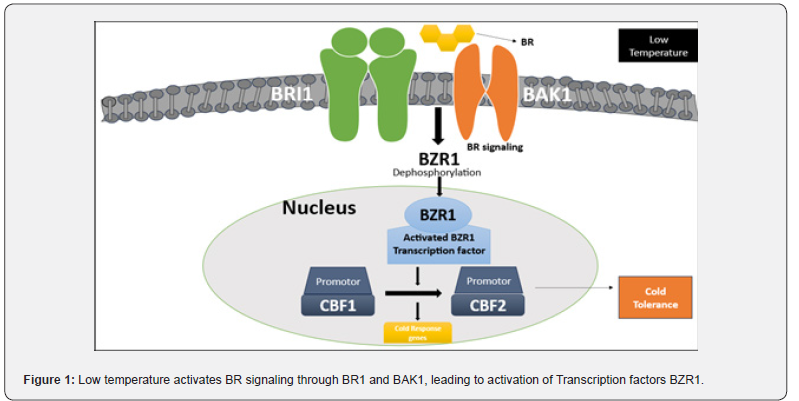
BrANS1, BrANS3, BrDFR2, BrDFR4, BrDFR8, and BrDFR9 only showed very high responses to cold stress in pigmented B. rapa samples, while BrANS2, BrDFR1, BrDFR3, BrDFR5, BrDFR6, and BrDFR10 responded to cold and freezing stress treatments [8]. Molecular studies have revealed that the ABA-independent pathway is also crucial for stress tolerance in plants. Dehydrationresponsive element binding protein 1 (DREB1)/C-repeat binding factor (CBF) and DREB2 are primarily involved in responding to cold and heat stresses, respectively [9]. Several proteins, such as ICE1, ZAT12, CAMTA3, and MYB15, have been identified as regulators of DREB1/CBF genes [10]. The anthocyanin biosynthetic genes C4H, F3H, DFR, ANS, and UFGT were enhanced under low temperature treatment [11]. Low-temperature treatment during the growth process can induce the synthesis of anthocyanins, thereby increasing their nutritional quality, ornamental appearance, and cold tolerance. A highly inbred line, Xiao Baojian’ (XBJ), was utilized to investigate the anthocyanin regulation pathway and its associated genes under low-temperature stress. Consistent with previous studies, low temperature caused the leaves of Chinese cabbage to gradually turn purple [12]. Interestingly, BZR1 (Brassinazole resistant 1), an important transcription factor for BR signaling, can bind directly to the promoter regions of CBF1 and CBF2 (CBF/DREB) and promote their expression in response to low-temperature stress, further illustrating the promotion of BR signaling for low-temperature resistance (Figure 1) [13].
The 17 different S-nitrosylation sites were identified in lowtemperature- stressed Brassica juncea [14]. In addition, the content of SNO under low-temperature stress was significantly increased by 1.4 times at 1 h. Low temperatures affect the photosynthesis of plants, reducing their photosynthetic efficiency [15]. Low temperature is a major environmental factor that limits plant growth, development and geographical distribution [16]. and may significantly reduce crop yields, including vegetable crops. Cabbage (Brassica oleracea var. capitata L.) is a widely distributed cruciferous vegetable crop in the world. If cabbage encounters low temperatures before the heading stage, or seedlings meet their vernalization conditions, afterwards, they are easy to bolt in the long daylight, resulting in the failure to form tight and leafy heads, which serve as a storage organ and edible product. If the temperature is lower than the tolerance of cabbage, the seedlings will freeze to death, resulting in serious economic losses. In Arabidopsis, the overexpression of miRNA156 causes delayed flowering at lower ambient temperatures, which is probably associated with the reduced levels of SPL3 mRNA [17]. MADS-box genes play an important role in many aspects of plant development [18]. MADS-box genes were initially identified as floral homeotic genes and are among the most extensively studied transcription factors (TFs) involved in developmental control [19]. The coldresistant variety known as Longyou-7 has demonstrated its ability to survive extreme temperatures as low as 30 C, indicating the presence of numerous cold-resistance genes within it [20].
Cold stress has been found to have a significant impact on various aspects of plant physiology, biochemistry, metabolism, and molecular processes, ultimately affecting plant growth and development [21]. Cold-tolerant varieties exhibited elevated GST enzyme activity and increased expression levels of 28 stressrelated genes in response to low-temperature stress. Certain CmGSTs, specifically those classified as Tau, Phi, and DHAR, were found to play a crucial role in response to cold stress. The study suggests that the JrGSTU1 transgenic walnut has the potential to enhance its cold tolerance by upregulating the expression of the GSTs gene and increasing GST enzyme activity under cold stress conditions [22]. Low-temperature stress was also shown to influence specialized metabolism in Brassica plants. For example, flavonoids and anthocyanins were reported to accumulate in response to cold and frost stress in Brassica rapa [6].
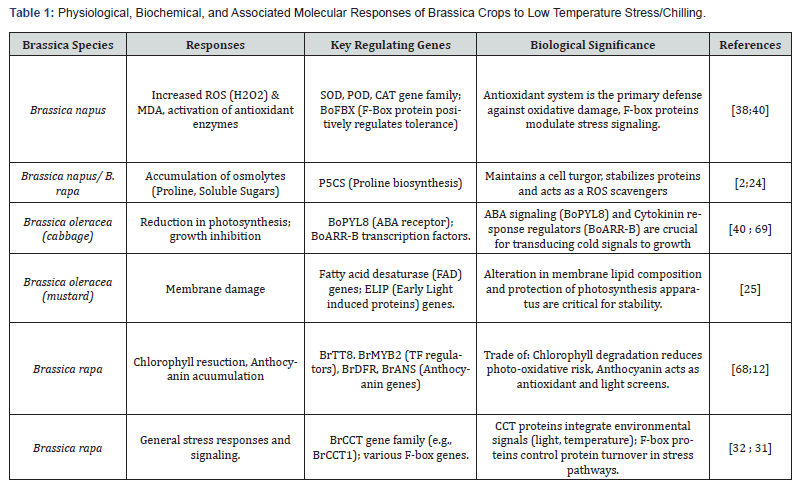
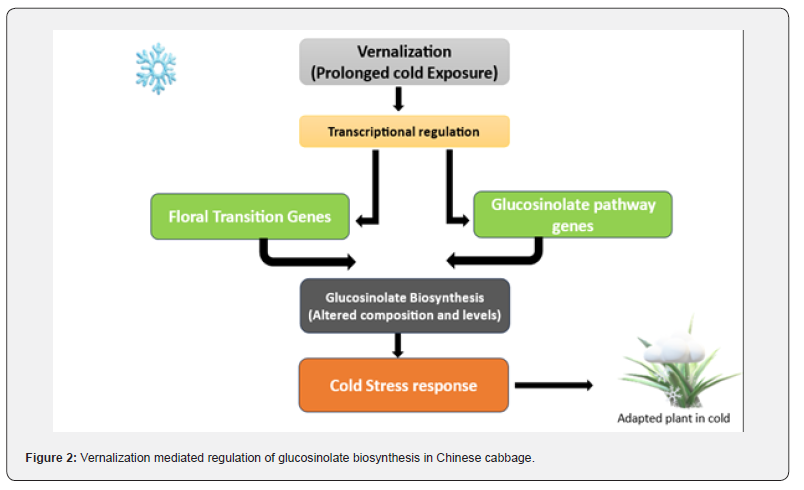
While low-temperature stress leads to the accumulation of specific flavonol glycosides and hydroxycinnamic acid derivatives in Brassica oleracea var. sabellica [7]. Plant response to abiotic stress may involve the induction of biosynthesis of various metabolites (polyphenolic compounds, carotenoids, glucosinolates) that are beneficial to human health. Kale (B. oleracea var. acephala) is tolerant to low temperatures, and in culinary practice it is considered to have the best organoleptic properties when harvested late in the growth season, after exposure to low temperatures and frost [23]. In response to low temperatures, Chinese cabbage undergoes biochemical changes, resulting in the increased production of protective compounds, including antioxidants and glucosinolates, which contribute to enhanced nutritional properties [24]. Vernalization up regulated the transcription of floral transition and glucosinolate (GSL) pathway genes and modulated glucosinolate biosynthesis in B. rapa, suggesting that GSL biosynthesis pathway is important for cold stress response in Chinese cabbage (Table 1) [25].
HD-ZIP genes participate in cold stress response by regulating cell membrane stability and ROS scavenging [26]. Brassica rapa is one of the most economically important vegetable crops worldwide. The whole-genome sequencing of B. rapa (Chiifu-401-42), conducted by the Brassica rapa Genome Sequencing Project Consortium (2011), enables us to undertake the genome-wide identification and functional analysis of gene families related to the morphological diversity and agronomic traits of Brassica crops [27]. Furthermore, B. rapa serves as a crucial reference for understanding polyploidy-related crop genome evolution because of its agronomic importance and phylogenetic relationships [27]. Crop yields are negatively affected by cold stress, including chilling (0~12°C) and freezing stress (≤0°C), resulting in constrained sowing time, damage to plant tissues, and stunted plant growth [28]. Plants respond to cold stress through a series of physiological adaptations, including regulation of phytohormones (e.g., abscisic acid, brassinosteroids, and jasmonic acid) [29].
Plants employ a range of strategies to cope with environmentally induced stresses, in which phytohormones play crucial roles [30]. Using RNA-seq, comprehensive analyses of heat treatments in NHCC identified 9,687 novel long non-coding RNAs (lncRNAs) under heat stress in B. rapa [31]. Moreover, due to promoter demethylation, high BramMDH1 expression was exhibited in coldacclimated B. rapa and the overexpression of BramMDH1 enhanced heat-tolerance and the growth rate in Arabidopsis [32]. Plants undergo a series of physiological and morphological changes to cope with cold stress including increasing malondialdehyde (MDA) content, membrane permeability, proline accumulation, and altering antioxidant enzymes including superoxide dismutase (SOD), ascorbate peroxidase (APX), catalase (CAT), peroxidase (POD) and glutathione peroxidase (GPX) activities; such effects are generally achieved through significant transcriptional regulation [33]. Plants from temperate regions can improve their FT upon exposure to cold temperatures through a process called cold acclimation [34].
This proposes that the exogenous application of compatible solutes/osmolytes could potentially be one of the intervention strategies to improve plants’ FT. Glycine betaine (GB) is one of such osmolytes that play an important role in cellular osmotic adjustment, which is associated with improved freezing tolerance through increase in resistance to freeze-induced dehydration/ desiccation [35]. Numerous studies have also noted that SA treatment enhanced plant stress tolerance against abiotic stresses such as ozone, heat, salinity, chilling, and drought [36]. In addition to the physiological responses to cold and heat, plant resistance to stress is often activated by alterations in gene expression. Transcriptomics is used to evaluate systematic changes in gene expression and estimate the response of plants to temperature stress. The positive roles of high COR gene expression and the conserved mechanism of circadian clock-related genes in tobacco’s response to cold stress have provided valuable insights for crop improvement under cold stress [37]. Previous studies have shown that calcium ions regulate enzyme activity in plants, including synthesis, secretion, and promotion of metabolic reactions, which helps maintain normal plant metabolism, growth, and development, as well as aiding resistance to environmental stresses such as drought, salinity, and low temperatures [38]. Among the families of transcription factors related to plant stress resistance, there are four significant categories of bZIP, WRKY, AP2/EREBP and MYB (Figure 2) [39].
Organisms are exposed to daily environmental cycles of light and temperature. These 24 h cycles trigger an endogenous biochemical oscillator known as the circadian clock in almost all living organisms [40]. This circadian clock coordinates internally generated rhythmic behaviors and biological processes, functioning to anticipate environmental changes associated with the day–night cycle [41]. The B. rapa Chinese cabbage is a plant belonging to the polyploid genus Brassica, and along with bok choy, turnip, and broccoli to, it is an important agricultural crop worldwide. After multiple genome duplications and diplidization, circadian clock genes were preferentially retained relative to their neighboring genes in the B. rapa genome [41]. The expression levels of BrSRO genes in leaves were analyzed under abiotic stresses for 24 hours, 48 hours, and 72 hours. Our results showed that the responses of BrSROs were different among heat, low temperature, drought, and salt stresses. BrSRO8 is sensitive to high temperatures, and the expressions of BrSRO1, 3, 7, 8, and 9 were higher under low-temperature treatment. The responses to drought stress were mediated by BrSRO1, 5, and 9, while those to NaCl stress were mediated by BrSRO7 and BrSRO8.
The expression level changed over time; it may be that plants regulate themselves to resist changes in the external environment. Interestingly, the expression levels of all 12 genes were upregulated after 24 h of salt treatment, indicating that all the genes responded to salt stress within 24 h. Excess salts in soils cause growth arrest, molecular damage, and even the death of many of the salt-sensitive crop species that are grown today [42]. Many important yield-related agronomic traits vary greatly among different Chinese cabbage varieties after a long period of evolution and breeding. QTL analysis, as a powerful tool, has been performed to identify candidate genes responsible for the morphological diversity of Chinese cabbage [43]. In plants, the roles of GLY systems in resistance to biotic and abiotic stresses have garnered increasing attention recently. The role of GLY systems in resisting salt, extreme temperature and heavy metal stresses was reported [44]. GLYI and GLYII can be induced by stresses at transcription and translation levels. For example, in Brassica juecea, GLYII expressions were significantly regulated under zinc stress [45].
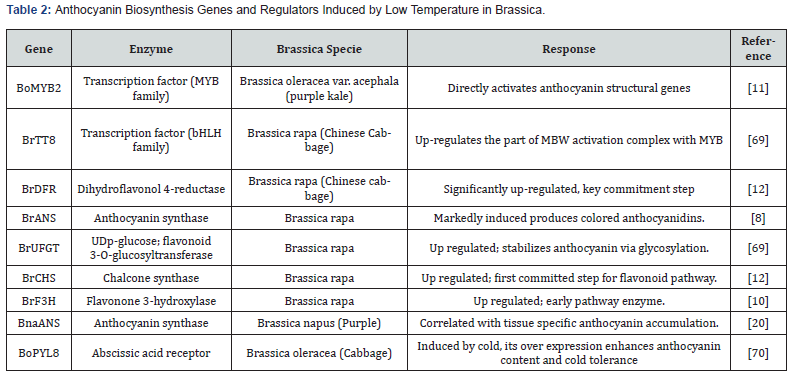
The GLYI protein in rice roots at the seedling stage was significantly induced by low temperature stress [46]. A greater expression of LEA proteins is essential for plants to maintain normal life activities during growth or under abiotic stressrelated processes. It has been demonstrated that LEA genes are upregulated in response to abscisic acid (ABA) treatment, indicating their association with ABA-related pathways [47]. 82 BrLEA gene members were identified by analyzing the genome data of Chinese cabbage. Among them, BrLEA73 belongs to the LEA-6 subfamily, for which there is less research available. Research on Caragana CkLEA6_1 found that the expression level of this gene changed significantly under low temperatures [48]. which is consistent with the results of this study. This indicates that BrLEA73 responds to low temperature stress in plants and enhances plant tolerance (Table 2).
The nsLTPs play critical roles in plant responses to abiotic stresses, e.g., cold, heat, salt and drought, as well as biotic stresses, e.g., bacterial and fungal pathogens [49]. Plant trichomes often secrete and synthesize different types of defense substances, such as terpenoids, amino acids, phenylpropanes, lipid derivatives. These secondary metabolites can protect plants from both biological and abiotic stress, playing a crucial role in defense. Phenylalanine, tryptophan, and tyrosine are all aromatic amino acids, among which tryptophan is the precursor of auxin, alkaloids, indoline, and plant antitoxin, while tyrosine is the precursor of isoquinoline alkaloids, betaine, and quinones [50]. Phenylalanine is the precursor of the phenyl cyclopropane pathway, and p-coumaryl coenzyme A is the intermediate of the phenyl-propane metabolic pathway, as well as the precursor of various substances such as phenylpropylene and flavonoids [51]. Chinese cabbage is a cool season crop, an overly low temperature or an extended period of low temperature would still cause harm to Chinese cabbage. In the growth cycle of plants, the reproductive growth stage is the most vulnerable to temperature, encompassing the formation of reproductive organs, flowering, fruit-bearing, and seed maturation. Once they encounter a low temperature, the yield of the crops will be seriously affected [52].
A low temperature would increase the activity of the antioxidant enzymes [52]. when it encounters a low-temperature environment, and many genes related to cold tolerance such as CBFs, ICE1, and WRKYs have been identified [53]. Abscisic acid plays a crucial role in the processes of plant resistance and adaptability to various abiotic stress conditions. Additionally, ABA plays a crucial role in various physiological processes, including seed formation, dormancy, germination, and reproduction. Moreover, ABA regulates reactions to environmental stresses, including heat, cold, salt, drought, and excessive levels of radiation [54]. The gene function of S3 (CT001_A03119840) was identified as abscisic acid 8’-hydroxylase. Abscisic acid (ABA) is involved in numerous processes related to environmental stress responses, as well as growth and development. Abscisic acid 8-hydroxylase is a key enzyme to regulate ABA [55]. Whole-genome duplication provides a rich genetic material for the expansion of gene families or the evolution of new genes in plants [56].
The analysis of cis-acting elements within the promoter region of the citrus SNAT gene revealed the presence of 32 distinct types of elements associated with growth and development, hormone responsiveness, and stress response. In flowering Chinese cabbage, the BcSNAT1 promoter also exhibited a high density of cis-acting elements responsive to phytohormones (including auxin, GA, MeJA, salicylic, and abscisic acid), stress (such as anaerobic induction, defense and stress responses, light, low temperature, and drought inducibility), and development (meristem) [57]. Investigation of transcriptional alterations of plants during cold acclimation is crucial for understanding the underlying molecular mechanism under LT stress. Until now, a significant number of cold responsive genes have been identified and several gene regulated networks have been reported. Among these, ICE-CBF-COR is one of the most wildly reported pathways. In most plant species, the ICE-CBF-COR pathway is induced by LT stress and then activates the appropriate expression of downstream genes, which encode osmoregulation substances [58]. Some of the cold-responsive genes have an ABA responsive element and dehydration responsive element in their promoter regions [59].
A number of studies suggest that ABA can induce increases in the transcript levels of CBF genes, perhaps via binding to the CRT/ DRE element. It has the potential to encourage CBF activation. In addition, AtHAP5A regulates freezing stress tolerance through binding to the CCAAT motif of AtXTH21 in Arabidopsis. AtHAP5A and AtXTH21 overexpressing plants were more tolerant of freezing stress but less susceptible to ABA than WT plants [60]. The regulation of GAox expression has also been explored in multiple species. Research has found that GAox plays an important role not only in development and growth but also in the response to stimulation by different exogenous hormones and abiotic stresses [61]. GAox belongs to the 2OG-Fe (II) oxygenase superfamily, which is divided into multiple small families based on structural and functional differences [62]. Brassica plants, including B. Juncea, B. Oleracea and B. napus, and B. rapa, are globally important crops known for their diversity. Chinese cabbage, a B. rapa subspecies, is particularly valued for its economic and nutritional value to humans. However, it is subject to various biotic (e.g., fungi, bacteria, viruses, and insects) and abiotic stresses (e.g., low temperatures, salt, and drought) in its natural environment. This leads to severe growth stagnation, yield loss, and quality reduction of Chinese cabbage crops [63].
BrBASS7 harbors great potential for regulating cold stress. The RT-qPCR showed that this gene’s relative expression fell considerably under low temperature stress. Analysis of the promoter elements revealed that BrBASS7 contained a lowtemperature response element, an abscisic acid response element, and an auxin-responsive hormone response element. When plants are exposed to cold conditions, stomatal opening in their leaves is inhibited, resulting in the accumulation of ABA during stomatal closure that in turn enables plants to cope with cold stress [64]. Research has confirmed that the synthesis of GLS in Brassica plants was also affected by ambient temperature, in that low temperatures promoted the production of GLS in response to external factors [65]. Brassica contains many vegetables rich in anthocyanins. In Brassica species, numerous studies have focused on identifying genes associated with anthocyanin accumulation and their subsequent functional analysis. In rapid cycling B. rapa, an anthocyaninless (anl) locus, which inhibits anthocyanin synthesis, had been mapped to R9 [66]. BrPur, a single dominant gene controlling endophytic leaf anthocyanin accumulation in Chinese cabbage, had been mapped to linkage group A07 [67]. Additionally, numerous genes related to anthocyanin accumulation have been identified and cloned. For example, low-temperature treatment induced the expression of BoTT8 and BoMYB2/BoPAP1, regulating the accumulation of anthocyanins in purple kale [11]. The low-temperature induction of anthocyanin biosynthesis in Brassica species is achieved mainly by a core transcriptional activation complex and the induction of structural pathway genes. This induction is mediated by the activation of specific transcription factors, with MYB proteins acting as master regulators. For example, BoMYB2 (also referred to as BoPAP1) from purple kale (Brassica oleracea var. acephala) is strongly induced by cold and directly binds to the promoters of anthocyanin biosynthetic genes to activate their expression (Table 3) [11]. MYB factor BoMYB2 itself does not act alone but exerts its function within the well-characterized MBW complex, which requires interaction with a bHLH partner. Similarly, in Chinese cabbage (Brassica rapa), the bHLH transcription factor BrTT8 is upregulated by low temperature and is required for the formation of this active complex [68]. The activated MBW complex then orchestrates the coordinated expression of the whole anthocyanin biosynthetic pathway.
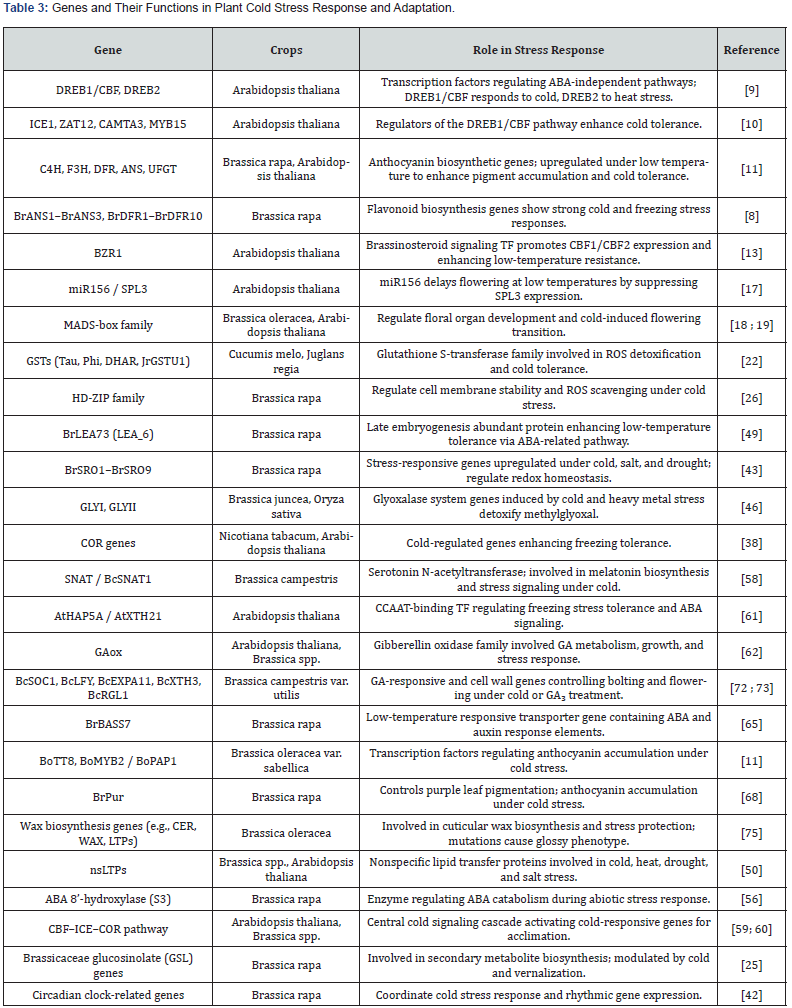
The key structural genes that code for early enzymes, including BrCHS and BrF3H, and later specifically dedicated genes, including BrDFR, BrANS, and BrUFGT, are all highly upregulated during chilling stress. Further, multiple (e.g., BrDFR1- BrDFR10 and BrANS1-BrANS3) cold-responsive paralogs of critical DFR and ANS have been reported in the B. rapa genome. This transcriptional cascade results in the biosynthesis and accumulation of anthocyanins, which serve as potent antioxidants to scavenge reactive oxygen species and as light-attenuating pigments to reduce photo-oxidative damage and enhance freezing and chilling tolerance (Ahmed et al., 2015). Moreover, hormone signaling interacts with this pathway, for which evidence has been provided by the ABA receptor gene BoPYL8, whose coldinduced expression and activity further promotes anthocyanin biosynthesis and cold acclimation in cabbage [69].
Flowering Chinese cabbage (Brassica campestris L. ssp. Chinensis var. utilis Tsen et Lee) is a highly cultivated and productive vegetable in southern China [70]. It belongs to the Chinese cabbage subspecies of Brassica species in the Brassicaceae family. The main product organ is the flowering stalk. The formation of the flowering stalk involves two simultaneous processes: bolting, which is characterized by stem elongation and thickening, and flowering. Gibberellin (GA) is a crucial factor influencing bolting in flowering Chinese cabbage. Treatment with exogenous gibberellin A3 (GA3) has been shown to induce the up regulation of BcSOC1 and genes encoding cell wall structural proteins (BcEXPA11, BcXTH3) in flowering Chinese cabbage, thereby facilitating early bolting and flowering processes. Moreover, low temperatures trigger GA accumulation at the stem tip, accelerating growth and flowering. Conversely, using a GA synthesis inhibitor (PAC) suppresses the initiation of bolting and flowering [71].
Loss-of-function mutations in BcRGL1, a DELLA protein, affect the expression of various genes in flowering Chinese cabbage. These genes include the GA regulatory gene BcGASA6, flowerrelated genes BcSOC1 and BcLFY, and genes encoding cell wall structural proteins BcEXPA11 and BraXTH3. These mutations promote flowering and bolting. Conversely, overexpression of BcRGL1 suppressed both bolting and flowering in flowering Chinese cabbage [72]. The proportion of aldehyde, primary alcohol, and ester significantly increases in leaf cuticle wax in Brassica oleracea var. gemmifera under lower light and higher temperature conditions, whereas the biosynthesis of alkanes, secondary alcohol, and ketones is enhanced at higher light and lower temperature levels [73]. The accumulation of glaucous powdery wax on the surface of leaves and stems is completely or partially dampened in wax-deficient mutants, so that wax-deficient leaves and stems generally exhibit a glossy green appearance. In cabbage, numerous wax biosynthesis-related genes have been characterized as glossy green mutants. A large number of genetic analyses have shown that most wax-deficient mutations in cabbage are controlled by a single recessive gene [74].
Conclusion
Cold stress represents a major constraint to the growth, development, and productivity of Brassica crops. Understanding the interplay among phytohormones, transcription factors, secondary metabolism, and circadian regulation provide valuable insights for breeding cold-tolerant cultivars with improved yield and nutritional quality.
References
- Zhu JK (2016) Abiotic stress signaling and responses in plants. Cell 167(2): 313-324.
- Raza A, Ashraf F, Zou X, Zhang X, Tosif H (2020) Plant adaptation and tolerance to environmental stresses: mechanisms and perspectives Plant ecophysiology and adaptation under climate change: mechanisms and perspectives I: General consequences and plant responses. Springer pp. 117-145.
- Khan AR, Salam A, Li G, Iqbal B, Ulhassan Z, et al. (2024) Nanoparticles and their crosstalk with stress mitigators: A novel approach towards abiotic stress tolerance in agricultural systems. The Crop Journal 12(5): 1280-1298.
- Ullah I, Mao H, Rasool G, Gao H, Javed Q, et al. (2021) Effect of deficit irrigation and reduced N fertilization on plant growth, root morphology and water use efficiency of tomato grown in soilless culture. Agronomy 11(2): 228.
- Finch SWE, Leubner MG (2006) Seed dormancy and the control of germination. New Phytol 171(3): 501-523.
- Soengas P, Rodríguez VM, Velasco P, Cartea ME (2018) Effect of temperature stress on antioxidant defenses in Brassica oleracea. ACS omega 3(5): 5237-5243.
- Neugart S, Krumbein A, Zrenner R (2016) Influence of light and temperature on gene expression leading to accumulation of specific flavonol glycosides and hydroxycinnamic acid derivatives in kale (Brassica oleracea var. sabellica). Front Plant Sci 7: 326.
- Ahmed NU, Park JI, Jung HJ, Hur Y, Nou IS (2015) Anthocyanin biosynthesis for cold and freezing stress tolerance and desirable color in Brassica rapa. Funct Integr Genomics 15(4): 383-394.
- Chinnusamy V, Zhu JK, Sunkar R (2010) Gene regulation during cold stress acclimation in plants. Methods Mol Biol 639: 39-55.
- Doherty CJ, Van BHA, Myers SJ, Thomashow MF (2009) Roles for Arabidopsis CAMTA transcription factors in cold-regulated gene expression and freezing tolerance. Plant Cell 21(3): 972-984.
- Zhang B, Hu Z, Zhang Y, Li Y, Zhou S, et al. (2012) A putative functional MYB transcription factor induced by low temperature regulates anthocyanin biosynthesis in purple kale (Brassica Oleracea var. acephala f. tricolor). Plant cell rep 31(2): 281-289.
- He Q, Ren Y, Zhao W, Li R, Zhang L (2020) Low temperature promotes anthocyanin biosynthesis and related gene expression in the seedlings of purple head Chinese cabbage (Brassica rapa L.). Genes 11(1): 81.
- Li H, Ye K, Shi Y, Cheng J, Zhang X, et al. (2017) BZR1 positively regulates freezing tolerance via CBF-dependent and CBF-independent pathways in Arabidopsis. Mol Plant 10(4): 545-559.
- Ye Z, Hu F, Zhang W, Fang D, Dong K, et al. (2023) Amino acid transporters of Brassica napus: Identification, evolution, expression and response to various stresses. Industrial Crops and Products 194: 116338.
- Gao X, Ma J, Tie J, Li Y, Hu L, et al. (2022) BR-Mediated Protein S-Nitrosylation alleviated low-temperature stress in mini chinese cabbage (Brassica rapa ssp. pekinensis). Int J Mol Sci 23(18): 10964.
- Thomashow MF (1999) Plant cold acclimation: freezing tolerance genes and regulatory mechanisms. Annu Rev Plant Physiol Plant Mol Biol 50: 571-599.
- Kim JJ, Lee JH, Kim W, Jung HS, Huijser P, et al. (2012) The microRNA156-SQUAMOSA PROMOTER BINDING PROTEIN-LIKE3 module regulates ambient temperature-responsive flowering via FLOWERING LOCUS T in Arabidopsis. Plant physiology 159(1): 461-478.
- Alvarez BER, Liljegren SJ, Pelaz S, Gold SE, Burgeff C, et al. (2000) MADS‐box gene evolution beyond flowers: expression in pollen, endosperm, guard cells, roots and trichomes. Plant J 24(4): 457-466.
- Messenguy F, Dubois E (2003) Role of MADS box proteins and their cofactors in combinatorial control of gene expression and cell development. Gene 316: 1-21.
- Ma L, Bai J, Zhao YH, Sun BL, Hou XF, et al. (2022) Protein and physiological differences under cold stress, and identification and analysis of BnGSTs in Brassica napus L.
- Qin C, Weifu K, Pengfei W (2004) Plant freezing tolerance and genes express in cold acclimation: a review. Acta Ecologica Sinica, 24: 806-811.
- Yang G, Xu Z, Peng S, Sun Y, Jia C, et al. (2016) In planta characterization of a tau class glutathione S-transferase gene from Juglans regia (JrGSTTau1) involved in chilling tolerance. Plant cell rep 35(3): 681-692.
- Steindal ALH, Rødven R, Hansen E, Mølmann J (2015) Effects of photoperiod, growth temperature and cold acclimatisation on glucosinolates, sugars and fatty acids in kale. Food Chem 174: 44-51.
- Zhang J, Liu S, Li H, Sun M, Yan B, et al. (2025) Global Transcriptome and Weighted Gene Co-Expression Network Analyses of Cold Stress Responses in Chinese Cabbage. Genes 16(7): 845.
- Kang H, Nugroho ABD, Park M, Kim JA, Lee SW, et al. (2022) Vernalization regulates flowering genes and modulates glucosinolates biosynthesis in chinese cabbage. Journal of Plant Biology 65: 157-173.
- Li Y, Yang Z, Zhang Y, Guo J, Liu L, et al. (2022) The roles of HD-ZIP proteins in plant abiotic stress tolerance. Front Plant Sci 13: 1027071.
- Mun JH, Yu HJ, Shin JY, Oh M, Hwang HJ, et al. (2012) Auxin response factor gene family in Brassica rapa: genomic organization, divergence, expression, and evolution. Mol Genet Genomics 287(10): 765-784.
- Karkute S, Krishna R, Ansari W, Singh B, Singh P, et al. (2019) Heterologous expression of the AtDREB1A gene in tomato confers tolerance to chilling stress. Biol Plant 63: 268-277.
- Guo J, Beemster GT, Liu F, Wang Z, Li X (2023) Abscisic acid regulates carbohydrate metabolism, redox homeostasis and hormonal regulation to enhance cold tolerance in spring barley. Int J Mol Sci 24(14): 11348.
- Mickelbart MV, Hasegawa PM, Bailey SJ (2015) Genetic mechanisms of abiotic stress tolerance that translate to crop yield stability. Nature Reviews Genetics, 16(4): 237-251.
- Song X, Liu G, Huang Z, Duan W, Tan H, et al. (2016) Temperature expression patterns of genes and their coexpression with LncRNAs revealed by RNA-Seq in non-heading Chinese cabbage. BMC genomics 17: 297.
- Liu T, Li Y, Duan W, Huang F, Hou X (2017) Cold acclimation alters DNA methylation patterns and confers tolerance to heat and increases growth rate in Brassica rapa. J Exp Bot 68(5): 1213-1224.
- Feng Y, Li Z, Kong X, Khan A, Ullah N, et al. (2025) Plant coping with cold stress: molecular and physiological adaptive mechanisms with future perspectives. Cells 14(2): 110.
- Thomashow MF (2010) Molecular basis of plant cold acclimation: insights gained from studying the CBF cold response pathway. Plant Physiol 154(2): 571-577.
- Uemura M, Tominaga Y, Nakagawara C, Shigematsu S, Minami A, et al. (2006) Responses of the plasma membrane to low temperatures. Physiologia Plantarum 126(1): 81-89.
- Khan MIR, Fatma M, Per TS, Anjum NA, Khan NA (2015) Salicylic acid-induced abiotic stress tolerance and underlying mechanisms in plants. Front Plant Sci 6: 462.
- Hu R, Zhu X, Xiang S, Zhan Y, Zhu M, et al. (2016) Comparative transcriptome analysis revealed the genotype specific cold response mechanism in tobacco. Biochem Biophys Res Commun 469(3): 535-541.
- Zhang X, Ma M, Ye B, Liu L, Ji S (2021) Calcium ion improves cold resistance of green peppers (Capsicum annuum L.) by regulating the activity of protective enzymes and membrane lipid composition. Scientia Horticulturae 277: 109789.
- Jolma A, Yin Y, Nitta KR, Dave K, Popov A, et al. (2015) DNA-dependent formation of transcription factor pairs alters their binding specificity. Nature 527(7578): 384-388.
- Wang B, Tang Z, Lao L, Wang G, Jing T, et al. (2024) Rice stem lodging properties and bending modeling under the influence of circadian temperature difference. Int J Agric & Biol Eng 17(3): 21-32.
- Farré EM, Liu T (2013) The PRR family of transcriptional regulators reflects the complexity and evolution of plant circadian clocks. Curr Opin Plant Biol 16(5): 621-629.
- Liang W, Ma X, Wan P, Liu L (2018) Plant salt-tolerance mechanism: A review. Biochem Biophys Res Commun 495(1): 286-291.
- Li F, Zou Z, Yong HY, Kitashiba H, Nishio T (2013) Nucleotide sequence variation of GLABRA1 contributing to phenotypic variation of leaf hairiness in Brassicaceae vegetables. Theor Appl Genet 126(5): 1227-1236.
- Veena, Reddy VS, Sopory SK (1999) Glyoxalase I from Brassica juncea: molecular cloning, regulation and its over-expression confer tolerance in transgenic tobacco under stress. Plant J 17(4): 385-395.
- Saxena M, Bisht R, Roy SD, Sopory S, Bhalla SN (2005) Cloning and characterization of a mitochondrial glyoxalase II from Brassica juncea that is upregulated by NaCl, Zn, and ABA. Biochem Biophys Res Commun 336(3): 813-819.
- Lee DG, Ahsan N, Lee SH, Lee JJ, Bahk JD, et al. (2009) Chilling stress-induced proteomic changes in rice roots. J Plant Physiol 166(1): 1-11.
- Lee SC, Luan S (2012) ABA signal transduction at the crossroad of biotic and abiotic stress responses. Plant Cell Environ 35(1): 53-60.
- Jiang Y, Zhang S, Xu H, Tian H, Zhang M, et al. (2023) Identification of the BcLEA gene family and functional analysis of the BcLEA73 gene in Wucai (Brassica campestris L.). Genes 14(2): 415.
- Liu F, Zhang X, Lu C, Zeng X, Li Y, et al. (2015) Non-specific lipid transfer proteins in plants: presenting new advances and an integrated functional analysis. J Exp Bot 66(19): 5663-5681.
- Barros J, Serrani YJC, Chen F, Baxter D, Venables BJ, et al. (2016) Role of bifunctional ammonia-lyase in grass cell wall biosynthesis. Nat Plants 2(6): 16050.
- Vogt T (2010) Phenylpropanoid biosynthesis. Molecular plant 3: 2-20.
- Huner NP, Öquist G, Hurry VM, Krol M, Falk S, et al. (1993) Photosynthesis, photoinhibition and low temperature acclimation in cold tolerant plants. Photosynth Res 37(1): 19-39.
- Wang Z, Wang F, Tang J, Huang Z, Xiong A, et al. (2014) C-repeat binding factor gene family identified in non-heading Chinese cabbage is functional in abiotic and biotic stress response but different from that in Arabidopsis. Acta Physiologiae Plantarum 36: 3217-3229.
- Vu NT, Park JM, Kim S, Tran T, Jang DC (2020) Effect of abscisic acid on growth and physiology of arabica coffee seedlings under water deficit condition. Sains Malays 49(7): 1499-1508.
- Cutler AJ, Rose PA, Squires TM, Loewen MK, Shaw C, Quail JW, et al. (2000) Inhibitors of abscisic acid 8 ‘-hydroxylase. Biochemistry 39(44): 13614-13624.
- Hittinger CT, Carroll SB (2007) Gene duplication and the adaptive evolution of a classic genetic switch. Nature 449(7163): 677-681.
- Anwar A, Zhang S, Wang Y, Feng Y, Chen R, et al. (2023) Genome-wide identification and expression profiling of the BcSNAT family genes and their response to hormones and abiotic stresses in flowering Chinese cabbage. Scientia Horticulturae 322: 112445.
- Zhang F, Jiang Y, Bai LP, Zhang L, Chen LJ, et al. (2011) The ICE-CBF-COR pathway in cold acclimation and AFPs in plants. Middle East J. Sci. Res8 (2): 493-498.
- Yadav SK (2010) Cold stress tolerance mechanisms in plants. A review. Agronomy for sustainable development 30(3): 515-527.
- Shi H, Ye T, Zhong B, Liu X, Jin R, et al. (2014) At HAP 5A modulates freezing stress resistance in Arabidopsis through binding to CCAAT motif of AtXTH21. New Phytol 203(2): 554-567.
- Rieu I, Ruiz RO, Fernandez GN, Griffiths NF, Powers SJ, et al. (2008) The gibberellin biosynthetic genes AtGA20ox1 and AtGA20ox2 act, partially redundantly, to promote growth and development throughout the Arabidopsis life cycle. Plant J 53(3): 488-504.
- Hedden P, Phillips AL (2000) Gibberellin metabolism: new insights revealed by the genes. Trends Plant Sci 5(12): 523-530.
- Fang Y, Xiong L (2015) General mechanisms of drought response and their application in drought resistance improvement in plants. Cell Mol Life Sci 72(4): 673-689.
- Agurla S, Gahir S, Munemasa S, Murata Y, AS Raghavendra (2018) Mechanism of stomatal closure in plants exposed to drought and cold stress. Adv Exp Med Biol 1081: 215-232.
- Kissen R, Eberl F, Winge P, Uleberg E, Martinussen I, et al. (2016) Effect of growth temperature on glucosinolate profiles in Arabidopsis thaliana accessions. Phytochemistry 130: 106-118.
- Burdzinski C, Wendell DL (2007) Mapping the anthocyaninless (anl) locus in rapid-cycling Brassica rapa (RBr) to linkage group R9. BMC genetics 8: 64.
- Wu JQ, Zhao J, Qin ML, Ren YJ, Zhang HM, et al. (2016) Genetic analysis and mapping of the purple gene in purple heading Chinese cabbage. Horticultural Plant Journal 2(6): 351-356.
- Dai Y, Zhang L, Sun X, Li F, Zhang S, et al. (2022) Transcriptome analysis reveals anthocyanin regulation in Chinese cabbage (Brassica rapa L.) at low temperatures. Scientific Reports 12: 6308.
- Li Q, Cai Y, Gu L, Yu X, Wang Y, et al. (2024) Transcriptome reveals molecular mechanism of cabbage response to low temperature stress and functional study of BoPYL8 gene. Scientia Horticulturae 323: 112523.
- Rasool G, Guo X, Wang Z, Hassan M, Aleem M, et al. (2020) Effect of buried straw layer coupled with fertigation on florescence and yield parameters of Chinese cabbage under greenhouse environment. Journal of Soil Science and Plant Nutrition 20: 598-609.
- Guan H, Huang X, Zhu Y, Xie B, Liu H, et al. (2021) Identification of DELLA genes and key stage for GA sensitivity in bolting and flowering of flowering Chinese cabbage. Int J Mol Sci 22(22): 12092.
- Wang Y, Song S, Hao Y, Chen C, Ou X, et al. (2023) Role of BraRGL1 in regulation of Brassica rapa bolting and flowering. Hortic Res 10(8): uhad119.
- Baker E (1974) The influence of environment on leaf wax development in Brassica oleracea var. gemmifera. New Phytologist 73(5): 955-966.
- Ji J, Cao W, Tong L, Fang Z, Zhang Y, et al. (2021) Identification and validation of an ECERIFERUM2-LIKE gene controlling cuticular wax biosynthesis in cabbage (Brassica oleracea L. var. capitata L.). Theoretical and Applied Genetics 134(12): 4055-4066.

























