




 JOJHA Home



From Comets to Space Debris: Assessing Extraterrestrial Impacts on Earth’s Biodiversity
Kashaf*
Department of Botany, GCWUF Faisalabad, Pakistan
Submission:February 16, 2026;Published: February 25, 2026
*Corresponding author: Kashaf, Department of Botany GCWUF, Faisalabad, Pakistan
How to cite this article: Kashaf. From Comets to Space Debris: Assessing Extraterrestrial Impacts on Earth’s Biodiversity. JOJ Horticulture & Arboriculture, 6(2). 555684.DOI: 10.19080/JOJHA.2026.06.555684.
Abstract
Earth is continuously exposed to a variety of extraterrestrial objects, including comets, asteroids, meteoroids, meteors, fireballs, meteorites, and anthropogenic space debris. These cosmic visitors can have significant effects on the environment, ecosystems, and biodiversity, ranging from catastrophic impacts to subtle, long-term influences. The consequences of such interactions can manifest as habitat destruction, climate alterations, introduction of extraterrestrial materials, and ecological stress, ultimately affecting plants, animals, and humans. This review synthesizes current knowledge on types, frequency, and mechanisms of extraterrestrial impacts, highlighting their direct and indirect effects on terrestrial life. Understanding these interactions is crucial for biodiversity conservation, disaster preparedness, and ecological research, as humanity faces increasing risks from both natural and artificial cosmic debris.
Keywords:Near-Earth Objects (NEOs); Comets; Asteroids; Meteoroids; Meteorites; Fireballs; Space debris; Biodiversity; Ecological impact; Human-environment interactions
Introduction
Earth exists in a dynamic and interconnected cosmic environment, constantly influenced by extraterrestrial objects (ETOs) originating from both natural celestial bodies and humanmade debris [1]. Natural objects such as comets, asteroids, meteoroids, and meteors originate from the solar system’s asteroid belt, the Kuiper Belt, or beyond. These objects vary in size, composition, and frequency of Earth encounters [2]. While many small meteoroids burn harmlessly in the atmosphere, larger bodies such as asteroids or comets can cause catastrophic environmental and ecological disturbances, as seen in historical mass extinction events like the Cretaceous-Paleogene extinction approximately 66 million years ago [3]. In addition to natural objects, anthropogenic space debris, including defunct satellites and rocket stages, is becoming an increasing concern [4]. Though smaller and less frequent in terms of catastrophic potential, space debris can affect terrestrial ecosystems when fragments survive atmospheric entry [5]. The study of extraterrestrial impacts extends beyond astronomy and physics; it is intrinsically connected to ecology, evolutionary biology, and environmental science, as these events influence ecosystem dynamics, species evolution, and biodiversity patterns [6]. The interaction of Earth with cosmic bodies can af fect plants, animals, and humans in multiple ways [7]. For plants, impacts can alter soil composition, nutrient availability, and photosynthetic efficiency, potentially causing localized die-offs or genetic changes over generations [8]. Animal populations may face habitat destruction, food scarcity, and altered migration patterns, while humans can experience direct physical harm, health risks from atmospheric toxins, and long-term socio-economic effects [9]. Even subtle contributions from cosmic dust and meteorites may introduce essential minerals or organic compounds, influencing microbial and plant diversity and, indirectly, food webs [10]. This review aims to provide a comprehensive synthesis of current knowledge regarding extraterrestrial impacts on Earth, detailing types of objects, mechanisms of interaction, and specific effects on plants, animals, and humans, while highlighting research gaps and future directions in the interdisciplinary field of Astro ecology.
Types of Extraterrestrial Objects
Comets
Composed of ice, dust, and organic molecules, often described as “dirty snowballs.” When approaching the Sun, comets produce bright comas and tails, which may deposit prebiotic organic materials on Earth. Effects include soil enrichment, microbial stimulation, and potential contributions to early evolutionary processes [11].
Asteroids
Primarily rocky or metallic bodies located in the asteroid belt. Large impacts can cause mass extinctions, firestorms, tsunamis, and climate disruption. Smaller asteroids contribute to elemental deposition, influencing plant nutrient cycles [12].
Meteoroids, Meteors, and Fireballs
Small fragments of comets or asteroids. When entering the atmosphere, they become meteors, producing light phenomena; exceptionally bright ones are called fireballs. May shock ecosystems, alter local climates, and contribute micronutrients to soil [13].
Meteorites
Fragments that survive atmospheric entry. Provide direct evidence of extraterrestrial chemistry, including rare metals and organic compounds. Influence soil chemistry and may affect plant growth and microbial diversity [14].
Anthropogenic Space Debris
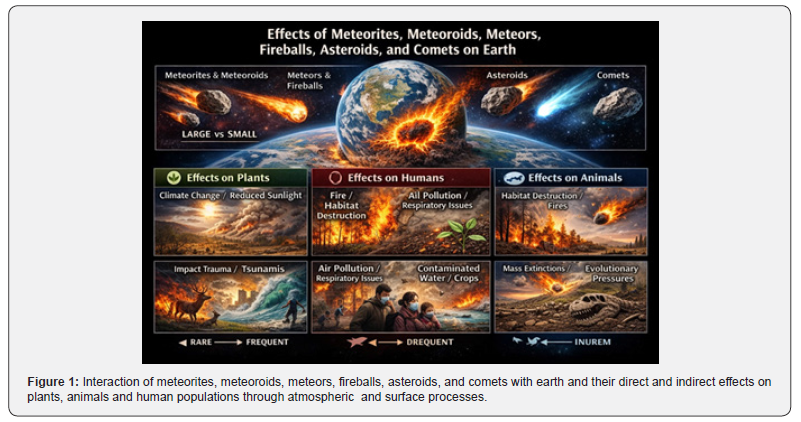
Includes satellites, rocket stages, and discarded hardware. Upon re-entry, can introduce toxic metals and pollutants, potentially disrupting aquatic and terrestrial ecosystems [15] as shown in (Figure 1).
Mechanisms of Impact on Earth’s Biodiversity
Effects on Plants
Alteration of soil nutrient composition through deposition of minerals and cosmic dust. Physical destruction of vegetation from large impacts [16]. Indirect effects via climate change: reduced sunlight or increased aerosols can affect photosynthesis, growth rates, and reproductive cycles. Introduction of mutagenic compounds, potentially influencing genetic diversity [17]..
Effects on Animals
Habitat destruction due to impact craters, tsunamis, and wildfires. Disruption of food chains and migration patterns [18]. Increased mortality from direct impacts or environmental stress. Long-term evolutionary pressures, potentially driving adaptation or speciation [19].
Effects on Humans
Physical hazards from large meteorite impacts or falling debris. Exposure to toxic elements or aerosols, affecting respiratory health and water quality [20]. Disruption of agriculture, infrastructure, and global economies due to ecological imbalance. Psychological and social effects in populations affected by impact events [21].
Environmental and Ecological Effects
Local and global climate perturbations due to dust and aerosols [22]. Nutrient enrichment in ecosystems from extraterrestrial material. Influence on microbial diversity, potentially affecting decomposition and soil fertility. Creation of new habitats in crater regions, supporting unique ecosystems [23].
Factors Determining Severity of Impact
Size, mass, and velocity of the object
Larger and heavier objects contain more kinetic energy, resulting in more severe impacts. Even relatively small objects, if moving at very high speeds, can cause localized ecological damage, such as forest fires or crater formation that disrupts soil microbial communities [24]. High-speed impacts generate shock waves, intense heat, and ejecta that may spread debris and toxic gases over wide areas. For plants, this can damage foliage, destroy seed banks, and alter nutrient dynamics. Animals and humans face heightened risks of injury and mortality due to blast effects [25]. The combined effect of size, mass, and speed can make a small, fast-moving meteoroid more destructive than a larger but slower asteroid. This interplay can help identify which ecosystems, plant communities, or animal populations are most vulnerable to impact events [26].
Composition (rocky, icy, metallic)
Rocky objects generate extreme heat and intense shock waves, causing fires and sterilizing soils. Icy objects release water vapor and gases during entry, which can influence local microclimates, temporarily flood areas, or change soil moisture conditions [27]. Metallic objects more likely to survive atmospheric entry and deliver heavy metals or rare elements to ecosystems. While small quantities may benefit plants, high concentrations can be toxic, altering soil and water chemistry [28]. The composition of an object determines the type of ecological effects are; Rocky are composed of fire and soil sterilization Icy are composed of flooding and moisture stress Metallic are composed of trace elements and heavy metal contamination [29]. This factor uniquely links planetary material properties with ecological outcomes, a perspective often overlooked in current research..
Angle and location of impact (ocean, forest, urban)
Oblique angles disperse debris over larger regions but create shallower craters, whereas vertical impacts concentrate energy, causing maximum local destruction to soils and underground organisms [30]. Oceans may generate tsunamis affecting coastal ecosystems and human settlements. Forests can trigger fires, destroy habitats, and disrupt carbon storage. Urban areas cause human casualties, crop loss, and contamination of water systems [31]. Combining angle and location allows prediction of local vs. regional effects, which is crucial for disaster management. Forest and ocean impacts are especially important for biodiversity hotspots, providing guidance for conservation planning [32].
Frequency of impacts
Large but rare impacts can produce global catastrophes, such as mass extinctions. Smaller, more frequent impacts continuously influence ecosystems, affecting plant growth, animal behavior, migration, and human infrastructure [33]. Recurrent smaller events can act as selective pressures, favoring resilient species and shaping evolutionary trajectories over long time scales. This subtle, cumulative effect is often underestimated in traditional research [34].
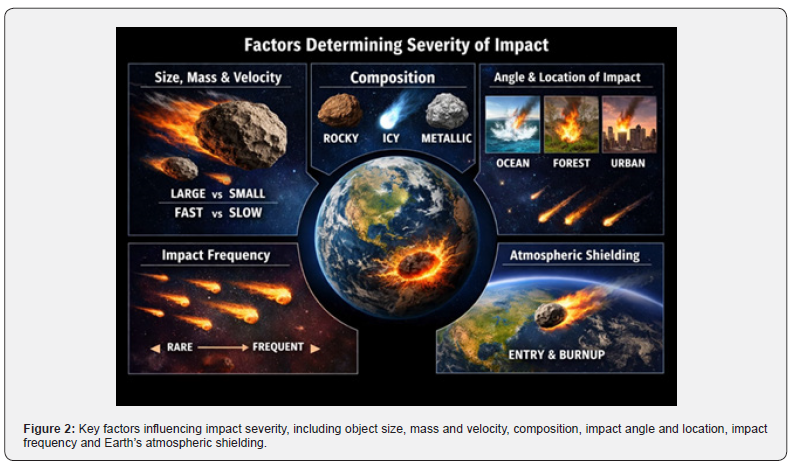
Earth’s atmospheric shielding
The atmosphere protects Earth by burning up most small objects before they reach the surface. Larger objects can survive entry, creating shock waves, fireballs, and localized blast zones [35]. Atmospheric protection depends on the object’s composition, speed, and entry angle. Ice and rocky objects may fragment mid-air, dispersing heat and chemical materials across ecosystems, while metallic objects can reach the ground intact, causing concentrated damage. This dual role of the atmosphere both shields and selectively exposes ecosystems to extraterrestrial impacts [36] as shown in (Figure 2).
Conclusion
Extraterrestrial objects, from comets and asteroids to meteoroids, meteorites, and space debris, have played a significant role in shaping Earth’s environment and biodiversity. While catastrophic events are rare, they can cause profound ecological disruption, habitat destruction, and species extinction. More frequent, smaller interactions subtly influence ecosystems through nutrient enrichment, soil alteration, and microbial stimulation, affecting plants, animals, and humans. Anthropogenic space debris adds a modern dimension to these interactions, posing chemical and physical risks. Understanding these processes is crucial for biodiversity conservation, ecosystem management, and disaster preparedness, and requires continued research across astronomy, ecology, and environmental sciences. Integrating knowledge of cosmic impacts into ecological planning may help humanity anticipate risks and preserve life on Earth in an increasingly interconnected cosmic environment.
References
- Chilingarian A, Arakelyan K, Avakyan K, Babayan V, Bostanjyan N, et a. (2005) Correlated measurements of secondary cosmic ray fluxes by the Aragats Space-Environmental Center monitors. Nuclear Instruments and Methods in Physics Research Section A: Accelerators, Spectrometers, Detectors and Associated Equipment 543(2-3): 483-496.
- Barenbaum A (2024) Origin of Solar System Comets. In Processes in GeoMedia. Singapore: Springer Nature Singapore 8: 167-198.
- Nemchinov I, Shuvalov V, Svetsov V (2008) Main factors of hazards due to comets and asteroids. In Catastrophic events caused by cosmic objects pp. 1-89.
- Albuja AA, Scheeres DJ, McMahon JW (2015) Evolution of angular velocity for defunct satellites as a result of YORP: An initial study. Advances in Space Research 56(2): 237-251.
- Efimov S, Pritykin D, Sidorenko V (2017) Defunct satellites in nearly polar orbits: Long-term evolution of attitude motion. arXiv preprint arXiv:1711.07046.
- Dick SJ (2013) The societal impact of extraterrestrial life: The relevance of history and the social sciences. Astrobiology, History, and Society: Life Beyond Earth and the Impact of Discovery pp. 227-257.
- Alemdar E (2020) High Consciousness! Cosmic Man and Cosmic Organs. nutrition 32(3): 25050-25056.
- Kardol P, Cregger MA, Campany CE, Classen AT (2010) Soil ecosystem functioning under climate change: plant species and community effects. Ecology 91(3): 767-781.
- White R (2017) Animal abuse resulting from wildlife habitat destruction. In The Palgrave international handbook of animal abuse studies pp. 249-268.
- Jones AP (2007) The mineralogy of cosmic dust: Astro mineralogy. European of Mineralogy 19(6): 771-782.
- Keller HU (1989) Comets: Dirty snowballs or icy dirtballs. In Physics and Mechanics of Cometary Materials Vol. 302.
- Britt DT, Guy Consolmagno SJ, Lebofsky L (2014) Main-belt asteroids. In Encyclopedia of the solar system pp. 583-601.
- Hipkins CR (2009). FIREBALLS: A History of Meteors and other Atmospheric Phenomena. Xlibris Corporation.
- Olah GA, Mathew T, Prakash GS (2016) Relevance and significance of extraterrestrial abiological hydrocarbon chemistry. J of the American Chemical Society 138(22): 6905-6911.
- Barato F (2021) Challenges of Ablatively Cooled Hybrid Rockets for Satellites or Upper Stages. Aerospace 8(7): 190.
- Reynolds R, Belnap J, Reheis M, Lamothe P, Luiszer F (2001) Aeolian dust in Colorado Plateau soils: nutrient inputs and recent change in source. Proceedings of the National Academy of Sciences 98(13): 7123-7127.
- Barbour L, Hanna M, Xiao W (2006) Mutagenesis. In Yeast Protocol pp. 121-127.
- Cooke SJ, Galassi DM, Gillanders BM, Landsman SJ, Hammerschlag N, et al. (2022) Consequences of “natural” disasters on aquatic life and habitats. Environmental reviews 31(1): 122-140.
- Costard F, Séjourné A, Lagain A, Ormö J, Rodriguez JAP, et al. (2019) The Lomonosov crater impact event: A possible mega‐tsunami source on Mars. J of Geophysical Research: Planets 124(7): 1840-1851.
- De Hon RA (2023) Meteor impact hazard. In Biological and Environmental Hazards, Risks, and Disasters pp. 499-524. Elsevier.
- Sears DW, Sears H, Ostrowski DR, Bryson KL, Dotson J, et al. (2016) A meteorite perspective on asteroid hazard mitigation. Planetary and Space Science 124: 105-117.
- Adachi SA, Nishizawa S, Yoshida R, Yamaura T, Ando K, et al. (2017) Contributions of changes in climatology and perturbation and the resulting nonlinearity to regional climate change. Nature Communications 8(1): 2224.
- Mrozek M, Mrozek D, Smolana M, Anguilano L (2025) Concept and preliminary structural analysis of a crater-covering dome for future lunar habitats. Scientific Reports 15(1): 24744.
- Beeby SP, Torah RN, Tudor MJ (2008) Kinetic energy harvesting.
- Veysset, David, Jae-Hwang Lee, Mostafa Hassani, Steven E Kooi, Edwin L Thomas, et al. (2021) "High-velocity micro-projectile impact testing." Applied Physics Reviews 8(1): 1.
- Moorhead A, Cooke B, Blaauw R, Moser D, Ehlert S (2019) A Meteoroid Handbook for Aerospace Engineers and Managers (No. NASA/TM-2019-220142).
- Nott J (2006) Extreme events: a physical reconstruction and risk assessment. Cambridge University Press.
- Edo GI, Samuel PO, Oloni GO, Ezekiel GO, Ikpekoro VO, et al. (2024) Environmental persistence, bioaccumulation, and ecotoxicology of heavy metals. Chemistry and Ecology 40(3): 322-349.
- Morel JL (1996) Bioavailability of Trace Elements. Soil ecotoxicology 141.
- Wen XZ, Huang J, Ke FW, Ma ZX, Liu S (2014) Debris dispersion effect in N-shape configuration. Acta Astronautica 104(1): 173-178.
- Chang SE, Adams BJ, Alder J, Berke PR, Chuenpagdee R, et al. (2006) Coastal ecosystems and tsunami protection after the December 2004 Indian Ocean tsunami. Earthquake Spectra 22(3_suppl): 863-887.
- Nichols CR, Zinnert J, Young DR (2018) Degradation of coastal ecosystems: causes, impacts and mitigation efforts. In Tomorrow's Coasts: Complex and Impermanent pp. 119-136.
- Budyko MI, Golitsyn GS, Izrael YA (2013) Global climatic catastrophes. Springer Science & Business Media.
- Blong R (2021) Four global catastrophic risks-a personal view. Frontiers in Earth Science 9: 740695.
- Dewey JM (2018) Explosive flows: shock tubes and blast waves. In Handbook of flow visualization pp. 495-513.
- Settles GS (2006) High-speed imaging of shock waves, explosions and gunshots: new digital video technology, combined with some classic imaging techniques, reveals shock waves as never before. American Scientist 94(1): 22-31.

























