




 JOJHA Home



Analysis of Legal and Infrastructural Barriers to the Transfer of New Technologies for Green Product Production in Iran
Mohammad Taleghani1* and Mohammadreza Jabreilzadeh Sola2
1 Associate Professor, Department of Industrial Management, Rasht Branch, Islamic Azad University (IAU), Rasht, Iran
2Department of Management, Gorgan Branch, Islamic Azad University, Gorgan, Iran
Submission:September 09, 2025;Published: November 26, 2025
*Corresponding author: Mohammad Taleghani, Associate Professor, Department of Industrial Management, Rasht Branch, Islamic Azad University (IAU), Rasht, Iran Email: M.Taleghani454@yahoo.com
How to cite this article: Mohammad Taleghani1* and Mohammadreza Jabreilzadeh Sola. Analysis of Legal and Infrastructural Barriers to the Transfer of New Technologies for Green Product Production in Iran. Juniper Online Journal of Public Health, 6(1). 555679.DOI: 10.19080/JOJHA.2025.06.555679.
Abstract
The transfer of new technologies for green product production is essential for sustainable development in developing countries like Iran, where environmental degradation, resource constraints, and geopolitical factors present major challenges [1,2]. This paper examines the legal and infrastructural barriers impeding such technology transfer in Iran, incorporating insights from studies and policy developments between 2020 and 2025 [3,4]. Legal barriers encompass stringent intellectual property (IP) regulations, international sanctions, and insufficient environmental policies, while infrastructural barriers include unreliable energy grids, limited digital integration, and inadequate transportation networks [5,6]. Employing a qualitative methodology based on literature review and secondary data analysis, the study identifies core impediments and introduces a novel framework for mitigation through policy reforms, international collaborations, and domestic innovation [7,8]. The analysis demonstrates how sanctions intensify these barriers by restricting access to foreign technologies, resulting in elevated costs and delayed adoption [9]. Recommendations focus on enhancing local R&D, restructuring subsidies, and promoting public-private partnerships [10,11]. This research advances the discussion on green technology transfer in sanctioned economies, emphasizing the importance of tailored, original solutions to Iran’s socio-political context [12]. The findings highlight the critical need to address these barriers to meet Iran’s sustainable development objectives [13].
Keywords:Technology Transfer; Green Products; Legal Barriers; Infrastructural Barriers; Sanctions; Sustainable Development; Environmental Policy
Introduction
Amid rising climate change concerns, adopting green technologies for product production is vital for nations pursuing sustainability [14]. Green product production entails manufacturing processes that reduce environmental impact via renewable energy, waste minimization, and eco-friendly materials [15]. For Iran, endowed with abundant natural resources but facing issues like water scarcity, air pollution, and soil degradation, the transfer of such technologies could drive a greener economy [16,17]. However, legal and infrastructural barriers substantially obstruct this progress [18,19]. Iran’s adherence to global accords such as the Paris Agreement and its national development plans prioritize greenhouse gas reduction and renewable energy promotion [20]. Yet, advancement is sluggish; recent data show Iran’s renewable energy capacity at merely 1% of its total energy mix, well below global norms [21,22]. This delay stems from complex barriers, including international sanctions that curb technology imports and domestic infrastructures unsuited for innovation [23,9]. This paper provides a comprehensive analysis of these barriers, emphasizing legal elements like IP laws, regulatory frameworks, and sanctions, as well as infrastructural challenges Such as energy instability and logistical shortcomings [24,25]. Its novelty integrates post-sanction developments from 2020-2025 and proposes an original framework merging institutional reforms with technology localization [3,7]. The structure includes a literature review, methodology, barrier analysis with tables and figures, discussion, recommendations, and conclusion.
Literature Review
Literature on technology transfer for green production in developing countries identifies legal and infrastructural barriers as primary obstacles [26,6]. Technology transfer involves sharing knowledge, skills, and equipment from developed to developing nations, often via foreign direct investment (FDI), licensing, or joint ventures [10,27]. In green technologies, IP protection plays a dual role, potentially facilitating or impeding transfer; robust IP regimes may discourage sharing due to infringement risks, especially in climate technologies [24]. In developing contexts, weak enforcement exacerbates this [28,29]. Barriers to renewable energy adoption include economic, technical, and regulatory issues, with Iran encountering unique geopolitical challenges [4,30]. Sanctions feature prominently in Iran-specific research, diminishing energy efficiency by restricting clean technology access and increasing emissions and costs [9,31]. Environmental impacts of sanctions include greater dependence on obsolete, carbon-heavy methods [1]. Infrastructurally, grid instability and absent digital tools hinder smart energy management [8,22]. Studies from 2020-2025 on Iran’s energy policies highlight reform efforts, like the 6th Development Plan aiming for 7,500 MW of renewable capacity by 2030 [2]. However, subsidy inefficiencies
Infrastructural Barriers
and governance stall implementation [20]. Comparative cases, such as Ghana’s green building barriers, stress government incentives and financing [5,25]. Novel contributions include SWOT analyses for green hydrogen in Iran, noting solar opportunities amid sanction threats [3]. Barriers to renewable penetration, like high costs and regulatory voids, are prioritized using methods like AHP [30]. Organic agriculture studies in Iran reveal motivations and conversion challenges, underscoring educational needs [12,13,32-34]. This review synthesizes these, addressing gaps in legal-infrastructural interactions in Iran.
Analysis of Barriers
Legal Barriers
Iran’s legal frameworks pose major hurdles to green technology transfer. IP laws misalign with international standards, complicating licensing [24]. Existing IP law lacks strong enforcement, discouraging foreign firms [11]. US-led sanctions restrict green technology imports, inflating costs by up to 10 times [9,23]. Post-2020 reimpositions worsened this, affecting industrial energy efficiency [31]. Environmental policies, like the Third National Communication to UNFCCC, seek to aid transfer but suffer bureaucratic gaps [20]. Table 1 summarizes these.
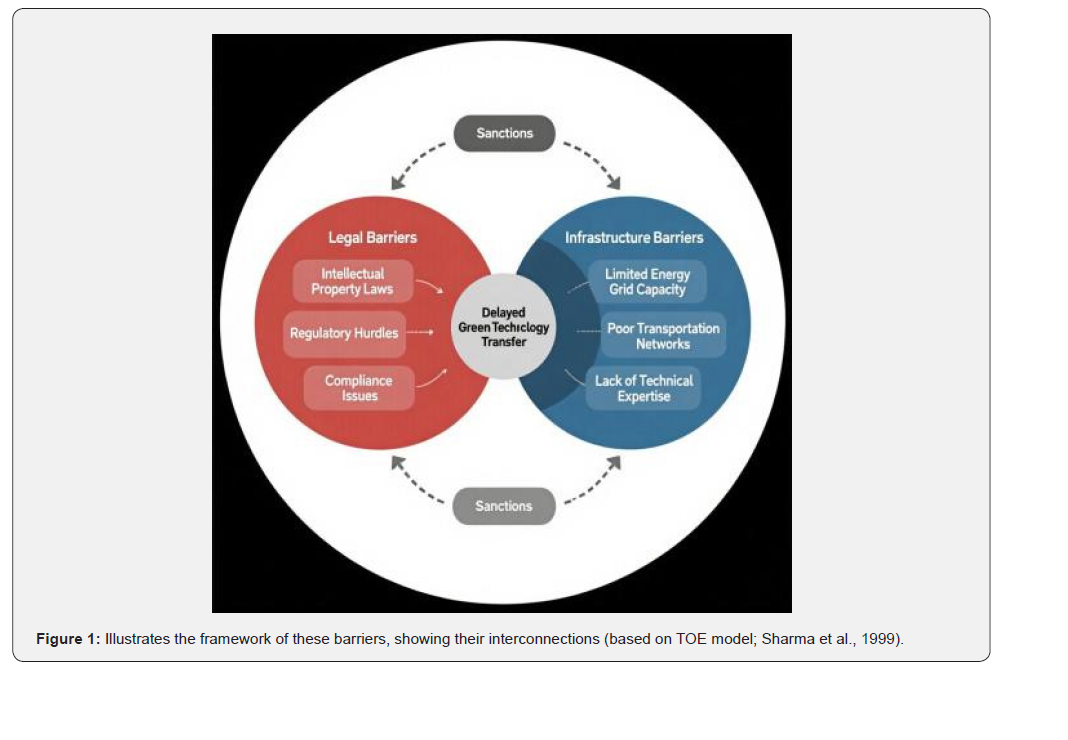

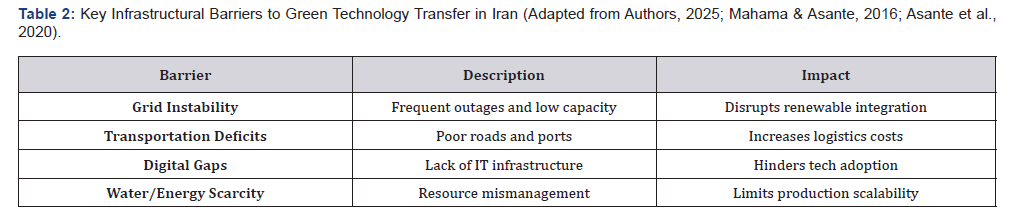
Infrastructural shortcomings amplify issues. Energy grids face instability with outages disrupting green processes [22]. Aging plants hinder renewable integration like solar PV [17,21]. Transportation deficits raise logistics costs for green equipment, worsened by sanctions [6,19]. Digital lags limit cloud adoption for smart manufacturing [8]. Resource mismanagement constrains scalability [13]. Table 2 details these (Figure 1) [35].
Discussion
Legal and infrastructural barriers interlink in a vicious cycle in Iran; sanctions block transfer channels and erode infrastructure funding [9,22]. This differs from successes like China’s policydriven green innovation [11,15]. Novelty here includes post- 2023 insights, such as green hydrogen potential despite barriers [3]. Original recommendations propose hybrid models of local R&D and partnerships [7,10]. For stakeholders, policymakers should reform subsidies for green investments, while industries emphasize domestic bypasses [36,37]. Recent X posts highlight Iran’s atomic software advancements and green hydrogen progress, suggesting pathways for innovation [38-40].
Recommendations
To overcome these barriers:
• Reform IP laws to international standards with green
tech incentives [5,24].
• Upgrade infrastructure like smart grids via publicprivate
partnerships [22,26].
• Counter sanctions through diplomacy and local
development, as in recent advancements [10,40].
• Initiate awareness campaigns and subsidies, inspired by
agricultural models [12,32,34].
• These foster Iran-specific innovations [7,41-43].
Conclusion
Legal and infrastructural barriers, intensified by sanctions and policy gaps, obstruct green technology transfer in Iran [6,9]. This analysis, rooted in recent data, offers a reform framework emphasizing localized solutions [2,3]. Tackling these is vital for sustainability, potentially establishing Iran as a regional green leader [17].
References
- Altieri M (1987) Agroecology. The scientific basis of alternative agriculture. Boulder, CO: Westview Press.
- Bello A, Lopez-Perez JA, Díez-Rojo MA, Lopez-Cepero J, García-Alvarez A (2008) Principios ecológicos en la gestión de los agrosistemas. Arbor Ciencia, Pensamiento y Cultura CLXXXIV 729 enero-febrero 19-29: 0210-1963.
- Porta J, López-Acevedo M, poch R (2014) Edafologí uso y protección de suelos. Ed. Mundiprensa 211-247.
- Orts C (2025) Gestión de la mejora del suelo con cubiertas vegetales en el cultivo del caqui (Dyospiros kaki Lf.): Integración de técnicas clásicas, herramientas de geoprocesamiento, teledetección y espectrorradiometrí Universitat Politécnica de València.
- Jansssens IA and Lankreijer H (2001) Productivity overshadows temperature in determining soil and ecosystem respiration across European forests. Global Change Biology 7(3): 269-278.
- Ryan MG and Law BE (2005) Interpreting, measuring, and modeling soil respiration. Biogeochemistry 73: 3-27.
- Parisi V, Menta C, Gardi C, Jacomini C, Mozzanica E (2005) Microarthropod communities as a tool to assess soil quality and biodiversity: a new approach in Italy. Agriculture, Ecosystems and Environment 105: 323-333.
- Walkley A and JA Black (1934) An examination of the Detjareff method for determining soil organic matter and a proposed modification on the chromic acid titration methods. Soil Sci 37: 29-38.
- Tullgren A (1918) Ein sehr einfacher Ausleseapparat fu r terricole Tierfaunen. Z. angew. Entomol 4: 149-150.
- Braun-Blanquet J (1925) Zur Wertung der Gesellschaftstreue in der Pflanzensoziologie. Vierteljahrsschr. Naturf. Ges. Zü 70: 122-149.
- Alcaraz FJ (2011) El método fitosocioló Vegetación y tipos de hábitats de interés en la Unión Europea. Lesson 3. Universidad de Murcia. Spain.
- Anderson TH (1994) Physiological analysis of microbial communities in soil: Applications and limitations, 67-76. In: K Ritz, J Dighton, KE Giller (eds.). Beyond biomass, compositional and functional analysis of soil microbial communities. Wiley-Sayce. Chichester, UK.
- Insam H and Domsch KH (1988) Relationships between soil organic carbon and microbial biomass on chrono sequences of reclamation sites. Microbial Ecology 15: 177-188.
- Paolini JE (2018) Actividad microbiológica y biomasa microbiana en suelos cafetaleros de los Andes venezolanos. Terra Latinoamericana 36(1).

























