




 JOJHA Home



The role of green covers in soil health for irrigated persimmon orchards in Valencia (Spain)
Carmen Orts1,3, Ángel Marqués2 and María Desamparados Soriano3
1 Valencian Institute of Agricultural Research. Generalitat Valenciana. Carretera CV-315, Km 10,7; 46113 -Moncada. Valencia (España)
2Department of Cartographic Engineering, Geodesy and Photogrammetry. Universitat Politècnica de València, Cami de Vera s/n 46022, Valencia (España)
3Department of Plant Production. Universitat Politècnica de València, Cami de Vera s/n 46022, Valencia (España)
Submission:October 10, 2025;Published: November 14, 2025
*Corresponding author: Carmen Orts, Valencian Institute of Agricultural Research. Generalitat Valenciana. Carretera CV-315, Km 10,7; 46113 -Moncada, Department of Plant Production. Universitat Politècnica de València, Cami de Vera s/n 46022, Valencia (España) E-mail: orts.mca@gmail.com
How to cite this article: Carmen Orts, Ángel Marqués and María Desamparados Soriano. The role of green covers in soil health for irrigated persimmon orchards in Valencia (Spain). Juniper Online Journal of Public Health, 5(6). 555676.DOI: 10.19080/JOJHA.2025.05.555676.
Abstract
Green covers are used as a tool to improve the soil health, its physicochemical properties, its edaphic biodiversity, and as a reservoir of useful fauna for the associated agricultural crops. The soil has the capacity to regenerate after disturbance thanks to the species that live in it, also creating positive effects on its fertility and on the biological control of pests. It is the reason that soil fauna can be used as an indicator of the quality and health of an agroecosystem. The aim in this experimental work is to study the relationship of seeded green covers with edaphic biodiversity based on mesofauna, and with the management of soil moisture and temperature. For this purpose, different green covers of legumes, grasses, and a mixture of flowers from different botanical families were sown in an orchard. Soil samples were analyzed, arthropods were extracted for their study, soil moisture sensors were placed to measure soil moisture and soil temperature, and vegetative biomass was measured. As a result, all the covers were favorable for the soil, although the mixed flower green cover was the most suitable for this orchard, in addition to blooming throughout the year and therefore being a reserve of useful fauna, it increased the soil moisture and lowered the soil temperature, and there was also an increment of microarthropods in the soil, which enhances soil quality. This study shows the growers the best options to avoid the use of phytosanitary products, accomplishing European regulations.
Keywords:agrosystems; green cover; soil health; biomass; soil biodiversity
Introduction
Mediterranean climate is favorable to the growth and vegetative development of spontaneous and cultivated plants. In addition to numerous native plants such as olive groves, vineyards and carob trees, there are others from Asia and America, such as fruit trees. In addition, adventitious plants that colonize the possible spaces, especially in agricultural soils rich in nutrients, can be the auxiliary tool used by farmers to improve the soil and its microbial life, acting as soil and biodiversity improves. Due to the widespread use of phytosanitary products and herbicides since the mid-20th century, in recent decades, management models of the agricultural system have been established [1], developing various practices, such as permaculture, organic farming or integrated production, the latter regulated by European rules. In these practices, rules are implemented for the use of phytosanitary products, herbicides, and fertilizers. Green covers are used, either through the management of spontaneous adventitious plants or the sowing of various species of plants, to improve the soil and the agrosystem [2]. In Valencia there are more than 14,000 Ha of persimmon (Diospyros kaki, Lf.) cultivation in irrigation system, that means a production around 200.000 tons, which is largely the economic engine of the area Ribera del Xúquer at the South of Valencia (Spain).
Approximately 30% of the area use green covers, seeded or spontaneous, or well inert with pruning waste. Although many growers use herbicides or soil plowing for weed control. This experiment was carried out using green covers of legumes, grasses, and flowers, studying their effect on the improvement of edaphic properties, physics, chemical and biological, in typical fruit crops of Mediterranean area with blanket irrigation. Organic matter is one of the most important soil quality indicators, due to its dynamic property, as it has an impact on the physical, chemical and biological properties of the soil [3]. On the one hand, due to its influence on soil color, it can retain, maintain or decrease temperature more easily. Also, due to its electrical charge, it contributes to its property as a soil buffer against pH variations. On the other hand, microbial biomass activities, enzymatic activities and soil respiration measurements are parameters that can be used as early indicators of changes in microbiological activity and soil quality [4]. Soil respiration is composed of the respiration of the plant cover and the respiration of soil microorganisms [5] and “soil CO2 flow is defined as the amount of carbon dioxide exchanged between the atmosphere and soil measured per unit area per unit time” [6].
Soil fauna is an essential component of soil biota and can be used to evaluate the fertility level of a soil or its degradation. Many of the species are considered as indicators of soil quality [7]. The general objectives include an evaluation of soil properties from a geospatial approach and promoting the use of green covers among farmers. Ultimately, the aim is to improve soil fertility by increasing organic matter and its decomposers, and to find a soil management method using geoprocessing tools, which will facilitate the farmer’s work when making decisions on pest control, the reduction of inputs such as fertilizers, water, or dependence on herbicides to avoid the competitiveness of spontaneous flora with the crop and to avoid soil and water contamination, thus contributing to the preservation and improvement of the agricultural ecosystem. All this within the context of European agricultural policies such as Farm to Fork and Biodiversity Strategies for the 2030 Horizon whose challenges in soil and environmental management were to reduce nutrient loss, to reduce the use of fertilizers and pesticides, to avoid erosion, to improve soil structure or to increase soil organic matter and biodiversity.
Material and Method
Green covers have been monitored in one persimmon orchard, for a year, between January and December 2023, since the green covers were growing and blooming.
Three types of green covers were sown in the interrow of the
orchard:
Grasses: Festuca arundinacea, Schreber and Bromus inermis,
Leyss.
Legumes: L., Onobrychis viciifolia, Scop; Trifolium alexandrinum,
L. and Vicia sativa, L.
Flowers: Brachypodium distachyon, (L.) P. Beauv, Festuca
arundinacea, Schrber; Bromus inermis, Leyss; Medicago
sativa, L., Calendula officinalis, L., Aquillea millefolium, L., Diplotaxis
erucoides, (L.) DC, and Lobularia maritima (L.) Desv.
In this field experience it was decided to realize a systematic sampling of the Granja orchard, and 21 soil samples were taken in specific points from legumes, grasses, and flowers cover crops. Soil sensors (Meter Group) were placed, at 5 and 20 cm depth to measure soil temperature, moisture and electric conductivity (EC). The type of soil moisture sensors used for this experimental work were capacitive (FDR). Soil moisture sensors GS3, 5TE and TEROS10 were low cost, but very efficient with the accuracy of the results. Teros 10 only measures volumetric soil moisture, and GS3 and 5TE measure, in addition, soil temperature and conductivity. Being in GS3, the EC measurements are more robust and more accurate than the previous ones. Basal respiration was measured with a gas analyzer PP System EMG5 in each sample point. Soil samples were analyzed for organic matter (SOM) with Walkley Black [8] method, to compare with mesofauna, basal respiration and the growth of the green covers. Arthropods were quantified as soil health indicators, specifically Oribatid and Gammasid mites, as well as Collembola family, because they are decomposers of organic matter. In this work, 21 extractions of arthropods were studied from their soil samples, using the Berlese funnel (1905) and Tullgren [9], observing them in a 51 MP microscopy camera.
The arthropods were counted by groups and by their metamorphic evolution, transforming them into SBQ (Soil Biological Quality Index), using the method of Parisi [7]. To measure the biomass vegetation, it was made a square frame of 1 x 1 m in a grid, obtaining 25 grids of 20 x 20 cm. Once the frame is placed on the vegetation cover, an estimation of plant species coverage and dominance is made. The cover density data is taken by measuring the percentage of total vegetation in each of the squares and the percentage of vegetation of each botanical family, making a difference by grasses, legumes, composites, or others. The tables used for this study were specifically adapted for this purpose and are based on other previous works for the classification of a plant community and its associations. All these works are close to the European point of view of classification in which species coverage [10], dominance and species fidelity to their community are estimated [11]. In this period, a drone was used to follow the green covers of vegetative development. The reference points were marked with a GNSS RTK receiver, and it was used a multispectral Micasense Red Edge camera, with five bands, R, G, B, NIR and Red Edge and two flights were done. Images were processed with Metashape and QGIS.
Result and Discussion
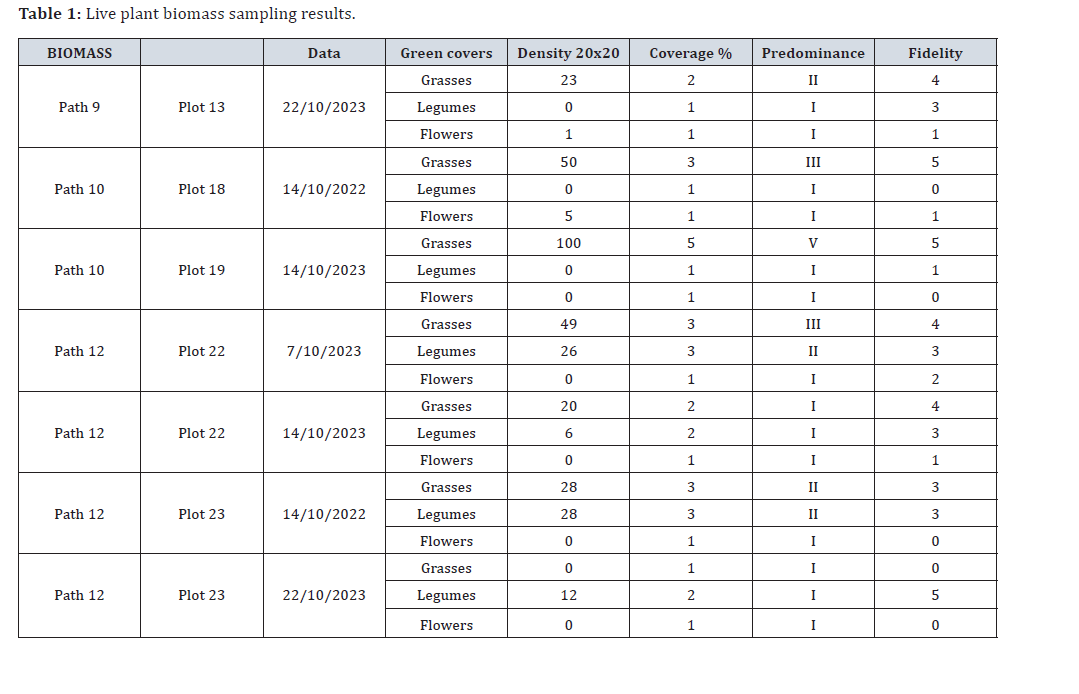
According to table 1 of results, using the methodology described above, it was evident that during this sampling period, grass were the plants that colonized all the area and provided the greatest coverage, predominance, and fidelity to their community. However, in the interrow with the flower green cover, it was observed that legumes and grasses were easily associated, with a high plant cover of both and predominance of legumes, while the presence of floral species were testimonial. In the paths with legumes, spontaneous grasses colonized the space, with practically no legumes plants being found during this period. The blooming of each of the species seeded in the cover crops was observed to be different. The grasses mainly flowered in summer, the legumes in spring and early summer, while the flowering mixtures were summer autumn, except for the species Diplotaxis erucoides, L. DC. which blooms all year round, as well as the species Medicago sativa (L), as summarized below:
- February to July: Vicia sativa, L. and Onobrychis viciifolia,
Scop.
- April to July: Brachipodium distachyon, L. P. Beauv., Festuca
arundinacea, Schrber and Bromus inermis, Leyss.
- Summer-autumn: Calendula officinalis, L. and Aquillea
millefollium, L.
- Winter: Lobularia marítima, L. Desv. and Trifolium alexandrinum,
L.
- All year round: Medicago sativa, L. and Diplotaxis erucoides,
L. DC.
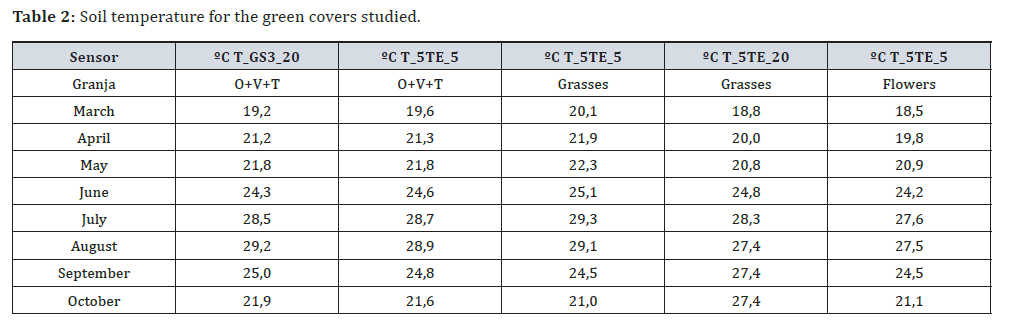
Comparing the moisture sensors data with those of the vegetation covers, all the studied green covers maintain soil moisture and lower the soil temperature possibly due to effect of their roots. The leguminous cover crop only maintained moisture to a depth of 20 cm and has no effect on soil temperatures, since its roots are pivotal and deep. On the other hand, the flower mixture cover crops kept soil moisture at 5 and 20 cm depths and could reduce the temperature in summer a few tenths below that legume cover crops and grass cover crops (Table 2). Figure 1 shows the samples taken in the different periods throughout the year 2023, where the grass, legume and flower green covers behaved differently in each one of them, highlighting the soil under flower green cover with the highest SBQ, increasing the values in a similar way in almost all the sampling periods. This SBQ index was also high for soil with legumes. While the soil under grass cover behaved very unevenly, with little or no SBQ values in the sampling corresponding to the summer and high values in the sampling in autumn. When comparing the SBQ values at the sampling points where the moisture sensors were placed in the soil under the green covers, and CO2 and SOM were measured for this micro test It was observed especially in the sampling of September 2023 very low SBQ values, even negligible in the soils with grasses, while the highest CO2 values were observed in the flower green cover. These low or negligible values could have been caused by excess soil moisture during the month of September after an irrigation period and abundant rainfall. Considering that samples from the first 15 cm of soil were analyzed, the organic matter analyzed was the fresh, non-humified portion, so the number of microorganisms and arthropods is constantly evolving to fragment the decomposing organic matter, a function partly of mites and springtails, but also of other arthropods.
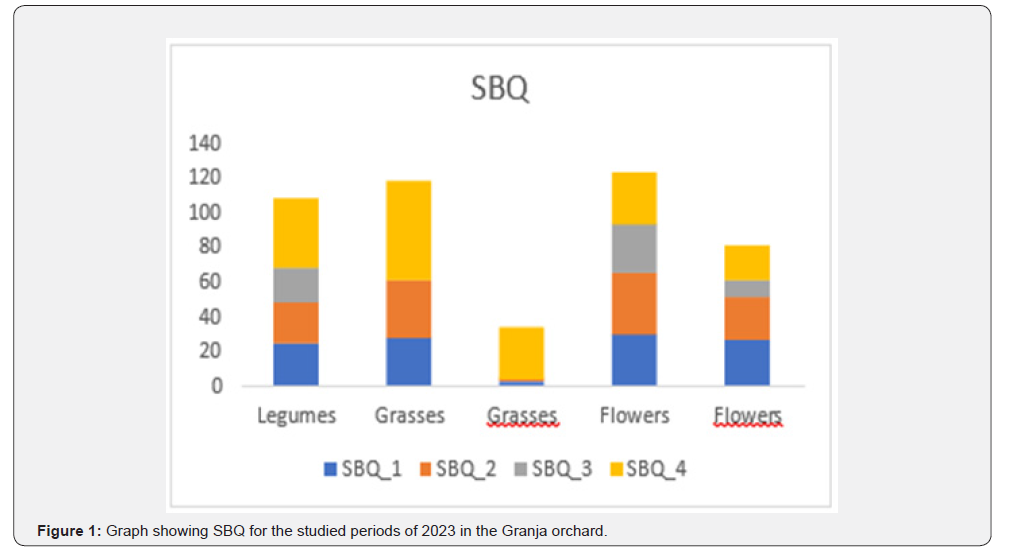
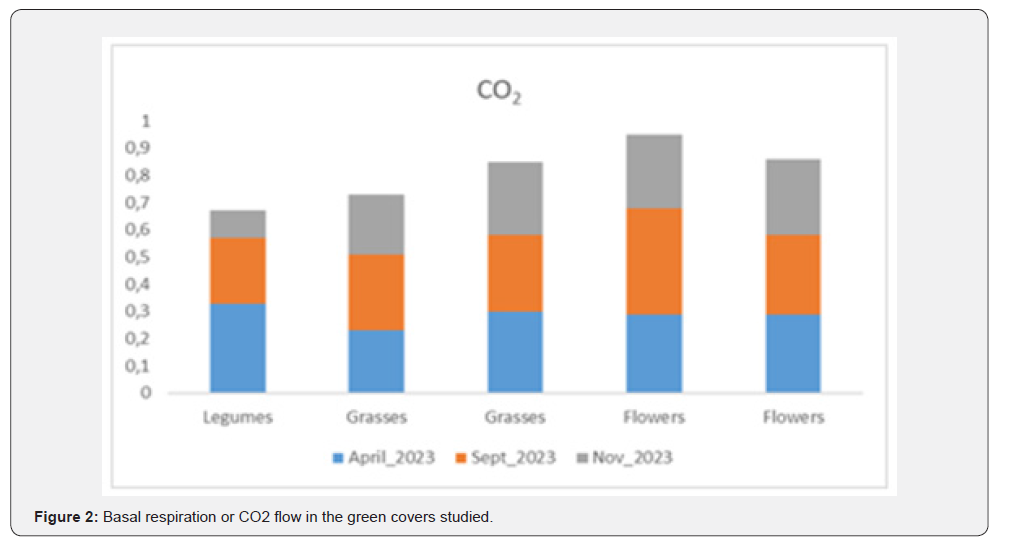
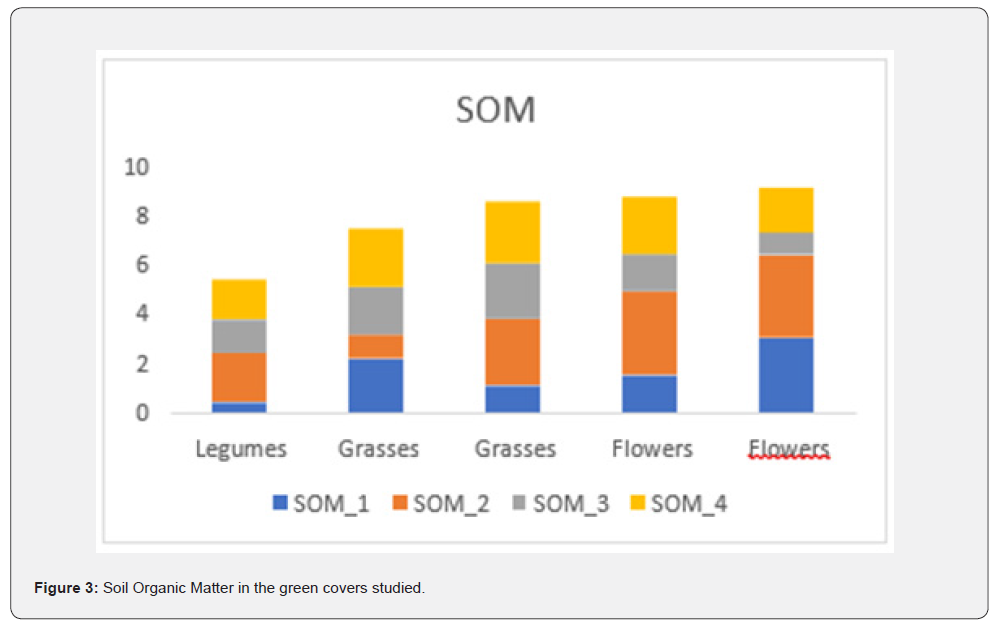
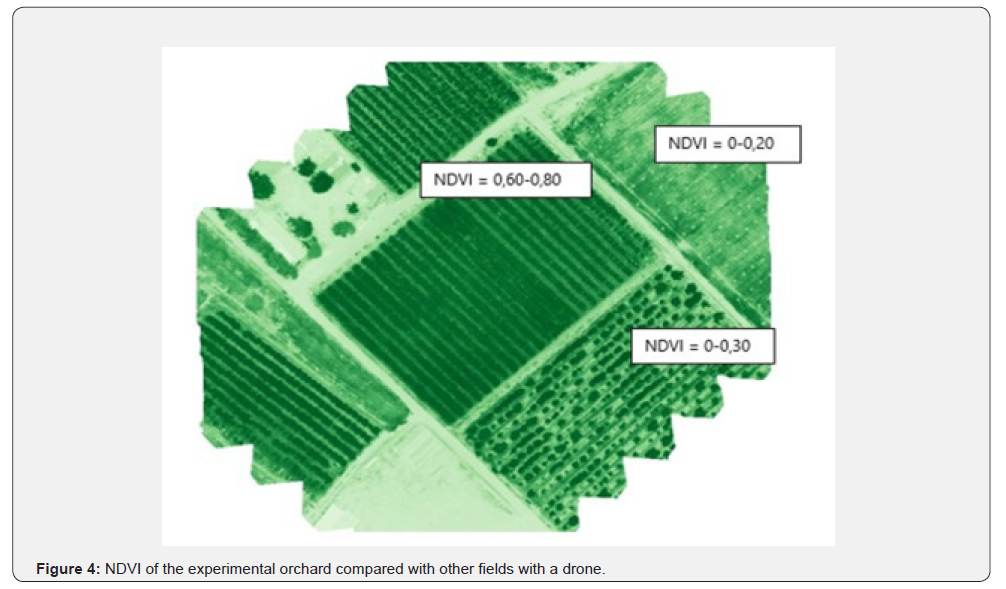
In Figure 2 it could be observed that soils with grasses and flowers green covers had a flow of CO2 higher than soils with legumes. In previous research it was observed that “In periods where field conditions are unfavorable, microorganisms require more energy to maintain biomass and therefore CO2 increases” [12-14]. In this work, it corresponded to the September sampling, after soil moisture was higher due to the application of blanket irrigation and subsequent widespread rainfall, a period in which the orchard was stressed by excess of moisture. The data are also compared with those analyzed for SOM, which is also an indicator of soil health. Figure 3 shows the same increasing rate as the edaphic biodiversity in the soil under grasses and flowers green covers, while soil for legumes green covers had low rate of SOM. According to Boluda et al. (2014) “Cultivated soils with conventional agricultural practices and degraded soils have lower MOS contents, N contents and respiration rate”. In addition, the number of arthropods such as springtails and soil mites, and the SBQ index decrease with such conventional practices. Images from a drone were processed and NDVI was calculated (Figure 4). It could be observed that NDVI from the green covers varies between 0.60 for grasses and 0.80 for flowers, while legumes are around 0.50. Compared with other orchards in the neighborhood with bare soil and herbicide treatments, with NDVI around 0.20- 0.30, the green cover from the experimental orchard has higher vegetative development.
Conclusion
Our study shows that mixtures of legumes, grasses and sown flowers green covers promote better soil health, improving biological, chemical and physics properties. All the green covers studied were able to improve soil quality by keeping soil moisture, lowering soil temperature, and increasing soil biodiversity and organic matter. As a result, spontaneous grass colonized the interrow seeded with legumes, during the summer and autumn. The soil with legumes and grasses kept moisture at 5 and 20 cm depth. Soil with flowers green cover was kept with a more adequate moisture and temperature for plant growth, edaphic diversity, soil respiration and soil organic matter. Also, there was an evolution of aerial auxiliary fauna and pollinators because plants were flowering all year round. The use of cover crops in fruit orchards avoids the indiscriminate use of phytosanitary products, herbicides, and fertilizers, complying with EU regulations.
References
- Altieri M (1987) Agroecology. The scientific basis of alternative agriculture. Boulder, CO: Westview Press.
- Bello A, Lopez-Perez JA, Díez-Rojo MA, Lopez-Cepero J, García-Alvarez A (2008) Principios ecológicos en la gestión de los agrosistemas. Arbor Ciencia, Pensamiento y Cultura CLXXXIV 729 enero-febrero 19-29: 0210-1963.
- Porta J, López-Acevedo M, poch R (2014) Edafologí uso y protección de suelos. Ed. Mundiprensa 211-247.
- Orts C (2025) Gestión de la mejora del suelo con cubiertas vegetales en el cultivo del caqui (Dyospiros kaki Lf.): Integración de técnicas clásicas, herramientas de geoprocesamiento, teledetección y espectrorradiometrí Universitat Politécnica de València.
- Jansssens IA and Lankreijer H (2001) Productivity overshadows temperature in determining soil and ecosystem respiration across European forests. Global Change Biology 7(3): 269-278.
- Ryan MG and Law BE (2005) Interpreting, measuring, and modeling soil respiration. Biogeochemistry 73: 3-27.
- Parisi V, Menta C, Gardi C, Jacomini C, Mozzanica E (2005) Microarthropod communities as a tool to assess soil quality and biodiversity: a new approach in Italy. Agriculture, Ecosystems and Environment 105: 323-333.
- Walkley A and JA Black (1934) An examination of the Detjareff method for determining soil organic matter and a proposed modification on the chromic acid titration methods. Soil Sci 37: 29-38.
- Tullgren A (1918) Ein sehr einfacher Ausleseapparat fu r terricole Tierfaunen. Z. angew. Entomol 4: 149-150.
- Braun-Blanquet J (1925) Zur Wertung der Gesellschaftstreue in der Pflanzensoziologie. Vierteljahrsschr. Naturf. Ges. Zü 70: 122-149.
- Alcaraz FJ (2011) El método fitosocioló Vegetación y tipos de hábitats de interés en la Unión Europea. Lesson 3. Universidad de Murcia. Spain.
- Anderson TH (1994) Physiological analysis of microbial communities in soil: Applications and limitations, 67-76. In: K Ritz, J Dighton, KE Giller (eds.). Beyond biomass, compositional and functional analysis of soil microbial communities. Wiley-Sayce. Chichester, UK.
- Insam H and Domsch KH (1988) Relationships between soil organic carbon and microbial biomass on chrono sequences of reclamation sites. Microbial Ecology 15: 177-188.
- Paolini JE (2018) Actividad microbiológica y biomasa microbiana en suelos cafetaleros de los Andes venezolanos. Terra Latinoamericana 36(1).

























