




 JOJHA Home



Abstract
For over a dozen years, original potted flowers such as lachenalia from South Africa have been increasingly available on the market. Intensive breeding within this interesting genus of Lachenalia (Hyacinthaceae) allowed to obtain several attractive varieties with good postharves durability, varied flower colors and a shape suitable for pot cultivation. The genus Lachenalia includes over 100 species. Lachenalia bulbs are perennial, but they have a low reproductive rate. Vegetative methods of propagating Lachenalia mainly include: seeds, side bulbs formed from the mother bulb, bulbs (air bulbs) and the production of bulbs from leaf cuttings. Due to the high costs and relatively low efficiency of the in vitro method, the leaf cuttings method is most often used for commercial propagation of this lachenalia. In pot cultivation, the size and quality of inflorescences depend primarily on the size of the planted bulbs and the proper preparation of the bulbs for cultivation. The aim of the research was to assess the growth and flowering of two varieties of lachenalia ‘Ronina’ (yellow flowers) and Ruppert (purple flowers) depending on the size of the planted bulbs. Before planting, the sprouted bulbs were weighed and their diameter measured, and then grown in pots from October to April - with additional lighting in winter. Plants obtained from small bulbs (less than 10 g) usually had only one inflorescence, while larger bulbs (10-20 g) produced 2-3 inflorescences and the bulbs divided to produce several new bulbs.
Keywords:Cape Hyacinths; Cut Flowers; Geophytes; Flower Quality
Introduction
For over a decade, unique flowers such as Lachenalia, native to South Africa, have become increasingly available on the market [1-5]. The genus Lachenalia contains more than 100 species. Bulbs of this plant are perennial, but have a low propagation rate. Vegetative methods of Lachenalia propagation include seeds, lateral bulbs (bulblets) developed from the mother bulb, aerial bulbs, and bulb production from leaf cuttings. Due to the high cost and relatively low yield of the in vitro method, bulb formation from leaf cuttings is most commonly used in commercial Lachenalia propagation Plants of this species have recently become more and more popular as attractive pot plants or cut flower due to intensive breeding programs [6] and interesting new varieties usually multiplied using in vitro methods [7-9] or via leaf cutting [10-15]. According to many authors [16- 22]. Lachenalia species used for forcing as pot plants or cut flowers requires high light intensities, well-drained soil and adequate range of temperatures. However, due Lachenalia origin from South Africa, bulbs cultivated in Norther Hemisphere should be planted in autumn period and then cultivated under covers (greenhouse, tunnels). For spring plantings periods Lachenalia bulbs should be correctly stored in adequate temperatures [2,3,5]. In natural conditions Lachenalia plants is characterized by active leaf growth during autumn, flowering during mild winters, followed by leaf senescence and a dormant period during the hot dry summer [5,16,20]. In pot cultivation of lachenalia the size and quality of inflorescences depend primarily on the growth period and spacing and size of the planted bulbs, proper preparation of the bulbs before planting (temperature, length of storage) and proper agricultural techniques: selection of substrate, fertilization, lighting [17,18,23].
The aim of the study was to evaluate the growth and flowering of two varieties of lachenalia ‘Ronina’ (yellow) and Rupert (purple) depending on the size and quality of the planted bulbs.
Material and methods
The sprouted lachenalia bulbs (with visible “nose”) after summer dormant period were weighed and their diameters ere measured before planting. Then the bulbs were individually potted into square pots [13x13 cm] and grown from October to April, with supplementary lighting using LED lamps during the winter (November-March). They were 60 bulbs of each cultivar. Bulbs were planted at 9 October 2023 and then grown in conditions according to general routine and requirements [16,18,20]. Plants were irrigated 2-3 times a week according to plant requirements. As fertilizer the slow-release fertilizer Osmocote 15:9: 12 Hi End + TE, 3-4 M were used at a dose 2 g/pot. During flowering period inflorescence size and number per plant were measured. Flowers were not harvested but left on plant. Flowering period: Ronina - second half of December 2023 up to end of January 2024, Rupert: from mid-January to mid-February 2024. After inflorescence and gradual leaf senescing irrigation was stopped plants rested for curing dry up to bulb harvesting. All bulb were harvested at the end of April 2024. Then all bulbs were weighed and their number per each pot was counted. Bulb measurements were done at 16 May, 2024. Assessed parameters: bulb weight and diameter before planting, number and weight of bulbs after flowering, number and size of inflorescences. The correlation between bulb weight at planting and bulb weigh and number after flowering were calculated.
Results and discussion
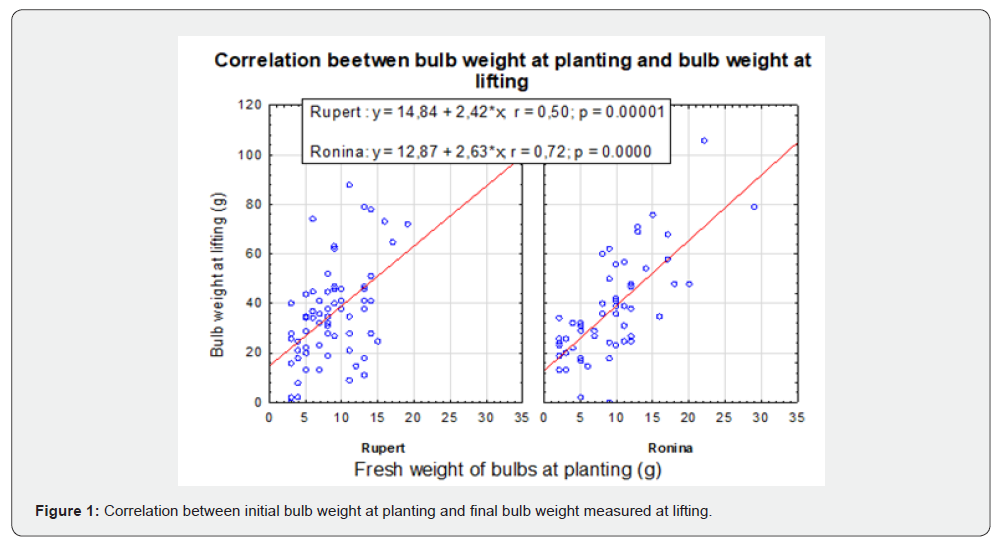
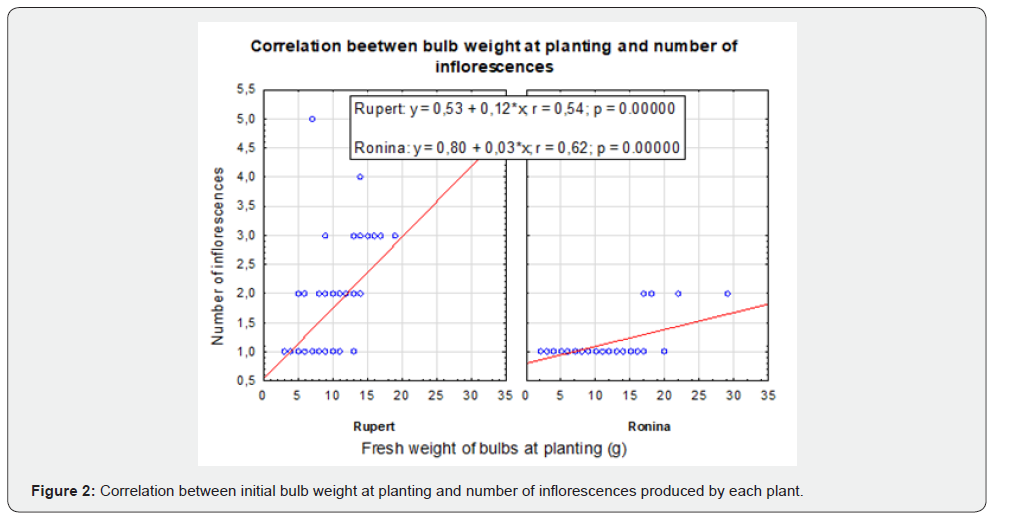
The initial weight of planted bulbs of lachenalia of both cultivars was significantly correlated with the weight of bulbs dug-up at the end of cultivation period (Figure 1) and the number of inflorescences per plant obtained after the cultivation period (Figure 2). The stronger correlation was observed in case of Ronina (determination coefficient 0,72) comparing to Ronina (determination coefficient 0,50). Usually, the fresh weigh of bulbs increased 3-5 times comparing to initial weight of bulbs at planting. As the weight and diameter of the planted bulbs increased, the weight of the progeny bulbs harvested after cultivation period increased. As it was expected the bigger the bulbs the higher inflorescence number were obtained (Figure 2). Similar result showing the dependency of bulb weight on flowering was described by Kapczynska [17, 18]. and Louw [19]. The number of inflorescences and bulb growth can be also related to cultivar and genetic properties [21-24] or growing condition such as term of cultivation, spacing and also growth regulators such as flurprimidol used during cultivation [25,26]. In the present experiment the yellow flowering ‘Ronina’ gave no more than 2 inflorescences, irrespectively od initial bulb size (Figure 2).
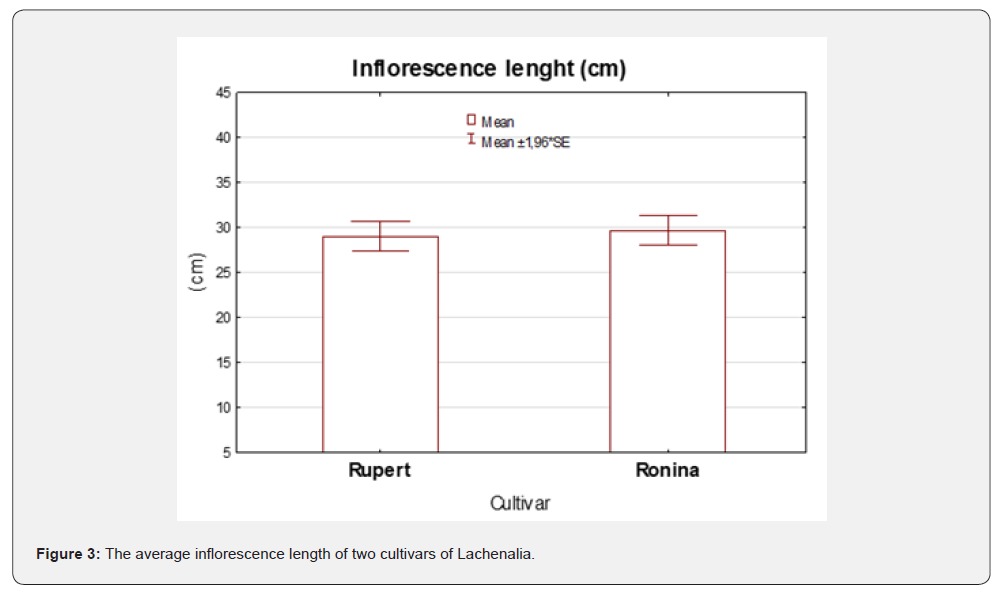
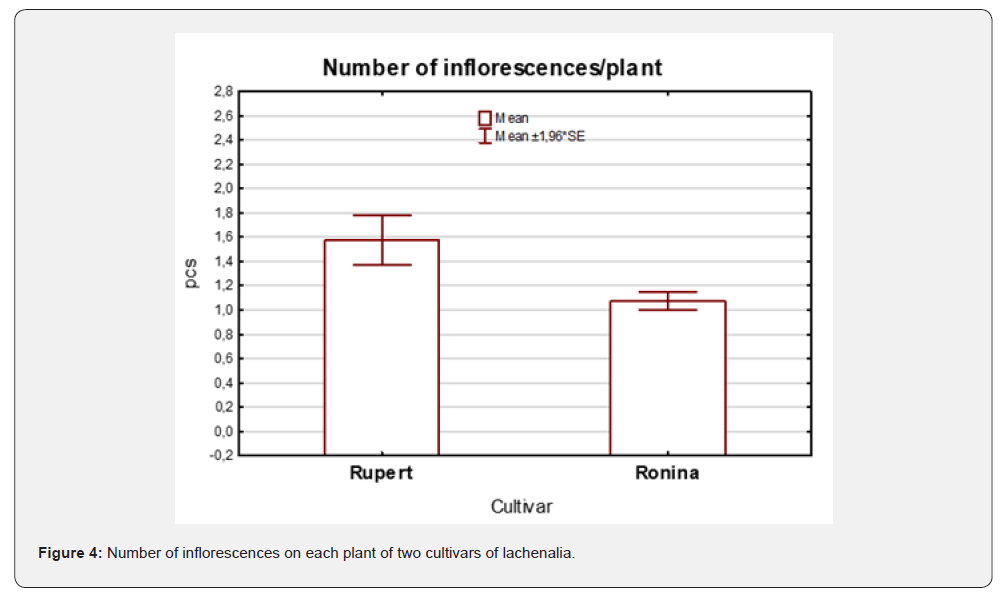
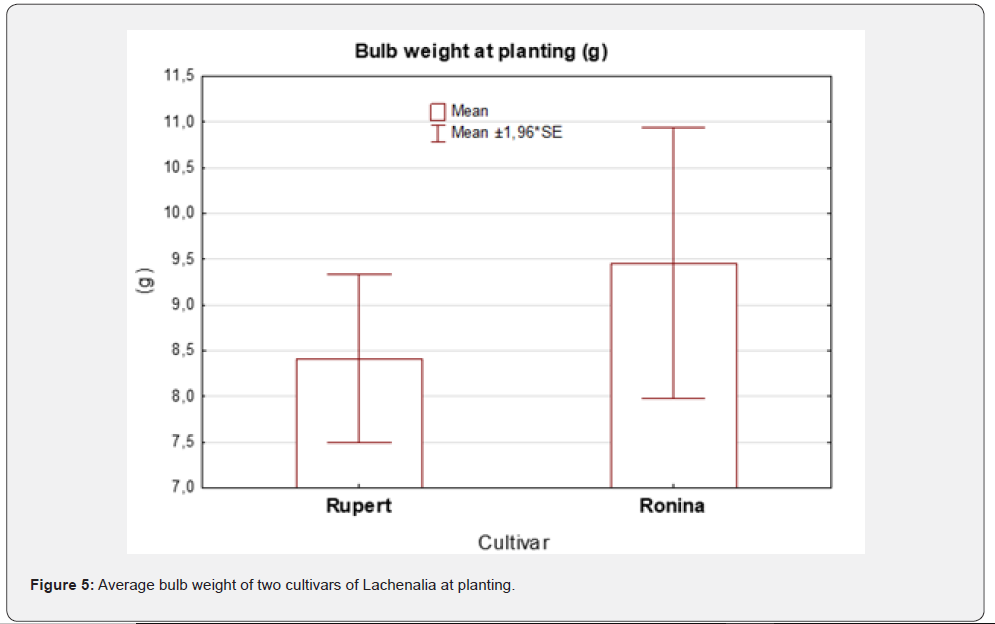
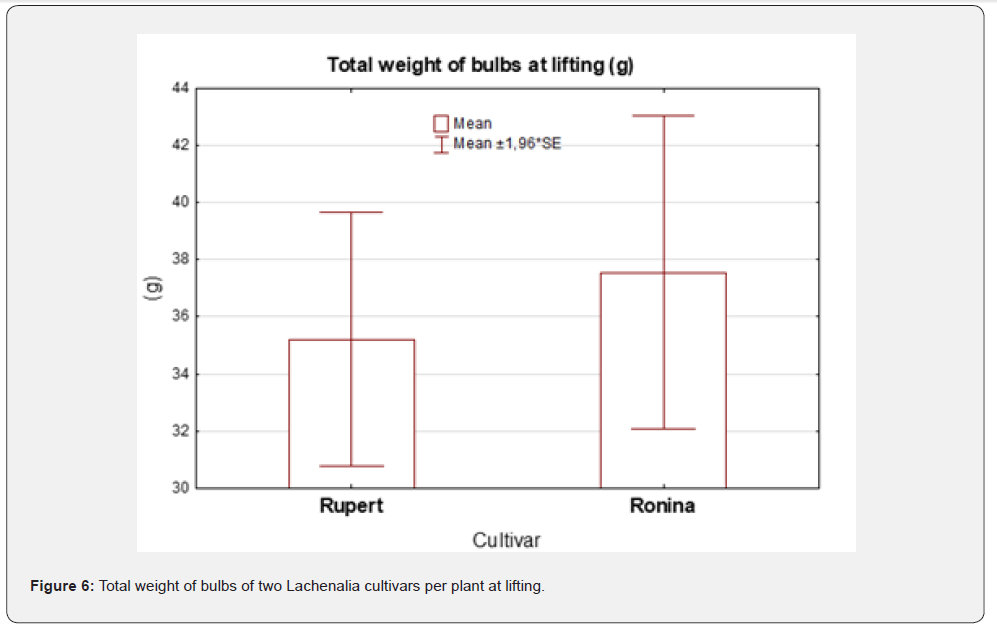
However blue flowering ‘Rupert’ gave up to 4-5 new bulbs (bulblets) from initial bulb of weight between 15-20 gram. The inflorescence length measured at full flowering was similar in both cultivars and lasted around 30 cm per each (Figure 3). However, the number of inflorescences was significantly higher in Rupert, 1,6 per plant comparing to Ronina, 1,1 per plant (Figure 4). The fresh weight of bulbs obtained after the cultivation period had approximately four times higher than the initial weight of the planted bulbs in both cultivars (Figure 5). Some bulbs were “divided,” producing several successor smaller bulbs usually known as bulblets. On average, approximately 1.9 new bulbs were obtained from each bulb. The weight of the bulbs obtained from small bulbs at planting (less than 10 g) typically had only one inflorescence, while larger bulbs (10-20 g) produced 2-3 inflorescences. According to Kapczynska et al. [27] growth, flowering can be affected by light condition during plant cultivation. Usually, Lachenalia plants should be grown with supplemental lighting when they are cultivated in winter months in Northern Hemisphere. Both tested cultivars of Lachenalia ‘Ronina’ and ‘Rupert’ are very valuable as pot plants but when cultivated from larger bulbs the inflorescences can be used also as attractive cut flowers (Figure 6) [28].
References
- Duncan GD, Edwards TJ, Mitchell A (2005) Character variation and a cladistic analysis of the genus Lachenalia Jacq f. ex-Murray (Hyacinthaceae). Acta Hortic 673: 113-120.
- Duncan GD (2012) The Genus Lachenalia. Botanical magazine monograph. Kew Publishing, Kew, 479 pp.
- Duncan GD (2013) Geophyte research and production in South Africa. In: Kamenetsky, R., Okubo, H. (Eds.), Ornamental Geophytes. From Basic Science to Sustainable Production. CRC Press Taylor & Francis Group pp. 485-503.
- Reinten EY, Coetzee JH, Van Wyk BE (2011) The potential of South African indigenous plants for the international cut flower trade. S Afr J Bot 77: 934-946.
- Kleynhans R, Niederwieser JG, Hancke FL (2002) Lachenalia: development and commercialization of a new flower bulb crop. Acta Hortic 570: 81-85.
- Kleynhans R (2006) Lachenalia spp. In: Flower breeding and genetics: issues, challenges, and opportunities for the 21st century, Anderson, N.O. (ed.). Springer, Dordrecht pp. 491-516.
- Bach A and Kapczyńska A (2013) Initiation of in vitro cultures of Lachenalia. Ann. War-saw Univ. Life Sci. - SGGW. Hortic Landsc Archit 34: 3-12.
- Slabbert MM and Niederwieser JG (1999) In vitro bulblet production of Lachenalia. Plant Cell Rep 18: 620-624.
- Ndou AM (2000) Optimization of bulblet production by leaf cuttings in Lachenalia. PhD dissertation, Faculty of Natural and Agricultural Science, University of Pre-toria, Pretoria, South Africa, p. 89.
- Ndou AM, Niederwieser JG, Robbertse PJ (2002) Effect of leaf-section position and physiological stage of the donor plant on Lachenalia leaf-cutting performance. S Afr J Plant Soil 19(4): 178-181.
- Knippels PJM (2012) Advanced in vivo propagation techniques for speciality bulbs. Floricult Ornam Bio-technol 6(2): 154-157.
- Niederwieser JG and Vcelar BM (1990) Regeneration of Lachenalia species from leaf explants. Hort Science 25(6): 684-687.
- Perrignon RJ (1992) Bulblet production in vivo from leaves of Lachenalia (Jacq). Acta Hortic 325: 341-348.
- Suh JK, Roh MS, Lee JS (1997) Leaf cutting propagation, growth and flowering of Lachenalia. Acta Hortic 430: 369-376.
- Kapczyńska A (2019) Propagation of Lachenalia cultivars from leaf cuttings. Acta Sci Pol Hortorum Cultus 18(1): 189-195.
- Ruffoni B, Cervelli C, Kleynhans R, Hancke FL (2013) Forcing Trials of Lachenalia Cultivars in Mediterranean Area. Acta Hort 1000: 277-284.
- Kapczyńska A (2014a) Effect of planting term on growth and flowering of two cultivars of lachenalia produced in a greenhouse as potting plants during winter months. J Hortic Res 22: 29-34.
- Kapczyńska A (2014b) Effect of bulb size on growth, flowering and bulb formation in lachenalia cultivars. Hort Sci (Prague) 41(2): 89-94.
- Louw E (1992) The effect of temperature on inflorescence initiation and differentiation and development of Lachenalia cv. ‘Romelia’. M.Sc. Thesis. Department of Horticulture, University of Pretoria.
- Roh MS, Lawson RH, Song C-Y, Louw E (1995) Forcing Lachenalia as potted plant. Acta Hort 397: 147-153.
- Roh MS (2005) Flowering and inflorescence development of Lachenalia aloides ‘Pearsonii’ as influenced by bulb storage and forcing temperature. Scientia Hort 104(3): 305-323.
- Roh MS, Grassotti A, Guglieri L (1998) Storage and forcing temperatures affect inflorescence initiation, flowering and floret blast of Lachenalia aloides ‘Pearsonii’. Acta Hort 454: 213-221.
- Kapczyńska A (2013) Effect of plant spacing on the growth, flowering and bulb production of four lachenalia cultivars. S Afr J Bot 88: 164-169.
- Niederwieser JG and Ndou AM (2002) Review on adventitious bud formation in Lachenalia. Acta Hortic 570: 135-139.
- Kapczyńska A and Kidawska A (2016) ‘Namakwa’ lachenalia’s response to flurprimidol and different planting dates. Folia Hort 28(2): 173-179.
- Kapczyńska A and Malik M (2016) Planting time and flurprimidol treatment influence the growth and flowering of lachenalia. Hort Technology 26(3): 293-298.
- Bach A, Kapczyńska A, Dziurka K, Dziurka M (2015) Phenolic compounds and carbohydrates in relation to bulb formation in Lachenalia ‘Ronina’ and ‘Rupert’ in vitro cultures under different lighting environments. Sci Hortic, 188: 23-29.
- Kapczyńska A, Maślanka M, Mazur J (2025) Longevity od lachenalia cut flowers. Acta Hortic 1435: 249-256.

























