




 JOJHA Home



Growing Pea Plants under Heat and Drought Stresses using Auxin- and Cytokinin-Like Substances Based on Pyrimidine Derivatives
Tsygankova VA*, Andrusevich YaV, Vasylenko NM, Kopich VM, Solomyannyi RM, Kachaeva MV, Kozachenko OP, Bondarenko OM, Pilyo SG, Popilnichenko SV and Brovarets VS
Department for Chemistry of Bioactive Nitrogen-Containing Heterocyclic Compounds, V.P. Kukhar Institute of Bioorganic Chemistry and Petrochemistry, National Academy of Sciences of Ukraine, 1, Academician Kukhar str., 02094, Kyiv-94, Ukraine.
Submission:August 31, 2025;Published: September 10, 2025
*Corresponding author: Tsygankova Victoria Anatolyivna, Dr. Biol. Sci., Principal researcher, Senior Staff Scientist E-mail: vTsygankova@ukr.net
How to cite this article: Tsygankova VA*, Andrusevich YaV, Vasylenko NM, Kopich VM, Solomyannyi RM et al. Growing Pea Plants under Heat and Drought Stresses using Auxin- and Cytokinin-Like Substances Based on Pyrimidine Derivatives. Juniper Online Journal of Public Health, 5(5). 555674.DOI: 10.19080/JOJHA.2025.05.555674.
Abstract
Screening of new physiologically active synthetic azaheterocyclic compounds, thioxopyrimidine derivatives, capable of exhibiting auxin- and cytokinin-like regulating effect on the growth and photosynthesis of pea (Pisum sativum L.) plants variety Pristan, as well as increasing plant adaptation to heat and drought stresses, was carried out. It was found that the studied synthetic azaheterocyclic compounds, thioxopyrimidine derivatives, used in a concentration of 10-6 M, exhibit a regulating effect equivalent to or exceeding the effect of auxin IAA or known synthetic azaheterocyclic compounds, derivatives of sodium and potassium salts of 6-methyl-2-mercapto-4-hydroxypyrimidine (Methyur, Kamethur), used in a similar concentration of 10-6 M for seed treatment. The morphological indicators (average length of the shoots (mm), average length of the roots (mm), average number of the roots (pcs)) and content of photosynthetic pigments (chlorophylls a, b and carotenoids (mg/g FW)) of two-week-old pea plants grown under conditions of heat and drought stresses, treated with IAA, Methyur, Kamethur and thioxopyrimidine derivatives, significantly increased compared to control plants treated with distilled water. Based on the obtained results, the relationship between the regulatory activity of the synthetic azaheterocyclic compounds, thioxopyrimidine derivatives, and their chemical structures was analyzed. Possible intracellular mechanisms of the regulatory action of synthetic azaheterocyclic compounds, thioxopyrimidine derivatives similar to the studied synthetic analogues of auxins and cytokinins, as well as new plant growth regulators created on the basis of pyrimidine or pyridine derivatives are discussed.
Keywords:Pisum sativum L; IAA; Methyur; Kamethur; thioxopyrimidine derivatives; heat and drought.
Introduction
Pea (Pisum sativum L.) is a major legume crop grown worldwide and used as a grain and as a sprouted vegetable in the human nutrition and animal feed due to its high content of biologically active nutrients and phytochemicals (proteins, carbohydrates, easily digestible starch, essential fatty acids, dietary fiber, vitamins, chlorophyll, carotenoids, lutein, polysaccharides, flavonoids, lectins, phytates, phenolic acids, saponins, galactooligosaccharides, macroelements and microelements) [1-8]. According to FAOSTAT database, global pea production currently ranks third among major legumes after common bean and chickpea, with 12.4 million tons of dry peas and 20.5 million tons of green peas produced in 2021 [9]. Abiotic stresses, such as heat and drought, negatively affect the growth of crops, including pea, and reduce their productivity by disrupting physiological and metabolic processes in plants, disrupting the stability of cell membranes, inhibiting nutrient uptake through the root system, reducing respiration and water content in leaves, which leads to reduced photosynthesis, reduced flower number and seed size and weight, as well as growth retardation, especially at reproductive stages, reduced ability to form nodules and symbiotic nitrogen fixation (SNF) and, as a result, limited crop yields [9-14]. Plants have evolved defensive strategies to combat stress by synthesizing osmoprotectants, such as proline and sugars, to maintain cell function under water stress, regulating the opening and closing of stomata to control water loss, modifying root systems to improve water uptake, producing antioxidants to protect cells from damage by reactive oxygen species (ROS) that cause oxidative stress, and expressing heat shock proteins [9,10,13-15,16-21].
In the context of global climate change and soil pollution by agrochemicals toxic to humans, animals, and the environment, agriculture is faced with the problem of developing environmentally friendly technologies for growing crops, including pea, based on the use of phytohormones [22-31], biostimulants [32,33], or fertilizers [34] that can improve plant growth, increase their yield and seed quality, and increase plant resistance to heat, drought, and other abiotic stresses by stimulating antioxidant enzyme systems and the synthesis of secondary metabolites, as well as inducing the RNAi process in plant cells. Nevertheless, the priority task of modern agriculture is the development of new effective plant growth regulators. This is evidenced by the data that global sales of plant growth regulators (PGRs) in 2015 amounted to about 1.5 billion US dollars, and in 2022 increased to approximately 2-3 billion US dollars [35]. In recent years, considerable attention of plant biologists has been attracted by new environmentally friendly plant growth regulators created on the basis of synthetic low molecular weight azaheterocyclic compounds, exhibiting growth-regulating activity similar to the phytohormones auxins and cytokinins in the range of non-toxic low molar concentrations 10-5-10-9 M [36,37]. Among these synthetic low molecular weight azaheterocyclic compounds, pyrimidine and pyridine derivatives, which are used as plant growth regulators, herbicides, pesticides, fungicides, and antimicrobial agents, represent a potentially plant growth-promoting and more environmentally friendly alternative to some traditional agrochemicals [35, 38-48].
In Ukraine, novel plant growth regulators have been created on the base of known synthetic azaheterocyclic compounds, derivatives of N-oxide-2,6-dimethylpyridine (Ivin), sodium and potassium salts of 6-methyl-2-mercapto-4-hydroxypyrimidine (Methyur, Kamethur), as well as new pyrimidine derivatives that exhibit a growth-regulating effect similar to the phytohormones auxins and cytokinins on various grain, leguminous, vegetable, industrial and horticultural crops, as well as fungi, improving plant growth, increasing plant height and enhancing plant root development, improving plant productivity and enhancing adaptation to abiotic stress factors such as heat and drought, salinization, and soil contamination with trace elements [36,37,49-70]. Due to the broad specificity of the regulatory effect on various plant species expressed in improved seed germination, enhanced growth of roots, shoots, leaves, and reproductive organs of plants, increased photosynthesis in plant leaves, as well as the absence of toxic effects on the environment, human and animal health, pyrimidine and pyridine derivatives, can be considered as effective and environmentally friendly plant growth regulators [35-38,48,49-70]. Application of synthetic low molecular weight azaheterocyclic compounds, pyrimidine and pyridine derivatives, in non-toxic low molar concentrations are capable of reducing the toxic effects of pesticides and fungicides [71-75], which is of great importance for the environmental ecology and human health.
The aim of this work is application of known synthetic low molecular weight azaheterocyclic compounds, derivatives of sodium and potassium salts of 6-methyl-2-mercapto-4- hydroxypyrimidine (Methyur, Kamethur), as well as new pyrimidine derivatives, to improve the growth of pea (P. sativum L.) variety Pristan during the vegetation phase and to enhance the adaptation of plants to heat and drought stresses.
Material and Method
Chemical structures of the studied compounds
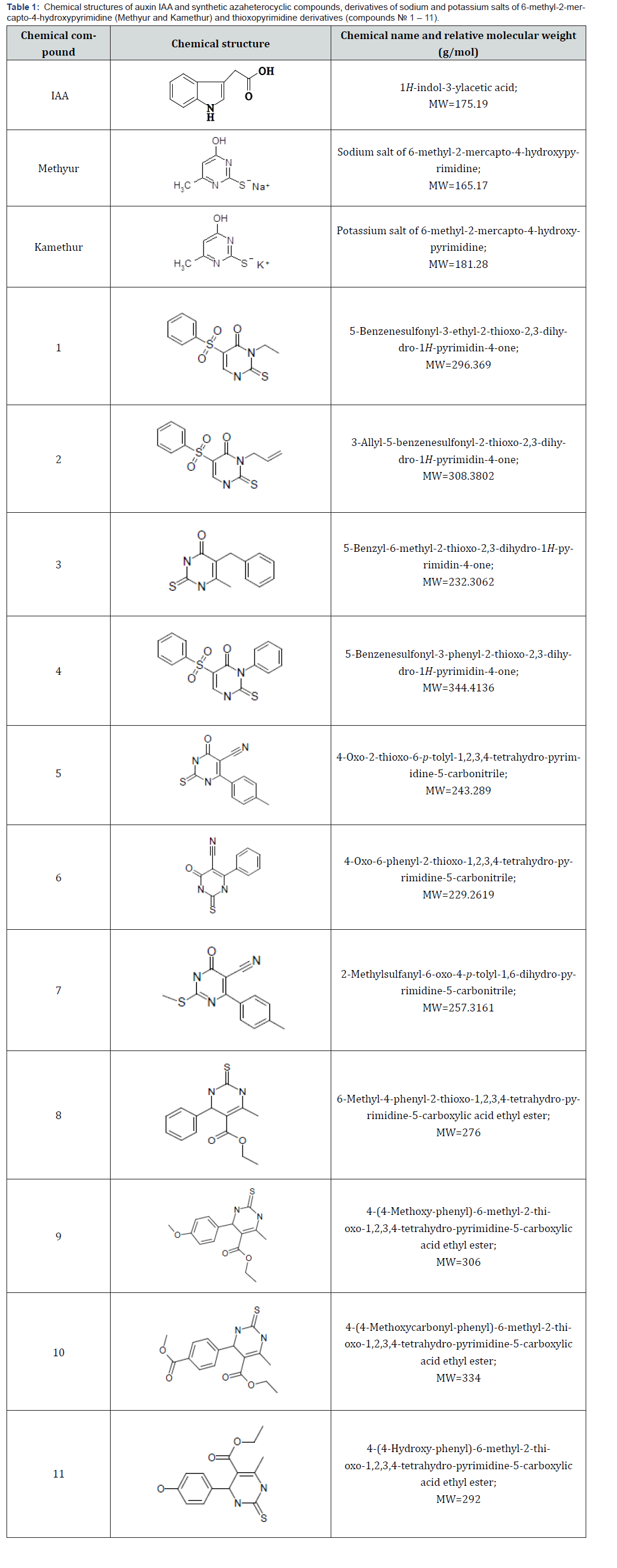
Synthetic low molecular weight azaheterocyclic compounds, derivatives of sodium and potassium salts of 6-methyl-2-mercapto- 4-hydroxypyrimidine (Methyur and Kamethur), as well as new thioxopyrimidine derivatives were synthesized at the Department for Chemistry of Bioactive Nitrogen-Containing Heterocyclic Compounds, V.P. Kukhar Institute of Bioorganic Chemistry and Petrochemistry of the National Academy of Sciences of Ukraine, the phytohormone auxin IAA (1H-indol-3-yl)acetic acid) was produced by Sigma-Aldrich, USA. The chemical structures of auxin IAA and synthetic azaheterocyclic compounds such as Methyur, Kamethur and new thioxopyrimidine derivatives (compounds № 1 - 11) are presented in Table 1.
Seed treatment with the studied compounds and plant growth conditions
The seeds of pea (P. sativum L.) variety Pristan were sterilized with 1 % KMnO4 solution for 15 min, then treated with 96 % ethanol solution for 1 min, after which they were washed three times with sterile distilled water. After this procedure, seeds were placed in the plastic cuvettes (each containing 20-25 seeds) on an artificial substrate - perlite saturated with distilled water (control sample) or water solutions of auxin IAA (1H-indol-3-yl)acetic acid or synthetic azaheterocyclic compounds, derivatives of sodium and potassium salts of 6-methyl-2-mercapto-4-hydroxypyrimidine (Methyur and Kamethur), or thioxopyrimidine derivatives (compounds № 1 - 11) in a concentration of 10-6 M (experimental samples). Then seeds were placed in the thermostat for germination in darkness at the temperature 20-22 °C during 48 h. The germinated seeds were placed in a climatic chamber, in which the seedlings were grown for 2 weeks under a light/dark regime of 16/8 h, light intensity of 3000 lux, 60-80% air humidity, and also under conditions of abiotic stress factors: heat (at elevated temperatures up to 35 °C) and drought (with a 50% reduction in watering). A comparative analysis of the morphometric parameters of pea plants (average length of the shoots (mm), average length of the roots (mm), and average number of the roots (pcs)) after two weeks was performed according to the methodological manual [76]. Morphometric parameters determined on experimental pea plants, in comparison with similar parameters of control plants, were expressed as %.
Determination of chlorophyll and carotenoid content in plant leaves
The content of photosynthetic pigments such as chlorophylls a, b and carotenoids (mg/g FW) in pea plants was analyzed according to methodological recommendations [77,78]. To perform the extraction of photosynthetic pigments, we homogenized a sample (500 mg) of leaves separated from seedlings in the porcelain mortar in a cooled at the temperature 10 °С 96 % ethanol at the ratio of 1: 10 (weight: volume) with addition of 0,1-0,2 g CaCO3 (to neutralize the plant acids). The 1 ml of obtained homogenate was centrifuged at 8000 g in a refrigerated centrifuge K24D (MLW, Engelsdorf, Germany) during 5 min at the temperature 4 °С. The obtained precipitate was washed three times, with 1 ml 96 % ethanol and carotenoids at above mentioned conditions. After this procedure, the optical density of chlorophyll a, chlorophyll b and carotenoid in the obtained extract was measured using spectrophotometer Specord M-40 (Carl Zeiss, Germany).
The content of chlorophyll a, chlorophyll b, and carotenoids in
plant leaves was calculated in accordance with formula [77,78]:
Cchl a = 13.36×A664.2 - 5.19×A648.6,
Cchl b = 27.43×A648.6 - 8.12A×664.2,
Cchl (a + b) = 5.24×A664.2 + 22.24×A648.6,
Ccar = (1000×A470 - 2.13×Cchl a - 97.64×Cchlb)/209,
Where, Cchl - concentration of chlorophylls (μg/ml), Cchl a - concentration of chlorophyll a (μg/ml), Cchl b - concentration of chlorophyll b (μg/ml), Ccar - concentration of carotenoids (μg/ ml), А - absorbance value at a proper wavelength in nm.
The chlorophyll and carotenoids content per 1 g of fresh
weight (FW) of extracted from plant leaves was calculated by the
following formula (separately for chlorophyll a, chlorophyll b and
carotenoids):
A1=(C×V)/(1000×a1),
Where, A1 - content of chlorophyll a, chlorophyll b, or carotenoids (mg/g FW), C - concentration of pigments (μg/ml), V - volume of extract (ml), a1 - sample of leaves (g).
The content of photosynthetic pigments determined in the leaves of experimental plants in relation to control plants was expressed as %.
Statistical data analysis
Each experiment was performed three times. Statistical processing of the experimental data was carried out using Student’s t-test with a significance level of P≤0.05; mean values ± standard deviation (± SD) [79].
Result and Discussion
Study of morphological indicators of growth and adaptation of pea plants to heat and drought stresses
Our research is devoted to screening new physiologically active synthetic low molecular weight azaheterocyclic compounds, thioxopyrimidine derivatives № 1-11, presented in Table 1, capable of exerting a plant growth-regulating effect similar to effect of phytohormones auxins and cytokinins, which are known to play a key role starting from the seed germination stage, promoting the formation and growth of plant root system and shoot branching, enhancing metabolic processes, increasing seed yield, and improving plant adaptation to various abiotic stresses such as heat, drought, cold and soil salinity, which significantly limit crop yields [23,24,30,31,80-94]. As shown in previously published studies, synthetic azaheterocyclic compounds, derivatives of sodium and potassium salts of 6-methyl-2- mercapto-4-hydroxypyrimidine (Methyur and Kamethur), as well as new pyrimidine derivatives, exhibit an auxin- and cytokininlike effects on the growth of various agricultural crops [49- 63], including pea (P. sativum L.) plants varieties Slobozhansky whiskered and Pivnich [55,63], as well as a protective effect on the adaptation of soybean (Glycine max (L.) Merr.) plants variety Syaivo, maize (Zea mays L.) plants of the hybrid Ostrech SV and the varieties Twist and Mas 24.C to abiotic stress factors such as soil salinity, heat and drought [49,64-66], as well as Miscanthus × giganteus plants to soil contamination with trace elements [67]. In this work, the regulatory effect of new synthetic azaheterocyclic compounds, thioxopyrimidine derivatives № 1-11, presented in Table 1, on the growth of shoots and roots of pea (P. sativum L.) variety Pristan during the vegetation period under conditions of heat and drought was investigated.
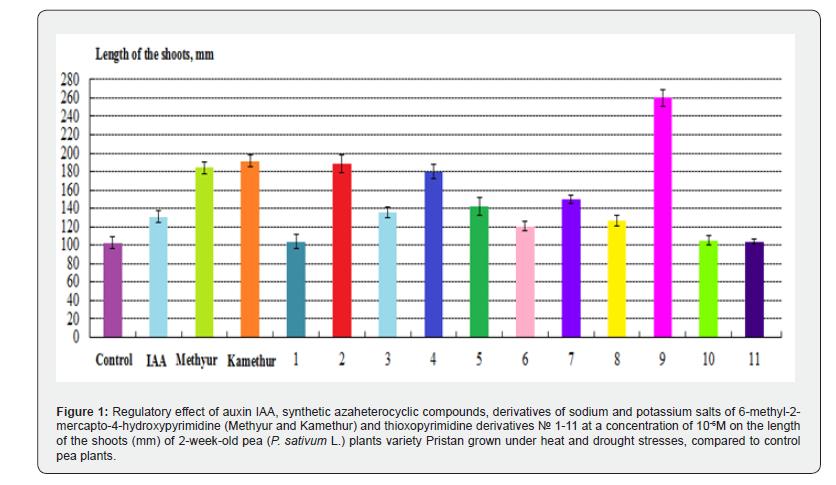
The conducted study has been shown that the regulatory effect of the thioxopyrimidine derivatives, used in a concentration of 10-6 M, is similar to or higher than the regulatory effect of auxin IAA or derivatives of sodium and potassium salts of 6-methyl-2- mercapto-4-hydroxypyrimidine (Methyur and Kamethur), used in a similar concentration of 10-6 M. Morphometric parameters of pea plants (average shoot length (mm), average root length (mm), and average number of roots (pcs)) after two weeks of their growth under heat and drought stress significantly improved compared to control plants, whose growth slowed down. Statistical analysis of the morphometric parameters of 2-week-old pea plants, grown under heat and drought stresses, showed that the highest average length of the shoots (mm) was observed in pea plants treated with Methyur, Kamethur, and thioxopyrimidine derivatives № 2, 3, 4, 5, 7 and 9, compared to control plants (Figure 1). The average length of the shoots (mm) of pea plants increased as follows: by 79.22% - under the treatment of Methyur, by 86.36% - under the treatment of Kamethur, by 31.82-153.25% - under the treatment of thioxopyrimidine derivatives № 2, 3, 4, 5, 7 and 9 compared to control plants (Figure 1). The lower average length of the shoots (mm) was observed in 2-week-old pea plants, grown under heat and drought stresses, treated with auxin IAA and thioxopyrimidine derivatives № 1, 6, 8, 10 and 11, compared to control plants (Figure 1). The average length of the shoots (mm) of pea plants increased as follows: by 27.6% - under the treatment of IAA, by 1.3-23.38% - under the treatment of thioxopyrimidine derivatives № 1, 6, 8, 10 and 11 compared to control plants (Figure 1).
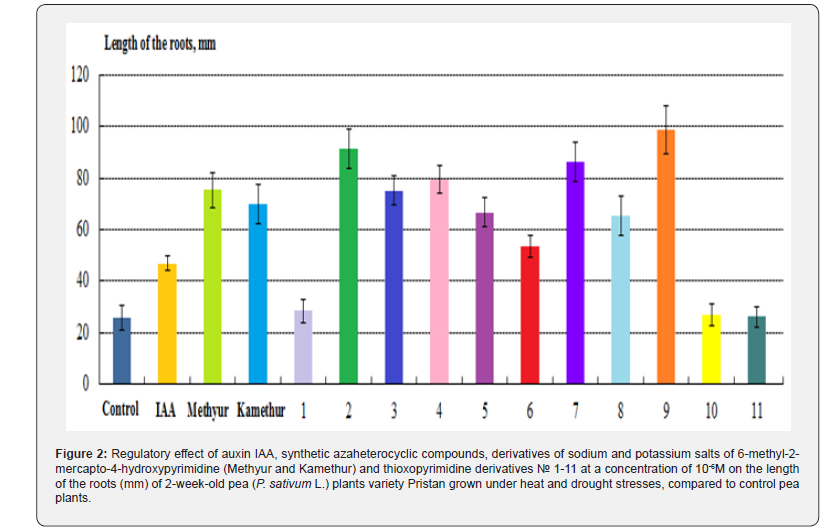
As is known, phytohormones auxins control the formation, organization, and maintenance of the plant root system, which plays a key role in providing plants with water, micro- and macroelements, as well as organic matter from the soil and enhances plant adaptation to abiotic stresses such as heat, drought, and soil salinity, which significantly limit crop yields [23,24,81,82,84,86-90,95-97]. In this work, the regulatory role of synthetic azaheterocyclic compounds, derivatives of sodium and potassium salts of 6-methyl-2-mercapto-4-hydroxypyrimidine (Methyur and Kamethur) and thioxopyrimidine derivatives № 1-11 on the formation and development of the root system of pea plants (P. sativum L.) variety Pristan, grown under conditions of heat and drought stresses, was studied in comparison with the regulatory role of auxin IAA. Statistical analysis of the morphometric parameters of 2-week-old pea plants, grown under heat and drought stresses, showed that the highest average length of the roots (mm) was observed in pea plants treated with Methyur, Kamethur, and thioxopyrimidine derivatives № 2, 3, 4, 5, 6, 7, 8 and 9, compared to control plants (Figure 2). The average length of the roots (mm) of pea plants increased as follows: by 193.51% - under the treatment of Methyur, by 172.73% - under the treatment of Kamethur, by 107.79-284.42% - under the treatment of thioxopyrimidine derivatives № 2, 3, 4, 5, 6, 7, 8 and 9, compared to control plants (Figure 2). The lower average length of the roots (mm) was observed in 2-week-old pea plants, grown under heat and drought stresses, treated with auxin IAA and thioxopyrimidine derivatives № 1, 10 and 11, compared to control plants (Figure 2). The average length of the roots (mm) of pea plants increased as follows: by 81.82% - under the treatment of IAA, by 1,5-10,39% - under the treatment of thioxopyrimidine derivatives № 1, 10 and 11, compared to control plants (Figure 2).
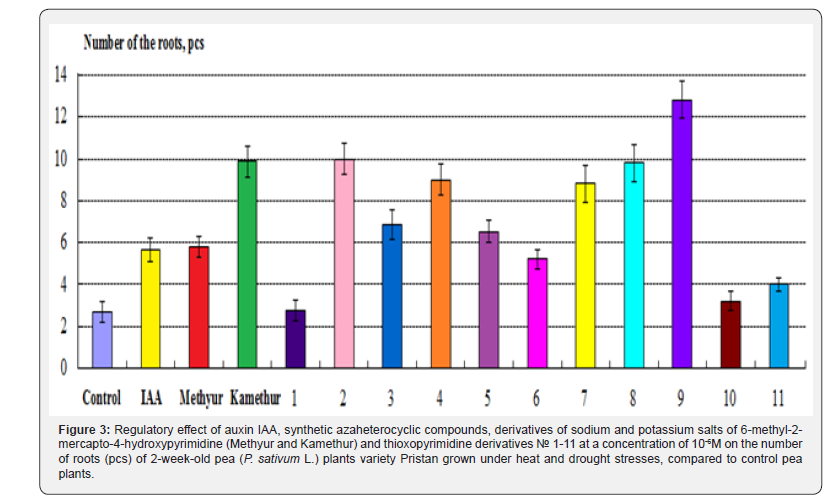
Statistical analysis of the morphometric parameters of 2-weekold pea plants, grown under heat and drought stresses, showed that the highest average number of roots (pcs) was observed in pea plants treated with Kamethur, and thioxopyrimidine derivatives № 2, 3, 4, 5, 7, 8 and 9, compared to control plants (Figure 3).
The average number of roots (pcs) of pea plants increased as follows: by 270% - under the treatment of Kamethur, by 145- 380% - under the treatment of thioxopyrimidine derivatives № 2, 3, 4, 5, 7, 8 and 9, compared to control plants (Figure 3). The lower average number of roots (pcs) was observed in 2-week-old pea plants, grown under heat and drought stresses, treated with auxin IAA, Methyur, and thioxopyrimidine derivatives № 1, 6, 10 and 11, compared to control plants (Figure 3). The average number of roots (pcs) of pea plants increased as follows: by 112.5% - under the treatment of IAA, by 117.5% - under the treatment of Methyur, by 2.5-95% - under the treatment of thioxopyrimidine derivatives № 1, 6, 10 and 11, compared to control plants (Figure 3). The obtained data indicate that the synthetic azaheterocyclic compounds Methyur, Kamethur and thioxopyrimidine derivatives № 2, 3, 4, 5, 7, 8 and 9, showed the highest regulatory effect on the parameters of shoots and roots of pea plants, while the synthetic compounds, thioxopyrimidine derivatives № 1, 6, 10 and 11 showed a lower regulatory effect on the parameters of shoots and roots of pea plants compared to similar parameters in control pea plants. The regulatory effect of the synthetic compounds Methyur, Kamethur and thioxopyrimidine derivatives № 2, 3, 4, 5, 7, 8 and 9, was similar to or higher than the effect of auxin IAA. Thus, the obtained results allow us to conclude that synthetic azaheterocyclic compounds Methyur, Kamethur and thioxopyrimidine derivatives № 2, 3, 4, 5, 7, 8 and 9 have a regulatory effect similar to auxins on the growth and development of the deep root system, improving the water uptake by the above-ground plant organs - shoots and thereby promoting their growth and preventing their wilting, as well as their ability to maintain their water status and, as a result, improving the adaptation of pea plants to drought and heat stresses [23,24,81,82,84,86-90,95-97] when grown even in the absence of nutrients in the artificial substrate - perlite.
Study of the photosynthesis indicators of pea plants during their growth and adaptation to heat and drought stresses
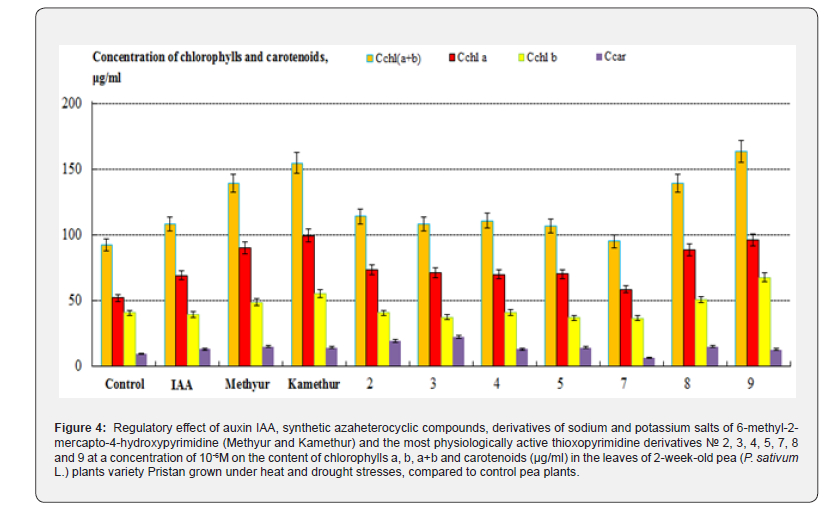
Our research is devoted to screening new physiologically active synthetic low molecular weight azaheterocyclic compounds, thioxopyrimidine derivatives № 1-11, presented in Table 1, capable of exerting a regulating effect similar to the effect of phytohormones cytokinins, which are known to play a key role in the cell division, morphogenesis of shoots and leaves, and the prevention of their senescence, enhance respiration and photosynthesis, prolong the vegetative phase and maintain efficient metabolic activity in plants over extended periods, thereby increasing the yield of agricultural crops, and also improving the adaptation of plants to various abiotic stresses, such as heat, drought, cold and soil salinity [23,24,30,31, 81- 83,85-87,89,91-94]. As shown in previously published studies, synthetic azaheterocyclic compounds, derivatives of sodium and potassium salts of 6-methyl-2-mercapto-4-hydroxypyrimidine (Methyur and Kamethur), as well as new pyrimidine derivatives, exhibit an cytokinin-like effects on the photosynthesis of various agricultural crops [49-63], including pea (P. sativum L.) plants varieties Slobozhansky whiskered and Pivnich [55,63], as well as a cytokinin-like effect on photosynthesis and protective effect on the adaptation of soybean (G. max (L.) Merr.) plants variety Syaivo and maize (Z. mays L.) plants of the varieties Twist and Mas 24.C to such abiotic stress factors as heat and drought [49, 64-66]. This work investigated the regulatory role of synthetic azaheterocyclic compounds, derivatives of sodium and potassium salts of 6-methyl-2-mercapto-4-hydroxypyrimidine (Methyur and Kamethur) and the most physiologically active thioxopyrimidine derivatives № 2, 3, 4, 5, 7, 8 and 9, selected according to plant morphological indicators, on the photosynthesis of pea plants (P. sativum L.) variety Pristan, grown under conditions of heat and drought stresses, in comparison with the regulatory role of auxin IAA.
Statistical analysis of the photosynthetic parameters of 2-week-old pea plants, grown under heat and drought stresses, showed that the highest regulatory effect on the content of chlorophylls a, b, a+b and carotenoids (mg/g fresh weight) in plant leaves is exerted by auxin IAA and derivatives of sodium and potassium salts of 6-methyl-2-mercapto-4-hydroxypyrimidine (Methyur and Kamethur) and thioxopyrimidine derivatives № 2, 3, 4, 5, 8 and 9, under the effect of which the content of chlorophyll a increases: by 32.61% - under the effect of IAA, by 73.67% - under the effect of Methyur, by 91.25% - under the effect of Kamethur, by 34.37-85% - under the effect of thioxopyrimidine derivatives № 2, 3, 4, 5, 8 and 9; the content of chlorophyll b increases: by 20.20 % - under the effect of Methyur, by 36.36% - under the effect of Kamethur, by 24.9-66.3% - under the effect of thioxopyrimidine derivatives № 8 and 9; the content of chlorophylls a+b increases: by 17.13% - under the effect of IAA, by 50.25% - under the effect of Methyur, by 67.20% - under the effect of Kamethur, by 15.55- 76.82% - under the effect of thioxopyrimidine derivatives № 2, 3, 4, 5, 8 and 9; the content of carotenoids increases: by 38.99% - under the effect of IAA, by 58.41% - under the effect of Methyur, by 50.28% - under the effect of Kamethur, by 35.06-134.66% - under the effect of thioxopyrimidine derivatives № 2, 3, 4, 5, 8 and 9, compared to similar parameters of control plants (Figure 4). The lower regulatory effect on the content of chlorophylls a, b, a+b and carotenoids (mg/g fresh weight) in plant leaves is exerted by thioxopyrimidine derivative № 7, under the effect of which the content of chlorophyll an increase by 12.81%, the content of chlorophylls a+b increases by 2.82%, compared to similar parameters of control plants (Figure 4). At the same time, under the influence of this compound, the content of chlorophyll b and carotenoids was slightly lower than that of control plants.
The results obtained allow us to conclude that the synthetic azaheterocyclic compounds Methyur, Kamethur and thioxopyrimidine derivatives № 2, 3, 4, 5, 8 and 9 have a regulatory effect similar to cytokinins on the photosynthesis in the leaves of pea plants, enhancing the synthesis and slowing down the degradation of chlorophyll a, b and carotenoids in plant leaves and preventing wilting and aging of leaves, thereby improving the adaptation of pea plants to drought and heat stresses [23,24,30,31,81-83,85-87,89,91-94] when grown even in the absence of nutrients in the artificial substrate - perlite.
Summarizing the results obtained and analyzing the relationship between the regulatory effect on the growth and photosynthesis of pea plants and the chemical structure of new synthetic azaheterocyclic compounds, we can conclude that the thioxopyrimidine derivatives № 2, 3, 4, 5, 7, 8 and 9 are most physiologically active compounds due to the presence of substituents in their chemical structures: compound № 2 contains an allyl substituent in position 3, a phenylsulfonyl group in position 5 of the 2-thioxo-2,3-dihydro-1H-pyrimidin-4-one ring; compound № 3 contains a benzyl substituent in position 5, a methyl group in position 6 of the 2-thioxo-2,3-dihydro-1Hpyrimidin- 4-one ring; compound № 4 contains a phenyl group in position 3, a benzenesulfonyl group in position 5 of the 2-thioxo- 2,3-dihydro-1H-pyrimidin-4-one ring; compound № 5 contains a p-tolyl group in position 6, a cyano group in position 5 of the 4-oxo-2-thioxo-1,2,3,4-tetrahydropyrimidine ring; compound № 7 contains a methylsulfanyl group in position 2, a p-tolyl group in position 4, and a cyano group in position 5 of the 6-oxo-1,6- dihydropyrimidine ring; compound № 8 contains a methyl group in position 6, a phenyl group in position 4, and an ethoxycarbonyl group in position 5 of the 2-thioxo-1,2,3,4-tetrahydropyrimidine ring; compound № 9 contains a methyl group in position 6, a 4-methoxyphenyl group in position 4, and an ethoxycarbonyl group in position 5 of the 2-thioxo-1,2,3,4-tetrahydropyrimidine ring (Table 1).
The decrease in the regulatory effect on the growth and photosynthesis of pea plants of synthetic compounds, thioxopyrimidine derivatives № 1, 6, 10 and 11, can be explained by the presence of substituents in their chemical structures: compound № 1 contains a benzenesulfonyl group in position 5, an ethyl group in position 3 of the 2-thioxo-2,3-dihydro-1Hpyrimidin- 4-one ring; compound № 6 contains a phenyl group in position 6, a cyano group in position 5 of the 4-oxo-2-thioxo- 1,2,3,4-tetrahydropyrimidine ring; compound № 10 contains a methyl group in position 6, a 4-methoxycarbonylphenyl group in position 4, and an ethoxycarbonyl group in position 5 of the 2-thioxo-1,2,3,4-tetrahydropyrimidine ring; compound № 11 contains a methyl group in position 6, a 4-hydroxyphenyl group in position 4, and an ethoxycarbonyl group in position 5 of the 2-thioxo-1,2,3,4-tetrahydropyrimidine ring (Table 1). It is obvious that the auxin-like and cytokinin-like action of synthetic compounds, thioxopyrimidine derivatives № 2, 3, 4, 5, 7, 8 and 9, is based on their effect on the processes of division, elongation, and differentiation of plant cells, which are the basis for the growth and development of meristems of roots and shoots of pea plants in the vegetative phase, on the activation of photosynthesis in plant leaves and slowing down their aging, as well as on the prevention of wilting and death of plants, which leads to increased adaptation of pea plants to heat and drought stresses. The data obtained in this work correlate with the data of our previously published work, in which we studied the auxin- and cytokinin-like regulatory effects of azaheterocyclic compounds, derivatives of sodium and potassium salts of 6-methyl-2-mercapto-4-hydroxypyrimidine (Methyur and Kamethur), as well as thioxopyrimidine derivatives № 1-11 (Table 1) on the growth, photosynthesis, and adaptation of soybean plants (G. max (L.) Merr.) of the Syaivo variety to heat and drought stresses [64].
Comparing the results of this work with our previously published work [64], it can be concluded that synthetic azaheterocyclic compounds, derivatives of sodium and potassium salts of 6-methyl-2-mercapto-4-hydroxypyrimidine (Methyur and Kamethur), and thioxopyrimidine derivatives № 2, 5, 7, 8, demonstrate the high auxin- and cytokinin-like regulatory effects on growth, photosynthesis, and adaptation to heat and drought stresses of both soybean and pea plant species, while thioxopyrimidine derivatives № 1, 3, 4, 6, 9, 10, and 11 demonstrate selectivity in their auxin- and cytokinin-like regulatory effects on soybean and pea plant species. That is, we can conclude about the selectivity of the plant growth regulating and protective effects against heat and drought stresses of thioxopyrimidine derivatives № 1, 3, 4, 6, 9, 10, and 11 on various agricultural crops, which is obviously explained by the different specificity of their intracellular regulatory action, similar to the studied synthetic analogues of auxins and cytokinins, as well as new plant growth regulators created on the basis of pyrimidine or pyridine derivatives, on various intracellular signaling pathways of auxins and cytokinins, or their modulating action on the intracellular pathways of biosynthesis, homeostasis and metabolism, conjugation and oxidation of endogenous auxins and cytokinins in plant cells [23,30,31,40,45,89,92,93,94,98-118].
Conclusion
The regulatory effect of new synthetic azaheterocyclic compounds, thioxopyrimidine derivatives, on the grown and photosynthesis of two-week-old pea (P. sativum L.) plants variety Pristan and their adaptation to heat and drought stresses was studied. It has been found that the treatment of pea seeds with thioxopyrimidine derivatives improves morphological indicators and increases the content of chlorophylls a and b, and carotenoids in two-week-old pea plants grown under heat and drought stresses. The regulatory effect of thioxopyrimidine derivatives, used in a concentration of 10-6 M, was equal to or higher than the regulatory effect of auxin IAA, or known synthetic azaheterocyclic compounds, derivatives of 6-methyl-2-mercapto-4-hydroxypyrimidine sodium and potassium salts (Methyur and Kamethur), used in a similar concentration of 10-6 M. An analysis of the correlation between the chemical structure and the selectivity of the regulatory effect of thioxopyrimidine derivatives was carried out. Based on the obtained results, the most physiologically active thioxopyrimidine derivatives № 2, 3, 4, 5, 7, 8 and 9 were selected, which, as well as Methyur and Kamethur, were proposed to be used to improve pea growth, enhance photosynthesis and increase plant adaptation to heat and drought stresses.
Statement of conflict of interest
The authors are declared that they have no conflict with this research article.

























