




 JOJHA Home



Effect of Extraction Method on the Yield and Physico-Chemical Property of Cashew Nut
Abubakar Badamasi1, Kazeem Ibraheem Ajadi1* and Abdullahi Nuraddeen Bakori2
1Department of Chemical Engineering, Ahmadu Bello University Zaria, Nigeria
2Department of Chemical Engineering, Kaduna Polytechnic, Nigeria
Submission:August 22, 2025;Published: September 04, 2025
*Corresponding author: Kazeem Ibraheem Ajadi, Chemical Engineering Department, Ahmadu Bello University Zaria, Nigeria
How to cite this article: Abubakar Badamasi, Kazeem Ibraheem Ajadi and Abdullahi Nuraddeen Bakori. Effect of Extraction Method on the Yield and Physico-Chemical Property of Cashew Nut. Juniper Online Journal of Public Health, 5(5). 555673.DOI: 10.19080/JOJHA.2025.05.555673.
Abstract
In order to determine the optimal extraction technique and the oils’ suitability for ingestion and other applications, this study aimed to extract oils from cashew kernels using cold press, mechanical, and soxhlet extraction. The study also compared the yield and physicochemical properties of the oils. The cold press was done using a traditional local method; the mechanical method was done with hydraulic presses; and the extraction was done with a Soxhelt apparatus using n-hexane as the solvent. The percentage oil extracted from the kernel was 40% for soxhlet extraction, 27% mechanical and 12% cold press respectively. Cashew Kernel Oil (CKO) is light yellow in color, according to physical analysis results; physical and chemical characterization revealed a pH of 5.65, 5.4, and 5.4; acid value of 8.25mg KOH/g, 8.43mg KOH/g, and 8.697mg KOH/g; density of 0.91g/cm3, 0.909g/cm3, and 0.907g/cm3; and free fatty acid of 4.125, 4.215, and 4.348 for soxhlet extraction, mechanical, and cold press, respectively. Since cashew kernel oil is non-toxic, this suggests that it could be used in the food and cosmetic industries.
Keywords:Extraction; Soxhlet; Mechanical; Cold press; Cashew; Characterization
Introduction
Due to its essential oils, cashew (Anacardium occidentale L.) is one of the main sources of edible oil in the world and is gaining interest from many nations. Since Nigeria is one of the major cashew nut producers in Africa, not much progress has been made in extracting the nut’s essential ingredients. In terms of agricultural produce, cashew nuts are regarded as a lost crop in Nigeria, despite their potential for both industrial use and export. Almost every part of the cashew tree, including the roots, stem, bark, and other parts, is utilized. It is a multipurpose crop. Like peanut and pistachio nuts, its nuts are valued commodities and frequently served as appetizers. Additionally, cashew nuts are used in the food industry and as an ingredient in a variety of confections. The nutritional value of cashew nut kernels to humans is good. They are an excellent source of proteins (17.8%), fats (46.5%), and vitamins (A, D, and E). Additionally, according to Kapinga et al. [1], they have relatively significant concentrations of the following minerals in dry weight: calcium (504.0mg/kg), iron (90.8mg/kg), zinc (31.3mg/kg), copper (16.4mg/kg), potassium (5600 mg/kg), phosphorus (4600mg/kg), magnesium (2400mg/kg), and sodium (22.8mg/kg). Cashew nut shell liquid (CNSL), a liquid extracted from the pericarp of cashew nuts, is one of their main byproducts. One source of naturally occurring phenols is CNSL. It is a viscous, poisonous, amber-colored oil that is extracted through extraction methods from the cashew nut’s by-product shells. It is frequently regarded as a more beneficial and affordable source of unsaturated phenols. In the polymer-based industries, CNSL is used in a wide range of products, including wood preservatives, paints, laminating resins, rubber compounding resins, surfactants, epoxy resins, and friction linings [2]. The cashew nut shell liquid can be extracted from cashew nuts using three main techniques, mechanical extraction, roasting, and solvent extraction. The nuts are roasted using a traditional method that involves an open flame. The liquid, a valuable source of natural phenols, is wasted in the process of charring off the CNSL. Nonetheless, the mechanical approach is technologically and economically sound enough to be implemented on an industrial scale right away [3]. Exploration and exploitation of Nigeria’s cashew nut, which, if properly managed, can contribute to the country’s eventual self-sufficiency, are urgently needed. The purpose of this study is to extract cashew nuts oil using three different extraction method and potential applications that could result in both local and foreign wealth creation for Nigeria. Oil from cashew nuts produced.
Material and Method
For two weeks, the cashew nuts from Samaru Zaria, in the Nigerian state of Kaduna, were exposed to the sun. In order to prevent scorching, they were cleaned, decorated, and then soaked in water. To separate and extract the kernels free of cracks, they were dried once more and shelled. They were manually cracked using a wooden mallet after being placed on a level stone. The kernels and the shell are the end products. A mortar was used to crush 250g of the dried kernel (AFR species) and the shell, which were then screened to ensure uniformity in size distribution.
Methodology
Preparation of Cashew Nut Sample
With the help of an oven, the cashew nuts from Samaru Zaria, Kaduna State, were dried until all moisture was gone. Then, a mortar and pestle were used to grind the dried cashew nuts. In order to ensure an appropriate extraction process, the ground nuts were weighed and placed in a different sealed vessel to prevent contamination.
Soxhlet extraction of oil from cashew nut
The number of shells was split up into four batches in order to perform batch extraction procedures. Each batch weighed 50g of sample, and 200ml of hexane was used as the extraction solvent. The extraction procedure was carried out with water flowing continuously at a temperature of 100°C. For two hours, each batch was subjected to Soxhlet extraction. Following extraction, each batch’s oil and solvent mixture was moved to a round-bottom flask for filtration to get rid of any remaining sediment. A Buchner funnel and filter paper dampened with hexane were used to vacuum filter the mixtures. To separate the oil from the solvent, each batch’s filtrate was moved to a flask with a circular bottom.
Mechanical extraction of oil from cashew nut
The ready samples (from section 3.1) were ground to provide more surface area for a simple oil extraction. The ground samples were mixed with hot water droplets to facilitate the formation of cakes, which were subsequently put onto a stainless-steel tray. The oil was supposed to run on a stainless-steel bowl that was positioned beneath the hydraulic press. In order to maintain a slow stream of oil flowing continuously, pressure was applied. The pressure was raised and maintained there until the oil stopped dropping completely after the oil stream had reduced to a few drops. After the extracted oil was gathered and sealed in a plastic bottle, the constituents of the resulting crude cashew oil were examined.
Cold press extraction of oil from cashew nut
250g of cashew seed were grinded to powdered and pour in a stainless container, 70ml of warm water was added and mixed thoroughly until the oil is coming out a sieve-like cloth is use to drain the oil.
Determination of percentage cashew nuts oil yield
Following the extraction procedure, the weight of oil recovered was noted, and each case’s percentage oil yield was computed by dividing the weight of extracted oil by the initial weight of the cashew sample and multiplying the result by 100. Equation 1 was used to determine the oil yield in percentage terms.

Characterization processes for the extracted cashew nut oil
Determination of density
The ASTM D5355-95 method was utilized to determine S.G. Distilled water was poured into a clean, dried bottle until it was completely full, and the temperature was between 20 and 23oC. After that, a stopper was inserted and left for 30 minutes in a water bath at 25 ± 0.2oC. After the bottle was taken out, the contents were weighed. The weight of the bottle and its contents were subtracted to determine the weight of water inside. To find the oil’s density, the same process was repeated and then calculated.
Determination of free fatty acid
The ASTM-specified procedure D5555-95 was applied. The extracted oil weighed 1.0g, which was then put into a 250ml conical flask. In a 250ml beaker, 25ml of diethyl ether and 25ml of ethanol were combined. After that, the mixture was added to the oil sample in the conical flask along with two milliliters of the phenolphthalein indicator solution. Before adding oil, the mixture was titrated with 0.1M sodium hydroxide to an end point while being vigorously shaken until a permanent pink color corresponding to the intensity of neutralized alcohol appeared. Equation 2 was used to calculate the percentage of free fatty acid.

Determination of iodine value (I.V)
The ASTM-specified procedure D5554-95 was applied. A 50 ml conical flask containing 0.4g of the sample was filled with 20ml of carbon tetra chloride. Next, using a 25ml pipette, 25ml of Wijs solution was added to the flask. After inserting the stopper, the flask’s contents were vigorously swirled to guarantee an intimate mixture. After that, the flask was kept at 25 ± 5oC in the dark for 30 minutes. After this time, 100ml of distilled water and 20ml of potassium iodide were added using a measuring cylinder. With continuous shaking, the solution was titrated with 0.1M sodiumthiosulphate solution until the yellow color nearly vanished. The starch indicator solution was added in one milliliter, and then the thiosulphate solution was added drop by drop until the blue color vanished. The blank test and the other samples were processed using the same method. Next, the iodine value was computed using equation 3.

Determination of saponification value
The ASTM-specified procedure D5558-95 was applied. A 250ml conical flask was filled with 2g of the sample, and 25ml of 0.1N ethanolic potassium hydroxide was added after that. For 30 minutes, the flask’s contents were continuously stirred and the flask was gradually heated. The mixture’s flask was set on top of a reflux condenser. The warm solution was mixed with 2 milliliters of phenolphthalein indicator, which was then titrated with 0.5 milliliters of hydrochloric acid to the end point, or until the indicator’s pink color completely vanished. The other samples and the blank underwent the same process.
Determination of pH
The samples’ pH was measured using a Hanna Instruments combo Gro” check pH meter (Model No. H1991404). The pH was then determined by measuring the samples’ pH using the pH meter’s probe and recording the results.
Results and Discussion
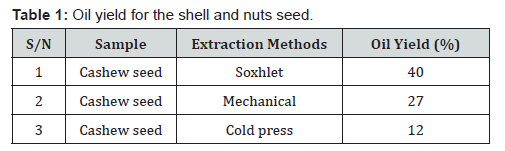
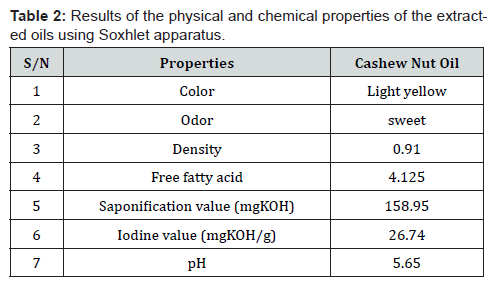
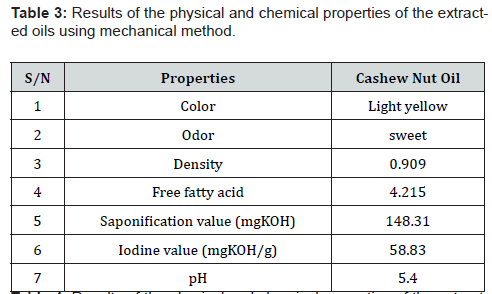
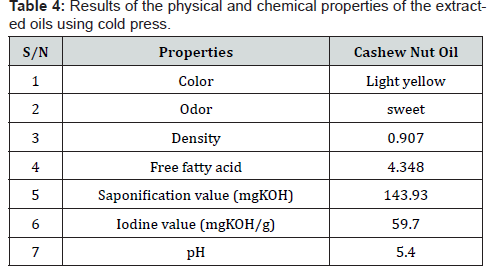
Table 1 shows the Oil yields for the three-extraction process employed in the Research work. Analyses were conducted on the extracted oils’ free fatty acid (FFA), saponification value, iodine value, pH, and density. For cashew nuts, the soxhlet apparatus yielded a higher percentage of oils (40%). Based on Table 2-4, it was determined that the free fatty acid content of cashew nut oil obtained through soxhlet extraction was 4.125, mechanical extraction was 4.215, and cold press was 4.348. The experiment was completed as soon as the oils were extracted, and no longer than a few hours. The outcomes fall within the range of the values that Idowu and Abdulhamid [4] previously reported. This suggests that, as previously reported by Abitogun and Borokini [5], refining cashew nut oil and storing it for an extended period of time may promote oxidative deterioration, which may lead to the formation of an off-flavour component. An assessment was also conducted on the Iodine value, which serves as a gauge for the characteristics of unsaturated organic components and a sign of how reactive the double bond is in an oil sample. The soxhlet extraction, mechanical extraction, and cold press cashew shell nut yielded values of 47.74mg KOH/g, 58.83mg KOH/g, and 59.7mg KOH/g, in that order. The existence of traces of the solvent used in the Soxhlet extraction was the cause of the variation in the iodine values of cashew nut oils. The ASTM standard was met by the iodine values. According to Pearson [6] and Ataise et al. [7], the majority of edible oils are classified as non-drying oils (80-100g/100g) due to their low degree of unsaturation. Cashew nut oil from Soxhlet, mechanical cold press extraction, had pH values of 5.65, 5.4, and 5.4, respectively. A few of the properties that were acquired differed slightly from what was reported by Akinhanmi & Akintokun [8]. This could be caused by variations in the cashew nut species, the cultivation conditions, and the techniques used to extract the oils prior to characterization. The raw, unrefined state of the oils’ results was used for this analysis. The analyzed cashew nut oil’s physical and chemical characteristics, as reported by Bertha [9] and Weiss [10], demonstrated a greater degree of conformity with the characteristics displayed by groundnut and melon oils. This indicates that the food and pharmaceutical industries might find use for it. Its characteristics were in good agreement with the chemical and physical characteristics of castor oil as reported by Aldo [11] and linseed oil as described by Vitorica-Mirela [12]. This implies that it can be used in the manufacturing and processing sectors.
Conclusion
The extraction of cashew nut was carried out in this study and the result were presented in the table above. The findings compared the yield and physicochemical properties of the oils. The cold press was done using a traditional local method; the mechanical method was done with hydraulic presses; and the extraction was done with a Soxhelt apparatus using n-hexane as the solvent. The percentage oil extracted from the kernel was 40% for soxhlet extraction, 27% mechanical and 12% cold press respectively. Cashew Kernel Oil (CKO) is light yellow in color, according to physical analysis results; physical and chemical characterization revealed a pH of 5.65, 5.4, and 5.4; acid value of 8.25mg KOH/g, 8.43mg KOH/g, and 8.697mg KOH/g; density of 0.91g/cm3, 0.909g/cm3, and 0.907g/cm3; and free fatty acid of 4.125, 4.215, and 4.348 for soxhlet extraction, mechanical, and cold press, respectively. Since cashew kernel oil is non-toxic, this suggests that it could be used in the food and cosmetic industries.
References
- Kapinga HJ, Idah PA, Simeon MI, Mohammed MA (2014) Extraction and characterization of Cashew nut Anarcadium occidentale oil and cashew shell liquid oil.
- Adebayo SE, Orhevba BA, Adeoye PA, Musa JJ, Fase OJ (2012) Solvent extraction and characterization of oil from African Start Apple (Chysophyllumalbidum).
- Chaudhari AP (2012) Studies of extraction of cashew nut shell liquid (Doctoral dissertation, College of agricultural engineering and technology, dr. bskkv, dapoli.
- Idowu MO, Abdulhamid DA (2013) Compositional studies and physicochemical characteristics of cashew nut (Anarcadium occidentale) flour. Pakistan J of Nutrition 5(4): 328-333.
- Abitogun MO, Borokini OD (2009) Extraction, compositional and physiochemical characteristics of cashew (Anarcadium occidentale) nuts rejects oil. Asian J of Applied science and Engineering 3(1): 33-40.
- Pearson DA (1981) Chemical analysis of food (8th edn). London: Church-hill, Living stone.
- Atasie (2009) Proximate analysis and physico-chemical properties of groundnut (arachis hypogaea). Pakistan J of nutrition 8(2): 194-197.
- Akinhanmi TF, Akintokun PO (2008) Chemical composition and physicochemical properties of cashew nut (Anarcadium occidentale) oil and cashew nut shell liquid. J of Agricultural, Food and Environmental sciences 2(1): 1-10.
- Bertha OI (1992) Comparative studies of the physiochemical properties of Oil extracted from palm kernel, coconut, groundnut, and melon seeds. An unpublished HND thesis; Kaduna polytechnic, Kaduna, pp. 9-45.
- Weiss EA (2000) Oilseed crops, (2nd edn), Oxford: Blackwell science ltd, pp. 287-329.
- Aldo HI (2012) Chemical properties of biodiesel from Jatropha and Castor oils. International J of renewable energy research 2(1).
- Viorica-mirela JK (2012) Fatty acids composition and oil characteristics of linseed (linum usitatissimum ) from romania. Journal of Agroalimentary Processes and Technologies 18(2): 136-140.

























