




 JOJHA Home



Comparative Trial of Five Mini Wax Gourd Varieties Under Different Cultivation Modes in Nantong Area
Yang Xianjuan1, Lin Wenli2 and Zhou Tingting1
1Nantong College of Science and Technology, Nantong 226007, Jiangsu, China
2Nantong Haimen District Institute of Agricultural Sciences, Haimen 226100, Jiangsu, China
Submission:May 24, 2025;Published: June 06, 2025
*Corresponding author: Yang Xianjuan, Nantong College of Science and Technology, Nantong 226007, Jiangsu, China
How to cite this article: Yang Xianjuan, Lin Wenli and Zhou Tingting. Comparative Trial of Five Mini Wax Gourd Varieties Under Different Cultivation Modes in Nantong Area. Juniper Online Journal of Public Health, 5(4). 555666.DOI: 10.19080/JOJHA.2025.05.555666.
Abstract
In order to screen out mini wax gourd varieties suitable for fall planting in Nantong area, five varieties were introduced in Haimen, Nantong, and tested in two cultivation methods, vertical and climbing. The shapes were compared by their adaptability, ripening period, commercialization, productivity and virus resistance. The test results showed that Xiaguan No. 1 and Cuiyu and Yuenong have significant advantages in fruit harvesting period, fruit sugar, yield and disease resistance, etc. The cultivation mode can be adopted vertical cultivation to improve the quality and yield of different varieties.
Keywords:Mini Wax Gourd; Cultivation Pattern; Quality; Disease Resistance
Introduction
Miniature winter melon individual moderate, good storage resistance, bright skin color, juicy flavor, popular with consumers, in the Nantong area has a certain cultivation [1]. For this reason, five varieties such as Xia guan No. 1, Yue Nong, Cuiyu, Mini 3201, Cuiju and Hejiahuan 1104 were introduced for fall cultivation comparative test. Through the adaptability of different Mini wax gourd varieties, maturity and disease resistance, etc. to investigate and compare, in order to screen out suitable for Nantong region in the fall to promote the cultivation of Mini wax gourd varieties, for the promotion of good varieties and production and cultivation technology guidance to provide reference.
Material and Method
Test Material
Five varieties were tested: Xiaguan No. 1 (Guangdong Provincial Academy of Agricultural Sciences), Yuenong (Guangdong Provincial Academy of Agricultural Sciences), Mini 3201 (Guangzhou Nongda Vegetable Research Institute), Cuiyu (Taiwan Hejiahuan Agricultural Products Co., Ltd.), and Hejiahuan 1104 (Taiwan Hejiahuan Agricultural Products Co., Ltd.).
Test Methods
The experiment was carried out at the base of Haimen Agricultural Science Institute, designed as a single greenhouse with three replications, comparing the production habits of five varieties under two different cultivation methods, namely vertical and ground-crawling. The seeds were sown on August 14th, transplanted on September 2nd, and harvested on October 12th. Cultivation methods and requirements are as follows:
i. Vertical cultivation: 4 rows per shed, plant spacing 0.50cm, row spacing 1.20m, single vine branching [2].
ii. Ground climbing cultivation: Each shed planted 2 rows, plant spacing 0.55cm, row spacing of 3.00 meters, double vine branching [3].
Measurement of Indicators
The fruit’s external traits were measured with the reference of the “Winter Melon Variety Evaluation Guidelines NY/T 3054-2016”. For sugar content determination: flesh samples were collected from both sides of the fruit to extract juice and measured using a PAL-1 portable digital refractometer (ATAGO,Japan), The results were expressed in %, and the average of two measurements was recorded as the sugar content. After transversely cutting the middle part of the fruit, flesh thickness and peel thickness were measured using a vernier caliper [4]. Yield was determined by averaging values from three random plots under each cultivation mode. Virus disease incidence (%) = (number of infected plants / total surveyed plants) × 100; virus disease incidence was surveyed during the fruit expansion stage [5].
Data Analysis
The data were processed using Excel 2016 and analyzed via one- way ANOVA in SPSS 26.0. Significant differences (P <0.05) were determined using Duncan’s multiple range test.
Results and Analysis
Fertility Analysis
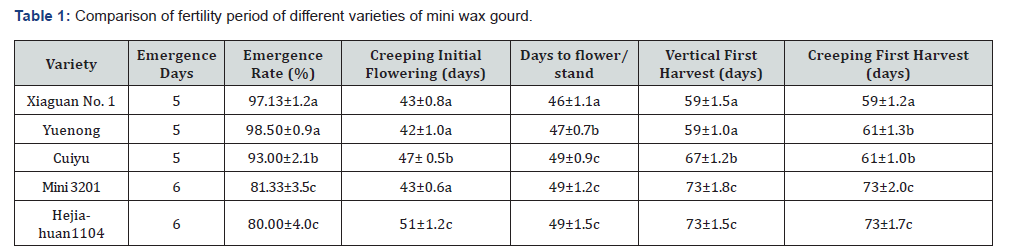
By comparing the main agronomic traits such as fertility period, it was found that there were some differences in the fertility period of five varieties of mini wax gourd under the same cultivation conditions. There were also differences in the fertility period of the same variety under different cultivation methods.
From the results in Table 1, it can be seen that the seedling emergence time of the five varieties for testing ranged from 5~6 days. Xiaguan No. 1, Yuenong and Cuiyu all emerged on the 5th day, while Mini 3201 and Hejiahuan 1104 emerged on the 6th day; in terms of seedling emergence rate, Mini 3201 and Hejiahuan 1104 had a lower seedling emergence rate of 81.33% and 80%, respectively, while Xiaguan No. 1 and Yuenong had a higher seedling emergence rate of 97.13% and 98.5%, respectively. Under vertical cultivation, Yuenong had the earliest time for flower initiation(42 days) and the shortest time for first harvest of fruit(59 days). Hejiahuan 1104 had the latest time for flower initiation, and the longest time for first harvest of fruit(73 days). Xiaguan No. 1 had the earliest time for first harvesting, 59 days after flowering. The time for first harvest (73 days) of Mini 3201 was the same as that of Hejiahuan 1104. Cuiyu’s flower initiation and first harvest time were both in the middle, 47 and 67 days, respectively.
Under the ground crawling cultivation method, the earliest time for flower initiation and first harvest of Xiaguan No. 1 was 46 and 59 days, respectively. The time for flower initiation of Yuenong was 47 days, and the latest time for flower initiation of Cuiyu, Mini 3201, and Hejiahuan 1104 was 49 days. The latest time for first harvest of Mini 3201 and Hejiahuan 1104 was 73 days, and the first harvest of Yuenong and Cuiyu was in the middle of the range, at 61 days (Table 1). Compared with the vertical cultivation, Xiaguan No. 1, Yuenong, Cuiyu, and Mini 3201 started flowering later than the crawling cultivation, whereas Hejiahuan 1104 showed that the ground crawling cultivation was earlier than the vertical cultivation. The first harvesting period of Xiaguan No. 1, Mini 3201, and Hejiahuan 1104 was the same in both vertical and crawling cultivation, while Yuenong was 2 days later in ground climbing cultivation than in vertical cultivation, and Cuiyu was 6 days earlier in ground climbing cultivation than in vertical cultivation (Table 1).
Fruit Traits and Commercial Traits
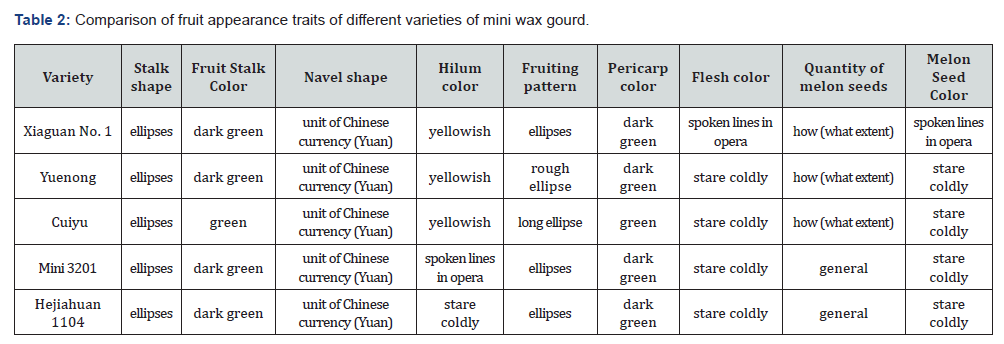
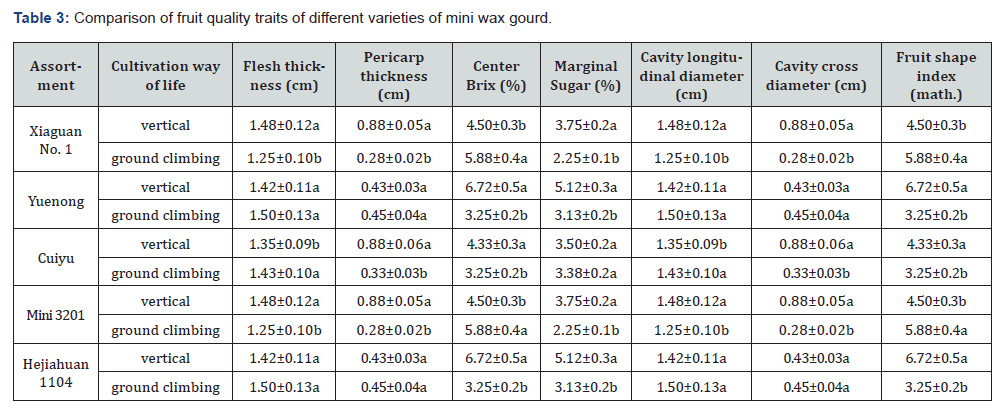
From the umbilicus point of view, the umbilicus of all five varieties were round, Xia guan No. 1, Yue Nong and Cuiju showed light yellow color, and Mini 3201 and Jiajiajun 1104 showed white color. The skin of Cuiyu was green, and the skin of the other four varieties was dark green, and the flesh of all five varieties was white. Mini 3201 and Hejiahuan 1104 had a medium number of seeds, while the other three varieties had a high number of seeds (Table 2). In terms of flesh thickness, under vertical cultivation, Hejiahuan 1104 was significantly larger than other varieties, followed by Mini 3201, Xiaguan 1, Yue Nong and Cuiyu; and underground climbing cultivation, flesh thickness was in the order of thickest to thinnest for Hejiahuan 1104, Mini 3201, Yuenong, Cuiyu and Xiaguan No. 1. It can be seen that the cultivation method had no significant effect on the flesh thickness of Hejiahuan 1104 and Mini 3201, while vertical cultivation increased the flesh thickness of Xiaguan No. 1 and decreased the flesh thickness of Yuenong and Cuiyu compared with crawling cultivation. In terms of pericarp, the thickest pericarp among the five varieties was found in Hejiahuan 1104. Different cultivation methods had an effect on the thickness of the pericarp, compared with ground climbing cultivation, the vertical cultivation method greatly increased the thickness of the pericarp of Xiaguan No. 1. The thickness of the vertical cultivation was 0.43 cm, while the thickness of the ground climbing cultivation was 0.28 cm. Cuiyu’s pericarp thickness under vertical cultivation was 0.88 cm, while the thickness of the pericarp under the ground climbing cultivation was 0.33 cm.
Under vertical cultivation, Xiaguan No. 1 had higher fruit center sugar and margin sugar than other varieties, with 5.88 and 2.25%, respectively, followed by Yuenong, Cuiyu, Hejiahuan 1104 and Mini 3201. However, under creeping cultivation, Xia guan No. 1 had the highest center sugar of 6.72 %, followed by Hejiahuan 1104 (3.75 %), Yuenong and Cuiyu were basically the same, and Mini 3201 was the lowest; and margin sugar was the highest for Hejiahuan 1104 (3.50 %), followed by Mini-3201 and Xia guan No. 1. 3201 was the lowest, while the highest marginal sugar was found in Hejiahuan 1104 (3.50 %), followed by Cuiyu, Yuenong , Mini 3201 and Xiaguan No. 1. It can be seen that the effect of cultivation mode on the fruit sugar content was very obvious, and in general, the fruit sugar content was higher in vertical cultivation than in ground crawling cultivation, which might be related to the better light condition of the plants in the vertical cultivation mode. The longitudinal diameters of the fruit cavities under both vertical and climbing cultivation were, in descending order, Cuiyu, Xia guan No. 1, Yuenong , Hejiahuan 1104, and Mini 3201; the cultivation methods affected the transverse diameters of the cavities. 3201, Yuenong , Xiaguan No.1, Hejiahuan 1104 and Cuiyu. The fruit shape indices of Cuiyu, Xiaguan No.1, Yuenong, Hejiahuan 1104, and Mini 3201 were in descending order, while those of Xia guan No.1 under vertical and crawling cultivation were significantly smaller than those under vertical cultivation. Yuenong , Mini 3201, and Hejiahuan 1104 also showed a tendency to become smaller, while Cuiyu became slightly larger (Table 3).
Single Fruit Weight and Yield
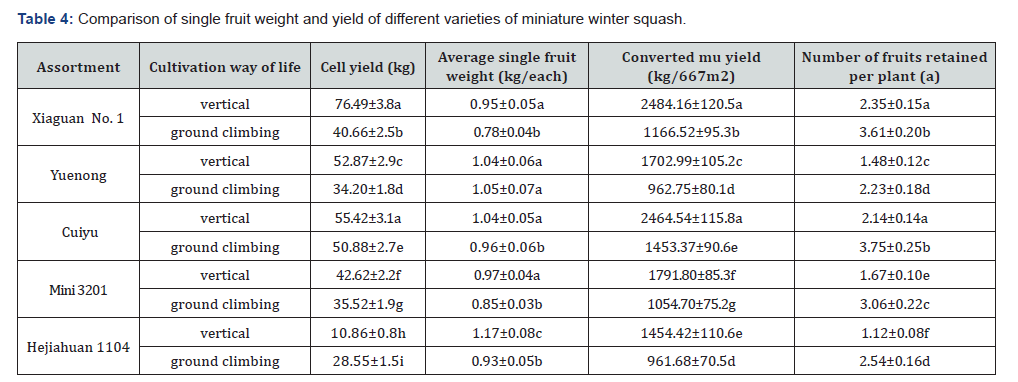
In terms of single fruit weight, there was no significant difference between Cuiyu and Cuiyu under the two cultivation methods, while Xiaguan No.1, Mini-3201, and Hejiahuan 1104 were significantly higher than climbing cultivation under vertical cultivation. In terms of total yield, under vertical cultivation, Xia guan No. 1 and Cuiyu were not significantly different from each other and were higher than the other three varieties, followed by Mini-3201, Yueh-Nong, and Hejiahuan 1104, while underground climbing cultivation, the total yields of Cuiyu, Xiaguan No. 1, Mini 3201, Yuenong and Hejiahuan 1104 were the lowest and not significantly different from each other in descending order. Compared with the ground climbing cultivation method, vertical cultivation significantly increased the total yield of each variety (Table 4).
Varietal Virus Resistance
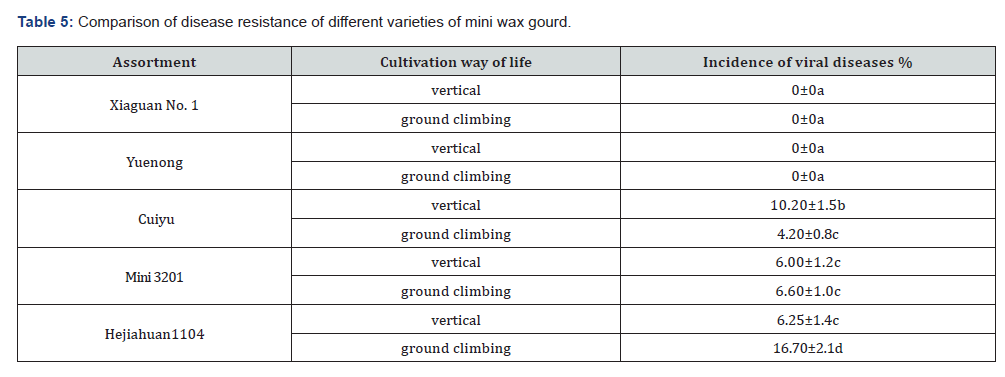
The field survey found that the virus incidence rate of Xiaguan1 and Yuenong in vertical cultivation was 0. The virus incidence rate was 10.20% for Cuiyu, 6.00% for Mini 3201 and 6.25% for Hejiahuan 1104, respectively. The virus incidence rate of Xia guan No. 1 and Yuenong in ground climbing cultivation method was 0., Cuiyu and Mini 3201 were 4.20% and 6.60%, respectively and Hejiahuan 1104 was as high as 16.70%. It can be seen that Xia guan No. 1 and Yuenong virus were more resistant, Mini 3201 was the second most resistant, while Cuiyu and Hejiahuan 1104 were susceptible to the disease (Table 5).
Summary
The above research showed that there are varying degrees of differences in growth periods, fruit traits, yield, and disease resistance among different varieties underground-trailing and vertical cultivation conditions. Notably, vertical cultivation significantly advanced the initial flowering time, increased fruit sugar content, and substantially improved yield. Comparative analysis of different varieties revealed that Xiaguan No.1, Cuiyu, and Yuenong exhibited significant advantages in fruit harvest timing, sugar content, yield, and disease resistance. Vertical cultivation enhances plant spatial distribution through trellising, improving light utilization efficiency, ensuring uniform light exposure for leaves and fruits, and boosting photosynthetic efficiency, thereby increasing yield and fruit quality [6]. Additionally, vertical cultivation maximizes greenhouse space utilization and increases planting density per unit area, consistent with the findings of Liao Daolong et al [7]. Furthermore, vertical cultivation improves ventilation, reduces humidity, and minimizes viral transmission, thereby lowering disease incidence [8].
Planting density and pruning/fruit retention are critical technical measures in wax gourd production. Vertical cultivation employs single-vine pruning to restrict vegetative growth and promote reproductive organ development [9]. In this study, the number of retained fruits per plant under vertical cultivation for Xiaguan No.1 (2.35) was significantly lower than undergroundtrailing (3.61), but the single-fruit weight increased by 0.17 kg, and yield per mu rose by 113%, aligning with Deng Jianying’s research [10]. Future studies could explore optimal planting densities and pruning/fruit retention methods under vertical cultivation to regulate single-fruit weight, yield, or quality for efficient wax gourd production. Therefore, comprehensive comparisons suggest that in the Nantong region, varieties such as Xiaguan No.1, Cuiyu, and Yuenong exhibit strong adaptability and should be prioritized for promotion. Disease-susceptible varieties like Hejiahuan 1104 require enhanced disease control during cultivation. Vertical cultivation can be adopted to improve both quality and yield across different varieties.
References
- Tingting Z, Xianjuan Y (2016) Spring Early Cultivation Techniques for Mini Wax Gourd in Nantong Region[J]. Zhongguo Gua-cai 29(5): 50-52.
- Lingling X, Linhuan C, Xianghong N (2020) Discussion on Cultivation Technology of Wax Gourd[J]. Hunan Agricultural Sciences 12: 101-104.
- Haiping F, Jisong Q, Lijuan Z (2013) High-Yield Cultivation Techniques for Ground-Trailing Wax Gourd in Spring Open Fields of Ningxia Dryland Region[J]. Northern Horticulture 19: 63-64.
- Dasen X, Xiaoming H, Qingwu P (2009) Identification and Evaluation of Benincasa hispida Cogn·Genmplasm Resources[J]. China Vegetables 8: 36-41.
- Dasen X, Jian K, Xiaoming H (2011) Development of Multi-resistant Materials and Changes of Physiological and Biochemical Characteristics in Winter Gourd[J]. Chinese J of Tropical Crops 9(32): 1665-1668.
- Jin W, Formiga Lopez D, Heuvelink E (2023) Light use efficiency of lettuce cultivation in vertical farms compared with greenhouse and field[J]. Food and Energy Security 12(1): e391.
- Daolong L, Xinglai C, Zhuangsheng W (2012) Vertical regeneration cultivation technique of small seedless watermelon in green house in Hainan[J]. Guangdong Agricultural Sciences 18(39): 55-57.
- Van Gerrewey T, Boon N, Geelen D (2022) Vertical Farming: The Only Way Is Up?[J]. Agronomy 12(1): 2.
- Linchuang W, Lu L, Yanshan F (2023) Effects of Different Planting Densities, Pruning and Fruit Retention Methods on Size, Yield and Quality of Small-fruit Watermelon in Greenhouse[J]. Acta Agriculturae Jiangxi 04(35): 52-56.
- Jianying D, Zhenglin W, Chaoan L (2014) Comparison test on different pruning methods on black wax gourd[J]. J of Southern Agriculture 01(45): 90-93.

























