




 JOJDC Home



Cutaneous Lupus Erythematosus: Disease Area and Severity Index Reliability in Clinical Evaluation and Assessment of Cutaneous Lupus Erythematosus Lesions in Pediatric Cases
Al Sadat Mosbeh1* and Ahmed Shible Mahdy Ezz2
1Department of Dermatology, Faculty of Medicine, Al-Azhar University, Egypt
2Department of Rheumatology and Rehabilitation, Faculty of Medicine, Al-Azhar University, Egypt
Submission: September 19, 2023;Published: October 04, 2023
*Corresponding author: Al-Sadat Mosbeh, Department of Dermatology, Faculty of Medicine, Al-Azhar University, Egypt
How to cite this article: Ahmed A, Al-Sadat M, Ahmed Shible Mahdy E. Cutaneous Lupus Erythematosus: Disease Area and Severity Index Reliability in Clinical Evaluation and Assessment of Cutaneous Lupus Erythematosus Lesions in Pediatric Cases. JOJ Dermatol & Cosmet. 2023; 5(4): 555668. DOI: 10.19080/JOJDC.2023.05.555668
Abstract
Background: Treatment and diagnosis is clinically an evident challenge in children with systemic lupus erythematosus. Cutaneous lupus erythematosus reflects SLE dermatological symptoms that can be divided into LE-specific and LE-nonspecific aspects. The Cutaneous Lupus Erythematosus illness Area and Severity Index (CLASI) and Physician Global Assessment (PGA) are clinical measures used to classify the severity of the dermatological illness in cutaneous lupus disease patients.
Aim of study: Assessment of CLASI scoring reliability and usefulness in pediatric cutaneous lupus.
Methodology: The present study included 100 participants with pediatric cutaneous lupus erythematosus. The age range of the cases was 6 to 18. The cutaneous Physician’s Global Assessment and the CLASI clinical instruments were both used to evaluate each research study subject.
Results: Dermatologists’ interrater and intra rater ratings for CLASI damage were higher (ICC = 0.810, 0.893 sequentially), whereas rheumatologists’ interrater and intra rater scores were lower (ICC =0.397, ICC =0.786, respectively) for CLASI activity (ICC = 0.965, 0.993, 0.924, 0.975 consecutively). In terms of PGA activity, dermatologists exhibited outstanding inter-rater reliability (ICC=0.830) and great intra rater variability (0.912), whereas rheumatologists had poor inter rater and intra rater reliability (ICC=0.754, 0.784 consecutively). Dermatologists and rheumatologists who rated the same patient’s PGA damage concurrently demonstrated fair intra rater reliability (ICC=0.783, 0.756) and moderate intra rater reliability (ICC=0.593, 0.684).
Keywords: Erythematosus Lesions; Cutaneous lupus; Skin activity; Skin damage
Introduction
A chronic autoimmune condition with a wide range of clinical signs is systemic lupus erythematosus. The biochemical and clinical manifestations of SLE in children are more severe, even though a considerable portion of them already have major renal or central nervous system damage at the time of clinical diagnosis. Intriguingly, though, the worsening severity could be brought on by inadequate levels of management protocol adherence and postponed clinical diagnosis [1,2].
A treatment and diagnostic problem are clinically evident in children with systemic lupus erythematosus. Early start makes it possible to study the normal course of SLE without the complicating factors often present in later instances. The choice of medicine is influenced by ongoing physical and emotional development and maturation, especially when cutaneous signs are present and have an impact on the likelihood that a management protocol will be successful. Although 50-year or 60-year survival rates are seen to be the key clinical issue, 5-year or 10-year survival rates are not regarded to be a clinically adequate outcome for SLE in children [3,4].
Cutaneous lupus erythematosus is a dermatological manifestation of SLE that may be divided into LE-specific and LE-nonspecific characteristics. A characteristic vacuolar alteration in the basal cell layer together with lichenoid tissue are what define LE-specific traits. The characteristics and clinical classifications of cutaneous lupus erythematosus in connection to systemic illness have been widely studied in adult age ranges; however, research data on the afflicted pediatric population is limited. Under 18-yearolds often experience the first symptoms of 10% to 20% of systemic lupus disease patients. The word “lupus erythematosus” refers to a broad spectrum of linked system problems, with skin lesions developing in more than 70% of children with systemic lupus [5,6].
At some point over the course of their illness, 80% of people with lupus eventually acquire recognizable dermatological lesions. Clinical efficacy of therapy must be accurately tracked by doctors and pharmaceutical companies, which calls for trustworthy evaluation instruments. Both the Cutaneous Lupus Erythematosus illness Area and Severity Index (CLASI) and the Physician Global Assessment (PGA) are clinical measures used to classify the severity of dermatological illness in instances of cutaneous lupus [7,8]. Pediatric patients with cutaneous lupus are at high risk for morbidity, poor quality of life, and psychological harm. A good evaluation allows for a correct and enhanced management protocol evaluation, which helps to raise the standard of care for those types of situations among the pediatric population [9,10].
Aim of study: Assessment of CLASI scoring reliability and usefulness in pediatric cutaneous lupus.
Methodology
The present study included 100 subjects with pediatric cutaneous lupus erythematosus were included in a clinical investigation. The age range of the cases was 6 to 18. Using the CLASI and cutaneous Physician’s Global Assessment clinical instruments, all research study participants were evaluated.
Skin Physician’s Global Assessment
Numerous skin disease validation studies have included estimation of the total severity of skin disease. The instances of skin-related health must be scored by doctors on a 0–10 scale for the patient’s total skin score, skin activity, and skin damage (0 = the worst skin condition possible, 10 = ideal health). The general skin condition of the patient is also rated by the doctor as mild, moderate, or severe. Assessing and evaluating the reliability of the inter- and intra-raters, the dermatologists and the rheumatologists were evaluated individually and together for inter-rater reliability.
Statistical analysis
The Statistical Package for Social Science (SPSS) version 23 was utilized to collect, edit, and input the data. The means, standard deviations, and ranges used to represent quantitative data were contrasted with the percentages and numbers used to represent qualitative data. We estimate inter-rater ICC within each medical group (dermatologists and rheumatologists) and utilise the interclass correlation coefficient (ICC) to evaluate the intra-rater reliability for each of the four examined ratings. The allowed margin of error was set at 5% with a 95% confidence range. The p-value was therefore deemed significant in all analyses at P 0.05.
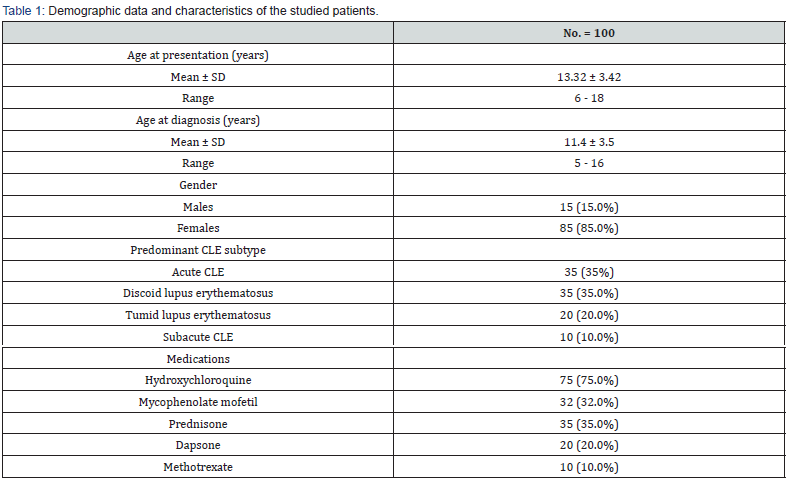
Table 1 shows that age distribution of the 100 research study participants selected for the study is as follows: Males made up 15% of the study population while females made up 85%, as measured by mean SD, age at presentation, and diagnosis (13.32 3.42 years, 11.4 3.5 yrs, sequentially). Acute CLE was the most common CLE subtype, accounting for 35% of cases, followed by discoid lupus erythematosus (35% of cases), tumescent lupus erythematosus (20%), and subacute CLE (representing 10% of cases) (Table 2).
95% CI: 95% Confidence interval; CLASI: Cutaneous lupus erythematosus disease area and severity index; ICC: Intraclass correlation coefficients; PGA: Physician’s Global Assessment.
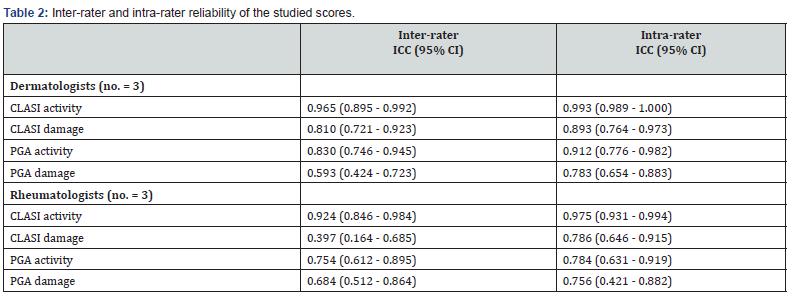
95% CI: 95% Confidence interval; CLASI: Cutaneous lupus erythematosus disease area and severity index; ICC: Intraclass correlation coefficients; PGA: Physician’s Global Assessment For CLASI activity, dermatologists and rheumatologists achieved excellent inter-rater and intra-rater reliability scores (ICC = 0.965, 0.993, 0.924, 0.975 consecutively), whereas for CLASI damage, dermatologists achieved good inter-rater and intra-rater reliability scores (ICC = 0.810, 0.893 consecutively), but poor inter-rater and intra-rater reliability scores (ICC =0.397).
In terms of PGA activity, rheumatologists had low inter-rater and intra-rater reliability (ICC=0.754, 0.784, respectively), whereas dermatologists had excellent inter-rater reliability (ICC=0.830, 0.830, respectively) and substantial intra-rater variability (0.912). When rheumatologists and dermatologists separately evaluated the same patient for PGA damage, the findings revealed acceptable intra rater reliability (ICC=0.783, 0.756) and moderate inter-rater reliability (ICC=0.593, 0.684).
Discussion
Significant morbidity and quality of life impairment are associated with cutaneous lupus erythromatosis, particularly in affected paediatric groups. In cases that are undiscovered and do not adhere to therapy, the earlier the starting, the more serious the sickness, and the more horrible the prognosis is expected [11,12] For the correct diagnosis and follow-up of clinically afflicted patients with cutaneous lesions, effective clinical scoring systems are essential. Adult populations with cutaneous lupus concerns have previously been studied and investigated using the CLASI score system. However, earlier research studies did not adequately assess the paediatric group afflicted by cutaneous lupus symptoms [13,14].
The degree of pathological progressive defect caused by cutaneous lupus erythematosus is inversely proportional to the age at which symptoms first appear, causing physical and psychological symptoms to manifest at crucial periods of growth and development. On the other hand, it was disclosed and demonstrated by several study groups of researchers that childhood-onset SLE differs significantly from adult-onset SLE, with a larger incidence of end-organ damage difficulties, such as renal affection, and increased overall death rates [15].
An earlier statistical analysis of 26 paediatric research study participants with cutaneous lupus erythematosus found that 7 instances (27%) had neonatal lupus erythematosus (71% females and 29% males). Ninety-five percent of the other 19 kids with cutaneous lupus erythromatosis were female. The average and median age at which a diagnosis was clinically confirmed was 11. 80% of the patients studied exhibited nonspecific dermal signs of lupus erythromatosis, and all cases had cutaneous lesions unique to the disease. The research study findings, on the other hand, showed that 28% of patients had unusual early lesions, and 22% of patients had uncommon lupus erythematosus variants. Eighty three percent of patients had acute cutaneous lupus erythematosus, 44% had subacute lesions, and 22% had chronic lesions. In 44% of instances, there were autoimmune associations, and in 61% of cases, there was a family history of autoimmune illnesses. The team of researchers came to the conclusion that although the research study is in accordance with present study results, additional research efforts are necessary to clarify the clinical spectrum of pediatric cutaneous lupus erythematosus around the world. They also found that when cutaneous lupus erythematosus was apparent clinically, there was a considerable female predominance affection and a higher clinical risk of systemic illness [1,3,7].
The CLASI activity scoring system exhibited great inter-rater reliability, according to a past research study that was done using an approach and technique identical to the current research study. That showed strong inter-rater reliability in comparison to PGA. Since the severity of contemporary skin diseases is assessed in clinical trials, it is interestingly well known that activity scoring is a more meaningful metric than damage scoring [2,4,9]. Additionally, it was demonstrated that, generally, the CLASI scoring system is a more reliable instrument than the PGA system, particularly in the evaluation of children’s disease activity levels. This finding is consistent with the current research study and is strikingly comparable to it. [11,13].
Conclusion and Recommendation
CLASI, which outperformed the PGA, showed outstanding levels of inter- and intra-rater reliability among dermatologists and rheumatologists. Scoring system. to further substantiate the current research study findings, however, future research studies will need to take a wider range of situations into account. It is also advised that these studies adopt a multicentric approach. Future research efforts should take into account racial and ethnic variations in order to build a relevant research data base that might support the application of practical clinical recommendations in the diagnosis and management of paediatric cutaneous lupus lesions patients.
References
- AlKharafi NN, Alsaeid K, AlSumait A et al. (2016) Cutaneous lupus erythematosus in children: experience from a tertiary care pediatric dermatology clinic. Pediatr Dermatol 33: 200-208.
- Albrecht J, Werth VP (2010) Clinical outcome measures for cutaneous lupus erythematosus. Lupus 19:1137-1143.
- Furie R, Khamashta M, Merrill JT, Werth VP, Kalunian K, et al. (2017) Anifrolumab, an antiinterferon- a receptor monoclonal antibody, in moderate-tosevere systemic lupus erythematosus. Arthritis Rheumatol 69: 376-386.
- Werth VP, Fiorentino D, Sullivan BA, Boedigheimer MJ, Chiu Ket al. (2017) Brief report: pharmacodynamics, safety, and clinical efficacy of AMG 811, a human antiinterferon- c antibody, in patients with discoid lupus erythematosus. Arthritis Rheumatol 69: 1028-1034.
- Furie R, Werth VP, Merola JF, Stevenson L, Wang W, et al. SAT0222 BIIB059, a monoclonal antibody targeting BDCA2, shows evidence of biological activity and early clinical proof of concept in subjects with active cutaneous LE. Ann Rheum Dis 76 (Suppl. 2): 857.
- Werth VP, Furie R, Gaudy A et al. (2017) CC-220 decreases B-cell subsets and plasmacytoid dendritic cells in systemic lupus erythematosus (SLE) patients and is associated with skin improvement: pharmacodynamics results from a phase IIa proof of concept study. Arthritis Rheumatol 69 (Suppl. 10): 886.
- Rosenbach M, Yeung H, Chu EY, Kim EJ, Payne AS, et al. (2013) Reliability and convergent validity of the cutaneous sarcoidosis activity and morphology instrument for assessing cutaneous sarcoidosis. JAMA Dermatol 149: 550-556.
- Tiao J, Feng R, Bird S, Choi JK, Dunham J, et al. The reliability of the Cutaneous Dermatomyositis Disease Area and Severity Index (CDASI) among dermatologists, rheumatologists and neurologists. Br J Dermatol 176: 423-430.
- Tiao J, Feng R, Berger EM, Brandsema JF, Coughlin CC, et al. Evaluation of the reliability of the Cutaneous Dermatomyositis Disease Area and Severity Index and the Cutaneous Assessment Tool-Binary Method in juvenile dermatomyositis among paediatric dermatologists, rheumatologists and neurologists. Br J Dermatol 177: 1086-1092.
- Yeung H, Farber S, Birnbaum BK, Dunham J, Ogdie A, et al. (2015) Reliability and validity of cutaneous sarcoidosis outcome instruments among dermatologists, pulmonologists, and rheumatologists. JAMA Dermatol 151:1317-1322.
- Artim-Esen B, Sahin S, Cene E, Şahinkaya Y, Barut K et al. Comparison of disease characteristics, organ damage, and survival in patients with juvenile-onset and adult-onset systemic lupus erythematosus in a combined cohort from 2 tertiary centers in Turkey. J Rheumatol 2017; 44: 619-625.
- Kuhn A, Landmann A (2014) The classification of cutaneous lupus erythematosus. J Autoimmun 49: 14-19.
- Dickey BZ, Holland KE, Drolet BA, Galbraith SS, Lyon VB, et al. (2013) Demographic and clinical characteristics of cutaneous lupus erythematosus at a paediatric dermatology referral centre. Br J Dermatol 169(2): 428-433.
- Yachoui R, Cronin PM (2013) Systemic lupus erythematosus associated with erythema multiforme-like lesions. Case Rep Rheumatol 2013: 212145.
- Hon KL, Leung AK (2012) Neonatal lupus erythematosus. Autoimmune Dis 2012: 301274.

























