

 JOJDC Home



Sclerotic Fibroma Review of the Literature Concerning a Case of a Pediatric Patient Presented in an External Consultation Service of the General Teaching Provincial Hospital of Riobamba Year 2020
Carlos Martinez Fiallos1, Viviana Ceron2 and Gabriela Torres3*
1 Medico Dermatologo Hpgdr, Universidad Central del Ecuador, Ecuador
2Medico Patologo Hpgdr, Universidad Central del Ecuador, Ecuador
3Medico Dermatologo, Universidad Central del Ecuador, Ecuador
Submission: June 13, 2020;Published: June 24, 2020
*Corresponding author: Gabriela Torres, Medico Dermatologo, Universidad Central del Ecuador, Ecuador
How to cite this article: Carlos M F, Viviana C, Gabriela T. Sclerotic Fibroma Review of the Literature Concerning a Case of a Pediatric Patient Presented in an External Consultation Service of the General Teaching Provincial Hospital of Riobamba Year 2020. JOJ Dermatol & Cosmet. 2020; 3(1): 555605. DOI: 10.19080/JOJDC.2020.02.555605
Introduction
Sclerotic fibroma is a benign neoplasm, which is generally solitary. It preferably occurs in areas such as the face, upper and lower extremities, and the trunk. Its characteristic is small papular lesions or as whitish or normal skin-colored nodules [1,2]. The first authors to describe this isolated lesion were Weary in 1972 in an association with Cowden’s disease; the observations of Brownstein, Starink, and Barax followed, this being the one that proposes the denomination of Cowden’s fibroma; Pujol in 1988 suggests considering it as a major criterion for the diagnosis of Cowden disease, Rapini and Golitz in 1989, with a series of 11 cases, coined the term of skin sclerotic fibroma without association to Cowden disease [3]. From the histopathological point of view, it is an exophytic neoformation, circumscribed, consisting of thick, hyalinized, hypocellular collagen bundles that interlock, leaving between them the presence of clefts, the same ones that present mucin, other manifestations may be acanthosis, hyperpigmentation of the basal layer.
Case
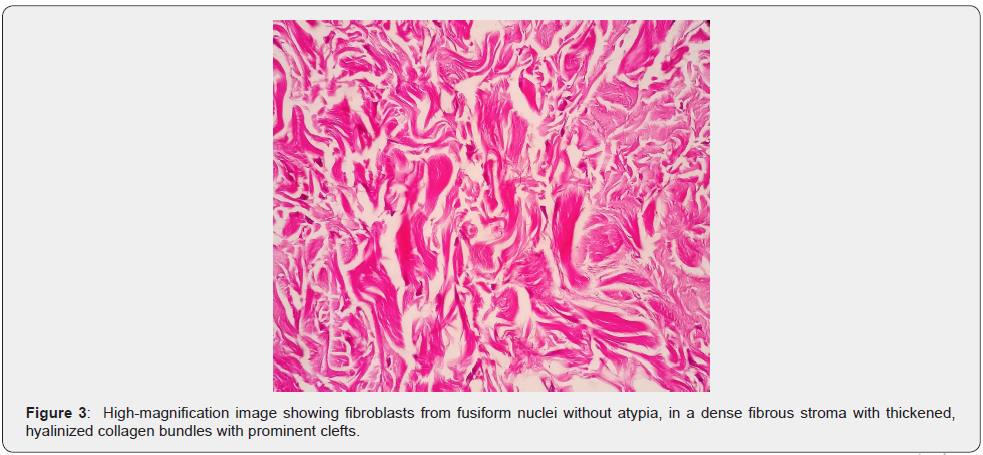
This is a 14-year-old female patient born and resident in the city of Riobamba, who has a clinical picture characterized by soft, non-painful lesions located in the gluteal area, the same as 1 year prior to the dermatology consultation. Electrofulguradas, in a period of 7 months the lesions remit, so the patient is referred to the primary care center and hence referred to the Riobamba General Teaching Hospital. Physical examination revealed a dermatosis characterized by the presence of skin-colored, mobile, soft, nodular lesions located on the left gluteal region (Figure 1). Excisional biopsy of the lesion was performed, the histopathological result of which was: the cuts showed benign circumscribed lesion. , located at the level of the dermis, consisting of thickened and homogenized collagen bundles, with a laminated arrangement forming indentations, I diagnose sclerotic fibroma (Figure 2).


Discussion
Sclerotic fibroid also called storiform collagenoma is a rare, peculiar autosomal dominant genodermatosis that has two forms of presentation: solitary or multiple lesions frequently associated with Cowden disease. This skin lesion has a higher prevalence in women and men, the difference being minimal, it occurs in all races. The macroscopic features that occur most frequently in sclerotic fibroma are benign, solitary skin neoplasms, similar to papules or nodules of firm consistency, normal skin color (Figure 3). While from the histopathological point of view they appear as benign hypocellular lesions formed by thick, homogeneous, hyaline-looking collagen fibers that leave behind clefts which contain mucin. But in this case, it is not fully met. The sclerotic fibroma of this casuistry, in addition to presenting certain common characteristics, has peculiar aspects: they appear as exophytic lesions, multiple, with a rough surface, of progressive growth, located in the right gluteal region, cupular with a central black point similar to a giant mud that when exerting pressure on if they expel sebaceous content. In addition, the differential diagnosis should be considered with other CD34-positive spindle cell neoplasms [2]. Therefore, it is considered to be a particular case due to the differences it presents with respect to the cases previously described according to the literature. However, the result of the histopathological study shows certain characteristics characteristic of sclerotic fibroma; because there are bundles of thick, homogenous collagens that also leave between them clefts. In this patient, treatment with the exercises of the lesion was decided, which at the moment has not presented local recurrence.
References
- Izquierdo MJP (2001) Actas- Dermosifiográ Recuperado el 15 de Febrero de 2017, de Actas- Dermosifiográfica.
- José Antonio MA, Nieto Gallo MA (2006) Solitary fibrous tumor of the skin. Relationship with sclerotic fibroma. Revista Española de Patología 40(2): 109-112.
- Izquierdo MJP (2017) Slerotic fibroma with multinucleated giant cells. de Actas-Dermosifiográ