




 JOJCS Home



Abstract
Luxatio erecta (inferior shoulder dislocation) is a rare entity, infrequent, but with a good prognosis. There are two mechanisms for this injury to occur, by an indirect force, which is the most frequent, and by a direct force. Both involve hyperabduction of the arm. Most cases can be treated with closed reduction and immobilization, but in case of irreducibility, it requires reduction under general anesthesia and/or further operative measures. The surgery is also reserved for patients with recurrent instability, open dislocation, or humeral fractures. We present the case of a 42-year-old man who went to the emergency compatible with Luxation erecta of the glenohumeral joint. Subsequently, a closed reduction was performed with good results. The patient is currently undergoing physical therapy and rehabilitation.
Keywords: Luxatio erecta; Hyperabduction; Case report
Introduction
Luxatio erecta of the humerus or inferior dislocation of the shoulder was first described in 1859 [1]. It corresponds to an infrequent presentation injury with less than 1% of all shoulder dislocations. The clinical presentation is unmistakable and the diagnosis is clinical. The treatment of choice is closed reduction due to the excellent results and good prognosis but in case of irreducibility, it requires reduction under general anesthesia and/or further operative measures [2]. The surgery is also reserved for patients with recurrent instability, open dislocation, or humeral fractures [3]. We present a case of an acute traumatic LEH reduced under anesthesia and treated with a Velpeau arm sling shoulder immobilizer brace.
Observation
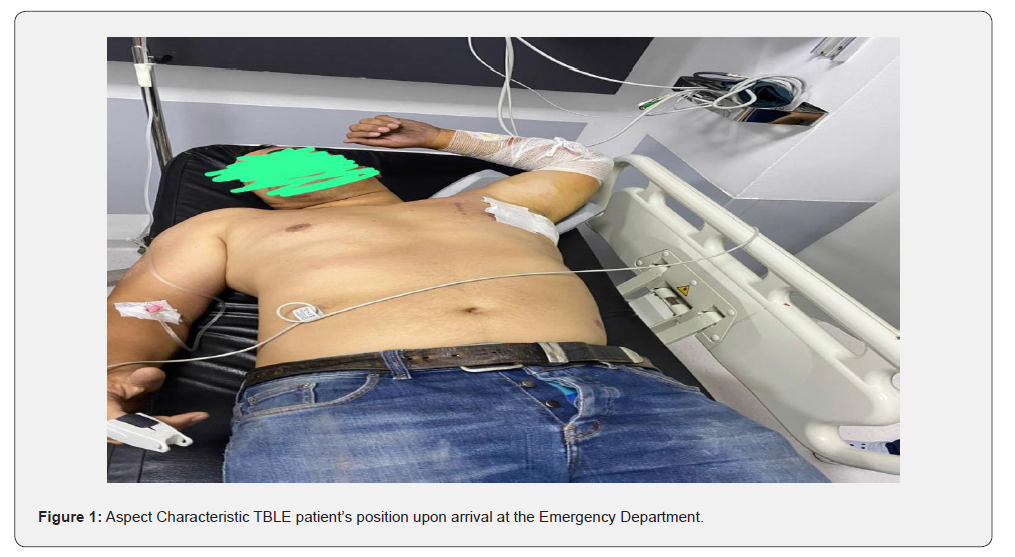
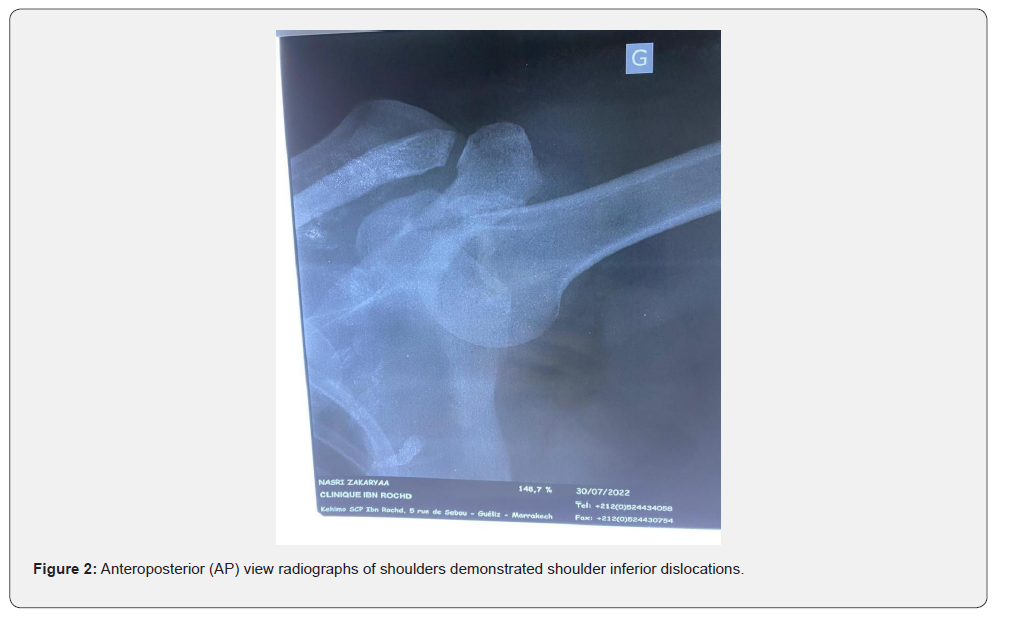
A 42-year-old man, right-handed and healthy presented to our emergency room. He was hitted by a motorcycle with impact on his left upper limb with the abducted left arm. The physical presentation of the left upper limb was distinctive (Figure 1) The elbow flexed, the forearm, and the hand pronated lying behind the patient’s head with the arm elevated and hyperabducted at the shoulder. He was setting with the right hand that grabbed the contralateral hand at physical examination, the humeral head prominence was visible and palpable in the axilla, and there were no wounds and neurovascular deficits. An X-ray (Figure 2) of the left shoulder was performed, which revealed an inferior glenohumeral dislocation. A closed reduction was carried out, after sedation, with the Milch maneuver, followed by the Hippocrates maneuver. Subsequently, a brief adduction, hyperextension and external rotation of the right upper limb was accomplished; and joint congruence and immediate pain relief were obtained.
Discussion
The shoulder is the joint that is most frequently dislocated due to its wide range of movement [4,5]. Shoulder dislocations are more frequently anterior 95%, and in a lower percentage posterior 4-5% and inferior 0.5% [6]. Luxatio erecta is an extremely rare and infrequent injury [7], the predisposing factors for this type of injury are advanced age and previous instability of the joint in patients with a previous history of shoulder injuries [8]. There are two mechanisms causing the ISD. The first mechanism is a hyperabduction force to an already abducted arm in which the acromion acts as lever on proximal humerus, and the second mechanism is an axial compression on the abducted arm in which a direct load of the humeral head breaks the capsule and the inferior glenohumeral ligaments. The ISD in 12% of cases is caused by the fall from standing height. In our case traffic accident was the cause. The erect dislocation clinically is characterized by presenting the totally abducted arm, elevated, supported on the head, the partially flexed elbow, and the forearm in pronation [1,4,5]. This position is known as the “Hands Up” position [5,9], in some cases, it can be seen that the hand contrary to the lesion holds the affected arm in order to reduce pain [10]. Also, in thin patients, the humeral head displaced down in the axillary region can be felt Approximately 80% of these lesions are associated with fractures of the humerus itself or the glenoid scapular cavity, soft tissue injuries, and neuro-vascular deficits. The physical exam is essential for the diagnosis of this pathology [8,9]. Radiological support is necessary to confirm the diagnosis and to rule out possible complications or associated injuries [10].
The closed reduction with the traction-contraction technique, accompanied by conscious sedation, analgesia, and muscle relaxation, is the treatment of choice in most cases and this is very frequently successful [5-7,9]. Followed by shoulder immobilization for three to six weeks and physical therapy and rehabilitation, according to medical indication. The long-term prognosis for this injury after treatment is excellent [10,11].
Conclusion
Luxatio erecta humeri may occur from trapping, depending on the direct loading force on a fully abducted arm. In our case closed reduction by the traction and counter traction method was accomplished without complications.
References
- Rickert M, Loew M (2006) Glenohumeral interposition of a torn rotator cuff in a young motorcyclist. Arch Orthop Trauma Surg 126: 184-187.
- Robinson CM, Longino D, Murray IR, Duckworth AD (2010) Proximal humerus fractures with valgus deformity of the humeral head: the spectrum of injury, clinical assessment and treatment. J Shoulder Elbow Surg 19(7): 1105-1114.
- Robinson CM, Shur N, Sharpe T, Ray A, Murray IR (2012) Injuries associated with traumatic anterior glenohumeral dislocations. J Bone Joint Surg Am 94(1): 18-26.
- Scharm B (1859) De nova humerus luxationis. Breslau: Inaugural Dissertation, 26.
- Scholten R, Boons HW (2017) Complete avulsion of the rotator cuff footprint in an irreducible traumatic posterior glenohumeral fracture-dislocation due to infraspinatus interposition. J Shoulder Elbow Surg 26(8): e259-e263.
- Seo JB, Yoon SH, Yang JH, Yoo JS (2020) Irreducible posterior fracture and dislocation of shoulder with massive rotator cuff tear due to incarceration of biceps tendon: a case report. J Orthop 21: 6-9.
- Shah R, Koris J, Wazir A, Srinivasan SS (2016) Anterior humeral circumflex artery avulsion with brachial plexus injury following an isolated traumatic anterior shoulder dislocation. BMJ Case Rep 2016: bcr2015213497.
- Soon EL, Bin Abd Razak HR, Tan AHC (2017) A rare case of massive rotator cuff tear and biceps tendon rupture with posterior shoulder dislocation in a young adult - surgical decision-making and outcome. J Orthop Case Rep 7(2): 82-86.
- Sparks SR, De La Rosa J, Bergan JJ, Hoyt DB, Owens EL (2000) Arterial injury in uncomplicated upper extremity dislocations. Ann Vasc Surg 14(2): 110-113.
- Visser CP, Coene LN, Brand R, Tavy DL (1999) The incidence of nerve injury in anterior dislocation of the shoulder and its influence on functional recovery. A prospective clinical and EMG study. J Bone Joint Surg 81(4): 679-685.
- Tiefenboeck TM, Zeilinger J, Komjati M, Fialka C, Boesmueller S (2020) Incidence, diagnostics and treatment algorithm of nerve lesions after traumatic shoulder dislocations: a retrospective multicenter study. Arch Orthop Trauma Surg 140:1175-1180.

























