




 JOJCS Home



Abstract
Background: Thoracic endovascular aortic repair (TEVAR) is the preferred treatment for descending thoracic aortic aneurysms (DTAA) in high-risk patients, but adequate iliac access is a prerequisite. Hostile iliac anatomy — encountered in up to 30% of candidates — constitutes one of the most challenging obstacles to successful endograft delivery.
Case Report: An 83-year-old woman with multiple comorbidities presented with refractory chest pain caused by acute expansion of a giant DTAA measuring 104mm. Computed tomography angiography (CTA) revealed complete occlusion of the right common iliac artery and severe fibrodysplastic changes of the left iliac axis with alternating aneurysmal dilatations and sub-occlusive segments. A hybrid strategy was employed: complex recanalization of the left iliac axis was accomplished via an antegrade brachial approach using the body-wire technique, followed by angioplasty and structural stabilization with a Wrapsody covered stent (Merit Medical), enabling safe deployment of two E-vita thoracic endografts (JOTEC). Right lower-limb perfusion was re-established with a crossover femorofemoral bypass using an ePTFE graft.
Conclusion: This case demonstrates that the integration of advanced endovascular manoeuvres, contemporary covered stenting technology, and conventional surgical bypass constitutes an effective and reproducible strategy for managing urgent aortic pathology in patients with severely compromised iliac anatomy.
Keywords: Thoracic endovascular aortic repair (TEVAR); Hostile iliac access; Hybrid vascular surgery; Covered stent; Femorofemoral bypass; Body-wire technique; Aortic aneurysm; Fibrodysplasia
Introduction
Thoracic endovascular aortic repair (TEVAR) has fundamentally transformed the management of descending thoracic aortic aneurysms (DTAA), offering substantially reduced perioperative morbidity and mortality compared with open surgical repair — particularly in elderly patients with significant comorbidities [1,2]. Current Society for Vascular Surgery guidelines recommend TEVAR when the maximum aneurysm diameter exceeds 5.5cm in anatomically suitable patients, and as the preferred approach in urgent or emergent scenarios whenever anatomy permits [3].
However, TEVAR is intrinsically dependent on adequate ilio-femoral access. Contemporary thoracic endograft delivery systems require introducer sheaths ranging from 18F to 24F (outer diameter), demanding iliac and femoral arteries with sufficient calibre, limited calcification, and acceptable tortuosity. Hostile iliac anatomy — broadly defined as severe stenosis, occlusion, extreme tortuosity, or abnormal wall structure — is encountered in up to 30-47% of TEVAR candidates and may preclude conventional transfemoral access entirely [4,5]. In such situations, a variety of alternative strategies have been described, including surgical iliac conduits, retroperitoneal aortic access, axillo-femoral approaches, and — more recently — endovascular iliac reconstruction using covered stent technology [6,7].
Fibrodysplasia of the iliac arteries is a particularly hazardous variant of hostile access anatomy. Unlike atherosclerotic occlusive disease, fibrodysplastic vessels present alternating aneurysmal and stenotic segments with structurally fragile walls that are highly susceptible to dissection or rupture during instrumentation [8]. This pathological substrate demands an individualized and carefully orchestrated approach to access preparation before stent-graft deployment can be safely attempted.
We present a technically complex case of emergency TEVAR for a giant DTAA in a frail octogenarian, in whom bilateral hostile iliac anatomy required a novel hybrid approach combining brachial body-wire recanalization, contemporary covered stent scaffolding, dual thoracic endograft implantation, and a crossover femorofemoral bypass — all performed in a single operative session.
Case Report
Clinical presentation and diagnostic workup
An 83-year-old woman — a former smoker with a long-standing history of arterial hypertension, dyslipidaemia, and peripheral arterial occlusive disease including bilateral femoro-popliteal occlusion — was admitted to the emergency department on 8 January 2025 with severe, refractory chest pain unresponsive to standard analgesia. She had been followed in an outpatient vascular clinic since 2016 for an infrarenal abdominal aortic aneurysm (AAA), which at that time measured 30mm in diameter.
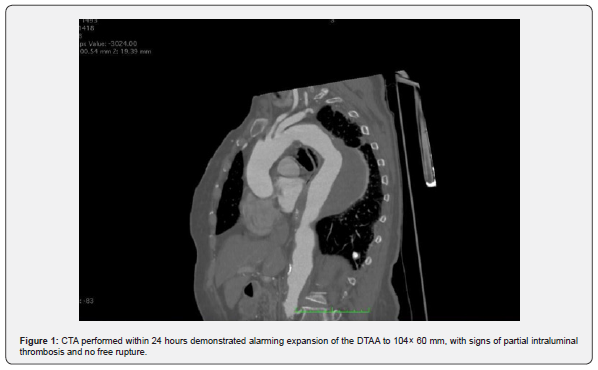
On admission, an urgent computed tomography angiogram (CTA) of the thoracic aorta revealed a descending thoracic aortic aneurysm with a maximum transverse diameter of 78mm. Following transfer to a tertiary referral centre, a repeat CTA performed within 24 hours demonstrated alarming expansion of the DTAA to 104 × 60mm, with signs of partial intraluminal thrombosis and no free rupture (Figure 1). The infrarenal AAA remained stable at 30 × 28mm. Critically, the same examination identified complete occlusion of the right common iliac artery (RCIA) with preserved distal reconstitution, and severe fibrodysplastic changes of the entire left common iliac artery (LCIA) axis, characterised by alternating aneurysmal dilatations and sub-occlusive stenoses. The left internal iliac artery was patent bilaterally.
Therapeutic planning
After exclusion of alternative aetiologies for chest pain — including aortic dissection, which was absent on imaging — the diagnosis of acute aneurysm expansion with imminent rupture risk was established. Given the patient’s prohibitive open surgical risk (advanced age, cardiac comorbidities, bilateral femoro-popliteal occlusion) and the urgency of the clinical scenario, endovascular repair was elected. Multidisciplinary planning acknowledged that bilateral hostile iliac anatomy represented the pivotal procedural challenge: the right side offered no usable transfemoral access owing to complete RCIA occlusion, while the left side, though patent, presented a structurally unstable wall incompatible with the direct advancement of a large-calibre thoracic endograft delivery system.
Operative procedure
The procedure was performed under general anaesthesia with continuous invasive haemodynamic monitoring. Three vascular accesses were established simultaneously:
a) Left brachial artery, surgically exposed via cutdown, with placement of a short 5F introducer sheath (antegrade access for recanalization).
b) Right common femoral artery (RCFA), surgically exposed, with a 5F sheath inserted (diagnostic and secondary access).
c) Left common femoral artery (LCFA), surgically exposed, with an 8F sheath placed for the main endograft access.
Initial diagnostic arteriography confirmed the pre-operative CTA findings. On the right, total occlusion of the RCIA was confirmed, with a filiform and diseased right external iliac artery; the right internal iliac artery was patent. On the left, the filiforme-aneurysmal fibrodysplastic pattern of the LCIA was clearly delineated, with patent left internal iliac artery (Figure 2).
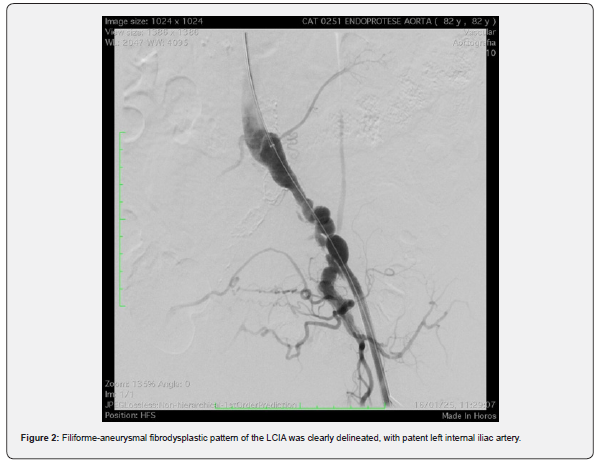
Attempts to recanalize the left iliac axis via a conventional retrograde femoral approach were unsuccessful due to inability to navigate the guidewire through the alternating sub-occlusive segments. Accordingly, an antegrade approach through the left brachial access was adopted. A steerable microcatheter combined with a high-support hydrophilic guidewire (Balancium®) was advanced under fluoroscopic guidance from the brachial artery through the stenotic segments of the left iliac axis. Once the guidewire traversed the lesions and reached the LCFA, it was captured using a 6F En Snare® loop retrieval system, establishing a through-and-through brachial-to-femoral body-wire circuit. This technique effectively converted a challenging antegrade recanalization into a stable, co-axial rail for device delivery.
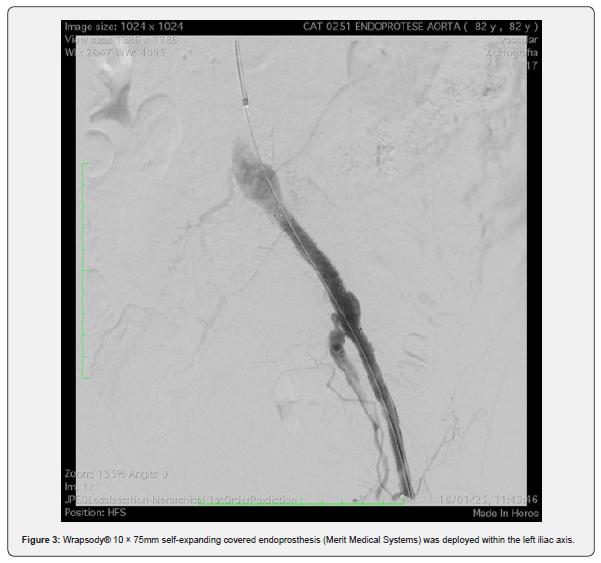
With the body-wire circuit in place, sequential balloon angioplasty was performed: first, a 5 × 60mm balloon was used on the left external iliac artery, followed by an 8 × 60mm balloon on the left common iliac artery. Post-dilatation revealed residual dissection flaps and parietal irregularities. To consolidate the access corridor, prevent dissection propagation, and create a protected endoluminal scaffold capable of withstanding the passage of the thoracic endograft delivery system, a Wrapsody® 10 × 75mm self-expanding covered endoprosthesis (Merit Medical Systems) was deployed within the left iliac axis. Post-implantation balloon moulding with Atropos 9 × 40mm and Manatee 10 × 80mm balloons ensured optimal apposition (Figure 3).
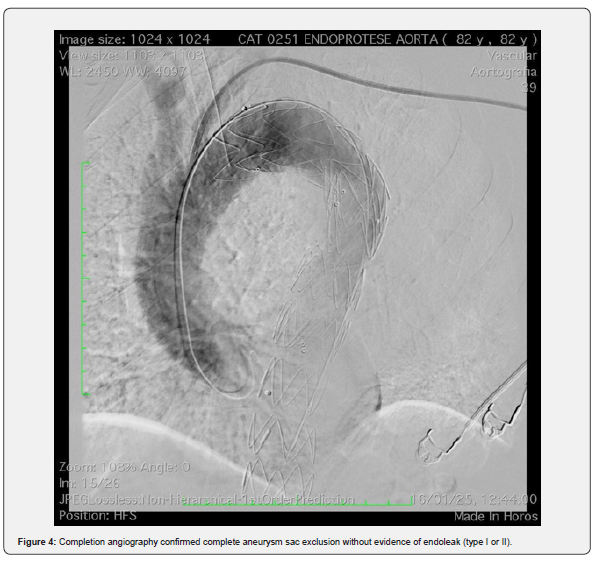
With the left access corridor now structurally stable, a thoracic aortogram delineated the giant descending thoracic aneurysm extending from the distal aortic arch to within 30 mm proximal to the coeliac axis origin. Two E-vita thoracic endografts (JOTEC GmbH) were sequentially deployed: a proximal module (38 × 33 × 170mm) followed by a distal module (36 × 30 × 170mm). Completion angiography confirmed complete aneurysm sac exclusion without evidence of endoleak (type I or II), with preserved patency of the coeliac trunk (Figure 4).
Attention then turned to right lower limb perfusion. Although the right external iliac artery was successfully recanalized using a scoring balloon (Trivedge 5 × 60mm), the right common iliac artery remained occluded and unsafe to stent given its calcified and unfavourable anatomy. A crossover femorofemoral bypass was therefore constructed using a 6 × 50mm ringed ePTFE Lifespan® prosthesis anastomosed in end-to-side fashion to both common femoral arteries. Restoration of bilateral satisfactory femoral pulses was confirmed clinically and by Doppler assessment at the conclusion of the procedure. All arteriotomies were repaired with 6-0 polypropylene sutures and wound closures were completed by anatomical planes without complications.
Postoperative course
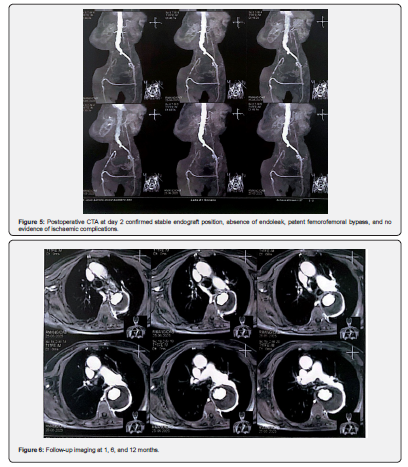
The patient was transferred to the intensive care unit for haemodynamic monitoring and was successfully extubated within 12 hours. Postoperative CTA at day 2 confirmed stable endograft position, absence of endoleak, patent femorofemoral bypass, and no evidence of ischaemic complications. She was discharged to a step-down care unit on postoperative day 7 in satisfactory clinical condition, with scheduled follow-up imaging at 1, 6, and 12 months (Figure 5 & 6).
Discussion
This case illustrates the full spectrum of technical challenges that can arise when TEVAR must be performed urgently in a patient with bilateral hostile iliac access. Three distinct but interrelated problems had to be sequentially resolved before definitive aneurysm repair could be accomplished:
1) Recanalization of a filiforme-aneurysmal left iliac axis that resisted conventional retrograde approach;
2) Structural reinforcement of that access corridor to safely accommodate a large-profile thoracic endograft; and
3) Restoration of right lower-limb perfusion in the absence of a usable ipsilateral iliac artery.
Incidence and impact of hostile iliac access in TEVAR
Adequate iliac access is a cornerstone of TEVAR feasibility. Henretta et al. [5] first quantified the problem, demonstrating that approximately 30% of TEVAR candidates harbour iliac anatomy that precludes standard transfemoral access [5]. More recent series, incorporating increasingly complex patients, suggest that significant iliac disease may challenge access in up to 47% of cases [4]. The clinical consequences are substantial: hostile access doubles procedure time, increases fluoroscopy exposure and contrast volume, and is independently associated with access-site complications including arterial rupture — a potentially catastrophic and often fatal intraoperative event [9].
Strategies to overcome hostile access range from relatively straightforward measures — such as progressive balloon dilatation ("paving and cracking") [10] or placement of a brachial guidewire to improve trackability [6] — to more invasive alternatives including surgical retroperitoneal iliac conduit, direct aortic access via laparotomy, or axillo-femoral access [7,11]. Each carries specific risk-benefit trade-offs that must be individualised to the patient’s anatomy, acuity, and comorbidity profile.
Fibrodysplasia of the iliac arteries: a particularly hazardous substrate
Among the variants of hostile iliac anatomy, fibrodysplasia poses unique technical hazards. The alternating aneurysmal and stenotic segments are accompanied by structural fragility of the medial layer, rendering the vessel highly susceptible to dissection, perforation, or rupture during guidewire manipulation or balloon dilatation. In TEVAR — where the delivery system diameter frequently exceeds 18F — the forces transmitted to a dysplastic iliac wall are substantially greater than in infrarenal EVAR, further amplifying rupture risk [4,8]. In our patient, the sub-occlusive segments of the left iliac axis initially resisted retrograde recanalization, necessitating an antegrade brachial strategy. This approach avoids the blind force application inherent to retrograde crossing attempts and allows the operator to select the true lumen preferentially, thereby minimizing dissection risk [6].
The body-wire technique
The establishment of a through-and-through femoral-to-brachial circuit — the so-called "body-wire" technique — is a well-recognised manoeuvre to overcome challenging iliac anatomy [6,14]. By capturing the brachially-advanced guidewire at the femoral level with a loop snare and externalising it, the operator creates a fully controlled, bidirectional rail that dramatically improves the trackability of large delivery systems through tortuous or sub-occlusive segments. The technique was originally described for coronary applications but has been adapted for complex aorto-iliac endovascular interventions and has proven particularly valuable when retrograde access fails [14]. In our case, this approach allowed atraumatic crossing of the fibrodysplastic left iliac axis after retrograde attempts had been abandoned, converting an apparently unsurmountable anatomical obstacle into a controlled procedural step.
Role of the wrapsody covered stent as an endoluminal scaffold
After successful recanalization and balloon dilatation, the residual parietal dissection flaps and wall irregularities represented an unacceptable risk for passage of the thoracic endograft delivery system. In this context, the deployment of a self-expanding covered stent served a dual purpose: it treated the iatrogenic dissections and simultaneously functioned as a protective "internal sheath" — a concept analogous to the endoconduit technique described for EVAR [10] — isolating the diseased wall from direct contact with the advancing device.
The Wrapsody® endoprosthesis (Merit Medical Systems) is a nitinol-framed, multi-layered ePTFE/PTFE covered stent originally designed for haemodialysis access circuit maintenance [15]. Its radial force profile, flexibility, and spun ePTFE covering make it well-suited for the irregular anatomy encountered in the iliac territory, and multiple case series and technical reports have described its off-label use in aorto-iliac occlusive and aneurysmal disease [16,17]. Compared with balloon-expandable alternatives, the self-expanding design offers advantages of adaptability to vessel tortuosity and the ability to be deployed precisely without foreshortening in the highly curved iliac anatomy. In our case, the Wrapsody stent effectively transformed the fragile, irregular left iliac artery into a smooth, adequately calibrated endoluminal conduit that could safely accommodate the E-vita thoracic delivery system.
Endograft selection and performance
The E-vita thoracic endoprosthesis (JOTEC GmbH) is a woven polyester stent-graft combining a braided nitinol exoskeleton with an inner woven Dacron fabric. Its low-profile delivery system and high conformability to aortic curvature have made it a frequently employed device in European TEVAR practice. In the setting of giant aneurysms — those exceeding 70mm — TEVAR carries significantly greater long-term reintervention risk compared with standard-diameter repairs, and residual sac volume after deployment represents an ongoing haemodynamic burden on the endograft [18,19]. In our patient, the use of two overlapping modules achieving full aneurysm exclusion without endoleak on completion angiography is therefore a critical short-term success criterion, acknowledging that rigorous long-term surveillance will be essential.
Crossover femorofemoral bypass in the hybrid context
Restoration of right lower-limb perfusion via a crossover femorofemoral bypass using a ringed ePTFE graft represents the surgical component of this hybrid strategy. Femorofemoral crossover bypass is a well-established extra-anatomical revascularisation procedure for unilateral iliac occlusive disease, offering acceptable perioperative risk in high-surgical-risk patients and published one-year primary patency rates of approximately 89%, with five-year primary patency approaching 70% [20,21]. A recent comparative study demonstrated comparable long-term limb salvage rates (94% at 8 years) between surgical femorofemoral bypass and endovascular revascularisation, with endovascular approaches offering shorter hospital stays but requiring more reinterventions [22].
In the specific context of hybrid aortic repair, the femorofemoral bypass has been repeatedly validated as an effective adjunct when contralateral iliac access cannot be established [9,11]. Its primary limitations — susceptibility to graft infection and progressive bypass occlusion — must be balanced against the technical impossibility of right iliac revascularisation in this case, where the right common iliac artery remained refractory to recanalization and the right external iliac calibre was deemed insufficient to serve as a TEVAR landing zone or primary access site.
Significance of the hybrid strategy
The concept of hybrid aortic repair — combining endovascular aneurysm exclusion with open surgical adjuncts — has progressively expanded the anatomical boundaries of TEVAR feasibility. The key contribution of our case is the simultaneous application of three interdependent techniques in a single operative session:
1) Antegrade brachial recanalization with the body-wire technique to overcome failed retrograde access;
2) Covered stent scaffolding to create a secure iliac access corridor; and
3) Surgical femorofemoral bypass to address contralateral limb ischaemia. Critically, this combination was executed without staging, minimising the risk of aneurysm rupture during any interval between procedures in a patient with acutely expanding disease.
From a broader perspective, this case reinforces a fundamental principle of contemporary complex aortic surgery: that the binary distinction between “endovascular” and “open” surgery is increasingly superseded by individualised hybrid strategies that leverage the complementary strengths of both approaches. As Stather et al. and others have argued, the most important skill set in treating high-risk aortic patients is not technical excellence in either domain in isolation, but the capacity to fluidly integrate both when anatomy demands it [11].
Conclusion
The successful management of acute DTAA expansion in an octogenarian patient with bilateral hostile iliac access required the coordinated application of advanced endovascular and open surgical techniques within a single operative session. The brachial body-wire recanalization technique, structural iliac reinforcement with a Wrapsody covered stent, and crossover femorofemoral bypass each addressed a distinct anatomical obstacle that would have precluded conventional TEVAR. This case contributes to the growing evidence that hybrid strategies expand the treatable population in aortic emergencies and should be within the armamentarium of any multidisciplinary vascular team managing complex aortic disease.
Ethical Statement and Consent
Informed written consent for the publication of this case report and associated radiological images was obtained from the patient’s legal representative in accordance with the guidelines of the Institutional Ethics Committee. No identifying information is included in the manuscript. The case report was prepared in compliance with the CARE (Case Report) guidelines.
Author Contribution
All authors contributed to the conception and design of the manuscript, acquisition of data, analysis and interpretation, drafting and critical revision, and final approval of the version to be published.
References
- Czerny M, Schmidli J, Adler S, van den Berg JC, Bertoglio L, et al. (2019) Current options and recommendations for the treatment of thoracic aortic pathologies involving the aortic arch: An expert consensus document of the European Association for Cardio-Thoracic surgery (EACTS) and the European Society for Vascular Surgery (ESVS). Eur J Cardiothorac Surg 55(1): 133-162.
- Pape LA, Awais M, Woznicki EM, Suzuki T, Trimarchi S, et al. (2015) Presentation, diagnosis, and outcomes of acute aortic dissection: 17-year trends from the International Registry of Acute Aortic Dissection. J Am Coll Cardiol 66(4): 350-358.
- Matsumura JS, Cambria RP, Dake MD, Moore RD, Svensson LG, et al. (2008) TX2 Clinical Trial Investigators. International controlled clinical trial of thoracic endovascular aneurysm repair with the Zenith TX2 endovascular graft: 1-year results. J Vasc Surg 47(2): 247-257.
- Bisdas T, Donas KP, Bosiers M, Torsello G, Austermann M (2012) Anatomical suitability of the Endurant stent-graft in patients with hostile infrarenal aortic and iliac artery anatomy. J Endovasc Ther 19(2): 225-231.
- Henretta JP, Karch LA, Hodgson KJ, Mattos MA, Ramsey DE, et al. (1999) Special iliac artery considerations during aneurysm endografting. Am J Surg 178(3): 212-218.
- Yano OJ, Faries PL, Morrissey N, Teodorescu V, Kerstein MD, et al. (2001) Ancillary techniques to facilitate endovascular repair of aortic aneurysms. J Vasc Surg 34(1): 69-75.
- Donas KP, Torsello G, Austermann M, Schwindt A, Troisi N, et al. (2010) Use of abdominal chimney graft and iliac conduit for combined endovascular repair of thoracic and abdominal aortic pathology. J Endovasc Ther 17(3): 355-360.
- Schindler N, Pratesi C (2002) Fibromuscular dysplasia of the iliac arteries: a rare cause of intermittent claudication. Ann Vasc Surg 16(5): 668-671.
- Tadros RO, Faries PL, Ellozy SH, Lookstein RA, Vouyouka AG, et al. (2013) The impact of stenting native aortoiliac vessels on the outcomes of endovascular aneurysm repair. Ann Vasc Surg 27(3): 296-303.
- Hinchliffe RJ, Ivancev K, Sonesson B, Malina M (2007) "Paving and cracking": an endovascular technique to facilitate the introduction of aortic stent-grafts through stenosed iliac arteries. J Endovasc Ther 14(5): 630-633.
- Stather PW, Sidloff D, Dattani N, Choke E, Bown MJ, et al. (2013) Systematic review and meta-analysis of the early and late outcomes of open and endovascular repair of abdominal aortic aneurysm. Br J Surg 100(7): 863-872.
- Fillinger MF, Greenberg RK, McKinsey JF, Chaikof EL (2010) Society for Vascular Surgery Ad Hoc Committee on TEVAR Reporting Standards. Reporting standards for thoracic endovascular aortic repair (TEVAR). J Vasc Surg 52(4): 1022-1033.
- Makaroun MS, Dillavou ED, Kee ST, Sicard G, Chaikof E, et al. (2005) Endovascular treatment of thoracic aortic aneurysms: results of the phase II multicenter trial of the GORE TAG thoracic endoprosthesis. J Vasc Surg 41(1): 1-9.
- Petersen MJ, Cambria RP (2009) The through-and-through wire (body-wire) technique to facilitate stent-graft delivery in hostile iliac anatomy. J Vasc Surg 50(2): 451-453.
- Gilbert J, Rai J, Kingsmore D, Skousen J, Ptohis N (2021) First clinical results of the Merit WRAPSODY™ cell-impermeable endoprosthesis for treatment of access circuit stenosis in haemodialysis patients. Cardiovasc Intervent Radiol 44(12): 1903-1913.
- de Athayde Soares R, Cury MVM, Futigami AY, Bortoluzzi CT, Silveira PG, et al. (2025) The use of Merit Wrapsody® covered stent for aortoiliac disease: An innovative device off the shelf. Clin Search Online.
- de Athayde Soares R, Cury MVM, Futigami AY (2024) The experience of Merit Wrapsody® covered stent for aortoiliac occlusive disease: a case series report. Clin Search Online.
- Andersen ND, Bhattacharya SD, Williams JB, McCann RL, Hughes GC (2012) Intraoperative use of the Talent thoracic endograft: results of a prospective multicenter trial. J Thorac Cardiovasc Surg 143(3): 613-622.
- Patel HJ, Williams DM, Upchurch GR Jr, Dasika NL, Deeb GM (2009) A comparative analysis of open and endovascular repair for the ruptured descending thoracic aorta. J Vasc Surg 50(6): 1265-1270.
- Eugene J, Goldstone J, Moore WS (1977) Fifteen-year experience with subcutaneous bypass grafts for lower extremity ischemia. Ann Surg 186(2): 177-183.
- Lee JS, Park YJ, Kim DI, Kim DK, Huh S, et al. (2017) Long-term outcomes of femorofemoral crossover bypass grafts. Vasc Specialist Int 33(2): 66-70.
- Ahmic E, Swatek P, Mykoliuk I, Busau A, Abdallah M, et al. (2025) Long-term outcomes of femorofemoral crossover bypass versus endovascular revascularization in iliac artery occlusions: a retrospective study. J Clin Med 14(6): 2109.

























