




 JOJCS Home



Abstract
Bardet Beidl syndrome is a rare, heterogenous, hereditary autosomal recessive, oligogenic disorder. It is a ciliopathy associated with abnormalities of protein involved with development and function of primary cilia. It is characterized by highly variable features of multi-system involvement. Post-axial polydactyly is the most common congenital feature. Chronic kidney disease is mostly associated with morbidity and mortality. Radiologically, it can be characterized by progressive renal parenchymal changes, polydactyly, and cryptorchidism. We present three cases of Bardet Beidl syndrome who were referred to Radiology Department for Ultrasound to rule out renal, hepatic and genital pathologies.
Keywords: Bardet beidl; Syndrome; Polydactyly; Ciliopathy; Obesity; Cryptorchidism
Introduction
BBS, previously known as Laurence-Moon-Bardet-Biedl syndrome, [1] is a rare multisystemic autosomal recessive disorder which falls under the spectrum of ciliopathic disorders [2].
This disorder is named after Arthur Beidl, a Romano-Hungarian pathologist and Georges Bardet, a French physician.
It usually manifests in first decade of life with polydactyly as the congenital feature in all extremities [3]. Other primary features are truncal obesity (Increasing BMI with age), intellectual disabillity, rod-cones dystrophy, renal dysfunction and male hypogonadism [4-6].
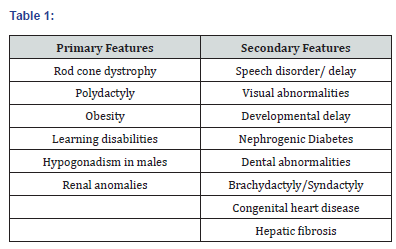
More over some secondary features associated with BBS are short stature, hepatic fibrosis, hypercholesterolemia, endocrinological disorders, developmental delay, speech defects and reproductive abnormalities. It is more of a clinical diagnosis rather than a genetic detection. Presence of 3 primary + 2 secondary or 4 primary features confirm the diagnosis [2,7].
The prevalence of the disease varies between isolated, inbred (Bedouin and Newfoundland – 1:13,500 and 1:16,000), consanguineous (Arab – 1:65,000), and other populations (North America and Europe – 1:140,000 and 1:160,000). (3,8) Unfortunately, there is very limited data regarding its incidence in Pakistan with very few cases reported. Our patient is an 8 years old male child with polydactyly, obesity, short stature and developmental delay, who was diagnosed as Bardet-Beidl Syndrome after ultrasonography of his renal tracts and genitalia.
Case Series
Patient A is an 8-years old male child who was referred to Radiology department from Paediatric department for Ultrasonography of his Abdomen and Inguinoscrotal region. He primarily presented with inability to walk, backache and blurred vision since last 3 months.
On examination, the child was pale, afebrile, irritable and tachycardic. He had increased body mass index, almond shaped eyes, mal-aligned teeth, supernumerary digits in bilateral hands and feet. There was hypertonia and bilateral plantar were upgoing.
He had ambiguous genitalia with testis not palpable in scrotal sac. Rest of the examination of Cardiovascular, chest and Abdomen was unremarkable without any visceromegaly.
He had delayed developmental milestones with neck holding achieved at 7 months, started sitting at 1 year and walking at 3 years. His parents had consanguineous marriage, with all other siblings normal.
He was fully vaccinated and his current nutrition status was limited to soft diet due to his poor dental condition, although he had history of formula fed with proper weaning.
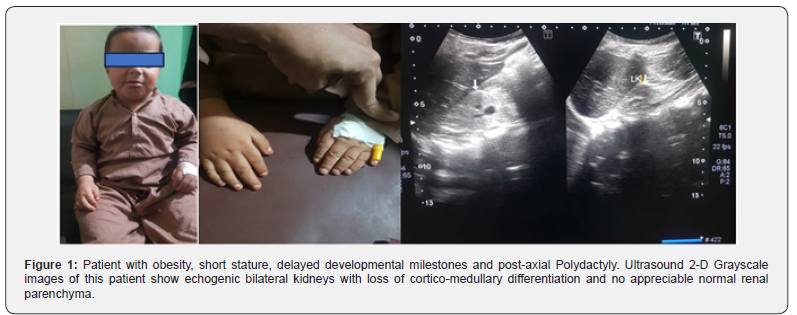
On further investigation, his hemoglobin levels were 8g/dl with low MCV and hematocrits and had deranged renal function with creatinine of 5mg/dl and urea of 164mg/dl.
When we did his ultrasound of Abdomen, it showed Bilateral increased renal echogenicity with loss cortico-medullary distinction in bilateral kidneys, suggesting chronic renal parenchymal changes”. Other viscera, such as liver, spleen, pancreas, gall bladder and urinary bladder were unremarkable.
His inguinoscrotal sac scan findings were “Non visualization of bilateral testis in its normal anatomical position. Bilateral testis seen high up in its corresponding inguinal region suggesting cryptorchidism”. In addition, he had micro penis and there was a vagina just beneath the scrotal sac, suggesting ambiguous genitalia and/or male hypogonadism.
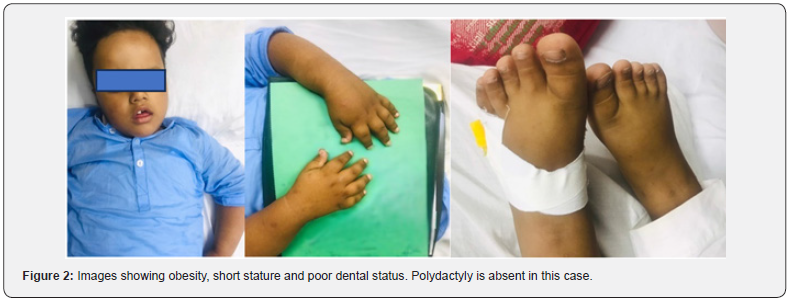
Patient B is a 6 years old male who was admitted in Paediatrics Department with recurrent chest infections, blurring of vision and increased blood pressure, rising up to 170/100mmHg.
His detailed history was of delayed cry on birth with delayed respirations. His developmental milestones were delayed. He started neck holding at 9 months, sitting at 2 years and started standing with support at 05 years of age. He was breast fed for 02 years. Antenatal history was unremarkable. On examination, this patient was of short stature with delayed reflexes and inability to walk. Polydactyly was an absent feature in this patient.
His laboratory investigations revealed deranged urea and creatinine with abnormally high serum cholesterol. His Ultrasound of Abdomen and Scrotal was done, which endorsed multi system findings such as Bilateral renal parenchymal changes and cryptorchidism with micro-penis and ambiguous genitalia.
Above mentioned detailed history, examination findings and ultrasound studies were of complications related to Bardet Beidl syndrome.
As Diabetes Mellitus is a well recognized feature in patients of BBS, this patient typically presented with Hypertension which was relatively a newer feature of Bardet Beidl Syndrome.
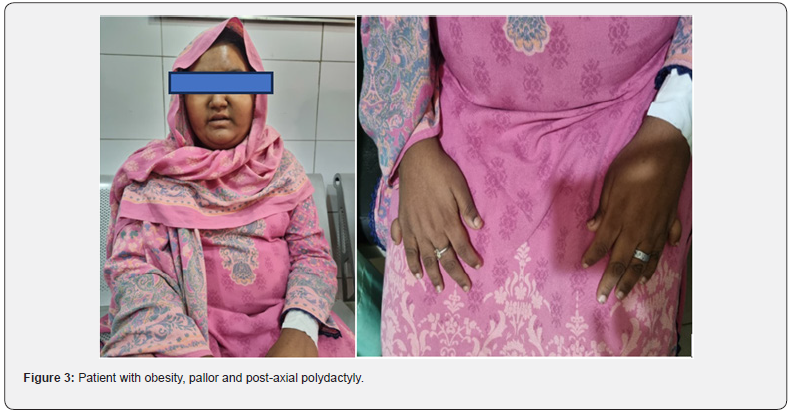
Patient C is a 21-years old unmarried female presented with complaints of progressive pallor, gradual loss of vision and easy fatigability since past three months.
On examination, she was an obese young female with delayed reflexes and delayed developmental milestones since birth. She was following commands only with assistance. She had post-axial polydactyly in both hands. Rest of her systemic examination is unremarkable.
Her laboratory investigations showed decrease in total leucocyte count (2.1 10*3 U/L), decreased haemoglobin (4.6g/dl) and markedly reduced platelets count (33000) indicating pancytopenia. Her serum urea, creatinine, electrolytes, uric acid and albumin were within normal limits. Her serum bilirubin was elevated (1.9mg/dl) however her ALT and ALP were normal. Her Ultrasound Abdomen and Pelvis was performed in our department and it showed Increased echogenicity and heterogeneous echotexture of hepatic parenchyma. Her spleen was massively enlarged measuring 18 x 7cm. She also had multiple low lying thick internal echoes in urinary bladder, suggesting urinary tract infection. Her gall bladder, pancreas, kidneys, uterus and bilateral ovaries appeared normal and there was no free fluid or abdominal lymphadenopathy.
In contrast to the two patients described earlier, this patient had pancytopenia and splenomegaly which suggests haematological involvement in this syndrome.
Her diagnosis fulfills three primary and two secondary features of Beales’ modified criteria for Bardet-Beidl syndrome.
Discussion
The rationale behind this study is the scarcity of data available information regarding BBS in Pakistan, even in the limited data available most of the cases are females. Both of our patients being male are expected to be the first reported cases from Islamabad.
Consanguineous marriage is a common practice in Middle east countries, Iran and Pakistan. It is major contributing factor in disease frequency [8]. In Pakistan, more than half of the population is consanguineous in nature with 80% being first cousins, thereby increasing possibility of homozygous mutations. Even then, the exact frequency of this disorder is unknown in Pakistan as most of the cases go undiagnosed due to multiple factors that precludes social norms and includes limited knowledge of BBS in health care community, particularly primary health care physicians.
The Beales’ modified diagnostic criteria of BBS is given below [7].
Diagnosis of BBS is based on:
a) Either 4 primary features.
b) 3 Primary with 2 secondary features.
BBS should be suspected in all newborns with polydactyly as it is the only evident congenital feature [9]. Additionally, these patients develop truncal obesity with age with short stature and delayed developmental milestones. Speech defects and intellectual disability are common features.
The more alarming feature is renal parenchymal abnormalities with progression to chronic kidney disease and end-stage renal disease until the second and third decade of life [4,6].
Some patients with BBS also develop deranged liver function termed as hepatic fibrosis. There is hypercholesterolemia and combined with obesity, probability of diabetes mellitus is greatly increased [2,6].
Most of the patients develop blurring of vision and night blindness due to retinal abnormalities, similar to retinosa pigmentosa.
Male hypogonadism with small scrotal sac and micropenis are important associated features which make them incompatible for reproduction.
Most of the cases of BBS are diagnosed in early childhood however prenatal diagnosis of this condition is rare but a possibility [3,8]. An anomaly scan done before 24 weeks of gestation can also aid in early diagnosis.
The treatment of BBS is mainly supportive and aims towards managing the manifestations of the illness [2]. Growth hormone replacement can reduce psychosocial burden. Proper nutrition and balanced diet should be initiated to control hypercholesterolemia and onset of diabetes. Low protein diet can be advised which slows progression of renal disease. Exercise and physical rehabilitation should be provided to reduce symptoms of spasticity [10,11].
Regular ophthalmologist visits, nephrology visits should be advised with proper guidance to parents regarding their child’s management.
Early diagnosis of our patients could have saved them from developing complications such as chronic kidney disease. blurring of vision and difficulty in walking [12,13].
Unfortunately, at the time of diagnosis, patient A has already developed chronic kidney disease with retinal abnormalities and weakness in lower limbs, while patient B has developed chronic kidney disease with hypertension and patient C have developed visual impairment and pancytopenia indicating haematological involvement. Parents of these patients were counselled regarding diagnosis and overall condition of their child. Aetiology, course and complexity of the disease was also discussed with them in detail.
Conclusion and Recommendation
Early and timely diagnosis is vital for patients with Bardet- Beidl syndrome for preventing renal, hepatic and ocular complications. Genetic testing for such rare syndromes are not available due to financial constraints, however awareness about the increased likelihood of this syndrome in consanguineous marriages should be given.
References
- Khan B, Shahid A, Bin Nazir M, Khan K, Punshi A (2019) Laurence-Moon-Bardet-Biedl Syndrome: A Case Report. Cureus 11(9):
- Elawad OAMA, Dafallah MA, Ahmed MMM, Albashir AAD, Abdalla SMA, et al. (2022) Bardet–Biedl syndrome: a case series. J Med Case Reports 16(1): 169.
- Rypens F, Dubois J, Garel L, Fournet J, Michaud J, et al. (2006) Obstetric US: Watch the Fetal Hands. Radiographics 26(3): 811-829.
- Bardet G (1995) Sur un syndrome d’obesitecongenitale avec Polydactilieetretinitepigmentaire (contribution a l’etude des formescliniquesdel’obesitehypophysaire) Amedee Le Grand 470: 407. [On congental obesity syndrome with poly-dactyly and pigmentary retinitis (contributions to the study of clinical forms of pituitary obesity)]. Obes Res 3(4): 387-399.
- Biedl A (1995) Ein Geschwisterpaar mit adiposo-genitaler Dystrophie Dtsch Med Woschenschr 1922 48: [A pair of siblings with adiposogenital dystrophy] Obes Res 3(4): 404.
- Mujahid S, Hunt KF, Cheah YS, Forsythe E, Hazlehurst JM, et al. (2018) The endocrine and metabolic characteristics of a large Bardet–Biedl syndrome clinic population. J Clin Endocrinol Metab 103(5): 1834-18
- Beales PL, Elcioglu N, Woolf AS, Parker D, Flinter FA (1999) New criteria for improved diagnosis of Bardet–Biedl syndrome: results of a population survey. J Med Genet 36(6): 437-4
- Ritchie G, Jequier S, Lussier-Lazaroff J (1988) Prenatal Renal Ultrasound of Laurence-Moon-Biedl Syndrome. Pediatr Radiol 19(1): 65-6
- Adams M, Smith UM, Logan CV, Johnson CA (2008) Recent advances in the molecular pathology, cell biology and genetics of ciliopathies. J Med Genet 45(5): 257-2
- Ansley SJ, Badano JL, Blacque OE, Hill J, Hoskins BE, et (2003) Basal body dysfunction is an expected cause of pleiotropic Bardet–Biedl syndrome. Nature 425(6958): 628-633.
- Dervisoglu E, Isgoren S, Kasgari D, Demir H, Yilmaz A (2011) Obesity control and low protein diet preserve or even improve renal functions in Bardet–Biedl syndrome: a report of two cases. Med Sci Monit 17(1): 12-1
- Forsyth R, Gunay-Aygun M, et al. (2003) Bardet–Biedl syndrome overview. In: Adam MP, Ardinger HH, Pagon RA, Wallace SE, Bean LJH, Mirzaa G, et al. (Eds.), GeneReviews®. Seattle: University of Washington, Seattle.
- Kumar S, Mahajan BB, Mittal J (2012) Bardet–Biedl syndrome: a rare case report from north India. Indian J Dermatol Venereol Leprol 78(2):

























