




 JOJCS Home



Abstract
Background: Uterine leiomyomas are the most common benign pelvic tumors in women, arising from smooth muscle cells of the myometrium. However, extrauterine leiomyomas are rare, with broad ligament fibroids accounting for less than 1% and cervical fibroids for 1-2% of all cases. Their presentation may mimic adnexal or malignant pelvic masses, leading to diagnostic dilemmas.
Case presentation: We report the case of a 44-year-old female, P4L4, who presented with progressive abdominal distention for 2.5 years, menorrhagia, and breathlessness for two days. She was previously admitted to a private nursing home where surgery was deferred due to uncertain anatomy. Examination revealed a firm, restricted abdominopelvic mass corresponding to 30 weeks’ uterine size. Investigations showed anemia (Hb 8 g%), normal CA-125 (17U/mL), elevated D-dimer (10,000ng/mL), and pulmonary embolism with mild pleural effusion on CTPA. The patient was managed with heparin and later planned for surgery after stabilization. Imaging suggested a granulosa cell tumor or uterine sarcoma. A prior operative video confirmed uterine origin of the mass. Exploratory laparotomy revealed a large right-sided primary broad ligament fibroid (20 × 15cm) along with multiple uterine fibroids. Due to difficult anatomy, myomectomy followed by total abdominal hysterectomy with bilateral salpingo-oophorectomy was performed. Histopathology confirmed benign leiomyoma.
Conclusion: Broad ligament leiomyomas, though rare, can closely mimic adnexal malignancies. Careful preoperative evaluation and intraoperative assessment are essential for accurate diagnosis and safe surgical management.
Keywords: Uterine leiomyomas; Pelvic tumors; Surgical management; Obstetrics and gynecology; Abdominal examination; Pulmonary embolism; Heparin; Uterine sarcoma
Introduction
Leiomyomas are benign smooth muscle tumors of the uterus and represent the most common pelvic neoplasm in women of reproductive age [1]. They are estrogen-dependent and typically arise from the uterine myometrium. Extrauterine leiomyomas, such as those originating from the broad ligament, are exceedingly rare and constitute less than 1% of all leiomyomas [2]. These tumors often pose diagnostic and surgical challenges due to their atypical location and proximity to vital pelvic structures. This case report highlights a rare presentation of a primary broad ligament leiomyoma that mimicked an adnexal or malignant mass and discusses its diagnostic and surgical management.
Case Presentation
A 44-year-old multiparous woman (P4L4) presented to the obstetrics and gynecology emergency with complaints of progressive abdominal distention for 2.5 years, heavy menstrual bleeding, and breathlessness for two days. She had a prior hospitalization at a private nursing home where surgical intervention was deferred due to unclear delineation of the organ of origin of the mass. On admission, her vital signs were stable except for tachypnea (RR 30/min) and oxygen saturation of 90% on room air. Abdominal examination revealed a firm, non-tender, restricted mass corresponding to a 30-week gravid uterus.
Investigations
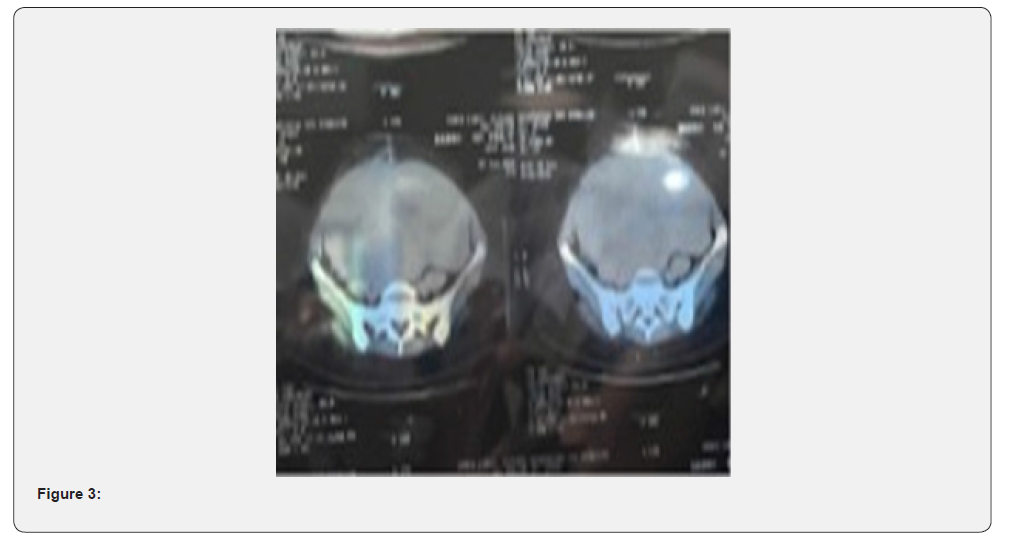
Laboratory findings showed Hb 8g/dL, CA-125 17U/mL, and markedly elevated D-dimer (10,000ng/mL). CTPA showed pulmonary embolism with mild pleural effusion. The patient was started on therapeutic anticoagulation with heparin. Ultrasonography suggested a granulosa cell tumor, while CT imaging indicated possible uterine sarcoma. After stabilization, communication with the previous surgeon provided an intraoperative video that confirmed the uterine origin of the mass. Surgery was planned after six weeks of anticoagulation therapy.
Intraoperative findings and management
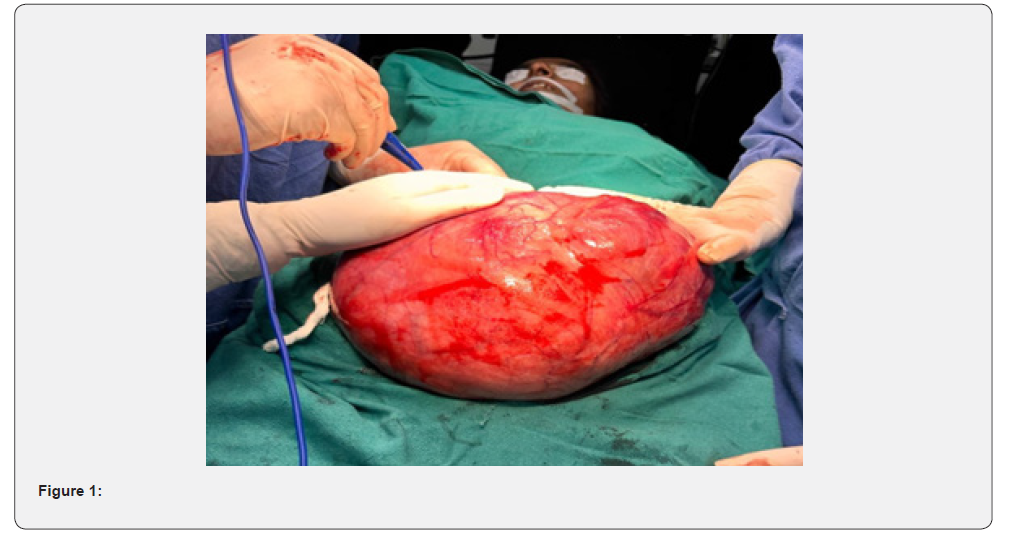
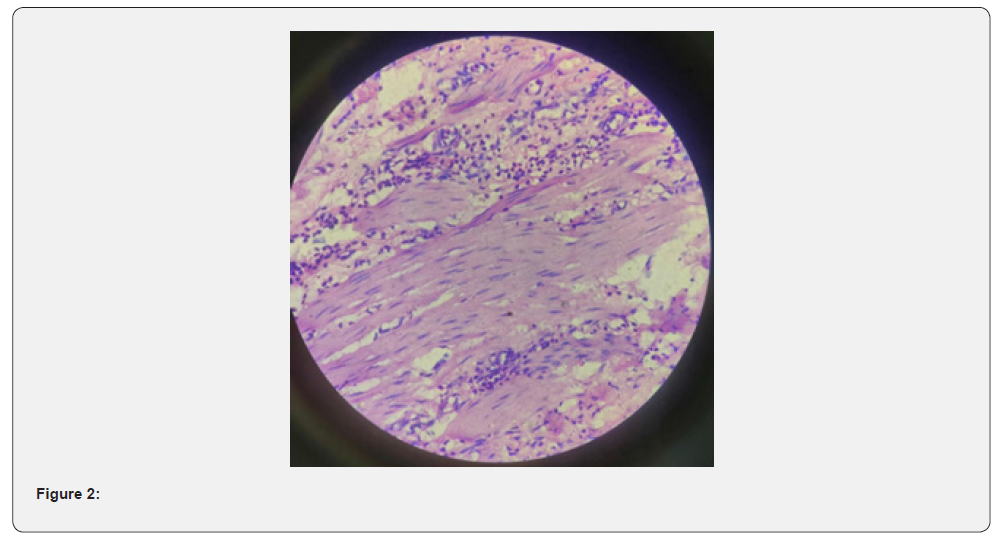
Exploratory laparotomy with frozen section was performed. Intraoperatively, a large right-sided broad ligament fibroid measuring approximately 20 × 15cm was identified, along with multiple uterine fibroids. The ureter was displaced medially, and dense bowel adhesions were present, making manipulation challenging. A myomectomy followed by total abdominal hysterectomy with bilateral salpingo-oophorectomy was performed. The intraoperative frozen section confirmed benign leiomyoma. The postoperative period was uneventful, and the patient was discharged in satisfactory condition on postoperative day seven.
Discussion
Broad ligament leiomyomas are rare extrauterine benign smooth muscle tumors arising from the broad ligament or parasitic growth of uterine fibroid tissue [3]. They may grow to a large size before causing symptoms and can be mistaken for ovarian or adnexal malignancies [4]. Clinically, these tumors can present with abdominal distension, menstrual irregularities, urinary symptoms, or pressure effects depending on their size and location. In our case, the large size and distorted pelvic anatomy led to diagnostic confusion with adnexal or malignant lesions. Imaging modalities such as ultrasound, CT, or MRI are useful but may not always clearly identify the organ of origin [5]. In this case, the preoperative video from a prior surgery was instrumental in establishing the diagnosis. Surgical excision remains the treatment of choice. During surgery, special attention must be paid to identifying and preserving the ureter, which is often displaced by the tumor [6]. Total hysterectomy may be required in women who have completed childbearing or when the anatomy is distorted by multiple fibroids, as in this case (Figure 1-3).
Conclusion
Primary broad ligament leiomyomas are rare benign tumors that can closely mimic ovarian or uterine malignancies. A multidisciplinary approach involving detailed imaging, surgical planning, and intraoperative assessment is vital to ensure accurate diagnosis and optimal patient outcomes. Awareness of this rare entity helps prevent misdiagnosis and guides appropriate management.
References
- Bhatla N (2018) Jeffcoate’s Principles of Gynaecology. (9th edn), New Delhi: Jaypee Brothers Medical Publishers.
- Fasih N, Prasad Shanbhogue AK, Macdonald DB, Fraser-Hill MA, Papadatos D, et al. (2008) Leiomyomas beyond the uterus: unusual locations, rare manifestations. Radiographics 28(7): 1931-1948.
- Jain S, Goyal P, Singla S, Jain S (2014) Broad ligament fibroid: A diagnostic dilemma. Int J Reprod Contracept Obstet Gynecol 3(4): 110-1109.
- Okafor CI, Onyegbule OA, Etigbue J, Okpala OC (2013) Primary broad ligament leiomyoma: a diagnostic dilemma. Ann Med Health Sci Res 3(3): 464-466.
- Takeda A, Imoto S, Mori M, Nakano T (2008) Diagnostic challenge in the management of broad ligament leiomyoma mimicking ovarian malignancy. J Obstet Gynaecol Res 34(3): 398-403.
- Bansal R, Sharma S, Saini V, Gupta R (2015) Giant broad ligament fibroid: a diagnostic and surgical challenge. Int J Reprod Contracept Obstet Gynecol 4(2): 519-522.

























