




 JGWH Home




Abstract
Background: Infertility is one of the health issues that today affects approximately 20% of Iranian couples.
Objective: The goal of this study was to look into the difficulties that Iranian infertile couples face during reproductive treatment.
Methods: A qualitative approach and the Grounded Theory method were employed to study this issue. In accordance with theoretical saturation, this study used in-depth semi-structured interviews with 32 infertile adults (22 women and 10 men).
Results: The difficulties in the current study are classified as 132 open codes, 13 axial codes, and a selective code (core category) of ''a rough road to understanding the sense of motherhood and fatherhood''. Economic, medical, individual, psychological, family, marital, social, cultural, unpredictable, leisure, jurisprudential, religious, and legal obstacles were all pointed out by participants.
Conclusion: The data revealed that infertile couples have numerous challenges during reproductive therapy; thus, these people require special attention from society, family, and healthcare institutions.
Keywords: Infertility, Infertile Couples, Assisted Reproductive Treatment, Qualitative Research
Introduction
Infertility is characterized as the incapacity to conceive, gestate, or deliver a child by natural means [1,2]. Infertility is commonly defined by professionals as the condition characterized by the failure to successfully conceive a pregnancy following a minimum duration of one year of coordinated attempts [3]. The prevalence of this condition has experienced a global rise, resulting in a current estimate of over 70 million couples globally suffering from infertility, mostly originating from developed countries [4]. Infertility affects people of all social classes and geographical locations [5]. The prevalence of infertility is estimated to be 20% in Iran, based on the most recent statistics data from the national program [6]. The prevalence of primary infertility is 18.85% in Tehran province and 20.17% nationwide [7]. Assisted reproductive technologies (A.R.T.) types of medical treatments involve a lengthy and tough process, frequently characterized by several instances of unsuccessful outcomes [8,9]. Additionally, this journey entails various stress-inducing elements, including the handling of daily injections, collection of blood samples, hormone fluctuations, laparoscopic surgery, and the anticipation of test results, and candidates may experience financial burdens as a result [10]. Over time, numerous studies have demonstrated that the diagnosis of infertility can give rise to emotional distress, heightened anxiety, and depression, with these psychological effects being more prevalent and severe among women [11]. In addition, the vast majority of fertility treatments, particularly those involving in vitro fertilization, are in vitro, invasive, time-consuming, frequently expensive, and have generally low success rates. All of these factors may affect and aggravate the physiological and psychological burden experienced by infertile couples, particularly when treatments fail [12].
According to what has been laid out, the diagnosis of infertility can place a significant burden on patients. As a result, conducting such research is crucial and essential, as evidenced by the aforementioned instances. First, according to statistics provided by the World Health Organization and Iran's medical service centres, the number of infertile individuals is on the rise, and a significant number of individuals struggle with this issue. Second, the current research seeks to address the challenges that individuals face during treatment. Very few studies have been conducted in this situation, and there is a research gap in this field of study. Moreover, infertile individuals already experience other challenges. Infertility treatment presents challenges in terms of its financial burden, its time-consuming process, and limited efficacy, hence exacerbating the difficulties faced by individuals experiencing infertility. By acknowledging these challenges, several issues faced by this group can be resolved. Furthermore, an additional aspect that warrants consideration in the imperative to do this research is cultural factors. Iran is a country that places significant emphasis on the societal, cultural, and religious significance of procreation. From a religious and historical perspective, popular culture holds the belief that children are regarded as sacred gifts, while the absence of children is viewed unfavorably. These societal standards pertaining to the institution of family are reinforced by cultural support. Consequently, confronting the challenges of infertility can help these individuals resolve their issues. Lastly, such an effort can be significant in terms of macro national policies, as the country's population is ageing and the number of births will increase considerably if the problems faced by approximately one million infertile people are resolved.
Consequently, based on the findings of the study, the problems of infertile individuals can be identified and alleviated through the implementation of government and Ministry of Health policies. The aim was to address the question, "What are the challenges encountered by infertile couples throughout the process of assisted reproductive treatment?"
Methods
Study design
A qualitative grounded theory method has been employed to identify the issues faced by couples undergoing assisted reproductive treatment. The research was carried out throughout the year 2022-2023 in the city of Tehran.
Sample size and sampling procedure
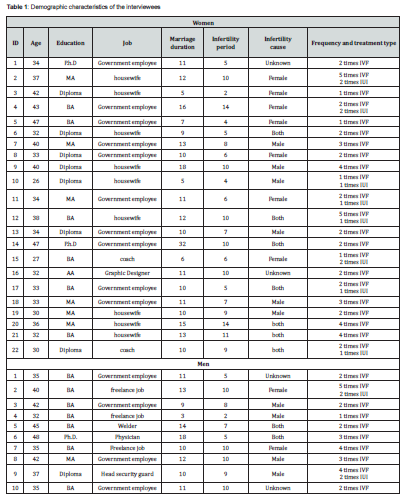
This study was part of a larger study that aimed to create a model and instructional program for infertile couples receiving treatment. 32 infertile individuals in total—22 women and 10 men—participated in the study. Men were usually not willing to participate in research; thus, there were fewer male than female participants. (Table 1) displays demographic information. Men were 39.1 years old on average, compared to 35.45 years for women. 3 participants have doctoral degrees, 7 have master's degrees, thirteen have bachelor's degrees, one has an associate degree, and 7 have a diploma. In terms of which spouse was the source of infertility, there were 13 infertile women and 9 infertile men. In 6 couples, both spouses were infertile, and 4 cases where the cause was unknown. The research's theoretical underpinnings and historical background were taken into consideration when choosing the method of purposeful sampling for the interviews.
Data collection
The selection of participants was conducted through a rigorous process involving advertising through online social media platforms and recruitment at infertility centres. Every individual was interviewed on a single occasion. The duration of the interviews ranged from 30 to 70 minutes. The inclusion criteria for participating in the interview were as follows: 1) A minimum of two years have passed since the initial diagnosis of infertility, 2) The individuals must have been referred to Tehran for medical treatment, and 3) They must have had at least one of the fertility treatment procedures, such as intrauterine insemination (IUI), in vitro fertilization (IVF), or intracytoplasmic sperm injection (ICSI), 4) having at least a diploma and 5) giving informed consent. The exclusion criteria were inappropriate responses to queries and a refusal to consent to meeting recording. The interviews continued until theoretical saturation was achieved, and no additional concepts could be derived from the data. Following each interview, transcription was immediately conducted. The analysis of the interviews was conducted utilizing the grounded theory approach developed by Strauss and Corbin (2007). The method described is a systematic procedure in which raw data is analyzed and categorized based on careful interpretation and inference. This categorization results in the creation of three types of codes: open, axial, and selective. These codes are derived from the reduction of relevant propositions. Trustworthiness was further ensured by several procedures. Firstly, the coding of the data was carefully reviewed by different researchers to minimize discrepancies and enhance accuracy. Additionally, during the interview process, the responses provided by the interviewee were reiterated to ensure clarity and verify the credibility of their statements. This approach was designed to reduce any potential biases and uphold the validity of the findings.
Ethical clearance
Furthermore, the article takes into account ethical principles. The participants were provided with information regarding the objective of the research and the procedural details of what was done. Participants were additionally provided with the assurance of information confidentiality and were granted the freedom to withdraw from the study at any given point. In addition, the subjects were required to provide written informed consent. Furthermore, it is important to note that this study has received official approval from the Islamic Azad University, Science and Research Branch, adhering to the established code of ethics with the designated reference number I.R.IAU. S.R.B.REC.1402.247.
Results
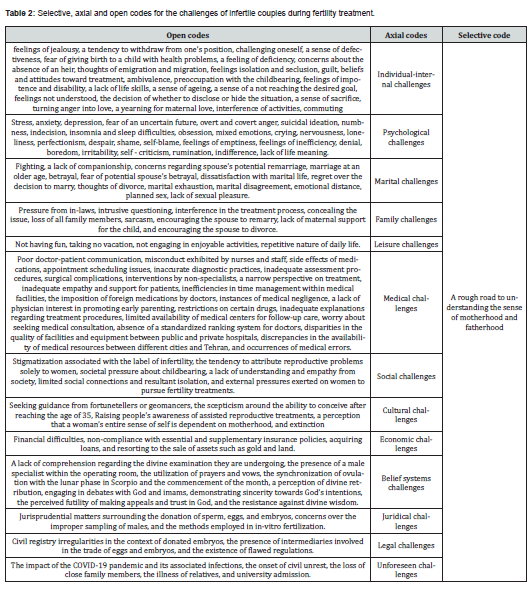
The participants were asked about the challenges they had experienced over the course of treatment, resulting in the identification of 132 open codes and 13 axial codes. (Table 2) displays the codes that have been extracted.
Couples facing infertility embark on a challenging and intricate journey in pursuit of the profound joys of parenthood. Based on the interviews conducted, a comprehensive analysis has led to the categorization of 13 core codes as outlined below:
Individual-internal challenges
This challenge includes many problems that have arisen for the individual throughout their treatment journey. Here are a number of phrases that individuals have articulated, each corresponding to a specific code. Phrases designated with "W" are intended for women, while those marked with "M" are designed for men.
“It's kind of like, you know, going into battle. You're not sure if you'll come out victorious. Personally, I'm still not fully convinced to give treatment another shot. They prescribed me medication and told me to return in 10 days, but I never ended up going back” (code 8-W).
“When I look at the pictures from the early years of our marriage, I can't help but think about how much I've aged and how challenging these past eight years have been for me” (code 3-M)
Psychological challenges:
The meaning of this code pertains to the psychological difficulties encountered by couples throughout the course of treatment.
“I'm really scared because I consider myself a religious person, and I feel like having thoughts about suicide is a sin. It's really upsetting to me that I even had these thoughts because I never thought I would be someone who thinks about suicide. I'm terrified and confused about why these thoughts keep coming into my mind” (code 2-W).
“I often blame myself and think this woman is frustrated living with me” (code 8-M)
Couple challenges
Couple challenges refer to different problems and barriers that couples encounter and comprehend within the context of treatment.
“My husband wasn't there for me for a while. He had me doing all sorts of things to distract myself from feeling lonely, but it ended up leading me down the wrong path. I ended up meeting a guy online. He was really a sick one, and he totally went off track with everything”. (code 22-W)
“It's really tough for her to have sex at certain times, and during those two weeks when we're waiting for the test results, we should avoid having sex”. (code 1-M)
Family challenges
This particular challenge relates to the in-laws and immediate relatives of the couple who experience difficulties in their relationship.
"We were going to the wedding, my mother-in-law said: You see that beautiful girl, she could not have children. She agreed with her husband's remarriage, and now they have two children" (Code 7-W).
“Everyone is aware of our presence here. That's why everyone is curious and wondering what happened”. (code 5-M)
eisure time challenge
His code refers to how to spend idle time, which is defined by the open codes of not having fun, taking no vacation, not engaging in enjoyable activities, and the repetitive nature of daily life.
“We haven't travelled at all in the past ten years. I've noticed everyone around us is going on trips, but we're all caught up in this treatment process” (code 22-M)
“Every day feels the same. This month is all about ovulation. Then, three whole months for the Embryo Transfer. Ugh, it's so frustrating! The test came back negative. It's just been a never-ending cycle of disappointment, day in and day out”. (Code 7-W)
Medical challenges
This code refers to the challenges couples face during the treatment procedure in centres and clinics. Of course, the most important challenge relates to this particular code.
“After ovulation, those drugs really made me hyper (OHSS)! My stomach was watering. I had to take a break from the whole process for a few months”. (code 20-W)
“when I take my wife to the clinic in the morning, we have to wait behind the door until it's our turn.” (code 8-M)
Social challenges
They refer to the various societal constraints imposed on couples concerning the issue of infertility.
“Women should realize that they are not alone in their infertility struggles. This viewpoint of society is so negative that they blame you first, and you feel isolated from other women, and those who become pregnant naturally are different from you, which is not a good feeling at all”. (code 9-W)
“You might find yourself spending less time with friends who have children, and that might bother you”. (code 6-M)
Cultural challenges
This code pertains to the societal views and convictions around infertility and its treatment.
“Not everything can be defined by a child alone. Each person has their own unique fingerprint and makes their own mark on the world. But a lot of people don't actually believe this, and it really bothers them” (code 20-M)
“Once you hit 40, nobody thinks you can have kids. You gotta create a culture for families, make films, and show 'em for it to be acceptable” (Code 14-G)
Economic challenges
This category refers to the financial difficulties experienced by couples undergoing treatment.
“We used up all the gold and money we had for this. So, we got a piece of land and decided to use it for this route” (code 12-W)
“We have supplementary insurance coverage; however, we have to pay the money upfront, and then we provide an invoice for the said payment. However, they often reduce the amount for various reasons. In the end, it feels like we don't really get anything out of it”. (code 8-M)
Belief systems Challenges
This core aspect relates to the religious and personal beliefs of couples undergoing infertility treatment, significantly influencing their thoughts and experiences.
“Every time it was negative, I would be like, "God, when will this ever end? Can you please hear me out?" Why don't you see me if I'm not your servant? I made all these vows; why aren't you responding to me?” (code 9-W)
“This is God's will; I am so convinced that every single thing that happens in life is filled with divine wisdom!” (code 5-M)
Juridical challenges
This category includes the difficulties and dilemmas arising from couples' insufficient understanding of Islamic jurisprudence and infertility, which can be attributed to their lack of knowledge.
“You wonder what really goes on in the laboratories?” (code 14-W).
“A question is raised in relation to the formation of an embryo. When they ask you to give a sperm sample, What is Sharia and religion's opinion on this? Is this considered masturbation or not?” (code 3-M).
Legal challenges
This issue relates to legal gaps that can be problematic for relationships.
“When our son was born, the Civil Registration asked us to get a letter from the clinic and the hospital to ensure the child was officially recognized as ours”. (code 17-W)
“It's really frustrating to see those egg and embryo brokers in some clinics. They grab someone's hand and bring him to the clinic. So, they grab the egg, and in the end, they give her some money. So, I asked them about the price of the donated egg, and they told me it was 200 million rials. Can you believe it? They mentioned that the price of the fetus is a whopping 700 million rials!” (code 1-W)
Unforeseen challenges
The concept refers to the unanticipated difficulties that arise during the couple's treatment, which were not anticipated beforehand and are beyond their control.
“During my first IVF round, I got COVID-19 right when I was ovulating. It was a tough situation for both me and my husband. The doctors were hesitant to proceed with the procedure, but eventually, they agreed after we pleaded with them and took extra precautions like wearing four layers of masks. Unfortunately, I didn't receive any treatment, and they discharged me pretty quickly”. (code 6-W)
“I was just sleeping at my mom's place. We were still sleeping at seven in the morning. So, my dad's phone rang, and it turned out that my grandfather had passed away. I can only imagine how shocking and sad it was for me”. (code 21-W)
Discussion
This study aimed to examine the challenges encountered by Iranian couples experiencing infertility in the context of reproductive treatment. 132 open codes, 13 axial codes, and a selective code have been identified ''a rough road to understanding the sense of motherhood and fatherhood''. Thirteen core codes were applied to each interviewee, with each participant referencing multiple codes during the interviews. The participants identified various challenges, including economic, medical, individual, psychological, family, marital, social, cultural, unpredictable, leisure, juridical, belief system, and legal challenges. Previous research has identified multiple challenges, as highlighted by [13], including social issues, familial pressures, personal worries, psychological distress, sexual difficulties, marital conflict, and treatment-related concerns. These findings align with the current body of research. In their study, [14] comprehensively analyzed the psycho-social challenges faced by infertile couples in India. The authors highlighted that these couples commonly experience a range of negative emotions, including guilt, emptiness, anxiety, depression, and stress. Additionally, the study found that these challenges often lead to adverse outcomes such as divorce, contemplation of divorce, social isolation, and diminished communication within the couples. These findings are consistent with the current findings.
The research literature [15] indicates that certain issues exhibit cultural variability between nations, while others are universally experienced by couples worldwide. Certain issues are associated with the advancement of the medical industry, and others are observed more in developing countries [16,17]. Certain challenges are associated with religious beliefs. The present study reveals that couples have challenges with assisted reproductive treatments due to factors such as beliefs, jurisprudence, and religion, which can be attributed to the cultural context of the Iranian-Islamic society. One aspect worth discussing relates to the method of sperm collecting, specifically when accomplished by masturbation, as it might give rise to challenges for couples2 . The presence of a male specialist within the medical staff in the women's operating room, as well as the timing of sperm production throughout different phases of the lunar month, has been identified as a source of concern among women. These difficulties are intricately tied to Islamic culture and may not be prevalent in countries that do not adhere to Islamic principles.
The influence of culture on fertility is a significant factor to consider from a sociological perspective. In collectivity societies that prioritize interdependence, such as Iran, there is a greater emphasis on family interactions and the involvement of individuals within the community. This is evident in the constant exchange of information among neighbors and acquaintances regarding the outcomes of fertility treatments. If individuals inquire, they are experiencing distress. [18] have also articulated this phenomenon in their conceptualized category of the ''actions and reactions of families and acquaintances''. The study conducted by in Pakistan likewise identified family and social pressures as significant factors, which are consistent with the findings of the present study. The interviewed couples expressed significant concerns over economic issues, as the high cost associated with reproductive treatment led them to discontinue the treatment in certain instances. The investigation of psychological difficulties experienced by couples facing infertility has been a subject of much scholarly inquiry. Various negative emotions, including sadness, grief, anger, crying, guilt, remorse, failure [19], insecurity, uncertainty about the future, depression, anxiety [20], and emotional distress, have been reported [21].
The participants involved in this study have also experienced a diverse range of negative affective states and emotions. The intensity of these negative feelings was heightened in instances when the outcome of the pregnancy test yielded a negative result. According to a study conducted by [22], individuals undergoing in vitro fertilization (IVF) reported heightened levels of stress, worry, and uncertainty during the two weeks of waiting for the results. The sense of deficiency was identified as a noteworthy component by couples, particularly women. The cultural significance of this phenomenon is noteworthy, particularly within Iranian society. It is observed that a woman's sense of self is considered incomplete until she assumes the role of a mother. Consequently, the absence of motherhood in a woman's life may lead to an incomplete understanding of her identity and a sense of inadequacy. The medical problem and its associated variables were identified as a prominent topic by a majority of participants. The category that has been commonly cited in this problem is the limited perspective of physicians and their tendency to make incorrect diagnoses. The adverse effects of the medications were also frequently mentioned by a majority of women, occasionally resulting in the development of additional medical conditions in the individual. The administration of hormonal medications has been associated with the manifestation of hyperactivity in certain women, increased susceptibility to frequent infections in others, and the development of cystic breasts in yet another group of individuals.
Limitations, implications and conclusions
The current investigation is part of a broader study aimed at developing an educational program for couples experiencing infertility who are undergoing reproductive treatment. The objective of this study was to elucidate the multifaceted challenges encountered and subsequently develop an educational resource tailored to the target group's specific needs based on these challenges. The study faced a number of obstacles, namely related to sampling difficulties. Some of the samples were not in an optimal state for communication, which necessitated conducting the interviews in many phases and consequently extended the duration of the research procedure. Another limitation that might be identified relates to the limited collaboration exhibited by men and their reluctance to discuss personal matters with a female researcher. Consequently, a male interviewer was employed in the study. One further limitation of the study was the lack of collaboration from reproductive institutions. Consequently, the researcher resorted to employing a virtual platform to reach out to individuals experiencing infertility in order to recruit participants.
The existence of each of the 13 challenges presented poses a potential threat to an individual's mental well-being, thereby diminishing reproduction rates [23,24]. Certain aspects are dependent on the social structure of a particular culture and become ingrained inside the collective beliefs of its members. The concept of motherhood holds significant importance for women, as it is commonly believed that a woman's sense of fulfilment is achieved by becoming a mother [25,26]. However, it is worth noting that not all women are able to experience this aspect of life, leading to potential feelings of inadequacy. In order to address this issue, it is essential to diminish the societal stigma associated with infertility by means of cultural initiatives and events. Individuals experiencing infertility face a multitude of emotional, marital, economic, and medical difficulties that hold significant importance. However, when confronted with additional problems, these individuals may experience a loss of psychological and behavioral regulation, leading to the manifestation of negative feelings. It is recommended that individuals of this nature engage in counselling sessions as a means to alleviate their psychological distress, thus enhancing their ability to actively engage in the process of fertility treatment.
Declaration of Conflicting Interests
The author(s) hereby declare that there are no conflicts of interest related to the study, the authorship, and/or publication of this article. This paper is derived from a doctoral dissertation and has not received any funding.
Data Availablity Statement
Data are available up on reasonable request from authors
References
- Vander Borght M, Wyns C (2018) Fertility and infertility: Definition and epidemiology. Clin Biochem 62: 2-10.
- Luk BH-K, Loke AY (2015) The impact of infertility on the psychological well-being, marital relationships, sexual relationships, and quality of life of couples: a systematic review. J Sex Marital Ther 41: 610-25.
- Salie M, Roomaney R, Andipatin M, et al. (2021) Scoping review of the psychosocial aspects of infertility in developing countries: protocol. BMJ Open 11(5): e044003.
- Mazumder U, Sultana N, Akhter Y (2020) Demographic Background & Clinical Profile of Primary Subfertility Attending Infertility Clinic in a Developing Country. Gynecol & Reproduct Health 4(4): 1-5.
- Palomba S, Daolio J, Romeo S, Battaglia FA, Marci R, et al. (2018) Lifestyle and fertility: the influence of stress and quality of life on female fertility. Reprod Biol Endocrinol 16(1): 113.
- Bagi M (2023) Prevalence, Reasons and Consequences of Childlessness in the World and Iran: A Systematic Review. Journal of Population Association of Iran 18(35): 97-148.
- Akhondi MM, Ranjbar F, Shirzad M, Behjati Ardakani Z, Kamali K et al., (2019) Practical difficulties in estimating the prevalence of primary infertility in Iran. Int J Fertil Steril 13(2): 113-117.
- Fisher J, Hammarberg K (2012) Psychological and social aspects of infertility in men: An overview of the evidence and implications for psychologically informed clinical care and future research. Asian Journal of Andrology 14: 121–129.
- Sut HK, Kaplan PB (2015) Quality of life in women with infertility via the FertiQoL and the Hospital Anxiety and Depression Scales. Nursing & Health Sciences 17: 84-89.
- An Y, Sun Z, Li L, Zhang Y, Ji H (2013) Relationship between psychological stress and reproductive outcome in women undergoing in vitro fertilisation treatment: Psychological and neuro hormonal assessment. Journal of Assisted Reproduction and Genetics 30(1): 35-41.
- Greil AL, Slauson Blevin KS, Lowry M, et al. (2019) Concerns about treatment for infertility in a probability-based sample of US women. Journal of Reproductive and Infant Psychology 38: 16-24.
- Chazan L, Kushnir T (2019) Losses and gains of psychosocial resources: Effects on stress among women undergoing infertility treatments and participating in social network systems. Psychiatric Quarterly 90(4): 717–732.
- Naz B, Batool SS (2017) Infertility Related Issues and Challenges: Perspectives of Patients, Spouses, and Infertility Experts. Pakistan Journal of Social and Clinical Psychology 15(2): 3-11.
- Sharma A, Shrivastava D (2022) Psychological Problems Related to Infertility. Cureus 14(10): e30320.
- Gamel WMA, Hassan HE, El-ezazy AA (2019) Male Infertility and Psychological Repercussions: Α Neglected Problem in Northern Upper Egypt. Int J Stud Nurs 4(4): 1-10.
- Bai CF, Sun JW, Li J, et al. (2019) Gender differences in factors associated with depression in infertility patients. Journal of advanced nursing 75(12): 3515-24.
- Sun H, Gong TT, Jiang YT, Zhang S, Zhao YH, et al. (2019) Global, regional, and national prevalence and disability-adjusted life- years for infertility in 195 countries and territories, 1990-2017: results from a global burden of disease study. Aging (Albany NY) 11(23): 10952-10991.
- Ebrahimi M, mohsenzade F, Zahrakar K (2022) Marital Challenges of Infertile Couples: A Phenomenological Study. Journal of applied family therapy 3(2): 67-84.
- Facchin F, Leone D, Tamanza G, Costa M, Sulpizio P, Canzi E, Vegni E (2020) Working With Infertile Couples Seeking Assisted Reproduction: An Interpretative Phenomenological Study With Infertility Care Providers. J Frontiers in Psychology 11: 1-9.
- Jastrzębska J (2017) Psychological aspects of infertility from the perspective of intersex differences and cultural determinants. Quarter of Sciences Fides et Ratio 1: 227-233.
- Delvin S (2020) The experiences of Infertility of West African women. Degree Programme in Nursing.
- Renzi A, Solano L, Di T, et al. (2020) The effects of an expressive writing intervention on pregnancy rates, alexithymia and psychophysical health during an assisted reproductive treatment. Psychology & Health 35: 718-733.
- Xie Y, Ren Y, Niu C, Zheng Y, Yu P, Li L (2023) The impact of stigma on mental health and quality of life of infertile women: A systematic review. Front Psychol 13: 1093459.
- Martens M, Schroer M, Williams T, Kennedy B (2023) Identifying Mental Health Issues Associated With Infertility. The Journal for Nurse Practitioners 19(2): 1-5.
- Corbin J, Strauss A (2007) Basics of qualitative research: Techniques and procedures for developing grounded theory (3rd ed.). Sage.
- Li X, Ye L, Tian L, Huo Y, Zhou M (2020) Infertility-Related stress and life satisfaction among chinese infertile women: a moderated mediation model of marital satisfaction and resilience. Sex Roles 82: 44-52.