




 JGWH Home



Abstract
Background: Periodontal disease is a multifactorial inflammatory condition that includes gingivitis and periodontitis and has increasingly been associated with systemic health outcomes. During pregnancy, hormonal, immunological, microbiological, and behavioral changes may increase susceptibility to periodontal alterations. Maternal periodontal disease has been proposed as a possible risk factor for adverse perinatal outcomes, particularly preterm birth (PTB) and low birth weight (LBW).
Objective: To analyze the possible association between periodontal disease during pregnancy, including gingivitis and periodontitis, and the
occurrence of preterm birth and/or low birth weight.
Methods: An observational clinical study was conducted in pregnant women in the third trimester of pregnancy recruited from two primary
healthcare centers in Murcia, Spain. After informed consent, participants underwent an intraoral periodontal examination using the Community
Periodontal Index of Treatment Needs (CPITN/CPI). Following delivery, gestational age at birth and neonatal birth weight were obtained by
telephone follow-up. The main study variables were maternal periodontal status, preterm birth, and low birth weight.
Results: A total of 35 pregnant women were initially included, and 30 provided complete postnatal outcome data. Gingivitis was observed in
91.4% of participants and periodontitis in 60%. Most births were full-term, and only one case of preterm birth was recorded. No statistically
significant associations were found between gingivitis and PTB or between periodontitis and PTB. A moderate positive correlation was observed
between gingivitis and LBW, whereas periodontitis showed a small positive correlation with LBW.
Conclusions: A high frequency of gingival and periodontal alterations was observed in this sample of pregnant women. Although no statistically significant association was found between periodontal disease and preterm birth, a positive correlation was identified between maternal periodontal disease and low birth weight, particularly in the case of gingivitis. These findings should be interpreted with caution due to the study’s methodological limitations.
Keywords: Pregnancy; Periodontal disease; Gingivitis; Periodontitis; Preterm birth; Low birth weight; Maternal oral health.
Introduction
The oral microbiota constitutes a complex ecosystem composed of more than 700 bacterial species, many of which are organized into biofilms adhered to dental surfaces and oral tissues [1-3]. These biofilms, also referred to as oral biofilm or dental plaque, are part of the physiological balance of the oral cavity; however, alterations in their composition or in the host response may lead to dysbiosis capable of triggering inflammation and damage to periodontal tissues [4]. Periodontal disease is a multifactorial inflammatory condition that mainly includes gingivitis and periodontitis. Gingivitis is a reversible inflammatory process limited to the gingival tissues, whereas periodontitis represents a more advanced and irreversible form characterized by destruction of the periodontal ligament and alveolar bone [5]. Due to its high prevalence, especially in the case of periodontitis, estimated at approximately 11% worldwide, this condition represents a significant public health concern.
In recent years, growing evidence has highlighted the bidirectional relationship between periodontal health and systemic health [6]. In this context, pregnancy is of particular interest, since the hormonal, immunological, microbiological, and behavioral changes that occur during gestation may favor the onset or progression of periodontal alterations [7,8]. Pregnancy gingivitis is highly prevalent and has been associated with an exaggerated gingival response to oral biofilm, even in the presence of plaque levels that are not necessarily high [9,10]. In addition, pregnancy has been associated with increased levels of periodontal pathogens such as Prevotella intermedia, Porphyromonas gingivalis, and Aggregatibacter actinomycetemcomitans, as well as vascular and immunological changes that increase periodontal inflammatory susceptibility [11]. Changes in diet and oral hygiene habits may also contribute to oral health deterioration during this period. The clinical relevance of this association lies in the possible relationship between maternal periodontal disease and adverse obstetric outcomes, including preterm birth (PTB), low birth weight (LBW), and preeclampsia3. Proposed pathophysiological mechanisms include hematogenous dissemination of periodontal pathogens or their lipopolysaccharides (LPS), as well as the systemic release of inflammatory mediators such as IL-1β, IL- 6, TNF-α, and prostaglandin E2 (PGE2), potentially involved in disruption of the fetoplacental environment and induction of premature uterine contractions [12-15]. Despite the increasing body of evidence, the association between periodontal disease and adverse perinatal outcomes remains controversial, particularly regarding the true magnitude of this association and the influence of confounding factors. In this context, the aim of the present study was to analyze the possible association between periodontal disease during pregnancy, including gingivitis and periodontitis, and the occurrence of PTB and/or LBW. It was hypothesized that maternal periodontal disease could be significantly associated with both perinatal outcomes.
Materials and Methods
Study Design and Sample
An observational clinical study was conducted in pregnant women in the third trimester of gestation, recruited from two Primary Health Centers located in Murcia, Spain, where they attended prenatal education and childbirth preparation sessions. Both health centers authorized the conduct of the study.
After receiving information about the study, the participants who agreed to collaborate signed an informed consent form and underwent an intraoral examination. Following delivery, a telephone follow-up was carried out to record gestational age at birth and neonatal birth weight.
Women in the third trimester of pregnancy, without gestational pathologies and without toxic habits such as smoking or alcohol consumption, were included. Pregnant women in the first or second trimester, those with diseases during pregnancy, or those with toxic habits were excluded. The study was approved by the Ethics Committee of the University of Murcia.
Periodontal Evaluation
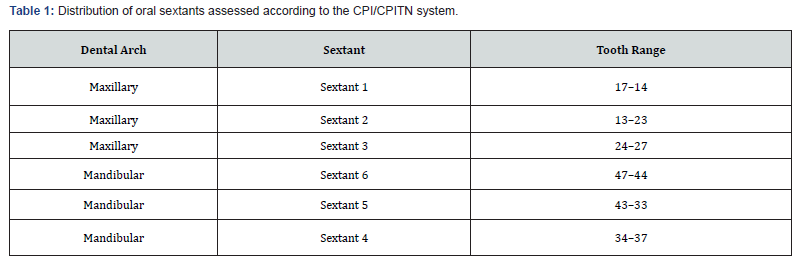
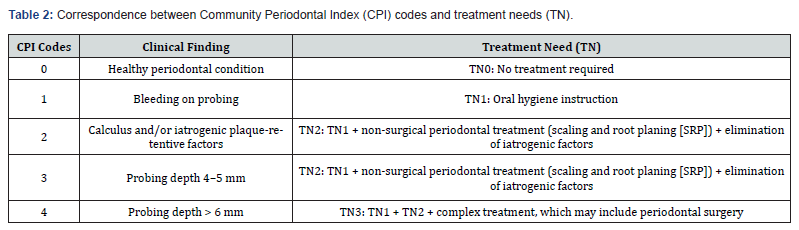
Clinical gingival and periodontal assessment was performed using the Community Periodontal Index of Treatment Needs (CPITN/CPI) (Table 1), with an intraoral mirror and a WHO millimetric periodontal probe. The oral cavity was divided into sextants, and the highest CPI code observed in each sextant was recorded. Six probing sites per tooth were assessed, and in epidemiological studies the index teeth established for this system were examined. Each of the conditions described above is identified by a numerical code (score), and a corresponding periodontal treatment need is assigned to each one. The CPI scores and their corresponding treatment needs (TN) are presented in (Table 2). Based on the clinical examination, the participants were classified in an orientative manner as having periodontal health, gingivitis, or periodontitis, according to the presence of gingival inflammation, bleeding on probing, and probing depth.
Study Variables
The main variables analyzed were maternal periodontal status
during pregnancy and perinatal outcomes, specifically preterm
birth (PTB) and low birth weight (LBW).
• PTB was defined as delivery before 37 weeks of gestation.
• LBW was defined as a neonatal birth weight below 2500g.
Statistical Analysis
Continuous variables were expressed as mean ± standard deviation (SD) when normally distributed, or as median and interquartile range (IQR) when non-normally distributed. Categorical variables were described using frequencies and percentages. Group comparisons were performed using the chisquare test, and when required due to sample size, Fisher’s exact test was used. The association between categorical variables was evaluated using Pearson’s chi-square test. Statistical analysis was performed using R Core Team 2020, and a p-value < 0.05 was considered statistically significant.
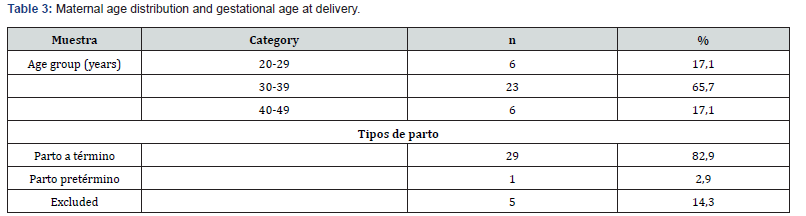
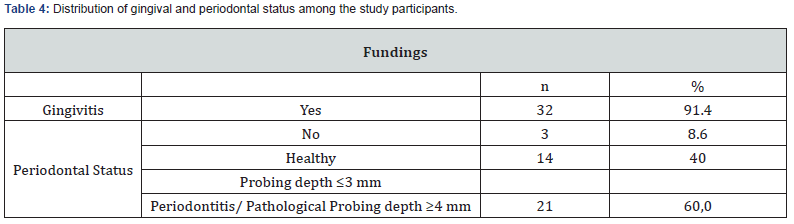
Of the 35 pregnant women initially included, all completed the periodontal examination, although only 30 provided complete information regarding gestational age at delivery and neonatal birth weight; therefore, the analysis of PTB and LBW was performed on this subsample. Most participants were between 30 and 39 years of age (65.7%), and the median gestational age at the time of examination was 32.21 weeks (Table 3). Gingivitis was observed in 91.4% of the pregnant women and periodontitis in 60%. Regarding perinatal outcomes, 82.9% of deliveries were full-term, and only one case of preterm birth was recorded. The median birth weight was 3.46 kg (Table 4).
Results
Combined Variable Analysis
This analysis included data from 30 participants, as complete information was unavailable for five women. No statistically significant association was found between gingivitis and gestational age at delivery (Fisher’s exact test, p = 0.966). Likewise, no significant association was observed between periodontal status and gestational age at delivery (p = 0.376). Regarding neonatal outcomes, a moderate positive correlation was identified between maternal gingivitis and low birth weight (LBW) (r = 0.32), while the association between pathological periodontal findings and LBW was small (r = 0.22). These results suggest that, in this sample, periodontal variables were not significantly associated with preterm delivery, although a possible relationship with low birth weight, particularly in relation to gingivitis, was observed.
Discussion
The present study analyzed the possible association between gingival and periodontal health status in pregnant women and the occurrence of preterm birth (PTB) and low birth weight (LBW). The main findings were the high frequency of gingivitis (91.4%) and periodontitis (60%) in the sample, the absence of a statistically significant association between gingivitis or periodontitis and PTB, and the presence of a positive correlation between gingivitis and LBW of moderate magnitude, as well as between periodontitis and LBW of smaller magnitude.
The high frequency of gingival and periodontal alterations observed in this sample is consistent with previous studies describing increased gingival inflammation and periodontal susceptibility during pregnancy as a consequence of hormonal, microbiological, and immunological changes7,14,16. However, these findings should be interpreted with caution, since the present study did not include a comparison group of non-pregnant women, which prevents attributing the high prevalence observed exclusively to pregnancy. In addition, the percentages found were higher than those reported by other authors for both gingivitis and periodontitis [16,17], which may be explained by methodological differences, sample size, or clinical assessment criteria. With regard to gestational timing, most participants were evaluated in the third trimester, with a median gestational age of 32.21 weeks. This aspect is relevant because several studies have reported greater clinical expression of gingivitis during the final stage of pregnancy, with improvement during the postpartum period [18- 23]. However, in the present study it was not possible to compare findings across trimesters or to assess postpartum evolution, and therefore a direct relationship between gestational trimester and the magnitude of periodontal disease cannot be confirmed.
Regarding perinatal outcomes, no significant association was found between gingivitis and PTB or between periodontitis and PTB, in agreement with some previous studies [24-26]. However, these results differ from other investigations that have reported an association between maternal periodontal disease and preterm birth. This discrepancy may be related to the very low frequency of PTB in the sample, as only one case was recorded, which substantially limited the statistical power of the study to detect associations between variables. As for LBW, a positive correlation was observed between maternal gingivitis and low birth weight, of moderate magnitude, as well as a weaker positive correlation between periodontitis and LBW. These findings partially agree with studies and reviews suggesting a relationship between maternal periodontal disease and adverse neonatal outcomes [27-33], although other authors have not identified significant associations [33-40]. In this regard, the present findings support the hypothesis of a possible relationship between maternal periodontal inflammation and neonatal birth weight, although the magnitude of this association appears limited and should be interpreted cautiously.
This study has several limitations. First, the small sample size and the low frequency of adverse obstetric events limit the statistical power and generalizability of the results. Second, potentially relevant confounding variables such as socioeconomic status, frequency of dental visits, previous periodontal history, and oral hygiene level were not collected. In addition, periodontal assessment was performed using the CPITN/CPI, a useful screening tool for epidemiological purposes, but insufficient to establish a complete periodontal diagnosis compared with more comprehensive methods such as full-mouth periodontal charting [41-43]. Overall, the findings of this study reinforce the high frequency of gingival and periodontal alterations during pregnancy and suggest a possible relationship with certain perinatal outcomes, particularly LBW. Nevertheless, further studies with larger samples, longitudinal designs, and more comprehensive periodontal assessments are needed to clarify more precisely the magnitude and clinical relevance of this association. In this sample of pregnant women, a high frequency of gingivitis and periodontitis was observed. No statistically significant association was found between periodontal disease and preterm birth, whereas a positive correlation was identified between maternal periodontal disease and low birth weight, particularly in the case of gingivitis. These findings should be interpreted with caution due to the methodological limitations of the study and highlight the need for future research with greater statistical power.
Ethics Statement
The study was approved by the Ethics Committee of the University of Murcia. All participants provided informed consent prior to inclusion in the study.
References
- Pasich E, Walczewska M, Pasich A, Marcinkiewicz J (2013) Mechanism and risk factors of oral biofilm formation. Postepy Hig Med Dosw 67: 736-41.
- Morón M (2021) Oral biofilms and their consequences in dental caries and periodontal disease. Ciencia e Innovation in Salud e134: 269-277.
- Jang H, Patoine A, Wu TT, Castillo DA, Xiao J (2021) Oral microflora and pregnancy: a systematic review and meta-analysis. Sci Rep 11(1): 16870.
- Kwon T, Lamster IB, Levin L (2021) Current concepts in the management of periodontitis. Int Dent J 71(6): 462–476.
- Sojod B, Périer JM, Zalcberg A, Bouzegza S, Halabi BE, et al., (2022) Enfermedad periodontal y salud general. EMC - Tratado de Medicina 26(1): 1-8.
- Bui FQ, Almeida-da-Silva CLC, Huynh B, Trinh A, Liu J, et al., (2019) Association between periodontal pathogens and systemic disease. Biomed J 42(1): 27–35.
- Amar S, Chung KM (1994) Influence of hormonal variation on the periodontium in women. Periodontol 2000 6(1): 79–87.
- López NJ, Da Silva I, Ipinza J, Gutiérrez J (2005) Periodontal therapy reduces the rate of preterm low birth weight in women with pregnancy‐associated gingivitis. J Periodontol 76(11S): 2144–53.
- O’Neil TC (1979) Maternal T-lymphocyte response and gingivitis in pregnancy. J Periodontol 50(4): 178-84.
- Raber-Durlacher JE, van Steenbergen TJ, Van der Velden U, de Graaff J, Abraham-Inpijn L (1994) Experimental gingivitis during pregnancy and post-partum: clinical, endocrinological, and microbiological aspects. J Clin Periodontol 21(8): 549–58.
- Fujiwara N, Tsuruda K, Iwamoto Y, Kato F, Odaki T, et al. (2017) Significant increase of oral bacteria in the early pregnancy period in Japanese women. J Investig Clin Dent 8(1): e12189.
- Shahi A, Khosravi S, Rezvan F, Salehi A, Mahmoudi MB (2023) Evaluation of the periodontal disease on oral microorganisms during pregnancy: A systematic review and meta-analysis. J Clin Transl Res 9(3):144–52.
- Huck O, Tenenbaum H, Davideau J-L (2011) Relationship between periodontal diseases and preterm birth: Recent epidemiological and biological data. J Pregnancy 2011:1–8.
- Wu M, Chen SW, Jiang SY (2015) Relationship between gingival inflammation and pregnancy. Mediators Inflamm 2015: 1–11.
- Ye C, Kapila Y (2021) Oral microbiome shifts during pregnancy and adverse pregnancy outcomes: Hormonal and Immunologic changes at play. Periodontol 2000 87(1): 276–81.
- Bazurto MJ, Luzardo Jurado G (2024) Prevalencia de enfermedad periodontal relacionada con parto pretérmino y bajo peso al nacer. Hospital Mariana de Jesú Rev Med UCSG 23(1): 36-41.
- Chen P, Hong F, Yu X (2022) Prevalence of periodontal disease in pregnancy: A systematic review and meta-analysis. J Dent. 125(104253):104253.
- Taani DQ, Habashneh R, Hammad MM, Batieha A (2003) The periodontal status of pregnant women and its relationship with socio‐demographic and clinical variables. J Oral Rehabil 30(4): 440-5.
- García A, Eltze L, Eltze M, Kiymet Karataban P, Natto Z, et al. (2013) Committee opinion no. 569: Oral health care during pregnancy and through the lifespan. Obstet Gynecol 122(2): 417-22.
- Tilakaratne A, Soory M, Ranasinghe AW, Corea SMX, Ekanayake SL, et al., (2000) Periodontal disease status during pregnancy and 3 months post‐partum, in a rural population of Sri‐Lankan women. J Clin Periodontol 27(10): 787-92.
- Figuero E, Carrillo-de-Albornoz A, Herrera D, Bascones-Martínez A (2010) Gingival changes during pregnancy: I. Influence of hormonal variations on clinical and immunological parameters. J Clin Periodontol 37(3): 220-9.
- Niederman R (2013) Pregnancy gingivitis and causal inference. Evid Based Dent 14(4): 107-108.
- Carrillo-de-Albornoz A, Figuero E, Herrera D, Cuesta P, Bascones-Martínez A (2012) Gingival changes during pregnancy: III. Impact of clinical, microbiological, immunological and socio‐demographic factors on gingival inflammation. J Clin Periodontol 39(3): 272-83.
- Kumar A, Basra M, Begum N, Rani V, Prasad S, Lamba AK, et al. (2013) Association of maternal periodontal health with adverse pregnancy outcome. J Obstet Gynaecol Res 39(1): 40-5.
- Abati S, Villa A, Cetin I, Dessole S, Lugliè PF, et al. (2013) Lack of association between maternal periodontal status and adverse pregnancy outcomes: a multicentric epidemiologic study. J Matern Fetal Neonatal Med 26(4): 369-72.
- Krüger MS da M, Casarin RP, Pinto G dos S, Pappen FG, Camargo MBJ, et al. (2019) Maternal periodontal disease and adverse perinatal outcomes: is there an association? A hospital-based case-control study. J Matern Fetal Neonatal Med 32(20): 3401-3407.
- Konopka T, Paradowska-Stolarz A (2012) Periodontitis and risk of preterm birth and low birthweight-a meta-analysis. Ginekol Pol 83(6): 446–53.
- Fogacci MF, Cardoso E de OC, Barbirato D da S, de Carvalho DP, Sansone C (2018) No association between periodontitis and preterm low birth weight: a case–control study. Arch Gynecol Obstet 297(1): 71–76.
- Muwazi L, Rwenyonyi CM, Nkamba M, Kutesa A, Kagawa M, et al. (2014) Periodontal conditions, low birth weight and preterm birth among postpartum mothers in two tertiary health facilities in Uganda. BMC Oral Health 14 (1): 14-42.
- Santa Cruz I, Herrera D, Martin C, Herrero A, Sanz M (2013) Association between periodontal status and pre‐term and/or low‐birth weight in Spain: clinical and microbiological parameters. J Periodontal Res 48(4): 443–51.
- Castro Arreaga H de A, Luzardo Jurado G (2024) Prevalencia de enfermedad periodontal relacionada con parto pretérmino y bajo peso al nacer. hospital de la mujer Alfredo G. Paulson 2017. Rev Med UCSG 23(2): 82-7.
- Goldenberg RL, Culhane JF, Iams JD, Romero R (2008) Epidemiology and causes of preterm birth. Lancet 371(9606): 75–84.
- Puertas A, Magan-Fernandez A, Blanc V, Revelles L, O’Valle F, et al. (2018) Association of periodontitis with preterm birth and low birth weight: a comprehensive review. J Matern Fetal Neonatal Med 31(5): 597–602.
- Manrique-Corredor EJ, Orozco-Beltran D, Lopez-Pineda A, Quesada JA, Gil-Guillen VF, (2019) Maternal periodontitis and preterm birth: Systematic review and meta‐ Community Dent Oral Epidemiol 47(3): 243–51.
- Pockpa ZAD, Soueidan A, Koffi-Coulibaly NT, Mobio GS, Pere M, et al. (2022) Association between periodontitis and preterm birth in a cohort of pregnant women in Ivory Coast. Oral Health Prev Dent 20(1): 363–368.
- Saadaoui M, Singh P, Al Khodor S (2021) Oral microbiome and pregnancy: A bidirectional relationship. J Reprod Immunol. 145(103293): 103293.
- Khader YS, Ta’ani Q. (2005) Periodontal diseases and the risk of preterm birth and low birth weight: A meta‐ J Periodontol 76(2): 161–5.
- Porto ECL, Gomes Filho IS, Batista JET, Lyrio AO, Souza ES, et al. (2021) Periodontite materna e baixo peso ao nascer: revisão sistemática e metaná Cien Saude Colet 26(suppl 3): 5383–92.
- Chambrone L, Guglielmetti MR, Pannuti CM, Chambrone LA (2011) Evidence grade associating periodontitis to preterm birth and/or low birth weight: I. A systematic review of prospective cohort studies: Periodontitis and adverse pregnancy outcomes. J Clin Periodontol 38(9): 795–808.
- Ide M, Papapanou PN (2013) Epidemiology of association between maternal periodontal disease and adverse pregnancy outcomes – systematic review. J Periodontol 84(4S): 181-94.
- Kiran S, Karnam Y, Ramya Y, Niharika B, Rani P (2022) Association between periodontitis and preterm low birth weight in human immunodeficiency virus seropositive pregnant women in India: A cohort study. J Family Med Prim Care 11(12): 7830-7835.
- López NJ, Da Silva I, Ipinza J, Gutiérrez J (2005) Periodontal therapy reduces the rate of preterm low birth weight in women with pregnancy‐associated gingivitis. J Periodontol 76(11S): 2144-53.
- Noack B, Klingenberg J, Weigelt J, Hoffmann T (2005) Periodontal status and preterm low birth weight: a case control study. J Periodontal Res 40(4):339-345.

























