



 JFSCI Home




Abstract
Clinical toxicology testing can support the diagnosis and management of suspected poisoning, identify exposure to drugs and other toxicants, and inform treatment monitoring. However, results are often misinterpreted when the specimen, timing of collection, analytical method, detection limits, metabolism, and clinical context are not considered together. This narrative review summarizes common sources of uncertainty across the pre-analytical, analytical, and post-analytical phases of testing. Urine is useful for detecting prior exposure, whereas blood and oral fluid may be more informative for selected questions concerning recent exposure; no specimen is optimal for every clinical purpose. Immunoassay results are presumptive and may be affected by cross-reactivity or limited assay coverage. Chromatography coupled with mass spectrometry can provide more specific identification, but only for analytes included in a validated method and above its reporting limits. Neither positive result nor a negative result, considered alone, establishes or excludes intoxication. Interpretation also requires attention to drug metabolism, specimen validity, therapeutic use, pharmacokinetic variability, and the changing range of new psychoactive substances. Laboratories should communicate method-specific limitations, report screening and definitive findings distinctly, and collaborate with clinicians to select testing that can inform patient care. Because this is a narrative review, recommendations should be read in conjunction with local laboratory procedures and applicable clinical guidance.
Keywords: Clinical toxicology; Drug testing; immunoassay; Mass spectrometry; Specimen validity; Detection window; New psychoactive substances
Abbreviations: GC-MS: Gas Chromatography-Mass Spectrometry; LC-MS/MS: Liquid Chromatography-Tandem Mass Spectrometry; NPS: New Psychoactive Substances; 6-MAM: 6-Monoacetylmorphine
Introduction
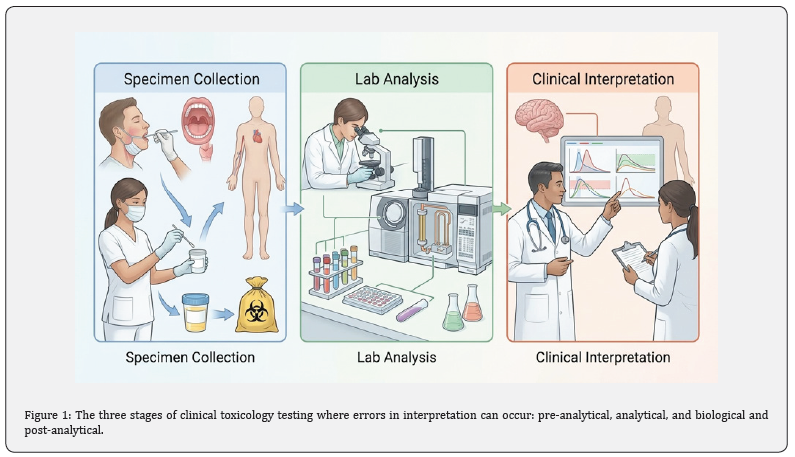
Clinical toxicology laboratory testing is used in emergency and acute care, addiction medicine, psychiatry, pain management, rehabilitation, and other settings. Its value depends not only on analytical performance but also on whether the test addresses the clinical question. A result may help identify an exposure, but it does not automatically establish dose, timing, impairment, causality, or a substance use disorder. Conversely, a negative result may reflect the assay’s scope, the reporting threshold, the specimen selected, or the interval between exposure and collection rather than the absence of exposure [1-3]. This narrative review discusses key pre-analytical, analytical, pharmacological, and post-analytical considerations. The central principle is that toxicology results should be interpreted alongside the history, examination, clinical course, and known limitations of the method (Figure 1).
Pre-Analytical Considerations
Specimen Selection
Specimen selection should follow the question being asked. Urine is commonly used because collection is relatively straightforward and many drugs or metabolites remain detectable longer than in blood. Urine results generally indicate exposure within a variable preceding interval; they do not, by themselves, establish current impairment or toxicity. Blood may be more useful when the clinical question concerns circulating concentrations, although concentration-effect relationships vary substantially by substance, tolerance, sampling time, and clinical circumstances.
Oral fluid can support assessment of relatively recent exposure for analytes covered by the method, but results may be influenced by oral contamination, collection-device characteristics, salivary flow, and analyte-specific partitioning. Hair can provide information about exposure over longer periods, but it is not appropriate for most acute treatment decisions and requires consideration of external contamination, cosmetic treatment, incorporation variability, and segmental-analysis limitations. The specimen and analytical approach should therefore be selected with the laboratory, where necessary, after defining whether the purpose is acute poisoning assessment, adherence monitoring, investigation of an unexpected result, or retrospective exposure assessment.
Timing of Collection
The interval between exposure and collection affects which parent compounds and metabolites are detectable. Very early collection may precede appreciable excretion into urine; later collection may yield a metabolite without measurable parent drug. Delayed presentation can also reduce blood concentrations despite a clinically important earlier exposure. Record the reported time of exposure, presentation, and specimen collection whenever available. Detection windows should be treated as approximate, substance- and method-specific ranges rather than fixed biological constants.
Specimen Integrity and Validity
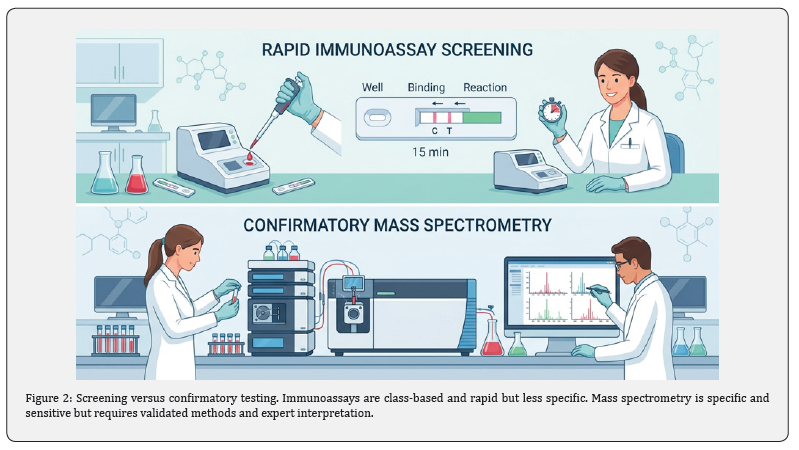
Urine may be dilute, substituted, or adulterated. Depending on the setting and applicable procedures, specimen-validity assessment may include creatinine, specific gravity, pH, temperature at collection, and testing for oxidizing or other adulterating agents. No single validity measure detects every form of manipulation, and an abnormal finding should be interpreted according to the relevant laboratory criteria rather than treated as proof of deliberate tampering. Collection procedures must be proportionate, documented, and consistent with consent, privacy, and local legal requirements (Figure 2).
Analytical Considerations
Screening and Definitive Testing
Immunoassays are widely used because they are rapid and relatively inexpensive. Most detect a drug class through antibody recognition and may not respond equally to every compound within that class. Cross-reactivity can produce presumptive positives, while poor recognition of a particular drug or metabolite can produce false-negative results. Results should be reported as presumptive or unconfirmed positives when appropriate, with assay-specific cut-offs and limitations available to clinicians [1-3].
Gas chromatography-mass spectrometry (GC-MS) and liquid chromatography-tandem mass spectrometry (LC-MS/MS) can provide more specific identification of targeted analytes. Their performance nevertheless depends on the analytes included, sample preparation, chromatographic separation, reference standards, calibration, quality control, and validated identification criteria. A mass-spectrometric method is not comprehensive merely because it uses advanced instrumentation: compounds outside its scope may not be detected. Definitive testing is most useful when the result is likely to affect management, when a presumptive result conflicts with the clinical picture, or when a relevant substance is not covered by the screening assay [4,5].
Cross-Reactivity and Interferences
Cross-reactivity varies by assay manufacturer, antibody design, concentration, and the potentially interfering compound. Certain prescription and non-prescription medicines have been reported to interfere with specific immunoassays; examples should not be generalized across all platforms. Laboratories should consult the package insert and assay-specific interference data. Unexpected results with important clinical or legal consequences should be discussed with the laboratory and, where indicated, assessed using a method based on a different analytical principle.
Panel Coverage and Reporting Thresholds
A negative result means that the target analyte was not detected at or above the method’s reporting threshold under the conditions used; it does not prove that no exposure occurred. Routine panels may not include fentanyl and its analogues, nitazenes, synthetic cannabinoids, novel benzodiazepines, cathinones, or other new psychoactive substances (NPS). Detection of gabapentinoids and other prescription medicines also depends on the assay or definitive panel. Laboratories should review test menus considering local drug trends and clinical needs, while communicating that expanded testing is still limited to the analytes and identification capabilities of the method [4,5]. Cut-offs may be selected for different purposes, including clinical decision-making, workplace testing, or forensic interpretation; values developed for one purpose should not automatically be applied to another. A concentration below a cut-off may still be clinically relevant in some circumstances. Reports should identify the method and relevant threshold, and clinicians should contact the laboratory when the clinical question requires a different sensitivity or analyte scope.
Matrix Effects and Method Validation
In mass-spectrometric assays, co-eluting matrix components can suppress or enhance ionization and affect qualitative or quantitative performance. Hemolysis, lipemia, contamination, sample preparation, and the composition of the biological matrix may influence results, depending on the method. Appropriate internal standards, matrix assessment, extraction procedures, chromatographic separation, calibration, quality controls, and validation are essential. Method validation should demonstrate fitness for the intended use, including relevant selectivity, sensitivity, accuracy, precision, carry-over, and stability characteristics [6].
Pharmacological and Biological Considerations
Metabolism and Metabolite Interpretation
Many substances are extensively metabolized, and the parent compound may be absent when metabolites remain detectable. Detection of 6-monoacetylmorphine (6-MAM), a heroin-specific metabolite, can support identification of heroin exposure within a relatively short interval; morphine alone cannot reliably distinguish heroin from all other possible sources. Other parent compounds and metabolites may be shared across drugs or formed through prescribed medicines and metabolic pathways. Parent-to-metabolite patterns can contribute to interpretation, but estimates of timing, dose, or route are uncertain unless supported by substance-specific evidence and appropriate contextual information.
Detection Windows and Individual Variability
Detection windows vary with the substance, dose, frequency and duration of use, route of administration, specimen, assay sensitivity, cut-off, renal and hepatic function, urine dilution, and time of collection. Repeated cannabis use, for example, may be associated with prolonged urinary detection of cannabinoid metabolites, whereas other compounds have different excretion profiles. Simple charts of fixed detection windows can be misleading unless the assumptions, analytes, methods, and evidence base are stated. Any table of detection windows included in this review should be supported by specific references and clearly labelled as approximate. Age, pregnancy, organ function, drug interactions, and genetic variation in drug-metabolizing enzymes can alter parent-drug and metabolite concentrations. However, an unexpected metabolite pattern should not be attributed to pharmacogenetics without considering alternative explanations, including sampling time, adherence, assay coverage, analytical uncertainty, and specimen integrity.
Therapeutic use and Non-Prescribed Exposure
A positive finding may reflect prescribed treatment, medication administered during healthcare, non-prescribed use, or another source. Interpretation should incorporate a complete medication history, including over-the-counter products and relevant treatment for substance use disorders. Toxicology testing alone should not be used to diagnose a substance use disorder, infer intent, or conclude non-adherence without considering alternative explanations and discussing unexpected findings with the patient and laboratory as appropriate.
Post-Analytical Interpretation and Communication
Detection is not Equivalent to Toxicity
The presence of a substance does not, by itself, establish intoxication, impairment, or causation of symptoms. Clinical effects depend on concentration, timing, tolerance, active metabolites, co-exposures, underlying disease, and individual susceptibility. Blood concentrations may contribute to assessment for selected substances, but concentration-effect relationships are not uniform, and a laboratory value should not replace clinical evaluation. Qualitative urine results are particularly unsuitable for determining current impairment.
Interpreting Negative Results
A negative result does not exclude exposure when the substance is outside the panel, the concentration is below the reporting threshold, collection is too early or too late, the specimen is dilute or compromised, or the method has insufficient sensitivity for the relevant analyte. If suspicion remains, clinicians should discuss the timing and specimen type with the laboratory and consider targeted testing or an alternative matrix where it is likely to answer the clinical question.
Reporting Language and Clinical Correlation
Reports should distinguish screening results from definitive identification and use clear terms such as “presumptive positive,” “detected,” and “not detected,” defined according to local reporting policy. Reports should identify the specimen, method, analytes or classes tested, relevant cut-offs or reporting limits, and material limitations. Interpretative comments are particularly valuable for unexpected or complex findings. Results should be integrated with symptoms, vital signs, electrocardiographic findings where relevant, mental status, treatment history, and the clinical course. Direct communication between clinicians and laboratory toxicologists can prevent inappropriate conclusions and improve the utility of testing [5].
New Psychoactive Substances and Changing Drug Markets
The emergence of synthetic opioids, including nitazenes and fentanyl analogues, synthetic cannabinoids, cathinones, and designer benzodiazepines creates ongoing challenges. Routine immunoassays may not detect these substances, and even targeted mass-spectrometric panels can become outdated as new compounds emerge. Reference materials, validated transitions or spectral libraries, and reliable information about local trends may be limited. Laboratories should establish a process for reviewing local surveillance data, evaluating requests for expanded testing, and communicating with clinical toxicologists and relevant public-health services. High-resolution mass spectrometry may support broader screening and retrospective investigation, but findings still require validated identification criteria and expert review [7-18].
Practical Recommendations
• Define the clinical question before selecting a specimen and test panel.
• Document the timing of suspected exposure and specimen collection whenever possible.
• Use specimen-validity procedures appropriate to the specimen and setting and interpret abnormalities cautiously.
• Report immunoassay findings as presumptive when applicable; consider definitive testing when the result could change care or resolve a clinically important discrepancy.
• State the analytes covered, method, reporting threshold, and material limitations in laboratory reports.
• Do not interpret a positive result as proof of intoxication, misuse, or a substance use disorder, or a negative result as proof of no exposure.
• Review panels periodically against local drug trends and the clinical needs of the service.
• Promote direct communication among clinicians, laboratory professionals, and medical or forensic toxicologists.
Conclusion
Reliable clinical toxicology interpretation requires specimen selection and timing, method scope and performance, metabolism, reporting thresholds, individual variability, and clinical presentation all influence what a result can establish. Specimen adulteration and validity, immunoassay cross-reactivity, limited panel coverage, reporting thresholds and detection limit, drug metabolism complexity, individual pharmacokinetic variability, misinterpretation of positive and negative results, rapid emergence of new psychoactive substances. Clear reporting and timely communication with the laboratory are essential, particularly when results are unexpected or when emerging substances are suspected. Testing should support, rather than replace, clinical assessment and should be ordered and interpreted according to its intended purpose.
References
- Moeller KE, Lee KC, Kissack JC (2008) Urine drug screening: practical guide for clinicians. Mayo Clin Proc 83(1):66-76.
- Moeller KE, Kissack JC, Atayee RS, Lee KC (2017) Clinical interpretation of urine drug tests: what clinicians need to know about urine drug screens. Mayo Clin Proc 92(5): 774-796.
- Saitman A, Park HD, Fitzgerald RL (2014) False-positive interferences of common urine drug screen immunoassays: a review. J Anal Toxicol 38(7): 387-396.
- Altawallbeh G (2025) Practical considerations for implementing immunoassays for urine drug testing in clinical laboratories. Clin Lab Med 45(2):153-164.
- Yang YK, Snozek CLH (2025) Value of improving result interpretation in direct-to-definitive urine drug panels. Clin Lab Med 45(2): 233-246.
- Wille SMR, Coucke W, De Baere T, Peters FT (2018) Update of standard practices for new method validation in forensic toxicology. Curr Pharm Des 24(22): 5442-5454.
- American Academy of Forensic Sciences Standards Board. ANSI/ASB Standard 036: Standard Practices for Method Validation in Forensic Toxicology. First edition. 2019.
- Substance Abuse and Mental Health Services Administration. Clinical Drug Testing in Primary Care. Rockville, MD: SAMHSA; 2012.
- Flanagan RJ, Cuypers E, Maurer HH, Whelpton R (2020) Fundamentals of Analytical Toxicology: Clinical and Forensic. Wiley.
- Moffat AC, Osselton MD, Widdop B, Watts J (2011) Clarke's Analysis of Drugs and Poisons. 4th ed. Pharmaceutical Press.
- Levine B, Fernandez-Salas A (1957) Principles of Forensic Toxicology. AACC Press.
- Klaassen CD (2019) Casarett and Doull's Toxicology: The Basic Science of Poisons. 9th ed. McGraw-Hill Education.
- Nelson LS, Howland MA, Lewin NA, Smith SW, Goldfrank LR, et al. (2011) Goldfrank's Toxicologic Emergencies. McGraw-Hill.
- Baselt RC () Disposition of Toxic Drugs and Chemicals in Man. Biomedical Publications.
- Pitfalls of toxicological analysis (Modern drug testing in clinical laboratories: a narrative review of practical approaches and emerging technologies. Journal of Laboratory and Precision Medicine.2003) Johnson-Davis KL (2025).
- Clinical and Laboratory Standards Institute (CLSI) Toxicology and Drug Testing in the Medical Laboratory. CLSI guideline C52, 3rd edition. This covers pre-examination, examination and post-examination considerations, including specimen collection, analytical methods, reporting and interpretation. CLSI C52 guideline.
- Christine LH Snozek, Matthew D Krasowski, Jennifer M Colby, Kamisha L Johnson-Davis, Rebecca E Bruccoleri, et al. (2026) Association for Diagnostics & Laboratory Medicine (ADLM) Guidance Document on Laboratory Testing for Drugs of Misuse to Support the Emergency Department. J Appl Lab Med 11(1): 155-180.
- Abu Dhabi Department of Health () Standard for Clinical Toxicology Testing in Clinical Laboratories. Useful for laboratory requirements, specimen collection and testing standards in the UAE. Read the clinical toxicology testing standard.