



 JFSCI Home


Abstract
Background: Continuous monitoring of substance use patterns is essential for developing effective prevention, treatment, and rehabilitation strategies. The National Rehabilitation Center (NRC) in Abu Dhabi, which will celebrate its 25th anniversary in 2027, is the primary institution for addiction treatment, rehabilitation, and substance use surveillance in the United Arab Emirates.
Objective: To evaluate changes in drug positivity trends among substances detected at the NRC over a two-year period (2024-2025) and to identify emerging substances of concern. The overarching aim was to anticipate current risks and threats and mitigate their consequences.
Methods: A retrospective descriptive analysis was conducted using NRC toxicology surveillance data. Drug-positive findings reported during the study period were categorized into major substance classes and compared using frequency counts and percentage changes. Screening was performed primarily using drug-of-abuse (DOA) immunoassays, with confirmation and quantitative analysis by gas chromatography-mass spectrometry (GC-MS) and liquid chromatography-tandem mass spectrometry (LC-MS/MS). These methods provide highly sensitive and specific results.
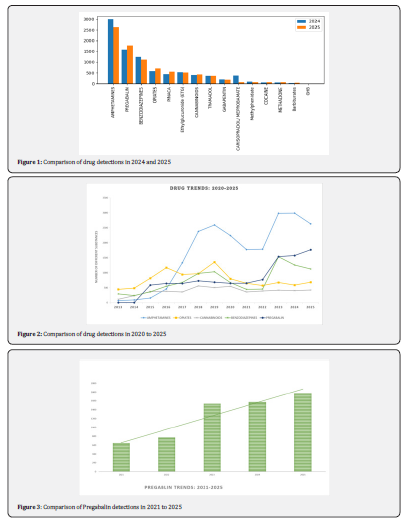
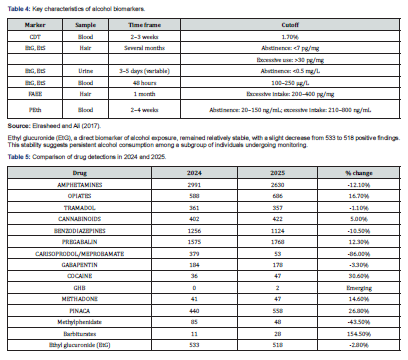
Results: A total of 8,882 positive findings were recorded in 2024, compared with 8,466 in 2025, representing a 4.7% decrease. Amphetamine-type stimulants remained the dominant drug class despite a decline from 2,991 to 2,630 findings. Pregabalin increased substantially from 1,575 to 1,768 findings (+12.3%), becoming the second most frequently detected substance. Synthetic cannabinoids (PINACA compounds) increased by 26.8% (from 440 to 558 findings), while opiates increased by 16.7% (from 588 to 686). Benzodiazepines decreased by 10.5% (from 1,256 to 1,124). Carisoprodol/meprobamate showed the largest decline, decreasing by 86.0% (from 379 to 53 findings).
Conclusion: The findings demonstrate the continued predominance of stimulant use in Abu Dhabi, UAE, while highlighting increasing misuse of pregabalin and synthetic cannabinoids. These trends emphasize the need for ongoing surveillance, advanced toxicological testing, targeted prevention programs, and adaptive treatment strategies, and provide valuable insight into the evolving drug landscape.
Keywords: Drug trends; NRC Abu Dhabi; Toxicology; Substance use disorder; Synthetic cannabinoids; Pregabalin
Abbreviations: AUDs: Alcohol Use Disorders; EtG: Ethyl Glucuronide; EtS: Ethyl Sulfate; OAT: Opioid Agonist Therapy; DOA: Drug-of-Abuse; GC-MS: Gas Chromatography-Mass Spectrometry; NRC: National Rehabilitation Center; SUDs: Substance Use Disorders; UNODC: United Nations Office on Drugs and Crime; UAE: United Arab Emirates
Introduction
According to the World Drug Report, substance use disorders (SUDs) remain a major public health challenge worldwide. Published annually by the United Nations Office on Drugs and Crime (UNODC), the report provides the latest web-based analysis of global, regional, and subregional estimates and trends in drug demand and supply. The report states that, in 2024, an estimated 331 million people used drugs, 34% more than a decade earlier. However, as healthcare needs continue to grow, access to treatment remains unequal. In many parts of the world, services are scarce or unavailable, leaving millions of people, especially women and members of vulnerable groups, without access to recovery and support, often because of stigma and discrimination.
Nearly half a million people died because of drug use in 2023, 29% more than a decade earlier. The Middle East and South-West Asia are currently experiencing conflicts and post-conflict instability that affect drug markets both within the region and worldwide. Rapidly evolving drug markets and the emergence of new substances also make detection and control extremely challenging. The National Rehabilitation Center (NRC) in Abu Dhabi, United Arab Emirates (UAE), was established to provide treatment, prevention, research, and surveillance services related to substance misuse. The NRC is the country’s principal specialist center for addiction treatment and monitoring and plays a critical role in identifying emerging drug threats [1-3].
The NRC has had access to surveillance data since its establishment in 2002. Each year, it publishes findings with an emphasis on emerging trends and their public health implications. Recent NRC studies have documented a shift from traditional substances, such as heroin and prescription sedatives, toward amphetamine-type stimulants, synthetic cannabinoids, and prescription medications with misuse potential. This study analyzes NRC toxicology surveillance data collected from January 2024 to December 2025 to characterize recent changes in substance use patterns and identify emerging concerns for healthcare providers and policymakers. The findings are also considered in relation to trends described in the World Drug Report 2026.
Materials and Methods
A retrospective analysis was conducted using NRC toxicology surveillance data for 2024 and 2025. Urine samples were initially screened using validated immunoassays, with confirmatory analysis performed by GC-MS or LC-MS/MS. The total number of drug-of-abuse screening tests processed increased substantially over the study period, from 219,254 in 2024 to 303,828 in 2025. LC-MS/MS was the predominant confirmatory method, with 86,968 tests conducted in 2024 and 93,467 in 2025. Descriptive statistics were used to examine frequency distributions and year-to-year percentage changes (Table 1).

Results
Amphetamine-Type Stimulants Remain Predominant
Amphetamine-type stimulants continued to account for the largest number of positive findings. Despite a decrease from 2,991 findings in 2024 to 2,630 in 2025, stimulants remained the predominant drug class. Previous NRC investigations have similarly identified amphetamine and methamphetamine as the leading substances detected among individuals receiving addiction treatment services in Abu Dhabi.
This finding is consistent with the World Drug Report, which states that:
“Amphetamine-type stimulant markets also continue to expand, spreading into new regions and reaching new consumer groups. While North America and East and South-East Asia remain the largest methamphetamine markets, developments elsewhere illustrate the adaptability of synthetic drug markets. For example, in the Middle East, disruptions to trafficking in ‘Captagon’ were followed by an expansion of methamphetamine trafficking, demonstrating how criminal groups rapidly adjust to changing circumstances (Table 2).

Increasing Misuse of Pregabalin
Pregabalin detections increased from 1,575 to 1,768, making it the second most frequently detected substance category. The continued increase in pregabalin positivity may reflect non-medical use, polydrug use, greater availability on illicit markets, or its use to potentiate opioid effects. This trend is consistent with growing international concern regarding pregabalin misuse and dependence. In 2019, we published a paper raising concerns about gabapentinoids, particularly gabapentin and pregabalin. These medications were initially introduced as antiepileptic agents and were subsequently approved or used for a broader range of indications, not without controversy. Experts remain divided regarding their safety because of concerns about misuse, diversion, and dependence. Evidence of pregabalin misuse has been reported with particular concern in Middle Eastern settings, including among patients seeking treatment at the National Rehabilitation Center in Abu Dhabi, UAE [5-7].
We concluded that “The dilemma faced by clinicians regarding Gabapentoids is all too familiar, new products are approved for an indication, they are found to be useful for other disorders, off label prescriptions are promoted, they get included in guidelines before concerns are raised and then they are back to the initial licensed indications only. The UK government’s decision to reclassify both drugs as Class C controlled substances from April 2019 under the 1971 Misuse of Drugs Act mentioned above lends a hand to the camp that supported caution and raised concerns about the Gabapentoids abuse potential. There is no doubt that these medicines are very useful and safe when indicated and when judiciously used. Clinicians need to be aware of the abuse potential especially in patients with a history of disorders of substance use. It is prudent to monitor patients started on these medicines closely and intervene promptly if signs of abuse are flagged”.
Benzodiazepines
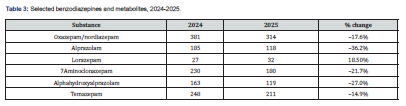
Total benzodiazepine detections decreased from 1,256 to 1,124 (Table 3), largely because of declines in alprazolam (185 to 118), clonazepam (3 to 1), and 7-aminoclonazepam (230 to 180). However, lorazepam detections increased from 27 to 32 (Table 3).
Emergence of Synthetic Cannabinoids
Synthetic cannabinoids were among the fastest-growing substance categories, increasing from 440 findings in 2024 to 558 in 2025. Earlier NRC reports identified synthetic cannabinoids as an emerging threat in the UAE, particularly compounds belonging to the PINACA family. The increasing prevalence of these substances presents major challenges because of:
• rapid structural modifications
• difficulties in routine detection
• severe neuropsychiatric effects
• an increased risk of overdose
Opiates and Traditional Drugs
Opiate positivity increased by 16.7%, from 588 to 686 detections. This finding contrasts with current reports indicating that opium cultivation in Afghanistan has remained at historically low levels. Tramadol, the most frequently detected opioid, remained relatively stable, with a marginal decrease of 1.1%. Over the years, we have clinically observed a shift in the opioids used, from plant-based to synthetic opioids. Heroin predominated during the first wave in the early 2000s and was sometimes combined with prescription medicines, including barbiturates and benzodiazepines. Tramadol subsequently replaced heroin as the principal opioid detected. The NRC pioneered the regional introduction of opioid agonist therapy (OAT) using buprenorphine and adapted prescribing practices in response to developments in available formulations (including Subutex and Suboxone in both sublingual and long-acting formulations), in accordance with international guidelines [8,9].
Alcohol Biomarker Findings
The diagnostic assessment of alcohol use disorders (AUDs) includes a thorough clinical history and examination, screening instruments, and biomarkers. Biomarkers may be categorized as direct or indirect physiological measures. Two direct biomarkers, ethyl glucuronide (EtG) and ethyl sulfate (EtS), are particularly valuable in helping clinicians retrospectively assess alcohol consumption over several days (Table 4,5 Figures 1-4).
Carisoprodol/Meprobamate (-86.0%)
The marked decline in carisoprodol/meprobamate detections may indicate effective regulatory controls or reduced availability.
Discussion
The 2024-2025 drug trend data from the National Rehabilitation Center reveal three principal findings. First, pregabalin became the second most frequently detected substance category among patients at the NRC. This finding reflects global concern about gabapentinoid misuse and suggests that prescription medication monitoring may need to be strengthened in the UAE. Second, although amphetamine use remained high, the modest decline between 2024 and 2025 may reflect successful law-enforcement measures or shifting preferences toward synthetic cannabinoids (PINACA compounds), detections of which increased by nearly 27%. Synthetic cannabinoids are associated with severe toxicity and unpredictable effects and therefore pose new clinical challenges.
Third, the increase in traditional opiates, including codeine and morphine, after years of decline was unexpected. It is nevertheless consistent with some post-pandemic patterns reported in Europe and North America, where heroin scarcity was associated with greater use of pharmaceutical opioids. The sharp decrease in buprenorphine detections (from 4,937 to 3,595) may indicate reduced treatment access or changes in prescribing practices and warrants further investigation. The near disappearance of carisoprodol/meprobamate (from 379 to 53 findings) may suggest effective regulatory action or substitution with other muscle relaxants. Conversely, the increase in barbiturate detections in 2024-2025 is concerning because these drugs have a narrow therapeutic index and high misuse potential [10-12].
Limitations
These data represent only individuals admitted to a single rehabilitation center and may not reflect prevalence in the general population. Changes in testing protocols or admission criteria may have affected year-to-year comparisons. In addition, the 2025 data is preliminary and may be subject to minor revision. The findings reveal a dynamic and evolving drug landscape in Abu Dhabi.
Several important observations emerge:
1. Stimulants remain the principal substances of misuse, confirming long-term trends observed at the NRC.
2. Pregabalin misuse continues to increase, requiring enhanced monitoring and prescribing oversight.
3. Synthetic cannabinoids are becoming a major public health concern, reflecting patterns observed internationally.
4. Misuse of traditional sedatives and prescription drugs appears to be declining, particularly for carisoprodol and benzodiazepines.
5. Opiate positivity has increased, warranting continued vigilance despite earlier declines.
These findings support the need for advanced analytical platforms, such as LC-MS/MS and high-resolution mass spectrometry (HRMS), to detect emerging psychoactive substances and monitor changing drug markets. Recent NRC studies have highlighted the importance of these technologies for identifying synthetic cannabinoids and novel psychoactive substances.
Conclusion
Analysis of NRC toxicology data from 2024-2025 demonstrates that amphetamine-type stimulants remain the predominant drugs of misuse in Abu Dhabi. However, substantial increases in pregabalin, synthetic cannabinoids, and opiates indicate a changing pattern of substance use.
The emergence of novel psychoactive substances and the continued increase in prescription drug misuse underscore the importance of:
• enhanced surveillance systems
• advanced toxicological testing
• evidence-based prevention programs
• targeted rehabilitation interventions
• continuous public health monitoring
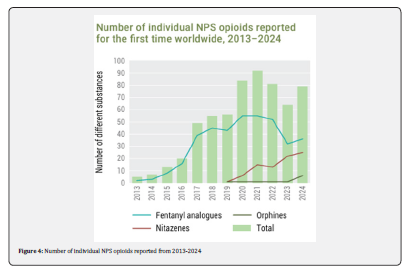
Ongoing trend analysis will be essential to inform addiction treatment strategies and public health policy in the UAE. Finally, continued vigilance requires the inclusion in monitoring systems of novel psychoactive substances reported in other parts of the world. These include highly potent and potentially lethal synthetic opioids, such as nitazenes and cychlorphine; vaping products containing synthetic cannabinoids; and semisynthetic cannabinoids, alongside substances included in standard toxicology panels.
References
- Ali AY, Alghaferi H, Elrasheed A (2019) The gabapentinoids conundrum: “Mind the Gabs”. Journal of Educational and Psychological Research 1(1): 1-4.
- Gawad TAA () A 6-year review of drug trends in the United Arab Emirates from the perspective of the National Rehabilitation Center (NRC), Abu Dhabi.
- Elrasheed A, Yousif Ali A, Al Mamari S, Venayikot M, Pichini S (2024) Emerging trends in new psychoactive substance use: A case study from the National Rehabilitation Center, Abu Dhabi, United Arab Emirates. Biochimica Clinica 49(1): 47-52.
- Elrasheed A, Al Mamari S, Elliott S, Alharthy B, Venayikot M, et al. (2022) Captagon abuse: Analysis of its constituents in drug rehabilitation in the UAE. Journal of Drug Abuse 8: 125.
- Elrasheed A, Al Ghaferi H, Yousif Ali A (2017) Assessment of alcohol exposure: Testing for ethyl glucuronide (EtG) and ethyl sulfate (EtS). International Journal of Emergency Mental Health and Human Resilience 19.
- Bertol E, Vaiano F, Borsotti M, Quercioli M, Mari F (2013) Comparison of immunoassay screening tests and LC–MS/MS for urine detection of benzodiazepines and their metabolites: Results of a national proficiency test. Journal of Analytical Toxicology 37(9): 659-664.
- McNeilage AG, Sim A, Nielsen S, Murnion B, Ashton-James CE (2024) Experiences of misuse and symptoms of dependence among people who use gabapentinoids: A qualitative systematic review. International Journal of Drug Policy 133: 104605.
- United Nations Office on Drugs and Crime (UNODC). (2023,2024 2026). World Drug Report. Vienna: UNODC.
- Elrasheed A, Taoufik Z, Rekha A, Hanan A, Amanda J Lee, et al. () A profile of patients with substance use disorders and treatment outcomes: A 10-year retrospective study from the National Rehabilitation Center. International Journal of Prevention and Treatment of Substance Use Disorders.
- Al Ghaferi, HA, Yousif Ali A, Gawad, TA, Wanigaratne S (2017) Developing substance misuse services in the United Arab Emirates: The National Rehabilitation Centre experience. BJPsych International 14(4): 91-94.
- Alblooshi H, Hulse GK, El Kashef A, et al. (2016) The pattern of substance use disorder in the United Arab Emirates in 2015: Results of a National Rehabilitation Centre cohort study. Substance Abuse Treatment, Prevention, and Policy 11(1): 19.
- Alhajri A, Almarri TS (2021) Synthetic drug markets and public health implications in the Gulf Cooperation Council countries. International Journal of Drug Policy 95: 103266.

























