



 JFSCI Home



Abstract
This case study of the former chief executive officer (CEO) at Norwegian Industries provides anecdotal evidence of deviant identity in terms of narcissistic organizational identification with the workplace. Narcissistic identification is a special type of narcissism, where the offender sees little or no difference between self and the workplace. The anecdotal evidence consists of his statements in criminal court blaming critics, ignoring ethical guidelines, refusing tax violation, claiming entitlement to benefits, suggesting mistakes and misunderstandings, and perceiving innocence. He made the rules for others to follow. The label “I am Norwegian Industries” seemed to fit him. Unlike traditional organizational identification where the person defines himself or herself through the organization by claiming that the organization is part of self, narcissistic identification reverses this by believing that the self is the organization. This article frames the case study within the theory of convenience suggesting that offenders commit economic crime motivated by possibilities and threats at the individual and organizational levels, enabled by opportunities to commit and conceal deviance, and deliberated by willingness attitudes of personal choice and perception of innocence. These three dimensions of motives, opportunities, and attitudes cover fourteen convenience propositions in the theory, where one of the interesting propositions addresses deviant identity explicitly in the dimension of attitudes. This article provides useful anecdotal insights into and evidence of the narcissistic identification phenomenon.
Keywords: Economic crime; Individual deviance; Convenience theory; Case study; Offender identity; Criminal trial
Abbreviations: CEO: Chief Executive Officer; IBU: International Biathlon Union
Introduction
The theory of convenience suggests that offenders commit economic crime motivated by possibilities and threats at the individual and organizational levels, enabled by opportunities to commit and conceal deviance, and deliberated by willing attitudes of personal choice and perception of innocence [1]. These three dimensions of motives, opportunities, and attitudes cover fourteen convenience propositions in the theory, where one of the interesting propositions addresses deviant identity explicitly in the dimension of attitudes.
The convenience proposition suggests that: A stronger deviant identity with the workplace will make economic crime more convenient for potential offenders. The theory has deviant identity as the first convenience proposition within the dimension of attitudes [2,3]. Economic crime as a choice can be based on an identity that makes it acceptable for elite members to violate the law, on a professional deviant identity, on an identity of a narcissist expecting preferential treatment, on deviant identity labelling, on reputation adapting to individual labels, and on narcissistic identification with the workplace [4].
This article addresses the following research question: How might the attitude of narcissistic organizational identification explain the convenience of economic infidelity and corruption? Past case studies have indicated that top executives in trusted positions tend to develop narcissistic organizational identification when they stay in the same elite position for years and possibly for decades, as previously documented by the case of the president at the International Biathlon Union (IBU) who was convicted of corruption to prison after more than twenty-five years in the presidency [5]. This article introduces a case study of the former chief executive officer (CEO) at the Federation of Norwegian Industries who faced charges of economic infidelity and corruption [6-10].
The case is interesting as it has important scholarly characteristics of very serious fraud such as culpable offender caused harm and violated trust [11], violation of trust was at the core [12], there were wide range of harms [13], significant social and financial costs occurred [14], scandal, crisis, [16], fear of retaliation and reprisals prevented whistleblowing [17], and the offender had strong motives, opportunities, and attitudes in favor of deviance [18]. According to the prosecutor, the former CEO “tapped Norwegian Industries and enriched himself” [19]. This article uses the term crime in the criminological rather than the legal sense. While the legal sense requires a penal provision for an act to be punishable, the criminological sense requires deviance where deviance refers to “actions and behaviors that go against institutional expectations, norms, or the law in a given context” [20].
Deviant behavior refers to “fundamentally counter normative behavior – that is, behavior that is at odds with societal expectations, informal norms, or written laws”, where “it is the responses of the conventional and conforming members of society who identify and interpret behavior as deviant which sociologically transform persons into deviants”, and “organizational deviance can therefore be defined as behavior judged by actors external to the organization as being in violation of established rules, norms, or other standards of behavior” [21]. Deviance “is a central object of study for organizational scholars” where “much organizational research has examined individual deviance or how organizational deviance emerges” [22]. Deviance can thus be a matter of both lack of compliance with laws and regulations and lack of conformance with norms and values. Compliance is a matter of the legal license, while conformance or conformity is a matter of the social license [23].
Literature Review
Members of the elite in society do often have convenient opportunities for deviance in their professions based on their status and access to resources [24,25]. Convenience refers to ways of achieving desired outcomes by saving time and effort and avoiding strain and pain. Deviance might seem convenient in attempts to reach preferred results, where convenience refers to the state of being able to proceed without difficulty to avoid strain and pain and to save time and effort by actions that are “fast, easy, simple, and expedient” [1]. Convenience is a concept that was theoretically mainly associated with efficiency in time savings. Today, convenience is associated with several other characteristics, such as reduced effort and reduced pain. Convenience says something about attractiveness and accessibility. A convenient individual is not necessarily neither bad nor lazy. On the contrary, people can view the person as smart and rational [26].
Convenience theory [1,5] has deviant identity as the first convenience proposition within the willingness dimension of attitudes [2,3]. Economic crime as a choice can be based on narcissistic identification with the workplace [4]. Narcissistic identification is a special type of narcissism, where the offender sees little or no difference between self and the workplace. Company money is personal money that the narcissist can spend whatever way the person prefers. Identification with the workplace is the process through which an individual’s identity becomes entangled with, and imprinted by, the organization [4,27]. The person’s unique sense of self comes with an understanding in reference to the workplace, where the organization defines individual self.
Personal willingness for deviant behavior increases as the gap between expected and actual treatment increases. Narcissistic organizational identification is a psychological state where an individual – typically an executive – views his or her personal identity as the core definition of the organization. Unlike traditional organizational identification where the person defines himself or herself through the organization by claiming that the organization is part of self, narcissistic identification reverses this by believing that the self is the organization. While most employees tend to think in terms of community by expressing the ‘we’ form, and owners of companies tend to think in terms of property by expressing the ‘mine’ form, the narcissistic identifier tends to think in terms of self by expressing the ‘I’ form.
The individual believes he or she is at the core of the organization as the driving force, the engine, the decision-maker, and the strategist behind the organization’s existence and performance. The individual attempts to shape the organization to mirror self, and the individual equates own performance with the organization’s performance that he or she created. In this creation, unethical behavior – such as abuse of funds – might seem justified. The person projects his or her self-concept onto the organization. Personal validation occurs through organization. Narcissistic organizational identification finds stimulation and trigger when an elevated level of trait narcissism enters a position of extreme power and influence. Narcissistic organizational identification implies seeing oneself as central to the organization’s identity with complete or partial overlap [14,27].
A particular version of narcissism is thus narcissistic identification with the organization, where the offender sees little or no difference between the self and the business [14]. A pervasive pattern of grandiosity, a need for admiration, and an empathy deficit typifies narcissism, as well as entitlement, dominance, and superiority [2]. Deviants demonstrate narcissistic identification with the corporation where they implicitly or explicitly claim that “I am the company [3,14,27]. The research method described below implies making notes every time the defendant says something about his own identity in criminal court. Identity is how an individual sees himself or herself in relation to others. Professional identity is how an individual sees himself or herself in relation to work. In sociology, identity is a function of the role in a social setting where the individual belongs.
In psychology, identity is a function of the social setting where the individual associates [28]. Gouvard et al. [29], argued that an identity “is not something one innately has but something one continuously does”: To be understood by others as having a specific identity – for example, a woman, an economist, or an evangelical – one’s interactional performances need to conform to audiences’ expectations about how such an identity is behaviorally enacted. Frandsen et al. (2025: 8) [30] discussed the distinction between an individual’s self-identity and social identities by referring to Watson (2008) [31]:
Watson (2008) [31] argued that to understand the relationship between an individual’s self-identity and social identities, whether linked to a profession, position, or organization, it is important to consider a three-step view of the relationship:
(a) the available discourses in and around the organization;
(b) the social identities created by these discourses; and
(c) the identity work through which individuals link their self-identity to these social identities.
In Watson’s (2008) [31] distinction between self-identity and social identity, the former is not seen as an asocial or inherent personality but rather as a social construct shaped by interactions with real or imagined others. Social identities are seen as discursively located personas that may influence individual self-identities as individuals look for various offers of social identity cues.
Similarly, Sonpar et al. (2024) [32] referred to social identity and self-identity: Social identities are that part of an individual’s self-concept which derives from his knowledge of his membership of a social group (or groups) together with the value and emotional significance attached to that membership. In the context of organizations and occupations, social identities inform members’ understanding of their work and of what kinds of attitudes, emotions and behaviors are appropriate. Social identities distinguish members of a social group from other groups in their eyes, both in descriptive terms (who we are) and in evaluative terms (how good we are). The deviant identity person is increasingly likely to become involved in social groups that consist of social deviants and unconventional others without feeling any doubt or regret since the behavior is in accordance with the identity label glued to the person also by others by stigmatization [33,34]. Furthermore, learning occurs by differential association where the offender associates with those who agree with him or her, and distances himself or herself from those who disagree [35,24,25].
Research Method
This article introduces a case study of the chief executive officer (CEO) at the Federation of Norwegian Industries who faced charges of economic infidelity and corruption [6]. The case is interesting as it has important scholarly characteristics of profoundly serious fraud mentioned in the introduction [5,11-16,18]. The relevant proposition in convenience theory suggests that: A stronger deviant identity with the workplace will make economic crime more convenient for potential offenders, and this article addresses the following research question: How might the attitude of narcissistic organizational identification explain the convenience of economic infidelity and corruption? A case study of the charged CEO is the empirical basis to answer the research question.
This research collected empirical evidence by the primary source of attending the criminal trial in a courtroom in the district court in Oslo, the capital of Norway, in January 2026. The trial went on for six weeks in the courtroom [36-38]. Two prosecutors and two investigators from the Norwegian National Authority for Investigation and Prosecution of Economic and Environmental Crime (Økokrim) were sitting on the left-hand side in the courtroom, while the main defendant and two co-conspirators with their six defense attorneys were sitting on the right-hand side. Facing the observer on the spectator bench for this research were the professional judge and three lay judges. After the prosecution from Økokrim had presented their charges, the defendant entered the witness box to present his story. His self-presentation observed in this research by attending the trial as well as presented in all major media in Norway are the empirical basis for the current study.
Even when this research attended the trial, this article makes references to media reports in the research results section to make statements traceable. The Norwegian serious fraud office Økokrim charged the former CEO at Norwegian Industries with gross corruption and financial infidelity fraud. The prosecution charged two other individuals as well in the same criminal case. The two individuals faced charges of complicity in gross financial fraud. One of these individuals also faced the charge of money laundering. According to the formal accusation, the former CEO had committed financial fraud against Norwegian Industries by causing the organization unjustified expenses of NOK 10.6 million (USD 1.2 million). An important part of Økokrim’s mandate is to investigate suspected irregularities committed by leading figures in Norwegian society [39]. During the investigation, forensic accountants revealed that the main defendant had also received NOK 1.9 million from a person who invoiced Norwegian Industries for NOK 4 million in the same period. According to the formal accusation, prosecutors considered his actions to constitute gross corruption where NOK 1.9 million represent kickback and no real services justified paying NOK 4 million (Økokrim, 2025) [40]:
· -We believe that systematic breaches of trust have been uncovered over a long period of time in that the main defendant has caused the employer significant unjustified costs, said the prosecution in the case, senior state prosecutor at Økokrim, Bård Thorsen.
· -The case is serious, especially considering his position as CEO of Norwegian Industries, which is an important institution in Norwegian society, says Thorsen.
· The other two individuals are charged with having contributed to gross financial infidelity by having issued fictitious invoices to Norwegian Industries.
The research method implies making notes every time the defendant says something about his own identity. Identity, as discussed above, is how an individual sees himself or herself in relation to others [30, 29,28,32]. The CEO with a deviant identity is increasingly likely to become involved in social groups that consist of social deviants and unconventional others without feeling any doubt or regret since the behavior is in accordance with the identity label glued to the person also by others by stigmatization [33,34] and by differential association [24,25,35].
Research Results
Before the analysis of statements made by the former CEO at Norwegian Industries in the role of defendant in criminal court in terms of potential narcissistic identification with the organization, it useful to review the case based on the presentation by Berglund (2026), in the Norwegian news media News in English: The former industry leader was indicted for fraud. He was once one of Norway’s most high-profile industrial leaders, representing employers in collective bargaining talks as head of their own national organization Norwegian Industries. He faced formal accusation for defrauding the membership organization for as much as NOK 10.6 million over a period of seven years, allegedly using members’ money to pay for his own passion for expensive hunting and outdoor life in the mountains. The man, born 1955, abruptly left Norwegian Industries in December 2023, just before that year’s labor negotiations were to begin in January 2024.
At issue, ironically enough, was workers’ discontent with industrial leaders’ high rate of compensation and refusal to share profits. Nobody presented a reason for his sudden resignation with severance pay, and he soon started working for the environmental organization Bellona. After a noticeably brief time, he left Bellona after the Norwegian police’s economic crime unit Økokrim indicted him for corruption, economic fraud, and money laundering. He faced accusations of charging Norwegian Industries and its employer-members for the costs of his expensive hunting and hunting lodges on Norway’s vast and scenic Hardangervidda. He also faced accusations of accepting so-called kickbacks amounting to NOK 1.9 million from one of Norwegian Industries’ consulting service providers. He justified his demands for reimbursement of the large expense accounts he often handed in for such things as meals, lodging costs, hunting rights, and even sea-plane transport into remote mountain areas.
He attributed his expenses to necessary and required network building on behalf of the organization and professional representation for a man in his position. He then faced prison for allegedly defrauding Norwegian Industries, which represents industrial employers especially in negotiations with labor unions. The former CEO at Norwegian Industries as the defendant in court had an interesting way of blaming others. While he claimed to be responsible for all his mistakes, he argued that everyone knew what he was doing. “I will take responsibility for what I have done, while at the same time being clear about what I believe are mistakes or misunderstandings” [41]. “To come and say that those who should have known did not know. It falls on its own complete unreasonableness” [42].
“My understanding is that everyone knew what was going on” [43]. This kind of blame attribution is a relevant aspect of narcissism where individuals make judgments about responsibility [44]. Linked to the blame game is shaming, where suspected elite members express social disapproval of innocent individuals in the organization, thereby attempting to gain social control on perceptions of wrongdoing. Shaming implies stigmatization and disapproval [45]. The defendant’s blame attribution and following shame of those claiming not to know seems to be a narcissistic trait in his case. The former CEO claimed that the ethical guidelines at Norwegian Industries did not apply to him. He made the rules but did not have to follow the rules himself. The rules were for employees, he said. “I had no obligation to do so, says Lier-Hansen, and points out that the issue applies to employees” [43].
While attending the trial, the following exchange occurred between prosecutor and defendant:
Prosecutor: Ethical guidelines say something about basic expectations for employees at Norwegian Industries. Have you lived up to them?
Defendant: Yes.
Prosecutor: So, the fact that you acknowledge gross infidelity does not change that?
Defendant: No.
Prosecutor: Were there special expectations for you?
Defendant: Yes, but it applied to salary settlements in the frontline profession.
Prosecutor: You described yourself as a facilitator. Were there any expectations for you in relation to ethical guidelines?
Defendant: I have never received any signals that anything was wrong. What I have done I have done to achieve the results that the member companies had for me.
In the perspective of narcissistic identification with the organization, the exchange above indicates that the defendant believed that the self was the organization making rules for everyone else but himself. He showed resilience that is related to the ability to navigate successfully during disruptive events, where there is “an ability to absorb change and disturbance” and still maintain and uphold self [46]. He did not only ignore ethical guidelines. He also violated the law by doing consulting work that led to undeclared income. In his position, he was not supposed to take on other kinds of income-generating assignments, and he was certainly supposed to declare income and pay tax on additional personal income. The additional income for unethical consulting work occurred by the client paying his private bills. He described in court the fact that his co-defendant covered large bills for him as a “practical arrangement” for the settlements [47,48]:
· We settled it that way. It was a practical arrangement.
· I must accept the consequences of this. For me, it was a consulting service for a friend. I did not think of it as undeclared work.
· It was not a big issue for us in Norwegian Industries, and I wasn’t that concerned about it. We have not had any major processes on undeclared work.
· I do not see that any of my assignments for him weakened my independence.
· I transported the money in a bag with envelopes. A large bag, the kind that I normally use to pack hunting equipment. Then I met him at Oslo Central Station. He was going on the night train to Trondheim.
· I have never really been concerned about undeclared work. It was not a big issue for us in Norwegian Industries.
· Prosecutor: So, you have worked black?
Defendant: Yes, that is what I am saying, and that is why I am sitting here. It is not entirely good. The quotes of defendant statements above indicate narcissistic traits. Narcissists exhibit unusual trust in themselves, believing that they are uniquely special and entitled to more deviance and benefits than are legitimately available to them [49]. They tend to exaggerate self-enhancement after receiving positive feedback, and they tend to discount failure (Howes et al., 2020) [50]. Liu et al. (2025) [51] described narcissism as a multifaceted personality trait with both positive and negative characteristics. Among the positive characteristics were self-confidence in doing work and visionary abilities when describing the future. Among the negative characteristics were arrogance towards other people.
The former CEO at Norwegian Industries had an interesting way of claiming to know what he was responsible for and “what I believe are mistakes and misunderstandings” [52]. He repeatedly talked about mistakes, while the prosecutor suggested words like lies and crimes. “I made some mistakes” [43]. “I was unconscious when I did it” [36]. “That means I am a sloppy cup” [37]. The former CEO felt entitled to the financial gain as he confirmed that: “I had a financial gain for myself”. “It has clearly been a financial gain for me” [36]. For example, he let Norwegian Industries pay several seaplane bills that covered his family and friends travelling into Hardangervidda to do moose hunting. When asked by the prosecutor, he said:
Speaking of the seaplane bill, it was wrong to charge Norwegian Industries, I made a wrong assessment. It should not have happened. I have done tasks to facilitate hunting. It was not deliberate, it was unconscious. Lies can be used. It has been an activity with hunting, with these names, but it had nothing to do with Norwegian Industries.
Prosecutor: What was your motivation for inflicting the costs on Norwegian Industries?
Defendant: I had a financial gain for myself.
Prosecutor: You have included names on trips that were not participating at all.
Defendant: Yes, but they have been participating on other trips.
The defendant argued in court that he had personally covered expenses that Norwegian Industries should have reimbursed him. At the same time, he had charged expenses to Norwegian Industries that he should have covered himself. He claimed entitlement to conduct such assessments on his own. To claim entitlement to action implies generally that the deviant perceives it as required behavior in this position. The offender claims to be in his right to do what he did, perhaps because of an incredibly stressful situation or because of misdeed perpetrated by others. This is defense of necessity, which is a kind of justification and neutralization that if the rule breaking seems necessary in the mind of the offender, one should feel no guilt when conducting the action.
While there is considerable variance in narcissistic tendencies across CEOs, a small fraction of CEOs has strong narcissistic personality traits such as self-focus, self-admiration, a sense of entitlement, and a sense of superiority [52]. For example, Galvin et al. (2015: 163) [4] found that: It is not uncommon to learn of individuals in positions of power and responsibility, especially CEOs, who exploit and undermine their organizations for personal gain. A circumstance not well explained in the literature, however, is that some of those individuals may highly identify with their organizations, meaning that they see little difference between their identity and the organization’s identity – between their interests and the organization’s interest. This presents a paradox, because organizational identification typically is not noted for its adverse consequences on the organization.
The former CEO violated the law by doing consulting work causing undeclared income. The prosecution once more highlighted Norwegian Industries’ ethical guidelines, which state that paid jobs outside Norwegian Industries must be cleared with the immediate superior. The prosecutor wanted to know if the defendant had done it. The defendant pointed out that his immediate superior as CEO was the chairman of the board:
· I had no obligation to do so, he said, and pointed out that the issue applies to employees.
· How are you supposed to know what applies to the CEO?
· I was involved in creating the guidelines.
· He repeated that no one at Norwegian Industries had reacted to his work outside the organization. The prosecutor moved on to a point about conflict of interest:
· Wasn’t that an issue that concerned the CEO, when you were a consultant for the man at the same time that he invoiced Norwegian Industries?
· Not in my opinion, but I understand the question.
· Did you focus on conflicts of interest?
· Yes, with a view to not going too far in the interests of individual companies.
· How well known was it in Norwegian Industries that you took assignments from the man?
· It wasn’t very well known, it wasn’t a permanent job, but assignments over a long period of time. But it didn’t take that much time out of a full-time year.
The former CEO further explained that there was no formal agreement, and that he did not keep timesheets. The price was set by the other man, according to the defendant, who said that he had complete confidence in the other man. He added: “This is my first time sitting on the defendant bench – it is obviously a special experience” [43]. On the invoices that the former CEO submitted for reimbursement, he consistently used the term ‘representation hunting’ [36]:
· This is relationship building. It is not representation hunting. But on the invoices, you use the word ‘representation hunting’, said the prosecutor.
· I understand that relationship building and representation hunting are not the same. It should have said network building or relationship building, the defendant replied.
In 2017, Norwegian Industries received an invoice. That same year, the CEO privately received payments from three people on the hunting team – payments for three quarters of the hunting costs. The starting point was that Norwegian Industries would only cover the CEO’s share. Nevertheless, the organization ended up paying the entire amount, while the CEO kept the money from the hunting team himself, according to the indictments. The prosecutor asked [53]:
· Do you acknowledge that Norwegian Industries should only have paid a quarter of this?
· Your reasoning is correct. That payment should have gone to Norwegian Industries in full. That is gross financial infidelity, the defendant replied.
·
The media discussed narcissistic organizational identification during the trial against the former CEO [54]: When the prosecution asked whether he followed the ethical guidelines of Norwegian Industries, he emphasized that it was something that concerned the relationship with the member companies, not himself.
· He shall decide for himself what is wrong. Then it becomes a practical solution that a friend pays the bills, and undeclared work is somehow okay, because that was not what they specifically worked on at Norwegian Industries. It fits into a pattern. Gottschalk refers to a phenomenon in psychology, “narcissistic organizational identification”.
· It is about narcissistic traits, about having high thoughts about yourself so that you do not distinguish between yourself and the organization.
· Gottschalk believes that the case against biathlon leader Anders Besseberg is much about the same thing:
· This perception of your own identity means that you do not see the difference between your own wallet and the company’s. This phenomenon often appears among senior managers who have been in office for a long time. It is so obvious that the explanation falls, but it is also interesting to see how common this is, says Gottschalk.
· We who have researched this, estimate that one in 10-15 who do this will be exposed.
As mentioned in the introduction, past case studies have indicated that top executives in trusted positions tend to develop narcissistic organizational identification when they stay in the same elite position for years and possibly for decades, as previously documented by the case of the president at the International Biathlon Union (IBU) in the quote above, who was convicted of corruption to prison after more than twenty-five years in the presidency [5]. Both the IBU president and the Norwegian Industries CEO were passionate hunters, where the corrupt IBU president accepted bribes in the form of exclusive hunting trips, while the fraudulent Norwegian Industries CEO made his employer pay for his exclusive hunting trips.
Key statements repeated in the defendant’s explanations included: “This is the way I worked. I took politicians and others on trips to discuss the situation for Norwegian Industries” [41]. “My understanding is that everyone knew what was going on” [41]. “I made some mistakes” [41]. “I was unconscious when I did it” [36]. “It has clearly been a financial gain for me” [36]. “Was it a deliberate lie? I can accept that you say that. There are not many other explanations” [36]. “I will take responsibility for what I have done, while at the same time being clear about what I believe are mistakes or misunderstandings” [43]. When referring to himself, he said: “There is only one criminal, and he is on trial” [10].
Discussion
The theory of convenience suggests that narcissistic identification with the organization makes deviance convenient for potential offenders. The case study has documented how the former CEO at Norwegian Industries as the defendant in court made statements about his own professional identity that are like characteristics in the scholarly literature about narcissistic organizational identification. The convenience proposition suggests that: A stronger deviant identity with the workplace will make economic crime more convenient for potential offenders.
Offender statements provide answers to the question: How might the attitude of narcissistic organizational identification explain the convenience of economic infidelity and corruption? Offender statements include blaming critics, ignoring ethical guidelines, refusing tax violation, claiming entitlement to benefits, suggesting mistakes and misunderstandings, and perceiving innocence. Furthermore, he made the rules for others to follow, and he was impersonating Norwegian Industries. Generally, offenders commit economic crime motivated by possibilities and threats at the individual and organizational levels, enabled by opportunities to commit and conceal deviance, and deliberated by willingness attitudes of personal choice and perception of innocence [5]. These three dimensions of motives, opportunities, and attitudes cover fourteen convenience propositions in the theory as illustrated in Figure 1. Narcissistic organizational identification is a deviant identity as a choice along the dimension of attitudes.
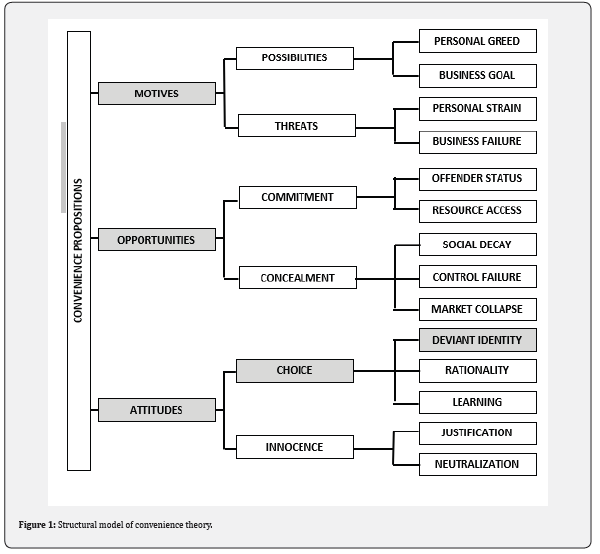
The CEO deviance characteristic might be exemplified by the following statement from a witness in court on March 12, 2026 [55]: He was high and low. He is the spirit that walks. Everyone knew about him, but no one saw him. It was because he was out a lot. He was out on business, hunting and fishing. As illustrated by the figure, many propositions might in many ways influence the convenience of deviance. To prevent deviance, narcissistic identification with the organization might not lead to deviance if the organization avoids social decay by institutional deterioration and secures effective controls by guardianship and oversight. However, in the current case study, the exact opposite occurred as the CEO could exploit his narcissistic traits since there was institutional deterioration and control failure at Norwegian Industries.
The deviant identity of the CEO seemed accepted by stakeholders and observers. While board members and others at Norwegian Industries claimed in court not knowing about the CEO’s extensive social networking causing substantial costs for the association, the CEO’s defense attorney argued that board members simply looked another way when the CEO handed in frequent invoices with high values [56,57]. After the criminal trial ended, but before the judge issued the verdict, Lier-Hansen appeared to use the neutralization technique of condemning his critics, arguing that outsiders did not understand the relevant conduct. In general, this technique involves accusing critics of questionable motives and shifting moral blame onto those who condemn the misconduct. Offenders may also deflect criticism by claiming that others engage in similar disapproved behavior. In addition, they may criticize criminal justice procedures, especially police investigations and interrogations, as well as media coverage of the case, thereby challenging the credibility of accusers and investigators [58]. In an interview, Lier-Hansen claimed that the process against him began because “it was to get rid of me” [59].
Conclusion
The case of the former CEO at Norwegian Industries provides anecdotal evidence of his deviant identity in terms of narcissistic organizational identification with Norwegian Industries. The evidence consists of his statements in criminal court blaming critics, ignoring ethical guidelines, refusing tax violation, claiming entitlement to benefits, suggesting mistakes and misunderstandings, and perceiving innocence. He made the rules for others to follow. The label that “I am Norwegian Industries” seemed to fit him. Unlike traditional organizational identification where the person defines himself or herself through the organization by claiming that the organization is part of self, narcissistic identification reverses this by believing that the self is the organization.
Therefore, this article has provided useful anecdotal insights into and evidence of the narcissistic identification phenomenon. The prosecution asked the court to convict the former CEO to five years and five months imprisonment [60,61]. This article relied on anecdotal observations drawn from attendance at a criminal trial without a clearly articulated or systematic analytic procedure. In future research, there is a need to provide more methodological detail, transparency, and rigor. In particular, the analysis might appear primarily illustrative of previously developed theoretical propositions rather than offering independent empirical advancement. Given an emphasis on theoretically and methodologically robust contributions to the study of white-collar and corporate crime, there are many avenues for future research.
Future Research
The research presented in this article has obvious limitations that might open for future research. One problematic issue is the legal status of the case that needs careful handling. The current article uses strong terms such as offender, crime, deviance, corruption, and fraud, while also discussing charges, court statements, and prosecution claims. Since the judgment is not final at the time of writing, the article should be much clearer about presumption of innocence and about the distinction between legal guilt, alleged conduct, admitted conduct, and criminological deviance. This is especially important because the current research relies heavily on trial statements and media coverage. In fact, it is important to stress that a defendant is to be considered innocent until guilt is proven beyond any reasonable and sensible doubt by a final verdict from the court. The research needs to more convincingly establish that the focal individual exhibits narcissistic traits. This is particularly important given the evaluative and potentially stigmatizing nature of such a label, especially when based on limited and indirect data.
A more careful engagement with personality literature, and with the limitations of unobtrusive assessments will strengthen the argument. Relatedly, narcissism alone – independent of narcissistic organizational identification – may already explain vulnerability to economic misconduct based on such phenomena as entitlement beliefs. This raises the question of incremental validity: What does organizational identification add beyond narcissism? Future research needs to explore whether organizational identification offers greater explanatory precision in this case. Future research might engage with alternative explanations. The observed statements may reflect legal defense strategy, impression management, retrospective rationalization, elite entitlement, weak governance, occupational norms around networking, or simple self-protection under trial pressure.
Narcissistic organizational identification interpretation is plausible, but the research needs to show why it is stronger and more theoretically useful than these alternatives. In fact, future research might consider excerpts to be consistent with alternative explanations, including entitlement and self-justification processes, breakdowns in governance and control systems, the corruptive effects of power and position, and norm development within elite networks. For example, the claim that expenses were framed as necessary for professional representation could reflect the normalization of deviant practices in elite contexts rather than identification with the organization per se. Similarly, externalization of blame may indicate vulnerable narcissism, but it can also reflect common defensive strategies in legal proceedings.
The interpretation of courtroom exchanges as evidence of narcissistic organizational identification is therefore not uniquely supported in the current presentation. In addition, more evidence is needed to demonstrate that the individual perceived a strong overlap between self and organization, which is a core feature of narcissistic organizational identification. The first limitation of innocence perception became irrelevant in May 2026 when the former CEO at Norsk Industri received a verdict from the Oslo district court of 5 years in prison. He was convicted of aggravated corruption and aggravated financial infidelity to five years in prison. The district court found beyond reasonable doubt that the former CEO demanded and received undue advantages related to his prominent position in Norwegian society. He was also convicted of paying back millions to his former employer [63].
References
- Gottschalk P (2025) Trusted chief executives in convenient white-collar crime. Crime & Delinquency 7(8): 2845-2873.
- Amos B, Longpré N, Roos M (2024) The dark triad of personality: Attitudes and beliefs towards white-collar crime. Journal of White Collar and Corporate Crime 5(1): 58-73.
- Veltrop, DB, Bezemer PJ, Nicholson G, Pugliese A (2021) Too unsafe to monitor? How board-CEO cognitive conflict and chair leadership shape outside director monitoring. Academy of Management Journal 64(1): 207-234.
- Galvin BM, Lange D, Ashforth BE (2015) Narcissistic organizational identification: Seeing oneself as central to the organization’s identity. Academy of Management Review 40(2): 163-181.
- Gottschalk P (2026) Business Conformance in Sport Management-Leadership Styles, Governance Structures, and Organizational Cultures, Routledge, UK: Abingdon.
- Berglund N (2025) Former industry leader indicted for fraud, News in English.
- Hoemsnes A (2026) Tillit trumfer etikk (Trust beats ethics), daily Norwegian business newspaper Dagens Næringsliv p: 10.
- Ingebrigtsen N (2026a) Det er bare én skurk, og han står på tiltalebenken (There is only one criminal, and he is on trial), daily Norwegian business newspaper Dagens Næringsliv p: 8-9.
- Ingebrigtsen N (2026b) Skal ha spist og drukket for 70.000: Jeg var ikke der (Shall have been eating and drinking for 70.000: -I was never there), daily Norwegian business newspaper Dagens Næringsliv p: 9.
- Ingebrigtsen N (2026c) Nektet for å ha vært på representasjonsjakt med Lier-Hansen (Denied having been on representation hunting with Lier-Hansen), daily Norwegian business newspaper Dagens Næringsliv p: 14-15.
- Cullen FT, Chouhy, C, Jonson CL (2020) Public opinion about white-collar crime, in: Rorie, ML (editor), The Handbook of White-Collar Crime, Hoboken, NJ: Wiley & Sons pp: 211-228.
- Dearden TE (2016) Trust: the unwritten cost of white-collar crime, Journal of Financial Crime 23(1): 87-101.
- Bisschop L, Bociga D, Kluin M, Homer E (2025) Examining the multifaceted harms of corporate and white-collar crime, Crime. Law and Social Change 83(18).
- Long J, Logan MW, Morgan MA (2021) Are white-collar prisoners special? Prison adaptation and the special sensitivity hypothesis. Journal of Criminal Justice 77.
- Han JH, Pollock TG, Paruchuri S (2024) Public enemies? The differential effects of reputation and celebrity on corporate misconduct scandalization. Strategic Management Journal 45: 2727-2762.
- Urzica AL, Gottschalk P (2024) Convenience propositions for white-collar offenders: Perceptions of seriousness in Romania. Journal of Economic Criminology.
- Gottschalk P, Gupta CM, Kamaei M, Abdullah A (2026) Perceptions of controls, norms, attitudes, and values as determinants of whistleblowing intentions. Pakistan Journal of Criminology 18 (1): 35-56.
- Abdullah A, Gottschalk P, Gupta CM, Kamaei M, Stadler W, et al. (2025) Perceptions of offender motives, opportunities and willingness for financial crime: An empirical analysis of survey responses in six nations. Journal of Financial Crime 32(2): 389-402.
- Schjetne S (2026) Aktor om Lier-Hansen: -Tappet Norsk Industri og beriket seg selv (Prosecutor about Lier-Hansen: -Tapped Norwegian Industries and enriched himself). Norwegian labor union newspaper Fri Fagbevegelse.
- Rintamäki J, Parker S, Spicer A (2025) Institutional parasites. Academy of Management Review 50(3): 612-631.
- Piazza A, Bergemann P, Helms W (2024) Getting away with it (or not): The social control of organizational deviance. Academy of Management Review 40(2): 249-272.
- Kim JH, Hurst R, Siegel J (2025) Status-amplified deterrence: Paul Manafort’s prosecution under the foreign agent’s registration act. Organization Science 37(1).
- Gottschalk P, Hamerton C (2025) Corporate Conformance and the Social License-A Criminological Perspective, Palgrave Macmillan, UK: London.
- Sutherland EH (1939) White-collar criminality. American Sociological Review 5(1): 1-12.
- Sutherland EH (1983) White Collar Crime – The Uncut Version, New Haven, CT: Yale University Press.
- Sundström M, Radon A (2015) Utilizing the concept of convenience as a business opportunity in emerging markets, Organizations and Markets in Emerging Economies 6(2): 7-21.
- Toubiana M (2020) Once in orange always in orange? Identity paralysis and the enduring influence of institutional logics on identity. Academy of Management Journal 63(6): 1739-1774.
- Ingram P (2023) Identity multiplicity and the formation of professional network ties. Academy of Management Journal 66 (3): 720-743.
- Gouvard P, Goldberg A, Srivastava SB (2023) Doing organizational identity: Earnings surprises and the performative atypicality premium. Administrative Science Quarterly 68(3): 781-823.
- Frandsen S, Grant J, Kärreman D (2025) Working with pride in the shadow of shame: Emotional dissonance and identity work during a corporate scandal. Human Relations 78(1): 3-31.
- Watson TJ (2008) Managing identity: Identity work, personal predicaments, and structural circumstances. Organization 15 (1): 121-143.
- Sonpar K, Pazzaglia F, Shrivastava S, Garg Y (2024) Into the danger-zone’: How intersubjective processes rooted in social identities shape responses to existential threats. Human Relations 77 (12): 1844-1870.
- Kolic P, Ives B, O’Hanlon R, Murphy R, Morse CI (2025) Stigma, menstrual etiquette, and identity work: Examining female exercisers’ experiences during menstruation. Sport. Education and Society 30(8): 927-939.
- Shi L, Denver M (2025) The transferal of criminal record stigma in the employment context: Evidence from conjoint and vignette experiments. Criminology 63(1): 89-121.
- Hernandez J, Araos C (2024) The banality of organizational wrongdoing: A reading on Arendt’s thoughtlessness thesis. Journal of Business Ethics 195(4): 713-727.
- Bjørndal B (2026a) Stein Lier-Hansen grillet i retten: -Jeg var ikke bevisstløs da jeg gjorde det (Stein Lier-Hansen grilled in court: I was not unconscious when I did it), daily Norwegian business newspaper Dagens Næ
- Bjørndal B (2026b) Grillet om korrupsjonsposten (Grilled about the corruption transaction), daily Norwegian business newspaper Dagens Næringsliv p: 10-11.
- Bjørndal B (2026c) Vitne mener Norsk Industri-styret må ha sovet i timen (Witness thinks the Norwegian Industries board must have been asleep during the session), daily Norwegian business newspaper Dagens Næringsliv p: 22-23.
- Gottschalk P (2024) Impression management following investigation and prosecution scandal in Norwegian police: A review of press releases, Policing and Society – An international Journal of Research and Policy 34(6): 596-612.
- Økokrim (2025) Tidligere administrerende direktør i Norsk Industri tiltales for grov korrupsjon og grov økonomisk utroskap (Former CEO of Norwegian Industries charged with gross corruption and gross financial dishonesty), press release from the Norwegian National Authority for Investigation and Prosecution of Economic and Environmental Crime Ø
- Tangen E, Rydne N (2026) Stein Lier-Hansen: -Jeg skal stå for det jeg har gjort (Stein Lier-Hansen: -I will take responsibility for what I have done), web-based Norwegian newspaper E24.
- NTB (2026) Lier-Hansen: Det faller på sin egen fullstendige urimelighet (Lier-Hansen: It falls on its own complete unreasonableness), daily Norwegian newspaper Aftenposten p:15.
- Tangen E, Rydne N, Bøe E, Kristiansen T (2026) Stein Lier-Hansen i retten (Stein Lier-Hansen in court), web-based Norwegian newspaper E24, www.e24.no.
- Piening EP, Salge TO, Antons D, Kreiner GE (2020) Standing together or falling apart? Understanding employees’ responses to organizational identity threats. Academy of Management Review 45(2): 325-351.
- Amry MA, Meliala A (2021) Lifestyle-related shaming: The significance of reintegrative shaming on drug relapse offenders in Indonesia. Journal of Social and Political Sciences 4(1): 145-153.
- Hernes T, Blagoev B, Kunisch S, Schultz M (2025) From bouncing back to bouncing forward: A temporal trajectory model of organizational resilience. Academy of Management Review 50(1): 72-92.
- Solli M (2026a) Innrømmer: Jobbet svart for 1,8 millioner (Admits: Worked black for 1.8 million), web-based Norwegian newspaper Nettavisen.
- Talsnes S, Hestegrei K (2026) Innrømmer i retten: Har mottatt millionbeløp svart (Admits in court: Has received millions in undeclared income), Norwegian commercial television station TV2.
- Gottschalk P, Asting C (2020) Entitled to embezzlement? The case of successful executives working for rich heirs. Deviant Behavior 41 (3): 269-277.
- Howes SS, Kausel EE, Jackson AT, Reb J (2020) When and why narcissists exhibit greater hindsight bias and less perceived learning. Journal of Management 46(8): 1498-1528.
- Liu X, Zheng X, Zhang Y, Liao H, Harms PD, et al. (2025) Paradoxical effects of narcissism on creative performance: Roles of leader-follower narcissism (in)congruence and follower identification with the leader. Human Relations 78(5): 517-549.
- Zhu DH,Chen G (2015) CEO narcissism and the impact of prior board experience on corporate strategy, Administrative Science Quarterly 60(1): 31-65.
- Ali KN (2026) Stein Lier-Hansen innrømmer uriktig forklaring (Stein Lier-Hansen admits to incorrect explanation), Norwegian public broadcasting NRK.
- Solli M (2026b) Stein Lier-Hansen oppga feil dødsår: -Totalt mistet troverdighet, (Stein Lier-Hansen told the wrong year of death: Total loss of credibility), web-based Norwegian newspaper Nettavisen.
- Bjørndal B (2026d) Toppadvokat om Stein Lier-Hansen: Han er ånden som går (Top lawyer about Stein Lier-Hansen: -He is the spirit that walks), daily Norwegian business newspaper Dagens Næ
- Bjørndal B (2026f) Forsvarer lanserer ny teori (Defense attorney launches new theory), daily Norwegian business newspaper Dagens Næringsliv p: 10-11.
- Bjørndal B (2026g) Skal altså ha hatt fullstendig hjemmealene-fest (Must have had a completely home-alone party), daily Norwegian business newspaper Dagens Næringsliv p: 18-19.
- Sims RL, Barreto TS (2022) In defense of leader misconduct: The use of neutralization techniques by ingroup members. The Journal of Social Psychology 162 (5): 621-639.
- Solem LK, Elvsborg Ø (2026) Stein Lier-Hansen om det spektakulære fallet: Har vært en ekstrem-situasjon (Stein Lier-Hansen about the spectacular fall: -Has been an extreme situation), daily Norwegian business newspaper Dagens Næringsliv.
- Bjørndal B (2026e) Ber om fengsel i fem år og fem måneder (Ask for prison of five years and five months), daily Norwegian business newspaper Dagens Næringsliv p: 12-13.
- Talos P (2026) Et klassisk tilfelle av grov korrupsjon (-A classic case of serious corruption), daily Norwegian newspaper Aftenposten p: 20.
- Hinna AK, Gullestad FH (2026) Tviler på om punktum er sett (Doubt that it is final), daily Norwegian newspaper Klassekampen 22: 8-9.

























