




 JFSCI Home



Abstract
In a spectacular case of stamp forgery colour change of a Greek stamp of the Small Hermes Heads issue from red violet to orange colour is discussed. By changing the molecular structure of the halochromic quinone type Alizarin dye by simple pH changes the chromophore and consequently the colour has changed drastically. First, the question concerning the new colour arose by experts and collectors is whether the stamp is extraordinary and unique or if it is a counterfeit. The pigments of the stamps concerned were analysed in a study by micro-Laser-Raman techniques.
The evaluation was a detective story and conclusively, a man made colour change by simple interference of the chemistry of the chromophore was found. Due to its importance for colour the chromophore of organic dyes is discussed in terms of quantum chemical molecular orbitals whereby linear combination of atomic orbitals, LCAO, the bonding and anti-bonding molecular orbitals are stepwise occupied. The energy gap of bonding and anti-bonding positions are decisive for light absorption from wavelength of the visible region. Exclusively, the π→π* transition allows the absorption by π-electron excitation.
Keywords: Forensic Philately; Greek Philately; Pigments; Dyes; Organic Chromophore; Forged stamp by colour change; Halochromism; Micro-Laser-Raman
Abbreviations:
Keywords: Forensic Philately; Greek Philately; Pigments; Dyes; Organic Chromophore; Forged stamp by colour change; Halochromism; Micro-Laser-Raman
Introduction
Authentication of stamps is a goal of all times using the classical methods of evaluation by specialized experts but more frequently involving physico-chemical procedures with highly sophisticated scientific measures. In a forensic sense these studies are focused mainly on pigments and colours but also on paper. When looking at the fundamentals of pigments and dyes in a scientific manner deviations, peculiarities and forgeries can often be detected. Previously, we have commented on the chromophores of inorganic pigments [1] which are different to that of organic-coloured dyes reported here. There are four electronic mechanisms of colour formation in pigments and dyes [2].
Only one of them can be observed in carbon based organic dyes by electron transition of molecular orbitals MO chromophores. The chromophore is the important part of a molecule which makes a matter coloured and points also to routes of possible chemical interference. Organic chromophores absorb light at specific wavelength which results in the colour we can see. A precondition for colour of common organic dyes is an extended but conjugated π-electron system, sometimes including various molecular organic functions. Most organic compounds are colourless due to the higher energy of excitation of s→σ*, transitions that are predominant in organic material.
In agreement with the MO theory the electron transfer from HOMO → LUMO states can occur already by visible light excitation, according to the general principle: the higher the number of conjugated double bonds the lower the energy of excitation. This classical chromophore we will find in this unprecedented case of an intelligent stamp forgery where the alizarin printing dye is chemically altered. That’s why, it is worth discussing some specific molecular states in more detail. The outstanding object of the presentation is a single Greek stamp of 1894 considered as colour error. Due to its chemical structure of the halochromic alizarin dye, whose colour varies with pH, the alteration of it is simple. The convincing choice of the analytical tool of the study is micro-Laser Raman spectroscopy prior to the metal element-based application of EDX. The basics of both methods are given in [1,2].
The Nature of the Common Organic Chromophore
The bonding in organic compounds is described by different types of orbitals according to quantum chemistry as e.g. bonding, antibonding, nonbonding and π bonding orbitals. Because of the transition energies only the the π→π* transition can occur in the visible part of white light. Mostly, only one double bond do not generate colour in general because the absorption band lies in the near UV. But a larger number of altogether 11 π-bonds in a conjugated arrangement makes such a molecule coloured as the β-carotine shows. Other possibilities consist in shifting the absorption into the visibile region by the presence of auxochrome ligands.
The cyanine dye of the general formula of the open chain type R2N+ = CH [CH = CH] n – NR2 is belonging to the polymethine group and shows colour already with a small π electron system of two double bonds only. Similar behaviour is observed with the colourless anthraquinone. If the anthraquinone is substituted by two hydroxy groups forming alizarin the electron cloud is extended and conjugated showing colour, see Figure 1 and 2. A conjugated system is per definition a molecular arrangement of alternating single and double bonds. Increasing intensity of colour is often achieved with some more electron donating auxochromes. A special mechanism of colour change is halochromism. This occurs when a substance changes colour as the pH value changes.
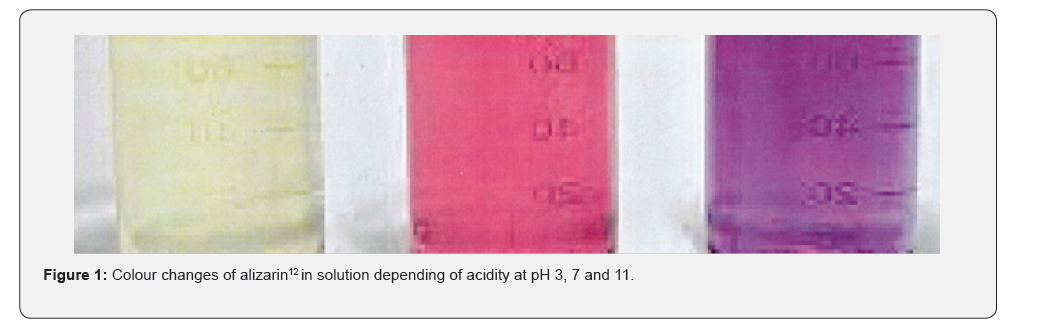
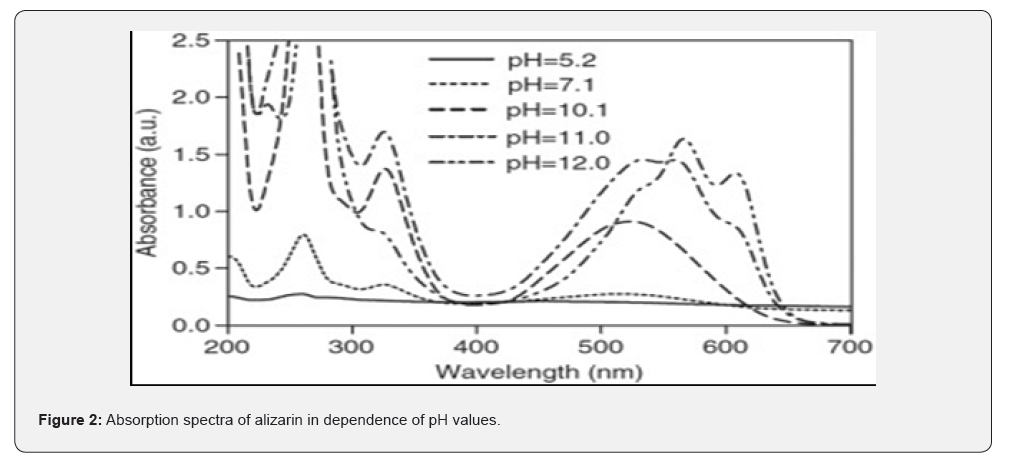
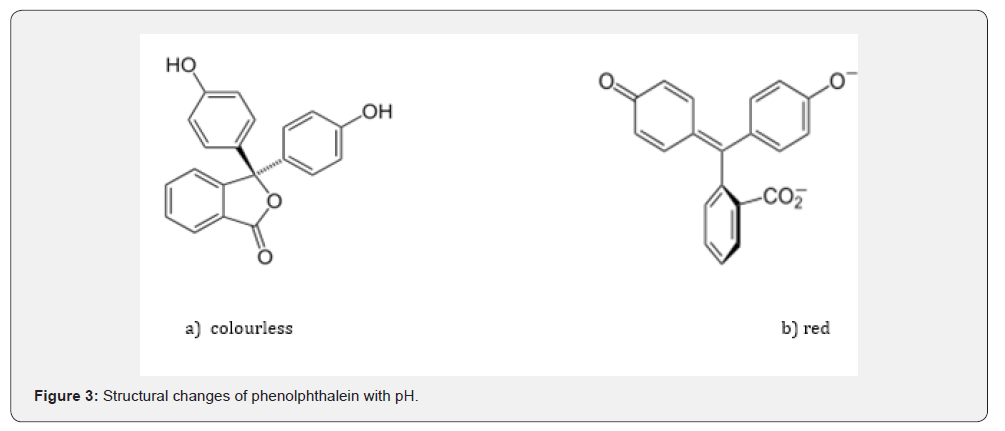
This is the typical property of pH indicators where molecular structural changes take place concomitantly with pH. In the case of phenolphthalein there is a colour change at pH 8.2 when going from acidic to basic conditions. In this triphenyl methane type dye are three aromatic rings bonded to a tetrahedral sp [3] hybridized carbon in the centre (figure 3a) without π-bonding in the pH range from 0 to 8. Above the pH of 8 the central carbon becomes part of a sp2 hybridized double bond where one p orbital overlaps with the π-bonding in the three rings. Then, by conjugation an extended chromophore is formed. In chemical terms, under basic conditions the lactone ring in 1a is opened forming structure (figure 3b).
There actually is one extraordinary example in German philately where this principle of colouring stamps with an indicator as a safety measure was used. The stamps of the German Reich, Michel [3] catalogue numbers Mi 45-50 of 1889-1900 show a colourless safety under-print of phenolpthalein which becomes visible as a red mark by the action of basic ammonia or other Bronsted bases. It was thought of as a special measure for the proof of genuineness. Afterwards a spectacular case in the history of philately is presented where parts of the above-mentioned scientific considerations became reality.
The Greek Unique Orange 25 Lepta Stamp of 18944 Rarity or Fake?
History of the Stamp
In 2004 the Greek auction house Vlastos [6] offered in their November auction in Athens an outstanding and unique piece of Greek philately for sale: the Small Hermes Head 25 lepta value of 1894 in the error colour of the 10 lepta. The stamp was sold for 223,630 Euro (Auction 228, lot 5004, starting price 30,000 Euro) and was thus considered to be the most expensive Greek stamp [6]. The only stamps catalogue in Greece which had a reference to the “unique stamp” was the Vlastos catalogue (2005 Vol.1, p 39) under the heading ”1889-91 Athens issues (Figure 4).”
In 2004 the Greek auction house Vlastos [6] offered in their November auction in Athens an outstanding and unique piece of Greek philately for sale: the Small Hermes Head 25 lepta value of 1894 in the error colour of the 10 lepta. The stamp was sold for 223,630 Euro (Auction 228, lot 5004, starting price 30,000 Euro) and was thus considered to be the most expensive Greek stamp [6]. The only stamps catalogue in Greece which had a reference to the “unique stamp” was the Vlastos catalogue (2005 Vol.1, p 39) under the heading ”1889-91 Athens issues (Figure 4).”
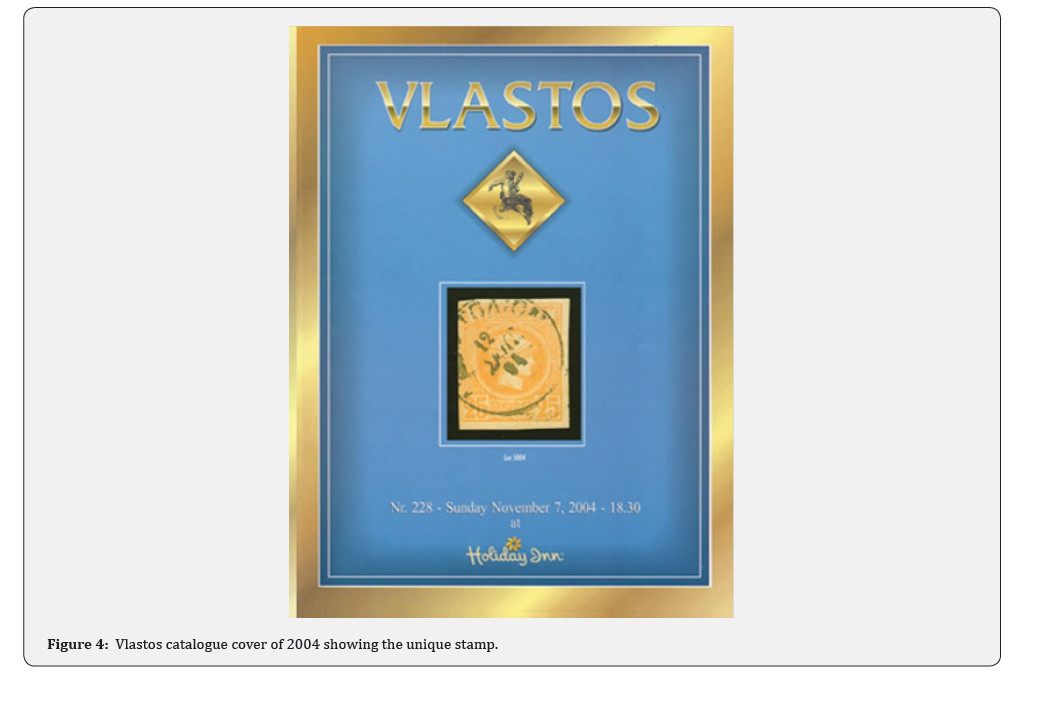
Our hypotheses is that probably not a misprint has taken place but rather a manipulation of colour of the red-violet 25 L stamp by chemical means. Under these auspices the blue 25 L of the second printing is not relevant for us. The blue pigments [9] are not suitable in this case because the used ultramarine blue is extremely unstable to acidic media and decomposes immediately while otherwise Prussian blue is extremely stable and cannot be manipulated as such. That’s why we were concentrating our efforts on Hellas 91a and 91d. Today the unique stamp is not generally accepted and therefore not listed in a catalogue at all.
Re-Examination of the 10 L and 25 L Stamps of 1894
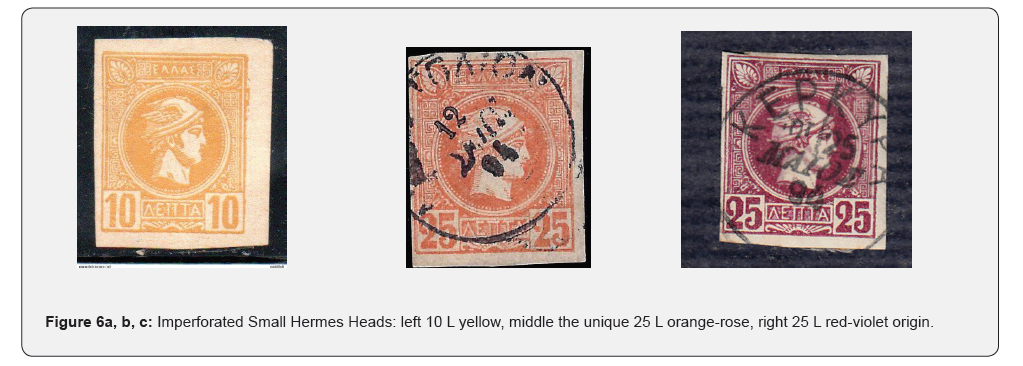
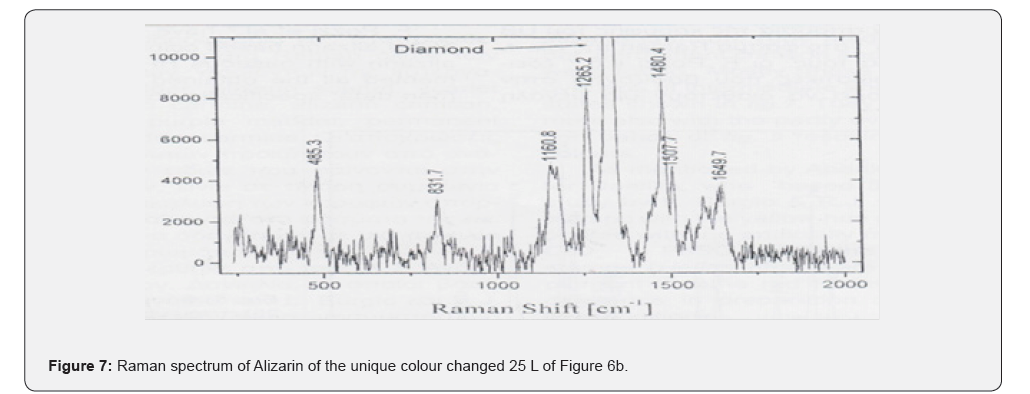
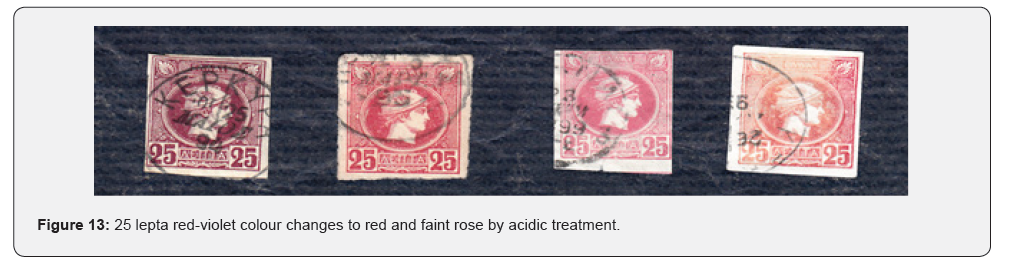
The error stamp as a “colour misprint” has been made some doubt by different serious reasons discussed below. In Figure 6 a-c the 3 Small Hermes Heads of the study are to be seen. The error stamp underwent a colour change from red violet to orange or frankly said, it has a hue of faint rose (Figure 6b). As already mentioned, certainly it was not a wrong plate in use, but more aggravating seems the fact of two chemically different pigments of the unique and the original stamp Hellas 88d. The first one in Figure 6b is obviously an alizarin-based compound (verified by Raman in Figure 7) but the second one is the inorganic classic pigment chrome yellow (lead chromate, PbCrO4). If we follow the arguments of Ioannidis the pigments and colours of Hellas 88 and the unique must be identical.
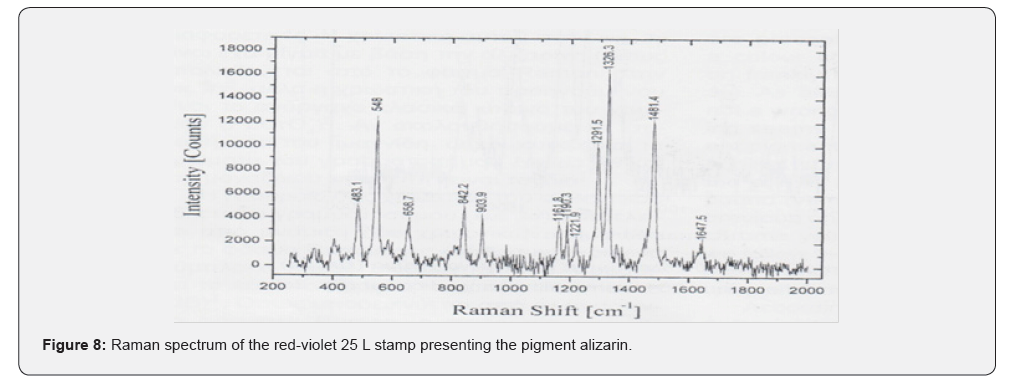
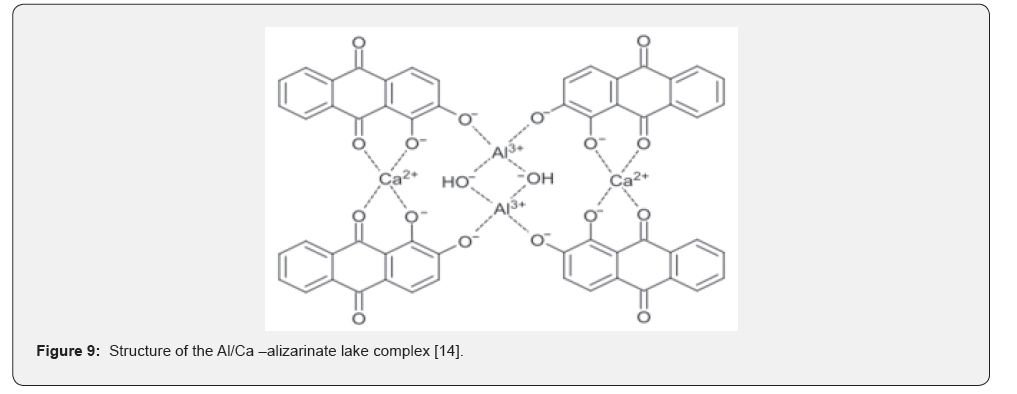
The red-violet pigment of the original 25 lepta stamp seen in 4c is according to the Raman spectrum of Figure 8 the organic alizarin dye in form of the lake complex (Figure 9). Mixed with classical acid sensitive pigment ultramarin blue (UB). UB is clearly indicated by its strong Raman peak at 548 cm -1, the ν 1 stretching vibration of the molecule. Most surprisingly, the former orange-rose colour of the unique is also an alizarin derivative as Raman data of Figure 7. The frame structure of absorptions for aromatic C = C, C=O, C-OH bonds are typical for unsaturated valence- and deformational vibrations of wavelength ranges of 600-1600 cm-1 with the most intensive and typical signals at 1323 cm-1 and 1476cm-1, as But more important is the absence of ultramarine blue in this spectrum. This points to the decisive hint of manipulation of the stamp. The UB dye is only stable under alkaline conditions. When changing the original stamp colour by forgery using a strong acid not only the alizarin dye is concerned, but also the ultramarin blue. Under acidic conditions the UB fades and is finally completely destroyed. This is convincingly illustrated by the missing of the UB 548 cm-1 main peak in the Raman spectrum.
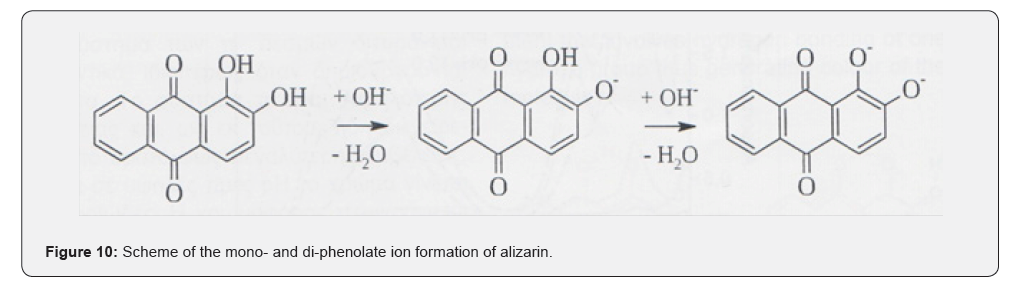
F. Pozzi et al. [10] have found a great variety of alizarinbased colorants when treating alizarin with gaseous HF. They have documented all the obtained products with Raman data: specifically, rose madder, alizarin scarlet, scarlet madder, alizarin carmin, alizarin crimson, ruby madder, purple madder, permanent crimson and madder carmin were found. Mostly, these colour hues overlap of intermediate chemical states shown in Figure 8. They are in full agreement also with the partly overlapped absorption bands of Figure 10 resulting in a variety of mixed colours.
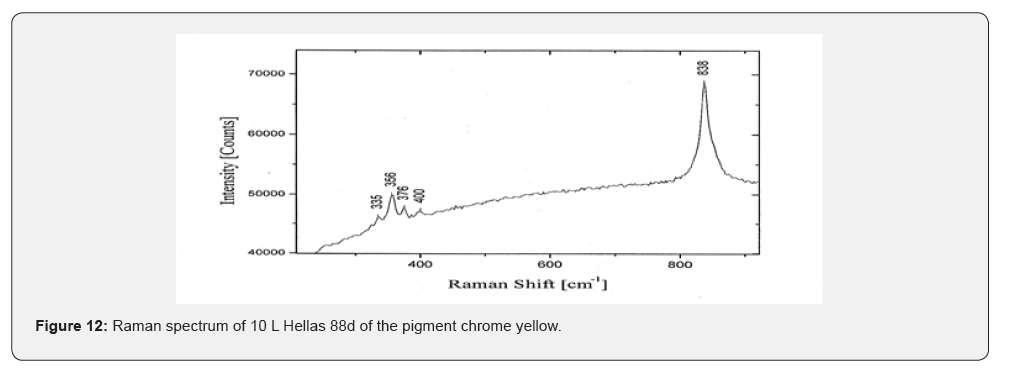
According to L. Burgio et al. [11] the stamp 10 L Hellas 88d with the yellow hue is printed with the artificially made pigment PbCrO4 ∙ n PbSO4, while the orange-coloured Hellas 88a is printed with the pigment chrome orange (red) PbCrO4 ∙ n PbO. The difference depends on their preparation under acidic or basic conditions. The two lead chromate pigments are different in colour, crystal structure and in Raman vibrations. Chrome yellow shows a sharp stretching at 840 cm-1 and bending at 360-80 cm-1, while Chrome orange (red) has remarkable broader absorptions shifted to lower wave numbers (Figure 12).
Chemical Background of Colour changes in the Alizarin Pigment System
In chemical terms Alizarin is the 1, 2-dihydroxy-9,10- anthraquinone of the formula C14 H8 O4, see Figure 10. In former times the outstanding pigment was extracted from the roots of the madder plant. As necessary for stability is the dye fixation on matter by a metal (III) / (II) - complex compound e.g. Al and Ca, see Figure 9. The alizarin molecule possesses an extended system of delocalized but conjugated π bond electrons. These are easily excited to π* electronic states by visible light and are therefore strongly coloured. As is seen from the scheme in Figure 10 the anthraquinone has two acidic hydroxyl groups which can be neutralized by alkali treatment. Thus, the first colour transformation occurs from yellow to red at pH-values from 4,5-6 and the second one from red to violet at pH [10-12]. This way one can change colour vice versa by adding acid or base, respectively. It means, alizarin is a colour indicator known for long.
The Chromophore System of Antraquinone
The chromophore of coloured organic compounds is different from that of non-carbon containing inorganic pigments and dyes [1]. The essential electronic mechanism consists in the transition of relevant electron orbitals. A chromophore makes matter coloured by an electronic mechanism: it means, the ground state of π-electrons is stimulated by light, and the electron is exited into a state of higher orbital energy π*. According to the absorped part of white light the remaining wavelength determines the complementary colour of matter. The double bond system of delocalized π electrons we find in the quinone molecular arrangement. The π bond system is largely extended especially when the negative ions are formed. The π system is less energetic and is therefore already excited by long range visible light. Thus, at high pH values the colour becomes red violet. The chromophore is expressed as the transition
π → π*
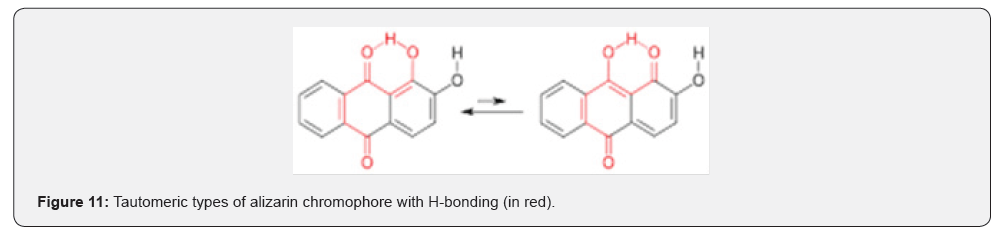
The molecular structure of the conjugated π-electron system is shown in Figure 10, including the tautomeric hydrogen bonding forms of alizarin (Figure 11). Hydrogen bonding significantly influences colour by altering the electronic structure of the chromophore through intermolecular proton transfer. Changes in the electron distribution may shift the absorption wavelength resulting in deviations of intensity as well as brightness and saturation of colour. Knowing the specific properties of the alizarin molecule, a stamp printed with an alizarin pigment can be relatively easy manipulated and altered by simple chemical means due to the rules of acid-base chemistry.
Testing the 25 Lepta Stamp toward Acidic Media
To make proof of the hypotheses, some red-violet 25 lepta stamps were treated in acidic aqueous solution of concentrated aqueous HCl as well with gasous HCl. While in solution the colour of dissolved alizarin has immediately changed functioning as indicator, in the solid state fixed as pigment on paper it is not as easy. Moreover, because of stability reasons the pigment exists as a lake complex, mostly with metal ions Al (III), Ca(II).
To make proof of the hypotheses, some red-violet 25 lepta stamps were treated in acidic aqueous solution of concentrated aqueous HCl as well with gasous HCl. While in solution the colour of dissolved alizarin has immediately changed functioning as indicator, in the solid state fixed as pigment on paper it is not as easy. Moreover, because of stability reasons the pigment exists as a lake complex, mostly with metal ions Al (III), Ca(II).
The lake complex of the dye is essential for practical use when colouring textiles, fibres and paper. The single alizarin molecule has a definite solubility and is therefore of limited use, such as, e.g., in painting. Increasing the molecular weight and complexing with a metal MeIII/ MeII e.g. Al/Ca is necessary for anchoring the dye at a surface. Although alizarin as a dye is known and used for more than thousands of years, the complex molecular structure [13,14] was inconsistent and controversial up to recently. In 1993 Wunderlich and Bergerhoff [14], solved the structure by single crystal structure analyses. The tetranuclear complex shown in Figure 9 is different to all formerly proposed structures. Also, 27Al-MAS NMR studies [15], contributed to the confirmation of the coordination numbers at the Al atoms [16].
Conclusion
The focus of this scientific study presents a common Greek stamp of 1894 as colour error which was verified by stamp specialist as genuine. Because of some more existing doubts the stamp then underwent a colour investigation of its printing dye by a scientific measure. The colour was found to be altered by chemical means, i.e. the alizarin dye was manipulated by using strong acids. For better understanding of the chemical background of the forgery the chemical changes at the molecular level, especially that of the chromophore, were discussed. This example teaches us that complicated cases, including forgeries, can only successfully be solved using highly sophisticated scientific methods as the matter of choice.
References
- Groß U (2018) Forensic Philately: The science of stamp authentication. ChemTexts 4: 18.
- Klöckl I (2020) Auflage,Verlag de Gruyter, Berlin. Chemie der Farbmittel Band 1: 2.
- Michel Katalog (2022) Deutschland Spezial Band 1, Seite 356, Schwaneberger Verlag
- Groß U, Tempelis E (2024) Philotelia 747: 206-217.
- 5a Ioannidis IP (1987) The Report, J of the Hellenic Philatelic Society of Chicago XX(4): 7-8.
- 5b (1987) Philotelia, published in Greek, French and English “The small Hermes Heads 10 lepta stamps printed on a 25 lepta plate” 522: 29-32.
- 6a Vlastos catalogue (2004) No 228, November 7
- 6b Philotelia (2004) 629:348
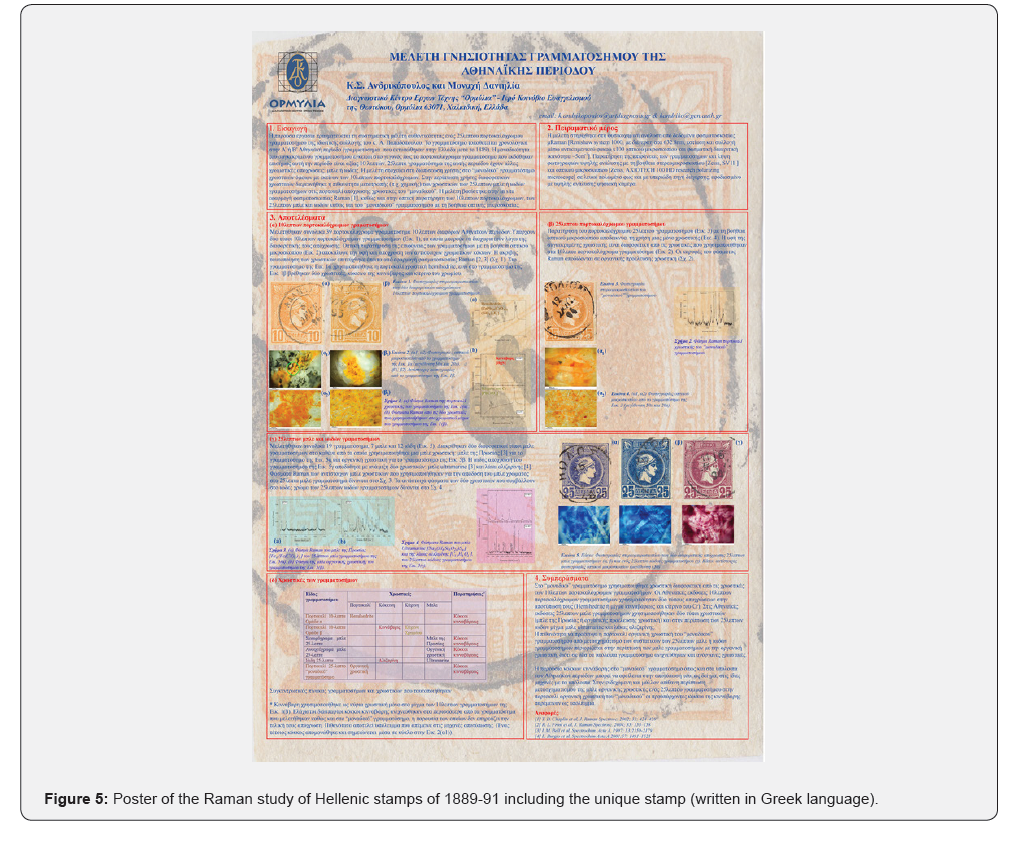
- Andrikopoulos KS, Lavinlia M (2005) Diagnostic Center of Works of Art Ormylia, Chalkidiki, Poster: Study of genuineness of a stamp of the Athenian period at the Panhellenic Conference on Solid-state Physics and Materials Science, University of Cyprus (in Greek).
- A Karamitsos (2020) Hellenic catalogue
- Groß U (2023) Ultramarinblaue Briefmarken. Schweizer Briefmarkenzeitung 1-2: 29.
- Pozzi F, Lombardi JR, Leona M (2013) Winsor & Newton original handbooks: a surface-enhanced Raman scattering (SERS) and Raman spectral database of dyes from modern watercolor pigments Science, 1: 23.
- Burgio L, Clark RJ (2001) Library of FT-Raman spectra of pigments, minerals, pigment media and varnishes, and supplement to existing library of Raman spectra of pigments with visible excitation. Spectrochimica Acta A Mol Biomol Spectrosc 57(7): 1491-1521.
- Wunderlich CH, Bergerhoff G, (1994) Chem. Berichte 127: 1185-1190.
- Wunderlich CH, Bergerhoff G, (1993) Z. Kristallogr 207: 189.
- Patrick Soubayrol, Gilbert Dana, Pascal P Man (1996) Aluminium-27 Solid-State NMR Study of Aluminium Coordination Complexes of Alizarin. Magnetic Resonance in Chemistry 34(8): 638-645.

























