



 JFSCI Home



Abstract
Some people consider the use of force by police to be distasteful. However, they do not understand that the use of force is inherent in the police role [1]. The best way to appreciate this is to explore training in the use of force. Sociologists call this, “police socialization.” To do this, we examined the acquisition of the skills and attitudes regarding the use of force by auxiliary (part-time) police officers. So, in this study we asked two questions: Did the training on the use of force differ between full-time and part-time officers? And, it is said that the use of force is determined by the) “police personality” [2]. Is this true? The information for this study was acquired by the author through an ethnographic study of the training of auxiliary (part-time) police officers in “Belleville,” a middle-class suburb of 20,000 to 30,000 people near a large Midwestern (US) city for over seven years (1995 to 2002).
Keywords: Police Socialization; Order Policing; Auxiliary
Introduction
Some people consider the use of force by police to be distasteful. However, they do not understand that the use of force is inherent in the police role [1]. The best way to appreciate this is to explore training in the use of force. Sociologists call this, “police socialization.” To do this, we examined the acquisition of the skills and attitudes regarding the use of force by auxiliary (part-time) police officers. So, in this study we asked two questions: Did the training on the use of force differ between full-time and parttime officers? And, it is said that the use of force is determined by the (authoritarian) “police personality” [2]. Is this true? The information for this study was acquired by the author through an ethnographic study of the training of auxiliary (part-time) police officers in “Belleville,” a middle-class suburb of 20,000 to 30,000 people near a large Midwestern (US) city for over seven years (1995 to 2002).
The Auxiliary Program
Full-time police officers in the state were required to graduate from a full-time, state accredited police academy. The training for city officers was 525 hours. Suburban officers received 400 hours of training. Part-time officers attended a part-time academy. They, too, had to complete a 400-hour program. Auxiliary officers usually held full-time jobs, so they did not have to attend the academy. Instead, auxiliary officers in Belleville were required to take a state-mandated 40-hour firearms course, plus 292 hours of additional in-house training on evenings and weekends. This usually took a year. The first portion of the program consisted of 150 hours of classroom and scenario training. This included classroom instruction, field training, and the state mandated firearms course. The second portion of the program consisted of 200 hours of on-the-job training.
Police Socialization
a. The Academy
There have been few studies of volunteer, part-time, auxiliary, and reserve police officers. These officers may be armed and ride on patrol with full-time officers, or they may be unarmed and perform traffic direction or crowd control functions. The literature on these officers is primarily from the 1960’s and 1970’s and appears to be the product of the police reform movement of that era [3-14]. Although there have been no studies of the socialization of these officers, there has been research on the socialization of cadets at police academies. For example, Harris (1973, 1978) [15,16] observed that the academy instilled in the cadets’ attitudes of masculinity, defensiveness, professionalism, and depersonalization. It also fostered group solidarity, a propensity to cut corners, and a cops-and-robbers mentality.
Gross (1991) [17] found that cadets feared physical danger, but they also feared organizational sanctions and court appearances. Harris (1973) [15] noted that the academy instilled a code of silence and fraternal bonding. This occurred to avoid departmental reprimands. Van Maanen (1973) [18,19] observed that most recruits found the academy to be a required, although tedious, stage in their police careers. This stage required cadets to give absolute obedience to departmental rules, endure rigorous physical training, and to tolerate dull lectures [20-24]. The academy also begins the process of forming the “police personality.” This personality is usually described as highly authoritarian, conventional, moralistic, domineering, rigid, and hostile [25]. Austin (1987) and Klopsch (1983) [26, 27] have argued that such personality types self-select themselves for police work. However, other research on police socialization has shown that this is not the case. Most police recruits are like other members of their cohort. However, intensive socialization in the academy funnel recruits into a narrow ideological perspective [28,29].
Tenerowicz (1992) [30] found that the academy made the officers more aggressive, defensive, controlling, domineering, rigid, and insensitive. Also, police officers came to identify themselves with power figures and were preoccupied with issues of dominance, strength, and leadership. Conti (2000) [29] observed that most of the idealistic cadets, or those merely curious about a police career, dropped out of the academy. He found that most of the cadets who completed the academy had a “realistic” perspective on police work. They had gained this from previous law enforcement experience [28]. However, Maghan (1988) [31] found that cadets were not just trained to be authority figures. Instead, they were also trained to be service oriented. In this process the recruits had to learn to decide the “amoral issue” of when to render service and when to enforce the law [32]. Waddington (1999) [33], noted that police subculture developed at the academy. This subculture stressed mission, macho attitudes, an us-versus-them mentality, and the emergence of cynicism. However, what also developed were the twin essentials of the police role: authority and danger; and this authority was ultimately based upon coercion.
Police Socialzation
b. The use of force
The academy may be important in police socialization. However, Neiderhoffer has a different view: “When the recruit finally meets older members of the force…the more experienced men tell him that in order to become a real policeman, he will have to forget everything he learned at the academy” [34]. Similarly, Wilson has reported that learning the craft of policing occurred by on-the-job apprenticeship [35]. Similarly, Van Maanen noted that new police officers learned their profession from their field-training officers. The key thing that these officers learned was that the use of force was not a philosophical issue. Rather, it is a question of where, when, and how much. When working the street, officers evaluate every person they meet in terms of whether they will be able to physically overpower them. New officers were tested on “hot” or “heavy” calls. Such calls required “real police work” and were “the measure of the man” [18]. The auxiliary officers that were studying had full-time jobs. So, they did not attend the academy. Instead, their training consisted of routine classes and on-the-job training. Since they worked only occasionally, this socialization occurred haltingly, in bits and pieces.
The single most important trait that all police officers learn is the non-negotiable use of coercion [1]. That is, the officer’s job is to gain the compliance of individuals or to gain control of a situation. The officers learned to do this through their use of force. Such force can be verbal, non-verbal, psychological, or physical. Verbal force can range from requests (“Please sit down.”) to commands (“Drop the knife!”). Non-verbal communication may consist of body position or hand movements. Psychological force may be the officer’s office, badge, uniform, or equipment. Physical force can range from a light touch to the use of deadly force [36]. One point, that is rarely appreciated by outsiders, is that for police officers’ interactions with citizens are almost always reactive. That is, police officers respond to the cues or actions of the citizen. A citizen’s actions can vary widely. They can consist of:
a. verbal or non-verbal danger cues;
b. unwillingness to comply with an officer’s directions;
c. refusal to move;
d. pulling away from or pushing an officer;
e. physically attacking an officer;
f. attempting to disarm an officer; or
g. attacking an officer with a weapon.
The first step in gaining citizen compliance is through “command presence”. Command presence is the quality that conveys authority and the physical ability to back it up. Command presence, coupled with weapons skills, allows officers to control almost all situations. One officer commented that all you need on the street is “the brains God gave you, your gun and command presence. If it came right down to it, you could do without the brains and the gun, but God help you if you don’t have command presence” [35,34]. One auxiliary officer from Belleville put it somewhat differently: “When I’m dealing with someone, no matter how nice or how stern I am, I have to convey to them, through body position, tone of voice, or words, that if things go sour, I’m going to knock them on their ass” personal communication, 2002.
Police Socialization
c. Firearms Training and the Street
Officers say: “A civilian is someone who runs away from trouble, while a cop runs towards trouble.” This was seen most strikingly in a firearms training class, and later actions, that Klein (2023, pp. 56-59) [2] observed for new auxiliary officers. In the first class that the auxiliary officers took, the instructor asked, “Who’s not sure if he can take a life?” One of the auxiliary officers raised his hand. The instructor went on, “What is the first rule of police work?” One student sheepishly raised his hand and said, “Catch the bad guy?” “No,” the instructor replied. “Everyone goes home at night!” He paused and then asked, “What’s the second rule of police work?” No one responded. “You do whatever it takes to go home!” He again paused. “So, if that means gouging someone’s eye out, or biting off their ear, you do it!” He then stared at the officers.
“And what do you do if someone pulls a gun on you?” No one responded. He then thundered, “You kill him!” The class members were stunned. What the instructor meant to communicate was that the recruits were no longer civilians. Now they were police officers; police officers who may have to use deadly force against another human being. In other words, they were now qualitatively different people than they used to be. However, what the trainer had said was literally not true. It had been said for the effect. One of the auxiliary officers later explained what to do in such a situation: “If someone pulls a gun on you, you don’t pull your gun and stare at each other, because if you do, someone may get shot, and it could be you. So, in that situation, you pull your gun, dive for cover, call for backup, and you wait. Behind that mailbox, tree, or car, you should be safe. Once backup arrives, hopefully, the guy gives up and nobody gets hurt.”
Such extreme situations are relatively rare. However, physical force, or the threat of physical force, is sometimes necessary. (We will focus only on this aspect of police socialization in this paper.) A good example of this is the description of one auxiliary officer’s first arrest: “Some kids drove off from a gas station without paying. We caught them a few blocks away. My partner got the two occupants out of the vehicle. He separated them. He sat one down on the curb near their vehicle. I walked the other kid over to the squad. The full-time officer then searched for the vehicle. He motioned to me to cuff the driver, so I did. I then leaned my prisoner over the hood of the squad car. After a few minutes, my prisoner said that his back hurt and asked if he could lean against the squad. I agreed. I turned him around and sat him on the hood. I then sneaked my arm through his and put my hand on his shoulder. I said, ‘You can sit like this if you behave, OK?’ ‘Yes, sir,’ he answered.
Then I spontaneously added, ‘Because if you don’t behave, your face goes into the concrete!’ I could not believe that I had said that; but, if he had tried to run, that was exactly what would have happened.” This change, from a civilian to a police officer, was illustrated by the evolution of one auxiliary officer’s attitude towards the use of force: Early in his career, the auxiliary officer responded to a report of a fight. He was accompanied by his field training officer (FTO). When the officers arrived, they were met by a woman who said her husband’s ex-wife had come to pick up the children for the weekend. However, a verbal argument had ensued She said the ex-wife had knocked her down and pulled her hair. However, the woman was drunk and appeared less sympathetic the more she talked. While the full-time officer talked to the couple, the auxiliary officer pulled the children off to the side and asked what had happened. One child said, “My new mommy jumped on my old mommy and pulled her hair.” Meanwhile, the ex-wife and her husband had driven to the station to report that the other woman had assaulted her.
The two officers returned to the station to speak to the woman who had been assaulted. The ex-wife had wanted to press charges. However, the full-time officer explained that in the end, nothing would happen to the woman. After a lengthy, two-hour discussion, the officer convinced the couple not to file charges. They convinced her to pick up the children and take them home for the weekend. The officers then drove back to the house. They parked across the street from home. The ex-wife and her husband parked one-half block away and waited in their vehicle. The wife and her husband were standing in front of their garage. The officers got out of their squad. To guarantee officer safety, they walked up opposite sides of the driveway. As they approached the couple, the FTO suddenly reached for his gun. The other officer was stunned. However, the FTO just as suddenly holstered his weapon and relaxed. A few minutes later, the children were picked up, and the other couple drove off.
Once the officers returned to the squad car, the auxiliary officer asked: “What was that?” The full-time officer said: “The husband leaned over and said to me, ‘She’s got a knife,’ so I went for my gun. Then the husband said, ‘But I took it away from her.’ So, I holstered my weapon.” The FTO then asked the auxiliary officer, “What would you have done if she had a knife?” The new auxiliary officer haltingly answered: “I would have pulled my baton out… and circled around her… and tried to knock the knife out of her hand?” “Huh!” the FTO blurted out as he threw his hands into the air. It was as if the FTO had said: “You God-damned liberal!” Then the FTO said in a very deliberate tone, “No, you pull your gun and say, ‘Drop the knife! Drop the knife! Drop the knife!’ until she does.” Later the auxiliary officer explained: “Since the other officer would have drawn his gun, I thought it was worth the chance to pull out my baton, circle around, and knock the knife out of her hand. I didn’t want to shoot a drunken, five-foot tall, 100-pound, suburban housewife…” His voice trailed off.
A few months later he had changed. The same two officers conducted a traffic stop on a car with four suspected gang members. The two officers exited the squad car. As they did, a second vehicle pulled up across the street with four more gang members. Fearing that they were going to be jumped, the full-time officer radioed for back-up. The auxiliary officer then rushed across the street to confront the other gang members. The auxiliary officer, who was not large, blocked their path, threw out his chest, and stared them down. In the end, the incident turned out to have been harmless, and everyone drove off. Afterwards, the researcher asked the officer, who was easy going and affable, what had prompted his behavior? He replied: “I’m a mean motherfucker, and if you fuck with me, I’ll kill you!” He had changed. Later on, he changed even more. He described a session of his at a computerized firearms training simulator (FATS).
When he arrived, the auxiliary officer locked his weapon in a steel box outside the training room. When he entered, he was given a plastic gun tied to the computer. Then he explained how the session progressed. “The simulator is set up in a 15 by 30-foot room. They turn off the lights, and a scenario is projected onto a screen. You respond with a simulated weapon that is tied to the computer. There are several scenarios with multiple endings. If you fire your weapon, the computer shows where your rounds would go. I’ve done this several times. Some of the scenarios are easy. That is, the choice is obvious. However, others are more ambiguous, judgment calls. Each time I did it, I got better at makin’ the right call. However, in one, my partner and I staked out a driveup banking facility where several robberies had taken place. In the scenario, a guy sneaks around the corner of the bank and robs the driver at an ATM.
Our squad car zooms up, and we catch him in the act. My partner and I pull our guns. The offender puts his gun to the driver’s head and ducks behind the car door. I yell, ‘Drop the gun! Drop the gun!’ He does not respond. I yell, ‘I drop the gun! Nobody must get hurt! Drop the gun!’ I wait. He doesn’t move. I yell, ‘Drop the gun! Nobody must die here. Drop the gun!’ He doesn’t respond. He fires and kills the hostage. I fire, hit the car door, and he escapes. I’m…I’m disconsolate. That’s not a cop word, but that was how I felt. I felt like…crap.” “In the second scenario, I’m off duty, but in uniform, and picking something out of a cooler near the front of a convenience store. This hype comes in and sticks a gun in the clerk’s face. No mask, no nothin’, and he wants the money. I drew my gun and yelled, “Police, dropped the gun!’ He doesn’t even hear me. His gun is shakin’. He’s so into this; he doesn’t know I even exist. I yell again, ‘Police, drop your gun!’ Nothin’. I wait. He shoots the clerk. I fire and miss him as he goes out the door.
I slump. One of the instructors tries to console me by saying, ’Judgment call, judgment call.’ The other instructor says, ‘Ya’ know, if it was me, I would have stood there, got a bead on this guy and…’ I didn’t even hear the rest. That’s it! I thought to myself, I should have shot the guy! I was too soft. I’m such a great talker, and I’m a cop, and I’ve got a gun. How could these two guys not surrender? Now the two hostages were dead, and the two bad guys were gone, because I was too soft! I should have shot them!” This was the same officer who, on the first day of firearms training, raised his hand when asked if there was anyone who was not sure they could take a life. He later said that he felt that the computer session was the culmination of his training; he now felt that he was a cop. We can say that some critics of the police find their use of force to be distasteful. However, police rarely use force. However, when an individual refuses to comply with a police order, the officer must overcome that resistance. The officer has a few tools at his disposal. Physical force is only one of these tools. However, if all else fails, then physical force becomes the tool that must be used.
Police-Citizen Encounters
Let us begin by discussing what police officers do while on duty. Only a handful of cities post data on how officers spend their time. However, Asher and Horowitz (2020) [38] analyzed the available data from 10 cities. They found that officers spend approximately 40 percent of their time responding to 911 calls from citizens. These are usually “calls for service.” These involve family disturbances, juvenile trouble, handling the mentally ill, and traffic accidents. Also, police spend a significant portion of their time on self-initiated traffic stops. The police only spend about 4 percent of their time responding to calls for serious violent crime. Gun violence was an even smaller portion of their time. Only .7 percent of the calls were spent responding to homicides and nonfatal shootings.
Research shows that from 2002 to 2011 there were almost 44 million annual police-citizen contacts in the U.S. The use of force occurred in only 1.6 percent of these encounters. Verbal force was used in .7 percent of these encounters, and physical force was used in .8 percent of the encounters. The police use of deadly force was rare. Only .0002 percent of police-citizen contacts resulted in the use of deadly force [39-41]. Media sources have argued that official statistics are inaccurate. The Washington Post, for example, using media sources, found that nearly 1,000 individuals were shot and killed each year by the police over a four-year period [42]. If we use the Washington Post data (990 deaths in 1990), that means that .00031 percent of the U.S. population were killed by the police in that year [43].
Johnson (2016) [43] points out that these 1,000 police shooting deaths are far below other causes of death in 2013. For example, 251,454 persons died from medical errors, 41,149 died from suicides, 38,851 died from accidental poisonings, 33,804 died from traffic accidents, 30,208 died from falls, and 16,121 died from criminal homicides. Therefore, Johnson argues, that the media’s focus on police related deaths distorts the reality of deaths in the U.S. Further, an excellent way to dispel the notion that police work constantly involves violence, is to examine data from the New York City Police Department (NYPD). Although the public does not appreciate it, the great majority of police work does not involve the use of force. It simply involves talking. For example, an early study of New York City patrol officers found that they used force in one-tenth of one percent of all police citizen encounters. Firearms were used in only 5 of the 1,762 incidents in which the officers used any form of force [44,45].
To appreciate this issue further, let us look at the data for the New York City Police Department. New York has over 8 million inhabitants. The New York City Police Department (NYPD) is the largest police department in the US It has 33,705 sworn officers. It made 260,503 arrests in 2024 [46]. The NYPD receives almost 7 million calls a year. In 2019, NYPD officers employed force only 8,518 times [47]. Further, firearms discharges in “adversarial conflicts” fell from 47 in 2009 to 17 in 2018 [47]. From 2016 to 2024 such shootings averaged 29 per year [46]. This change began when the department forbad warning shots and began thoroughly investigating all police shootings. In 1972, there were 994 police shootings. Once these changes were instituted, the number fell to 655 in 1973. In 2013, they were below 100. In 2018, the number of police shootings was 35. Also, the number of persons shot and killed by officers in 1971 was 93. In 2024, that number had dropped to 14 [47]. This meant that .01 percent of the department’s officers intentionally discharged their weapons [46]. We may conclude that, contrary to popular opinion, police officers act with restraint.
Methods and Data
It is impractical to conduct experiments on many groups or cultures. Further, in such groups, what factors (variables) that need to be studied are unknown or are unclear. Therefore, ethnographic (observational) field work is employed in this type of research. Such descriptive research is “holistic.” That is, the researcher seeks to identify the groups, institutions, or structures that allow the system to function. Such ethnographic research is “emergent;” by this we mean that as new data emerges, so too, does new theory. Such research has been called” grounded theory” (theory grounded in data). Here, the researcher is not simply the passive receiver of data. Rather, the researcher is drawn into actively generating and verifying hypotheses. This type of research is “immersive” and is also called, participant-observation research [2,48,49]. The data that the researcher collected in Bellville from 1995 to 2002 describes “real police work” [2].
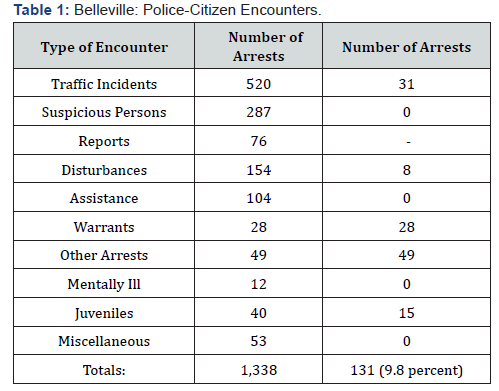
The researcher observed or was involved in 1,338 policecitizen encounters over the seven-year period of the research. He did this while he served as a sworn auxiliary (part-time) officer in Bellville. The 1,338 police-citizen contacts were divided into ten categories: traffic incidents, the investigation of suspicious persons or incidents, reports, disturbances, assistance calls, warrant service, other arrests, handling the mentally ill, juvenile apprehensions, and miscellaneous. In brief, these ten categories of police-citizen encounters produced the following results: Traffic incidents (including traffic stops) involved 520 police-citizen encounters. Thirty-one arrests were the result of these incidents.
There were 287 calls of suspicious people or incidents. No arrests resulted from any of these calls. Seventy-six reports were taken. There were 154 disturbance calls. Sixty-one of these were family disturbances. These family disturbances produced 5 arrests. There were 93 non-family disturbances. Three individuals were arrested in these incidents. There were 104 assistance calls. Most of these were to assist citizens with motor vehicle problems. There were 28 arrests for warrants. There were 49 people arrested for other reasons (these were usually for retail theft, alcohol intoxication, or drug possession). There were 12 incidents involving mentally ill persons. All these individuals were turned over to their families or transported to a hospital by paramedics.
There were 40 juvenile apprehensions. Eleven of these juveniles were ticketed and 15 were arrested. All, but one, were turned over to their parents. There were 53 miscellaneous calls or duties (administrative assignments, carnivals, parades, the 4th of July fireworks display, etc.). The details of these policecitizen encounters are not what one would expect. The police are usually perceived of as “crime fighters” who rush from call to call. (It sometimes is said that police officers are “slaves to their radios”). However, this is not the case. Five hundred and twenty police-citizen contacts were for traffic incidents (39 percent of all police-citizen encounters). There were 24 traffic accidents, 62 calls to back up another officer on a traffic stop, and 6 calls to remove traffic obstructions. These were all dispatched by radio. However, officers made 428 traffic stops on their own initiative (32 percent of all police-citizen encounters). These stops were for traffic infractions or suspicious vehicles. These stops produced 259 verbal warnings, 63 warning tickets, 75 formal tickets, and 31 arrests.
That is, traffic stops produced serious enforcement actions (arrests) in only 7 percent of all traffic stops. There were 287 calls of suspicious people or incidents. No arrests were made on any of these calls. That was because the individuals were “GOA” (gone on arrival), the situation was innocuous, or the individuals were given a verbal warning and sent on their way. Seventy-six reports were taken. A few of these were passed on to the investigators. However, most were merely filed away. There were 154 disturbance calls. Fifty-six of these were family disturbances. These calls were treated seriously because of their potential for violence. Even though blows were struck in a number of these cases, only 5 arrests occurred. That was because these incidents were usually seen as the product of long-standing disputes between family members or intimates, that could only be solved by the people involved. (In some states, there are mandatory arrest statutes if violence has occurred in a domestic disturbance. However, in the state in which the research was conducted, the decision to arrest in such situations is left up to the discretion of the officer.)
On such calls, the individuals were separated, calmed down, “counseled,” and a resolution was usually reached when one party agreed to leave the scene. Other disturbances, such as, loud parties or teenagers throwing firecrackers, were handled more routinely (there were 90 of these calls). They produced 3 arrests. There were 104 assistance calls. Nine of these were to assist the fire department or paramedics, and 14 were to assist other police agencies. Eighty-one of these calls were to assist a citizen. These were usually the result of a vehicle breakdown or “lockout.” The department expected the officers to respond to these calls, since the chief stressed that the department was “a service-oriented agency.” There were 28 warrant arrests. In many of these cases, the warrant was used as a tool to remove an individual from the street when the officers lacked enough evidence for an arrest. There were 49 other arrests. These included retail theft, intoxicated individuals, or young adults carrying small amounts of drugs. Twelve mentally ill persons were apprehended. None of these individuals had committed a serious crime. Instead, they had come to police attention because they had been “disorderly”.
Since they were not considered to be criminals, they were released to a relative without a charge or transported to a hospital by paramedics for evaluation and treatment. Forty juveniles were apprehended. Fifteen juvenile arrests were made, and tickets were issued to eleven other juveniles. Thirteen juveniles were not charged and were released to their parents. One youth was turned over to a state affiliated social service agency for foster care placement. All these calls were a nuisance by the officers. It was common for officers to say that juvenile apprehensions were a waste of time since “nothing ever happens to these kids.” Fiftyfour calls were listed under “miscellaneous.” Twenty of these were for routine administrative functions, such as vehicle repairs or the delivery of reports. Also included in this category were carnivals, parades, and the 4th of July fireworks display. Some officers considered these assignments to be fun, since they could “meet and greet” the public. Other officers considered them to be tedious. In either case, they did not involve individual calls; rather, they consisted of non-criminal actions, such as crowd control and traffic direction. These 1,358 incidents produced 131 arrests of all kinds. This is less than 10 percent of all police-citizen encounters (Table 1). In other words, in 90 percent of all cases, police officers dealt with citizens by talking. In the seven years in which the researcher observed police patrol, there were only 5 instances in which officers pulled their guns. No shots were fired in those situations. The researcher witnessed only 2 fights in 7 years between officers and civilians (one was very brief and the other was the repeated restraint of a drunken driver). However, during the research period, one officer was shot and one individual was killed.
Discussion
d. Negotiations
Ninety percent of police-citizen encounters do not produce an arrest. How are these interactions resolved? Whether the officer is full-time or part-time, the answer is through negotiation. Let us explain. Clay-Williams describes eight types of negotiation. Four of these are relevant here:
a. Competitive: A high level of importance for the outcome,
but a low level of concern for the relationship.
b. Collaborative: A high degree of importance for the
outcome, and a high level of concern for the relationship.
c. Accommodative: A low level of importance for the outcome
but a high level of concern for the relationship
d. Compromise: Here, both the outcome and the relationship
are important. As a result of this, those involved “split the
difference” in reaching a solution. This is a useful technique when
there is insufficient time or resources to deal with an issue or
situation [50].
Where an arrest must be made, all that matters is the outcome. However, when no arrest is to be made, the situation must be resolved. However, in such situations, time is a problem. When referring to calls, officers may say, “All human problems must be solved in 15 minutes;” and sergeants may say, “Let’s wrap it up, there are calls waiting.” As a result of such time pressure, collaboration and accommodation are often unrealistic. Such situations call for problem solving; that is, compromise (negotiation). This is often the only practical approach.
In this regard, Klein (2023, 2024) [2,51], has described 3 key characteristics of the officer’s role: discretion, control/threat or danger, and (doing) the job. Let us briefly review these categories:
e. Discretion
Officers use discretion when legal sanctions are seen as too harsh. In other words, the officer negotiates with himself (or herself) and gives the person “a break.”
f. Control/Threat or Danger
Officers need to control citizens in some situations. This is usually accomplished through verbal control.
g. The job
If someone threatens the life of an officer, the officer must respond. However, if the individual can be convinced, or cajoled, into cooperating, then no police action will be required.
The notion of negotiation nicely meshes with the theory of negotiated order. This sociological theory focuses on the never-ending adjusted process that occurs as organizational participants negotiate the rules that govern their daily lives. Such negotiations consist of individual striking bargains, making verbal agreements, and achieving implicit understandings. Such arrangements constitute the organization’s negotiated consensus. This also applies to outsiders that the organization deals with. Thus, negotiated order theory focuses on the social process of negotiation [48,49,51-53]. “The job,” was the same for both fulland part-time officers. Ten percent of the time they made arrests. That is, they used coercion. However, 90 percent of the time, the officers and citizens reached an understanding. In summary, police work does not consist of “catching the bad guy;” rather, police work (mostly) consists of “keeping the peace.” Let us explore this notion further.
Discussion
h. Street Level Due Process
To police offices, and to social scientists, the law is not a statute written in a book. Rather, the law is a process of conflict resolution or problem solving [54]. How do officers go about this? When an officer arrives on the scene he or she must “sort things out.” All officers know that “everyone lies,” and no one is ever guilty. Once the officer concludes that he or she has a rough approximation of the truth, they must act. As we have noted, most police work consists of talking. However, such talking is not just “chit chat.” Rather, it is conflict resolution or problem solving. However, such resolution cannot be arbitrary. It must be seen as fair (by the citizens). Therefore, the individuals involved expect what we call, street level due process. This means that the officer must act as a neutral arbiter to the conflict. And the uniform dictates that the officer is an official who will decide the situation in a reasonable manner based upon the facts [55-62].
Conclusion
Did the training for full-time and part-time officers differ? The part-time officers training occurred, “haltingly, in fits and starts.” However, the essence of their training on the use of force was the same as for full-time officers. Did the police’s personality determine the officers’ use of force? The police socialization literature is replete with terms for the “police personality.” These include “authoritarian,” “domineering,” “hostile” and “macho.” Certainly, officers are authoritarian, domineering, and macho, if they must make an arrest; and, if the individual resists, the officer may become hostile. However, as we have noted, most police work is talking. That is because police work is reactive, and situational. Therefore, the police personality does not explain police behavior. Rather, what does explain most police behavior is negotiation.
References
- Bittner E (1978) The Function of the Police in Modern Society. Aronson.
- Klein G (2023) Street Cop. New York Routledge
- Berg B, W Doerner (1988) The Volunteer Police Officers: An Unexamined Personnel Dimension in Law Enforcement. American Journal of Police 7(1): 81-89.
- Brown E (1976) The Police Reserve Officer in Dallas, Texas.” Texas Police Journal 24: 5-15.
- Greenberg M (1979) Police Volunteers: Are They Really Necessary?” In R Iacovetta and D Chang. Critical Issues in Criminal Justice. Durham, NC: Carolina Academic Press.
- Washnis G (1976) Citizen Involvement in Crime Prevention. Lexington: Lexington Books.
- King E (1960) The Auxiliary Police Unit. Springfield, Illinois: Charles C Thomas.
- Bartels E (2014) Voluntary Police in the United States. New York: Springer.
- Weinblatt R (2011a) The Cop Doc’s Classic Writings on Police Reserves. thecopdoc.com.
- Weinblatt R (2011b) Reserve Law Enforcement in the United States. Re-issue. thecopdoc.com.
- Hilal M (2003) Volunteer Police Reserve Officers: An Identity Theory Perspective. Dissertation. Brookings SD: South Dakota State University.
- Meunier G, T Koontz, R Weller (1995) Psychological Characteristics of Reserve Police Officers.” Journal of Police and Criminal Psychology 10: 57-59.
- McCallum D (1979) The Formation of an Auxiliary Police Force.” The Police Chief 46(6): 16.
- Grassi R (2009) Police Firearms Instruction. Boca Raton, Florida: CRC Press.
- Harris R (1973) The Police Academy. New York: Wiley.
- Harris R (1978) The Police Academy and the Professional Self-Image.” In Policing, edited by P. Manning and J. Van Mannen 273-291. New York: Random House.
- Gross P (1991) The Structure of Occupational Fears in Police Recruits. Police Studies 14: 176-179.
- Van Maanen J (1973a) Observations on the Making of Policemen. Human Organization 32(4): 407-418
- Van Maanen J (1973b) Working the Street: A Developmental View of Police Behavior. Working Paper #681-73. Cambridge: Massachusetts Institute of Technology.
- Van Maanen J (1972) Pledging the Police. Unpublished Doctoral Dissertation. Irvine, California: University of California at Irvine.
- Van Maanen J (1975) Police Socialization: A Longitudinal Examination of Job Attitudes in an Urban Police Department.” Administrative Science Quarterly 20(2): 207-228.
- Van Maanen J (1978a) The Asshole. In Policing. edited by P. Manning and J. Van Maanen 221-238. Santa Monica: Goodyear.
- Van Maanen J (1978b) People Processing: Strategies of Organizational Socialization. Organizational Dynamics 7(1): 19-36.
- McCreedy KR (1980) The Impact of Police Academy on the Socialization of New Police Officers. Thesis. Los Angeles, California: University of Southern California.
- Adlam K (1982) The Police Personality: Psychological Consequences of Being a Police Officer. Journal of Police Science and Administration 10: 344-349.
- Austin T (1987) Book Review: Auxiliary Police: The Citizen’s Approach to Public Safety.” Criminal Justice Review.
- Klopsh J (1983) Police Personality Change as Measured by the MMPI: A Five-Year Longitudinal Study. Unpublished Doctoral Dissertation. Fuller Theological Seminary.
- Hopper M (1977) Becoming a Policeman: Socialization of Cadets in a Police Academy.” Urban Life 6: 149-170.
- Conti N (2000) Creating the Thin Blue Line. Unpublished Doctoral Dissertation. University of Pittsburgh.
- Tenerowicz C (1992) A Longitudinal Study of Personality Changes in Urban Police Officers. Unpublished Doctoral Dissertation. Cleveland: Cleveland State University.
- Maghan J (1988) The 21st Century Cop: Police Recruit Perceptions as a Function of Occupational Socialization. Unpublished Doctoral Dissertation. City University of New York.
- Conti N, P Doreian (2014) From Here on Out, We're All Blue: Interaction Order, Social Infrastructure, and Race in Police Socialization.” Police Quarterly 17(4): 414-447.
- Waddington P (1999) Police (Canteen) Culture: An Appreciation. British Journal of Criminology 39(2): 287-309.
- Niederhoffer A (1967) Behind the Sheild. New York: Doubleday.
- Wilson JQ (1968) Varieties of Police Behavior. Cambridge: Harvard University Press.
- Rubenstein J (1973) City Police. New York: Ballantine.
- Barker J (1999) Danger, Duty, and Disillusionment. Prospect Heights, Illinois: Waveland.
- Asher J, B Horowitz (2020) How Do the Police Actually Spend Their Time. The New York Times, June 19.
- Hyland, SL Langton, E Davis (2015) Police Use of Nonfatal Force, 2002-11. Washington, DC: Bureau of Justice Statistics.
- Davis E, A Whyde, L Langton (2018) Contact Between the Police and the Public, 2015. Washington, DC: Bureau of Justice Statistics.
- Banks D, L Couzens, M Planty (2015) Assessment of Coverage in the Arrest-Related Deaths Program. Washington: Bureau of Justice Statistics.
- Sinyangwe S (2020) Police are Killing Fewer People in Big Cities, But More in Suburban and Rural America.” June 1. Five Thirty-Eight.
- Johnson R (2016) Dispelling the Myths Surrounding Police Use of Lethal Force. Dolan Consulting Group.
- Geller W, Scott (1992) Deadly Force. Washington, D. C.: Police Executive Research Forum.
- Sexton J (1988) The Culture of Cops and Guns.” The New York Times. January 11.
- New York City Police Department (NYPD) (2025) Use of Force Report.
- New York City Police Department (NYPD) (2019) Use of Force Report.
- Glasser B, A Strauss (1967) The Discovery of Grounded Theory. Chicago: Aldine.
- Klein G (2009) Law and The Dithedered. Lanham, MD: University Press of America.
- Clay-Williams R, Andrew Johnson, Paul Lane, Zhicheng Li, Lauren Camilleri, et. al. (2018) Collaboration in a Competitive Health Care System: Negotiation 101 for Clinicians.” Journal Of Health Organizations and Management 32(2): 262-278.
- Klein G (2024) Real Policing: An Exploration in Police Legitimacy.” Journal of Police and Criminal Psychology 39: 390-401.
- Strauss A, et. al. (1963) The Hospital and Its Negotiated Order.” In The Hospital in Modern Society. edited by E. Friedson. New York: Free Press.
- Strauss A, et al. (1964) Psychiatric Ideologies and Institutions. New York: Free Press.
- Nader L, B Yngvesson (1973) On Studying the Ethnography of Law.” In Handbook of Social and Cultural Anthropology, edited by J. Honigman, Chicago: Rand McNally. Pp: 883-922.
- Godfrey H, S Rich, A Tran (2024) 10,429 People Have Been shot and Killed by Police from 2015 to 2024.” The Washington Post.
- Van Maanen J (1974) Working the Street: A Developmental View of Police Behavior.” In The Potential for Reform of Criminal Justice, edited by H. Jacob. Beverly Hills: Sage pp: 83-128.
- Greenberg M (1978) Auxiliary Civilian Police - The New York City Experience.” Journal of Police Science and Administration 6: 86-97.
- Jonathan-Zamir T, Y Litmanovitz, N Haviv (2023) What Works in Police Training? Applying an Evidence-Informed, General, Ecological Model of Police Training.” Police Quarterly 26 (3): 279-306.
- Planty M, et. al. (2024) Understanding and Reducing Deaths in Custody. Research Triangle Park, NC.: RTI International.
- Van Maanen J (1984) Making Rank: Becoming an American Police Sergeant. Urban Life 13(2): 155-176.
- Van Maanen J (2006) Ethnography Then and Now. Qualitative Research in Organizations and Management 1(1): 13-21.
- Van Maanen J (2011) Tales of the Field. 2nd edition. Chicago: University of Chicago Press.

























